Home Blog Page 18

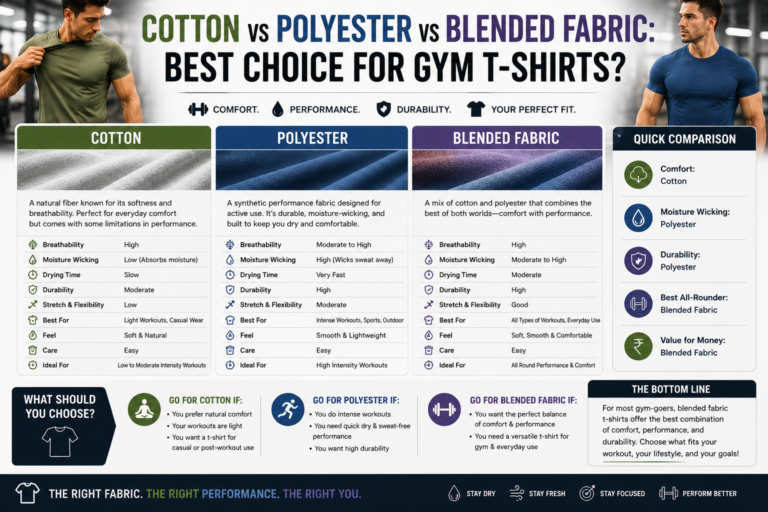
Cotton vs Polyester vs Blended Fabric: Best Choice for Gym T-Shirts?

When buying Gym T-Shirts Fabric Comparison, fabric choice impacts comfort, performance, and durability. Cotton, polyester, and blended fabrics are some of the options. Which is better for workouts? Here are the facts.

Cotton Gym T-Shirts

Cotton has long been a favorite for casual wear, and many people wonder if it works for activewear too. The biggest advantage of cotton is its breathability. It allows air to flow easily, keeping you cool during light to moderate workouts. Cotton is also soft, hypoallergenic, and gentle on sensitive skin, making it ideal for people who prioritize comfort.

However, cotton isn’t perfect for intense exercise. It tends to absorb moisture rather than wick it away. That means if you’re sweating heavily, your t-shirt can become wet and heavy, which can be uncomfortable and even chafe your skin. For gym-goers who do light workouts or yoga, cotton t-shirts from a reliable Gym T-Shirts Manufacturer can be a great choice.

Polyester Gym T-Shirts

Polyester is a synthetic fabric that is widely used in performance activewear. Its biggest advantage is moisture-wicking. Polyester pulls sweat away from your body and dries quickly, which keeps you comfortable even during intense gym sessions. It’s also durable, resistant to shrinking, and maintains its shape better than cotton after multiple washes.

On the downside, polyester is less breathable and can feel a bit sticky or plastic-like against the skin if it’s not high-quality. For people doing heavy lifting, running, or cardio, Gym T-Shirts Fabric Comperizon made from polyester or from a specialized Fitness Apparel Manufacturer can be ideal to manage sweat efficiently.

Blended Fabrics: The Best of Both Worlds?

Blended fabrics combine cotton and polyester to try and capture the best of both worlds. Typically, you’ll see blends like 60% cotton / 40% polyester. The cotton keeps the fabric soft and breathable, while the polyester adds durability and moisture management.

Blends are often considered the sweet spot for Gym T-Shirts Fabric Comperizon. They are soft yet quick-drying, comfortable but resilient, and generally suitable for a wide range of activities from yoga to high-intensity workouts. Many top Activewear Manufacturers offer blended fabric options for Gym T-Shirts Fabric Comperizon, tank tops, and even hoodies, ensuring you have versatile gear for your fitness routine.

Choosing the Right Fabric for Your Workout

Here’s a simple guide to help you decide:

  • Cotton – Best for yoga, stretching, or low-intensity exercises. Look for options from Yoga Wear Manufacturers if softness and comfort are your priority.
  • Polyester – Perfect for running, HIIT, or any sweat-heavy gym sessions. Check out Gym Wear Manufacturers for technical t-shirts that wick moisture efficiently.
  • Blends – Great for versatility. Blended fabrics work for almost any type of workout. You can find blended gym t-shirts from Compression Wear Manufacturers as well, which offer additional support during workouts.

Other factors to consider include fit, stretch, and the type of finish on the fabric. For example, t-shirts with a bit of spandex or elastane in a cotton-polyester blend can give you extra flexibility, making them ideal for dynamic movements.

Final Thoughts

There’s no one-size-fits-all answer. Your choice depends on the type of workouts, personal comfort, and fabric performance. Cotton is cozy and breathable, polyester keeps you dry, and blends offer a versatile combination of both.

If you want to explore high-quality options, you can check out manufacturers specializing in Gym T-Shirts, Tank Tops, Hoodies, and even Leggings to build a complete workout wardrobe. Choosing the right fabric not only enhances your performance but also makes your workouts more enjoyable.

FAQs

Which fabric is best for gym t-shirts?

Polyester is ideal for high-intensity workouts due to moisture-wicking properties, while cotton is comfortable for light exercise. Blended fabrics offer a balance.

Is cotton bad for working out?

Cotton absorbs sweat and dries slowly, which may lead to discomfort during intense workouts. It’s best for low-impact activities.

Why choose polyester for gym wear?

Polyester is lightweight, durable, and wicks moisture away, keeping you dry and comfortable during intense training.
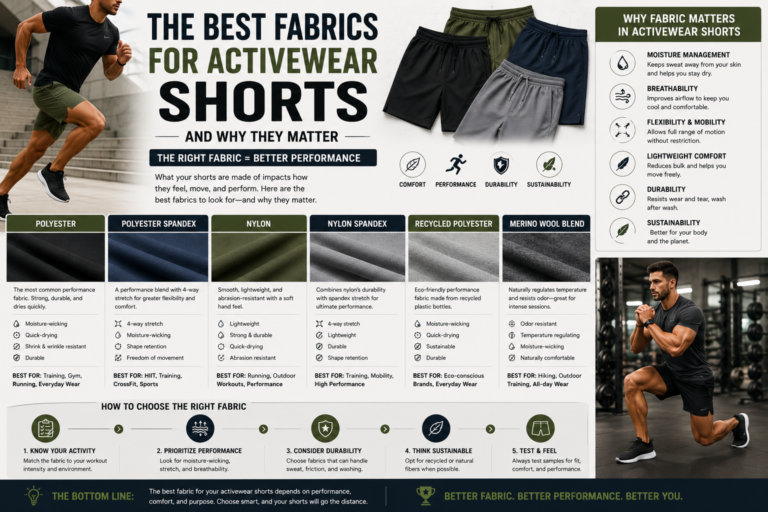
The Best Fabrics for Activewear Shorts and Why They Matter

Wearing the right clothes when working out is super important. The right Best Fabrics for Activewear Shorts helps you perform better and feel more comfortable. It also helps your clothes last longer, and helps you look good. There are some key benefits to wearing shorts, especially when the temperature is high.

Why Matters in Best Fabrics for Activewear Shorts

Luckily, shorts can come in a number of different materials. Not every material is right for every behavior, especially when it comes to working out. You need something breathable, flexible, and durable to make your workouts better and more comfortable.

EcoJersey is a leading activewear manufacturer that specializes in fabrics designed specifically for fitness enthusiasts. Their wide range of products ensures that every type of workout, from running to yoga, has the perfect fabric match.

Top Fabrics for Activewear Shorts

1. Polyester

Polyester is one of the most common best fabrics for activewear shorts. It’s lightweight, durable, and dries quickly, which makes it perfect for high-intensity workouts. Its moisture-wicking properties keep sweat away from the skin, reducing irritation. Many gym wear manufacturers prefer polyester blends because they maintain shape and color even after repeated washes.

2. Nylon

Nylon is smooth, stretchy, and very strong. It feels soft against the skin, making it a great choice for shorts that will be worn during yoga, pilates, or low-impact workouts. Nylon’s excellent elasticity ensures that your shorts move with you, while still holding their shape. EcoJersey’s yoga wear manufacturer collection uses nylon-rich fabrics for maximum comfort and mobility.

3. Spandex / Elastane

Most Best Fabrics for Activewear Shorts include a percentage of spandex (also called elastane). This fabric gives shorts their stretchiness, allowing full range of motion without restriction. Spandex is often blended with other fabrics like polyester or nylon to combine durability with flexibility. Check out EcoJersey’s compression wear manufacturer options to see how spandex enhances fit and performance.

4. Cotton Blends

Pure cotton tends to absorb moisture and can become heavy during workouts, but cotton blends offer the comfort of cotton with better moisture management. Shorts made with cotton-polyester blends feel soft, are breathable, and are ideal for moderate activities like walking or casual gym sessions. EcoJersey’s fitness apparel manufacturer lineup features carefully selected cotton blends for comfort-focused shorts.

Specialty Fabrics for Activewear Shorts

Some advanced fabrics are designed for athletes who demand high performance. These fabrics often include features like anti-odor treatment, UV protection, and ultra-lightweight weaves. For example, EcoJersey’s leggings manufacturer and tank tops manufacturer lines demonstrate how modern fabric technologies can enhance any activewear product, including shorts.

Matching Fabric to Your Workout

The ideal fabric depends on the type of activity.

  • High-intensity workouts: Look for polyester-spandex blends that wick moisture and allow maximum movement.
  • Yoga or Pilates: Soft nylon or cotton blends with spandex provide comfort and stretch.
  • Running or cycling: Lightweight, breathable fabrics with sweat-wicking technology keep you dry and focused.

EcoJersey’s shorts manufacturer collection offers versatile options that fit each of these workout needs.

Final Thoughts

Investing in high-quality fabrics for your activewear shorts is more than a style choice — it’s about performance, comfort, and longevity. Choosing the right material can prevent chafing, keep you cool, and enhance your workout experience. From polyester and nylon to spandex blends, each fabric offers unique benefits.

If you’re looking for top-tier activewear, Eco Jersey’s wide range of activewear manufacturing options ensures you get premium fabrics, expert craftsmanship, and designs that move with you. Whether it’s gym shorts, yoga shorts, or casual workout wear, the right fabric makes all the difference.

FAQs

What is the best fabric for activewear shorts?

Polyester-spandex blends are often the best choice due to their moisture-wicking, stretchy, and durable properties. Nylon and cotton blends are also good depending on your workout type.

Why does fabric matter in workout shorts?

The fabric determines breathability, stretch, moisture management, and overall comfort. High-quality materials prevent chafing and improve performance.

Can cotton shorts be used for intense workouts?

Pure cotton tends to absorb sweat and may feel heavy, so cotton blends or synthetic fabrics are better for high-intensity workouts.

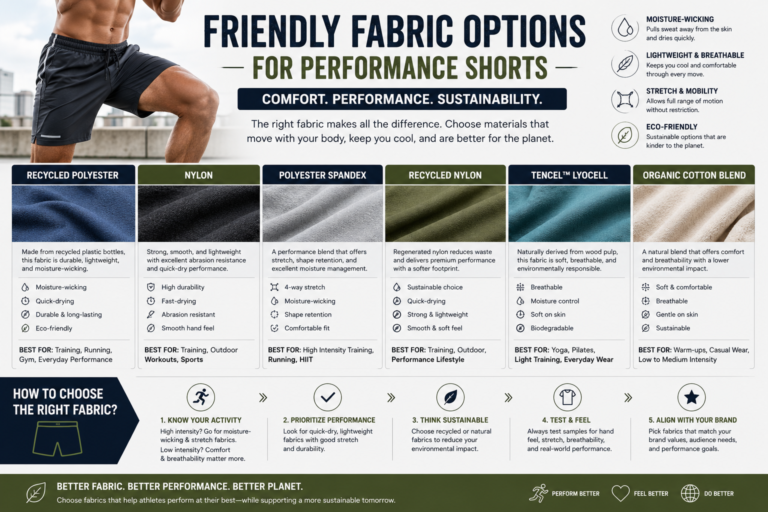
Friendly Fabric Options for Performance Shorts

The fabric can make or break a pair performance shorts. Customers will feel the difference the minute they wear them — stretch, breathability and the movement of the shorts. As a fitness company, choosing the best fabric for your performance shorts can be one of the biggest decisions. If you get it right, your customers will keep returning. If you get it wrong, returns and complaints will follow.

Polyester — The Performance Standard

It is lightweight, moisture-wicking and extremely durable. The fabric is extremely durable, lightweight and moisture-wicking. The polyester fabric wicks away sweat and dries quickly, so athletes can stay comfortable even during intensive training.

Polyester is also a good fabric for creating vibrant and eye-catching designs. Polyester is the best material to use if you want your brand to focus on gymwear or shorts that are high performance.For these exact reasons, many leading gym wear manufacturers base their performance collections on polyester blends.

Nylon — Lightweight and Incredibly Smooth

The skin feels luxurious when wearing nylon. The material is abrasion resistant, has excellent stretch and manages moisture well. The nylon shorts are light but they perform well under pressure.

The fabric is ideal for shorts that are used to train, run, or do yoga, where flexibility and softness matter more than performance. When creating yogawear collections, brands often use nylon blends to give their products the premium feel that customers demand.

Spandex Blends — Stretch and Shape Retention

There is no performance short that works without some spandex. A small amount of spandex — from 8% to 15 percent — can completely change the way a short moves and fits. The fabric can move in all directions without restrictions because of the four-way stretch provided by spandex.

Spandex blends are essential for:

  • High-intensity training shorts
  • Compression-style shorts
  • Yoga and flexibility-focused activewear
  • Running and cycling shorts requiring body-hugging fit

If your brand offers compression wear, spandex-heavy blends are non-negotiable for delivering the muscle support your customers need.

Recycled Fabrics — Performance Meets Sustainability

The activewear market is booming with recycled polyester and nylon. The fabrics are as durable and perform the same way as virgin materials, but they use a lot less resources. To meet consumer demand while reducing environmental impact, brands that are concerned about sustainability choose recycled fabrics.

Recycling fabric shorts will also help you to position your brand in the market, where consumers who are eco-conscious actively choose brands which align with their own values.

Cotton Blends — Comfort for Casual Performance Wear

For intense performance, pure cotton is not the best choice. Cotton-polyester blended shorts are softer and more casual, making them perfect for everyday wear, lifestyle activewear or warm-ups. The blends are breathable and comfortable, making them ideal for low-intensity movements.

For brands building a complete fitness apparel range, cotton blend shorts complement high-performance polyester styles perfectly — giving customers options for every training intensity

Choosing the Right Fabric for Your Brand

Every fabric has its place. Your choice depends on your customer’s activity level, your brand positioning, and your price point. A reliable shorts manufacturer guides you through fabric selection, provides samples, and helps you match the right material to the right style — so your finished product performs exactly as your customers expect.

Conclusion

Knowing your options when it comes to performance shorts will give your brand an edge. The best fabrics for performance shorts are polyester, nylon, spandex, recycled fabric, cotton blends and stretchy spandex. Smart brands offer a wide range of fabrics to meet the needs of their customers, from casual wear to heavy workout gear.

FAQs

What fabric should I choose for shorts meant for high-intensity workouts?

Polyester/nylon/spandex blends are great because they wick moisture, dry quickly, and have adequate stretch for high activity.

How much spandex should performance shorts contain?

Performance shorts typically have between 8% and 20% spandex. Compression styles tend to have higher percentages, while standard training styles have lower percentages.

Do recycled fabric shorts last as long as standard performance shorts?

Yes. Recycled polyester and recycled nylon are just as durable as virgin fabrics and perform well in moisture management and stretch.

Can I provide different fabric options with a single shorts line?

Yes, adding blends of polyester, nylon, and cotton/lycra in a single line gives options for your customers to choose the one that fits the style and needs of their training.

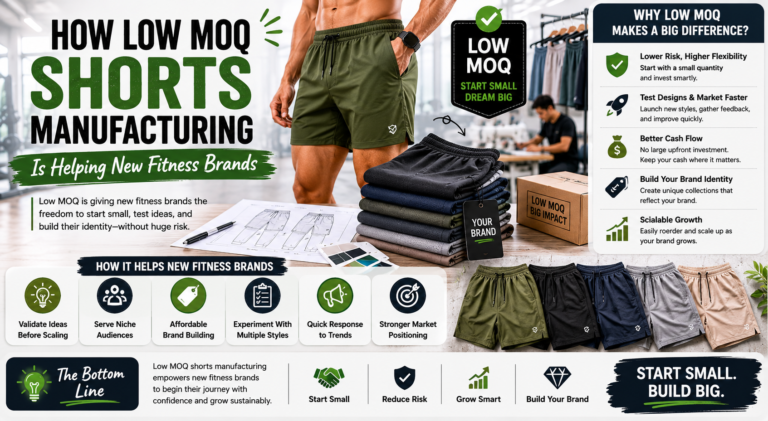
How Low MOQ Shorts Manufacturing Is Helping New Fitness Brands

Building a fitness brand is one part of the puzzle. Financing bulk production orders is the other. For a very long time, high minimum order quantities (MOQs) were the primary barriers for small businesses to enter the activewear market. Currently, low MOQ shorts manufacturing is changing that completely. Now, new fitness brands have a genuine opportunity to launch, test, and grow without the burden of finances.

The Old Problem With High MOQs

Standard manufacturers wanted bulk orders of 500-1000 pieces per style. This wouldn’t be a burden on established brands, but it would be a huge financial burden on new brands.

For most small brands, the financial burden of ordering 500 pairs of shorts is simply out of the question because it is out of the question for them to commit to an order before they even know what their target customers are potentially going to want to buy. Looking at unsold inventory and wasted space is deflating for new brands.

How Low MOQ Manufacturing Changes the Game

Manufacturers who offer low minimum order quantities (MOQs) for shorts manufacturing help break down those barriers. If a manufacturer lets you get started with 50 to 100 pieces per style, you can:

  • Launch with a small, focused collection
  • Test different styles, fits, and fabrics with real customers
  • Reinvest profits before scaling production
  • Reduce the risk of dead stock and wasted budget
  • Move faster from idea to market

This approach works well for fitness brands building across multiple categories. For fitness brands that launch products from different apparel categories joggers or gym wear, and gym wear, this approach allows testing each product category without locking the budget on a single style.

What to Look for in a Low MOQ Shorts Manufacturer

Low MOQ does not guarantee quality. Brand protection is critical, and you need to consider the following while picking a manufacturing partner.

Prioritize quality of fabric. Your shorts have to be high quality for running shorts and training shorts or just regular wear. Look into moisture-wicking fabric with four-way stretch. Shape retention and durability after washing and wearing multiple times is critical too.

Full customization is key. Low MOQ cannot equate to limited choices. Your manufacturer really needs to give you the options for custom cuts, colors, waistbands, pocket styles, and_PRIV.label branding. A great shorts manufacturer gives you full creative control even at smaller quantities.

Sampling process matters. A reliable manufacturer provides proper samples before bulk production. This protects your brand from costly mistakes and ensures the final product matches your vision exactly.

Low MOQ Helps You Build a Complete Activewear Brand

There are plenty of advantages of using low MOQ manufacturing that go beyond manufacturing shorts. It allows you to grow your activewear brand with complete control, and minimal financial burdens.

Start with shorts, then expand into tank tops, leggings, or compression wear as your customer base grows.customer base grows. Financial risks are eliminated when each product category becomes a manageable investment.

Working with an experienced activewear manufacturer who understands small brand challenges makes this journey smoother.The right partner grows alongside you from your first 50-piece order to your first 5000-piece bulk run.

Conclusion

For new fitness brands, low MOQ shorts manufacturing is no longer a luxury. Adjustable MOQ shorts manufacturing allows brands to reduce risk and market quickly. Furthermore, it allows brands to understand their clientele before they commit to scaling. If you’re trying to understand your market shorts while trying to launch your fitness brand, partner with a manufacturer that has flexible MOQ.

FAQs

What is a low minimum order quantity (MOQ) for shorts manufacturing?

New and small fitness brands have more options now as low MOQ usually ranges from 50 to 150 pieces per style.

Do shorts lose quality with low MOQ?

Of course not. A good manufacturer doesn’t compromise quality. Testing samples is wise.

Shorts customization with low MOQ?

Yes. Good manufacturers play with your designs, color preferences, styles, and private labels.

What is scaling with low MOQ?

Once customers embrace your designs, you maximize costs at the same manufacturer and focus to expand.

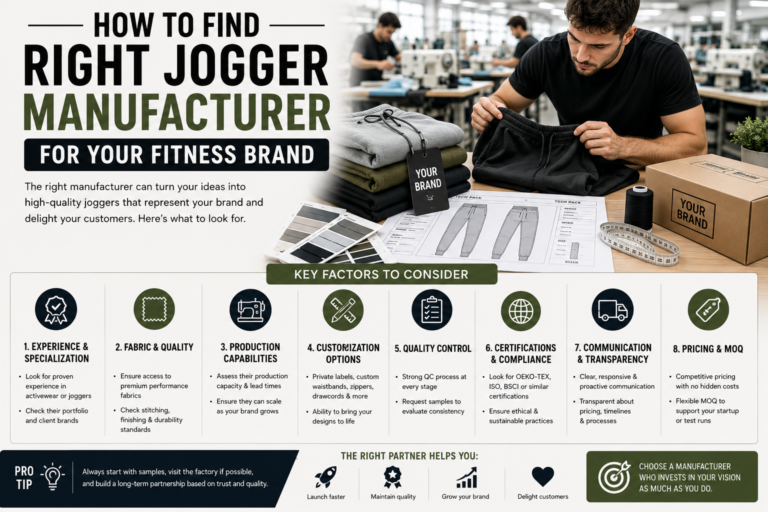
How to Find Right Jogger Manufacturer for Your Fitness Brand

Starting a fitness brand can be fun and rewarding. Unfortunately, there are many challenges, with choosing a good manufacturer being among the hardest. Your joggers need to look good, feel good, be durable, and survive the laundry hundreds of times. For that reason, finding a good manufacturer is essential since you’re laying the groundwork for your brand.

Start With Quality — It’s Non-Negotiable

You always verify the quality of fabric and construction first. Obtain a fabric sample before placing a full order. Feel the fabric, check how the stitches look, and put the joggers through a wash cycle or two. A manufacturer that delivers quality consistently will help you protect your reputation in the long run.

Find a manufacturer who works with performance fabrics — polyester blends, cotton fleece, and moisture-wicking fabrics. These are the materials your fitness clients actually want.

Customization Capabilities Matter More Than You Think

Your brand needs to be unique and so does your manufacturer. If they cannot customize cuts, fabrics, colors, waistbands, pockets, and provide private label branding, find another option. If they can only offer standard styles, look elsewhere.

A strong joggers manufacturer gives you control over every detail — from fabric weight to logo placement. That flexibility is what separates a generic product from a brand people recognize and trust.

Check Their Full Product Range

The best manufacturing partners grow with your brand. Today it might be joggers, tomorrow hoodies, shorts, or leggings. A manufacturer that covers your full range of activewear will save you money and time, if not more, on coordination.

Look for manufacturers who also produce:

Gym wear and performance tops

Compression wear for training support

Hoodies for lifestyle and streetwear crossover

Shorts for summer and cross-training collections

Leggings for yoga and high-performance training

Having one reliable partner for multiple products keeps your brand consistent and your supply chain simple.

Understand MOQ and Pricing Structure

Minimum order quantities are often the defining factor for a small brand’s success. Many larger factories implement high MOQs which small fitness brands cannot satisfy. You should always inquire about MOQ’s per style and per colorway.

When it comes to pricing you should always be strategic. The cheapest option is not always the best. You should be seeking value. Value can be seen as fair pricing with consistent quality, good communication, and dependable delivery. Sampling and revision costs are often hidden, but can quickly become a significant expense.

Communication and Reliability Are Everything

A manufacturer that suddenly stops communicating during production is your worst enemy. Good communication, time management, and honest updates are what to look for in a partner. You can assess the manufacturer’s communication skills when you first require a sample and before placing a large order.

As a trusted activewear manufacturer serving fitness brands globally, we understand that reliability is just as important as quality. Your customers depend on you — and you should be able to depend on your manufacturer the same way.

If your brand also includes fitness apparel beyond joggers, make sure your manufacturer can handle that growth without compromising on standards.

Conclusion

The right jogger manufacturer handles more than your brand’s product development — your brand’s growth and your customer satisfaction hinge upon them too. Quality, customization, options, minimum order quantities, and communication should guide your manufacturer selection process. Compare different manufacturers and do your research. Decisions made in haste can be as costly as a partnership with an untrustworthy provider.

FAQs

What MOQ should I expect from a jogger manufacturer?

MOQs vary widely. Many quality manufacturers offer flexible MOQs starting from 50 to 100 pieces per style for new brands.

How long does jogger sampling usually take?

The timeframe for sampling is usually anywhere from 7 to 14 business days. Complexity, fabric availability, and customization all play a role in determining the length of the sampling process.

Can I get my logo and branding on custom joggers?

Yes. Most professional manufacturers offer full private label branding including custom labels, tags, and logo embroidery or printing.

Should I work with a local or overseas jogger manufacturer?

Both have advantages. Overseas manufacturers often offer better pricing and wider customization, while local ones provide faster communication and shorter lead times.

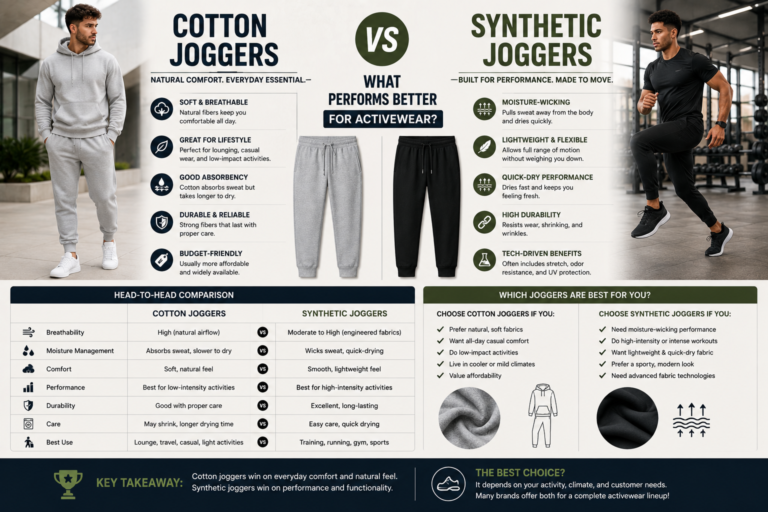
Cotton Joggers vs Synthetic Joggers: What Performs Better for Activewear?

The right pair of joggers will make or break any workout. Your fabric choice is more important than you might think, whether you are hitting the gym or going on a run. Since years, the debate between synthetic joggers and cotton has raged. The two fabrics are different, and each has its own strengths.

What Makes Cotton Joggers Special?

Cotton is such an amazing fabric. It’s soft, convenient to wear, and the breathability of cotton allows the body to cool and makes sweating a lot more manageable. This makes it great to wear during low-intensity activities, not to mention cotton absorbs sweat and keeps you feeling fresh.

Cotton does have its downsides. The first is that during more intense activities, it gets heavy and clingy. This is because it absorbs a lot moisture. This fabric isn’t ideal when you need freedom of movement or need the fabric to dry quickly.

Good uses for cotton joggers are for:

  • Casual everyday clothing
  • Light workouts or warm-ups
  • Yoga and movement that is low-impact
  • People who have sensitive skin

If you’re sourcing comfortable, everyday styles, explore our range at joggers manufacturer to find the right fit for your brand.


Why Synthetic Joggers Dominate Performance Activewear?

Synthetic fabrics like polyester, nylon, and spandex blends are built for performance. They are lightweight, moisture-wicking, and quick-drying. When you sweat hard, synthetic joggers pull moisture away from your skin and dry fast — keeping you comfortable throughout your session.

Synthetic joggers also offer better stretch and shape retention. They move with your body without losing structure. That’s exactly why most gym wear manufacturer brands rely heavily on synthetic blends for their performance lines.

Additionally, synthetic fabrics work perfectly for compression styles. If you’re building a range of compression wear for your brand, synthetic is the go-to choice every time.


Cotton Joggers vs Synthetic Joggers: Head-to-Head

FeatureCottonSynthetic
BreathabilityHighMedium–High
Moisture WickingLowHigh
Drying SpeedSlowFast
Stretch & FlexibilityLow–MediumHigh
Comfort for Casual WearExcellentGood
Performance in Intense WorkoutsAverageExcellent

Which One Should You Choose for Your Activewear Brand?

The answer depends on your target customer and their lifestyle. If your audience trains hard and sweats a lot, synthetic joggers are the smarter pick. If your brand focuses on casual, lifestyle-driven activewear, cotton blends give that soft, relaxed feel your customers love.

Many successful activewear brands today offer both options. As a reliable activewear manufacturer, we help brands customize both cotton and synthetic joggers based on their specific needs, fits, and performance goals.

If your line also includes other pieces like tank tops or fitness apparel, matching fabric choices across your collection creates a more consistent and professional brand identity.


Conclusion

Joggers should be made from both cotton and synthetic fabrics. Cotton joggers should work for everyday use. It should be comfortable and flexaable. When you need to push your self and do a rigorous work out, synthetic joggers should be your go to. The best brands have both cotton joggers and synthetic joggers. Knowing the difference between cotton and synthetic joggers helps design a line of activewear that performs and meets customer satisfaction.


FAQs

Are cotton joggers good for gym workouts?

Cotton joggers are fine for light gym sessions but struggle during intense workouts as they absorb sweat and become heavy.

Do synthetic joggers cause skin irritation?

Quality synthetic fabrics are generally skin-friendly. Choosing moisture-wicking blends reduces irritation significantly during workouts.

Which fabric is better for yoga — cotton or synthetic?

Cotton works well for gentle yoga. However, synthetic blends offer better stretch and moisture control for dynamic yoga styles.

Can I mix cotton and synthetic joggers in one activewear collection?

Absolutely. Offering both gives your customers options for casual wear and performance training, strengthening your overall brand range.

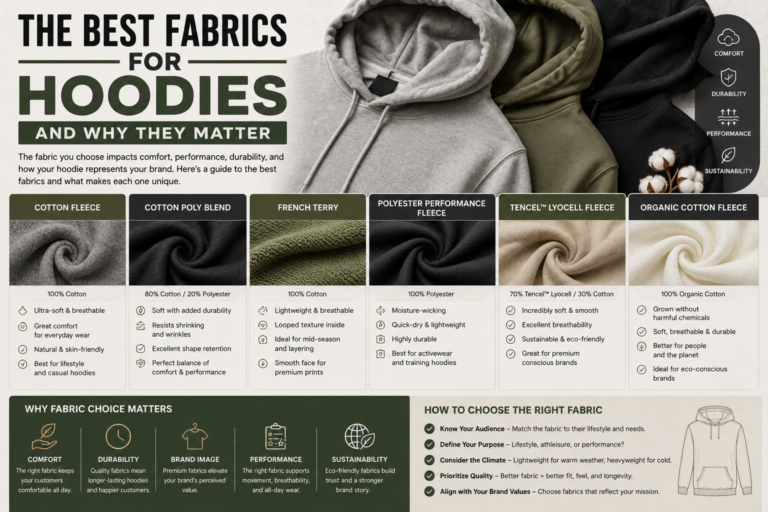
The Best Fabrics for Hoodies and Why They Matter

The fabric is what makes the hoodie. The best fabrics for hoodies. If you choose the wrong fabric, your hoodie will pill after three washings, lose its shape after one month or not feel as comfortable to the customer. If you choose the right fabric, your customers will reach for it every day.

This guide will cover the best fabrics for hoodies, including what they are, their performance, and which suits which styles and uses.

Why fabric choice is more important than most brands realize

The majority of new brands place a high priority on branding and design, and the best fabrics for hoodies are treated as an afterthought. This is a big mistake.

Fabric determines the feel of the hoodie against the skin. It also affects its performance during physical activity. How it is washed and how long it will last. If your customer loves the design of your hoodie, but it is uncomfortable or poorly made, they will not order it again and may even recommend it to others.

The most important thing that you can do to ensure your hoodie will perform well in the long term is to choose the right fabric from the beginning.

French Terry

French terry fabric is used for activewear and fitness hoodies. It is smooth on the outside and looped inside, giving it a light, breathable feeling without the weight of traditional fleece.

The fabric is durable, moves well and absorbs moisture. It also holds its shape after washing.

The jacket is also suitable for all seasons. It’s light enough for the warmer months and warm enough for cool environments in gyms. This year-round wearability is a smart commercial choice for brands looking to add a hoodie to their core range.

French terry is available from a specialist hoodies in varying weights, typically ranging between 220 GSM and 320 GSM. This allows you to choose the perfect feel for your product.

Fleece

The traditional fabric for hoodies is fleece. It is warm, soft and very comfortable. The fleece material is perfect for hoodies that are designed to be worn primarily as casual clothing and for warmth.

It is important to know the different types of fleece. Standard fleece is widely available and affordable. Brushed fleece is softer and more luxurious. Sherpa has a thick, textured inner lining that provides maximum warmth. Technical fleece, which is often used for outdoor and performance hoodies, offers wind resistance and moisture management properties.

Fitness brands should look for a brushed mid-weight fleece between 280 and 380 GSM to find the perfect balance of warmth, comfort and wearability both during and after workouts.

Cotton Blend

Cotton-polyester is a classic blend for casual hoodies. Cotton is soft and breathable. Polyester increases durability, shape retention and shrinkage reduction after washing.

Most commonly, 80 percent cotton and 20 percent polyester is used. However, 60/40 or 50/50 blends may also be popular depending on whether the brand wants softness or performance.

Cotton blends are a great choice for gym T-shirts and a matching hoodie set. They create a casual, cohesive aesthetic, which is perfect for fitness brands that cater to lifestyle. Cotton blends are also the most affordable fabric option, which makes it easier to keep costs down at smaller order quantities.

Performance Knit

Performance knit fabrics are ideal for brands creating technical performance hoodies, which can be worn while training, running or doing outdoor activities. Standard fleece and cotton blends cannot match the capabilities of performance knit fabrics.

The performance knits are usually a combination of polyester and spandex. They provide four-way stretch and moisture wicking while providing warmth in cooler training environments. They are lighter than fleece and move more freely than Cotton. They also hold their shape when used repeatedly.

The right fabric for brands that want to create a range of coordinated activewear, including shorts and tanks.

What Fabric to Use for Your Hoodie?

These are the questions that will help you make a fabric choice:

  • Does the hoodie have a primary use for casual wear or training?
  • What is the level of warmth required by your target customers?
  • Is it necessary for the fabric to stretch or move when you are exercising?
  • What is your target price at retail?
  • Sustainability credentials are important for your brand.

jogger’s or activewear manufacturer who also makes hoodies may recommend fabrics that coordinate across your entire range, so your hoodie, bottoms, and tops all work as one cohesive set, in terms of weight and drape.

Conclusion

It’s important to choose fabrics that are suitable for the purpose of your garment, not just those that are popular. French terry is great for active wear. Fleece is a great choice for comfort and warmth. Cotton blends to suit lifestyle positioning. Performance knits for technical training items.

If you choose the right fabric, your hoodie will be a strong foundation. If you get it wrong, no amount of design can save it.

Explore the options for hoodie manufacturers and find a partner who can help you.

FAQs

Which fabric is most commonly used to make gym hoodies and activewear?

 French Terry is often used because it is lightweight, breathable and retains its shape after repeated washing and wearing.

What’s the difference between French Terry and Fleece?

 French Terry is lighter and more breathable because it has a looped inside. Fleece, on the other hand, is thicker and warm. It’s better for casual or cold weather hoodies.

What GSM is the best fabric for hoodies? 

French terry, mid-weight fleece or 220 to 320 GSM are good choices. Heavier weights over 380 GSM are best for casual styles that focus on warmth.

Are cotton blends suitable for casual and lifestyle fitness hoodies or hoodies for activewear?

 Cotton is a great fabric for lifestyle and fitness hoodies. Polyester or performance knits are the better fabrics for high-performance activewear.

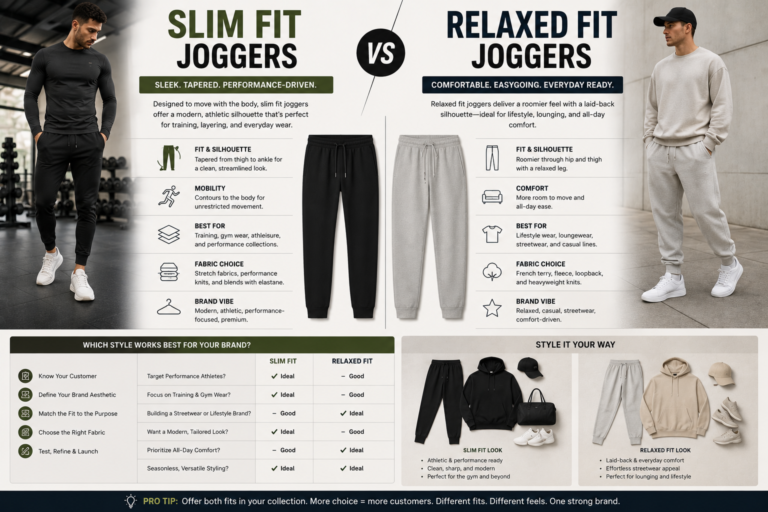
Slim Fit vs Relaxed Fit Joggers: Which Style Suits Your Brand

Slim fit vs relaxed fit joggers are a staple feature in a lot of activewear collections. However, not all joggers are the same, and the style you pick for your collection communicates a lot about your brand, your customer, and the sector in the market you are targeting.

Choosing between slim-fit joggers and relaxed-fit joggers is probably the most common choice fitness brands have to make when designing their bottoms. Both styles are easy to sell, and both styles have their loyal customer bases. However, the two styles fulfill different needs, and the wrong choice for your brand will result in a bottom that does not resonate with your target customer.

This guide explains the differences so you can make the right choice.

What Are Slim-Fit Joggers?

These joggers are cut with close (but not as much as leggings or compression clothing) in the thigh and slightly taper down the ankle. While they are closer than other joggers, they are still (not as close as leggings) cut to follow the shape of the leg, which gives the runner a nice and clean athletic style.

Maybe some of your customers just want a more performance with a little more control, and a clean and athletic style they want. These are great for not only training and warming up for runs, but they are also great for doing everyday things out and about.

From a manufacturing perspective, slim fit requires more precise pattern grading across the size range. The taper needs to be consistent and flattering at every size — which is why working with an experienced joggers manufacturer makes a real difference to the end result.


What Are Relaxed Fit Joggers?

Relaxed fit joggers have more room through the thigh and seat — offering a comfortable, easy-wearing silhouette that prioritizes comfort over a close athletic look. They still taper slightly at the ankle in most styles, but carry more volume through the body of the pants.

Relaxed fit is popular with customers who value comfort above all else — for recovery days, casual training, studio wear, and lifestyle use. They also tend to perform well across a broader size range because the looser cut is more forgiving of fit variation.

For brands targeting the wellness, yoga, and recovery market — or building a lifestyle-led activewear range — relaxed fit joggers are often the stronger commercial choice. They complement pieces like hoodies and tank tops naturally in a casual activewear set.


How Your Customer Should Drive the Decision

When deciding between slim fit vs relaxed fit joggers, let your customer — and not your own preference — lead the way.

Consider who your customer is and how they use your product. A customer who is training every day wants a gear that is both functional and visually appealing and is likely to buy slim fit joggers. A customer who does yoga and is more concerned with comfort and may also wear activewear throughout the day, is more likely to buy relaxed fit.

If you still don’t know what your market is like, check to see what is currently selling. Examine the product offerings of your main competitors and see where there is a gap in the market. Finally, if you already have customers, ask them.

Fabric Choices for Each Style

There is more of a clash between slim fit and relaxed fit joggers when it comes to which fabrics are used.

Slim fit joggers work best with a fabric that has some sort of stretch, such as a polyester-spandex blend or a jersey that is four-way stretch. The stretch helps the closely fitted joggers move and not feel as much of a hindrance to the body.

Relaxed fit joggers, because of how loose they are, can use a much larger range of fabrics like french terry, and even standard jersey can work. The fabric doesn’t need to have a stretch for it to be fit.ed to stretch as much because the cut already provides the necessary ease of movement.

A fitness apparel manufacturer experienced in both styles will help you match the right fabric to each silhouette — and advise on which combinations work best at your target price point.


Can You Offer Both?

Absolutely — and many successful activewear brands do. Offering slim fit and relaxed fit options within the same range gives your customers a choice and broadens your appeal across different use cases and body preferences.

The key is positioning each style clearly so customers understand which one is right for them. Use your product descriptions, size guides, and imagery to communicate the fit and intended use of each option.

From a production standpoint, running both styles with the same manufacturer keeps things streamlined. A shorts manufacturer or bottoms specialist who also produces joggers can often accommodate both silhouettes within a single production run — reducing setup costs and simplifying your supply chain.

Here are some things to consider to bring each fit into your collection:

  • Utilize model photography to capture and communicate each fit
  • Provide unique product descriptions for each fit
  • Experiment with different fabric weights for each fit and style
  • Use your main color palette for each fit to ensure visual cohesion
  • Differentiate prices based on fabric or construction

Conclusion

At the end of the day, offering slim fit joggers vs relaxed fit joggers comes down to knowing your customer and where you position your brand. Slim fit joggers are better for brands that are targeting the active and gym audience, while relaxed fit joggers better suit comfort and wellness brands positioning in lifestyle and recovery.

Knowing your customer allows you to decide what products to offer. If your collection allows for both, make sure to offer both and communicate the positioning of each fit.

When you’re ready to develop your joggers range, explore the full range of joggers manufacturing options and find the right partner for your brand.

Posts

Pages


FAQs

What is the main difference between slim fit and relaxed fit joggers?

Slim fit joggers taper close to the leg for an athletic silhouette. Relaxed fit joggers have more room through the thigh and seat for a comfortable, casual feel.

Which fit is better for gym training?

Slim fit is generally preferred for gym training — the close silhouette moves well during exercise and looks sharp in a performance-oriented setting.

Which fit is better for yoga and recovery wear?

Relaxed fit suits yoga, recovery, and lifestyle wear better — the extra room through the body provides comfort and ease of movement for lower-intensity activities.

What fabrics work best for slim-fit joggers?

Four-way stretch fabrics — polyester-spandex blends and performance knits — work best for a slim fit because they move freely with the body despite the close cut.

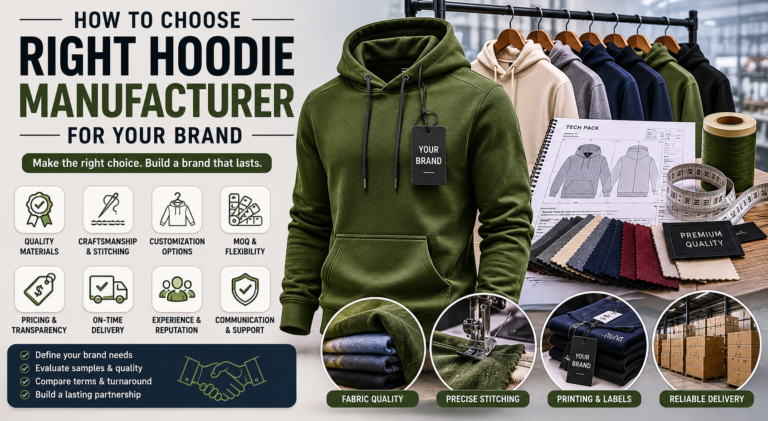
How to Choose the Right Hoodie Manufacturer for Your Brand

It is not difficult to choose right hoodie manufacturer. Finding the best one is another challenge. Hoodies are produced by hundreds of factories. Most of them, however, are not suitable for your brand, whether due to their minimum order quantity, quality standards, fabric capabilities or their experience in the area.

This guide will show you how to select the right hoodie maker for your brand before you make any commitments.

Start with Your Own Requirements

Be clear about what you need before you start evaluating manufacturers. What kind of hoodie do you produce — performance fleece or heavyweight cotton? Are they technical outerwear pieces, lightweight studio pieces, or a combination? How many pieces do you require for your initial order? What is your price target? What market do you sell into?

This information will help you determine the manufacturers that are most suitable to approach. A factory that specializes in fast fashion basics is very different from one that produces technical performance hoodies and fitness brands.

By being specific, you can avoid wasting time with factories who aren’t a good fit.

Find Relevant Experience Categories

Not all apparel manufacturers understand activewear and fitness sweatshirts. Dress shirts, formal wear and other apparel are produced in completely different environments.

Find a manufacturer who has experience in activewear. Ask to see previous hoodie production — samples, photos, or client references. A hoodies producer that works with fitness brands regularly will understand the construction requirements for active customers — kangaroo pocket, flatlock seams and drawstring quality.

Experience in a particular category is not just a nice to have. This is one of the best indicators that the factory will be able to deliver the product you require.

Assess Fabric Knowledge and Sourcing Ability

A hoodie’s quality is determined by its fabric. The right fabric is different for a gym jacket than for casual streetwear or for technical running layers.

Ask about the fabric sourcing capabilities of manufacturers when evaluating them. Can they source performance fleece that has moisture management properties? Do they use sustainable fabric suppliers for their products? Are they able to provide data on the fabric weight, durability and wash performance of their fabrics?

The development process is enhanced by a manufacturer who will guide you in your fabric selection, rather than simply accepting what you specify. You’re paying them for their knowledge about what works well in production, what lasts over time and what performs best at your price range.

Choose a activewear manufacturer that treats fabric selection as an important decision, not just a last-minute one.

Check Minimum Order Quantities Against Your Needs

MOQ is a practical filter to use when selecting a manufacturer. If you only need 200 units and a factory wants 1,000, then the conversation ends before it even begins.

Before engaging in lengthy discussions, confirm the MOQ. Ask about the MOQ for each colour and style, as factories may have different minimums per variation.

fitness clothing manufacturer that works with brands in growth and offers flexible order sizes will be a better option for you if your current volumes are small. As demand increases, you can scale up your orders.

Ask for samples before committing.

Never commit to mass production with a supplier you haven’t tested. Samples tell you more than a portfolio, website or sales conversation about the capabilities of a factory.

Request a sample that includes your fabric, construction requirements and branding. Examine every detail – the stitching, the finish of the seams, the construction of the pockets, the hardware for the drawstrings, and the durability after washing.

The sample should impress you. If the sample is returned with errors that could have been avoided or the factory fails to communicate well during the sampling phase, this will also be the case for bulk production.

Assessment of Quality Control Processes

Manufacturing relationships are made or broken by quality control. You should ask each manufacturer to describe their QC process, not just that they have one.

What checks are made on the fabric when it arrives? How are the fabrics checked during the cutting and sewing process? How are the finished hoodies checked before they are packaged? Quality is taken seriously by a manufacturer who can clearly answer these questions.

You can be confident that the manufacturer you choose will produce what you approve in samples.

Conclusion

You need more than just a factory with the ability to sew hoodies for your brand. You need to find a partner that understands your product, who shares your standards of quality, and can support you at the current stage of your growth and in future stages.

Spend the time necessary to properly evaluate. Sample before you commit. Choose based on fit and capability, not price.

Explore the range of manufacturing and find the best partner to help you build your brand.

FAQs

What qualities should I be looking for in a manufacturer of hoodies?

 Experience, fabric knowledge and clear QC processes.

What is the best way to determine if a manufacturer’s experience includes fitness hoodies and activewear? 

Request previous work from that category. Ask for samples of similar products that they have made and look at construction details pertinent to performance wear.

How many hoodies should I order from a manufacturer? 

The MOQ varies. Some manufacturers only work with 50-100 units per style. Some manufacturers require 500 units or more. Confirm before engaging in detailed discussion.

Should you visit the factory to make a decision? 

Yes, if possible. You can get a better picture of the factory, its team and production environment by visiting than you can through remote communication.

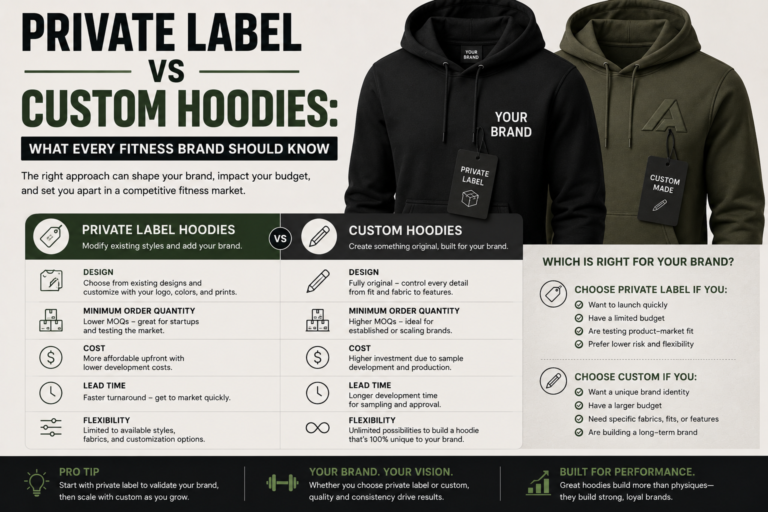
Private Label vs Custom Hoodies: What Fitness Brands Need

At some point, every fitness brand faces the same dilemma. You’re looking to expand your range of hoodies, but aren’t sure if you should go with a private label or a fully customized option. Both options are viable. Both options work, but in very different circumstances. The wrong choice can cost you money, time, and frustration. Here is a detailed debate named Private Label vs Custom Hoodies.

This guide will help you decide which hoodies are best for your brand.

What Is Private Label?

You can create your own private label by taking an existing, predesigned hoodie and adding your branding. The fabric, silhouette, and construction have already been decided. Choose from the available options, add your logo, and place your order.

It’s faster. It’s simpler. It’s usually easier to do. Private label can be a good option for brands who need to move fast or test a new category of product.

Everyone using the same brand can use the same base garment. Under the logo, your branded sweatshirt and that of a competitor could be identical.

What Is Custom?

The hoodie is built from scratch, according to your specifications. This includes your choice of fabric, your design, your details for construction, and your branding. The garment itself is not shared.

You can control every aspect of your product through custom production. You can tailor the fit to your specific customer. Fabrics can be selected for their performance or feel. The finished garment will be unique to you.

Time and investment are the trade-offs. Custom production is more expensive and requires a tech pack. The product may take longer to get to market, but it is unique and cannot be replicated by your competitors.

From fabric sourcing through to delivery, a dedicated manufacturer can handle everything.

Which One Is Right for Your Brand?

Your brand’s current position and your future goals will determine the answer.

If you want to launch quickly, have a limited budget or test whether hoodies will work for your target audience before investing in custom development, private labeling makes sense. It allows you to get product in the hands of your customers quickly with minimal investment.

If you want to differentiate your brand, have specific performance or fit requirements that are not met by off-the shelf options, or build a product line that will stand out in a crowded marketplace, custom is the way to go.

As they grow, many brands start out with private labels and then move to custom. Demand is validated by the first batch. Once the brand has a clear understanding of what customers want, it will then offer a custom range.

Key Differences at a Glance

Understanding the differences in the two approaches will help you to make a more informed decision. Private label is a good option for those who want speed, simplicity and a lower entry-cost, but it has limited uniqueness. Custom allows for full control, differentiation of the brand, and an entirely unique product. However, it requires more upfront time and money.

Choose a activewear provider that can support both strategies and will help you determine which is best for your business at this stage.

What to Consider Before You Decide

Be clear about a few points before making any decisions. How soon do you want to get your product on the market? What is your budget and minimum order? What importance do you place on product originality in your brand positioning strategy? Do you have the necessary technical expertise or support to handle a custom-development process?

Start with private label if the answer is speed and simplicity. If the answers point to differentiation and long-term branding, start with custom.

If you choose either option, be sure that your manufacturer is able to guide you honestly through the process and not simply push you towards what they think will work best for them.

Branding Either Way

No matter if you choose to go with a private label or a custom brand, the branding execution is important. Well-branded private label sweatshirts can feel and look premium. Poorly branded custom hoodies can ruin an otherwise great product.

Label quality, placement of logos, printing or embroidery, and packaging are all important. These are the details that customers see and feel, and they create a first impression for your brand.

manufacturers who have in-house branding abilities can handle all this, from the woven label on the collar to hang tags on the zip.

Conclusion

There is no right answer to the question of whether you should go with private label or custom hoodies. This is a question of where your brand stands right now, and what you need to do in order for it to grow.

Start by deciding what is most appropriate for you at this stage. From there, build. Work with a manufacturer that can help you grow your brand by supporting both strategies.

Explore the range of manufacturing and find out what’s right for you.

FAQs

What is the main difference between private label and custom hoodies?

Private label uses an existing base garment with your branding applied. Custom builds the hoodie from scratch to your exact specifications.

Which option is faster to market?

Private label is significantly faster — often weeks rather than months — because the base garment already exists and no sampling development is needed.

Is custom production more expensive than private label?

Yes — custom requires more upfront investment in development, sampling, and typically higher minimum orders. But it delivers a unique product that private label cannot.

Does private label limit my branding options?

Somewhat. You can apply your logo and choose from available colour options — but the garment silhouette and construction are fixed by the manufacturer’s existing range.