
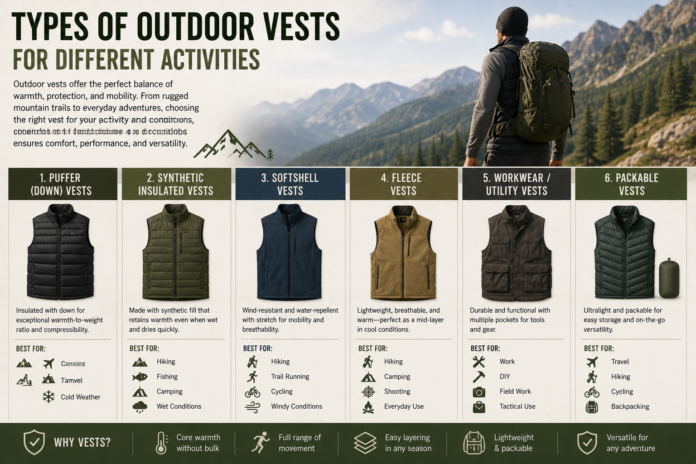
Decorated with the right types of outdoor vests, you can create one of the more tactically flexible wardrobes. Outdoor vests strike the perfect compromise between the full insulation and protection of jackets and the full range of movement and breathability of other garments. They insulate the core and protect against the elements while leaving the arms completely free. Outdoor vests come in a broad range of styles and types — from technical workwear vests to softshell vests to lightweight packable down vests — each designed for a specific activity, performance requirement, and temperature.
Why You Need Outdoor Vests For Every Outdoor Range
Many brands believe that types of outdoor vests are a secondary category, as they are considering jackets and base layers first. However, outdoor vests get great sales every season. Outdoor vests get great sales for every activity. outdoor vests get great sales every season. They solve a critical layering issue that no other garment solves.
Core Advantage Of The Vest
Vest construction creates two simultaneous advantages: bulk insulation and bulk weather protection. Vest construction concentrates insulation and protection at the core, where the body’s core retains the most heat. Vest construction also leaves the arms completely free. The bulk that vest construction leaves behind can also restrict and overheat during prolonged physical activities.
Consequently, outdoor vests are great for a large range of temperatures, and physical activities, as well as a great substitute for a full jacket. They are great during rest and low-output activities without the overheating that occurs during high-output activities. They are a great layering tool for outdoor and everyday use.
Where Vests Fit in the Outdoor Layering System
Vests can occupy up to two different positions in the layering system depending on their construction. Insulating vests can be either down vests or synthetic filled vests. Down vests can be considered mid-layers if they are worn beneath a shell jacket or can be considered a stand-alone outer-layer if the temperatures are mild. Shell vests and softshell vests can be considered lightweight outer vests that provide wind and weather protection. They can be worn over a base layer or a mid-layer fleece. Depending on what position a vest type occupies helps brands in designing a cohesive outdoor range and helps buyers select the right equipment for their needs.
Types of Outdoor Vests and Their Specific Uses
Down Insulated Vests
The most packable down vests are the lightest of all vests. They incorporate the natural insulating properties of down filled with duck or goose down. The clusters of down create an insulating layer that can trap air and can retain down heat across a large area with substantially less weight in comparison to other fabrics.
Additionally, down vests can be packed into their own pockets or small stuff sacks, adding to their versatility for a multitude of activities. For instance, down vests benefit trail running, hiking, cycling, and alpinism by adding warmth during rest breaks or drops in temperature while adding minimal weight to your pack during the rest of the activity.
Unfortunately, insulation down vests cannot maintain their insulation property once they get wet. This is because the clusters of down cannot trap air and lose their structure. Because of this, down vests are only useful in dry, cold settings. For cold, wet, down vests are not ideal, and a synthetic alternative would be recommended. Our outdoor vest manufacturing team offers the opportunity to create down vests with differing shell fabrics and insulation fill.
Synthetic Insulated Vests
Synthetic vests replace the insulation of a down vest with a polyester fill and maintain insulation when wet, unlike down. Because of this, synthetic vests are ideal for use in down vests are not ideal for use in wet environments.
Also, at the same insulation level, synthetic insulated vests cost less than their insulated vests with down insulation. Synthetic vests can therefore offer a better price-to-performance ratio for companies that require price-sensitive, technically performing vests for a wider range of outdoor markets. Synthetic fill insulation that has been recycled from post-consumer plastics and waste can also provide brands story of sustainability with greater insulation performance and remains comparable to virgin synthetic insulation. Recycled insulation fills are easy to obtain.
Synthetic insulated vests are a great option for brands that design outdoor apparel for camping that provides insulation and versatility for both dry and wet environments throughout. These vests can be used in all camping environments and seasons.
Softshell Vests
In softshell vests, a sleeveless construction of a softshell jacket utilizes composite stretch fabrics. Like their full sleeved counterparts, softshell vests become wind resistant, light water resistant, and breathable. The fabrics and construction stretch and maximize freedom for the arms.
Softshell vests provide protection from the wind and warm the core, and along with their light weight, provide protection for the arms along with freedom of movement. Softshell vests then are the best option for wind protection while fully warming the core during the following recommended activities: cool weather, wind protected, comfort, and freedom of movement trail running, wind protected skiing and riding, and climbing.
Our softshell vests along with our softshell jackets for layering solutions are best used during the protection phase of outdoor activities requiring truly freedom of movement, trade, and construction. For customers during the wind and weather protection layer, our vest trade softshell jackets make a great layering solution. These are especially great for ski touring, climbing, and outdoor activities.
Protecting from overheating during the trade phase of outdoor activities is especially great for ski touring and climbing. Our team of softshell jackets along with our softshell vests trade construction solutions make a great layering solution.
Fleece Vests
Fleece vests are sleeveless jackets that insulate the body while allowing the arms to breathe and move. A common use is to layer fleece vests between an outer shell and a base layer to insulate the core without limiting the arms.
Fleece vests appeal to brands that market both outdoor and lifestyle products because they are appropriate for both settings. Their insulation and breathability help make fleece vests appealing products for brands that are new to outdoor apparel.
Fleece vests naturally integrate with brands’ existing product offerings. When combined with a fleece jacket and base layer, they help provide customers with a complete, outdoor layered system. Contact our team to help with your fleece vest needs.
Waterproof Shell Vests
Waterproof shell vests protect the core the way waterproof jackets protect the full body. Waterproof shell vests are sleeveless and use a bulkless construction that allows jackets to be made lightweight. Waterproof shell vests use a waterproof membrane with a DWR coating and seam sealing.
Waterproof shell vests are excellent for activities where the arms get warm enough for light rain protection (without fully enclosed sleeves), like cycling and running. They also make good rain protection for the outdoors because they can be packed easily into a day pack. They sit in the day pack and are pulled out when rain protection is needed on the trail.
Waterproof shell vests are available with fully taped seams and advanced waterproof membranes because waterproof shell vests are part of our waterproof clothing manufacturing service. Reach out to us and we can manufacture a shell waterproof vest for your outdoor clothing line.
Hiking Vests
Hiking vests combine insulation and weather protection to help the outdoor adventurer on a long day hike. They have plenty of pockets to store all of the essentials. They also have plenty of fittings and adjustments to help seal in body warmth when the weather gets colder. Hiking vests also help solve the problem of bulky pack along the hike because they are designed to fit under a pack along a base layer and help hiking adventurers move along freely.
Of the various offerings that outdoor brands have, a hiking vest is an important addition to an outdoor brand’s offerings because a hiking vest serves a large segment of outdoor clothing customers.
Our hiking clothing manufacturing team designs vests as part of full hiking apparel lines, allowing us to achieve fabric and feature synergy as well as strategic merchandise positioning for all hiking apparel. Contact us to begin developing your hiking vests.
Hunting and Tactical Vests
Hunting and tactical vests are sleeveless, high mobility, and designed for demanding field use. These vests achieve a balance of weather protection, equipment carrying capacity, and a low visual signature.
Hunting vests will usually have different pocket designs tailored to certain field sports and may have game bags or shell loops. They come in different camouflage patterns to fit different hunting environments. Hunting vests may come in fabrics that will resist wear, weather, and also be quiet.
Our hunting apparel manufacturing team offers hunting vests as part of total hunting apparel lines which include camouflage pattern development, hunting fabrics, and field sport pocket technology. Contact us to begin developing your hunting vests.
Compare these Features when Evaluating Outdoor Vest Types
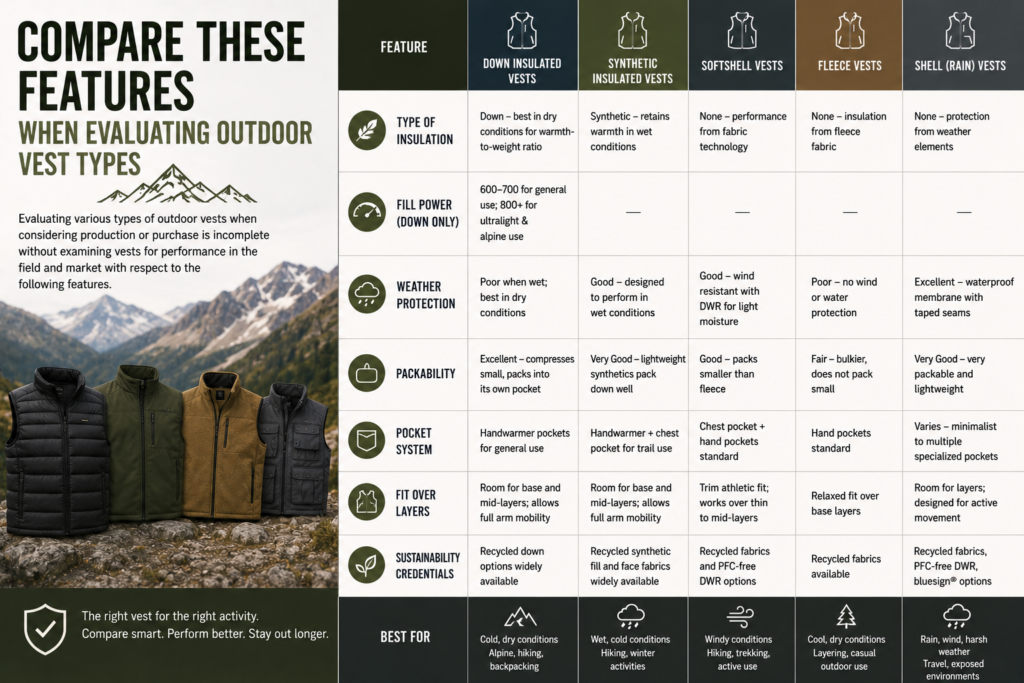
Evaluating various types of outdoor vests when considering production or purchase is incomplete without examining vests for performance in the field and market with respect to the following features:
- Type of Insulation — down is best in the dry for warmth-to-weight ratio, wet conditions require synthetic insulation, softshell and shell vests have no insulation
- Fill Power — for down vests, higher fill power means better warmth-per-gram efficiency; general use vests may have 600 to 700 fill with 800+ for ultralight and alpine use
- Weather Protection — for full protection, vests have a waterproof membrane with taped seams; a DWR softshell protects from wind and light moisture, fleece vests offer insulation with no weather protection
- Packability — vests with insulation that is either down or lightweight synthetic can be made to pack into their pocket and thus carried easily along a trail
- Pocket System — handwarmer pockets are for general use, trail use requires a vest with a chest pocket, specialty pockets are for hunting and vests of a tactical nature
- Fit over Layers — vests should comfortably accommodate base and mid-layer clothing with freedom of movement for the arms and no compression of the shoulder zone
- Sustainability Credentials — there is no performance compromise for the use of recycled down, synthetic fill, and face fabrics in most styles of vests
Considerations for Your Brand’s Outdoor Vest Selection
Outdoor vests are an excellent category to add to an outdoor apparel collection because of the variety available and the ability to meet a range of customer needs throughout the year across a variety of activities.
Additionally, vests generally have a higher price-to-production-cost ratio, making them more profitable compared to other items in an outdoor apparel collection. This allows companies to expand their collection by adding vests in addition to jackets.
The addition of vests and other complementary apparel products, such as waterproof jackets for complete protection against the elements and outdoor jackets for complete outerwear, completes an outdoor layering system for customers and provides products for all the different outdoor conditions and activities during the different outdoor seasons.
Would you like to add vests to your outdoor apparel collection? Reach out to our team! We provide outdoor apparel brands with everything they need to start their collections from the initial ideas, fabrics, and Tech Packs to the bulk production, quality control, and delivery.
Conclusion
Brands have many options when it comes to types of outdoor vests from ultralight, packable down vests for alpine and trail activities to tactical vests for field sports. Knowing the difference between the outdoor vests helps brands create targeted outdoor apparel collections and helps buyers select the vests for the specific activities and conditions they plan to face.
Having a good idea of the outdoor vests in the market and how they can be used is important for buyers looking to purchase a vest for their outdoor activities, and brands commercializing an outdoor vest collection.
For those interested in starting an outdoor vest line, our outdoor vest manufacturing page is a great first stop. You can look through all manufacturing options and reach out to our team to kickstart your production!
FAQs
What is the most versatile type of outdoor vest?
For the most versatility, a midweight synthetic insulated vest is ideal. It provides warmth in the in the insulated vest wet and packs down fairly small. It is also great for any outdoor activity from hiking and camping to skiing, as well as everyday use.
When should I choose a down vest over a synthetic insulated vest?
Down vests are great for weight and packability, but should only be used if the weather will be dry. In a wet environment, a synthetic insulated vest is the better choice. Synthetic insulation will keep its warmth in wet conditions, while down vests will collapse and lose insulation.
Can outdoor vests be used as standalone outer layers?
Of course! Heavyweight fleece vests, waterproof shell vests, and softshell vests can all be used as standalone outer layers. Insulated vests can also serve this purpose in dry, mild weather, but would need a shell to be used in more severe weather.
What fill power should I look for in a down outdoor vest?
For typical outdoor use, look for 600 to 700 fill power. This is a great balance for warmth, weight, and the price. For more alpine use and ultralight applications, 800 fill power and above will be a better option, but will also come at a higher price for the warmth to weight ratio.


