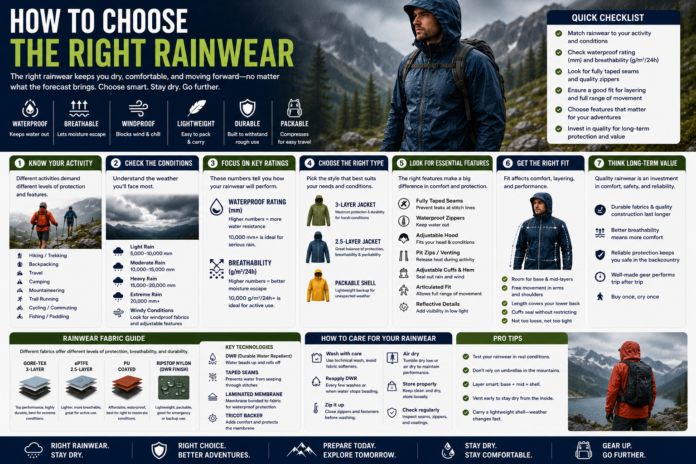
Rainwear is one of those purchases that reveals its quality only when conditions get genuinely difficult. A jacket that performs beautifully in light drizzle can fail completely during sustained mountain rain — leaving you cold, wet, and wishing you’d made a different decision before leaving the trailhead. Knowing how to choose the right rainwear for your specific activities, environments, and performance priorities prevents those experiences and ensures the gear you carry genuinely protects you when rain actually arrives outdoors.
Understand the Difference Between Waterproof and Water-Resistant
The single most important distinction in rainwear selection is understanding the difference between genuinely waterproof and merely water-resistant construction — because these terms describe fundamentally different protection levels that marketing language often blurs intentionally.
Waterproof rainwear uses membrane construction — Gore-Tex, eVent, Pertex Shield, or equivalent technologies — that prevents water penetration indefinitely during sustained rain exposure. Properly manufactured waterproof rainwear with sealed seams keeps wearers dry through hours of continuous heavy rain in demanding outdoor environments.
Water-resistant rainwear relies on DWR treatment applied to face fabrics — causing water to bead and roll off initially but eventually wetting out during sustained precipitation. Once the face fabric saturates, moisture penetration begins regardless of how well the DWR treatment performed during brief exposure.
For serious outdoor activities in reliably wet environments — mountain hiking, backcountry camping, ski wear applications — genuine waterproof membrane construction is non-negotiable. For casual outdoor use in environments with infrequent light rain, high-quality water-resistant construction may serve adequately at lower cost and weight.
Match Protection Level to Your Activity and Environment
Different outdoor activities and environments create genuinely different rainwear protection requirements — and matching protection level to actual needs prevents both under-specification that leaves you wet and over-specification that adds unnecessary cost and weight.
High-intensity mountain activities — alpine hiking, mountaineering, backcountry skiing — demand premium waterproof breathable membrane construction with maximum breathability ratings. Hardshell jackets with 20,000mm waterproofing and 20,000+ g/m²/24h breathability serve these applications — providing complete weather protection without the moisture accumulation that lower-breathability alternatives cause during sustained physical effort.
Recreational hiking and camping suit mid-range waterproof jacket constructions — providing genuine membrane waterproofing at more accessible price points than premium hardshell alternatives without sacrificing the reliable rain protection that outdoor use demands. Camping apparel collections built around practical waterproof performance serve this largest outdoor market segment effectively.
Trail running and cycling demand lightweight packable waterproof constructions that minimize weight while maintaining genuine membrane protection — because weight directly impacts performance in these activities and packability determines whether rainwear actually gets carried on every outing.
Hunting and field activities require hunting apparel specific constructions — combining waterproof protection with silent fabric performance and camouflage patterns that general outdoor rainwear doesn’t provide for field use applications.
Evaluate Waterproofing and Breathability Ratings
Understanding waterproofing and breathability ratings helps you compare rainwear options against the performance requirements your specific outdoor activities genuinely create — rather than simply accepting marketing claims without technical context.
Waterproofing is measured in hydrostatic head — the height of water column in millimeters that the fabric withstands before allowing penetration. Ratings above 10,000mm suit most outdoor recreational use. Ratings above 20,000mm suit serious mountain and alpine applications where sustained severe rain and snow create maximum pressure on fabric waterproofing performance.
Breathability is measured in moisture vapor transmission rate — grams of moisture vapor per square meter per 24 hours (g/m²/24h) that the fabric allows to pass outward. Ratings above 10,000 g/m²/24h suit moderate activity levels. Ratings above 20,000 suit high-intensity activities where significant perspiration requires rapid moisture vapor evacuation to maintain internal comfort.
The relationship between these two ratings determines how well rainwear serves active outdoor use — maximum waterproofing means nothing if inadequate breathability creates the internal dampness that external rain would have caused anyway through a different route.
Assess Seam Sealing Quality
Seam sealing quality determines whether waterproof fabric construction actually delivers complete rain protection or simply provides waterproof fabric panels joined by moisture-permeable seam lines. This construction detail separates genuinely waterproof rainwear from products that technically use waterproof fabrics but leak at every seam during sustained rain exposure.
Fully sealed seams cover all construction seam lines with thermally bonded tape — providing complete waterproof seam coverage across the entire garment. Fully sealed construction is the standard for premium technical rainwear and waterproof jackets claiming genuine waterproof performance.
Critically sealed seams cover only the most exposure-prone seam positions — typically shoulders, hood attachment, and sleeve insertions — leaving less-exposed seam positions unsealed. This approach reduces manufacturing cost while maintaining adequate waterproofing for most recreational use conditions where less-exposed seam positions rarely face direct sustained water pressure.
Unsealed seams indicate water-resistant rather than genuinely waterproof construction — regardless of what the face fabric waterproofing specification claims. Any rainwear purchase for serious outdoor wet weather use should specify seam sealing construction explicitly before committing to the purchase.
Check Hood Design for Your Use Case
Hood design significantly impacts how well rainwear actually keeps you dry during active outdoor use — particularly around the face and neck where rain enters if hood design fails to provide proper coverage and adjustment.
Helmet-compatible hoods accommodate ski helmets, climbing helmets, and cycling helmets beneath the hood — essential for activities where headwear is worn throughout the activity rather than just during rain events. Adjustable volume controls allow proper fit adjustment over different helmet sizes and shapes.
Wire-brim peaked hoods maintain hood shape against wind — preventing the hood from collapsing across the face during wind-driven rain that deflects flat-brim alternatives directly into your field of vision during the conditions that adequate hood design should prevent.
Roll-away hoods pack into the collar when not in use — providing clean aesthetics during dry conditions while remaining immediately accessible when rain arrives. This design suits casual and lifestyle rainwear applications where hood-free styling suits most conditions.
Fixed hoods provide permanent coverage without adjustment complexity — suiting simple recreational rainwear where consistent hood availability matters more than packability or styling versatility between conditions.
Evaluate Fit for Layering and Activity
Rainwear fit determines both performance during activity and compatibility with the layering systems it needs to work over in cold wet conditions. Getting fit right prevents the movement restriction that under-sized rainwear creates and the bulk accumulation that over-sized alternatives cause within layering systems.
Active fit — close to the body without restricting movement — suits running, cycling, and high-intensity activities where aerodynamic efficiency and minimal bulk matter alongside rain protection. Active fit rainwear layers correctly over base layers without creating the excess volume that interferes with athletic movement patterns.
Regular fit — roomier through chest and shoulders — accommodates mid-layers beneath the rainwear for cold wet condition use and suits moderate-intensity outdoor activities where layering flexibility matters more than aerodynamic efficiency during the physical demands these activities create.
Sleeve length requires checking specifically — full arm extension overhead should not pull the sleeve cuff up and expose the wrist gap between jacket and glove. This exposure point allows rain entry that undermines complete arm coverage during the sustained rain exposure that outdoor activities regularly create.
Consider Weight and Packability Requirements
Rainwear weight and packability determine whether it actually gets carried on every outing or left behind on days when pack weight optimization removes it from the kit list. A rainwear jacket that doesn’t get carried provides zero protection when unexpected rain arrives — making genuine packability a practical performance requirement rather than a purely convenience feature.
For trail running, cycling, and day hiking applications where the jacket travels in a pack between deployment opportunities — sub-200 gram weight and fist-sized packed volume represent practical targets that ensure the jacket genuinely accompanies every outing regardless of forecast conditions.
For camping, multi-day hiking, and activities where the jacket is worn throughout the day — weight efficiency matters less than durability, breathability, and feature completeness that lighter constructions often sacrifice for their packability advantage. Outdoor jackets collections that communicate these weight and packability trade-offs clearly help customers make genuinely informed choices rather than discovering limitations through experience.
Assess Additional Features Against Your Needs
Beyond waterproofing specification, seam sealing, hood design, and fit — specific construction features determine how well rainwear serves particular outdoor activities across real daily use conditions.
Essential features worth evaluating carefully:
- Waterproof zipper quality — YKK Aquaguard or equivalent waterproof zippers prevent moisture entry at closure points that standard zippers allow during rain exposure
- Pit zip ventilation — underarm ventilation systems allow rapid heat dumping during high-intensity activity without jacket removal during sustained rain that would immediately defeat the ventilation purpose
- Pocket placement and waterproofing — chest pockets with waterproof zippers provide secure dry storage during rain; hip pockets must position correctly for accessibility with pack hip belts during loaded hiking
- Hem and cuff adjustment — drawcord hems seal against wind-driven rain entry at the lower jacket opening; velcro or elastic cuffs seal against wrist gap rain entry
A professional rainwear manufacturer builds these features into product designs based on intended activity applications — ensuring every construction detail serves genuine functional purposes rather than adding specification complexity without meaningful performance justification for the target customer’s specific outdoor use.
Match Lower Body Protection to Upper Body
Most outdoor enthusiasts focus rainwear attention on jacket selection while neglecting lower body protection that sustained rain quickly penetrates through standard hiking trousers. Complete rain protection requires matching waterproof trouser or overpant specification to jacket waterproofing level — creating consistent protection performance across the entire body rather than a well-protected upper body and inadequately protected legs.
Waterproof clothing system approaches — matching jacket and trouser waterproof specifications, seam sealing standards, and DWR treatments — deliver consistent whole-body protection that mismatched component selections cannot achieve. Brands offering coordinated rainwear jacket and trouser systems serve customers who understand this requirement — and generate significantly higher average order values than brands selling only jacket rainwear without complementary lower body protection solutions.
Conclusion
Knowing how to choose the right rainwear means honestly evaluating waterproofing versus water-resistance needs, matching protection level and breathability to activity intensity, verifying seam sealing construction quality, selecting appropriate hood design, fitting correctly for layering system compatibility, and choosing features that serve your specific outdoor use rather than generic maximum specification. The right rainwear becomes one of the most trusted and consistently used garments in any outdoor kit — deployed confidently whenever conditions deteriorate because you know it genuinely protects rather than simply claiming to.
FAQs
What waterproof rating is sufficient for serious outdoor hiking in wet conditions?
A minimum 20,000mm waterproof rating with fully sealed seams provides reliable protection for serious outdoor hiking in sustained heavy rain — lower ratings may suffice for recreational use in moderately wet environments where sustained heavy precipitation is less common.
Is breathability important in rainwear for casual outdoor use?
Breathability matters less for low-intensity casual outdoor use where perspiration rates are low enough that even poorly breathable constructions don’t create uncomfortable internal moisture accumulation. For active hiking, running, and cycling — high breathability ratings significantly impact wearing comfort during sustained physical effort.
Should I buy rainwear that covers both jacket and trousers?
For activities involving sustained heavy rain where complete body dryness matters — yes. Jacket-only rainwear leaves legs exposed to rain penetration through standard hiking trousers that waterproof construction alone prevents reliably across extended wet weather outdoor use.
Can rainwear be produced under a private label for outdoor brands?
Yes. Professional outdoor apparel manufacturers offer complete private label rainwear production with certified waterproof membranes, seam sealing specifications, sustainable DWR treatments, custom colors, hardware, labels, and packaging — giving outdoor brands full technical and commercial control over their complete rainwear collection identity.