
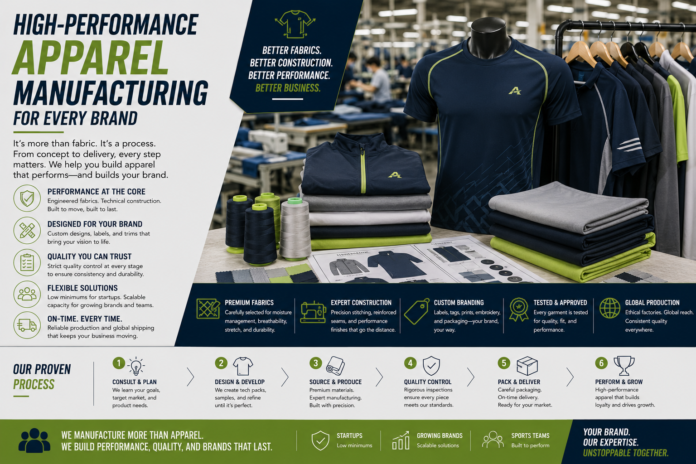
Many people believe that high-performance apparel manufacturing is as easy as selecting a fabric and sending it to a factory. It takes much more effort than that. The entire product can be ruined if you miss a step. This guide will show you how to complete each step. This guide is for startups, growing brands, and sports teams. This is all you need.
What is High-Performance Apparel Manufacturing (HPA)?
High-performance clothing is designed to be tough. It must stretch, breathe, control sweat and withstand repeated washing. This is very different than making a normal fashion item.
Construction of performance garments requires that decisions be made at each stage. Fabric, stitching and seam type all affect the performance of the final garment on the body.
This category includes more than just sportswear. This category includes workwear, outdoor gear and motorbike clothing. Although the demands may be different, the need for precision remains the same.
Choose the right fabric
Fabric is the basis of all things. If you get this wrong, nothing else can be done.
Each fabric performs a specific function. Polyester manages moisture. Spandex provides stretch. Nylon adds durability. Merino wool regulates the body’s temperature. Airflow is improved by using technical mesh.
Prior to placing an order, ensure that you have done the proper fabric development and sourcing. Check the GSM and the stretch recovery. Also, confirm that the fabric retains its color after washing. Although these tests may seem like extra work, they can save you from major problems in the future.
Fabric Properties You Should Look for:
- The moisture-wicking fabric is ideal for sweat management
- Stretch in four directions for full range motion
- UV protection for outdoor use
- Anti-odour treatment and antimicrobial treatment
- Lightweight yet durable construction
Create a detailed tech pack
The tech pack is your garment’s instruction manual. The tech pack tells the manufacturer exactly what they need to do — measurements, drawings, materials, types of stitching, and finishing details.
You leave too much to interpretation without a techpack. The factories will interpret the same thing differently each time.
Professional tech packs development transforms your idea into an easily understandable, practical document. Free tech pack templates are a great way to get started if you don’t have any experience.
A good techpack will reduce your sample process, eliminate back and forth, and protect you in the event of a production error.
Build your samples and refine the fit
You need to have a physical prototype before you can start mass production. You can see and feel the final product you have planned on paper.
Wear it. Wear it. It is possible to move in it. Test it in the same way that your customer will. Fix it immediately if something is wrong, and not after 500 units have been made.
A good pattern and sampling will ensure that your tech pack is created correctly. size grading and development will ensure that the garment fits across all sizes, not just the sample.
A few extra samples now are cheaper than an order in bulk that you won’t be able to sell.
Select the right High-Performance Apparel Manufacturing model
The production of high-performance clothing is not a one-size fits all process. Your budget, order size and the amount of control you want over your supply chain will determine which model is best for you.
| Manufacturing Model | Best for |
|---|---|
| CMT (Cut Make Trim) | Brands providing their own fabric |
| FPP (Full package production) | Startups that want end-to-end services |
| Private Label | Brands building a unique identity |
| Bulk Manufacturing | Scaling up teams and established brands |
A low MOQ manufacturer allows you to start small and grow at your pace. The MOQ Calculator will help you determine what size order is best for your budget.
Use Branding and Finishing
Now it can function like yours. It can now function just like yours.
You are not paying for an extra. You have many options with high-performance apparel manufacturing. Sublimation printing is a method of printing that embeds the ink into the fabric. It never cracks or fades. Embroidery can be used to finish uniforms and team kits.
You can also make your clothing work for you by custom printing, labeling, and packaging. Consistency is key.
Maintain Quality Control in Production
The quality control process is not just a check at the end. The process begins the moment the fabric is delivered to the factory.
All of these things need to be checked at different points in production. In-line and final checks are part of a solid production process before any product is packed.
Use checklists for manufacturing to keep track of each stage, especially if your production is managed remotely.
Who is High-Performance Apparel Manufacturing Made for?
- Sports Teams require durable fabrics, consistent sizes, and branding to last a season of training matches and competitions.
- Startups require flexibility. Low MOQ options allow you to test the market before committing large volumes.
- Established Brands need reliability. Every unit must match the previous one — same size, same color, same quality.
Fundamentals are universal. A great fabric, a clear specification, proper samples, and a quality manufacturer are all essential.
Estimating Costs Before You Start
The cost of a product can vary depending on the fabric chosen, the printing method used, the order volume and the packaging. Use the cost estimator to get a better idea of costs before contacting a supplier.
The conclusion of the article is:
If you plan and strategize well, high-performance clothing manufacturing can be a lucrative business. The fabric, samples, and tech packs must be perfect.
Manufacturing is a skill, not a cost. This can change the business.
Explore the entire range of options when you’re ready.nge of manufacturing solutions and find the approach that fits your business.
FAQs
What is high-performance apparel manufacturing?
It’s the process of making garments built for physical demands — with stretch, breathability, and durability designed in from the start.
Do I need a tech pack before contacting a factory?
Yes. Without one, factories have no clear reference and production becomes inconsistent.
How many sample rounds should I expect?
Most brands go through two to three rounds before approving for bulk production.
What does quality control cover?
Fabric inspection, in-line stitching checks, measurement accuracy, print quality, and a final inspection before shipment.


