Walk into any serious outdoor retailer and you’ll find both sitting side by side — softshell and hardshell jackets at different price points, with different technical specifications, and designed for genuinely different purposes. The softshell vs hardshell jackets question confuses a significant number of outdoor enthusiasts and brand buyers alike — because both look similar at a glance but perform very differently when conditions get serious. Understanding exactly what separates these two jacket types makes you a smarter buyer and a better brand builder.
What Is a Hardshell Jacket?
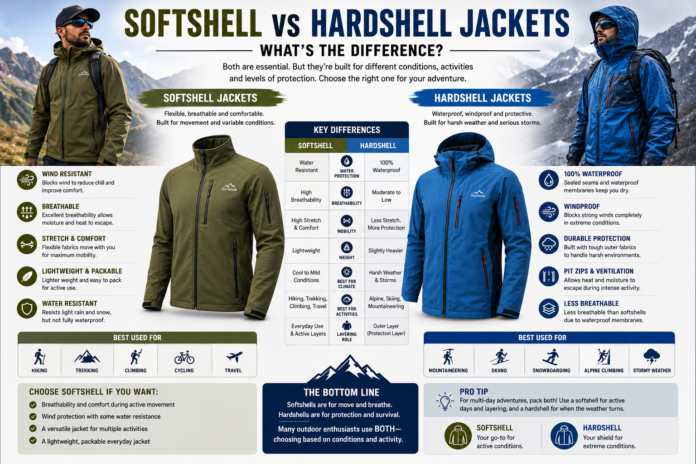
A hardshell jacket is the most technically advanced weather protection garment in outdoor apparel. It uses rigid waterproof breathable membrane laminates — Gore-Tex, eVent, or equivalent technologies — bonded directly to the face fabric to create an impenetrable barrier against rain, snow, and wind.
Hardshells contain no insulation. They function purely as weather barriers — worn over base layers and insulating mid-layers in cold conditions, or directly over base layers during high-intensity warm weather activity where insulation isn’t needed but weather protection is.
The defining performance characteristics of quality hardshell jackets are:
- Full waterproofing — typically 20,000mm hydrostatic head rating and above
- Complete windproofing across all fabric panels and construction points
- Breathable membrane performance allowing moisture vapor escape during activity
- Fully sealed seams preventing water entry through construction points
- Durable face fabric resisting abrasion from pack straps, rope contact, and terrain
Hardshells suit mountaineering, alpine climbing, backcountry skiing, and serious mountain hiking — activities where complete, reliable weather protection matters more than any other performance characteristic.
What Is a Softshell Jacket?
A softshell jacket takes a fundamentally different design approach. Rather than prioritizing maximum weather protection, softshells optimize for freedom of movement, breathability, and comfort during sustained high-output physical activity.
Softshell fabrics typically combine a stretch woven face — providing moderate wind and light rain resistance — with a fleece or gridback interior lining that adds comfort and mild insulation. The result is a jacket that moves freely with the body, manages temperature effectively during intense activity, and feels significantly more comfortable against the body than rigid hardshell alternatives.
Softshell jackets are genuinely windproof and water-resistant — but they are not waterproof in the way hardshells are. Sustained heavy rain will eventually penetrate a softshell fabric. In genuinely wet conditions, softshells require a waterproof layer over the top — or should be replaced entirely by a hardshell for complete protection.
Softshell vs Hardshell: Core Performance Differences
| Feature | Softshell | Hardshell |
|---|---|---|
| Waterproofing | Water-resistant only | Fully waterproof |
| Windproofing | Full | Full |
| Breathability | Very high | High |
| Stretch and Mobility | Excellent | Moderate |
| Weight | Light to moderate | Light to moderate |
| Packability | Good | Excellent |
| Comfort Against Body | Very high | Moderate |
| Insulation | Mild — fleece lining | None |
| Best Conditions | Active dry/cold/windy | Wet, snow, severe weather |
| Layering Requirement | Base layer sufficient | Base plus mid-layer in cold |
When to Choose a Hardshell
Choose a hardshell jacket when weather protection is the primary requirement. If your activity involves sustained rain, heavy snow, high alpine conditions, or any environment where getting wet creates genuine safety risk — hardshell is the correct choice. No amount of softshell breathability advantage justifies choosing a water-resistant jacket when waterproof protection is genuinely needed.
Hardshells are the correct outer layer for:
- Mountain hiking in changeable alpine weather
- Ski wear applications in heavy snow conditions
- Backcountry and expedition use where conditions deteriorate unpredictably
- Waterproof clothing needs in sustained wet lowland environments
- Any situation where the consequences of getting wet are serious
When to Choose a Softshell
Choose a softshell jacket when activity intensity and freedom of movement matter more than maximum weather protection. Softshells genuinely outperform hardshells in dry but cold and windy conditions — providing better comfort, more natural movement, and superior temperature regulation during sustained physical output.
Softshells are the correct choice for:
- Trail running and fast hiking in predominantly dry conditions
- Ski touring and uphill skinning where sweating is constant
- Hiking clothing applications on clear weather days with light wind
- Climbing and bouldering where stretch and mobility matter critically
- Any high-intensity activity in cold dry conditions where breathability matters most
Can You Use Both Together?
Absolutely — and many serious outdoor enthusiasts do exactly this. A softshell worn as an active layer during high-intensity uphill sections, with a packable hardshell available for deployment when weather deteriorates, provides the complete flexibility that demanding outdoor activities across changing conditions genuinely require.
This combination approach — softshell for comfort and mobility, hardshell for weather emergencies — gives outdoor users the best of both performance philosophies without being locked into the compromises each individual jacket type makes.
Brands building complete outdoor jackets collections serve customers best when they carry both types — with clear communication about when each jacket performs optimally rather than leaving customers to discover the limitations themselves through experience.
What About Three-in-One Jackets?
Three-in-one jackets combine a hardshell outer with a removable insulated or fleece inner — connecting through a zip system that allows all three configurations. They offer versatility at the cost of optimal performance in any single configuration — the hardshell outer is typically less breathable than a dedicated shell, and the inner layer is less warm than a dedicated insulated jacket.
Three-in-one designs suit outdoor lifestyle and casual use markets where versatility matters more than technical performance optimization — particularly strong for camping apparel collections targeting recreational users who want simplified gear choices over technical performance precision.
Building Both Into Your Outdoor Brand
For outdoor apparel brands, carrying both softshell and hardshell jackets isn’t optional — it’s commercially essential. Different customers, different activities, and different conditions all create genuine demand for both types. Brands that offer only one type consistently lose customers whose specific activity requirements the available jacket doesn’t serve correctly.
Working with a professional outdoor apparel manufacturer who produces both jacket types with equal technical expertise ensures fabric performance credentials, construction quality, and feature execution meet the real-world demands each jacket type faces across genuine outdoor use in demanding environments.
Conclusion
The softshell vs hardshell jackets decision isn’t about which jacket is better — it’s about which jacket is better for the specific activity, conditions, and performance priorities at hand. Hardshells protect completely in wet and severe conditions. Softshells move freely and breathe excellently during high-intensity dry weather activity. Understanding this distinction clearly — and communicating it effectively to customers — is what separates outdoor brands that genuinely serve their market from brands that sell jackets without helping customers make the right choices for their specific outdoor needs.
FAQs
Is a softshell jacket waterproof?
No. Softshell jackets are water-resistant — they handle light rain and moisture splash effectively but will eventually wet out in sustained heavy rain. Genuinely waterproof protection requires a hardshell membrane jacket.
Can I wear a softshell jacket skiing?
Softshells suit ski touring and uphill skinning in dry conditions where breathability matters. For resort skiing and any conditions involving snow or rain, a waterproof hardshell provides the weather protection that skiing in mountain environments reliably demands.
Are hardshell jackets uncomfortable during high-intensity activity?
Quality hardshells with premium breathable membranes manage moisture vapor effectively during sustained activity. However, softshells do breathe more freely — making them more comfortable during extended high-intensity output in dry conditions where weather protection isn’t the primary need.
Can softshell and hardshell jackets be produced under a private label?
Yes. Professional outdoor apparel manufacturers produce both jacket types under private label with custom fabrics, performance membranes, colors, hardware, and branding — giving outdoor brands complete control over their technical jacket collection identity.