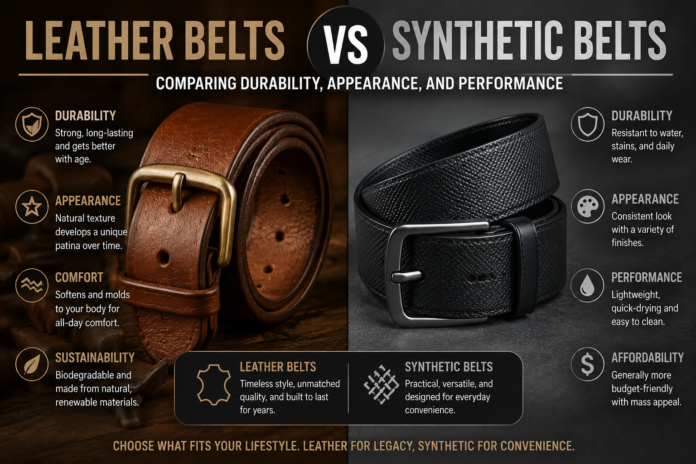
Choosing between leather belts vs synthetic belts is not only about price or style. The material affects how long a belt lasts, how it feels around the waist, how well it holds its shape, and how it looks after regular use. Leather has been used for belts for generations because it is strong, flexible, and able to develop character over time. Synthetic materials have become common because they can be lighter, cheaper, easier to clean, and available in many colors and finishes.
When comparing leather belts vs synthetic belts, there is no single material that works best for every person. A full-grain leather belt may be a better choice for someone who wants years of wear, while a synthetic belt may work well for sports, casual clothing, wet conditions, or a limited budget. Understanding the differences in construction, durability, appearance, comfort, maintenance, and intended use makes it much easier to choose the right belt.
Leather Belts vs Synthetic Belts: What Is the Main Difference?
The biggest difference between leather belts vs synthetic belts is the material itself. Genuine leather comes from animal hide that has been cleaned, tanned, finished, and cut into straps. Different leather grades can perform very differently. Full-grain leather keeps most of the natural surface of the hide and is known for strength and natural character. Top-grain leather is usually sanded or corrected to create a smoother appearance. Lower leather grades may contain split leather, bonded fibers, coatings, or other treatments.
Synthetic belts are usually made from materials such as polyurethane, polyester, nylon, PVC, or blends designed to imitate the appearance or function of leather. Some synthetic belts try to look like traditional dress belts, while others are designed for outdoor, sports, work, or casual use. Buyers comparing different leather belts can see that real leather itself comes in many constructions, so the comparison should consider quality rather than treating every leather product as exactly the same.
Durability and Long-Term Wear
Durability is one of the main reasons people compare leather belts vs synthetic belts. A well-made leather belt can handle repeated bending, fastening, and daily movement for a long time. Thick leather also has enough structure to support trousers without stretching too quickly. High-quality leather may become softer with use while still keeping much of its strength. Small surface marks can even become part of the belt’s natural appearance instead of making it look worn out immediately.
Synthetic belts vary much more in long-term performance. A strong nylon webbing belt can be extremely durable, especially for outdoor or work use. However, leather-look synthetic belts with a thin surface coating may crack, peel, split, or separate after repeated bending. Once that outer layer begins to peel, repairing it is usually difficult. Therefore, when judging leather belts vs synthetic belts for long-term use, buyers should look at the exact construction instead of only reading the material name on a label.
Why Full-Grain Leather Usually Lasts Longer
Full-grain leather is often considered one of the strongest options because the hide’s natural grain layer remains largely intact. It has not been heavily sanded to remove every mark or texture. That natural surface gives the leather strength while allowing it to develop a richer appearance with use. A properly made full-grain leather belt can gradually soften around the waist without becoming weak or losing its basic shape.
This does not mean every leather belt will automatically outlast every synthetic belt. Thin leather, weak stitching, poor-quality edge finishing, or cheap buckle hardware can shorten the life of a belt. At the same time, heavy nylon webbing may survive conditions that would damage untreated leather. The better way to compare leather belts vs synthetic belts is to consider material grade, thickness, stitching, buckle attachment, hole reinforcement, and edge construction together.
Appearance and Style
Appearance is another major difference in leather belts vs synthetic belts. Natural leather has grain patterns, small variations, and surface details that can make every belt look slightly different. Over time, quality leather may develop a patina. This means the surface can become smoother, deeper in color, and more personal as it is exposed to movement, oils, and normal use. Many people appreciate this gradual change because the belt develops character rather than simply looking older.
Synthetic belts can provide a much more controlled and uniform appearance. Manufacturers can produce the same color, texture, embossing, or surface finish across large quantities. This is useful when matching belts to uniforms, fashion collections, promotional products, or specific brand colors. Synthetic materials can also imitate smooth leather, textured leather, woven fabric, or technical webbing. For this reason, leather belts vs synthetic belts can both be stylish, but their style develops in very different ways.
Comfort and Flexibility During Daily Wear
Comfort depends on thickness, stiffness, width, edge finishing, and how the belt reacts to movement. Leather is often firm when new, especially when thick full-grain leather is used. However, good leather gradually becomes more flexible in the areas where the body naturally bends. This allows the belt to adjust to the wearer’s shape. A leather belt with smooth edges and a well-finished buckle area can therefore become more comfortable after repeated use.
Synthetic materials can feel comfortable from the first day because many are light and flexible. Nylon webbing, for example, bends easily and may be suitable for active movement. Some polyurethane belts are also softer than thick leather. However, very thin synthetic belts may roll, stretch, or fold under pressure. In a leather belts vs synthetic belts comparison, leather often offers a balance of structure and flexibility, while synthetics can offer lower weight and immediate softness.
Performance for Men’s, Women’s, and Fashion Belts
Belt performance also depends on how the belt will be worn. A traditional men’s belt may need enough stiffness to hold trousers securely throughout the day. Leather works well for this purpose because it combines strength with a clean appearance. A quality leather belt for men may work with jeans, chinos, business trousers, or other everyday clothing when the width, finish, and buckle are chosen correctly.
Women’s belts often include more variation in width, shape, color, and decorative hardware. Synthetic materials can be useful when designers want brighter colors, unusual textures, or lower-cost seasonal styles. Leather, however, remains attractive for classic waist belts and long-term accessories. This shows why leather belts vs synthetic belts cannot be judged by material alone. Fashion purpose, clothing type, buckle design, belt width, and expected frequency of wear all influence which option performs better.
Belt Construction Matters as Much as Material
Construction can make a major difference in how long any belt lasts. A leather belt cut from one solid piece of quality hide may perform differently from a belt made with several thin layers glued together. Stitching can improve structure, but weak thread or poorly placed stitches can become failure points. Buckle attachment is also important because this area experiences repeated pulling. Strong rivets, Chicago screws, stitching, or folded leather construction can help keep the buckle secure.
Synthetic belts also use different construction methods. Some use a woven webbing strap with a metal buckle, while others have a synthetic leather outer surface around a fabric backing. Bonded layers can look attractive when new but may separate if heat, moisture, or bending weakens the adhesive. When studying leather belts vs synthetic belts, checking the edges, buckle connection, stitching, holes, lining, and thickness often tells more about quality than simply looking at the front surface.
Key Differences at a Glance
A simple way to understand leather belts vs synthetic belts is to compare the everyday strengths and weaknesses of each material before buying:
- Leather usually offers a natural grain and more traditional appearance.
- Full-grain leather can become softer and develop a patina with age.
- Synthetic belts often cost less than premium leather belts.
- Nylon and other technical synthetics can perform well in wet conditions.
- Coated synthetic leather may crack or peel after repeated bending.
- Leather normally needs more careful cleaning and storage.
- Synthetic belts are often easier to wipe clean.
- Leather can provide stronger structure for formal and everyday trousers.
- Synthetic materials allow a wider range of bright colors and uniform finishes.
- High-quality construction matters more than choosing a material only by name.
- Thick leather can be heavier than many synthetic alternatives.
- Both materials can perform well when matched to the correct use.
These points show that leather belts vs synthetic belts involve trade-offs rather than one material winning every category. Buyers who need a formal, long-lasting, naturally aging accessory may prefer good leather, while people who need a lightweight, washable, or highly uniform belt may find a synthetic option more practical.
Maintenance, Water Resistance, and Everyday Care
Leather requires some care because natural hide can react to excessive moisture, heat, dryness, and strong cleaning chemicals. A leather belt should normally be wiped with a soft cloth and allowed to dry naturally if it becomes damp. Depending on the finish, occasional leather conditioning can help prevent excessive dryness. It is also better to hang or loosely roll a leather belt rather than sharply folding it for long periods.
Synthetic belts are often easier to maintain. Many can be wiped with a damp cloth, and some fabric webbing belts can handle more moisture than untreated leather. However, easier cleaning does not always mean longer life. Coatings may become brittle, adhesives may weaken, and printed surfaces can fade. In leather belts vs synthetic belts, synthetic materials often have the advantage in simple maintenance, while good leather usually rewards proper care with better long-term appearance.
Price, Value, and Cost Over Time
Synthetic belts usually have a lower starting price because their materials can be produced consistently and at large scale. This makes them useful for budget clothing, promotional products, seasonal fashion, uniforms, or situations where the belt may be replaced regularly. A lower purchase price can be attractive, especially when someone wants several colors or designs instead of one long-term belt.
Leather belts generally cost more when high-grade hide, strong hardware, careful edge finishing, and better construction are used. However, the lowest purchase price does not always provide the lowest cost over time. If a cheap belt needs frequent replacement, buying a stronger belt may offer better value. The leather belts vs synthetic belts decision should therefore consider how often the belt will be worn, the expected lifespan, and whether appearance improves or declines with age.
Which Belt Should You Choose?
Choose leather when you want a traditional look, firm support, natural texture, and the possibility of long-term wear. It is particularly suitable for dress belts, jeans belts, heritage-inspired clothing, workwear, and accessories where appearance matters as much as function. Good leather is also attractive to people who like materials that change naturally over time instead of maintaining a completely uniform surface.
Choose synthetic material when light weight, easy cleaning, lower cost, water tolerance, or consistent color is more important. Nylon webbing can be practical for outdoor activities, while synthetic leather can suit fashion products that are not expected to last for many years. The best choice in leather belts vs synthetic belts therefore comes from matching the material and construction to the job the belt actually needs to perform.
Conclusion
Leather belts vs synthetic belts offer different advantages. Quality leather usually stands out for natural appearance, structure, aging, and long-term value, while synthetic belts can provide lower cost, easy cleaning, light weight, and greater design flexibility. Neither material should be judged by name alone because thickness, construction, buckle quality, stitching, and intended use strongly affect performance. For a belt that will be worn regularly for years, well-made leather is often the stronger choice; for casual, wet, active, or budget-focused use, a good synthetic belt can be more practical.
FAQs
Are leather belts more durable than synthetic belts?
High-quality leather belts, especially full-grain designs, can last longer than many coated synthetic belts. However, heavy nylon webbing can also be extremely durable. Construction quality and intended use matter as much as the material itself.
Do synthetic belts crack or peel?
Some synthetic leather belts can crack or peel because repeated bending puts stress on the outer coating. Better synthetic materials may resist this problem longer, while woven nylon belts do not depend on a leather-like surface coating.
Are leather belts better for everyday use?
Leather is often a good everyday choice because it provides structure, works with many clothing styles, and can become more comfortable with use. Regular care can also help a quality leather belt maintain its appearance for years.
Which is better for wet conditions, leather or synthetic belts?
Synthetic materials such as nylon usually handle repeated moisture better than untreated leather. Leather can tolerate small amounts of moisture, but it should not remain soaked and should be dried naturally after getting wet.