Your leather apron choice affects the even weight distribution, flexibility, and longevity of the apron. A thinner apron feels light and flexible, whereas a thicker apron offers more overall resistance towards sparks and heat, as well as against the harsh conditions from the workbench. Thinking that a thicker leather apron is the best option for all workbench situations is wrong. The best thickness for a leather apron is work-dependent and influenced by how long the apron will be in use and how safe the user needs the apron to be.
Understanding Leather Apron Thickness
Leather apron thickness usually refers to how thick the leather sheet is before it is cut and assembled into an apron. Manufacturers may describe thickness in millimeters, ounces, or by general terms such as lightweight, medium-weight, and heavyweight leather. As a simple guide, leather around 1.0–1.4 mm is relatively light, 1.5–2.0 mm is medium weight, and leather above about 2.0 mm becomes noticeably heavier and more protective. These ranges are not strict standards because softness, tanning method, hide type, and finish also affect performance. Buyers comparing different apron styles can review a wider range of leather aprons to understand how coverage, construction, and material choices work together.
Leather Apron Thickness for Light-Duty Work
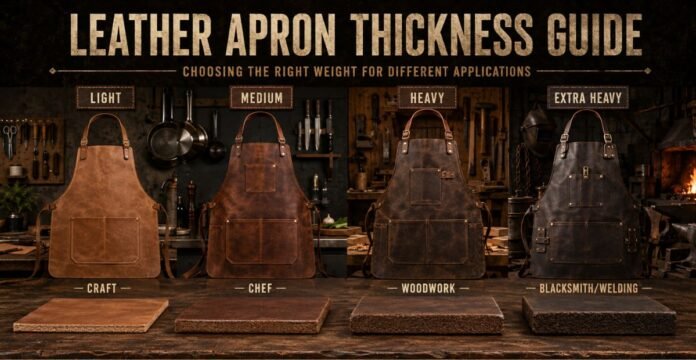
The barbers, crafters, woodworkers/leatherworkers, coffee shops, kitchens, and workshops in general will not require a thick leather apron for protection from light abrasions caused by dust, stains, or minor tools or workshop debris. So, a leather apron measuring in the range of 1.0mm – 1.4mm will work great for most light duty work applications. A leather apron of this thickness will also give the user more range of motion since it will be more flexible. A light leather apron, although it might cost you a little more, is actually easier to wear since it places less of a burden on your neck and shoulders compared to a heavy leather apron.
Medium Leather Apron Thickness for Everyday Workshops
A medium leather apron thickness is often the most balanced choice for general workshop use because it provides more protection than lightweight leather without becoming extremely heavy. Leather between about 1.5 and 2.0 mm is commonly suitable for woodworking, repair work, mechanical jobs, fabrication, gardening, and many craft applications. This leather apron thickness can resist normal rubbing, tool contact, wood chips, dirt, and repeated daily use while remaining reasonably flexible. A full-coverage design such as a bib leather apron can also protect the chest, waist, and upper legs while the leather itself provides the required barrier.
Leather Apron Thickness for Welding and Metalworking
More thickness is needed in leather aprons for welding, grinding and metalworking activities compared to others where sparks from activities can make surfaces rougher. Think between 1.8mm to 2.5mm for leather aprons for those jobs. The design and the extent of exposure to the harsh elements will dictate the leather apron thickness job requirements. Increasing the leather apron thickness will help to improve the resistance of the leather apron to abrasive wear. Leather thickness alone does not guarantee that an apron is safe and appropriate for all forms of welding. Quality of construction, coverage, the type seams, type of straps, type of hardware and how the leather holds up to heat all come into play.
Leather Apron Thickness for Blacksmithing and Heavy Workshop Use
Blacksmithing and heavy fabrication can place even greater stress on an apron, so a heavier leather apron thickness may be useful for these applications. Leather around 2.0–3.0 mm can provide strong resistance against abrasion, rough metal edges, repeated tool contact, and workshop damage. This increased leather apron thickness can also improve the apron’s structure, helping it stay in position during demanding work. The trade-off is greater weight and lower flexibility, especially when the apron covers a large area of the body. A durable material such as full-grain leather aprons can be useful where strength and long service life are priorities.
Key Leather Apron Thickness Choices at a Glance
The correct leather apron thickness becomes easier to choose when the work environment is considered first rather than choosing only by appearance.
- Light craft work: around 1.0–1.4 mm leather apron thickness for flexibility and low weight.
- Kitchen or service work: around 1.0–1.5 mm leather apron thickness where stains and light abrasion are the main concerns.
- Woodworking: around 1.4–2.0 mm leather apron thickness for a balance of comfort and durability.
- General workshop use: around 1.5–2.0 mm leather apron thickness for everyday protection.
- Welding: around 1.8–2.5 mm leather apron thickness where sparks and hot debris are expected.
- Blacksmithing: around 2.0–3.0 mm leather apron thickness where heavier mechanical protection may be needed.
- Long working shifts: choose only as much leather apron thickness as the job actually requires to reduce fatigue.
How Leather Type Changes the Effect of Thickness
Two aprons of the same thickness made from different types of leather can feel significantly different in a lot of ways, and that includes softness, stiffness, strength, and weight. Cowhide is a common leather of choice for work shop aprons given that it offers good strength and resistant to abrasion. Full grain leather is more strongly recommended since a good portion of the leather’s original surface is kept, which in result increases the leather’s toughness. Split leather might also be a good choice for shop aprons and welding aprons since it has a rough texture and good resistance to high temperatures. Stiff leather makes a leather apron with a low thickness feel bulky, while soft leather doesn’t.
Why Thicker Leather Is Not Always Better
People have this idea that the bigger the leather apron, the better the quality must be, and that isn’t always the case. Thickness is key. There is such a thing as an apron that is way too thick. Whether it’s for the kitchen or workshop, an whatever job you do outside of the home, an overly thick apron can potentially restrict movement, cause discomfort and up the stress on the straps of the apron. An overly thick apron can cause neck and shoulder fatigue. Even the most heavy duty aprons are going to prove uncomfortable if they are too thick. Thickness should clearly not be the determining factor when purchasing an apron.
Thickness, Weight, Coverage, and Comfort Must Work Together
Thickness and weight of leather increase with size and coverage. A large leather apron can be almost as heavy as a small leather waist apron. A bib apron can also be more burdensome, due to weight distribution across the chest and legs. Because of the trapped space and smaller proximity to the body, waist aprons can have leather of greater thickness than bib aprons without being excessive and burdensome. Design also plays a role. Waist aprons with a single neck strap can be more burdensome than waist aprons with crossed back straps, due to the difference in weight distribution.
Checking Leather Thickness Before Buying
When describing leather aprons, terms such as heavy-duty and premium leather tend to give a false sense of thickness. Rather than relying on these descriptions, buyers should ask suppliers for leather apron thickness in millimeters. To provide custom aprons, suppliers should be asked for type of leather, thickness, grade, finish of the leather, apron dimensions, hardware, stitching, material for straps and pockets, total weight of the apron, and natural variability in leather across the hide. While natural variability in leather is present, reliable suppliers should control thickness variability during production.
Conclusion
Balance is the key to picking the right leather apron thickness. Lightweight leather aprons, about 1.0-1.4 mm, will suffice for crafting, cooking, light work, etc. A medium thickness leather apron, about 1.5-2.0 mm, is more appropriate for workshops and many woodworking activities. Heavier leather apron thickness, about 1.8-3.0 mm, may be suitable for welding, blacksmithing, fabrication, and other strenuous activities. Leather apron thickness is a fairly incomplete metric as there are many other elements that influence the apron’s performance, including the type of leather, fit, flexibility, straps, stitching, and hardware. Leather aprons that are too heavy and cumbersome are usually not the thickest, and therefore are not the most protective.
FAQs
What is the best leather apron thickness for general workshop use?
A leather apron thickness of around 1.5–2.0 mm is a practical choice for many general workshop jobs because it balances durability, flexibility, and everyday comfort.
What leather apron thickness is suitable for welding?
A leather apron thickness of approximately 1.8–2.5 mm or more may be suitable for welding, depending on the heat, sparks, work process, coverage, and overall protective construction.
Is a thicker leather apron always better?
No. Greater leather apron thickness can improve durability and resistance to abrasion, but excessive thickness can increase weight, restrict movement, and make the apron uncomfortable during long working periods.