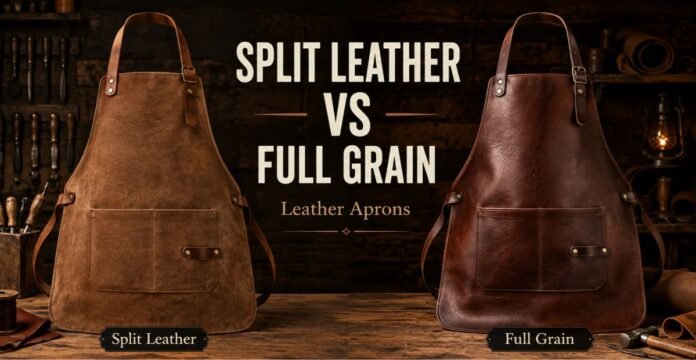
There’s more to split leather vs full grain leather aprons than just style and color. In fact, the type of leather will have an effect on how the apron will feel, how long it will last, how well it will withstand daily use, and how it will age. This is especially important when considering a leather apron for workshops, work areas in kitchens and studios, welding areas, etc. Knowing the differences between a split-grain leather apron and a full-grain leather apron will give you a better idea of which of the two aprons will best fit your work space, budget, personal comfort,
What Are Split Leather vs Full Grain Leather Aprons?
The main difference between split leather vs full grain leather aprons comes from the part of the animal hide used to make them. Full-grain leather uses the outer portion of the hide and keeps most of its natural grain. Split leather comes from a lower layer after a thick hide has been divided into layers. This difference affects strength, surface texture, aging, flexibility, and price. Buyers looking through different leather apron styles should therefore consider the leather type before focusing only on appearance. A well-made split leather apron can be practical for demanding work, while full-grain leather is often selected when long-term durability and natural character are higher priorities.
How Split Leather Is Made
To comprehend the differences between split leather vs full grain leather aprons, we will need to cover the process for split leather. Herd skins can get thick enough for multiple layers and can be split with the upper layer containing the natural grain and the lower section becoming split leather. The lower layer has a fibrous surface that is rougher. Manufacturers can choose to keep this texture and natural appearance, leave it as is, or apply different finishes to create a smoother surface. Due to the cost being more controlled, split leather gets more use when a certain level of real leather is required.
How Full-Grain Leather Is Different
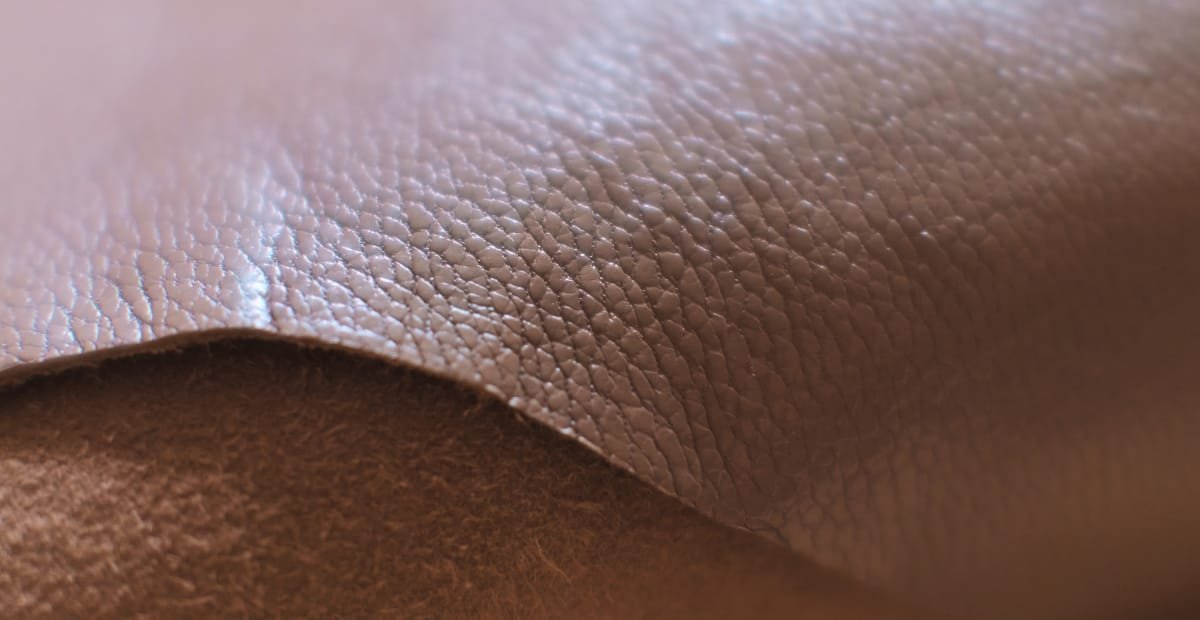
Split leather vs full grain leather aprons keeps the natural outer surface of the hide with very little correction. This means small marks, grain variations, pores, and other natural details may remain visible. These features are not always defects; they are part of genuine leather. In the split leather vs full grain leather aprons comparison, full-grain material generally stands out for its dense fiber structure and ability to develop character with use. A full-grain leather apron can be a suitable choice for buyers who want a strong apron with a natural surface and an appearance that changes gradually as the leather ages.
Strength and Everyday Durability
When comparing split leather vs full grain leather aprons, the main consideration is durability. Full grain leather has a naturally strong fiber structure because the outer grain is not removed. Full grain leather can handle frequent bending, rubbing, and long term use due to the nature of the workplace. Split leather can also be durable, but it will not be as flexible and will not last as long. Once again, this is not to say split leather is an inferior material. For a higher end apron with a high level of performance, the choice between the two will come down to how the apron will be used.
Main Differences at a Glance
The differences between split leather vs full grain leather aprons become easier to understand when the main points are viewed together. Each material has its own place, and neither option should be selected by name alone.
- Hide layer: Full-grain leather comes from the natural outer layer, while split leather comes from a lower section of the hide.
- Surface: Full-grain leather keeps more natural grain, while split leather normally has a rougher or more processed surface.
- Strength: Full-grain leather generally has a denser and stronger fiber structure.
- Price: Split leather is normally more affordable than high-quality full-grain leather.
- Aging: Full-grain leather can develop a richer natural patina with regular use.
- Work use: Split leather can be practical for jobs where coverage, thickness, and cost matter.
- Appearance: Full-grain leather usually provides a more natural and distinctive look.
- Maintenance: Both materials benefit from proper cleaning, dry storage, and suitable leather-care products.
Comfort, Weight, and Apron Design
Comfort should not be ignored in the split leather vs full grain leather aprons decision. Leather thickness, apron size, strap design, and weight distribution can matter just as much as the leather grade. A heavy apron may provide useful coverage but become tiring during a long shift if the straps place too much pressure on the neck. Cross-back straps can help spread weight across the shoulders and back. A well-designed bib leather apron can also provide broad coverage across the chest and upper legs. Buyers should therefore judge the complete apron instead of assuming that the leather type alone determines comfort.
Appearance and Natural Aging
Appearance is another disparaging factor when comparing split leather vs full grain leather aprons. Full grain leather tends to retain more of the hide’s original appearance. With exposure to the elements, color, and the surface may take on a new color with a process that is considered natural and is sometimes referred to as a patina. Each apron may gain a unique character that distinguishes it from others. Split leather, based on final surface treatment, may have an even surface or be suede-like. While both options may appeal for workwear, full-grain leather will naturally age in a way that will give a unique patina.
Cost and Long-Term Value
Price matters when deciding between split leather vs full grain leather aprons. Split leather does not use the top layers of the hide, reducing the cost of the leather, and can offer more efficient use of raw leather. This can be beneficial for buyers that purchase in high volume or have a tight budget. Alternatively, split leather vs full grain leather aprons is more expensive. This is because the outer layer is used and the grain is strong and requires good hides to select from. While the sticker price is important, it is not the only thing that should be assessed.
Choosing Leather for Different Jobs
The choice between split leather vs full grain leather aprons heavily depends on the job that the apron will be used for. A workshop worker may prefer a thick leather to help with abrasions from daily use. A leather apron for a woodworker may need pockets and flexible leather to help straps with the weight. A craft worker may prefer full grain leather to help with the aesthetics of the leather and how it will develop and mature over the years. Restaurant and hospitality workers may prefer a leather apron that is lightweight and flexible.
Care and Maintenance of Both Leather Types
Proper care can extend the life of all leather used in making aprons, whether split leather vs full grain leather aprons. Moisture, caustic cleaning agents, and direct exposure to extreme heat should all be avoided, as should prolonged exposure to moisture. Loose dust and dirt can be gently brushed away before a more thorough cleaning is done. Full-grain leather should be conditioned from time to time, as the moisture in the leather can evaporate, causing it to crack. It should be noted, however, that conditioning full-grain leather can also alter its look and feel. Personally, I have a split leather apron, and it has a suede-like finish that means it needs to be cleaned in a particular way.
Conclusion
When deciding between split leather vs full grain leather aprons, you need to take into consideration the intended use for the apron, as well as the price and construction. Split leather is the better choice for aprons in situations where good quality leather is needed, but coverage is the most important factor and money is tight. Full-grain leather is the better option when the intended use is for a situation where natural grain will be the most important factor and the aprons need to have a distinctive, long-lasting look. Leather grade is only part of the assessment of quality of an apron.
FAQs
Are split leather aprons made from real leather?
Yes. Split leather is real leather. It comes from a lower layer of an animal hide after the hide has been separated into layers.
Is full-grain leather stronger than split leather?
Full-grain leather generally has a denser natural fiber structure because the outer grain remains intact. However, actual apron durability also depends on thickness, tanning, stitching, and construction.
Which is better for a work apron, split leather or full grain?
Both can work well. Split leather can offer practical protection at a lower cost, while full-grain leather is often preferred for long-term durability, natural appearance, and aging.