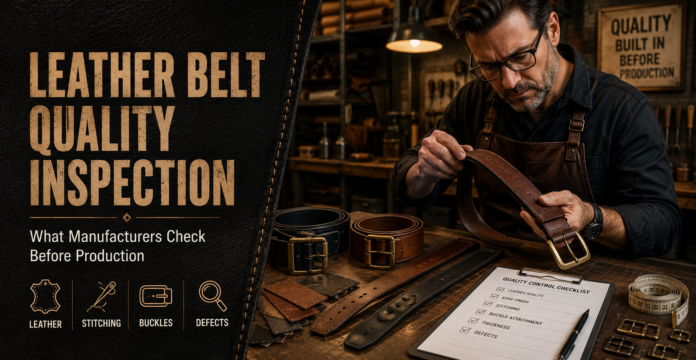
Leather belt quality inspection is the process manufacturers use to check leather, hardware, stitching, sizing, finishing, and construction before belts move into full production. These checks help factories find problems early, when they are still easier and cheaper to correct. A good inspection system also helps keep every belt in a production order close to the approved sample.
Leather belts may look simple, but many small details affect their strength, appearance, comfort, and useful life. Leather thickness can change from one hide to another, buckle plating can vary, holes can be placed incorrectly, and edges can become rough during cutting. For this reason, manufacturers usually inspect both materials and production details before approving a bulk order.
Why Leather Belt Quality Inspection Starts Before Bulk Production
A strong leather belt quality inspection process begins before large quantities are cut. Manufacturers first compare incoming leather, buckles, rivets, thread, lining materials, labels, and packaging with the approved specification. This early check reduces the risk of discovering a major material problem after hundreds or thousands of belts have already been produced.
Factories producing different leather belts may use different inspection standards depending on the belt design and intended use. A slim fashion belt does not face the same stress as a heavy work belt. However, both products still need consistent leather, secure hardware, correct sizing, clean edges, and an acceptable surface appearance before production continues.
Leather Belt Quality Inspection of Leather Type and Grade
The leather itself is one of the first materials checked because it affects almost every part of the finished belt. Inspectors confirm the leather type, grain, thickness, temper, color, surface condition, and overall feel. They also look for deep scars, loose grain, holes, cracks, weak sections, large wrinkles, or other defects that could affect the final product.
For products such as a full-grain leather belt, natural grain variation is expected and should not always be treated as a defect. The goal of leather belt quality inspection is usually consistency rather than making natural leather look completely artificial. Manufacturers select usable areas of each hide and avoid placing serious defects in highly visible or high-stress areas.
Checking Leather Thickness, Strength, and Flexibility
Leather thickness must remain within the range required by the product specification. If the leather is too thin, the belt may feel weak or stretch too quickly. If it is too thick, the belt can become stiff, heavy, and difficult to pass through normal belt loops. Manufacturers may measure several areas because natural hides are not always equally thick from edge to edge.
Leather belt quality inspection also considers flexibility and basic strength. Inspectors may bend the material to see whether the finish cracks or creates an unusual surface line. They may pull or flex sample strips to identify weak leather. For working products such as a leather tool belt, greater attention may be given to load-bearing areas because the belt can carry tools and experience more repeated stress.
Color, Grain, Surface, and Finish Inspection
Color consistency is important when many leather belts are produced for the same order. Natural leather can show small shade differences, but strong differences between belt straps can make an order look uneven. Manufacturers compare production leather with an approved color reference under suitable lighting before cutting a large quantity.
During leather belt quality inspection, the surface finish is also examined for scratches, stains, unwanted marks, uneven coating, excessive gloss, dull areas, or poor dye coverage. Inspectors check whether the finish suits the agreed product style. A matte belt, for example, should not randomly contain highly glossy areas unless natural variation is part of the approved design.
Cutting Accuracy and Belt Strap Dimensions
Accurate cutting gives the belt its basic shape. Manufacturers check strap width, overall length, end shape, tip design, leather direction, and cutting cleanliness. A cutting die, strap cutter, or automated cutting system must produce pieces that stay within the accepted measurement tolerance. Small cutting errors can become very visible when several belts are displayed together.
Leather belt quality inspection at this stage also helps prevent wasted material. Inspectors check whether cutters are avoiding weak or badly damaged sections of a hide. They also make sure the strap does not contain unwanted curves or uneven edges. A poorly cut strap can create problems later during edge painting, stitching, hole punching, buckle attachment, and final measurement.
Buckles, Rivets, Snaps, and Other Hardware
Hardware inspection is essential because even high-quality leather cannot make up for a weak buckle. Manufacturers normally examine buckle size, shape, material, finish, plating, pin movement, and attachment points. They also look for sharp edges, rough surfaces, scratches, discoloration, weak welds, or plating defects that can reduce the quality of the finished product.
Leather belt quality inspection should also cover rivets, snaps, Chicago screws, D-rings, keepers, eyelets, and other metal parts used in the design. Hardware should fit the leather thickness correctly and remain secure after assembly. Manufacturers may carry out simple pull, movement, or repeated-use checks to find loose components before the main production run begins.
Stitching, Edge Finishing, and Construction Checks
Stitched leather belts require careful control of stitch length, thread tension, seam position, thread color, back-tacking, and overall stitching appearance. The line should remain straight and should not move too close to the belt edge. Skipped stitches, broken thread, loose loops, large needle holes, and uneven stitch spacing can lower both strength and appearance.
Edge quality is another major part of leather belt quality inspection. Depending on the product, belt edges may be painted, burnished, folded, polished, waxed, or left with a controlled raw finish. Inspectors check for rough fibers, paint overflow, cracking, uneven layers, sticky surfaces, exposed lining, and sharp corners. Good edge work often makes a major difference in how professional the finished belt looks.
Important Leather Belt Quality Inspection Points
Manufacturers can use a clear checklist during leather belt quality inspection so important details are not missed. The exact limits may change by buyer, leather type, belt style, and price level, but the basic checks often remain similar throughout production.
- Check that leather type matches the approved specification.
- Confirm leather thickness is within the allowed tolerance.
- Inspect grain, scars, wrinkles, scratches, and surface defects.
- Compare leather color with the approved color reference.
- Check strap width and length before assembly.
- Confirm belt tip shape and cutting accuracy.
- Inspect buckle finish, movement, and attachment strength.
- Check rivets, snaps, screws, and other hardware.
- Inspect stitching for straightness and proper tension.
- Check painted, polished, or burnished edges.
- Measure buckle position and keeper placement.
- Confirm the number and spacing of belt holes.
- Check logo, embossing, printing, and label position.
- Test basic bending and repeated buckle movement.
- Inspect finished belts for stains, glue marks, and scratches.
- Confirm packaging matches the buyer’s requirements.
Belt Holes, Sizing, and Measurement Accuracy
Sizing problems can make a well-made belt difficult to use. Manufacturers usually measure the total strap length, buckle-to-center-hole length, hole spacing, hole diameter, buckle length, strap width, and keeper position. Leather belt quality inspection should follow one agreed measuring method because different measurement methods can create confusion between the factory and buyer.
Hole punching also requires consistency. Holes should remain centered on the strap and should have clean edges without serious tearing. The distance between holes should remain even unless the design requires something different. Inspectors also confirm that the stated belt size matches the agreed specification instead of relying only on a printed size label.
Logo, Embossing, Labels, and Branding Details
Branding can include debossed logos, embossed marks, laser engraving, metal logo plates, printed information, woven labels, size markings, or private-label packaging. During leather belt quality inspection, the manufacturer checks the position, size, spelling, depth, alignment, and clarity of these details against an approved sample or artwork.
Leather can react differently to heat and pressure, so embossing may look deeper on one area and lighter on another. Manufacturers normally test the branding method before bulk production to establish suitable settings. Labels and marks should also be placed where they do not create discomfort, interfere with buckle movement, or damage the appearance of the belt.
Pre-Production Sample and Production Approval
A pre-production sample gives the manufacturer and buyer a physical reference before bulk manufacturing begins. It should represent the approved leather, buckle, construction, dimensions, color, branding, stitching, edge finish, and packaging as closely as possible. leather belt quality inspection becomes easier when inspectors have an approved reference instead of depending only on written instructions.
Once the sample is approved, the factory can create production instructions and tolerance limits for the operators and quality team. These documents reduce personal interpretation on the production floor. They also help different departments understand which details are critical, which natural leather variations are acceptable, and which defects require correction.
In-Line Inspection During Leather Belt Manufacturing
Quality inspection should not be limited to the finished product. In-line inspection checks belts while cutting, skiving, gluing, stitching, edge finishing, hole punching, buckle attachment, branding, and other production operations are taking place. Finding a mistake early prevents the same problem from being repeated across the full order.
During leather belt quality inspection, inspectors may select pieces from the production line and compare them with approved specifications. If the hole position begins moving, the edge paint becomes uneven, or the buckle attachment becomes loose, the production team can adjust the process before a large quantity is affected. This makes quality control more practical and efficient.
Final Inspection Before Packing and Shipment
The final leather belt quality inspection checks whether completed belts are ready for packing. Inspectors review the overall appearance and look for scratches, stains, glue marks, uneven color, damaged edges, loose hardware, stitching problems, wrong labels, incorrect sizes, and poor finishing. Measurements may also be checked again on selected units.
Finished belts should be clean and correctly shaped before packaging. Manufacturers may also confirm barcode information, polybag size, hangtags, carton quantities, assortment ratios, carton markings, and other packing instructions. Final inspection cannot replace good production control, but it helps prevent visible problems from reaching the customer.
Conclusion
Leather belt quality inspection helps manufacturers control leather quality, measurements, hardware, stitching, edge finishing, branding, and final appearance before products are shipped. Checking materials before production and monitoring belts during manufacturing can reduce defects and improve consistency. A clear inspection system also gives buyers and manufacturers a shared standard for deciding what is acceptable in each production order.
FAQs
What is leather belt quality inspection?
Leather belt quality inspection is the process of checking leather, measurements, hardware, stitching, finishing, branding, and construction to confirm that belts meet approved requirements.
Why is leather inspected before belt production?
Leather is checked before production to find thickness differences, serious scars, weak areas, shade variations, surface damage, and other problems before the material is cut.
What defects are commonly checked in leather belts?
Common checks include scratches, stains, uneven color, rough edges, incorrect holes, loose buckles, weak rivets, poor stitching, wrong measurements, and incorrect branding.
Does leather belt quality inspection happen only after production?
No. Good quality control usually includes incoming material inspection, pre-production checks, in-line production inspection, and a final inspection before packing.