Choosing the right fabric for gym tank tops has several downstream implications. It influences how well the garment moves and holds up to the rigor of repeated use. It also plays a considerable role in how the wearer feels when exercising with you.
The choice isn’t about which fabric is better, but rather which one aligns better with your client, training setting, and brand. This guide covers the options clearly so you can know exactly the fabric for gym tank tops you’re using for your upcoming collection.
What GSM Weighs in for Fabric for Gym Tank Tops
Weight matters in tank fabric for comparisons, so here’s how tank fabric GSMs break down. Fabric weight GSM refers to how many grams of fabric fill a square of one by one meter.
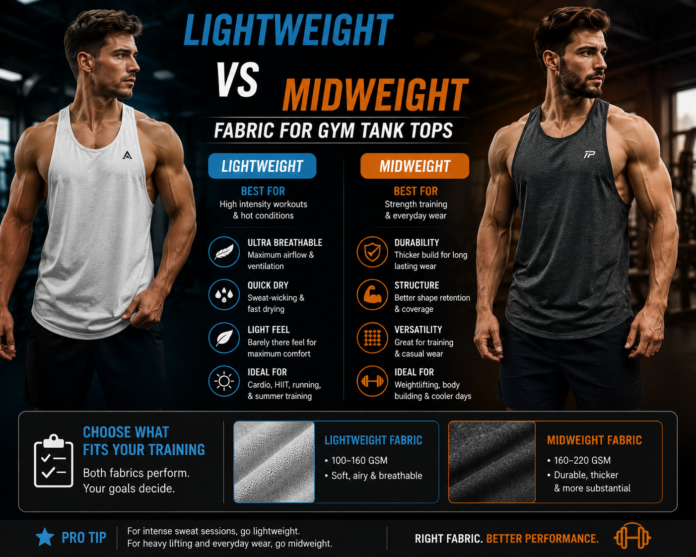
For gym tank fabrics, lighter options are in the 100 to 150 GSM range. Midweight fabrics range from 150 to 220 GSM. The GSM rating impacts how the fabric of gym tank tops holds and how the fabric moves during and after any physical activity.
However, considering the GSM alone presents an incomplete picture. The fiber used, the type of knit, and the type of finish used affect the fabric’s performance as much as the weight of the fabric. Therefore, a thorough evaluation of a fabric sample should not be limited to just the GSM.
Tank Tops That Stay Cool
Why Lightweight Fabric for Gym Tank Tops Shines in HIIT
Tank tops made from lightweight fabric shine in training and hot weather. Fabric that is thin and breathable helps move through every plane in the gym as the body moves. Customers who prefer HIIT sessions, cardio circuits, or outdoor runs use lighter fabrics to help prevent the tops from trapping body heat while they put in the effort.
Lightweight fabric options include:
- Polyester mesh and open-knit constructions at 100-130 GSM: These lightweight fabrics have small gaps in the knit structure to help airflow and prevent heat and moisture. They are extremely lightweight and cause discomfort. They are designed as high output training apparel where the color design and the open structure assist in content and customer visualization.
- Recycled polyester blends at 110-140 GSM: Fabrics that have the technical capacity of active fabrics help provide softer and lighter designs while helping the structure. These assist the marketing position in the sustainable fabrics section of active apparel and provide high performance and responsibility apparel for training.
Drawbacks of Lightweight Fabric for Gym Tank Tops
Lightweight fabrics have some drawbacks worth considering. A fabric with a weight under 120 GSM often feels flimsy and cheap to the average customer, who equates a heavier fabric with better value. Some lightweight fabrics may become a bit transparent when stretched. While some customers may not mind this, it often results in a higher rate of return due to their discomfort.
Lightweight fabrics provide less structural support around necklines and armholes. Without careful placement of the pattern pieces, these gaps will shift during movement and are often cited as a major fit complaint.
Midweight Fabric for Gym Tank Tops
Premium Feel of Midweight Fabric for Gym Tank Tops
Midweight fabrics provide a premium feel for both the designer and the customer, as they have a greater weight and structure, are more durable, and maintain their shape better after repeated wash and wear. They also sit more confidently on the body, adding to the overall comfort, and appeal to customers desiring a gym tank that can be worn throughout the day.
Here are some of the most commonly used midweight fabrics:
- Cotton-polyester blends at 160–200 GSM: This blend works for the relaxed natural cotton layering with the durable polyester. Functional but relaxed gym wear aligns with training aesthetics, making this fabric ideal for brands building relaxed gym wear collections. This contrasts with a purely technical and performance identity.
- Nylon-spandex blends at 150–180 GSM: This fabric offers great stretch recovery and smooth surfaces with colorfastness. It fits structured tank silhouettes, especially racerback styles. When choosing fabrics for their premium fitness apparel collections, brands gravitate towards this fabric because of the performance and quality perception.
[Image Placement: A model in a gym lifting with the load supported by a nylon-spandex gym tank top]
Alt Text: Midweight nylon spandex fabric for gym tank tops worn during training showing structured systems fit for use
Where Midweight Fabric for Gym Tank Tops Falls Short
Midweight fabrics at gyms or tank tops are not suitable for every training context. In environments featuring intense activity like hot yoga studios or outdoor summer training, midweight fabric traps more body heat than lightweight options. For customers who overheat easily, these fabrics will be uncomfortable for extended period of use.
Midweight fabrics are more expensive than lightweight fabrics, affecting the unit’s economics. This is vital when brands launch collections constrained by budget and low minimum order quantity (MOQ).
How to Choose the Right Fabric for Gym Tank Tops
Choosing fabric involves four questions:
Who is your customer and how do they train?
High-intensity, heat-generating workouts need lightweight fabric for gym tank tops. Midweight fabric suits moderate-intensity workouts and lifestyle training. For an audience that spans both, consider multiple styles in a collection by offering various weight categories in the same collection.
What is your brand positioning?
Brands that are focused on function while training gravitate towards lightweight fabrics while brands in the lifestyle space gravitate towards midweight fabrics or heavier fabrics of better quality or ‘substance’ and ‘handfeel’.
What silhouette are you building?
Light fabrics naturally incorporate drape and movement necessary for loose, dropped-armhole tanks. Midweight fabrics hold close-fit shapes and movement cleanly which suits fitted racerbacks and tanks. Brands wishing to expand their functional range offering midweight fabrics for coordinating sets should consider how their tank fabric choices pair visually and functionally with bottom weights.
What does your production model need?
Lightweight fabrics are easier to cut and sew at lower quantities as opposed to midweight which may require more careful cutting to avoid distortion. Both factors should be discussed with your manufacturer before finalizing your fabric for gym tank tops choice.
Fabric for Gym Tank Tops Across Your Broader Range
In an activewear line, tank tops often pair with shorts, joggers, and hoodies. Therefore, your choices related to fabric weight for tanks will have an impact on how the full range functions and coordinates.
For a cohesive high-performance look, a lightweight mesh tank and a lightweight woven short can pair well. A midweight structured tank will pair better with heavier joggers or premium French terry hoodies. For this reason, your fabric selections for gym tank tops should be a part of your overall range strategy, rather than an independent selection.
Final Thoughts
The correct fabric for gym tank tops will match your customer’s training, your brand’s visual identity, and your production strategy. For high-intensity training, the fabric should be lightweight, as they are more breathable and allow greater movement. A midweight fabric will offer more structure and be more versatile for use in other situations. These attributes are perceived as higher quality, probably due to their greater versatility.
To be successful, most activewear brands target both weight ranges across their tank top offering. Your short term focus should be on offering the weight range that most closely meets your core customer’s needs, with the other weight range added as your customer base and understanding is more developed.
FAQs
What is the best fabric for gym tank tops in terms of GSM?
For the most intense training, lightweight fabrics in the range of 100–150 GSM will be the best option. Midweight fabrics in the 150–220 GSM range will be more suited to lifestyle gym use and lower intensity training, and will be perceived to be of higher quality.
Is polyester or nylon better as fabric for gym tank tops?
Both options work well. But polyester is cheaper and has better moisture management. Nylon tank tops have a nicer feel, better stretch, better color retention, and are great for premium tank tops.
Can lightweight fabric for gym tank tops look cheap?
Lightweight fabrics can look cheap if they have low GSM and/or a poor knit. But with a proper construction and a GSM of 120–150, lightweight fabrics can look great and perform durably, especially when designed as a technical mesh for high-intensity training.
What fabric for gym tank tops works best for a racerback silhouette?
For a racerback style, 150–180 GSM nylon-spandex blends work great as they provide enough body for a clean and dynamic fitted silhouette without the extra weight.
How does fabric weight affect gym tank top production costs?
For medium-weight fabrics, the cost difference between lightweight and medium-weight is usually not as significant as the GSM numbers suggest, as they often require fewer finishing steps to achieve a good look.