Choosing a properly fitted motorcycle riding jacket is a core prerequisite for balancing riding safety and comfort: it can provide protection in the event of an accident while also ensuring unimpeded movement. This guide will explain in clear detail the fit standards for motorcycle jacket fit guide riding jackets, to build a solid safety foundation for every ride.
Why a Proper Fit is Non-Negotiable
The fundamental nature of a motorcycle jacket fit guide riding jacket is that of specialized protective gear, and it is by no means merely a fashion item. If a jacket is overly loose, its protective pads will shift away from the joints during a collision and lose their protective function; at high speeds, the fabric will catch wind and interfere with the rider’s operation of the vehicle; and when the rider skids along the ground, the jacket can also cause dangerous friction. Conversely, if a jacket is too tight, it will restrict limb movement and make it difficult to control the motorcycle.
The Golden Rule: Test the Fit in Your Riding Position
This is the most important piece of advice in all motorcycle riding suit fitting guides: do not assume that a riding suit that feels perfectly comfortable to wear while you are standing up is a good fit. Once you sit on your motorcycle jacket fit guide, it may cause discomfort and even create safety hazards. All riding suits are designed for the forward-leaning riding posture. Sport and racing variants are even equipped with pre-curved sleeves and a torso cut that is shorter at the front and longer at the back. When you try on a riding suit, you must mimic the riding posture. It is best to sit on your own motorcycle for the fitting.
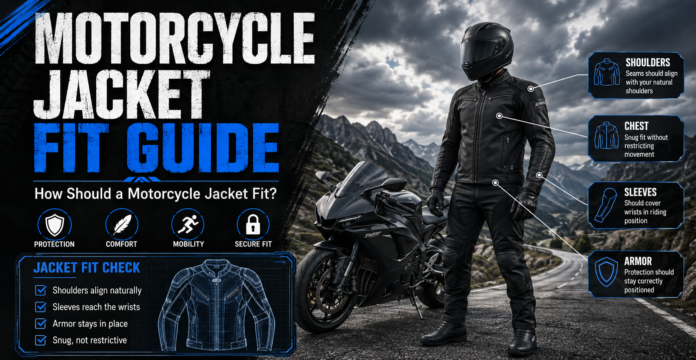
Key Fit Areas: A Checklist
This motorcycle jacket fit guide recommends checking these critical areas to ensure a proper fit.
- Shoulders: The shoulder seams should sit right at the edge of your shoulders. This is the anchor point for the entire jacket. If the seams hang off your shoulders, the jacket is too big. If they pull inward, it is too small and will restrict your arm movement.
- Chest and Torso: When zipped up, the jacket should feel snug around your chest and torso without being constricting. You should be able to take a deep breath comfortably.
- Sleeve Length: When in your riding position with arms extended, the sleeves must be long enough to cover your wrists and meet your gloves. If the sleeves ride up too far, your skin can be exposed in a crash.
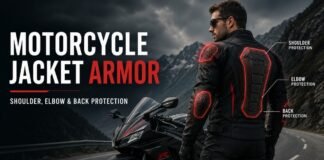
- Armor Placement: CE-rated armor should stay firmly in place over your joints. When you move into your riding position, the elbow armor should remain centered, and the shoulder armor should cap your shoulders without shifting.
- Jacket Length: The jacket should be long enough to overlap with your riding pants, especially at the back. When you lean forward, your lower back must remain covered.
Snug vs. Tight: Finding the Balance
When shopping for a motorcycle jacket fit guide riding jacket, the most common question everyone asks is: how tight is too tight? A new leather jacket should fit slightly snug when you first buy it, as it will stretch by 0.5 to 1 inch after use. A fabric jacket, by contrast, must fit properly right out of the box, with no need to leave extra room for stretching. The ideal fit feels like a firm handshake. If the motorcycle jacket fit guide pinches your skin or makes you feel numb when you move, it is too tight.
Material and Layering Considerations
The choice of material for a motorcycle jacket fit guide—whether leather or textile fabric—directly determines the required fit: leather is more wear-resistant but requires a long break-in period, so it must be purchased in a size that is smaller and tighter than the body’s natural measurements; textile fabric has good flexibility, and some variants come with waterproof features, so a slightly looser size can be selected. It is essential to try on the riding suit while wearing the inner layers that are normally used for daily riding; for winter models, sufficient space must be reserved for thermal liners.
Popular Styles and Their Fits
Different styles of motorcycle jacket fit guide are designed to match different riding postures, and the compatibility of a jacket’s cut directly affects its fitting effect.
Racing sport-style jackets are made for the aggressive forward-leaning riding posture. They use pre-curved arm cuts, and a body cut that is shorter in the front and longer in the back. With a tight, snug fit, these motorcycle jacket fit guide can keep built-in protective gear stable during high-speed riding.
Touring and adventure-style jackets suit the upright riding posture. They reserve space for layering clothes underneath, are equipped with multiple pockets, and have an overall loose cut. Their waist edges, cuffs, and necklines are all adjustable to ensure the motorcycle jacket fit guide stays secure on the wearer.
Cruiser retro-style jackets match the relaxed riding posture. They use a classic loose cut and thick leather materials. Per the requirements of motorcycle riding jacket fitting guidelines, this type of motorcycle jacket fit guide still needs to feature properly aligned shoulders, stay fixed on the wearer’s body, and not restrict movement.
Why Choose Premium Jackets for the Best Fit
Choosing a high-quality jacket ensures you get the best design for safety and comfort. Premium jackets feature precise construction with attention to fit details like articulated sleeves and adjustable closures. Top-tier motorcycle jacket fit guide, including the leather biker jacket from Eco Jersey, use 100% genuine cowhide with action shoulders and back panels that allow full movement while maintaining a secure fit.
Features That Enhance Fit and Comfort
The core design of modern motorcycle jacket fit guide is to help wearers achieve a suitable fit through various built-in functions: waist belts and cuff buckles allow fine adjustment of the fit, stretch fabric panels at key areas balance flexibility and protection, and detachable liners adapt the jacket for use across different seasons. The biker jacket men from Eco Jersey features ribbed cuffs that insulate warmth and block wind while helping the jacket stay securely in place during rides.
Fit Considerations for Women Riders
Female riders require exclusive riding jackets that fit their body shapes. Such motorcycle jacket fit guide must fit closely around the waist and hips, accommodate chest circumference, align shoulder lines accurately, and have sleeve lengths suited to women’s arm proportions. Below, we introduce styles that balance both aesthetic appeal and practical functionality. the brown biker jacket womens offers a cropped oversized design that creates a flattering silhouette while providing all-day comfort and freedom of movement.
How to Test Your Jacket’s Fit
Before purchasing a cycling jacket, you can check its fit through a few simple tests: First, extend your arms forward to mimic holding handlebars, and check if the sleeves are long enough; second, raise both hands above your head to confirm the motorcycle jacket fit guide does not slide upward excessively from the waist; third, perform a bending and twisting motion to check if the built-in protective pads shift out of place; last, take a deep breath and make sure the jacket does not feel tight across the chest and back. If you pass all these tests, you can confirm that the jacket has a proper fit.
Common Fit Mistakes to Avoid
Even if you are an experienced motorcycle jacket fit guide, it is still easy to make mistakes when choosing a riding jacket. Do not pick an overly loose jacket just to fit inner layers; instead, prioritize using the adjustment features built into the jacket itself. Never overlook sleeve length, and never compromise on the fit of the shoulders. Always prioritize functionality over fashion sense. If you follow this fit guide, you can avoid these common mistakes.
Frequently Asked Questions
How should a motorcycle jacket fit when standing vs. riding?
When standing, a motorcycle jacket will often feel snug, especially a leather one designed for sport riding. This is normal. The true test is in the riding position, where it should feel comfortable and the armor should stay in place.
What is the best material for a motorcycle jacket?
Leather offers the best abrasion resistance for maximum protection. Textile jackets are more versatile, often offering better weather protection and breathability. The best choice depends on your riding style and climate.
How do I know if my motorcycle jacket is too big?
A jacket is too big if the shoulder seams hang off, the armor shifts when you move, or there is excess material that bunches up and could flap at speed. It will feel loose and billowy.
How do I know if my motorcycle jacket is too small?
A jacket is too small if it restricts your breathing, causes pressure points, or limits your arm movement, especially when reaching for the handlebars. It will feel painfully tight, not just snug.