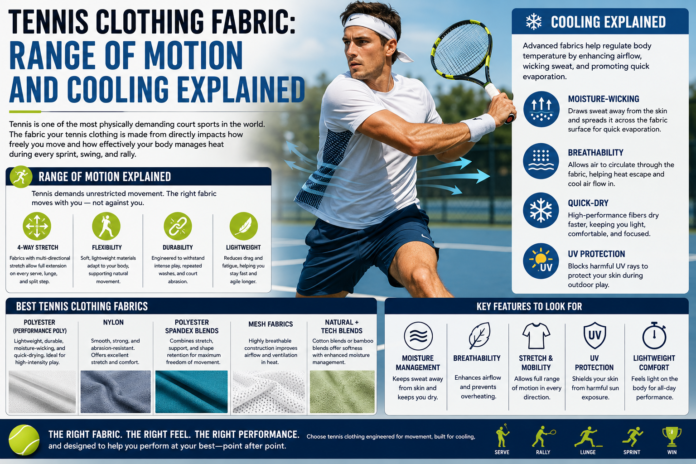
Tennis is one of the most physically demanding court sports in the world. Explosive lateral movement, overhead serving, rapid direction changes, and sustained rallies across multiple sets — all in direct sunlight on hard, clay, or grass surfaces. The fabric your tennis clothing is made from directly impacts how freely you move and how effectively your body manages heat during all of it. Understanding tennis clothing fabric helps brands build performance collections that serious players genuinely notice — and helps players make informed choices about the gear they compete in.
Why Fabric Choice Matters Specifically in Tennis
Tennis places two simultaneous demands on clothing that few other sports combine so intensely — complete freedom of movement in every direction alongside aggressive cooling during sustained high-intensity effort in outdoor heat.
A serve requires full shoulder rotation and overhead extension. A wide forehand demands complete hip and torso rotation. A split-step recovery demands unrestricted leg movement in multiple directions simultaneously. All of these movements happen repeatedly across matches lasting anywhere from one hour to five — and throughout that time body temperature rises continuously if clothing doesn’t manage heat effectively.
Fabrics that restrict movement reduce stroke mechanics quality and injury risk simultaneously. Fabrics that trap heat accelerate fatigue and reduce decision-making quality during critical match moments. The right tennis clothing fabric serves both demands simultaneously — and that combination requirement is what makes tennis apparel genuinely different from casual sportswear that looks similar but performs inadequately under competitive conditions.
Polyester Moisture-Wicking Fabrics — The Performance Foundation
Moisture-wicking polyester forms the foundation of virtually every serious tennis garment manufactured today. Engineered fiber cross-sections create capillary action that pulls perspiration from skin contact surfaces toward the outer fabric face — where airflow and evaporation remove moisture rapidly and continuously throughout intense match play.
This active moisture management keeps skin drier than passive absorption fabrics — reducing the heat retention that sweat accumulation causes and maintaining the lighter garment weight that soaked fabric would otherwise create during sustained physical effort.
High-performance polyester constructions used in professional tennis apparel incorporate advanced fiber geometries — cross-shaped, Y-shaped, and multi-channel fiber cross-sections — that significantly increase surface area per fiber weight, creating faster and more efficient moisture transfer than standard round-cross-section polyester fibers achieve.
Elastane and Spandex Blends — Movement Freedom
Pure polyester fabrics provide limited stretch — adequate for casual movement but insufficient for the explosive multi-directional athletic demands that competitive tennis imposes across every point. Adding elastane — typically 8% to 20% of total fabric composition — transforms polyester performance fabrics into stretch materials that move freely with athletic body positions.
Four-way stretch constructions allow simultaneous stretch in horizontal and vertical directions — critical for the multi-directional movement that tennis requires constantly. The elastic recovery of quality elastane blends ensures garments return to their original shape after each movement — maintaining correct fit and appearance throughout three or five-set matches rather than progressively losing shape as stretch fabrics without recovery properties do under sustained athletic stress.
Stretch fabric performance particularly matters at the shoulder seams of tennis shirts and at the hip and thigh areas of tennis shorts and skirts — the specific anatomical areas where movement restriction directly impacts stroke mechanics and court movement quality during competitive play.
Mesh Panels and Ventilation Zones — Targeted Cooling
Strategic mesh panel placement addresses the limitation that even the most breathable solid performance fabrics encounter during intense tennis play — the highest body heat generation zones require airflow rates that fabric breathability alone cannot achieve during sustained maximum-intensity effort.
Underarm mesh panels allow direct airflow into the highest perspiration zones during serving and overhead stroke movements. Back ventilation panels release accumulated heat from the largest continuous body surface area during baseline rallying. Side panels allow lateral airflow across the torso during the rapid direction changes that net play and baseline movement create.
Quality sportswear manufacturers position mesh panels based on physiological heat mapping — placing ventilation precisely where cooling benefit is highest rather than distributing mesh arbitrarily across garments for aesthetic effect without performance justification.
UV Protection Fabrics — Sun Safety for Outdoor Play
Outdoor tennis exposes players to significant UV radiation across match and practice duration — particularly on hard courts where surface reflection adds UV exposure to direct overhead radiation. UPF-rated tennis fabrics provide verified sun protection that standard performance fabrics without specific UV treatment cannot guarantee regardless of their technical performance in other areas.
UPF 30 blocks approximately 96.7% of UV radiation — adequate for moderate sun exposure during shorter practice sessions. UPF 50+ blocks 98%+ — recommended for competitive match play and extended practice sessions in high-UV environments where cumulative sun exposure across a tennis season creates meaningful long-term skin health risk.
Tightly woven performance fabrics combined with UV-absorbing fiber treatments create UPF-rated constructions that maintain protection performance across regular washing and extended garment use — unlike sunscreen that requires constant reapplication during physical activity.
Lightweight and Quick-Dry Properties — Match-Long Comfort
Tennis matches extend across unpredictable durations — a three-set match can last anywhere from 90 minutes to over three hours depending on conditions and competition level. Fabrics that maintain comfortable dry weight across this extended duration perform significantly better than alternatives that become heavy with accumulated moisture as match duration extends.
Quick-dry polyester constructions recover from thorough wetting within minutes under outdoor conditions — maintaining comfortable garment weight even when perspiration rates are highest during decisive match sets where physical and mental intensity reaches its peak simultaneously.
Lightweight fabric constructions — typically 120 to 160 gsm for tennis shirts and 130 to 180 gsm for tennis shorts — minimize the total weight burden that clothing adds to athletic movement — allowing players to focus entirely on ball and court rather than managing the discomfort that heavier, moisture-laden garments create during extended competitive play.
Fabric Technology Across Different Tennis Garments
Different tennis garment types apply these fabric principles with specific construction emphasis matching each piece’s movement and performance requirements.
Tennis shirts prioritize moisture management, stretch through the shoulder and back, and ventilation through strategic mesh placement — serving the upper body cooling and freedom demands that serving and groundstroke mechanics create continuously throughout match play.
Tennis shorts prioritize four-way stretch through the hip and thigh, lightweight construction that doesn’t restrict split-step movement, and secure pocket construction for ball storage that doesn’t interfere with lateral movement patterns during active points.
Tennis skirts and dresses combine these requirements with modesty considerations — built-in compression shorts beneath outer skirt layers providing coverage security during the athletic movements that competitive female tennis play creates across all court surfaces and match formats.
Badminton apparel applies similar fabric principles — the fast-twitch explosive movement demands of badminton create comparable stretch and cooling requirements that quality racket sport performance fabric construction addresses with equivalent technical sophistication.
Choosing the Right Fabric for Your Tennis Collection
Building a successful tennis apparel collection requires matching fabric specifications to performance demands at each price tier — and communicating performance credentials clearly enough that serious players recognize the quality difference between technical performance construction and casual sportswear aesthetics without genuine performance substance.
Working with a professional sportswear manufacturer who sources verified performance fabrics — with moisture management testing data, stretch recovery specifications, and UV protection ratings — ensures your tennis collection delivers the performance promises that serious players evaluate through actual court use rather than simply marketing claims.
Conclusion
Tennis clothing fabric directly impacts stroke mechanics, court movement quality, heat management, and match-long comfort in ways that casual sportswear never genuinely delivers. Moisture-wicking polyester manages perspiration. Elastane blends enable movement freedom. Strategic mesh panels provide targeted cooling. UV protection keeps players healthy. Lightweight quick-dry constructions maintain comfort across long matches. Understanding how each fabric property serves tennis performance specifically helps brands build collections that serious players trust — and helps players choose gear that genuinely supports their best tennis across every competitive situation.
FAQs
What fabric percentage of elastane works best for tennis clothing?
Most quality tennis garments use 8% to 15% elastane content — providing meaningful four-way stretch and recovery without compromising the moisture management performance that higher elastane percentages can reduce in some fabric constructions.
Does fabric weight affect tennis performance significantly?
Yes. Lighter fabrics between 120 and 160 gsm for shirts reduce the weight burden of accumulated moisture during extended match play — maintaining comfortable garment weight through long matches where heavier constructions become noticeably burdensome as perspiration accumulates.
Is UV protection important in tennis clothing fabrics?
Absolutely. Outdoor tennis creates significant cumulative UV exposure across practice and match play — UPF 50+ rated fabrics provide meaningful long-term skin health protection that regular performance fabrics without specific UV treatment cannot guarantee reliably.
Can tennis apparel collections be produced under a private label?
Yes. Professional sportswear manufacturers offer complete private label tennis apparel production with verified performance fabrics, custom designs, colors, labels, and packaging — giving sports brands full creative and commercial control over their tennis collection.