Whether you’re looking to launch a clothing brand or expand an existing one, a big decision you will have to make is how do I get my clothes manufactured?
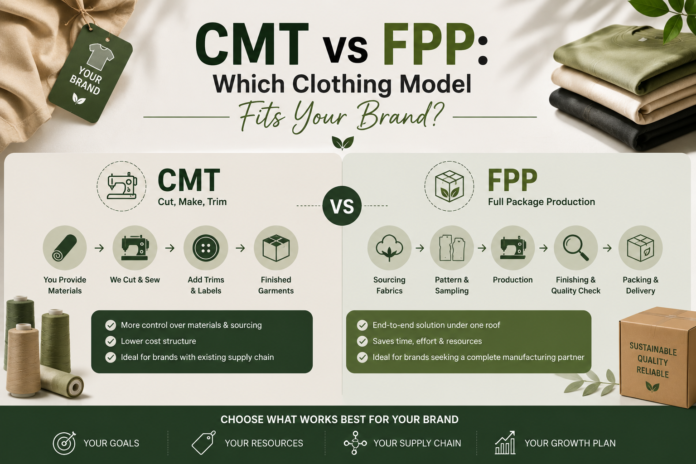
Cut, Make & Trim (CMT) and Full Package Production (FPP) are two common methods of production. CMT and FPP are both great methods of production, but you should be careful in choosing which one to go with. Choosing the wrong one can cost your brand a lot of time, money, and unnecessary headaches.
This guide will help you identify which method is appropriate for you by breaking both of them down and doing an honest comparison.
What Does CMT Mean?
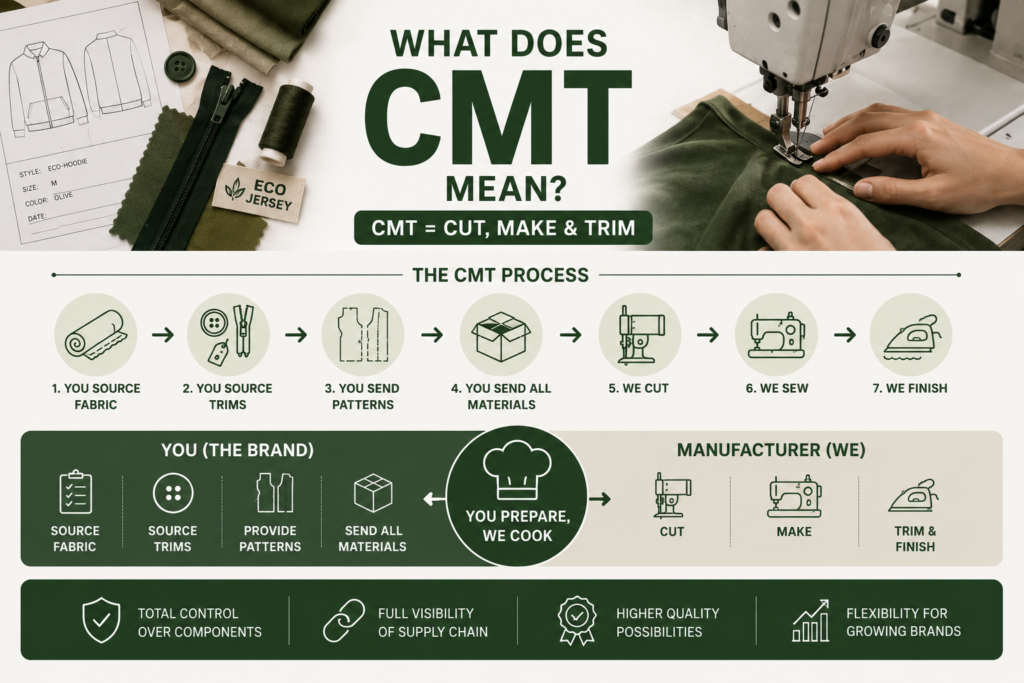
CMT is the abbreviation for Cut, Make & Trim.
With the CMT method, the brand is in charge of all the sourcing, whether that be the sourcing of the fabric, the sourcing of the trims (which can include the sourcing of buttons, zippers, labels, threads, etc.), or the sourcing of the patterns. After everything is sourced, the brand will send all of the pieces to the manufacturer. The manufacturer will only cut the fabric, sew the pieces together, and do the finishing touches.
Think of it as the brand is in charge of meal prep, and the manufacturer is in charge of the cooking.
With this method, you have total control of the garment components, but you have to put in more of the work.
If you are interested in the CMT method, Eco Jersey has a CMT clothing manufacturing service designed for the brands that care most about control of the supply chain.
Meaning of FPP
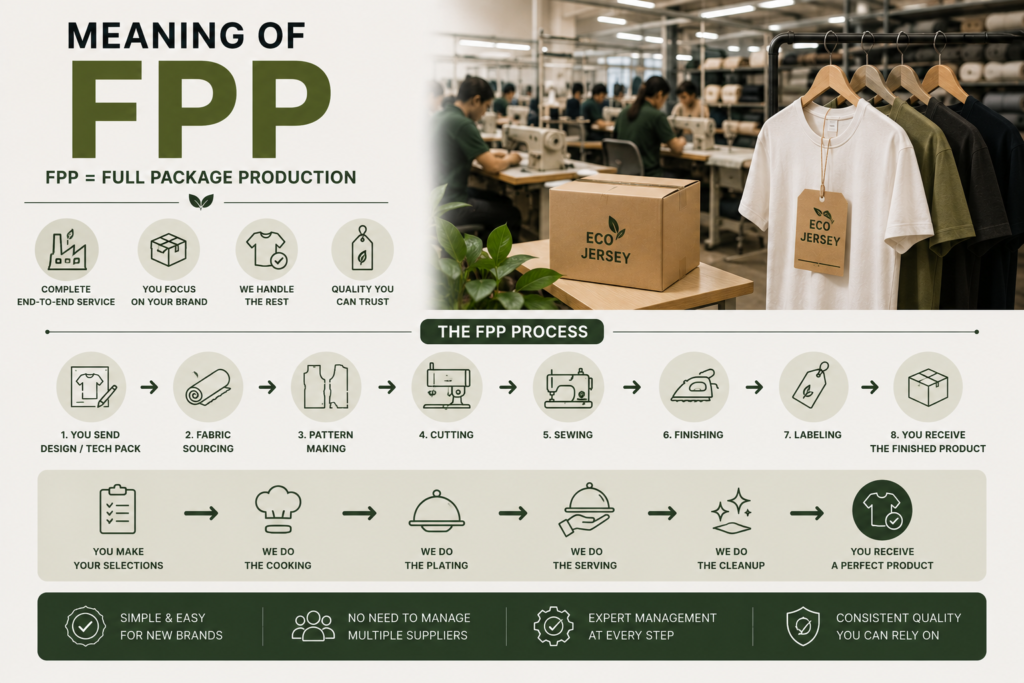
FPP means Full Package Production.
Under this arrangement, the factory handles the entire process, from start to finish. You send the factory the design idea or the tech pack, and the factory takes care of the fabric sourcing, the patterns, the cutting, the sewing, the finishing, and the labeling. You simply receive the completed product.
You can think of this as being similar to the way a restaurant operates. You make your selections, and then the restaurant takes care of the cooking, the plating, the serving, and the cleanup.
This approach is much easier for a new brand or business that lacks a deep understanding of fabric sourcing and supply chains.
Eco Jersey’s FPP apparel manufacturing service is perfect for brands seeking a complete end-to-end service solution without the hassle of dealing with multiple suppliers.
CMT vs. FPP: Side by Side Overview
| CMT | FPP | |
|---|---|---|
| Who sources the fabric? | You (the brand) | The factory |
| Who sources the trims? | You (the brand) | The factory |
| Control | Very high | Moderate |
| Effort required from brand | High | Low |
| Is this option good for beginners? | Not always | Yes |
| Is this option good for experienced brands? | Yes | Yes |
| Are the per unit costs better? | Can be | Slightly higher |
| Time to production | Longer (sourcing phase) | Faster |
When to Use CMT?
You can use CMT if:
- You have established relationships with fabric suppliers
- You have a preferred fabric or material
- You want to maintain control and visibility of every component of your product
- You’re operating a sustainable apparel brand and want to make sure the source of your eco-friendly materials
- You have a knowledge of garment production and the supply chain
CMT is for brands that want to have full visibility and control over their production and the sourcing of materials. This option is best for brands who have the time and knowledge of the manufacturing process and have connections to reliable suppliers.
When Should You Choose FPP?
FPP is a good option if:
- You are starting your first clothing line
- You prefer designing and branding over worrying about supply chain logistics
- You don’t have the time needed to deal with multiple suppliers
- You are looking for a made-to-order production model where everything is done for you
- You are engaging with a low MOQ clothing manufacturer and prefer having flexible full-service support
FPP takes a big chunk of work off your hands. Factories Function as production partners, and not simply as sewing factories.
What About Cost?
“You’d probably think a cost-related question would be the most common, but it’s typically this: is it cheaper?”
The blunt response is: it depends.
With CMT, you bring your own materials so you may have cheaper unit costs. However, you will have to spend to source materials, do logistics and supplier management. If you have any issues with your supply chain, that will also fall on your burden.
With FPP, you may actually be paying more per unit because the factory is doing more work via integrated supply chain services. However, you are getting a time savings, and risk and headache savings that come with not managing your own suppliers.
For bulk apparel manufacturing, both models work so it simply depends on your volume and how much effort you want to put in.
Can You Combine Both Models?
Yes and this is something a lot of growing brands do as well.
You might use FPP (full package production) for a product launch in order to have the factory manage everything. After that, once you’ve determined which fabrics are best for your brand, you can switch to CMT (cut, make, trim) for those specific products to achieve more control at better costs.
This flexibility in contracts is an advantage of working with a contract clothing manufacturer. A contract manufacturer will work under either model or a combination of both, depending on the product and your needs.
What Role Does MOQ Play?
MOQ means Minimum Order Quantity — the least amount of clothing that a factory will produce for one order.
The CMT model typically involves bigger MOQs due to the setup time for the process, whereas FPP can be more flexible, since the factory organizes the production flow and controls the processes.
If you are an emerging brand, partnering with a low MOQ manufacturer through an FPP model is one of the best options to produce your first collection without the burden of ordering a large quantity.
Is Sustainability Affected by Your Decision?
Yes. More and more brands are recognizing this.
With CMT, you have full control over which fabrics and materials to use. This means you can ensure that your garments are made from organic, recycled or responsibly sourced materials.
When utilizing an FPP model, you’re putting faith in the factory to use sustainable materials. As such, you need to choose manufacturers that value sustainability.
Eco Jersey maintains environmental standards regardless of whether you source your fabrics or if we source them. Thus, Eco Jersey has a sustainable apparel manufacturing service for companies choosing either production model.
Which Option is Right for a Growing Brand?
To understand which model to choose, keep the following in mind:
Pick CMT if you’re ready to take on your supply chain. This model rewards you with perhaps the greatest quality as well as the materials.
Pick FPP if you’re ready to go fast. This model emphasizes scaling your product line the quickest.
FPP is the choice of most brands quickly fulfilling demand and then choosing CMT once they learn how to supply.
If you’re looking for a dependable partner to fulfill bulk orders while working within the two models, Eco Jersey has your back.
How Eco Jersey Supports Both Models
At Eco Jersey, we support brands at every stage of the process — from the first collection all the way to large runs.
You can rely on us for a skilled CMT clothing manufacturer if you’re supplying your own fabric, or if you would like us to take care of everything with an FPP solution, we have the capability and experience to fulfill your requirements.
We also promote:
- Contract manufacturing for collaborative production agreements
- Made-to-order services for production based on imminent demand
- Low MOQ options for emerging businesses
- Sustainable manufacturing for environmentally-friendly collections
- Bulk production for brands planning on growth
Final Thoughts
There is no absolute ‘right’ answer to these production models. The appropriate options are determined by the level of experience, target timelines, available budget, and the desire of control on the production process.
When needed, a manufacturer knowledgeable in both practices will educate the brand to answer their questions and help them reach their goals. An excellent production partner will do more than push the brand toward the easiest option.
For help determining the most appropriate option for your upcoming collection, contact the Eco Jersey team today.
FAQs
What is the difference between CMT and FPP?
In CMT (Cut, Make, Trim), brands provide their own fabrics, and designs are created, whereas, FPP (Full-Package Production) oversees material sourcing and garment assistance.
Which model is better for small brands?
The flexibility and cost control offered by CMT is popular among small brands, making it a good option; on the other hand, FPP works well when brands are looking for a comprehensive solution to their production needs.
Can I switch between CMT and FPP?
Definitely. Brands may opt to utilize CMT for smaller production runs, and as demands increase, switch to the full one-stop factory solution offered through FPP.