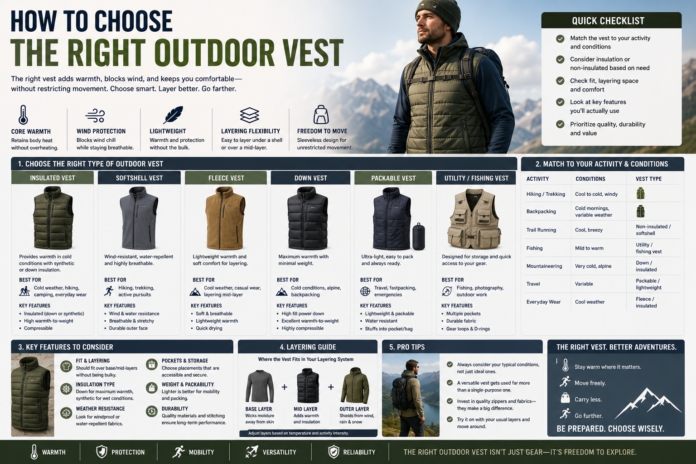
The outdoor vest is one of the most underrated garments in any outdoor wardrobe. Sleeveless by design but powerful in function — a well-chosen vest adds meaningful core warmth, wind protection, or storage capacity without restricting arm movement or adding the weight and bulk of a full jacket. But knowing how to choose the right outdoor vest for your specific activity, conditions, and layering system saves you from buying a vest that looks right but performs wrong when you actually need it outdoors.
Here’s everything that matters.
Understand Why You Need a Vest
Before evaluating specific vests, get clear on the functional role you need it to fill. Outdoor vests serve several distinct purposes — and the right choice depends entirely on which purpose matters most for your specific outdoor use.
Core warmth without arm restriction — the most common vest purpose. Adding meaningful torso insulation while keeping arms completely free for technical activities where jacket sleeves would restrict movement or cause overheating.
Wind and weather protection for the core — softshell and hardshell vest constructions protect the core from wind chill and light rain without the warmth addition that insulated alternatives provide — suiting higher-intensity activities where insulation would cause overheating but weather protection genuinely helps.
Storage and organization — fishing, photography, and field activity vests prioritize pocket number and organization over thermal performance — providing dedicated, accessible storage for equipment, tools, and essentials that jacket pockets cannot accommodate in sufficient quantity or accessibility.
Layering versatility — vests add a warmth layer between base and outer shell without adding sleeve bulk that reduces layering system flexibility — particularly valuable for activities involving rapid temperature transitions throughout the day.
Match Vest Type to Your Primary Activity
Different vest constructions suit different activities — and matching correctly prevents the disappointment of discovering your vest’s limitations through experience rather than informed selection.
Insulated vests suit hiking, camping, and general outdoor use where core warmth addition during rest stops, cold mornings, and evening activities improves comfort without the full coverage that conditions might not warrant throughout the entire day.
Puffer jackets and insulated vests use similar fill technologies — down or synthetic insulation — in sleeveless constructions that concentrate warmth where the body loses heat most critically while maintaining full arm freedom for technical tasks.
Fleece vests provide reliable mid-layer warmth with excellent breathability — suiting active hiking, trail running, and climbing where arm freedom and moisture management matter alongside core warmth retention. Outdoor fleece constructions in vest format work particularly well as mid-layers beneath waterproof shells during cold weather hiking where the full sleeve coverage of a fleece jacket would create uncomfortable heat accumulation during sustained uphill effort.
Softshell vests suit high-output activities in cold windy conditions — providing wind resistance and moderate weather protection alongside the stretch and breathability that softshell fabrics deliver. They suit trail running, ski touring approach sections, and fast hiking where wind protection matters but sleeve restriction would impair performance.
Fishing and field vests prioritize multiple accessible pockets over thermal performance — providing dedicated storage for lures, tools, cameras, and field equipment that general outdoor vests don’t accommodate. Hunting apparel specialists build field vests with the specific pocket configurations, game bag constructions, and silent fabric treatments that field activities genuinely demand.
Evaluate Insulation Type and Fill Power
For insulated vests specifically, fill material and specification determine warmth performance, weight efficiency, packability, and wet weather reliability — making these the most important technical decisions within this vest category.
Down insulation delivers exceptional warmth-to-weight ratio — making down vests significantly lighter and more packable than equivalent synthetic alternatives at comparable warmth levels. High fill power ratings — 700 to 900+ — indicate better quality down that creates more insulating air space per gram of fill weight. Hydrophobic down treatments improve wet weather performance by causing individual feathers to repel moisture rather than clumping when dampened.
Synthetic insulation maintains meaningful warmth performance even when wet — making it more reliable than untreated down in environments where internal perspiration or external moisture exposure regularly dampens the insulation layer. Premium synthetic fills — PrimaLoft Gold, Thermore, and equivalent technologies — approach down warmth-to-weight ratios while delivering this wet weather performance advantage that untreated down cannot match.
The right choice depends on your typical conditions — down for dry cold environments where weight efficiency matters most, synthetic for active use or wet environments where maintained wet performance justifies the slight weight premium over equivalent down specifications.
Check Fit for Layering and Activity
Vest fit determines both comfort in isolation and function within your layering system — and getting fit right matters as much as insulation specification for overall vest performance across real outdoor use.
Active fit — close to the body — suits high-intensity activities where excess fabric creates bulk within layering systems and reduces aerodynamic efficiency during running, cycling, and ski touring. Active fit vests layer cleanly over base layers and beneath shells without bunching that creates pressure points under pack straps.
Regular fit — roomier through chest — accommodates mid-layers beneath the vest for maximum cold weather versatility and suits moderate-intensity activities where layering flexibility matters more than aerodynamic efficiency.
Critical fit checkpoints for how to choose the right outdoor vest include hem length covering the lower back during forward lean — preventing cold air entry through the gap that short hems create during uphill hiking positions. Armhole sizing should allow full arm extension and rotation without the armhole binding across the shoulder — a common fit failure in vests that look correct at rest but restrict movement during activity.
Assess Key Features Against Your Needs
Beyond insulation type and fit, specific construction features determine how well a vest serves your particular outdoor application across real daily use.
Features worth evaluating carefully:
- Collar height — higher collars provide neck warmth that low collars sacrifice for clean aesthetics. Consider whether neck coverage matters for your specific activity and conditions
- Pocket number and placement — hand warmer pockets serve general warmth needs. Chest pockets provide accessible storage during pack wearing. Internal security pockets protect valuables during active use
- Packability — stuff-sack compatible vests or those packing into their own pocket suit activities where the vest travels in a pack between deployment opportunities
- Wind resistance — windproof face fabrics on insulated vests prevent convective heat loss through insulation layers that non-windproof constructions allow in exposed conditions
- Hood — some insulated vests include hoods for complete head coverage without a jacket. Useful for cold still conditions; less practical for high-intensity activities where hoods create heat accumulation
A professional outdoor vest manufacturer builds these features into vest designs based on intended activity use — ensuring construction details serve genuine functional purposes rather than adding specification complexity without performance justification.
Consider Layering System Compatibility
An outdoor vest performs within a layering system rather than in isolation — and compatibility with your specific base layers and outer shells determines how effectively it functions across the full range of conditions you actually encounter.
Vest hem and collar construction must accommodate outer shell systems cleanly — avoiding the collar conflict between vest zip pulls and jacket zip pulls that creates uncomfortable pressure points during extended wear. Vest body length must work correctly with shell jacket hip pockets — avoiding the hem-over-pocket overlap that prevents jacket pocket access when the vest is worn beneath.
Waterproof jackets and outer shells with internal storm skirts need sufficient internal volume to accommodate vest body bulk cleanly without the shell appearing distorted or restricting through the torso when the full layering system is assembled for cold weather use.
Conclusion
Knowing how to choose the right outdoor vest means matching vest type — insulated, fleece, softshell, or field vest — to your primary activity, choosing the right insulation for your typical conditions, fitting correctly for both standalone wear and layering system integration, and selecting features that serve your specific outdoor use rather than generic specification. A well-chosen outdoor vest becomes one of the most-used garments in any active outdoor wardrobe — deployed constantly for the targeted warmth, wind protection, or storage it delivers without the full coverage commitment of a complete jacket.
FAQs
Is a down or synthetic vest better for outdoor use?
Down suits dry cold environments where weight efficiency and packability matter most. Synthetic suits active use and wet environments where maintained performance when damp justifies the slight weight premium over equivalent down specifications.
Should an outdoor vest fit loosely or closely?
Active and high-intensity activities suit close active fit that layers cleanly and moves freely. General hiking and casual outdoor use suits regular fit that accommodates mid-layers beneath for cold weather versatility.
Can outdoor vests be produced under a private label?
Yes. Professional outdoor apparel manufacturers offer complete private label vest production with custom insulation specifications, fabrics, colors, hardware, labels, and packaging — giving outdoor brands full creative and commercial control.
What is the most versatile outdoor vest type for general use?
A lightweight down or synthetic insulated vest suits the broadest range of outdoor activities — providing meaningful core warmth addition in a packable format that works across hiking, camping, climbing, and casual outdoor use effectively.