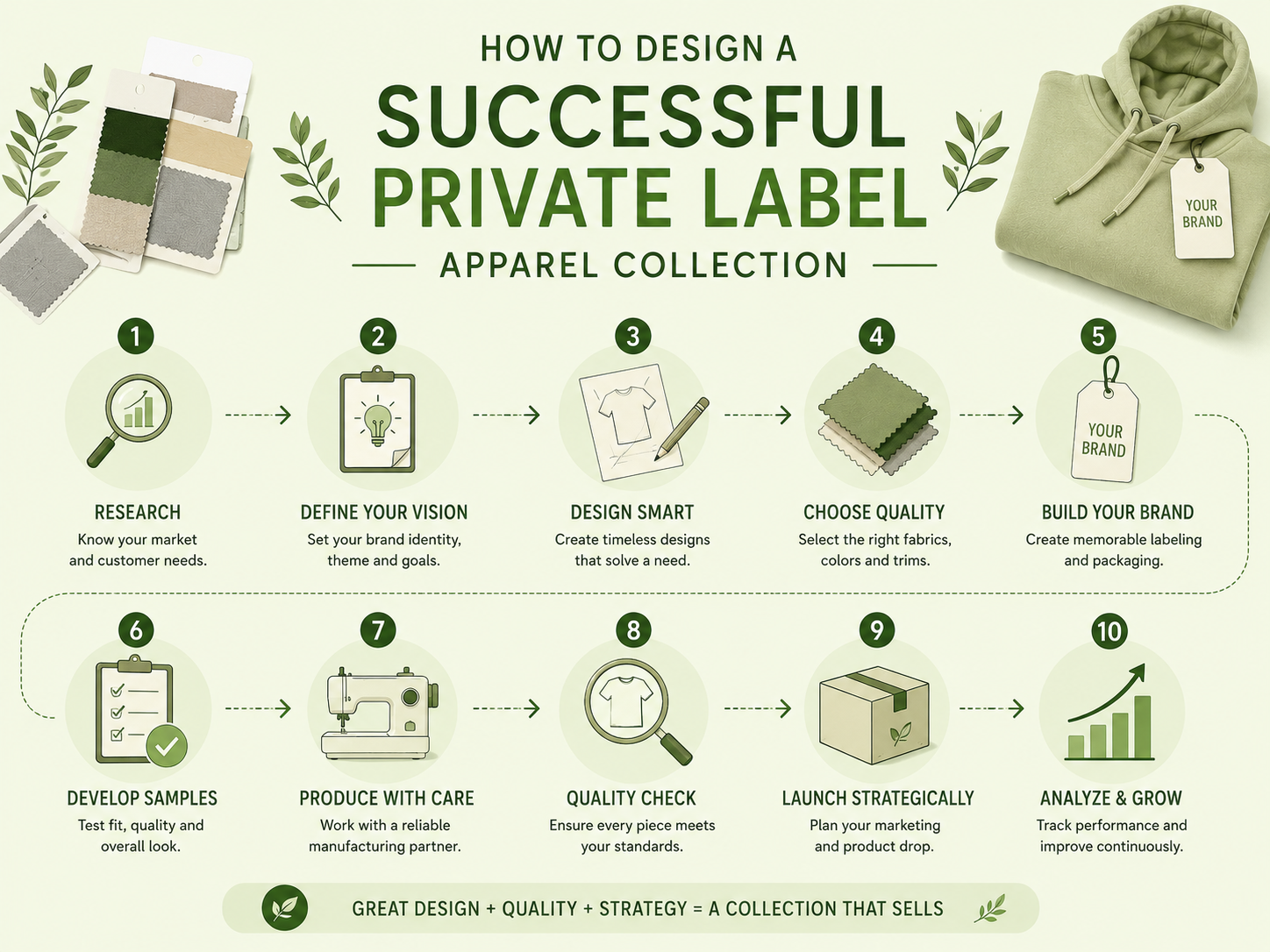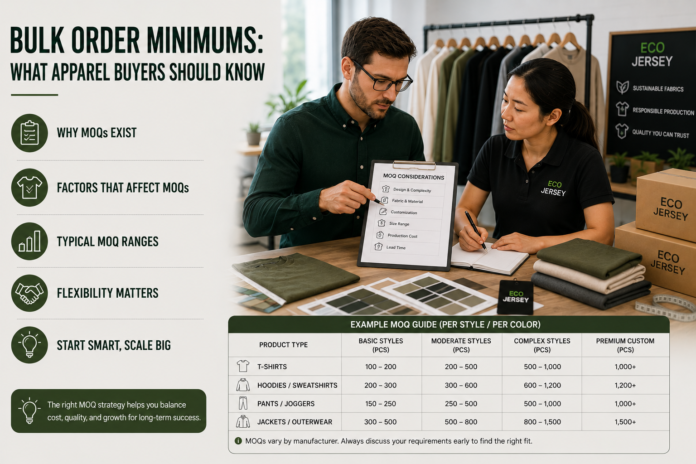
If you’ve ever approached a clothing manufacturer and been told you need to order 500 units minimum, you’ve hit a bulk order minimums. And if you didn’t know that was coming, it probably stopped you in your tracks. Bulk order minimums are one of the most misunderstood parts of apparel manufacturing. They confuse new brands, frustrate small buyers, and often make the difference between a deal getting done or falling apart.
This guide explains exactly what bulk order minimums are, why they exist, and how to work with them — or around them — depending on where your brand is right now.
What Are Bulk Order Minimums?
A bulk order minimums — also called a minimum order quantity or MOQ — is the smallest number of units a manufacturer will produce in a single order. Below that number, the factory simply won’t take the job.
Every manufacturer sets their own MOQ. Some require 1,000 units per style. Others work comfortably at 50 or 100. The number depends on the factory’s size, equipment, setup costs, and the type of garment being produced.
Understanding bulk order minimums before you approach any manufacturer saves you a lot of time. It also helps you shortlist the right factories for your current stage of growth — rather than pitching to factories that will never work at your volume.
Why Do Manufacturers Set Minimum Order Quantities?
This is the question most buyers want answered. And the honest answer is — it comes down to economics.
Every production run has fixed costs. Setting up the cutting machinery, preparing the fabric, calibrating the sewing lines, and running quality checks all take time and money — regardless of how many units you’re making. If a factory produces 50 units, those fixed costs get spread across 50 pieces. If they produce 1,000 units, those same costs spread across 1,000 pieces — making each unit far more cost-efficient.
Additionally, fabric is almost always purchased by the roll. A factory buying fabric for your order will have leftover material if your quantity is too small. That leftover represents a direct financial loss for the manufacturer.
So bulk order minimums are not arbitrary. They protect the factory’s margins while keeping your per-unit cost at a level that makes commercial sense.
Know Your Numbers Before You Approach Any Factory
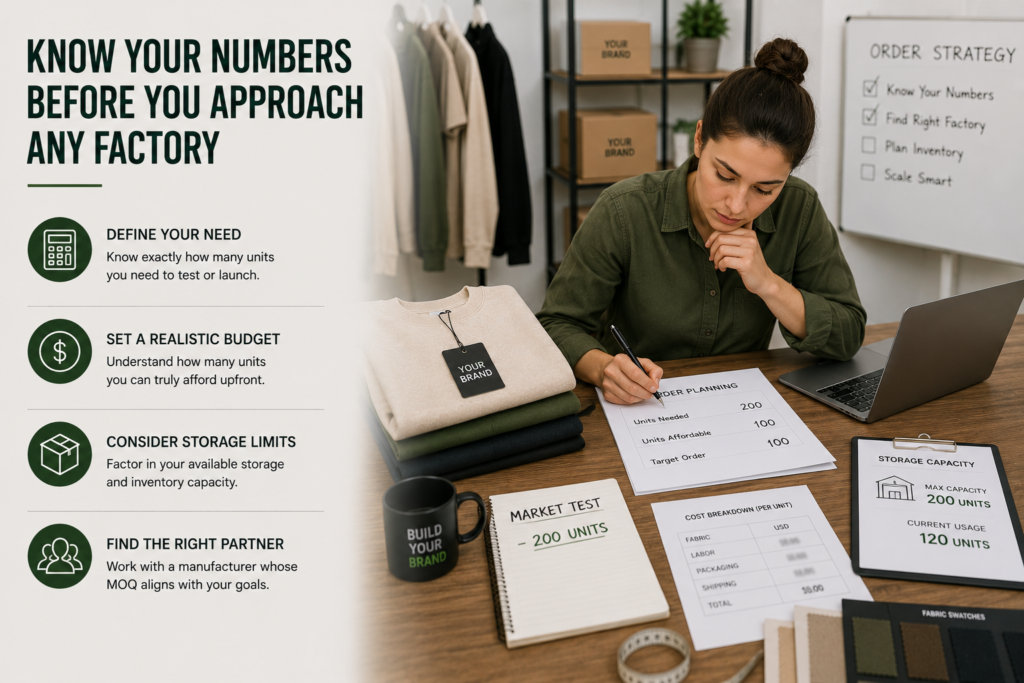
Before you contact a single manufacturer, get clear on how many units you actually need — and how many you can realistically afford to order.
These are often two very different numbers. A brand might need 200 units to test the market but can only afford 100 upfront. Or they might want 500 units but their storage capacity only handles 200 at a time.
Being honest with yourself about these numbers upfront saves you from entering conversations with factories that are the wrong fit. A bulk apparel manufacturer built for large volume runs is simply not the right partner for a brand testing a new product at 100 units.
Look for Low MOQ Options If You Are Starting Out
If your order volume is small, the good news is that low MOQ manufacturers exist specifically for brands at your stage. These factories are set up to handle smaller runs efficiently — without the financial pressure of committing to large quantities you’re not ready for.
A low MOQ clothing manufacturer allows you to start with manageable quantities, validate your product in the market, and scale your orders as demand grows. This is the smartest way to enter bulk production without overextending your budget.
The trade-off is that per-unit costs are typically higher at lower quantities. But that higher cost per unit is almost always worth it compared to the risk of sitting on 1,000 unsold garments.
Consider Made-to-Order Manufacturing for Maximum Flexibility
If unpredictable demand makes committing to fixed bulk quantities difficult, made-to-order manufacturing offers a practical alternative.
Rather than producing a large batch upfront and holding stock, a made-to-order apparel manufacturer produces garments only when an order is placed. This eliminates the risk of overproduction, reduces storage costs, and keeps your cash flow in much better shape.
Made to order works particularly well for brands with wide product ranges, seasonal collections, or highly customised products where holding pre-made stock simply isn’t practical.
Understand How MOQ Changes With Different Manufacturing Models
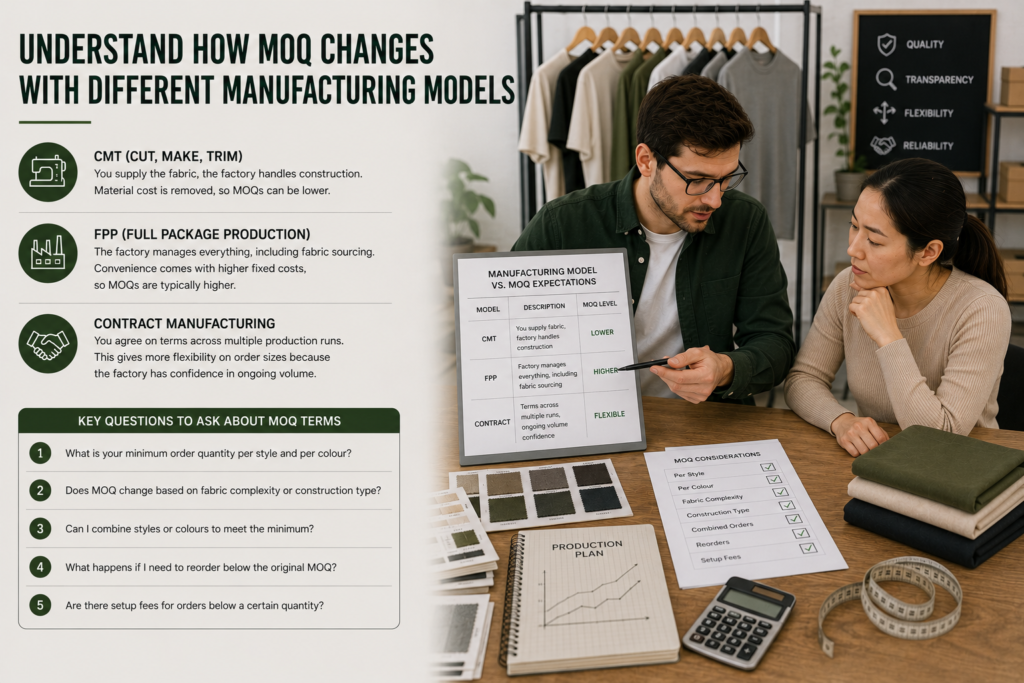
Bulk order minimums are not fixed across all manufacturing models. Different approaches to production come with different MOQ expectations — and understanding this helps you choose the right model for your situation.
With a CMT clothing manufacturer, you supply the fabric and the factory handles construction. Because the factory’s material cost is removed from the equation, CMT arrangements can sometimes accommodate lower minimums than full-package production.
With a FPP apparel manufacturer, the factory manages everything — fabric sourcing included. The convenience comes with higher fixed costs, which typically means higher MOQs to make each run financially viable for the factory.
With a contract clothing manufacturer, you agree on terms across multiple production runs. This often gives you more flexibility on individual order sizes because the factory has confidence in ongoing volume over time.
Here are the key questions to ask any manufacturer about their MOQ terms:
- What is your minimum order quantity per style and per colour?
- Does MOQ change based on fabric complexity or construction type?
- Can I combine styles or colours to meet the minimum?
- What happens if I need to reorder below the original MOQ?
- Are there setup fees for orders below a certain quantity?
Factor Sustainability Into Your Bulk Order Planning
As your brand grows and your order volumes increase, sustainability becomes an increasingly important part of your production planning. Larger bulk orders mean more fabric consumption, more energy use, and more waste — unless your manufacturer has responsible practices built into their process.
Working with a sustainable apparel manufacturer from early on means your production scales responsibly. They can advise on certified fabric options, responsible dyeing processes, and waste-reduction strategies to keep your bulk production aligned with your brand values as volumes grow.
Conclusion
Bulk order minimums are not a barrier — they are simply a reality of how manufacturing works. Once you understand why they exist and how different manufacturers approach them, you can confidently plan your production strategy around them.
Start with honest numbers. Find a manufacturer whose MOQ matches your current stage. And choose a production model that gives you the flexibility to scale as your brand grows.
When you’re ready to move forward, explore the full range of bulk apparel manufacturing options and find the right fit for your order volume and production goals.
FAQs
What is a bulk order minimums in apparel manufacturing?
It is the smallest number of units a manufacturer will produce in a single order — also known as a minimum order quantity or MOQ.
Why do manufacturers set minimum order quantities?
Because every production run has fixed setup costs. Spreading those costs across a larger number of units makes each unit more cost-efficient for both the factory and the buyer.
Can I negotiate a lower MOQ with a manufacturer?
Sometimes, especially if you commit to repeat orders or accept higher per-unit pricing. Always ask, but understand that very low quantities may simply not be viable for some factories.
What is the difference between low MOQ and made to order manufacturing?
Low MOQ means the factory produces small but fixed batches. Made-to-order means the factory produces only when a specific order is placed — eliminating the need to hold stock entirely.