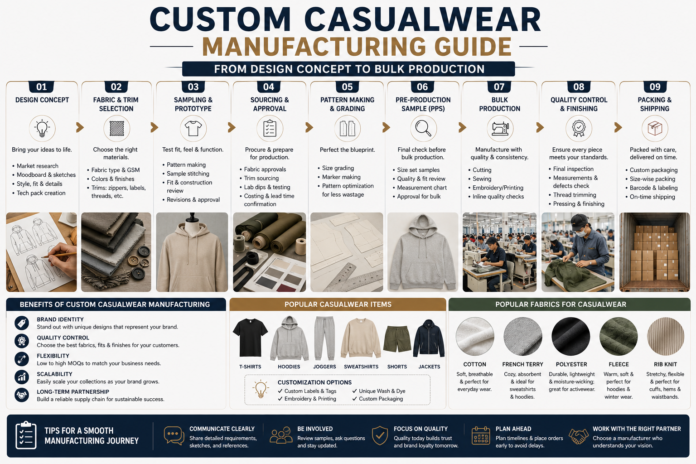
Creating a personalized casualwear line seems simple. What people don’t realize is that there are more stages and hurdles than they anticipate. Fortunately, there are ways to manage every step of the process, especially for first-time brands. This guide details the custom casualwear manufacturing guide, step by step, from the first idea to the final bulk shipment.
Stage 1 — Define Your Product and Brand Position
No design should happen before you know the answer to: “What are you going to sell?” and “Who are you going to sell to?”
These two questions seem easy to answer. However, they impact every design decision of the finished garment. A brand may decide to sell heavyweight hoodies to a premium segment, while a brand may opt for lightweight co-ordinates to sell to a budget segment.
Before reaching out to a manufacturer or designer, write a product brief. In a product brief, be sure to answer: What is the garment type? Who is the target customer? What is the target price? What are the design details? What are the garment performance details? This document will be referenced throughout the entirety of the design process.
Stage 2 — Choose Your Manufacturing Model
Your brand and design goals impact the manufacturing model you choose for producing your custom casualwear line. The model you choose will impact the design goals and cost of the final product. The model you choose will impact the design goals and cost of the final product. The model you choose will impact the design goals and company.
Full package production — where the manufacturer handles fabric sourcing, cutting, making, and finishing — is the simplest model for brands without established supply chain relationships. A casual wear manufacturer offering full package production gives you one point of contact for the entire process.
CMT — where you supply the fabric and the manufacturer handles cutting, making, and trimming — gives you more control over material sourcing but requires you to manage fabric procurement independently.
For brands entering casualwear for the first time, full package production is almost always the more practical starting point. It reduces the number of relationships you need to manage and keeps the development process more contained.
Stage 3 — Develop Your Tech Pack
A tech pack takes a design idea and outlines a viable way to make a product. It instructs a factory on how to carry out the design by providing details on every attribute of the item to be made.
When details on a tech pack are omitted, the factory will fill in the gaps for you. Unfortunately, the factory’s design assumptions will create inconsistencies in many aspects of the product, most notably, fit and branding. These gaps will become more of a problem the further along the process you are.
Tech packs include design pictures as well as technical details and draw every view of the product. They also include precise details on every aspect of the item, such as finish and fabric. Tech packs will also include design details such as the placement of various branding pieces and the placement of reinforcing branding. This will also outline the coordinates for placement.
For brands producing hoodies and sweatshirts as part of a casualwear range, the tech pack needs to specify hood construction, drawstring routing, kangaroo pocket dimensions, and cuff and hem rib depth — all details that affect the finished quality significantly.
Stage 4 — Fabric Selection and Approval
You select your fabric as you develop your tech pack — fabric impacts details concerning measurement, construction, and finishing methods of a tech pack.
Always order samples from your manufacturer before making any specifications. Weigh the fabric. Evaluate the bounce back of the stretch. Compare your design references to the fabric color. Lastly, see how the fabric ages by prewashing it. A fabric that shrinks or changes form will cause the same issue to the finished garment. Customers will see the changes after the first wash. The concern of form loss is not only on your end.
For a t-shirts manufacturer producing premium casualwear, fabric approval is a non-negotiable step — because the t-shirt’s quality is almost entirely determined by the fabric. Getting it wrong at this stage means the finished garment is wrong, regardless of how well it’s constructed.
Stage 5 — Sampling and Fit Approval
There’s a lot that happens between finalized tech packs, approved fabrics, and the beginning of sampling. This is the stage of the process where your design becomes the first physical version of itself, and where most of the development manifests.
The first sample is sometimes called the prototype or the fit sample. It is the sample that will be used to assess the construction of the sample and the fit of the sample. At this point in the process, the sample may not be made of the final iteration of the fabric, or the sample may not have final branding. At this point, your focus should be on the construction quality of the garment, the fit and proportion of the sample, and on the construction quality per the instructions in the tech pack.
As the designer, it is your responsibility to document any and all construction quality changes in detail. Be sure to reference the specific measurements where construction quality changes need to occur, and communicate this as a type of construction that is needed per the construction instructions given to the manufacturer. Vague responses like “make it a bit bigger” result in fit and construction inconsistencies. A response like “increase the chest width by 2cm and the body length by 1.5cm” will have the design completed to your specifications.
Most casualwear orders go through two, and sometimes, three sampling rounds before the order is approved for the main run. If this step is attempted to be expedited, more time and finances will be wasted in attempting to deal with the problems created by bulk production.
Stage 6 Branding and Print Approval
There is a lot of detail that goes into finishing the bulk production run, and before each of the elements of the garment are finalized, each of the elements need to be approved for construction. Print placement, the quality of the embroidery, the placement of the labels, and the finishing of the hardware will all require a round of approvals — because errors in production runs will be expensive and sometimes irreversible.
Before approving bulk production, request a branded pre-production sample, which includes the complete garment design in the final material with all branding elements added. This sample allows you to check each detail including the sharpness and accuracy of the print, the density and placement of the embroidery, and the quality and placement of the labels. Additionally, assess the quality of the branding hardware and its function.
For brands producing co-ord sets with matching branding across both pieces, this approval stage confirms that the logo placement, scale, and finish are consistent across the top and bottom — which is a detail that needs deliberate checking rather than assumption.
Stage 7 — Bulk Production and Quality Control
Bulk production can start once we have all the approvals. Every unit for that bulk run will be compared to your approved sample, which then becomes the reference standard.
Quality control occurred at various steps if the sample bulk run was approved. Rather than inspecting the finished product and determining if the sample was approved, the fabric used was inspected to ensure the correct material was supplied. Finally, every unit was inspected to ensure the bulk run conformed to the approved sample before packing.
For brands producing joggers or cargo pants in bulk, waistband construction, pocket attachment, and hem finishing are the construction points most likely to show variation across a large run — making them the priority areas for in-line quality checks.
Conclusion
This guide to custom casualwear manufacturing guide outlines all stages from concept to delivery. The takeaway from all of them is the same. Preparation prevents problems. Clear briefs, detailed tech packs, all the fabric approvals, and strict sampling techniques can help you in all stages. All of them help prevent the bulk production errors that set brands back a lot.
When you’re ready to start your custom casualwear production, explore the full range of casual wear manufacturing options and find the right partner for your brand.
FAQs
What is a tech pack, and why do I need one for casual wear?
A tech pack is a detailed manufacturing document that specifies every aspect of your garment — measurements, fabric, construction, and branding. Without one, factories make assumptions that lead to inconsistent results.
What is the difference between the full package and CMT production?
Full package means the manufacturer handles fabric sourcing and all production. CMT means you supply the fabric and the factory handles cutting, making, and trimming.
When should branding be approved in the production process?
Before bulk production begins, a dedicated branded pre-production sample that shows all print, embroidery, label, and hardware details applied to the final fabric.
What quality control checks should happen during bulk production?
Fabric inspection on arrival, in-line construction checks during production, and a final inspection before packing — covering measurements, construction, branding, and finish.