When launching a fashion category, brands must decide whether to focus on men’s, women’s, unisex, or all three product lines. Understanding Men’s vs Women’s vs Unisex Fashionwear is essential because this decision impacts design, production, sizing, fabric selection, marketing, and overall business costs. Choosing the right approach from the start helps create fit-for-purpose products that meet customer expectations and represent the brand accurately.
This guide provides clear distinctions of the designs of Men’s vs Women’s and Unisex fashionwear.
Why the Distinction Matters More Than Most Brands Anticipate
Many of the less mature brands think that by creating a garment in more than one size, they have created a garment for a different gender. They have not. Men’s and Women’s Garments differ in so many ways (beyond just a smaller size of Men’s Garments).
Let’s use Hoodies as an example. A Women’s Hoodie is not a Men’s Hoodie with a smaller size. Women’s Hoods have a different shoulder to chest ratio, different waisters and hip ratio, different shoulder length, different sleeves length, and different proportionate body lengths, and all of which require a different garment and not just a different size.
A fashionwear manufacturer who understands gendered pattern making will tell you this from the first conversation. One who suggests simply grading a men’s pattern down for women is not the right partner for a brand that takes fit seriously.
Men’s Fashionwear: What Makes It Different
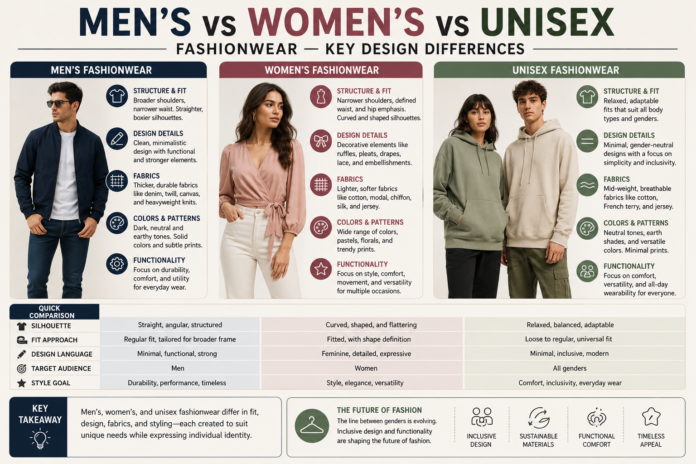
Men’s fashion focuses on wider shoulder placement, straighter torso shapes, and longer body and sleeve lengths relative to width. The fit with the chest and shoulders works with the fabric and drape of the garment, since men’s clothing hangs from the shoulder. The fit of the shoulder dictates the drop of the remainder of the garment. Body structure is not accounted for beyond the fit of the shoulders and the chest.
Men’s clothing styles are basically less contoured. Hoodies, sweatshirts, and T-shirts are typically cut with little to no waist suppression and are left with a straight silhouette from the chest down to the hem. That makes it easier to design and manufacture patterns for men’s clothing than for women’s clothing, but men’s clothing requires varied attention to fit throughout the full size range for the shoulder and chest.
In men’s fashion, designs have the labels and hardware less visible and positioned less prominently, internally on the garment and often stitched in place using tonal embroidery with a stenciled patch, as opposed to the visible branding that is often acceptable on a unisex style and women’s clothing.
For brands producing cargo pants or tracksuits specifically for men, the rise, the leg opening, and the waistband construction all follow men ‘s-specific proportions, which differ meaningfully from women’s equivalents in the same style.
Women’s Fashionwear: What Makes It Different
Around the world, women’s clothing and fashion is designed for different body shapes, across proportional differences seen in areas such as the shoulders, waist, and torso. These fashion differences require advanced shapes, especially in the waist and hip region.
Almost all clothing styles for women use some form of waist shaping, even the more relaxed and looser styles. The side seam curvature, the placing of darts, and the hip-to-waist proportion must be created specifically for women and cannot be adapted from men’s or unisex styles.
Compared to men’s clothing and fashion, women’s clothing involves more construction details and shape variations. These differences increase the difficulty of manufacturing, but also the potential for different styles of fashion.
The choice of fabric used for women’s clothing is highly different than that of men’s clothing. Women’s clothing is frequently made from lighter and softer fabrics than men’s clothing, which makes fabric sourcing more difficult and leads to more advanced manufacturing processes.
A co-ord set manufacturer producing women’s styles understands that the top and bottom in a women’s co-ord need to be graded independently — because the hip-to-waist relationship changes across sizes in ways that affect both pieces differently.
Unisex Fashionwear: What It Actually Means
Unisex fashion is quite different from some common assumptions. Some brands think it means designing one style of clothing that everyone can wear. That’s not really the case. Thoughtfully designed unisex clothing often makes compromises. For example, if a clothing style uses a gendered pattern, it may fit women’s bodies better than men’s (or vice versa). In contrast, unisex clothing may not fit as well, but it probably fits a greater number of body types.
Unisex fashion works best for designs that use more relaxed or oversized proportions. A style like this will likely fit a greater number of body types. For example, oversized hoodies work as unisex clothing while fitted T-shirts do not. A fitted men’s T-shirt probably won’t fit women’s torsos without a lot of adjustments to the pattern.
The greatest challenge while making clothing unisex is probably the sizing. Developing a unisex size chart works best rather than borrowing one from men’s or women’s clothing lines, and then, this chart needs to be clearly stated to have a successful unisex fashion line.
A hoodies manufacturer with experience in unisex production understands how to develop sizing that works commercially — appealing to the broadest possible customer base while maintaining a coherent fit identity.
When to Choose Each Approach
The preferred method is contingent on your brand’s positioning and your consumer. For example, if you have a niche brand catering to women’s streetwear or men’s casualwear, gendered patterns allow you to establish a better fit and stronger product relevance.
For a brand based on gender inclusivity, gender-neutral identity, or gender community, gender-neutral clothing is a commercially viable option that increases ease of production and expresses your brand values.
Many brands begin with gender-neutral clothing, as it allows a single size run to meet the needs of a broader consumer base and reduces the complexity of developing patterns. As the brand and its consumer base grow, they often add gendered clothing options.
A sweatshirts manufacturer or fashionwear specialist who has produced across all three approaches can advise on which makes most sense for your specific product and brand positioning.
How Production Differs Across Each Approach
From a manufacturing standpoint, gendered production has more intricacies than unisex production due to the separate requirements for each gender, including developing and managing separate patterns, grading, and fabric specifications.
Unisex production streamlines pattern development but complicates sizing and customer expectations. Unisex garments may fit well, but if customers are not informed about the fit, they may return the garment, as they assume it will fit like a gendered garment.
A t-shirts manufacturer who has worked across men’s, women’s, and unisex production can advise on the pattern and grading implications of each approach before development begins — saving significant revision time later.
Conclusion
Saying unisex clothing is simply a different size than men’s or women’s apparel is only partly true. In Men’s vs Women’s vs Unisex Fashionwear, factors like fit, fabric selection, brand positioning, production strategy, and marketing all play an important role in how garments are designed and sold.
You need to understand your consumer product to clothing strategies. Select a partner manufacturer that understands how subtle the differences are and can implement them correctly.
When you’re ready to develop your fashionwear range, explore the full range of fashionwear manufacturing options and find the right partner for your collection.
FAQs
What is the main difference between men’s and women’s fashionwear patterns?
Women’s patterns are built around a defined waist, wider hips relative to shoulders, and a shorter torso. Men’s patterns follow broader shoulders, a straighter torso, and different length proportions.
Can I make a unisex garment by simply grading a men’s pattern down?
No. A well-designed unisex garment requires its own pattern development, making considered compromises between body proportions rather than scaling an existing gendered pattern.
What styles work best as unisex fashionwear?
Oversized and relaxed silhouettes work best — because they are inherently more forgiving of body proportion differences. Fitted styles rarely work effectively as genuine unisex.
How does fabric choice differ between men’s and women’s fashionwear?
Women’s fashionwear typically uses lighter weights and softer handfeel fabrics more frequently than men’s equivalents — though this varies significantly by category and brand positioning.