Ski masks are an essential part of any winter wardrobe. Types of Ski masks (aka balaclavas) are garments that cover the head, neck, and face. They protect people from the elements while engaging in winter activities that could expose skin to icy air, snow, and ultraviolet rays. Whether you are an Outdoor Apparel brand creating winter gear or a customer buying outdoor winter gear, it is important to know that ski masks are designed at varying levels of protection. Ski masks can be a simple, single-layer fleece cover that can be easily packed in a pocket or a technical, three-hole, windproof, heated mask, or a tactical mask.
Why Ski Masks are Important Outdoor Apparel
When considering what outdoor gear to purchase for winter activities, most people think the most important items are the jackets and pants. However, heads, faces, and necks are the body’s biggest heat protectors during the cold, and compromises in those areas put your safety and comfort at risk, no matter how good the clothing system is overall.
Face and Head Protection Study
Faces and heads have lots of blood vessels which are located close to the surface of the skin, which makes them great at losing heat, but ultimately it’s inefficient in the cold. To make things worse, the wind makes the cold even worse. Something that is minus five degrees in still air, can feel significantly colder at five degrees when the wind is blowing. This is even worse for exposed skin.
Therefore, protecting your face and head during the colder months has huge benefits that far outweigh the bulk and weight of winter clothing. For this reason, ski masks are the best investment in your outdoor winter clothing. The right type of ski mask will add great warmth and protection with minimal cost to your gear.
Ski Masks in a Winter Layering System
Ski masks are like a base layer for heads and faces, and are the first layer against the skin. Like a base layer, ski masks are the first layer that create a primary barrier against cold air and winds, and help manage face moisture.
They coordinate with helmet and goggle combinations for on-slope skiing and snowboarding, with hat and buff combinations for lower intensity winter activities, and as stand-alone head and face protection in tactical and extreme cold environments.
Knowing where each type of ski mask fits in the winter clothing layer helps brands build coherent winter protection lines and helps buyers put together complete cold-weather systems that cover every exposed area. If your brand is producing ski masks for your winter outdoor range, feel free to reach out to our ski mask manufacturing team to talk about your product ideas.
Ski Masks and Their Specific Use Cases
What falls under ski masks is a vast array of construction methods, coverage, fabric technology, and features all optimized for specific winter activities, temperature ranges, and protection requirements. Each type also fills a different commercial gap. Because of this, ski masks are a commercially versatile product category for outdoor brands to create differentiated winter apparel.
Full Balaclava Ski Masks
These ski masks are the most protective of all the ski masks. They give the head the most coverage along with the neck and face. Full balaclava ski masks are the right choice for extreme cold environments.
Other types of ski masks leave gaps in the coverage of the clothing, allowing the cold air to hit the face, chin and neck. This version provides 100% coverage, not leaving gaps in coverage, even when the wind is howling.
Full balaclavas also go great under helmets while alpine skiing or snowboarding. Full balaclavas that are manufactured by our ski mask manufacturing team are available in several different fabric weights and technologies. These balaclavas integrate easily with the neck coverage of the base layer or mid layer that lies beneath the collar of your jacket. If you’re interested in developing a balaclava, we are ready to assist you.
Three Hole Ski Masks
As the name implies, three hole ski masks feature three separate openings, two for the eyes and one for the mouth. They provide full coverage of the head and face. Because of the opening for the mouth, they also provide the ability to breathe. This design eliminates the need for a single eye opening, because the masks allow full vision. This design is so popular, as it provides almost full face coverage while allowing the breathing and vision comfort that is needed for the most active of winter sports.
Ski masks that feature a three hole design also integrate well with ski goggles. When ski goggles are placed over the mask, they create an airtight seal that prevents cold air from hitting the face. This design allows full coverage of the face while providing the clarity of vision and the protection from the sun that ski goggles provide.
Contact our manufacturing team to design custom three-hole ski masks for your brand.
Open Face Ski Masks
Open face ski masks leave the face entirely exposed. They cover the head and neck, and, although they leave the face exposed, they provide fantastic warmth at the head and neck. They are very popular for moderate cold and low intensity winter activities because they do not restrict breath and do not require adjustments around frame goggles.
Open face ski masks work very well for cross country skiing, hiking, and snow shoeing. These activities create enough aerobic exertion to heat the face and make full ski masks and balaclavas restrictive and uncomfortable. Open face ski masks provide the convenience of head and neck warmth during the activity, while allowing the face to breathe freely during high-output winter activities.
Open face ski masks are also great for covering the head and neck in mild winter conditions, while sitting under a winter hat or helmet. They also do not provide the full balaclava cover of the winter helmet. Eco Jersey, our outdoor fleece manufacturing gives us the ability to manufacture open face ski masks and neck warmers. Please contact us for your open face mask production needs.
Windproof Ski Masks
Windproof Ski Masks use a windproof membrane or tightly woven windproof face fabric for mask construction. They provide a breathing face fabric with excellent wind blocking compared to traditional fleece and knit ski masks.
They’re ideal for alpine ski racing, riding fast on snowmobiles, ski touring on exposed ridges, and any outdoor winter activity where sustained high velocity winds lead to extreme wind chill.
Generally, windproof ski masks combine a windproof outer layer and a soft inner layer that wicks moisture and, thus, leaves the face dry. The inner layer pulls sweat away from the face during an activity and the outer windproof layer protects from the cruel elements.
A suitable ski wear manufacturing partner knows about ski masks and the lamination and bonding of membranes that windproof ski masks require. A ski mask manufactured by them most probably has a windproof layer that maintains its windproofing ability during multiple outdoor uses and washings. With the help of our team, you can have windproof ski masks in your technical winter range.
Fleece Ski Masks
Fleece ski masks are the softest, warmest, and most breathable ski masks available to the general public. They tend to use brushed polyester fleece of 150 to 250 GSM construction. Because of the balance between warmth, next-to-skin comfort, care, and price, they are the most popular and most commercially available ski masks. They provide comfort under helmets without the pressure points of traditional materials. Their construction allows them to breathe during moderate levels of activity without trapping moisture.
Fleece ski masks are a great option for brands looking to provide entry to mid-range outdoor offerings. They are warm and comfortable and are price accessible for the majority of consumers. Our ski mask manufacturing team makes a variety of fleece ski masks, contact us for your fleece mask innovations.
Merino Wool Ski Masks
Merino Wool Ski Masks use the natural performance qualities of merino wool to provide a moisture managing mask that regulates temperature and is odour-free. They provide the highest comfort for those undertaking multi-day winter trips where frequent washing is not an option.
Merino ski masks also offer a superior temperature range to fleece masks. This is especially important for those undertaking the wide ranging conditions that are encountered during an alpine day with activities ranging from frigid to warm. Merino masks are especially useful for ski touring, winter mountaineering and backcountry skiing.
We’re excited to present your brand with merino ski mask options.
Tactical and Camouflage Ski Masks
Tactical and camouflage ski masks protect against winter weather like traditional ski masks but are constructed to have low visual signatures. These masks include camouflage patterns, and use dark or earth tone colors, and matte finish fabrics in order to prevent visual detection in winter and woodland environments.
Additionally, tactical ski masks include features that are useful in military and law enforcement fields. These features include reinforced fabric, matte finishes, and fabrics that meet military standards. These ski masks are made to work with an entire tactical clothing system. Tactical ski masks work with camouflage balaclavas and tactical clothing to provide winter field operations.
Tactical ski masks are also useful in civilian hunting and winter sports. In these activities, like winter wildlife photography, protection from the cold while remaining concealed is critical.
Main Features to Compare when Ski Mask Shopping
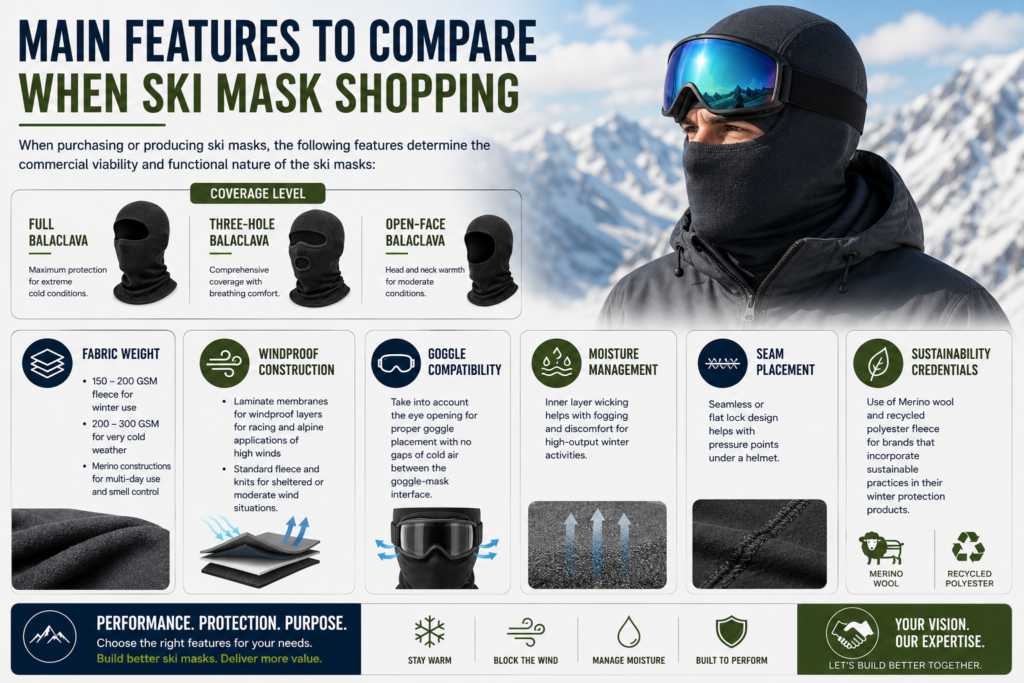
When purchasing or producing ski masks, the following features determine the commercial viability and functional nature of the ski masks:
- Coverage level: full balaclava for maximum protection in extreme cold, three-hole for comprehensive coverage with breathing comfort, open-face for head and neck warmth in moderate conditions
- Fabric weight – 150 – 200 GSM fleece for winter use and 200 – 300 GSM for very cold weather and for constructions of merino for multi-day use and smell control
- Windproof construction – laminate membranes for windproof layers for racing and alpine applications of high winds and standard fleece and knits for sheltered or moderate wind situations.
- Goggle compatibility – Take into account the eye opening for proper goggle placement with no gaps of cold air between the goggle-mask interface.
- Moisture management – Inner layer wicking helps with fogging and discomfort for high-output winter activities.
- Seam placement – Seamless or flat lock design helps with pressure points under a helmet.
- Sustainability credentials – use of Merino wool and recycled polyester fleece for brands that incorporate sustainable practices in their winter protection products.
Building a Ski Mask Range for Your Winter Outdoor Brand
There are many types of ski masks for basic fleece balaclavas that offer affordable pricing all the way to premium constructions of merino and multi-day backcountry use and technical windproof masks for racing and extreme cold. This makes for a strong ski mask category that is commercially viable.
In addition, if ski masks are designed with face and winter head protection, ski wear jackets and pants (to cover the entire body), and outdoor fleece (to provide insulation for the core) mid-layers, a full winter protection suite for the customer to use all winter to do all their outdoor pursuits is created.
Cohesive construction and color coordination of ski masks and all winter apparel items in your range help create a strong collection with high average order values and integration of your brand identity across all items in your winter outdoor range.
Looking to add ski masks to your winter line? Our manufacturing team can help you every step of the way, from choosing the right fabric to outdoor brand specific bulk manufacturing and quality control processes.
Conclusion
Winter ski masks are a diverse product line. For example, there are full balaclavas for cold expeditions or tactical camo ski masks for winter hunting and field sports. Ski masks come in many designs based on activity, fabric, level of wind resistance, and coverage. Knowing the distinctions will help you build a ski mask line that will help your customers tackle any winter challenge.
No matter if you need ski masks for winter adventures or want to build an outdoor apparel line with a face protection range, knowing the distinctions of ski masks and their cold weather use cases will help you make informed product decisions and purchases.
Looking for a ski mask line? Check out our ski mask manufacturing services and contact our team to help you begin your outdoor protective winter apparel line today!
FAQs
What is the warmest type of ski mask for extreme cold conditions?
The warmest option is a full balaclava made of heavyweight fleece or merino wool. This covers the full head, face, and neck, leaving only a small eye slit.
What type of ski mask works best with ski goggles?
Three-hole ski masks are designed specifically for goggle compatibility — the separate eye openings allow the goggle frame to seal against the surrounding mask fabric without creating cold air gaps between the goggle and the mask.
What is the difference between a fleece ski mask and a merino wool ski mask?
Fleece ski masks dry faster and suit single-day use at accessible price points. Merino wool ski masks provide superior temperature regulation and natural odour resistance — making them the preferred choice for multi-day backcountry trips where washing between uses is not possible.
When should I choose a windproof ski mask over a standard fleece mask?
Choose a windproof ski mask for activities involving sustained high wind exposure — alpine ski racing, ski touring on exposed ridges, and snowmobile riding at speed where wind chill at the face is the dominant cold challenge.