
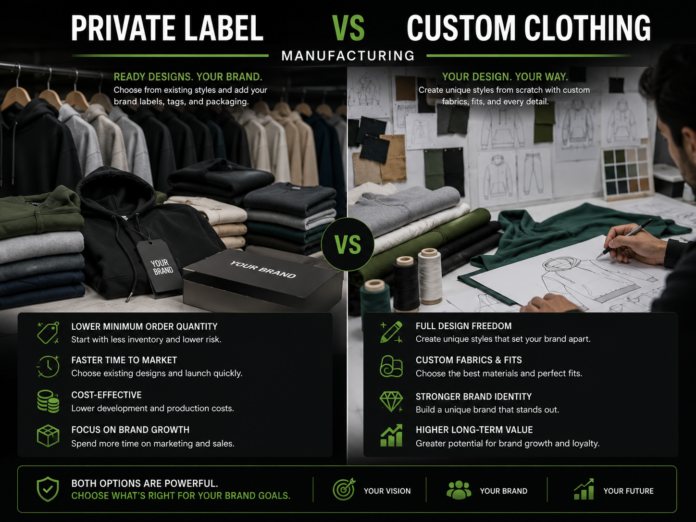
When establishing your clothing line, one of the first critical decisions you must make is selecting the right manufacturing model. Private labels and custom clothing manufacturing vary greatly, and to choose the best option for your business, you must understand these differences. Each model has distinct advantages, but only they can be aligned with specific goals, budgets, and time frames.
At Eco-Jersey, we provide support for international brands in both models. Here, we present all the information, so you can make an informed decision.
What is Private Label Clothing Manufacturing?
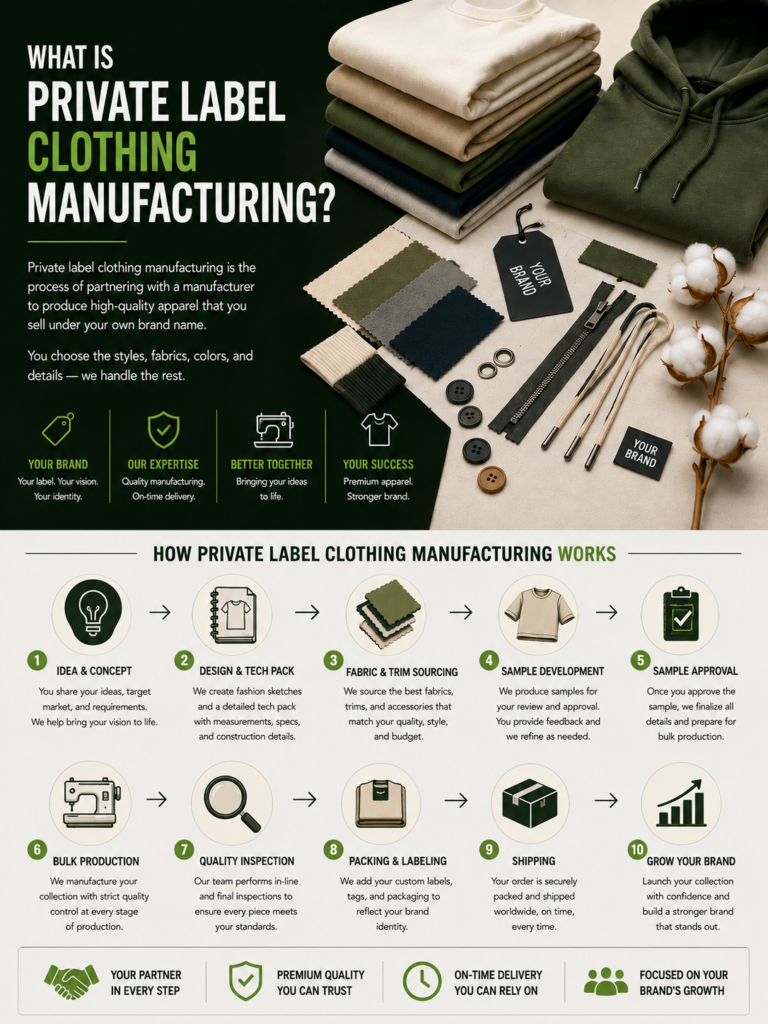
Private label manufacturing is a model in which the manufacturer produces garments using the brand owner’s label, logo, and branding. In this case, the brand owner has full control of the identity of the product and logos. The control of the manufacturing process is done by the manufacturer.
This model is faster and more cost efficient, as well as easier to scale. Consequently, it is the preferred model for startup and growing brands who wish to launch quickly and with a smaller capital outlay.
What Is Custom Clothing Manufacturing?
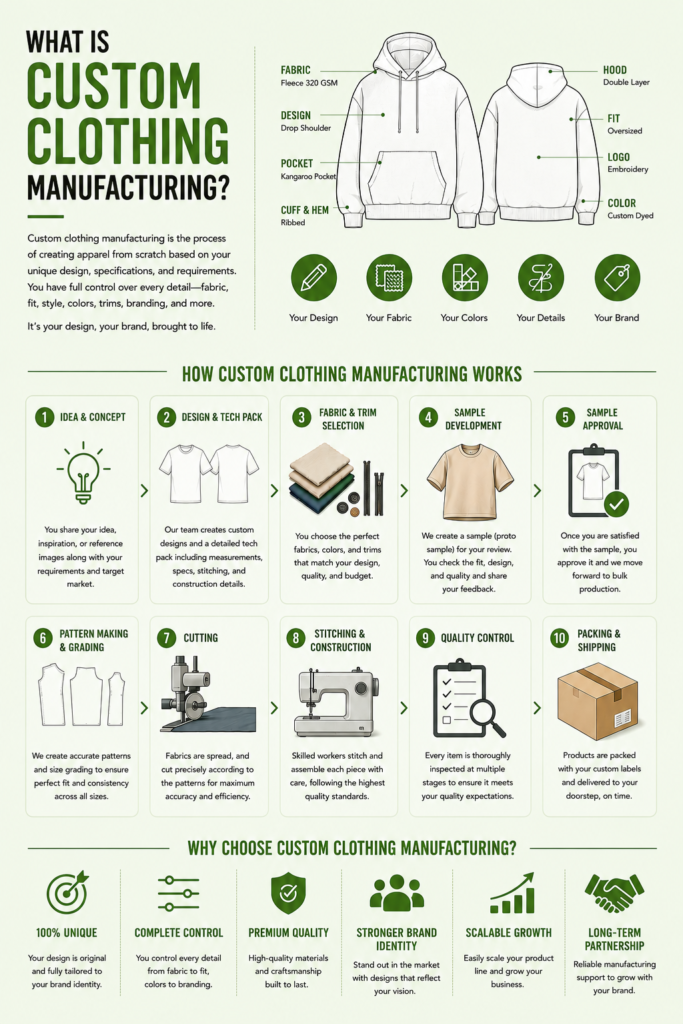
Custom clothing manufacturing involves a clothing brand owner being involved in the design process such as fabric selection, pattern creation, and stitch methods/techniques. Every piece of clothing made under this process is built according to the desires of the brand owner.
This model allows a high degree of originality and creative freedom. However, it requires a high level of investment, time, and a detailed knowledge of the processes and techniques involved in clothing production.
Private Label vs Custom Clothing Manufacturing: Key Differences
| Factor | Private Label | Custom Manufacturing |
|---|---|---|
| Design Freedom | Moderate — works within existing frameworks | Full — built entirely from scratch |
| Production Cost | Lower — more budget friendly | Higher — due to pattern and material development |
| Minimum Order Quantity | Lower MOQs — accessible for startups | Higher MOQs — setup costs need to be spread |
| Production Timeline | Faster — established systems speed up production | Slower — every element developed from scratch |
| Brand Exclusivity | Moderate — branded exclusively to you | High — fully original and unique products |
| Scalability | Easy and efficient to scale | More complex and costly to scale |
Which Model Is Right for Your Brand?
Select Private Label Manufacturing If:
You need to develop a brand quickly to start The goal is to minimize the risk and costs of using capital The goal is to develop products that can be expanded quickly to maximize the value of the product line Your goal is to control costs and focus on the marketing of the product.
Select Custom Manufacturing If:
Your brand is well-known with a strong identity Your goal is to have unique one-of-a-kind products Your goal is to have a perceived premium unique product with high value and low costs of acceptance Your goal is to fund and have a custom product developed fully.
Is It Possible to Integrate Both Methods?
Yes; it is what many successful brands do. It starts with private label manufacturing to generate assets and brand control. The custom-manufactured pieces are introduced to add unique and differentiated products as the brand expands into longer manufacturing. This provides a basis for a custom brand to identify and control costs for the value, making it a premium product.
Why Eco-Jersey for Private Label and Custom Manufacturing
Eco-Jersey is a Pakistan-centered clothing company that supplies internationally with regional offices in locations ranging from North America to Europe, the Middle East, and Australia. We manufacture custom clothing and private-label garments. We value the individuality of our customers and their specific needs. Our skilled and experienced team handles your order with care, assuring you quality performance, strict quality standards, and reliable international shipping services.
Conclusion
The question is not whether private-label manufacturing is superior to custom clothing manufacturing; it is which model is correct for your brand at this moment in time. Private-label manufacturing is faster, cheaper, and allows for scalability. On the other hand, custom manufacturing allows for original and creative designs that are unique to the brand. Therefore, the most successful brands are able to use both methods.
Frequently Asked Questions
Is private-label tailoring cheaper and of lower quality than custom tailoring?
No. In this case, the production process does not determine the quality. It is an independent factor. Many successful and established premium brands are catered to private-label manufacturing.
Am I able to switch from private-label manufacturing to custom manufacturing?
Yes, many brands begin with private-label catering in order to establish their presence in the market. This allows them to grow and mature their identity, and as a result, their budget allows them to switch to custom manufacturing.
How can I shield my designs from custom manufacturing?
This can be done through the use of non-disclosure agreements with your manufacturer, in addition to brand trademarks. Make sure you are dealing with a manufacturer who is considerate of intellectual property rights.



