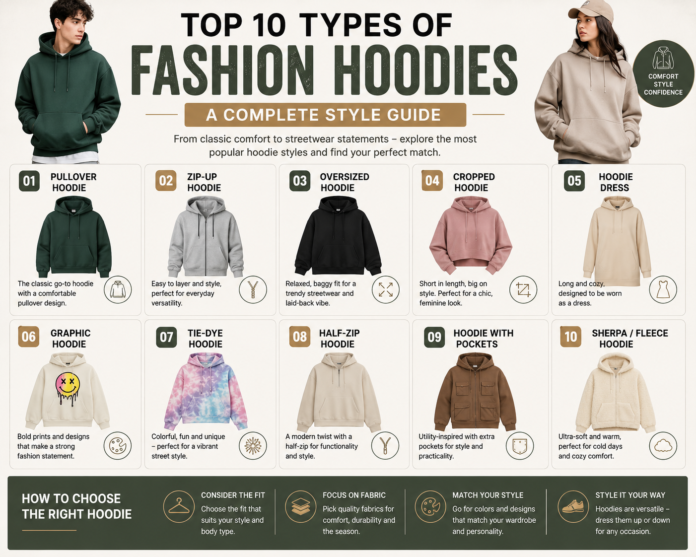
Hoodies have evolved far beyond basic casualwear. Today they anchor streetwear collections, lead fashion campaigns, and sit confidently across luxury, lifestyle, and athletic markets simultaneously. But knowing the top 10 types of fashion hoodies and understanding what makes each one sell is what separates brands that build strong collections from brands that guess and hope. Here’s your complete style guide.
Pullover Hoodie — The Timeless Foundation
The pullover hoodie is the starting point for every serious hoodie collection. No zipper, no buttons — just clean lines, a kangaroo pocket, and a drawstring hood. Its simplicity is its strength. It works across every demographic, every season, and every styling approach — making it the highest-volume seller in almost every casualwear brand’s range.
Every brand working with a professional hoodies manufacturer starts here — and for very good reason.
Zip-Up Hoodie — Versatile and Practical
Zip-up hoodies add a full-length front zipper — transforming the garment into a layering piece that customers wear open over tees or fully zipped against cooler temperatures. That versatility makes zip-ups consistent sellers across casualwear and streetwear collections year-round.
Half-zip variations — stopping midway up the chest — carry strong athletic and preppy crossover appeal, particularly in premium casualwear and collegiate-inspired collections.
Oversized Hoodie — The Streetwear Essential
Oversized hoodies feature deliberately extended body length, dropped shoulders, and wide sleeves — creating that relaxed, confident silhouette streetwear culture has made iconic. Heavyweight fleece between 350 and 450gsm gives oversized styles the structure and premium hand-feel that justify their price point in customers’ hands.
This style consistently drives the strongest social media engagement for fashion brands — because it photographs powerfully and styles effortlessly across multiple outfit combinations.
Cropped Hoodie — Fashion-Forward and Versatile
Cropped hoodies hit above the natural waist — pairing perfectly with high-waisted bottoms and co-ord sets for defined, fashion-forward looks. Lighter fabric weights — 250 to 300gsm — work best for cropped styles, allowing the shortened hemline to sit cleanly without unwanted bulk.
This style performs strongest in women’s fashion, lifestyle, and athleisure crossover collections targeting younger, trend-conscious demographics.
Graphic Hoodie — Brand Expression at Its Strongest
Graphic hoodies carry bold printed artwork, typography, or brand imagery across the chest, back, or sleeves. They are one of the most powerful brand-building tools available in casualwear — because the graphic itself communicates brand identity instantly without requiring any additional context.
Screen printing, embroidery, heat transfer, and puff print techniques each deliver different aesthetic results. The right technique depends on your graphic complexity, fabric weight, and target price point.
Sleeveless Hoodie — Activewear Crossover Appeal
Sleeveless hoodies — sometimes called hoodie vests — remove the sleeves entirely while retaining the hood and kangaroo pocket. They bridge casualwear and activewear markets effectively — working as gym layers, festival pieces, and urban streetwear simultaneously.
Brands building collections that cross between casual wear and performance markets find sleeveless hoodies deliver strong sales precisely because they serve customers in multiple contexts rather than just one.
Sherpa-Lined Hoodie — Premium Warmth and Texture
Sherpa-lined hoodies feature a soft, fleece-like lining inside the hood and sometimes throughout the body — adding serious warmth alongside a distinctive textural contrast. The sherpa detail elevates the perceived value of the hoodie significantly, supporting higher retail price points and stronger margins.
This style sells powerfully during autumn and winter seasons and performs particularly well for brands positioning at premium casualwear and lifestyle price points.
Hoodie Co-ord Set — The Complete Look
Hoodie co-ord sets pair matching hoodies and bottoms — joggers, shorts, or sweatpants — in the same fabric and colorway. The matching set offers customers a complete, effortless outfit in one purchase — which drives higher average order values and stronger customer satisfaction simultaneously.
Brands already producing joggers and sweatshirts can expand into co-ord sets with minimal additional development investment — maximizing return from existing manufacturing relationships.
Tech Hoodie — Performance Meets Fashion
Tech hoodies use performance fabrics — moisture-wicking blends, four-way stretch materials, or lightweight shell fabrics — to create a hoodie that performs athletically while looking fashion-forward. Functional details like hidden pockets, earphone cable ports, and reflective prints add genuine utility alongside strong aesthetic appeal.
This style targets the growing market of customers who demand performance functionality from every garment they wear — including their everyday casualwear and streetwear pieces.
Longline Hoodie — Dramatic Silhouette, Strong Statement
Longline hoodies extend significantly below the hip — sometimes reaching mid-thigh — creating a dramatic silhouette that carries strong fashion-forward energy. They layer powerfully over tracksuits and suit streetwear brands targeting customers who build deliberately layered, high-impact outfits.
Longline styles work best in mid to heavyweight fabrics that provide enough structure to hold the extended length cleanly without collapsing or distorting through daily wear.
Building Your Hoodie Collection Strategically
The top 10 types of fashion hoodies each serve a specific customer need and market segment. Smart brands don’t launch all ten simultaneously — they identify their core customer, select three to five styles that serve that customer most directly, and expand from there as revenue and brand understanding grow.
Working with a trusted fashionwear manufacturer ensures consistent fabric quality, construction standards, and customization capabilities across every hoodie style in your collection — so each product reflects the same brand quality your customers expect every time they shop.
Conclusion
Understanding the top 10 types of fashion hoodies gives your brand the knowledge to build collections with genuine commercial intention behind every style choice. Each hoodie type serves real customers with real preferences — and covering the right combination for your specific market turns your hoodie range into one of the most reliable, consistently performing product categories your brand produces.
FAQs
Which hoodie type sells most consistently across all markets?
Pullover and oversized hoodies consistently outperform other styles globally — their broad demographic appeal and styling versatility make them reliable year-round sellers for virtually every fashion brand.
What fabric works best across most hoodie styles?
320 to 380gsm cotton fleece or cotton-polyester blend suits most hoodie styles well — providing comfort, durability, print quality, and the premium hand-feel customers expect at mid to premium price points.
Can all 10 hoodie types be produced under a private label?
Yes. All styles support full private label customization including custom fabrics, colors, graphics, hardware, labels, and packaging — giving your brand complete creative and commercial control over every piece.
How many hoodie styles should a new fashion brand launch with?
Start with two to three styles — typically a pullover, an oversized, and one trend-driven style relevant to your specific market. This covers your core customer base without overextending your initial production investment.