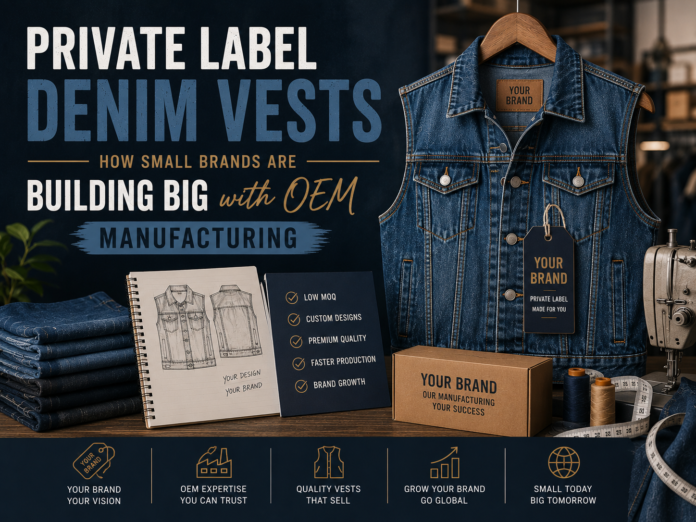
Starting small doesn’t mean thinking small. Across the global fashion industry, small brands are launching competitive, distinctive denim collections — and private label denim vests are becoming one of their strongest entry points. OEM manufacturing has democratized fashion production in a way that simply wasn’t possible a decade ago. Today, a small brand with a clear vision and the right manufacturing partner can compete confidently with established players — and win.
What Is OEM Manufacturing and Why Does It Matter?
OEM stands for Original Equipment Manufacturer. In fashion, OEM manufacturing means a factory produces garments according to your brand’s specific designs, specifications, and requirements — exclusively for you. You own the design. You own the product. The manufacturer simply has the expertise and equipment to bring it to life at scale.
This model gives small brands access to professional production capabilities — advanced machinery, skilled labor, wash facilities, and quality control systems — without the enormous capital investment of building their own factory. The result is a finished product that looks and performs like it came from a major brand — because it went through the same professional production process.
Why Denim Vests Are a Smart Private Label Starting Point
Denim vests occupy a unique commercial sweet spot. They are simpler to construct than full denim jackets — making sampling and development faster and more cost-effective. Yet they carry strong fashion credibility across multiple market segments simultaneously — streetwear, festival fashion, vintage-inspired collections, and workwear crossover styles.
For small brands entering denim manufacturing, vests offer a lower-risk product development entry point with genuine market demand behind them. A successful vest launch builds the brand confidence, customer data, and revenue needed to expand into more complex products like denim jeans and full outerwear collections.
How Small Brands Build Big With Private Label Denim Vests
The brands winning with private label denim vests follow a clear, repeatable strategy. They don’t try to compete on price — they compete on identity.
Here’s what that looks like in practice:
- Develop a signature wash or finish a specific acid wash, a unique distressing pattern, or a raw indigo finish that becomes instantly recognizable as your brand’s aesthetic
- Customize hardware consistently branded buttons, custom rivets, and distinctive metal finishes that run across your entire collection
- Build a strong fit identity oversized, cropped, relaxed, or structured — and own that fit consistently across every season
- Add signature details custom embroidery, patches, contrast stitching, or inside lining prints that surprise and delight customers beyond the obvious exterior
A professional denim vest manufacturer makes all of these customizations accessible — even at relatively small order quantities — giving emerging brands the same creative tools that large fashion houses use to build recognizable product identities.
The Role of Private Label Manufacturing in Brand Scaling
Private label OEM manufacturing doesn’t just produce your first vest. It builds the operational foundation your brand scales on. Once you establish a working relationship with a reliable private label denim manufacturer, expanding your range becomes significantly more efficient.
Your manufacturer already knows your quality standards, fit preferences, brand specifications, and communication style. Adding denim shirts, denim shorts, or denim skirts to your collection becomes a faster, smoother process with every new season — because the foundational relationship and brand understanding already exist.
That compounding efficiency is one of the most underrated advantages of building with OEM manufacturing from the very beginning.
What to Expect From a Strong OEM Partnership
Not all OEM manufacturers deliver equally. The strongest partners offer more than just production. They offer genuine collaboration — guiding you through fabric selection, wash development, hardware sourcing, and quality standards with the expertise that comes from producing thousands of garments across dozens of brands.
Look for OEM partners who also serve streetwear denim brands and understand the fast-moving, trend-sensitive nature of fashion production. These manufacturers understand deadlines, seasonal pressures, and the importance of getting products to market at exactly the right moment.
A strong denim apparel manufacturing partner invests in your brand’s success — because your growth directly drives their long-term business relationship with you.
Conclusion
Private label denim vests give small brands something genuinely powerful — a distinctive, exclusive product built to their exact specifications, backed by professional OEM manufacturing, and ready to compete confidently in the market. The brands building big today didn’t start big. They started smart — with the right product, the right manufacturing partner, and a clear brand identity worth building around. Your denim vest collection could be exactly that starting point.
FAQs
What is the typical MOQ for private label denim vests through OEM manufacturing?
Most OEM manufacturers offer private label denim vest production starting from 50 to 100 pieces per style — making it genuinely accessible for small and emerging brands.
How long does it take to develop a private label denim vest from concept to delivery?
The full development process — from initial brief through sampling, approval, bulk production, and delivery — typically takes eight to fourteen weeks depending on customization complexity.
Can I protect my private label denim vest designs from being copied?
Yes. Reputable OEM manufacturers sign non-disclosure agreements and produce your designs exclusively for your brand — your designs remain your intellectual property throughout the relationship.
Do I need a large budget to start with private label OEM denim manufacturing?
Not necessarily. Many OEM manufacturers work with emerging brands at accessible entry points — focusing on building long-term relationships rather than demanding large upfront commitments from day one.