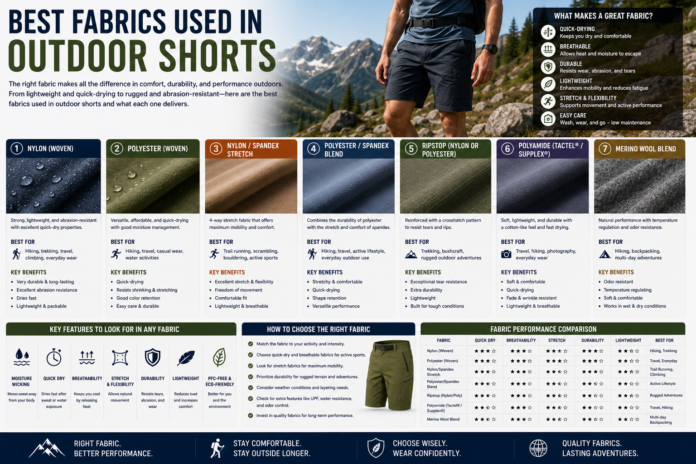
Fabric choice determines everything an outdoor short can and cannot do. The right material keeps you comfortable during intense trail activity, dries fast after stream crossings, resists abrasion from rough terrain, and maintains its performance properties across seasons of demanding outdoor use. Understanding the best fabrics used in outdoor shorts helps brands build products that genuinely perform outdoors — and helps customers make informed choices that serve their specific activities reliably. Here’s a complete breakdown of every major outdoor short fabric and what each one delivers.
Nylon — The Performance Gold Standard
Nylon is the most widely used fabric in performance outdoor shorts — and its dominance reflects genuine performance merit. Lightweight, strong, quick-drying, and naturally smooth against the skin — nylon delivers the combination of properties that outdoor activity demands more consistently than most alternative fabrics.
Nylon’s tensile strength significantly exceeds equivalent weight polyester — meaning nylon outdoor shorts resist tearing and abrasion from rock scrambling, brush contact, and pack hip belt friction better than lighter alternatives. This durability-to-weight ratio makes nylon the preferred face fabric for hiking clothing manufacturers building shorts that survive serious trail use across multiple seasons without seam failure or fabric degradation.
Ripstop nylon variants — incorporating reinforcing grid threads at regular intervals — add tear propagation resistance that makes them particularly valuable for demanding outdoor applications where small snags from branches or rock edges could otherwise develop into larger tears across standard woven constructions.
Polyester — Versatile and Color-Stable
Polyester serves outdoor short applications across multiple performance requirements — particularly excelling in moisture-wicking constructions that move sweat away from skin during high-intensity activity. Its UV resistance maintains color vibrancy across extended sun exposure significantly better than nylon alternatives — making it particularly valuable for outdoor shorts worn constantly in high-UV environments.
Moisture-wicking polyester constructions use fiber cross-sections engineered to maximize surface area — creating capillary action that draws moisture from skin contact surfaces toward outer fabric layers for evaporation. This active moisture management keeps wearers significantly more comfortable during sustained physical output than fabrics that simply absorb moisture and hold it against the skin.
Recycled polyester — produced from post-consumer plastic waste — delivers identical performance to virgin polyester while significantly reducing environmental impact. A growing number of outdoor brands specify recycled polyester for their outdoor shorts collections — responding to consumer demand for more sustainable outdoor clothing without compromising the technical performance their customers depend on across demanding field use.
Nylon-Elastane Blends — Stretch Performance for Active Use
Pure nylon and polyester fabrics provide limited stretch — adequate for casual hiking but insufficient for the extreme range of motion that trail running, climbing, and technical scrambling demands. Adding elastane — typically 8% to 20% of total fiber content — transforms these fabrics into stretch performance materials that move freely with athletic body positions without restriction or recovery lag.
Four-way stretch constructions allow simultaneous horizontal and vertical stretch — accommodating the multi-directional movement demands that outdoor activity creates across hips, thighs, and knees during challenging terrain navigation. The elastic recovery of quality elastane blends ensures shorts return to their original shape after each movement cycle — maintaining correct fit and appearance throughout extended active wear rather than progressively bagging out during the day.
Outdoor cargo pants manufacturers apply similar stretch nylon principles to shorts versions — creating cargo constructions that carry essential storage without the fabric tension that rigid non-stretch constructions create across the hip and thigh areas where cargo pockets add fabric volume.
Ripstop Fabrics — Tear Resistance Without Weight Penalty
Ripstop constructions weave reinforcing threads at regular intervals through base fabric — creating a distinctive grid pattern that prevents small tears from propagating into larger fabric failures. This property is particularly valuable for outdoor shorts that regularly contact abrasive surfaces — rock scrambles, thorny vegetation, and rough terrain contact all create small snags that ripstop construction contains while standard woven fabrics allow to grow.
Ripstop nylon suits technical hiking, climbing, and field activity shorts where durability matters alongside packability. Ripstop polyester suits amphibious and water-contact applications where the additional UV stability of polyester complements the tear resistance that ripstop construction adds.
The weight penalty for ripstop construction is minimal — typically adding only 5% to 15% above equivalent non-ripstop constructions — making the durability benefit essentially free in terms of weight budget for most outdoor short applications where some abrasion resistance is genuinely needed.
Quick-Dry Polyester Mesh — Ventilation and Moisture Management
Mesh polyester fabrics appear primarily in trail running shorts liners, active shorts panels, and ventilation zones within technical outdoor shorts — providing maximum airflow and rapid moisture evaporation in the areas where body heat generation is highest during intense physical activity.
Internal liner shorts built from lightweight mesh polyester serve multiple functions simultaneously. They provide modest modesty coverage beneath outer shorts, create a smooth skin contact surface that prevents chafing during running and cycling movement patterns, and accelerate moisture evaporation through their open construction that restricts airflow less than solid woven face fabrics.
Cotton-Nylon Blends — Comfort Meets Durability
Pure cotton performs poorly in demanding outdoor shorts applications — absorbing moisture heavily, drying slowly, and losing structural integrity when wet in ways that synthetic alternatives avoid entirely. However, cotton-nylon blends combine cotton’s softness and comfortable skin feel with nylon’s quick-drying properties and durability — creating fabrics that suit casual outdoor shorts, travel shorts, and light hiking applications where comfort matters alongside moderate performance.
These blends suit camping apparel collections targeting recreational campers who prioritize wearing comfort during campsite activities over the technical performance specifications that more demanding trail use requires. The softer hand feel of cotton content makes these fabrics genuinely more comfortable for extended casual wear than pure synthetic alternatives — particularly during sedentary campsite activities where moisture management performance matters less than all-day wearing comfort.
Softshell Stretch Wovens — Cool Weather Performance
Softshell stretch woven fabrics bring windproof and water-resistant properties to outdoor short construction — creating cool weather shorts that protect against wind chill and light precipitation that standard lightweight shorts cannot handle without causing uncomfortable cold leg exposure.
These fabrics combine a stretch woven face — providing windproofing and moderate weather resistance — with a grid fleece or smooth backing that adds comfort and mild insulation against bare skin contact. The stretch performance allows full athletic movement while the windproof construction prevents the chilling wind penetration that exposes lightweight shorts legs in exposed mountain terrain and cool morning trail conditions.
Softshell jackets manufacturers applying the same fabric principles to shorts constructions create complete softshell outfit systems — coordinating technical performance across jacket and shorts combinations that suit shoulder-season hiking and mountain activities where temperatures and conditions vary significantly throughout the outdoor day.
DWR Treated Fabrics — Surface Water Repellency
DWR treatment applied to outdoor short face fabrics causes water to bead and roll off the surface rather than saturating the fabric — maintaining comfortable dry weight and appearance during light rain and moisture splash that untreated fabrics would absorb immediately.
DWR performance degrades progressively through use and washing — requiring periodic refresh through tumble drying or specialist re-treatment products. This maintenance requirement matters more for shorts than jackets because shorts experience more frequent washing from trail dirt and sweat accumulation — accelerating DWR degradation rates compared to outer layers that are washed less frequently.
Fluorocarbon-free DWR formulations — meeting increasingly stringent environmental regulations — now deliver comparable initial performance to traditional C8 chemistry treatments while addressing the environmental persistence concerns that prompted regulatory pressure toward cleaner treatment alternatives across the outdoor apparel industry.
Building Your Outdoor Shorts Collection Around the Right Fabrics
The best fabrics used in outdoor shorts serve different performance requirements across different short types and target activities. Ripstop nylon suits technical hiking and field applications. Stretch nylon-elastane blends suit trail running and climbing. Quick-dry polyester suits moisture-management priority applications. Cotton-nylon blends suit casual camping and travel use.
Working with a professional outdoor apparel manufacturer who sources verified performance fabrics — with genuine technical credentials rather than unverified supplier specifications — ensures your outdoor shorts collection delivers the performance promises your brand makes to customers who evaluate products through real-world outdoor use rather than marketing claims.
Conclusion
Understanding the best fabrics used in outdoor shorts — nylon, polyester, elastane blends, ripstop constructions, mesh liners, cotton-nylon blends, softshell wovens, and DWR treatments — gives outdoor brands the technical foundation to build shorts collections that genuinely perform across their intended use cases. Every fabric decision communicates your brand’s commitment to outdoor performance quality. Choose verified materials, partner with experienced outdoor apparel manufacturers, and build outdoor shorts that earn the trust of customers who depend on their clothing when conditions make performance matter most.
FAQs
What is the most important fabric property in outdoor shorts?
Quick-drying performance is most critical for active outdoor use — fabrics that dry rapidly after perspiration, rain, or water crossings maintain comfort and prevent the heavy, cold, chafing sensation that slow-drying alternatives create during sustained outdoor activity.
Do outdoor shorts need stretch fabric for hiking?
Four-way stretch fabrics significantly improve hiking comfort across steep terrain — accommodating full hip flexion and stride extension without restriction. Standard non-stretch constructions work for moderate trails but limit movement freedom on technical terrain.
Can outdoor shorts with performance fabrics be produced under a private label?
Yes. Professional outdoor shorts manufacturers offer complete private label production with verified performance fabrics, DWR treatments, custom colors, pocket configurations, labels, and packaging — giving outdoor brands full technical and commercial control.
How does recycled polyester compare to virgin polyester in outdoor shorts?
Recycled polyester delivers identical performance to virgin polyester in moisture management, UV resistance, and durability — while significantly reducing environmental impact through diverting plastic waste from landfill and ocean environments.