The sport of rugby is mainly recognized for being one of the most brutal team sports, and there is constant contact during scrums and tackles against an opponent, and the jerseys must be built to endure this constant contact without breaking, ripping, or stretching out of shape. Rugby jersey construction goes beyond the typical sportswear manufacturing process. This construction guide outlines the materials, construction methods, and design elements of a rugby jersey. This guide will assist clubs, brands, and buyers in recognizing the significant value added to a rugby jersey by quality construction as compared to a typical piece of sportswear.
Why Rugby Jerseys Need Special Construction
Rugby imposes specific challenges to apparel unlike any other team sport. During tackles and scrums, jerseys are torn and ripped, and significant stress is applied to seams and collars. Additionally, the jersey must be able to stretch freely during the game. If a jersey has poor construction, it will tear during contact, and the construction will lose its shape and restrict movement during the game. Because of this, rugby jersey construction focuses on the apparel’s flexibility and strength.
Rugby jersey design starts from a foundational knowledge of the best materials available. Construction details are then created from this knowledge. What fabric selection informs us is critical to design construction and selection of materials from the right base elements.
Heavy-Duty Polyester Blends
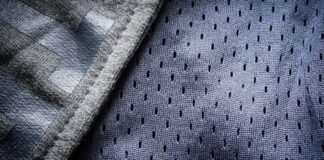
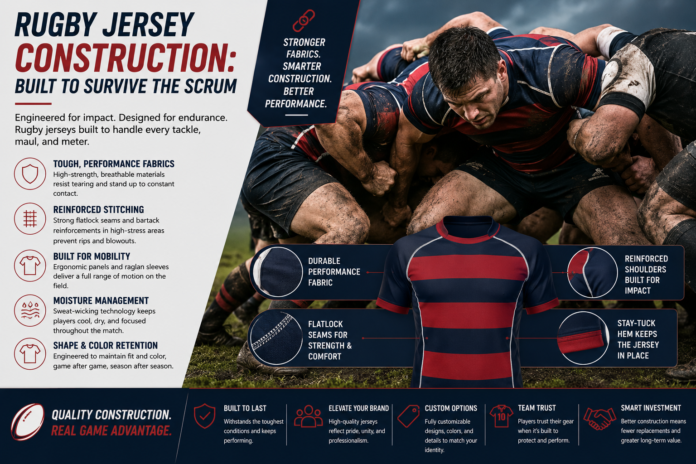
Heavy-duty polyester blends are used in most match-grade rugby jerseys. These fabrics blend durability with good moisture management and shape retention. The lightweight polyester found in most sports jerseys does not have the strength to sustain rugby’s repeated tearing and pulling. Rugby- specific fabrics use dense weaves with higher denier counts to resist tearing. These fabrics also employ a blend of high denier count, durable polyester, and moisture-wicking fabrics. This serves to keep players drier and more comfortable while engaged in high-activity play. Because of the above properties, heavy-duty polyester is the most important material in quality rugby jersey construction.
Cotton-Polyester Blends
Cotton-polyester blends are used in some traditional and training rugby jerseys. Cotton-polyester blends soften the jersey’s feel and give a more classic aesthetic. However, pure cotton has poor moisture management and durability. When blended with polyester, cotton improves moisture management and provides a comfortable texture. Due to the above properties, cotton-polyester jerseys are found in mainly training jerseys, supporter jerseys, and heritage style jerseys. They are not commonly used in elite rugby match wear.
Stretch Fabric Panels
Some areas of a rugby jersey require different construction methods than the jersey’s main body. For example, rugby jerseys require unrestricted movement for reaching, tackling, and passing. Stretch fabric is a blended construction method using spandex and elastane, which is incorporated in the underarm gussets and side and sleeve panels. Stretch fabric recovers its shape quickly, allowing rugby jerseys to maintain their shape and fit throughout the match.
Grip Fabric Technology
Grip fabric is found in most modern rugby jersey construction. Grip fabrics are created to assist team members in securing grip during rugby lineout lifts and scrummaging. They are used in the shoulder and chest areas of rugby jerseys.
This fabric surface makes it easier to grip without adding weight. As a result, this technology has established a noticeable edge during rugby set pieces. Because of this, fabric grip technology has become a signature characteristic of high-end rugby jerseys.
Further, a well-designed collar will retain its shape and fit through the season, rather than becoming warped after just a few matches.
Bonded and Taped Seams
A small number of elite rugby jerseys have incorporated bonded seams or heat-taped seams, which fill needle holes and create a stronger, smoother seam than stitched seams. This construction method increases sewing seam strength and reduces the chance of moisture getting through the seams when playing in wet conditions. Because of this, bonded seam technology is being used more often in high-end rugby jerseys designed for professional and semi-professional rugby clubs.
Key Features of a Match-Grade Rugby Jersey
In terms of construction quality, there are a few elements that illustrate a rugby jersey will stand up to the demands of the match day:
- Reinforced collar: Look for double-layer or bonded collar construction that helps resist stretching during tackles and scrums.
- Grip fabric panels: Ensure that the fabric used for the shoulder and chest panels is textured grip fabric.
- Reinforced stress points: Look for bartack stitching at sleeve joins, seam and collar joins.
- Stretch panels: Check that the underarm and side panels are constructed from a stretch fabric.
- Moisture-wicking fabric: Confirm that the fabric used for the main body of the jersey aids in moisture control under match conditions of high intensity.
- Flatlock seaming: Construction of smooth flat seams that helps to reduce irritation during sustained contact play.
Combining all of these elements, clubs and the end-users of the jersey will have a high level of confidence that the jersey has truly been constructed to match-play standards.
Matching Rugby Jersey Construction to Competition Level
It is clear that each level of competition has different demands on jersey construction. Therefore, matching the demands placed on your jersey specifications to the level of competition that your team is playing in is a logical and cost-effective approach.
Professional clubs at the highest level gain the most from premium features like grip panels, bonded seams, and premium stretch fabric because the finer details yield the most benefits during an elite match. However, for many amateur and youth clubs, the trade-off for performance features tends to be durability and price. These clubs forgo all the features found in elite gear and opt for reinforced polyester construction.
For clubs and brands that go beyond the jersey in the complete kit, the Rugby apparel range provides the construction match jersey quality to coordinate shorts and socks, as well as training apparel. For organizations that run multiple sports, the sportswear range provides the quality match jersey construction for Soccer apparel and all the other sports in the program.
For Match-Grade Rugby Jerseys
Care for rugby jerseys match-grade rugby jerseys is very important as it extends the life of the jersey and preserves the integrity of the construction. When washing jerseys, use a mild detergent and a wash on a cool cycle. Fabric softeners should be avoided as they can leave a resin on the fibers that can reduce the jerseys ability to wick away moisture. Moreover, to protect printed details and reduce the pilling of the jersey, turn the jersey inside before a wash. To maintain the integrity of the jersey, use air-dry the jersey or use a low temperature setting.
To construct Rugby Jerseys Match-Grade Rugby Jerseys, you need a Partner you can Trust.
No matter if you’re outfitting a professional club or an amateur league, a good manufacturer will make sure reinforced seaming, grip fabric panels, or bonded collar construction are part of a detail-driven process that will achieve high standards of performance for the sewn products.
We understand the demands of competitive rugby and partner with clubs and brands to develop quality singlets. If you want to discuss the detail that goes in to making kits for your team, please contact us to discuss your options for fabrics, construction, and how we plan to work with you to meet the level of competition you face.
Conclusion
Building a rugby jersey is a fine art. sportswear has to keep contact players safe, and every fabric, seam, technique, and detail have to be considered. High levels of intense activity are to be expected in a match that runs for 80 minutes and features multiple scrums and tackles. Flatlock construction, grip fabric panels, reinforced seaming, and heavy-duty polyester blends all combine to ensure a jersey stands the test of time. Taking into consideration the level of competition and the construction of the jersey, clubs are less likely to spend money on jerseys that have too many features for recreational play.
How does the construction of a rugby jersey differ from other sports jerseys?
Rugby jerseys need reinforced seams, tough fabrics, grip construction, bonded collars, and a few more features that other sports jerseys do not. Because of the nature of the game (tackles, scrums, rucks, etc.), rugby puts a lot of stress on all the jerseys. Very different stresses from other sports.
Why do rugby jerseys have grip fabric panels?
Grip fabric panels in the rugby jersey help players maintain a secure grip on teammates during a lineout lift or scrum. This helps increase the friction between two players and does not add bulk to the jersey.
How long should a rugby jersey last?
If a match-grade rugby jersey is constructed well and is built with the right materials, it can last a full season of rugby. Standard jerseys do not have reinforced seams and rugby jerseys do.
Can rugby jerseys be customized with club branding?
Rugby jerseys can be customized and can include club crests and sponsor logos with custom colorways. This can be achieved through a number of different methods like sublimation printing, embroidery, and screen printing.