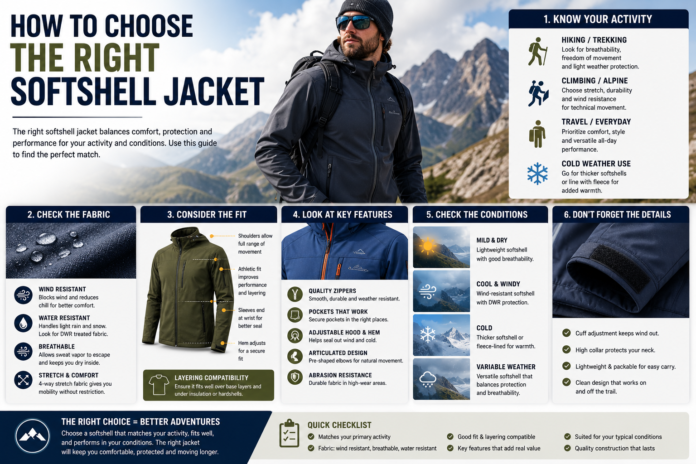
Softshell jackets look similar on the hanger. They feel similar at first touch. But take two different softshells into the mountains and the performance gap between a well-chosen and poorly-chosen jacket becomes immediately obvious. Knowing how to choose the right softshell jacket for your specific activity, conditions, and performance priorities saves you from expensive mistakes and genuinely improves your outdoor experience from the very first use. Here’s exactly what to consider.
Understand What a Softshell Actually Does
Before evaluating specific jackets, get clear on what softshells are designed for — and where they fall short. Softshell jackets optimize for stretch, breathability, and comfort during high-intensity physical activity in dry to lightly wet outdoor conditions. They provide genuine windproofing and water resistance — but they are not waterproof in sustained heavy rain.
This performance profile suits trail running, fast hiking, ski touring, climbing, and cycling in cold dry or lightly wet conditions where breathability and freedom of movement matter more than complete weather protection. Understanding this helps you evaluate softshells against the right criteria rather than judging them against hardshell waterproofing standards they were never designed to meet.
Match the Jacket to Your Primary Activity
The most important softshell selection decision is matching construction and weight to your primary use case. Different activities demand different performance priorities — and softshell manufacturers build specific designs around these different requirements.
High-intensity aerobic activities — trail running, ski touring, fast hiking — demand maximum breathability and minimal weight. Lightweight single-layer softshells with highly breathable face fabrics suit these applications. Heavier, fleece-lined constructions would cause overheating that undermines the entire performance purpose of choosing a softshell over a hardshell alternative.
Moderate-intensity activities — regular hiking, climbing, camping — suit mid-weight softshells with fleece or gridback linings that add comfort and mild warmth alongside wind and weather resistance. These constructions work as standalone outer layers across a wider temperature range than ultralight versions.
Hiking clothing specialists build softshells specifically around trail use requirements — with articulated knees, hem length optimized for pack hip belt compatibility, and pocket placement that works correctly with harnesses and backpack straps rather than being blocked by them.
Evaluate Fabric Construction and Weight
Softshell fabrics vary significantly in construction — and these differences directly impact performance across your specific activity and conditions.
Single-layer softshell fabrics — stretch woven face without interior lining — offer maximum breathability and minimal weight. They suit the highest-intensity applications where moisture management matters more than warmth or comfort against the skin.
Two-layer softshell fabrics — stretch woven face bonded to a grid fleece or smooth lining — add comfort and mild insulation while maintaining good breathability. They suit moderate-intensity activities across a wider temperature range.
Three-layer softshell constructions — face fabric, membrane, and interior backer bonded together — provide the closest softshell performance to hardshell weather resistance while retaining meaningful stretch and comfort advantages over rigid membrane jackets.
Fabric weight typically ranges from 200 to 400 g/m² across quality softshell constructions. Lighter weights suit warm-weather and high-intensity applications. Heavier weights suit cold conditions where the softshell functions as a primary warmth and wind protection layer.
Assess Stretch and Mobility
The stretch performance of a softshell fabric directly determines how freely you move during demanding physical activity — and this matters enormously for choosing how to choose the right softshell jacket for activities requiring full range of motion.
Four-way stretch fabrics allow simultaneous stretch in both horizontal and vertical directions — accommodating the multi-directional movement demands of climbing, skiing, and trail running without fabric pulling or binding at shoulders, elbows, and back. Two-way stretch provides horizontal stretch only — adequate for hiking and general outdoor use but limiting for technically demanding activities requiring overhead reaching and complex body positioning.
Test jacket mobility deliberately before purchasing — raise both arms fully overhead, swing arms across the body, and simulate a crouching position. Any pulling or restriction indicates either insufficient fabric stretch or incorrect fit for your body proportions.
Check Wind and Water Resistance Performance
All quality softshells provide meaningful windproofing — but water resistance varies significantly between constructions and price points. Understanding the water resistance level you need prevents choosing a jacket that disappoints in the conditions you actually encounter.
DWR treatments cause water to bead and roll off the face fabric surface rather than saturating it. Fresh DWR performs well in light rain — maintaining breathability by preventing face fabric saturation that blocks moisture vapor transmission from inside the jacket. DWR performance degrades with use and washing — requiring periodic refresh through tumble drying or specialist re-treatment products.
For activities in environments with frequent light rain — trail hiking, camping apparel use, general mountain activities — choosing a softshell with membrane lamination provides significantly more reliable light rain protection than DWR treatment alone. For severe or sustained rain, carry a packable waterproof jacket as emergency backup regardless of softshell quality.
Evaluate Fit for Layering and Activity
Softshell fit affects both performance and layering capability — and getting fit right matters as much as fabric choice for overall jacket performance.
Active fit — close to the body without restricting movement — suits high-intensity activities where excess fabric creates aerodynamic drag and thermal inefficiency. Active fit jackets layer cleanly over base layers without bunching during movement.
Regular fit — slightly roomier through the chest and shoulders — accommodates mid-layers underneath for cold weather use and suits moderate-intensity activities where pack weight and movement demands are lower than high-intensity applications.
Sleeve length should allow full arm extension without the cuff riding up and exposing wrist skin during overhead reaching. Hem length should cover the lower back during a forward bend — preventing cold air entry during uphill hiking and climbing positions that shorter hems fail to cover adequately.
Review Key Features for Your Use Case
Beyond fabric and fit, specific construction features determine how well a softshell serves your particular outdoor use case:
Hood design — helmet-compatible hoods suit climbing and ski wear applications. Packable hoods suit hiking and running where helmet compatibility isn’t needed. Some softshells offer no hood — suitable for activities where a separate hat provides adequate head coverage.
Pocket placement and quantity — chest pockets suit harness-wearing activities. Hip pockets work for general hiking and casual use. Internal pockets provide security for valuables during high-movement activities.
Cuff design — velcro adjustable cuffs seal against cold air entry. Elasticated cuffs provide quick-donning convenience without adjustment. Thumb loops maintain sleeve position during high-arm-reach activities.
Ventilation — pit zip vents allow rapid heat dumping during intense climbing or skiing ascents without jacket removal. Not all softshells include ventilation — relevant primarily for high-intensity applications where body heat generation significantly exceeds the jacket’s passive breathability capacity.
A professional softshell jackets manufacturer builds these features into specific jacket designs based on intended activity use — ensuring every construction detail serves the performance requirements of the target outdoor user rather than adding features without functional justification.
Consider Durability and Long-Term Value
Softshell face fabrics face significant abrasion from pack straps, rope contact, rock surfaces, and general outdoor use. Face fabric durability — measured in abrasion resistance cycles — determines how long the jacket maintains its performance and appearance across repeated demanding use.
Denier weight of face fabric yarns indicates durability — higher denier fabrics resist abrasion more effectively at the cost of slightly reduced stretch and breathability. Reinforced panels at high-wear zones — shoulders, elbows, and forearms — extend jacket lifespan significantly for activities involving regular contact with abrasive surfaces.
Brands building complete outdoor apparel ranges alongside outdoor jackets and hardshell jackets benefit from applying consistent durability standards across their entire jacket collection — because customers who trust one jacket from your brand extend that trust to every other product you produce.
Conclusion
Knowing how to choose the right softshell jacket comes down to matching fabric construction, stretch performance, water resistance level, fit, and specific features to your primary activity and the conditions you regularly encounter. A well-chosen softshell becomes one of the most-reached-for garments in any outdoor wardrobe — worn constantly across the conditions where its breathability and mobility advantages genuinely shine. Choose it thoughtfully and it rewards you with exceptional performance across hundreds of demanding outdoor days.
FAQs
How do I know if I need a softshell or hardshell jacket for my activity?
If your activity involves sustained heavy rain or severe mountain weather — choose a hardshell. If breathability and freedom of movement during high-intensity activity in dry or lightly wet conditions matter most — a softshell is the better choice.
Can a softshell jacket replace a waterproof jacket entirely?
For light rain and wind protection during high-intensity activity in moderate conditions — yes. For sustained heavy rain, serious mountain weather, or activities where getting wet creates safety risk — no. Always carry waterproof backup in unpredictable environments.
How should I care for my softshell jacket to maintain performance?
Wash according to manufacturer instructions using technical fabric wash products. Tumble dry on low heat to refresh DWR treatment. Avoid fabric softeners that block fiber breathability and degrade DWR coating performance over time.
Can softshell jackets be produced under a private label for outdoor brands?
Yes. Professional softshell manufacturers offer complete private label production with custom fabrics, stretch constructions, colors, hardware, labels, and packaging — giving outdoor brands full creative and commercial control over their softshell jacket collection.