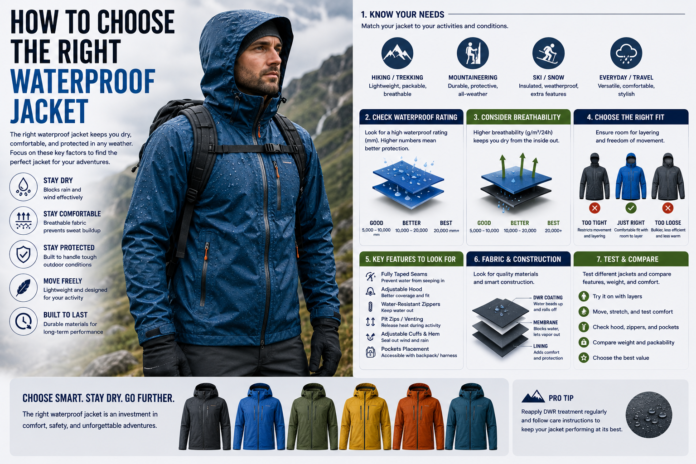
For outdoor enthusiasts, learning How to Choose the Right Waterproof Jacket is an essential skill. With so many waterproof jackets available today, finding the best option can feel overwhelming. This is especially true for brands entering the technical outerwear market or consumers looking for reliable protection in challenging weather conditions. Understanding How to Choose the Right Waterproof Jacket requires evaluating important factors such as fit, fabric construction, waterproof ratings, breathability, and performance features. By focusing on these key elements, you can confidently select a jacket that matches your environment, activity level, and weather protection needs.
Define Your Needs First
The most important aspect of buying a waterproof jacket is knowing exactly what you need it for. Depending on the outdoor activities you choose, the demands on waterproof outerwear vary significantly.
Activities that Require a High Jacket Performance
Activities such as running, ski touring, and fast hiking, produce a lot of body heat and a good deal of perspiration. For these types of activities, specific jacket features are required.
Breathability is the most important factor for any jacket in these situations. If a jacket has a high waterproof rating, but has bad breathability, you’ll just get wet from the sweat on the inside of the jacket. This defeats the purpose of a waterproof jacket.
For high output activities, you should get jackets with a breathability rating of 20,000g/m²/24h or higher. You should also consider jackets made from a lightweight softshell for conditions with little to no heavy rainfall. This is because softshell jackets are far more breathable than hardshell jackets, and are much lighter.
Static and Low-Output Activities
Low-output activities, like camping, fishing, and hiking, require a jacket that is primarily designed to keep water out. This is because the body does not generate as much heat, and moisture from sweat is not as important to manage as the water from the elements.
For activities that involve no body movement, a jacket that is primarily designed to keep water out of the jacket is ideal. These jackets may not have a high breathability rating, but their construction will keep water out. For this style of jacket, you can look for rainwear that is designed to keep the elements out of the jacket and is designed for sustained protection against inclement weather.
Important Technical Specifications
Once the activities are defined, the next step is to evaluate the important technical specifications that impact jacket performance. These specifications will appear on a product or material data sheet, and will help you to differentiate the jackets.
Waterproof Rating
The waterproof rating indicates the amount of water that a fabric can hold before it begins to leak, and is measured in millimeters.
A jacket rated at 10,000mm can stand up to a column of water that is 10,000mm high. In theory, 10,000mm can withstand water intrusion during most outdoor activities. 20,000mm and higher is warranted for extended alpine activities during heavy, continuous rainfall.
The construction of a seam plays a critical role in the waterproof performance of a jacket as does a fabric rating. Fully taped seams cover all stitch lines and prevent water intrusion at the seams. The critical tape seams cover the main structural seams and are adequate for less severe weather conditions at a lower price point. Fabric ratings and construction of seams are equally as important when evaluating a jacket.
Breathability Rating
The breathability rating documents a fabric’s capacity to pass moisture vapor. It is the amount of moisture vapor in grams that the fabric can transmit, measured per square meter, and occurring in a 24 hour period. Ratings of 10,000g are adequate for most outdoor activities and hiking. Breathability ratings of 20,000g and above are suited for activities of such a high degree of output that significant moisture vapor is produced.
Breathability is also performance rated against temperature and humidity. Most membranes perform better when the outside temperature is higher than the inside temperature of the jacket. Knowing what temperature and conditions the jacket will perform best in will aid in determining the breathability ratings.
Layering of Construction
Layering in the construction of waterproof jackets impacts the performance, weight, and durability of the jacket.
The two-layer construction system uses a separate hanging inner lining that bonds the membrane to the outer fabric, building a lighter and cheaper jacket – suited for general outdoor activities. Going a step further, a two and a half layer system aids base membranes with patterns for super lightweight applications, again eliminating the need for a lining.
With a three-layer system, a membrane is bonded with both the outer fabric and lining made of a single composite fabric. This construction builds the most durable jackets and the most technical and highest performance jackets. Every brand building hardshell jackets for demanding alpine or mountaineering applications should insist on three-layer builds for their standard.
How to Get the Right Jacket for Your Needs
Knowing the difference between the jacket types available should assist the buyer greatly as each type is designed for a specific range of activities and conditions.
Hardshell Jackets
Hardshell jackets are designed to handle the worst of the weather. Using waterproof, breathable membrane fabrics with fully taped seams, technical features like hoods that accommodate helmets and underarm ventilation zips are included. Hardshell jackets are designed for the worst weather, so they are heavier and less packable than softshell or windbreaker jackets.
If your brand is designing technical hardshell outerwear, our hardshell jacket manufacturing services will assist you from design to manufacture.
Softshell Jackets
Softshell jackets convenience the stretch and breathability of the fabric, but compromise full weather protection.
They are designed to be used in environments where heavy downpours are not frequent, where continuous sustained physical activity is the norm, and where the system utilizes the outer layer of the system for the cool and dry, or the lightly moist environments.
In addition, softshell jackets are more comfortable than hardshell jackets, during physical activity. This makes softshell jackets the better choice during physical activities where freedom of movement is needed as well as protection from the elements. Our softshell jackets manufacturing capabilities include everything from fabric selection to bulk production — contact us to start your softshell development today.
Windbreaker jackets
By far the lightest and most packable in the line of waterproof outerwear, windbreaker jackets are the best choice where only the most lightweight and waterproof outerwear is needed. They make the perfect addition to gear for any activity that could possibly change along the way, as they effectively fend off wind and light rain and, pack down into their own pocket. They are, however, not meant for prolonged heavy rain.
Windbreakers are the best choice for cycling, trail running, and travel. Our windbreaker jackets manufacturing is the best addition to any lightweight, waterproof outer layering collection.
Waterproof Insulated Jackets
Waterproof insulated jackets provide protection from the elements on the outer layer, and the insulation needed on the mid-layer, simplifying jacket systems for cold and wet environments. They help to fulfill the needs of cold weather camping, winter hiking, and ski day jackets.
They also help to simplify the decision for insulation for cold and wet environments, as they influence the mid-layer insulation choice significantly.
Synthetic fill is more useful in damp environments as it retains heat in wet conditions. Down has a better warmth-to-weight ratio in dry conditions. Our puffer jackets manufacturing team can help you choose the correct insulation and construction solutions for your product. Contact us to begin.
Fit Considerations for Waterproof Jackets
Fit is often the most overlooked aspect when it comes to choosing a waterproof jacket. But it has a big impact on both the effectiveness and comfort of the jacket in the real outdoor environment.
Layering Clearance
Waterproof jackets need space to fit the layers underneath, whether they be base layers and/or mid layers, and must fit without restriction and without the compression being uncomfortable. Therefore, it is normally the case when choosing a waterproof jacket to select a larger size than your normal casual fit jacket.
Hood Design and Fit
Of all the features of a waterproof jacket, the hood has the most importance. A good hood design retains its position when you move, covers the forehead without a total view blockage and seals around the facial opening to keep the elements out. When looking at waterproof outerwear designed specifically for the Alps and skiing, a hood that fits over a helmet is a must. For all other hiking and camping the hoods that provide the best fit and coverage are the adjustable three-point hoods.
Hem, Cuff, and Collar Sealing
Along with the Rocky Mountain Range, the hems, cuffs, and collar are the most popular seepage and leakage points for waterproof jackets.
Adjustable hem draw cords, Velcro or snap cuff closures, along with a high collar and chin guard, help block rain at major entry points. Also, a storm flap over the front zip keeps rain from entering along the zip teeth during torrential rain.
What to Look for in Waterproof Jacket Features
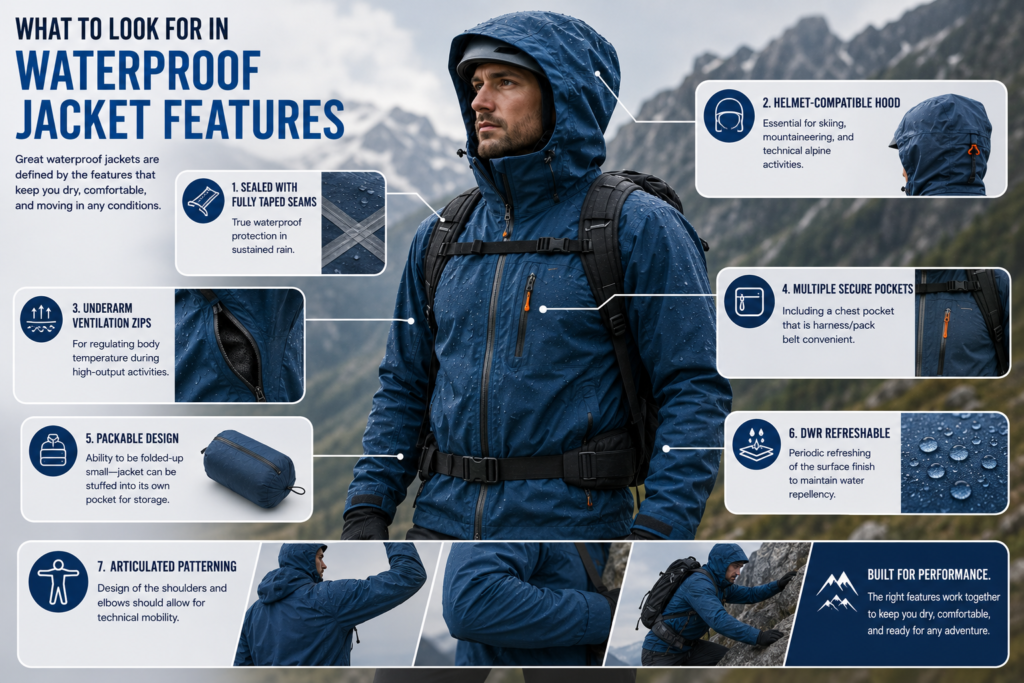
Beyond the technical specifications and fit, there are features that determine the quality of the design of a waterproof jacket. Look for the following:
- Sealed with Fully Taped Seams — True waterproof protection in sustained rain.
- A Helmet-Compatible Hood — Essential for Skiing, Mountaineering, and Technical Alpine Activities.
- Underarm Ventilation Zips — For regulating body temperature during high-output activities
- A Number of Secure Pockets, including a Chest Pocket that is Harness/Pack Belt Convenient.
- Ability to be Folded-Up Small — Jacket can be stuffed into its own pocket for storage.
- Ability to be DWR Refreshed — Periodic refreshing of the surface finish to maintain water repellency.
- Articulated Patterning — Design of the shoulders and elbows should allow for technical mobility.
Choosing a Waterproof Jacket Manufacturer for Your Brand
If you are building an outdoor apparel brand and adding waterproof jackets to your range, choosing the right manufacturing partner is as important as choosing the right fabric and construction. A specialist waterproof clothing manufacturer brings the technical expertise — membrane sourcing, seam taping, hardware selection, and quality control — that general apparel factories simply cannot match.
Additionally, working with a manufacturer experienced across the full outdoor jacket category — including outdoor jackets production across multiple styles and constructions — gives your brand the production versatility to build a cohesive outdoor outerwear range from a single trusted partner.
Ready to start developing your waterproof jacket range? Contact our team today — we support brands at every stage of the development process, from initial fabric selection and tech pack development through to bulk production and delivery.
Conclusion
Knowing how to choose the right waterproof jacket comes down to four connected decisions — understanding your activity and its specific performance demands, interpreting technical specifications accurately, selecting the right jacket type for your conditions, and evaluating fit and features against your real-world use requirements. When these four decisions align, the result is a waterproof jacket that genuinely performs — keeping you dry, comfortable, and protected through whatever the outdoors delivers.
Whether you are a brand developing your next outdoor collection or a buyer choosing a jacket for your next adventure, starting with these four decisions gives you the clarity and confidence to choose correctly every single time.
FAQs
What waterproof rating do I need for hiking in heavy rain?
A waterproof rating of 20,000mm and above with fully taped seams suits sustained heavy rain during hiking. For general outdoor use in moderate conditions, 10,000mm is adequate.
Is a higher breathability rating always better?
Higher breathability ratings deliver better moisture management during high-output activities — but in low-exertion contexts, the difference is less significant. Match the breathability rating to your activity’s intensity level rather than always choosing the highest available rating.
What is the difference between fully taped and critically taped seams?
Fully taped seams seal every stitch line on the jacket for maximum waterproof protection. Critically taped seams cover only the main structural seams — appropriate for moderate conditions at a lower production cost.
How should a waterproof jacket fit over layers?
A waterproof jacket should have enough room to accommodate a base layer and mid-layer beneath it without restricting movement or creating uncomfortable compression — typically one size larger than a standard casual fit.