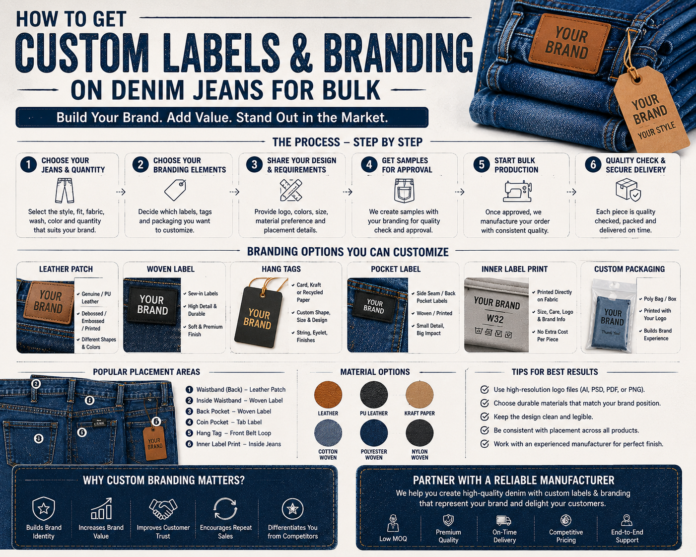
Branding denim goes far beyond just stamping on a logo. Denim has more branding touchpoints than any other article of clothing. Moreover, each of these touchpoints has to be executed precisely, consistently, and uniformly across every pair that is made in bulk.
Brand your jeans the right way, and each one strengthens your branding when it is delivered to the customer. Brand them poorly, and customers will show off the inconsistencies of your jeans. They will also let you know why they are returning the product and which stores are reporting poor audits.
This guide covers the branding points for denim jeans, the touchpoints, and how to produce in bulk consistently.
Why Labels & Branding on Denim Jeans Are Different
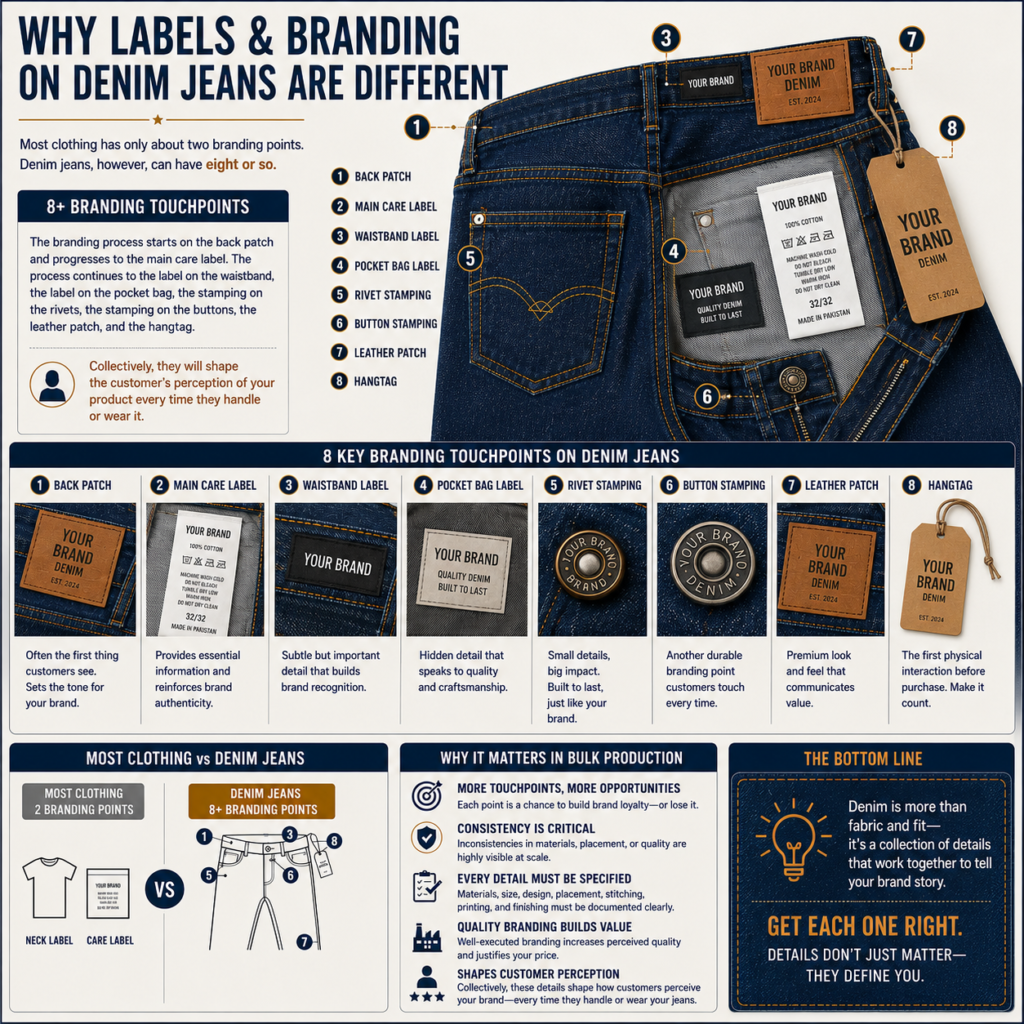
Most clothing has only about two branding points. Denim jeans, however, can have eight or so. The branding process starts on the back patch and progresses to the main care label. The process continues to the label on the waistband, the label on the pocket bag, the stamping on the rivets, the stamping on the buttons, the leather patch, and the hangtag. Collectively, they will shape the customer’s perception of your product every time they handle or wear it.
The layering process leaves many touchpoints for denim jeans and creates many places to execute branding properly (and improperly). In bulk production, denim jeans will create a myriad of touchpoints, and each will have to be specified and branded accurately.
The Back Patch: Your Most Visible Brand Statement
The biggest branding element of a pair of jeans is the patch that goes on the back right side, at the rear waistband. Since that’s the first thing people see when looking at someone from behind, it sets the standard for the rest of the brand experience.
The material for back patches includes leather, vegan leather, woven fabric, or paper card. Leather and vegan leather are the premium standard. They elongate the life of the patch, but also serve as an unspoken signal for high quality before the stitching or hardware is seen.e.
For brands building in the private label denim space, the back patch is often the most important customisation decision — it’s what visually separates your branded product from the base garment.
Specify the patch material, dimensions, logo emboss or print method, and attachment stitching precisely in your tech pack. Inconsistency in patch placement — even by a few millimetres — is visible at a glance.
Waistband Labels and Flag Labels
The main care and composition label is located at the inner center back of the waistband. This label must meet the standards of the markets you sell into. The label must correctly state the care instructions and the fiber contents. The origin and size must also be stated on the label.
The left side of the waistband has another small attachment called the Flag label. This label is also a secondary branding opportunity. This is where a brand may decide to place its logo or a small branding attachment.
Both labels need to be consistent in placement, print quality, and attachment across every unit. A denim apparel manufacturer with experience in international market labeling requirements can guide you through what each label must include, so you don’t need to reprint and relabel after production.
Rivets and Button Stamping
Rivets and fly buttons are structural elements that also serve as places to communicate your brand. By adding your brand name and/or logo to a rivet or button, you are creating a detail that your customers will appreciate.
Both the quality of the rivet and/or button and the quality of the stamp matter. A solid, deep, clean stamp communicates that your product is quality; a shallow, off-centre stamp communicates the opposite.
Specify rivet and button material, finish, stamping depth, and logo or text precisely in your tech pack. Confirm consistency across a minimum of ten units before approving bulk production. A denim jeans manufacturer with strong hardware sourcing will have clear specifications for their rivet and button suppliers — and will provide approval samples before bulk stamping begins.
Pocket Bag Labels and Interior Details
Interior branding builds customer delight after the purchase. With the ‘pocket bag’ interior branding label feature, premium denim customers are justifiably proud to display labels woven into the front pocket.
They may be even prouder to own brands with even more creative branding, like branded pocket bag fabric, stamp logos on the inner waistbands, or coin pocket stitches.
These interior details cost relatively little to add but significantly increase the perception of quality and brand intention. For brands producing streetwear denim or premium fashion jeans, interior branding is a meaningful differentiator.
Hangtags and Packaging
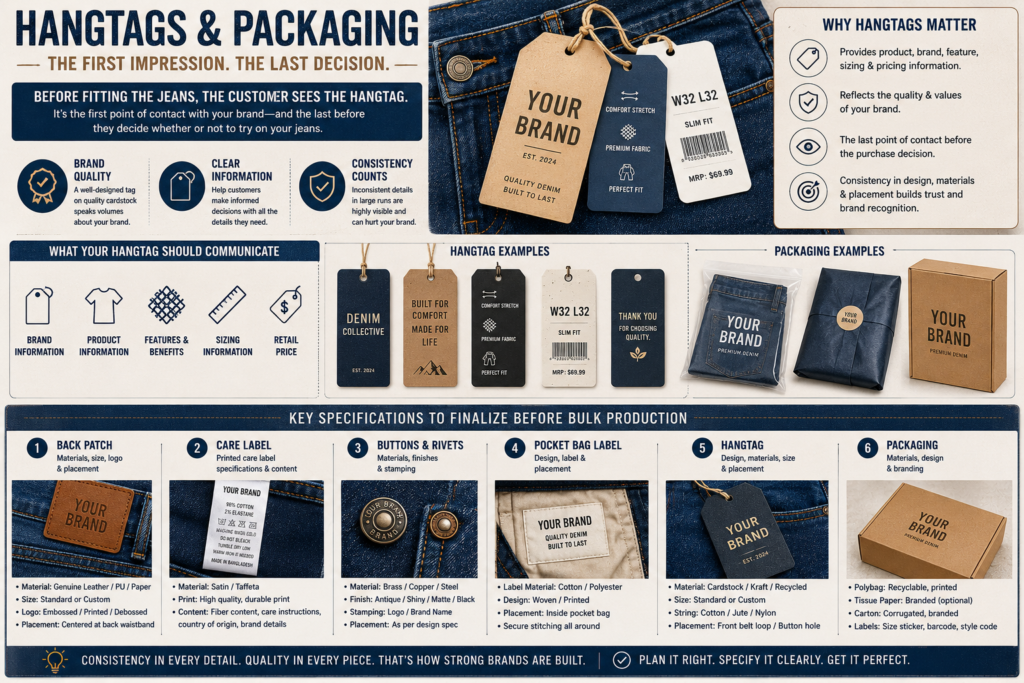
Before fitting the jeans, the customer sees the hangtag, which serves as the first point of contact for the brand. The hangtag provides the customer with product information, brand information, useful product features, sizing information, and recommended retail price. The hangtag is the customer’s last point of contact before deciding whether or not to try on the jeans.
Hangtags are evidence of the brand’s quality. A hangtag with a fuzzy logo on flimsy cardstock is a reflection of the brand. A tag on quality cardstock with a logo printed on the tag with quality and care communicates a different message.
Attention to consistency is key. A detail that’s easily dismissed, like consistent positioning during a large run, is highly visible when it is inconsistent.
The specifications to be detailed before a large production run include the following:
- Materials, size, logo, and placement of the Back Patch
- Printed care label specifications and content
- Specifications of button and rivet materials, finishes, and stamping
- Design of the pocket bag label and the label’s placement
- Specifications of hangtag design, materials, size, and placement
Conclusion
Labels & branding on denim jeans are extremely vital, as they are essential to the product. The labels placed on the denim and bag patches help communicate the brand. Be sure to detail and document everything with a manufacturer that values consistent branding just as much as construction quality.
When you’re ready to develop your branded denim collection, explore the full range of denim jeans manufacturing options and find the right production partner for your brand.
FAQs
What are the main branding touchpoints on a pair of denim jeans?
Back patch, care label, waistband flag label, rivets, fly button, pocket bag label, and hangtag — each one contributing to the overall brand experience.
What material should a denim back patch be made from?
Leather and vegan leather are the premium standard. Woven fabric and paper card are also used — at lower price points or for brands with specific aesthetic preferences.
Do rivets and buttons need to be branded?
Not always — but stamping your brand name or logo into the rivet and button face adds a premium detail that customers notice and significantly elevates perceived quality.
How do I ensure branding consistency across a large bulk run?
Document every branding specification precisely in your tech pack, approve a fully branded sample before bulk begins, and confirm in-line checks for branding placement throughout production.