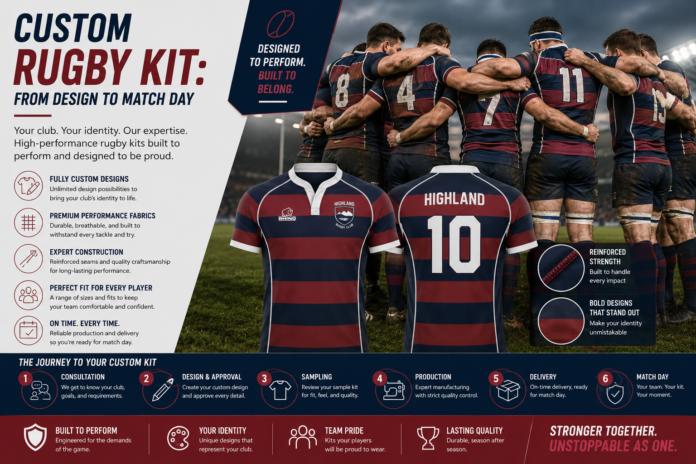
Every rugby club needs a fully functional kit that withstands the demands of match day and a full season of play, while also reflecting the identity of the club. Creating a custom rugby kit is a lot more than a design brief with some color selections and a club logo with a print. Each step of the process from initial design to final delivery is a dedicated effort with a manufacturing partner of choice. It provides each group with the knowledge and the understanding for each step of the process, and how to make the best possible choices for a kit that the team is going to be proud to wear.
Why a Custom Rugby Kit Matters for Your Club
A good quality, custom rugby kit showcases the identity of a club on and off the pitch. It also builds team unity, improves confidence, and holds the professional presence the club needs in each competitive engagement. Quality custom kits also improve performance, as they hold up to the various pulls, scrums, and tackles that wear down inferior jerseys and kits. Failing to plan a custom rugby kit can end up in a several poor quality custom kits that are a mismatch in color, size, and the worst of all a kit that is delivered after the start of the season which can leave a team with no kit during the season.
Stage One: Outlining Your Personal Rugby Kit Requirements
The first step of any custom rugby kit project is the outline of a brief capturing your design expectations, required level of performance and any constraints your club may have. An effective rugby kit brief will have the following sections: your design expectations, performance requirements, and budget and time constraints. This section will provide you guidance on what to include when drafting each of these sections.
Design Expectations
The first section of your kit brief is design expectations. Start by including your club’s colors, any logos or branding your club may have, and final decisions on kit components (i.e. socks, shorts, jerseys). The design expectations section will also capture any club kit design preferences (i.e. vertical stripes, horizontal stripes, sublimated, etc.). Having a thorough design preferences section will eliminate any costly design revisions during development and ensure a design reference is available for all stakeholders.
Performance Requirements
In addition to aesthetics, the project brief should also capture required performance standards for the custom rugby kit. Some things to consider are which fabrics and textiles will be required and which construction methods will be appropriate based on the intended performance level of the kit. For instance, are reinforced seams and grip fabrics required for the kits, or will a basic construction be acceptable? Performance fabrics are also helpful in getting the desired effect of a high performance kit (i.e. moisture management).
Budget & Time Constraints
Setting a realistic budget and confirming a delivery date will make a manufacturer’s job much easier. Since design and order requirements dictate how busy a manufacturer will be, a project deadline will determine how realistic your requirements are.
Aligning budget and timeline expectations ensures preferred suppliers are able to meet your requirements and avoids the frustration of realizing your preferred supplier cannot meet your season start date.
Stage Two: Design Development and Digital Mockups
Design Development takes the approved brief and creates visual representations of the concept for stakeholder feedback and approval.
Creating Technical Design Files
Before a manufacturer can start production, they need technical design files. These files need to specify color codes, the size of logos, and details of patterns. Designers who understand sportswear can help ensure your digital mockups are translated to garments. To help ensure your printed mockups are the correct size and resolution, provide your digital mockups in vector format and to scale.
Reviewing and Approving Mockups
Digital mockups show clubs what their kits will look like. These mockups are shown in front, back, and sleeve views. Before production, kits can be changed; changes to mockups are reviewed for color, proportion, and placement of branding. These mockups are reviewed and approved by design stakeholders to help ensure support for the design. These stakeholders can include club members and sponsors.
Stage Three: Fabric Selection and Construction Specifications
Design approvals require the selection of fabrics and construction details to help realize the vision of the kits on the pitch.
Choosing the Right Fabric for Your Level of Play
Elite fabrics are heavy-duty fabrics that have resistive construction and grip fabric panels. Community and youth clubs may prioritize fabrics that are durable and cost efficient.
Furthermore, fabric panels that stretch in the side and underarm panels enhance players’ movement and are worth their inclusion regardless of budget. Thus, fabric specifications of the apparel should be matched to the level of competition to ensure the right investment in the apparel, without overspending or underspending on the specifications of the Racing apparel.
Construction Specifications
Besides the fabric specifications, outlining construction specifications of the apparel, such as type of seams, collar, and stitching of the stress points, determines the durability and comfort of the apparel. For instance, Flatlock seams provide comfort during contact and a reinforced collar is constructed so that it does not stretch from being grabbed repeatedly. Hence, giving construction specifications in addition to the design of the apparel aids the manufacturers in fabricating the apparel that provides the right functionality from the first match.
Step 4: Sampling and Fit
Review
Sampling provides the first opportunity in the custom rugby kit development process for clubs to physically check the accuracy of their design and the fit before the bulk production occurs.
Sending Out Request for Physical Samples
You must always request physical samples in 2 or 3 sizes at a minimum before agreeing to bulk production, as digital mockups will not accurately show the final product as fabric, color, and construction details will on a finished garment. During this step, check color accuracy against provided design approval files, check seam construction and collar finishes, check GSM of fabric, and weigh the fabric. During this step, it is important to keep in mind that this step adds time to the process; however, it is better to add this time than to incur the expense of a subpar production run.
Player Fit Tests
Rugby players are a heterogeneous group due to the number of different positions and body types that exist, so sampling and player fit tests are the first opportunity to get fit feedback from actual players.
We request players replicate match movements, including scrumming, lineout lifts, and passing, during fit tests to ensure kits accommodate movement. Player feedback, particularly by position, helps us refine fit prior to beginning mass production, which will finalize production specifications.
Stage Five: Mass Production and Quality Assurance
Following sample approval, mass production is initiated. Quality assurance takes the following form:
- Color Checks: Assurance the correct and matching colors are used across the fabric and prints.
- Seam Checks: Assurance samples and orders have seams that are reinforced and constructed to the standards.
- Size Checks: Assurance samples and orders are constructed to the correct size.
- Stress Checks: Assurance samples and orders have the correct line construction on the stress points and the collar.
- Grip Checks: Assurance match wear jerseys have the correct construction and coverage of grip panels.
- Damage Prevention: Assurance the orders have been prepared for transit and arrive in the correct condition.
Adhering to these steps provides confidence to clubs and kit managers that the completed orders can be distributed to the squad.
Stage Six: Delivery and Pre-Season Distribution
Custom rugby kits are distributed to players for use prior to the commencement of the season.
Ensure the quantity of jerseys received matches the order and examine a sample for defects. Take concerns to the manufacturer before the schedule is released. It is also wise to set the delivery date before the first game in order to avoid disruption to the first matches if unexpected problems occur.
If your club is looking to broaden the range of custom kits beyond jerseys, you can explore Rugby apparel to find training shorts and warm up tops as well as supporter merch that can all be customized to match your design. You can also find sportswear that helps clubs and organizations that sponsor multiple sports to customize apparel for rugby, Soccer apparel and others while maintaining the same look and feel.
Custom Rugby Kits You Can Trust
Getting a custom rugby kit on to the pitch from the first brief is only possible if the manufacturer has a lot of experience making contact sport apparel. Whether your club is elite or community based, a manufacturer who knows about grip fabrics, reinforced seams and the right type of performance fabrics will help you create a kit that will see you through a full season.
We are a custom kit manufacturer and we help clubs and brands create custom rugby kits that consider the budget and quality. If you are interested in starting a kit project, contact us with details on design, fabrics and when you would like to have the kits by.
Conclusion
There are many stages involved when creating a custom rugby kit. After the design brief stage, the journey consists of choosing the concepts, fabrics, and samples, and then planning the bulk production, and then the final commutation. Each stage is vital in ensuring the kit matches the club’s identity and withstands match conditions for the full competitive season. The relationship with a qualified manufacturing partner is vital. A partner who understands the construction requirements of contact sports will make every stage of the process much more assured and of a much higher quality.
FAQs
How long does it take to develop a custom rugby kit?
The full development process from initial brief to final delivery typically takes two to four months, depending on design complexity, sampling rounds, and production volume. Starting the process well before your season launch date helps avoid timing pressure.
What fabric works best for a custom rugby kit?
Heavy-duty polyester blends offer the best combination of durability, moisture management, and shape retention for competitive rugby. Adding stretch panels in the underarm and side sections improves movement without compromising the fabric’s resistance to contact forces.
Should I always request samples before bulk production?
Yes, requesting physical samples before bulk production allows you to verify color accuracy, construction quality, and fit before the full order is committed. Skipping this step frequently leads to costly issues that are difficult and expensive to resolve after bulk production is complete.
Can I include sponsor logos on a custom rugby kit?
Yes, sublimation printing, embroidery, and screen printing all allow for sponsor logo placement on jerseys, shorts, and training wear. Confirming logo placement and sizing with sponsors before finalizing your design files helps avoid revision delays during production.