Every fashion brand eventually faces this question — oversized or fitted? Both styles have passionate customer bases. Both generate strong sales in the right collections. But understanding exactly where oversized t-shirts vs fitted t-shirts stand in 2025 helps brands make smarter product decisions rather than following assumptions that may no longer reflect current market reality. Here’s a clear, honest breakdown of both styles and what they mean for your brand right now.
The Rise and Reign of Oversized T-Shirts
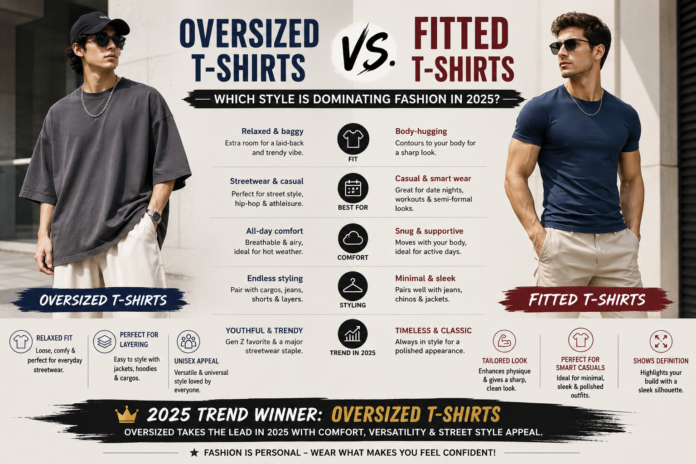
Oversized t-shirts have dominated streetwear and casual fashion for several years — and in 2025 that dominance continues without significant signs of slowing. The deliberately large silhouette — dropped shoulders, extended body length, wide chest — communicates the relaxed confidence that contemporary fashion culture celebrates consistently across social media, music, and youth culture globally.
What makes oversized t-shirts commercially powerful is their universal appeal. They work across genders, body types, and styling approaches without requiring any particular fashion expertise to wear well. A customer who buys an oversized tee from your brand wears it constantly — and that repeated visibility builds brand recognition organically every single time they step outside.
Oversized styles perform strongest in:
- Streetwear collections targeting youth and urban markets
- Unisex and gender-neutral fashion brands
- Graphic tee collections where print impact benefits from larger canvas
- Brands building around heavyweight premium fabrics and luxury casualwear positioning
- Co-ord collections paired with matching joggers or wide-leg bottoms
Heavyweight cotton between 220 and 280gsm gives oversized t-shirts the structure and premium hand-feel that customers expect at mid to premium price points. Lightweight fabric in an oversized cut looks and feels cheap — and customers notice immediately at the moment of purchase.
The Enduring Strength of Fitted T-Shirts
Fitted t-shirts never truly go out of style — because they serve fundamental human needs that fashion trends cannot eliminate. A well-fitted t-shirt flatters the body naturally, layers cleanly under jackets and outerwear, and works effortlessly across casual, smart-casual, and semi-formal contexts simultaneously.
In 2025, fitted t-shirts are experiencing a genuine resurgence — particularly in markets responding to the clean, minimal aesthetic that positions itself as a counterpoint to years of oversized dominance. Slim-fit and classic-fit styles are performing strongly across men’s fashion specifically — driven by customers who want the contemporary aesthetic without the extreme volume of oversized silhouettes.
Fitted t-shirts work best for:
- Casual wear brands targeting professional and smart-casual markets
- Premium basics collections built around fabric quality and precise construction
- Brands targeting older demographics who prefer polished, tailored casual dressing
- Layering pieces under fashion jackets and knitwear
- Athletic crossover collections where body-conscious silhouettes matter
Mid-weight cotton between 160 and 200gsm suits fitted t-shirts well — light enough for comfortable all-day wear while providing enough body to hold the clean, structured silhouette that makes fitted styles genuinely flattering rather than simply tight.
Oversized vs Fitted: 2025 Market Comparison
| Feature | Oversized T-Shirts | Fitted T-Shirts |
|---|---|---|
| Current Trend Strength | Dominant in streetwear | Resurgent in premium and minimal markets |
| Gender Appeal | Strongly unisex | Broad — particularly strong in menswear |
| Fabric Weight | 220 to 280gsm recommended | 160 to 200gsm recommended |
| Styling Versatility | Extremely high | High — especially for layering |
| Best Market Segment | Streetwear and youth fashion | Premium basics and smart-casual |
| Social Media Performance | Very strong — photographs powerfully | Strong in clean and minimal aesthetics |
| Price Point Potential | Mid to premium | Mid to premium |
| Body Type Universality | Excellent | Good with correct sizing |
What the Data Tells Us About 2025
Oversized t-shirts maintain the stronger overall market position in 2025 — particularly in streetwear, youth fashion, and social media-driven brand building. Their broad demographic appeal and powerful visual impact on platforms like Instagram and TikTok give them a commercial advantage that fitted styles struggle to match in purely volume terms.
However, fitted t-shirts are gaining ground meaningfully — particularly among consumers experiencing what fashion analysts describe as silhouette fatigue with extreme oversized proportions. Clean, well-fitted basics are resonating strongly with premium consumers who prioritize fabric quality, precise construction, and understated elegance over volume and graphic impact.
The most commercially successful brands in 2025 aren’t choosing one style over the other. They’re building both into their collections — serving the oversized customer with heavyweight streetwear pieces and the fitted customer with premium basics that justify their price through quality rather than trend alignment.
A professional t-shirts manufacturer produces both silhouettes with the pattern precision and fabric expertise each style requires — ensuring your oversized pieces have genuine structure and your fitted pieces have accurate proportions across every size in your range.
Building Both Styles Into Your Collection
Brands that offer both oversized and fitted t-shirts within a cohesive collection serve a significantly wider customer base without fragmenting their brand identity — provided both styles maintain consistent fabric quality, brand detailing, and construction standards throughout.
The key is intentionality. Your oversized styles should feel deliberately oversized — structured, weighty, and proportionally considered. Your fitted styles should feel precisely fitted — not just smaller versions of the same blank. Each silhouette requires its own pattern development, fabric weight selection, and construction approach.
Expanding beyond t-shirts into co-ord sets, tracksuits, and hoodies becomes significantly more efficient when your manufacturing partner already understands your fit philosophy and quality standards across both t-shirt silhouettes — maintaining collection cohesion without starting from scratch with every new product development.
Working with a trusted fashionwear manufacturer ensures that collection cohesion is maintained consistently — from first sample through bulk production and every reorder that follows as your brand grows.
Conclusion
In the oversized t-shirts vs fitted t-shirts debate for 2025, oversized maintains its dominant market position — but fitted styles are staging a meaningful resurgence that smart brands are already responding to. The most commercially successful approach isn’t picking one winner — it’s understanding what each silhouette delivers, which customer each one serves, and building both into your collection with the intentionality and quality that turns first-time buyers into loyal customers who return for every new drop your brand releases.
FAQs
What fabric weight works best for oversized t-shirts in 2025?
220 to 280gsm heavyweight cotton delivers the structure, drape, and premium hand-feel that makes oversized t-shirts feel intentional and luxurious rather than simply large and shapeless.
Are fitted t-shirts making a comeback in 2025?
Yes. Fitted t-shirts are experiencing a genuine resurgence — particularly in premium basics, menswear, and minimal aesthetic markets responding to years of oversized silhouette dominance across mainstream fashion.
Can oversized and fitted t-shirts be produced in the same collection?
Absolutely. Many successful brands offer both silhouettes within cohesive collections — each in appropriate fabric weights with individual pattern development that serves each silhouette correctly.
Which t-shirt style generates stronger social media performance for fashion brands?
Oversized t-shirts currently generate stronger social media engagement — their visual impact, graphic canvas size, and styling versatility create more dynamic content that performs well across Instagram, TikTok, and Pinterest platforms.