Tactical apparel doesn’t get a second chance. When professionals and outdoor enthusiasts depend on their clothing in demanding environments — law enforcement, military operations, hunting, hiking, or extreme outdoor conditions — every feature either performs or fails. There is no middle ground. Understanding the 10 features of tactical apparel that separate genuinely high-quality gear from inadequate alternatives helps brands build products that professionals trust and customers recommend without hesitation.
Durable Fabric Construction
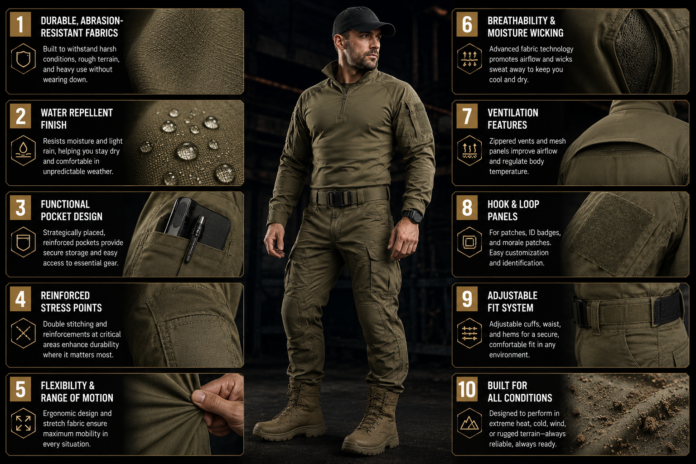
High-quality tactical apparel starts with fabric that withstands serious punishment. Ripstop nylon, reinforced polyester blends, and Cordura fabrics resist tearing, abrasion, and puncture across demanding daily use. The ripstop weave pattern specifically prevents small tears from spreading — maintaining garment integrity even when fabric contacts sharp surfaces repeatedly.
A professional tactical outdoor apparel manufacturer selects fabric weight and construction specifically for the intended use environment — lighter weight for mobility-focused applications, heavier construction for maximum protection and durability requirements.
Moisture Management and Breathability
Tactical users generate significant body heat during physical activity — and staying dry directly impacts both comfort and operational performance. Quality tactical apparel uses moisture-wicking fabric constructions that pull sweat away from the skin surface and transfer it toward the outer fabric layer for rapid evaporation.
Breathable membrane technologies — including Gore-Tex and similar constructions — allow moisture vapor to escape while preventing external moisture from penetrating. This combination keeps wearers dry from both inside and outside simultaneously — a critical performance requirement for waterproof clothing used across demanding outdoor environments.
Freedom of Movement
Tactical apparel must never restrict the movement its wearer depends on. Articulated knees, gusseted crotches, stretch panels, and strategic seam placement all contribute to freedom of movement that allows running, climbing, crouching, and reaching without fabric pulling, binding, or restricting.
Four-way stretch fabric panels in high-movement zones — shoulders, elbows, knees — are particularly valuable for hiking pants and tactical bottoms where lower body mobility is constantly demanded across varied terrain and physical activity levels.
Strategic Pocket Placement and Organization
Tactical users need quick, reliable access to equipment, tools, and supplies without breaking operational focus. Quality tactical apparel features thoughtfully positioned pockets — chest pockets, thigh cargo pockets, hidden internal pockets, and sleeve pockets — each designed for specific storage purposes with secure closure systems.
Zipper pockets, button flaps, and Velcro closures each serve different security and access speed requirements. Outdoor cargo pants with properly designed pocket systems allow users to carry essential equipment without requiring external bags or pouches that reduce mobility and operational efficiency.
Weather Protection
Tactical apparel must perform across unpredictable weather conditions without requiring complete outfit changes mid-operation. Water resistance, wind protection, and thermal regulation work together to protect wearers across changing environmental conditions.
DWR (Durable Water Repellent) treatments cause water to bead and roll off fabric surfaces rather than saturating the material. Waterproof jackets with fully seam-sealed construction and waterproof zippers provide complete weather protection for tactical users operating in wet environments where saturated clothing creates serious performance and safety risks.
Camouflage and Low-Visibility Options
Tactical users in hunting, military, and law enforcement applications frequently require clothing that minimizes visual detection across specific environments. Quality camouflage clothing uses scientifically developed pattern designs that break up the human silhouette against specific terrain backgrounds — woodland, desert, arctic, and urban environments each requiring distinct pattern approaches.
Beyond visual camouflage, advanced tactical apparel increasingly incorporates infrared-reducing treatments that minimize detection by night vision equipment — a critical requirement for professional military and law enforcement applications.
Reinforced High-Stress Points
Tactical apparel experiences significantly more stress at specific construction points than standard clothing. Knee areas, elbow patches, seat panels, pocket openings, and belt loops all receive concentrated wear and force during tactical activity. Quality manufacturers reinforce these points with additional fabric layers, bartack stitching, and abrasion-resistant material patches.
Pre-shaped knee panels with internal padding pockets — allowing users to insert protective pads — add genuine functional value for users who spend extended periods kneeling on hard or rough surfaces during operations or outdoor activities.
Temperature Regulation Across Conditions
Tactical users often transition rapidly between high-intensity physical activity and stationary observation or waiting — creating significant body temperature fluctuation that poor clothing management handles badly. Quality tactical apparel addresses this through layering system compatibility and smart thermal regulation features.
Base layer clothing works with softshell jackets and outdoor fleece to create adaptable layering systems that users adjust quickly as activity levels and environmental temperatures change — maintaining comfortable core temperatures without carrying excessive clothing weight.
Secure and Silent Closure Systems
Velcro closures offer quick access but generate significant noise during operation — unacceptable in situations requiring silence. Quality tactical apparel balances security, speed, and silence across its closure systems — using YKK zippers for durability and smooth operation, button snaps for silent secure closure, and strategic Velcro placement only where noise impact is acceptable.
Magnetic closures represent emerging technology in tactical apparel — offering silent, quick-release functionality that neither traditional Velcro nor zipper systems can match for specific tactical applications.
Durability Through Repeated Use and Washing
Tactical apparel gets worn hard and washed frequently. Construction quality that maintains performance through hundreds of wash cycles — retaining DWR treatments, shape, color, and structural integrity — separates genuinely durable tactical gear from products that look impressive in showrooms but deteriorate rapidly under real operational conditions.
Brands building comprehensive outdoor apparel ranges that include hunting apparel and hardshell jackets benefit from working with manufacturers who test garments through accelerated wear and wash cycles — verifying performance durability before products reach customers who depend on them in genuinely demanding environments.
Conclusion
The 10 features of tactical apparel that define genuine quality — durable fabric, moisture management, freedom of movement, strategic pockets, weather protection, camouflage capability, reinforced stress points, temperature regulation, silent closures, and wash durability — work together to create garments that professionals trust completely. Brands building tactical apparel collections must deliver all ten features consistently — because tactical customers evaluate gear through real-world performance rather than marketing claims, and their recommendations or criticisms travel powerfully through the tight-knit communities they belong to.
FAQs
What fabric is most commonly used in high-quality tactical apparel?
Ripstop nylon and Cordura polyester blends are most common — both offering excellent tear resistance, abrasion durability, and fabric weight efficiency critical for demanding tactical applications.
How important is waterproofing in tactical apparel?
Extremely important. Wet clothing reduces performance, comfort, and in extreme conditions creates genuine safety risks — making proper waterproof membrane construction and DWR treatment essential features in quality tactical gear.
Can tactical apparel be produced under a private label?
Yes. Professional tactical apparel manufacturers offer full private label production including custom fabrics, camouflage patterns, hardware, labels, and packaging — giving brands complete control over their tactical product identity.
What certifications should quality tactical apparel meet?
Quality tactical apparel should meet relevant performance standards for waterproofing, breathability, and abrasion resistance — specific certifications vary by application but ISO, ASTM, and EN standards cover most professional tactical apparel performance requirements.