Face coverings can be useful when you intend to spend time outdoors in cold weather or simply need to remain discreet. Many opt to use Types of Camouflage Balaclavas to cover their face and head. These coverings are not solely used by the military. They are useful to hunters, hikers, and skiers. A quality balaclava will cover your head, neck, and most of your face, while leaving just your eyes or nose exposed for viewing or breathing. There are various styles of camouflage balaclavas, differentiated by the type of fabric used. Some are more lightweight, while others are more insulated to be used in extreme cold. If you want to see high quality balaclavas, check out outdoor apparel makers.
The Classic Full-Head Balaclava
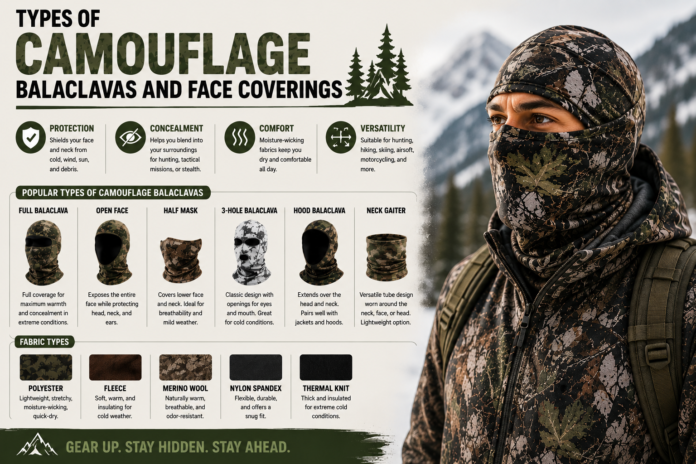
Among all styles of Types of Camouflage Balaclavas, this is the most popular. It will cover your head just like a hood, and can be pulled down to cover to your neck, or rolled to cover to your beanie. The great thing about this style of balaclava is that you get to choose how much of your face is covered. Many of this type feature a large slit for the eyes, and a smaller opening for the mouth. This style is great for hunting apparel because it hides your skin from animals. Animals cannot see your face move, so you stay hidden. It also protects your ears from windburn during long days outside.
The Half Mask or Face Shield
The half mask is one of the options for a Types of Camouflage Balaclavas. It is the shortest of the options and covers the lower half of your face. The half mask does not cover the half of your head. People like to wear these for active sports because the half mask is more ventilated. A separate hat can easily be worn. Paired with a windbreaker jacket, the half mask can keep the wind from entering the open collar of your jacket. The half mask is very easy to pull down, making it ideal for hydration and snacks during fast breaks.
The Sniper or Scout Hood
This style is used for those who need to conceal themselves entirely. The most distinctive part about the Types of Camouflage Balaclavas in this style is that they are very long. They cover both your head and your shoulders and sometimes even your chest. This style can break up the outline of your body, making you look like a boulder or bush. This style is used by hunters who keep a low profile and lie down for extended periods of time. It even keeps your neck covered from mud. You can wear it with a camouflage clothing set to disappear into the forest. The sniper hood is loose so you can move your head freely.
Materials Used in Balaclavas
The fabric makes a big difference. Here are the common materials found in different types of camouflage balaclavas:
- Polyester: Dries fast and is great for moisture.
- Merino Wool: Keeps warmth and contains no odors.
- Cotton Blend: Best for silent and still disciplines.
- Nylon: Strong and windproof.
For very wet weather, pairing a balaclava with waterproof clothing keeps you dry all over. Thicker fabrics are for winter, while thin ones are for spring. Always choose the material based on how much you will move. If you run or climb, pick a thin one.
The Convertible Balaclava
This type of balaclava is the smartest by far. A major feature of these is the ability to adjust its shape through the use of fasteners or zippers. Because of this, it can be worn fully, as a hood, as a half mask, or a neck warmer. Some balaclavas have a flap that can be either a covering for the nose or a flap to hold the covering down by the chin. Because of this feature, it is more suitable for an all day use. You can store it easily in your outdoor cargo pants pocket.
Why Camouflage Pattern Matters
When selecting patterns for your mask, the options should align with the environment you choose to camouflage within. Some patterns include woodland which is brown and green, winter which is white and grey, and desert which is all tan. When selecting a balaclava ensure it matches your environment as you want to remain camouflaged, for example if you choose a balaclava which is all green in a snow environment you will easily be spotted. When choosing camouflage patterns, consider large and small patterns. Sizes of the shapes should correspond with the distance or proximity. A good base layer clothing under your balaclava also helps control sweat so your face does not get too cold when you stop moving.
How to Choose the Right One
Picking the right mask is pretty straightforward if you’re aware of what activity you’ll be doing. You can ask yourself three questions. First, will the weather be extremely cold or just exceptionally windy? Second, will you be doing a lot of physical activity or will you be sitting down? Third, will you need to talk or use your phone? A tough, Types of Camouflage Balaclavas with breathing holes works best for snowboarding. Something that is thin and quick to dry works best for hiking. A thin fire resistant balaclava would work for tactical training. A good mask should fit snug but not too tight.
Conclusion
With the variety Types of Camouflage Balaclavas designed for specific functions, you can be sure that there is exactly what you need for outdoor fun. Whether you want a full mask and hood for hunting, a half mask for running, or a balaclava for sniper stealth, you are covered. You can be sure of the balaclava’s fabric, fit, and print. A good balaclava will accomplish all of the tasks of keeping you warm, concealed, and protected. A good balaclava will have a low profile, thin fabric, and strong stitching. A balaclava can be a good winter pick. Also a thin fabric can help a lot with concealment. The perfect fabric can help winter fun outside.
FAQs
What is the warmest type of camouflage balaclava?
The warmest types of camouflage balaclavas are made of fleece or merino wool. They trap heat very well. Look for ones with a “windstopper” layer for the coldest days.
Can I wear a balaclava under a helmet?
Yes, many types of camouflage balaclavas are made thin specifically to fit under a ski helmet or tactical helmet. Choose a “low-profile” style for the best fit.
How do I wash my camouflage balaclava?
You should wash most types of camouflage balaclavas by hand in cold water. Use mild soap. Do not put them in a hot dryer because the heat can ruin the stretchy fabric and the camo print. Lay them flat to dry.