Home Blog Page 9

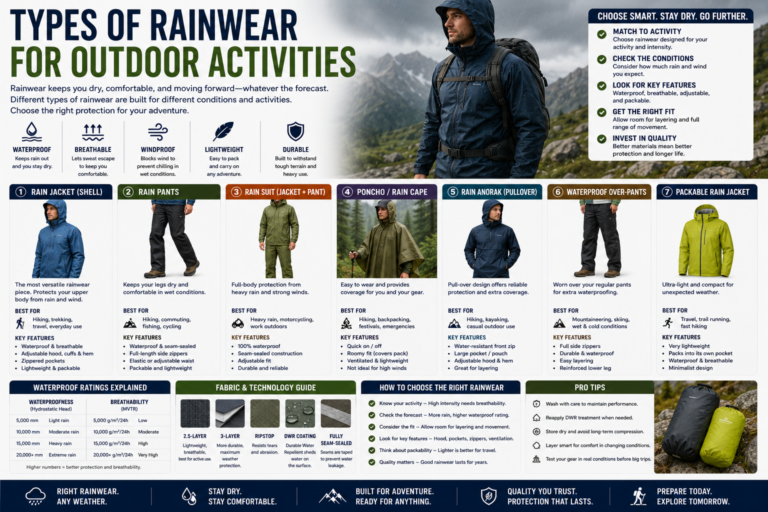
Types of Rainwear for Outdoor Activities

Rain stops underprepared outdoor enthusiasts. It doesn’t stop prepared ones. The difference between a miserable wet retreat and a confident continued adventure often comes down entirely to the rainwear you chose before leaving home. But types of rainwear vary enormously in construction, protection level, weight, and intended use — and understanding these differences helps brands build collections that serve real outdoor needs and helps customers choose gear that genuinely protects them when conditions deteriorate. Here’s a complete breakdown.

What Makes Rainwear Genuinely Effective?

Before diving into specific types, understanding what separates effective rainwear from inadequate alternatives makes every evaluation more meaningful. Genuine rainwear protection requires three things working simultaneously — waterproof face fabric or membrane that prevents water penetration, sealed seams that prevent water entry through construction points, and waterproof closures that prevent moisture entry at zip and opening points.

DWR treatment alone — without membrane construction — provides water resistance, not waterproofing. This distinction matters enormously for outdoor activities in sustained rain where water-resistant constructions eventually wet out while genuine waterproof membrane construction maintains protection indefinitely across extended precipitation exposure.

Hardshell Rain Jacket — Maximum Technical Protection

Hardshell rain jackets represent the most technically capable rainwear available for outdoor activities. Waterproof breathable membrane constructions — Gore-Tex, eVent, Pertex Shield, and equivalent technologies — provide complete rain and wind protection while maintaining breathability that prevents internal moisture accumulation during physical activity.

Fully sealed seams, waterproof zippers, and adjustable storm hoods create a complete weather barrier that serious mountain hiking, alpine climbing, and backcountry adventure genuinely demands. Hardshell jackets suit any outdoor activity where sustained rain, wind, and demanding physical output occur simultaneously — conditions where lighter rainwear alternatives compromise either protection or comfort in ways that technical hardshell construction avoids.

The premium cost of hardshell construction is justified through performance consistency that less technical alternatives cannot deliver across the demanding conditions serious outdoor users regularly encounter — making hardshell investment worthwhile for frequent outdoor enthusiasts who experience serious weather regularly.

Waterproof Rain Jacket — Reliable Everyday Protection

Waterproof rain jackets cover a broad category between entry-level rain protection and premium hardshell performance — using DWR-treated face fabrics combined with either membrane lamination or polyurethane coating to prevent water penetration during rain exposure across recreational outdoor activities.

These jackets suit recreational hikers, campers, and outdoor lifestyle consumers who encounter rain regularly but don’t subject their gear to the extreme mechanical stresses and sustained severe conditions that professional outdoor users impose. Waterproof jackets at accessible price points serve the largest outdoor market segment — delivering meaningful rain protection without premium hardshell specification costs that casual outdoor use doesn’t require to justify.

The key performance distinction within this category is breathability — membrane-laminated constructions breathe significantly better than polyurethane-coated alternatives, making them more comfortable during active outdoor use where body heat and perspiration accumulate within the jacket system.

Rain Poncho — Packable Simplicity

Rain ponchos provide the simplest possible rain protection in the most packable format available. A single piece of waterproof material with a hood and opening for the head — no zippers, no seams at critical shoulder points, no sleeve construction complexity — creates a rain barrier that deploys instantly and covers both the wearer and their backpack simultaneously.

The pack coverage advantage makes ponchos particularly valuable for hikers who want to keep their pack and its contents dry during brief rain events without the complication of pack rain covers as separate equipment. Ponchos suit light recreational hiking, festival use, travel, and any application where simplicity and packability matter more than the fitted construction and technical performance that jacket alternatives provide.

The tradeoff is reduced performance in wind — ponchos billow and allow wind-driven rain entry at the open sides in ways that fitted jacket constructions prevent completely. Serious wind and rain conditions genuinely demand fitted jacket protection that poncho constructions cannot provide.

Lightweight Packable Rain Jacket — Emergency Weather Insurance

Lightweight packable rain jackets use ultralight waterproof constructions — typically 2.5-layer membrane technology — to create genuine waterproof protection in jacket formats that compress to fist-sized volumes and weigh as little as 100 to 200 grams. They pack into their own chest pocket or a small stuff sack — making them genuinely portable as constant emergency carry items.

Trail runners, day hikers, cyclists, and travelers all benefit from lightweight packable rain jackets that provide reliable rain protection when conditions deteriorate unexpectedly — without the weight or pack volume penalty that heavier alternatives impose during the majority of outings when conditions remain benign.

Outdoor jackets collections that include packable rain jacket options serve the casual and recreational outdoor market effectively — providing the genuine waterproof protection this segment needs in the accessible, portable format that occasional use justifies over premium hardshell investment.

Rain Suit — Complete Head-to-Toe Protection

Rain suits combine waterproof jacket and matching waterproof trousers into a complete precipitation protection system — covering both upper and lower body against rain penetration that jacket-only alternatives leave the legs exposed to during sustained downpours.

Complete body rain protection matters particularly for activities where lower body wet-out creates serious comfort or safety consequences — extended mountain hiking in persistent rain, fishing and water-adjacent activities, and outdoor work environments where remaining dry throughout the entire body is practically necessary rather than simply preferable.

A complete rainwear suit manufactured to consistent waterproof standards across both jacket and trouser components — matching seam sealing, membrane specification, and DWR treatment — ensures protection performance is uniform across the complete outfit rather than creating a well-protected upper body and inadequately protected lower body through mismatched component specifications.

Waterproof Softshell — Active Weather Protection

Waterproof softshell rainwear combines softshell stretch performance with waterproof membrane construction — creating rain protection garments that move freely with the body during high-intensity outdoor activity rather than restricting movement the way rigid hardshell face fabrics do.

These garments suit trail running, ski touring, and fast mountain hiking where sustained physical output demands maximum breathability and freedom of movement alongside meaningful rain protection. The stretch face construction accommodates athletic body positions that rigid hardshell fabrics resist — making waterproof softshell constructions genuinely superior for high-intensity activities despite their slightly lower weather protection specification compared to dedicated hardshell alternatives.

Softshell jackets with waterproof membrane integration represent premium product positioning within outdoor jacket collections — commanding higher retail prices through the performance combination that stretch waterproof construction delivers beyond what either pure softshell or pure hardshell alternatives achieve independently.

Hunting Rain Gear — Silent and Concealed

Hunting rainwear addresses specific performance requirements that general outdoor rain jackets don’t serve — silent fabric constructions that prevent the noise regular waterproof fabrics create during movement, camouflage patterns for visual concealment in hunting environments, and scent-control treatments that reduce human scent detection by game animals.

Fabric noise elimination is the most technically demanding requirement — standard waterproof membranes and face fabrics create audible rustling during movement that alerts game animals to hunter presence before visual detection occurs. Hunting apparel manufacturers develop specific fabric constructions that achieve waterproof performance while meeting the strict silence requirements that effective field hunting demands across varied movement conditions.

Children’s Rainwear — Durable and Fun

Children’s rainwear combines genuine waterproof protection with the durability required to withstand the rough treatment children inflict on their clothing — plus the colors, patterns, and designs that make children willing to wear their rain gear rather than abandoning it at the first opportunity.

Construction priorities for children’s rainwear include reinforced knees and seat panels that withstand kneeling, sliding, and ground contact during outdoor play, easy-open closures that children can operate independently, and reflective details that improve visibility during low-light outdoor conditions.

Brands building camping apparel collections that include family and children’s product lines find children’s rainwear among their strongest-performing items — because parents prioritize keeping children dry and comfortable during outdoor activities and invest in quality rainwear that makes continued outdoor participation possible regardless of weather conditions.

Building a Rainwear Collection for Your Outdoor Brand

The types of rainwear each serve specific protection needs across different outdoor activities and customer segments. Brands building outdoor apparel collections don’t need to cover every rainwear type simultaneously — they need to identify which types serve their specific target customer most effectively and build those styles with genuine waterproof performance credentials that customers can trust when rain actually arrives.

Working with a professional outdoor apparel manufacturer who understands membrane technology, seam sealing requirements, and DWR treatment specifications ensures rainwear collections deliver the genuine protection performance outdoor customers evaluate through real-world use in actual rain rather than simply assessing from specification sheets and marketing descriptions.

Conclusion

Understanding the types of rainwear — hardshell jackets, waterproof rain jackets, ponchos, packable emergency layers, rain suits, waterproof softshells, hunting-specific rain gear, and children’s constructions — gives outdoor brands the knowledge to build rainwear collections that genuinely protect their customers across real outdoor activities in real rain. Every rainwear type serves a distinct protection need and customer segment — covering the right combination for your specific market creates a rainwear range that performs reliably, builds genuine customer trust, and establishes your brand as a serious, credible outdoor apparel provider.

FAQs

What is the difference between waterproof and water-resistant rainwear?

Waterproof rainwear uses membrane construction that prevents water penetration indefinitely during sustained rain. Water-resistant rainwear uses DWR treatment that repels light rain initially but eventually wets out during sustained heavy precipitation — allowing moisture penetration that genuine waterproof construction prevents.

Do I need fully sealed seams in outdoor rainwear?

Yes — for genuinely demanding outdoor rain exposure. Unsealed seams are the primary moisture entry point in waterproof garments — making full seam sealing at critical construction points a non-negotiable requirement for rainwear that must perform reliably across sustained heavy rain.

How often should DWR treatment be refreshed on rainwear?

DWR performance should be checked before each outdoor season and refreshed when water no longer beads visibly on the outer fabric surface — typically every 10 to 15 wash cycles through tumble drying or specialist re-treatment product application.

Can rainwear be produced under a private label for outdoor brands?

Yes. Professional outdoor apparel manufacturers offer complete private label rainwear production with certified waterproof membranes, seam sealing, custom colors, hardware, labels, and packaging — giving outdoor brands full technical and commercial control over their rainwear collection.
How to Choose the Right Base Layer Clothing

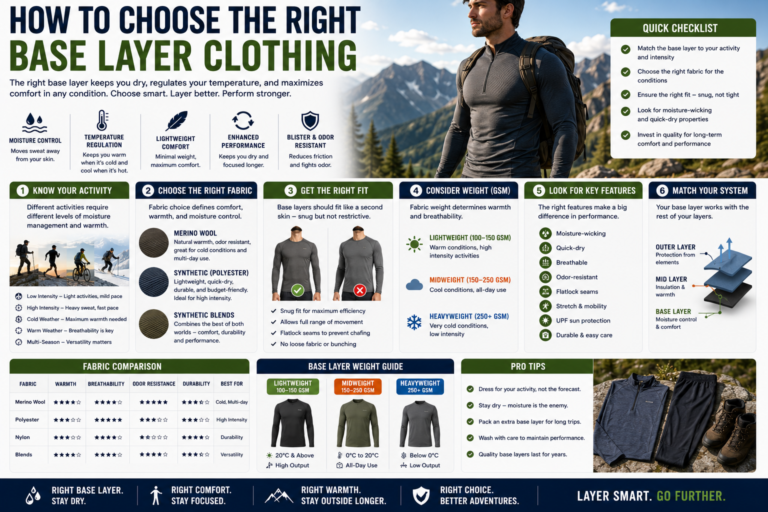
Base layers are the most important garment in any outdoor clothing system — yet they receive the least attention from most outdoor enthusiasts who focus their buying decisions on impressive outer shells and insulating mid-layers. The base layer sits directly against your skin throughout every outdoor activity — managing moisture, regulating temperature, and determining whether every layer above it functions as intended. Knowing how to choose the right base layer clothing for your specific activity and conditions transforms your entire outdoor clothing system performance from the inside out.

Understand What a Base Layer Actually Does

Before evaluating specific options, get clear on the base layer’s fundamental role within the outdoor clothing system. A base layer serves two primary functions simultaneously — managing moisture and contributing to thermal regulation — and how well it performs these functions determines the effectiveness of every other layer worn above it.

Moisture management is the critical function. During physical activity, the body produces significant perspiration that must move away from the skin surface rapidly — preventing the wet, cold, clammy sensation that moisture accumulation creates against skin. Fabrics that wick moisture effectively pull perspiration from the skin contact surface and move it outward toward the fabric’s outer face where evaporation can occur — keeping skin surface dry and comfortable throughout sustained activity.

Thermal contribution varies by base layer weight — lightweight bases contribute minimal insulation while heavyweight bases add meaningful warmth directly against the skin where its insulating effect is most immediately felt. Understanding which thermal contribution your activity requires guides weight selection more reliably than generic temperature guidance that doesn’t account for activity intensity variations.

Choose the Right Material for Your Activity and Conditions

Material choice is the most important base layer decision — directly determining moisture management performance, thermal properties, comfort against skin, and care requirements across regular outdoor use.

Merino Wool — the premium natural fiber option. Merino’s natural crimp structure manages moisture through fiber absorption rather than surface wicking — absorbing perspiration into the fiber core where it doesn’t create the cold wet sensation that surface moisture causes. Natural odor resistance through protein fiber structure allows multi-day wear without washing — genuinely valuable for extended backcountry trips where washing opportunities are limited.

Temperature regulation is merino’s most distinctive property — the fiber naturally moderates body temperature across a wider range of conditions than synthetic alternatives, making merino bases genuinely comfortable from cool mountain mornings through warm afternoon hiking sections within the same wearing day. Base layer clothing built from quality merino wool serves the broadest range of outdoor conditions from a single garment — making it particularly valuable for outdoor enthusiasts who want simplified, versatile kit rather than multiple activity-specific alternatives.

Synthetic — Polyester and Nylon Blends — the performance moisture management option. Synthetic base layers wick moisture from the skin surface rapidly — moving perspiration to the outer fabric face for fast evaporation. Quick-drying performance exceeds merino significantly — synthetic bases recover from thorough wetting in minutes rather than the longer drying times that merino’s moisture absorption properties create.

However, synthetic fibers support bacterial growth that creates persistent odor during multi-day use without washing — a meaningful limitation for extended backcountry applications where merino’s natural odor resistance provides genuine practical advantage. Synthetic bases suit high-intensity activities where maximum moisture wicking speed matters more than odor resistance across multi-day use periods.

Merino-Synthetic Blends — combining natural fiber comfort and odor resistance with improved durability and faster drying than pure merino. These blends represent the most commercially balanced base layer option — delivering meaningful advantages from both fiber types while minimizing the limitations each has in isolation. Brands building camping apparel and outdoor clothing collections find merino-synthetic blends serve the broadest customer base across varied outdoor applications.

Select the Right Weight for Your Conditions

Base layer weight — measured in grams per square meter — determines thermal contribution and appropriate use temperature range more directly than any other specification. Matching weight to your typical activity conditions prevents the overheating that heavy bases cause during intense activity and the insufficient warmth that lightweight bases provide in genuinely cold conditions.

Lightweight — 100 to 150gsm suits warm weather hiking, high-intensity aerobic activities, and warm climate outdoor use where moisture management matters far more than thermal contribution. These bases regulate temperature effectively during high-output activity by managing perspiration without adding warmth that would cause overheating.

Midweight — 150 to 220gsm suits cool to cold weather hiking, skiing, snowboarding, and outdoor activities where both moisture management and meaningful warmth contribution matter across varied activity intensities throughout the outdoor day. This weight range suits the broadest range of outdoor conditions — making midweight the most commercially versatile base layer specification for brands covering general outdoor markets.

Heavyweight — 220gsm and above suits cold weather camping, winter activities, and any application where significant warmth contribution matters alongside moisture management. Ski wear applications in genuinely cold mountain conditions benefit from heavyweight base layers that provide serious thermal foundation for the insulation and shell layers built above them.

Match Fit to Activity Requirements

Base layer fit significantly impacts both comfort and moisture management performance — and the right fit depends on how the base layer will be worn and what activity it serves.

Close-fitting or compressive fit — the standard recommendation for most outdoor base layer applications. Close contact between fabric and skin maximizes moisture transfer efficiency — fabric must touch skin to wick moisture from it effectively. Loose base layers create air gaps between fabric and skin that reduce wicking performance and allow moisture to pool against skin rather than transferring to the fabric surface for evaporation.

Active fit — close but not compressive — suits most outdoor hiking, skiing, and general activity applications where full range of motion matters alongside moisture management performance. Active fit base layers move with the body without restricting joint movement during the varied physical demands of outdoor activity.

Compressive fit — genuinely tight against muscle groups — suits specific applications where compression benefits like improved circulation and reduced muscle vibration add performance value beyond moisture management. Trail running and endurance activities benefit from compression base layers in ways that casual hiking doesn’t.

Flatlock seam construction eliminates the raised seam edges that create friction points during extended wear — particularly important for base layers worn directly against skin during high-repetition activities like running and cycling where seam contact against the same skin point occurs thousands of times per hour.

Consider Specific Activity Requirements

Different outdoor activities create specific base layer requirements beyond the general material and weight principles that serve most applications adequately.

Skiing and snowboarding demand heavyweight merino or merino-synthetic blend bases that provide serious thermal foundation while managing the significant perspiration that lift-accessed skiing creates during physical effort sections. Ski wear base layers must also accommodate the layering volumes of mid-layers and shell pants over the base — requiring slim enough profiles to avoid bulk within the combined system.

Hiking and backpacking benefit from mid-weight merino or blend bases that manage moisture during uphill exertion and provide meaningful warmth during rest stops and cold morning starts without overheating during sustained physical effort. Multi-day backpacking specifically benefits from merino odor resistance — reducing the washing frequency that synthetic alternatives require across extended trips.

Hunting and field activities sometimes require scent-control base layer treatments alongside thermal and moisture management performance — specialist requirements that hunting apparel manufacturers address through specific fabric treatment options unavailable in general outdoor base layer constructions.

Cold weather camping and winter outdoor activities demand heavyweight base layers that provide maximum thermal foundation for the insulation layers built above them — prioritizing warmth contribution over moisture management speed in applications where activity intensity is lower and thermal retention matters most across extended cold exposure periods.

Evaluate Top and Bottom Separately

Most outdoor enthusiasts focus base layer attention on tops while neglecting base layer bottoms that serve equally important thermal and moisture management functions across the lower body. Matching base layer bottom specification to top specification — same material, same weight — creates a consistent layering foundation across the full body rather than a performance mismatch between well-served upper body and inadequately supported lower body thermal and moisture management.

Base layer bottom length matters for specific activities — full-length thermal bottoms suit skiing and cold weather activities, three-quarter length suits cycling, and shorts-length thermal liners suit running and warmer weather hiking applications where full-length coverage would cause lower body overheating during sustained aerobic effort.

Conclusion

Knowing how to choose the right base layer clothing means matching material to your moisture management and odor resistance priorities, selecting weight appropriate for your typical activity conditions, fitting correctly for maximum moisture transfer performance, and considering the specific requirements that your primary outdoor activity creates beyond general base layer principles. The right base layer transforms your entire outdoor clothing system performance — keeping you comfortable, dry, and thermally regulated from the inside out across every outdoor activity and condition you encounter.

FAQs

Is merino wool or synthetic better for outdoor base layers?

Merino suits multi-day outdoor activities where odor resistance and natural temperature regulation matter most. Synthetic suits high-intensity activities where maximum moisture wicking speed and fast drying performance after thorough wetting are the primary performance priorities.

How tight should a base layer fit?

Base layers should fit close to the body without restricting movement — close enough for fabric-to-skin contact that maximizes moisture wicking efficiency, but not so tight that it restricts the range of motion your specific outdoor activity demands.

Can I wear a base layer as a standalone garment for outdoor activities?

Lightweight and midweight base layers suit standalone warm weather use effectively. In cold conditions, base layers are designed to work within a layering system — their thermal contribution is meaningful but insufficient for standalone cold weather protection without mid-layer and outer shell additions.

Can base layer clothing be produced under a private label for outdoor brands?

Yes. Professional outdoor apparel manufacturers offer complete private label base layer production with merino, synthetic, and blend fabric options, custom weights, colors, labels, and packaging — giving outdoor brands full technical and commercial control over their base layer collection.

Types of Outdoor Cargo Pants and Their Uses

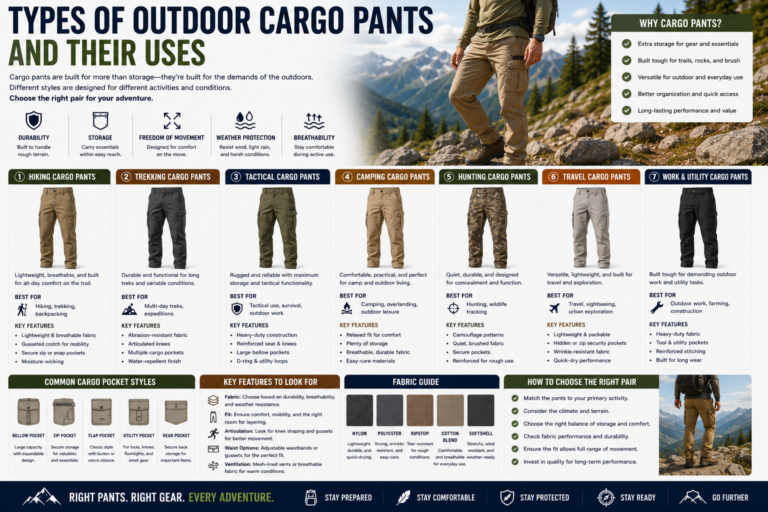
Outdoor cargo pants serve a simple but powerful purpose — carrying essential equipment within immediate reach while providing the durability and performance properties that demanding outdoor environments require. But types of outdoor cargo pants vary significantly in construction, fabric, pocket configuration, and intended use — and understanding these differences helps brands build collections that genuinely serve specific outdoor customers rather than producing interchangeable products that serve no activity particularly well.

Here’s a complete breakdown of every major outdoor cargo pant type and its specific use case.

Hiking Cargo Pants — Trail Performance With Storage

Hiking cargo pants combine the technical construction of dedicated trail pants with the storage functionality that cargo pocket configurations provide — creating a single garment that handles varied terrain, weather, and equipment carrying needs across multi-day outdoor adventures.

Lightweight nylon or nylon-elastane blend fabrics provide the quick-drying performance and stretch freedom that demanding trail hiking requires. Four-way stretch constructions accommodate the full hip and knee flexion that steep ascents and technical terrain demand without fabric restriction that compounds into fatigue across long hiking days.

Cargo pocket placement on hiking pants requires specific design intelligence — thigh pockets must position correctly to avoid interfering with pack hip belt placement during loaded hiking, and must close securely enough to prevent contents loss during technical terrain scrambling. A professional hiking clothing manufacturer understands these placement requirements and builds them into pattern development from the very first sample.

Tactical Cargo Pants — Professional Field Performance

Tactical cargo pants represent the most technically demanding construction within the outdoor cargo category — built specifically for law enforcement, military, security, and serious outdoor professionals who depend on their clothing across genuine operational field conditions.

Construction quality tolerances are significantly higher than recreational alternatives. Reinforced stress points, bartack stitching at all pocket junctions, doubled knee panels, and abrasion-resistant face fabrics all contribute to durability that withstands sustained hard professional use without the seam failures and fabric degradation that recreational constructions experience under equivalent mechanical stress.

Pocket configuration in tactical cargo pants serves specific operational requirements — accessible thigh pockets for immediate-reach items, knee pad compatibility pockets for extended kneeling environments, and secure internal pockets for documents, devices, and sensitive equipment. Tactical outdoor apparel manufacturers understand these specialized requirements through genuine field use experience rather than aesthetic interpretation of what tactical clothing should look like.

Softshell Cargo Pants — Cold Weather Active Performance

Softshell cargo pants apply softshell fabric technology to cargo construction — creating pants that provide wind resistance and moderate weather protection alongside the stretch performance that high-intensity cold weather outdoor activity demands.

These pants suit shoulder-season and winter outdoor activities where standard lightweight cargo constructions leave legs cold and wind-exposed but full waterproof shell pants over-insulate during sustained physical effort that generates significant body heat. Windproof face fabrics prevent the wind chill penetration that exposed lightweight pants suffer in mountain environments — while stretch constructions maintain the movement freedom that active outdoor use requires throughout demanding physical days.

Softshell jackets and matching softshell cargo pants create coordinated technical outfit systems — giving outdoor brands strong visual collection coherence alongside genuine complementary performance across jacket and pants combinations.

Waterproof Cargo Pants — Complete Weather Protection Below the Waist

Waterproof cargo pants extend complete weather protection to the lower body — using waterproof breathable membrane constructions to prevent rain and snow penetration through the leg panels while maintaining breathability during active outdoor movement. They suit wet climate hiking, alpine approaches, and any outdoor activity where lower body wet-out creates genuine comfort or safety consequences.

Fully sealed leg seams prevent water entry through construction points that waterproof face fabric alone cannot seal. Ankle adjustment systems seal against boot tops — preventing water entry from below during stream crossings and heavy rain events. Waterproof clothing manufacturers apply the same seam sealing standards to cargo construction that shell jacket construction demands — because partial seam sealing on trousers creates exactly the same moisture entry problems it creates on jackets.

Convertible Cargo Pants — Versatile Two-in-One Performance

Convertible cargo pants feature zip-off legs that transform full-length trousers into shorts — providing both coverage and shorts functionality in a single garment that adapts to variable temperature and terrain conditions throughout the outdoor day or trip.

The zip-off design serves multi-day hiking, travel, and camping applications where pack weight management matters and conditions genuinely change sufficiently to make both full leg coverage and shorts appropriate across different sections. Cargo pocket configurations in convertible pants must function correctly in both trouser and shorts configurations — requiring specific design attention to pocket positioning across the zip-off line that separates the two garment configurations.

Camping apparel collections that include convertible cargo styles serve weight-conscious outdoor consumers who maximize kit versatility through intelligent dual-function gear selection — a growing consumer priority as outdoor travelers increasingly optimize pack weight for extended adventure travel.

Insulated Cargo Pants — Cold Weather Warmth and Utility

Insulated cargo pants combine cargo storage functionality with internal insulation fill — providing lower body warmth alongside the pocket organization that field activity and cold weather outdoor use demands simultaneously. Synthetic insulation maintains warmth performance when wet — critical for cold weather outdoor applications where precipitation exposure and perspiration dampening regularly affect insulation layer performance.

These pants suit high-altitude approaches, cold weather camping, winter field activities, and any application where maintaining lower body warmth across stationary periods matters as much as mobility during active movement sections. Articulated knee construction maintains mobility despite insulation bulk — ensuring insulated cargo pants don’t sacrifice the movement freedom that demanding outdoor terrain requires.

Lightweight Travel Cargo Pants — Versatile Everyday Performance

Lightweight travel cargo pants prioritize versatility, packability, and comfortable multi-context wearability over technical outdoor performance optimization. Wrinkle-resistant fabrics maintain presentable appearance across varied wearing conditions. Quick-dry performance handles the moisture exposure that travel environments regularly create. Multiple pockets provide the secure storage that travel security considerations demand.

These pants suit outdoor travelers who move between trail activity, town visits, transport, and social contexts throughout their trips — requiring garments that perform adequately across varied demands without the specialized construction that single-activity technical alternatives provide for dedicated outdoor professionals.

Hunting and Camouflage Cargo Pants — Field Concealment and Performance

Hunting cargo pants combine camouflage pattern construction with the functional storage and durability requirements that field hunting demands across varied terrain, weather, and game pursuit applications. Silent fabric constructions prevent the noise that movement creates against synthetic face fabrics — critical for stealthy approach and blind sitting applications where fabric noise betrays hunter position to game animals.

Scent-control fabric treatments reduce the human scent that game animals detect — a genuinely functional requirement in this specialized category that general outdoor cargo pants cannot replicate through simple camouflage pattern application to standard constructions. Hunting apparel manufacturers build these specialized performance requirements into hunting cargo pants through genuine field hunting understanding that goes significantly beyond visual camouflage application.

Building Your Outdoor Cargo Pants Collection

The types of outdoor cargo pants each serve specific customers and activities that other types cannot optimally replace. Brands building outdoor apparel collections benefit from carrying multiple cargo pant types — covering recreational hiking and travel customers alongside specialized tactical and hunting markets that premium performance specifications command premium retail pricing.

Working with a professional outdoor cargo pants manufacturer ensures fabric performance verification, pocket construction quality, and hardware durability that creates cargo pants customers depend on across genuine demanding outdoor use rather than occasional recreational activity.

Conclusion

Understanding the types of outdoor cargo pants — hiking, tactical, softshell, waterproof, convertible, insulated, lightweight travel, and hunting — gives outdoor brands the commercial knowledge to build collections that serve real outdoor customers across real activities and conditions. Each type makes specific construction choices that optimize performance for its intended application — and covering the right combination for your target market creates an outdoor cargo pants range that performs reliably, sells consistently, and builds the brand reputation that serious outdoor customers reward with loyalty and recommendation across their communities.

FAQs

What fabric works best across most outdoor cargo pants applications?

Nylon-elastane blends suit the broadest range of outdoor cargo applications — providing quick-drying performance, four-way stretch freedom, durability appropriate for trail and field use, and fabric weight efficiency that serves most active outdoor activities effectively.

How many cargo pockets are optimal for outdoor pants?

Most outdoor cargo pants perform best with four to six pockets — two thigh cargo pockets alongside standard front and back pockets providing sufficient organized storage without the excess weight and bulk that additional pocket hardware adds beyond genuine carry requirement needs.

Can outdoor cargo pants be produced under a private label?

Yes. Professional outdoor apparel manufacturers offer complete private label production with custom fabrics, pocket configurations, performance treatments, colors, labels, and packaging — giving outdoor brands full technical and commercial control over their cargo pants collection.

Are convertible cargo pants worth considering for outdoor brand collections?

Yes. Convertible styles serve the growing consumer segment that prioritizes pack weight optimization and gear versatility — attracting outdoor travelers and weight-conscious hikers who value two-garment functionality from single-garment investment and pack weight.

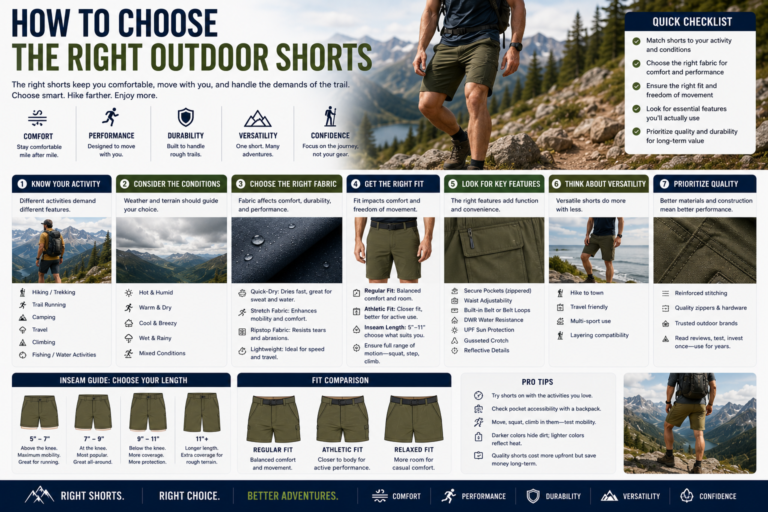
How to Choose the Right Outdoor Shorts

Outdoor shorts seem like a simple purchase until you’re two hours into a steep trail with shorts that chafe, don’t dry, or restrict your stride at every step. Knowing how to choose the right outdoor shorts prevents those experiences — matching construction, fabric, fit, and features to your specific activity and conditions before you ever leave the trailhead. Here’s everything that genuinely matters when making this decision.

Start With Your Primary Activity

The most important outdoor shorts selection decision is matching the construction to your primary use case. Different activities create fundamentally different performance demands — and shorts optimized for one activity often perform poorly in another.

Hiking demands durability, moisture management, and enough stretch for steep terrain movement. Shorts that resist abrasion from pack hip belts, rocky terrain contact, and brush exposure serve trail hikers significantly better than lightweight constructions built for lower-impact activities.

Trail running demands minimum weight, maximum freedom of movement, and built-in liner construction that prevents chafing during high-cadence running movement. Every unnecessary gram and every fabric restriction point compounds across long distances into meaningful performance and comfort impacts.

Camping and travel prioritize comfort, versatility, and storage capacity over technical performance optimization. Shorts that transition comfortably between campsite activities, casual hiking, and town visits serve travelers better than highly specialized technical constructions optimized for single activities.

Water activities — stream crossings, kayaking, coasteering — demand fast-drying fabrics that return to comfortable land performance within minutes rather than remaining heavy and wet for extended periods after water exposure.

A professional outdoor shorts manufacturer builds different short constructions around these specific activity requirements — ensuring the details that matter for each use case are present rather than compromised for universal average performance.

Match Fabric to Performance Needs

Fabric choice directly determines how well your outdoor shorts perform across the specific demands your activity creates. Understanding the key fabric properties helps you evaluate shorts against the right criteria.

Moisture management matters most for high-intensity activities. Moisture-wicking polyester and nylon fabrics pull sweat away from skin surfaces — preventing the saturated, heavy feeling that non-wicking fabrics create during sustained physical effort. Quick-drying fabrics recover rapidly after perspiration, rain, or water exposure — restoring comfortable dry weight and reducing the chafing risk that prolonged wet fabric contact creates.

Stretch performance determines movement freedom across demanding terrain. Four-way stretch fabrics accommodate simultaneous horizontal and vertical stretch — critical for the hip flexion demands of steep trail climbing and the stride extension requirements of trail running. Non-stretch constructions restrict movement in ways that compound into genuine discomfort across long active outdoor days.

Durability determines how long shorts maintain their performance properties across repeated demanding use. Ripstop nylon and higher denier constructions resist the abrasion from rock scrambling, vegetation contact, and pack friction that gradually degrades lighter weight alternatives. Hiking clothing designed for serious trail use specifies fabric durability appropriate for the mechanical stresses trail activity regularly imposes.

Quick-dry performance matters for all outdoor activities involving water exposure or high perspiration rates. Fabrics that dry within 20 to 30 minutes of thorough wetting serve multi-activity outdoor use far more effectively than slower-drying alternatives that require hours of wear or sun exposure to return to comfortable dry weight.

Choose the Right Length

Inseam length significantly impacts both performance and comfort across different outdoor activities — and the right length depends on your activity, terrain type, and personal preference for coverage.

3 to 4 inch inseam suits trail running and high-intensity activities where maximum leg freedom matters above coverage considerations. Short inseams eliminate any potential for fabric bunching during high-knee movements and maintain the aerodynamic profile that running efficiency benefits from.

5 to 7 inch inseam suits most hiking applications — providing adequate thigh coverage for sun protection and brush contact resistance while maintaining the movement freedom that trail climbing demands. This range represents the most commercially popular inseam length across outdoor hiking short collections.

8 to 10 inch inseam suits casual hiking, camping, and travel where additional coverage provides sun protection and modest appearance across various outdoor environments. These longer constructions also suit camping apparel applications where shorts are worn throughout full days including campsite activities, town visits, and varied social contexts.

Evaluate Waistband Construction

Waistband construction determines both fit security and compatibility with the equipment systems outdoor activities require. Getting this detail right prevents the constant waistband adjustment that poorly designed alternatives demand throughout active outdoor use.

Elastic waistbands with internal drawcords provide secure, adjustable fit across the full range of body positions that outdoor activity creates — from seated rest to aggressive uphill climbing lean. The drawcord allows precise fit dialing that elastic alone cannot achieve across different body proportions and layering system configurations.

Pack hip belt compatibility matters specifically for hiking applications. Waistband bulk and position must allow pack hip belt placement and adjustment without creating uncomfortable pressure points where belt and waistband overlap across the hip crest. Low-profile waistband constructions suit hiking applications better than thick, structured alternatives that conflict with hip belt positioning during long loaded hikes.

Belt loop inclusion serves travel and casual outdoor applications where a conventional belt provides preferred fit adjustment — and creates versatility that elasticated-only constructions can’t offer for the urban and casual outdoor contexts that travel shorts regularly navigate.

Assess Pocket Design and Storage

Pocket configuration determines how useful how to choose the right outdoor shorts guidance is for your specific carry requirements — because storage needs vary significantly between activities and personal gear management preferences.

Consider these pocket requirements by activity:

  • Trail hiking — secure zippered hand pockets for phone and valuables, accessible back pocket for map or snack, thigh pocket for quick-access items during movement
  • Trail running — minimal pockets to reduce weight and profile, secure closure on any pocket carrying phone or keys during high-movement running gait
  • Camping and travel — generous pocket capacity including secure closure options for valuables in varied environments where pickpocket risk may exist
  • Field and tactical use — multiple accessible cargo pockets for equipment organization, secure closures that maintain pocket contents during physical activity

Outdoor cargo pants principles applied to shorts constructions create cargo short options with maximum storage capacity — serving field activities, fishing, photography, and any outdoor use where carrying multiple items within immediate reach genuinely improves activity efficiency.

Check Sun Protection Rating

Extended outdoor activity in open terrain, water environments, and high-altitude settings creates significant UV exposure that inadequate fabric protection allows to reach skin harmfully. UPF-rated outdoor shorts provide verified sun protection that construction weight alone doesn’t guarantee.

UPF 30 blocks approximately 96.7% of UV radiation — adequate for moderate sun exposure conditions. UPF 50+ blocks 98%+ of UV radiation — recommended for extended sun exposure during hiking, water activities, and high-altitude outdoor pursuits where UV intensity increases meaningfully above sea level.

Tightly woven fabrics, darker colors, and synthetic fiber constructions generally provide better natural UV protection than lightweight open weaves and light colors — though only UPF-rated fabrics provide verified protection credentials that marketing descriptions without testing cannot guarantee.

Consider Liner and Brief Construction

Internal liner construction significantly impacts comfort across different outdoor activities — and choosing correctly based on activity type prevents the friction and chafing discomfort that inappropriate liner configurations create during sustained movement.

Built-in brief liners suit most hiking and general outdoor applications — providing modest support and reducing the need for separate base layer shorts beneath the outer shell. Quality brief liners use soft, quick-drying fabrics that minimize friction against inner thigh areas during walking movement patterns.

Mesh liner shorts suit trail running and cycling applications — extending further down the thigh than brief liners to prevent the inner thigh friction that high-cadence leg movement creates against outer short fabric during running and cycling specific movement patterns.

Liner-free constructions suit water activities and amphibious use where liner fabrics would retain water longer than the outer shell — and where boardshort-style construction or separate quick-dry underwear serves the combined water and land performance requirements more effectively than built-in liner alternatives.

Evaluate Durability Against Your Use Intensity

Matching durability specification to actual use intensity prevents both overpaying for heavy constructions that casual use doesn’t justify and under-buying lightweight alternatives that fail prematurely under demanding regular use.

Light recreational camping and travel use suits 40 to 50 denier nylon or polyester constructions — adequate durability for the limited abrasion contact these activities create without unnecessary weight addition. Regular technical hiking suits 70 to 100 denier constructions — providing meaningful abrasion resistance for frequent rock, pack, and vegetation contact that lighter fabrics don’t withstand across multiple seasons of regular trail use.

Demanding field applications — tactical outdoor apparel use, serious scrambling, multi-day technical routes — suit heavyweight ripstop constructions in 100 denier and above that prioritize durability over weight optimization for the sustained mechanical stresses professional and serious recreational outdoor use regularly imposes.

Conclusion

Knowing how to choose the right outdoor shorts means honestly matching activity requirements, fabric performance, length, waistband construction, pocket configuration, sun protection, liner type, and durability specification to your specific outdoor use rather than selecting on appearance or price alone. The right outdoor short becomes one of the most comfortable and reliable garments in your outdoor kit — worn constantly across the warm-weather activities it was built to serve. Choose thoughtfully and it delivers reliable performance across every outdoor adventure you take it on.

FAQs

What is the most important feature in outdoor hiking shorts?

Moisture management and quick-drying performance are most critical for hiking — fabrics that handle perspiration effectively and dry rapidly after water exposure maintain comfort throughout long active outdoor days more reliably than any other single performance characteristic.

Should outdoor shorts have a liner built in?

For most hiking applications — yes. Built-in liners provide modest support, reduce chafing, and eliminate the need for separate base layer shorts beneath the outer shell. Trail running applications benefit specifically from mesh liner shorts that extend further down the thigh than brief liners.

What length outdoor shorts suit most outdoor activities?

5 to 7 inch inseam suits the broadest range of outdoor activities — providing adequate thigh coverage for sun protection and brush resistance while maintaining movement freedom for technical terrain and varied trail activity.

Can outdoor shorts be produced under a private label for outdoor brands?

Yes. Professional outdoor apparel manufacturers offer complete private label production with verified performance fabrics, custom lengths, pocket configurations, colors, labels, and packaging — giving outdoor brands full technical and commercial control over their shorts collection.

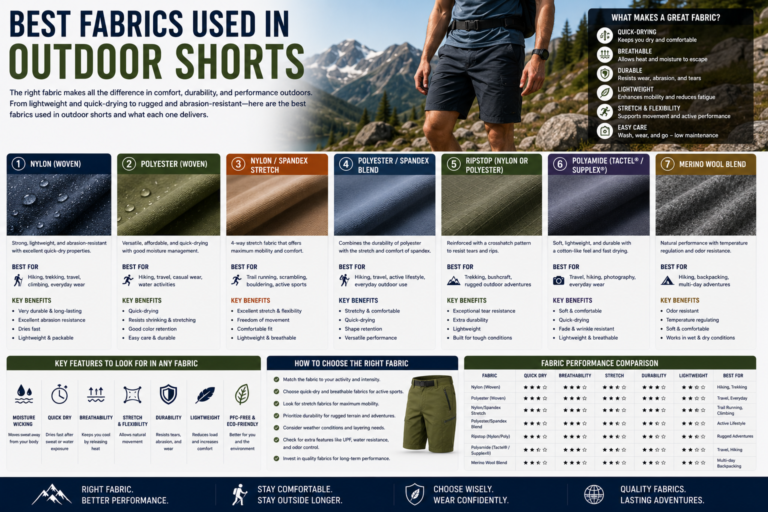
Best Fabrics Used in Outdoor Shorts

Fabric choice determines everything an outdoor short can and cannot do. The right material keeps you comfortable during intense trail activity, dries fast after stream crossings, resists abrasion from rough terrain, and maintains its performance properties across seasons of demanding outdoor use. Understanding the best fabrics used in outdoor shorts helps brands build products that genuinely perform outdoors — and helps customers make informed choices that serve their specific activities reliably. Here’s a complete breakdown of every major outdoor short fabric and what each one delivers.

Nylon — The Performance Gold Standard

Nylon is the most widely used fabric in performance outdoor shorts — and its dominance reflects genuine performance merit. Lightweight, strong, quick-drying, and naturally smooth against the skin — nylon delivers the combination of properties that outdoor activity demands more consistently than most alternative fabrics.

Nylon’s tensile strength significantly exceeds equivalent weight polyester — meaning nylon outdoor shorts resist tearing and abrasion from rock scrambling, brush contact, and pack hip belt friction better than lighter alternatives. This durability-to-weight ratio makes nylon the preferred face fabric for hiking clothing manufacturers building shorts that survive serious trail use across multiple seasons without seam failure or fabric degradation.

Ripstop nylon variants — incorporating reinforcing grid threads at regular intervals — add tear propagation resistance that makes them particularly valuable for demanding outdoor applications where small snags from branches or rock edges could otherwise develop into larger tears across standard woven constructions.

Polyester — Versatile and Color-Stable

Polyester serves outdoor short applications across multiple performance requirements — particularly excelling in moisture-wicking constructions that move sweat away from skin during high-intensity activity. Its UV resistance maintains color vibrancy across extended sun exposure significantly better than nylon alternatives — making it particularly valuable for outdoor shorts worn constantly in high-UV environments.

Moisture-wicking polyester constructions use fiber cross-sections engineered to maximize surface area — creating capillary action that draws moisture from skin contact surfaces toward outer fabric layers for evaporation. This active moisture management keeps wearers significantly more comfortable during sustained physical output than fabrics that simply absorb moisture and hold it against the skin.

Recycled polyester — produced from post-consumer plastic waste — delivers identical performance to virgin polyester while significantly reducing environmental impact. A growing number of outdoor brands specify recycled polyester for their outdoor shorts collections — responding to consumer demand for more sustainable outdoor clothing without compromising the technical performance their customers depend on across demanding field use.

Nylon-Elastane Blends — Stretch Performance for Active Use

Pure nylon and polyester fabrics provide limited stretch — adequate for casual hiking but insufficient for the extreme range of motion that trail running, climbing, and technical scrambling demands. Adding elastane — typically 8% to 20% of total fiber content — transforms these fabrics into stretch performance materials that move freely with athletic body positions without restriction or recovery lag.

Four-way stretch constructions allow simultaneous horizontal and vertical stretch — accommodating the multi-directional movement demands that outdoor activity creates across hips, thighs, and knees during challenging terrain navigation. The elastic recovery of quality elastane blends ensures shorts return to their original shape after each movement cycle — maintaining correct fit and appearance throughout extended active wear rather than progressively bagging out during the day.

Outdoor cargo pants manufacturers apply similar stretch nylon principles to shorts versions — creating cargo constructions that carry essential storage without the fabric tension that rigid non-stretch constructions create across the hip and thigh areas where cargo pockets add fabric volume.

Ripstop Fabrics — Tear Resistance Without Weight Penalty

Ripstop constructions weave reinforcing threads at regular intervals through base fabric — creating a distinctive grid pattern that prevents small tears from propagating into larger fabric failures. This property is particularly valuable for outdoor shorts that regularly contact abrasive surfaces — rock scrambles, thorny vegetation, and rough terrain contact all create small snags that ripstop construction contains while standard woven fabrics allow to grow.

Ripstop nylon suits technical hiking, climbing, and field activity shorts where durability matters alongside packability. Ripstop polyester suits amphibious and water-contact applications where the additional UV stability of polyester complements the tear resistance that ripstop construction adds.

The weight penalty for ripstop construction is minimal — typically adding only 5% to 15% above equivalent non-ripstop constructions — making the durability benefit essentially free in terms of weight budget for most outdoor short applications where some abrasion resistance is genuinely needed.

Quick-Dry Polyester Mesh — Ventilation and Moisture Management

Mesh polyester fabrics appear primarily in trail running shorts liners, active shorts panels, and ventilation zones within technical outdoor shorts — providing maximum airflow and rapid moisture evaporation in the areas where body heat generation is highest during intense physical activity.

Internal liner shorts built from lightweight mesh polyester serve multiple functions simultaneously. They provide modest modesty coverage beneath outer shorts, create a smooth skin contact surface that prevents chafing during running and cycling movement patterns, and accelerate moisture evaporation through their open construction that restricts airflow less than solid woven face fabrics.

Cotton-Nylon Blends — Comfort Meets Durability

Pure cotton performs poorly in demanding outdoor shorts applications — absorbing moisture heavily, drying slowly, and losing structural integrity when wet in ways that synthetic alternatives avoid entirely. However, cotton-nylon blends combine cotton’s softness and comfortable skin feel with nylon’s quick-drying properties and durability — creating fabrics that suit casual outdoor shorts, travel shorts, and light hiking applications where comfort matters alongside moderate performance.

These blends suit camping apparel collections targeting recreational campers who prioritize wearing comfort during campsite activities over the technical performance specifications that more demanding trail use requires. The softer hand feel of cotton content makes these fabrics genuinely more comfortable for extended casual wear than pure synthetic alternatives — particularly during sedentary campsite activities where moisture management performance matters less than all-day wearing comfort.

Softshell Stretch Wovens — Cool Weather Performance

Softshell stretch woven fabrics bring windproof and water-resistant properties to outdoor short construction — creating cool weather shorts that protect against wind chill and light precipitation that standard lightweight shorts cannot handle without causing uncomfortable cold leg exposure.

These fabrics combine a stretch woven face — providing windproofing and moderate weather resistance — with a grid fleece or smooth backing that adds comfort and mild insulation against bare skin contact. The stretch performance allows full athletic movement while the windproof construction prevents the chilling wind penetration that exposes lightweight shorts legs in exposed mountain terrain and cool morning trail conditions.

Softshell jackets manufacturers applying the same fabric principles to shorts constructions create complete softshell outfit systems — coordinating technical performance across jacket and shorts combinations that suit shoulder-season hiking and mountain activities where temperatures and conditions vary significantly throughout the outdoor day.

DWR Treated Fabrics — Surface Water Repellency

DWR treatment applied to outdoor short face fabrics causes water to bead and roll off the surface rather than saturating the fabric — maintaining comfortable dry weight and appearance during light rain and moisture splash that untreated fabrics would absorb immediately.

DWR performance degrades progressively through use and washing — requiring periodic refresh through tumble drying or specialist re-treatment products. This maintenance requirement matters more for shorts than jackets because shorts experience more frequent washing from trail dirt and sweat accumulation — accelerating DWR degradation rates compared to outer layers that are washed less frequently.

Fluorocarbon-free DWR formulations — meeting increasingly stringent environmental regulations — now deliver comparable initial performance to traditional C8 chemistry treatments while addressing the environmental persistence concerns that prompted regulatory pressure toward cleaner treatment alternatives across the outdoor apparel industry.

Building Your Outdoor Shorts Collection Around the Right Fabrics

The best fabrics used in outdoor shorts serve different performance requirements across different short types and target activities. Ripstop nylon suits technical hiking and field applications. Stretch nylon-elastane blends suit trail running and climbing. Quick-dry polyester suits moisture-management priority applications. Cotton-nylon blends suit casual camping and travel use.

Working with a professional outdoor apparel manufacturer who sources verified performance fabrics — with genuine technical credentials rather than unverified supplier specifications — ensures your outdoor shorts collection delivers the performance promises your brand makes to customers who evaluate products through real-world outdoor use rather than marketing claims.

Conclusion

Understanding the best fabrics used in outdoor shorts — nylon, polyester, elastane blends, ripstop constructions, mesh liners, cotton-nylon blends, softshell wovens, and DWR treatments — gives outdoor brands the technical foundation to build shorts collections that genuinely perform across their intended use cases. Every fabric decision communicates your brand’s commitment to outdoor performance quality. Choose verified materials, partner with experienced outdoor apparel manufacturers, and build outdoor shorts that earn the trust of customers who depend on their clothing when conditions make performance matter most.

FAQs

What is the most important fabric property in outdoor shorts?

Quick-drying performance is most critical for active outdoor use — fabrics that dry rapidly after perspiration, rain, or water crossings maintain comfort and prevent the heavy, cold, chafing sensation that slow-drying alternatives create during sustained outdoor activity.

Do outdoor shorts need stretch fabric for hiking?

Four-way stretch fabrics significantly improve hiking comfort across steep terrain — accommodating full hip flexion and stride extension without restriction. Standard non-stretch constructions work for moderate trails but limit movement freedom on technical terrain.

Can outdoor shorts with performance fabrics be produced under a private label?

Yes. Professional outdoor shorts manufacturers offer complete private label production with verified performance fabrics, DWR treatments, custom colors, pocket configurations, labels, and packaging — giving outdoor brands full technical and commercial control.

How does recycled polyester compare to virgin polyester in outdoor shorts?

Recycled polyester delivers identical performance to virgin polyester in moisture management, UV resistance, and durability — while significantly reducing environmental impact through diverting plastic waste from landfill and ocean environments.

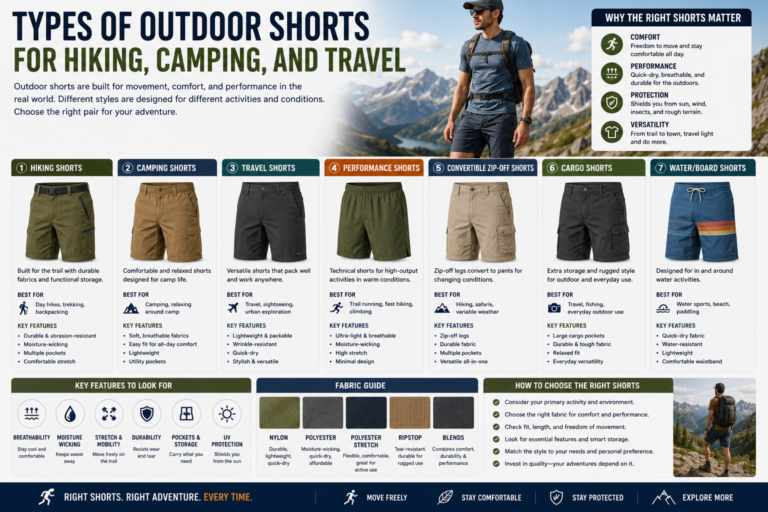
Types of Outdoor Shorts for Hiking, Camping, and Travel

Outdoor shorts are among the most commercially active categories in warm-weather outdoor apparel. Every hiker, camper, and traveler needs reliable shorts that handle physical activity, variable terrain, and unpredictable conditions without failing at inconvenient moments. But types of outdoor shorts vary significantly in construction, fabric, and intended use — and understanding these differences helps brands build collections that genuinely serve outdoor customers rather than simply filling seasonal inventory with similar-looking products.

Here’s a complete guide to every major outdoor short type and what makes each one the right choice for specific activities.

Hiking Shorts — Trail Performance Essentials

Hiking shorts are the foundational outdoor short category — built specifically around the performance demands that trail use creates. They balance mobility, durability, moisture management, and weather resistance in constructions optimized for sustained physical activity across varied terrain.

Key performance requirements distinguish quality hiking shorts from casual alternatives. Four-way stretch fabrics accommodate the full leg extension and hip flexion that steep trail climbing demands without restricting natural movement. Quick-drying synthetic fabrics manage perspiration effectively — preventing the heavy, saturated feeling that cotton alternatives create during high-intensity uphill sections.

Reinforced seat and thigh panels withstand the abrasion from rock scrambling, stream crossings, and pack contact that trail hiking imposes regularly. Secure zippered pockets prevent trail essentials from falling during scrambling sections where pocket contents shift with body position changes.

A professional hiking clothing manufacturer builds hiking shorts with the specific construction details trail users depend on — including inseam length optimized for trail movement freedom, waistband construction compatible with pack hip belt positioning, and fabric weight balanced between durability and packability for multi-day trail applications.

Trail Running Shorts — Ultralight and Unrestricted

Trail running shorts prioritize minimum weight, maximum freedom of movement, and superior moisture management above all other performance characteristics. Every gram matters when running long distances — and shorts that restrict stride or cause friction during high-turnover running gait create cumulative discomfort that significantly undermines performance and enjoyment across long distances.

Lightweight nylon or polyester fabrics — typically 30 to 60 denier — create the lightest possible constructions without completely sacrificing durability. Built-in liner shorts eliminate the need for separate base layer shorts — reducing total weight while preventing chafing through integrated construction that maintains correct position throughout running movement.

Split hems and deep side vents maximize leg freedom during running stride — allowing complete hip extension without fabric restriction at the front hem that standard outdoor short constructions create during running movement.

Cargo Shorts — Storage-Focused Field Performance

Outdoor cargo shorts combine the basic function of shorts with multiple storage pockets specifically designed for field use — creating garments that carry equipment, tools, and essentials without requiring additional carrying systems. Multiple thigh pockets, back pockets, and side slash pockets distribute storage across accessible positions that remain usable during active movement.

Outdoor cargo pants and cargo shorts serve similar storage functions — with shorts offering the mobility and temperature advantages of reduced leg coverage during warm weather outdoor activities. Fishing, photography, field research, and light tactical applications all benefit from cargo short constructions that keep essential items within immediate reach throughout activity.

Ripstop nylon and durable cotton-nylon blends suit cargo short face fabrics — providing the abrasion resistance and tear strength that multiple pocket hardware placements and field activity contact demands across extended regular use.

Swim and Amphibious Shorts — Water-Ready Versatility

Amphibious shorts bridge the gap between dedicated swim shorts and land activity shorts — performing effectively in both aquatic and terrestrial environments without requiring outfit changes during activities that involve both. Stream crossings, coasteering, kayaking, and beach camping all benefit from amphibious constructions that dry rapidly after water immersion and return to comfortable land activity performance within minutes.

Quick-dry polyester mesh fabrics — sometimes combined with stretch nylon face fabrics — achieve the fast-drying performance that true amphibious use demands. Water-shedding DWR treatments accelerate surface drying by preventing fabric saturation during brief water contact. Internal mesh liners provide modest support without the slow-drying foam padding that dedicated swim shorts use.

Camping apparel brands find amphibious shorts among their strongest warm-weather performers — because the versatility of a single garment serving both water and land activities appeals powerfully to weight-conscious outdoor travelers who minimize kit through intelligent gear selection.

Softshell Shorts — Cool Weather Outdoor Performance

Softshell shorts use the same stretch woven face constructions as softshell jackets — providing wind resistance and moderate water resistance alongside meaningful stretch performance for cool weather outdoor activities where standard lightweight shorts would leave legs cold and wind-exposed.

These shorts suit shoulder-season hiking, trail running in cool conditions, and mountain activities where temperatures and wind conditions make bare-leg exposure in standard shorts uncomfortable without warranting the full coverage of long trousers. Stretchy face fabrics accommodate full athletic movement while the windproof construction prevents the wind chill that exposed lightweight shorts suffer in exposed terrain.

Convertible Shorts — Two Garments in One

Convertible shorts feature zip-off legs that transform full-length trousers into shorts at the zip line — providing both coverage and shorts functionality in a single garment without carrying separate pieces. The value proposition is clear — one garment serves variable temperature and terrain conditions across a full outdoor day without requiring additional pack weight for separate shorts.

The zip-off design suits multi-day hiking, travel, and camping where pack weight management matters and conditions change sufficiently throughout the day or trip to make both full leg coverage and shorts desirable across different sections. Hiking clothing collections that include convertible styles serve weight-conscious outdoor consumers who optimize kit selection for maximum versatility from minimum gear investment.

Board Shorts — Recreational Water and Lifestyle

Board shorts use fast-drying woven polyester or nylon constructions in longer inseam lengths — originally developed for surfing and water sports but now serving broad recreational outdoor, beach, and lifestyle markets simultaneously. Their longer length — typically hitting at or just above the knee — provides more sun protection and moderate coverage than shorter alternatives.

Stretch fabrics have improved board short athletic performance significantly — allowing the hip mobility that active water sports and beach activities require while maintaining the casual aesthetic that lifestyle outdoor consumers prefer. Secure pocket constructions prevent contents loss during water activities — particularly important for consumers who carry phones and valuables during casual outdoor and beach use.

Bouldering and Climbing Shorts — Technical Movement Optimized

Climbing and bouldering shorts prioritize stretch performance above all other characteristics — because technical climbing positions demand the absolute maximum hip and leg mobility that any outdoor short construction must deliver without restriction. High-stretch fabrics — typically incorporating 15% to 25% elastane — accommodate deep hip flexion, high foot placement, and extreme leg extension positions that standard outdoor short constructions restrict uncomfortably.

Articulated construction — pre-shaped crotch gussets and positioned seam lines — supplements fabric stretch by ensuring the short’s shape matches athletic body positions rather than fighting against them. Minimal pocket hardware reduces the profile snagging that climbing movement creates on protruding pocket zippers and hardware against rock surfaces.

Tactical and Field Shorts — Durability and Utility

Tactical shorts serve law enforcement, military, security, and serious outdoor enthusiasts who need garment durability, pocket organization, and performance characteristics that casual outdoor shorts don’t provide. Reinforced construction throughout, multiple accessible pockets with secure closures, and durable face fabrics that withstand sustained rough field use define this category.

Tactical outdoor apparel manufacturers understand the specific durability requirements, pocket configurations, and construction standards that professional tactical users evaluate through real operational field experience — distinguishing genuinely tactical garments from fashion-inspired alternatives that look tactical without performing to professional field standards.

Building Your Outdoor Shorts Collection

The types of outdoor shorts each serve specific customer activities and performance needs that other types cannot optimally replace. Brands building outdoor apparel collections benefit from understanding which short types serve their specific target customer most directly — and building those styles with genuine performance credentials rather than simply adding outdoor aesthetics to basic construction.

Working with a professional outdoor shorts manufacturer ensures fabric performance verification, construction quality standards, and feature execution that creates outdoor shorts customers depend on across genuine field use rather than simply wearing occasionally during casual outdoor activities.

Conclusion

Understanding the types of outdoor shorts — hiking, trail running, cargo, amphibious, softshell, convertible, board shorts, climbing, and tactical — gives outdoor brands the knowledge to build collections that serve real outdoor customers across real activities and conditions. Each type makes specific construction choices that optimize performance for its intended use case — and covering the right combination for your target market creates an outdoor shorts range that performs reliably, sells consistently, and builds the brand reputation that serious outdoor customers reward with long-term loyalty.

FAQs

What fabric works best across most outdoor short types?

Lightweight nylon or polyester with four-way stretch suits the majority of outdoor short applications — providing quick-drying performance, freedom of movement, and durability appropriate for hiking, trail running, and general outdoor use across most warm-weather conditions.

What inseam length suits most hiking applications?

5 to 7 inch inseam lengths suit most hiking use — providing adequate coverage for sun protection and brush contact resistance while maintaining the freedom of movement that trail climbing and technical terrain demands.

Can all outdoor short types be produced under a private label?

Yes. All outdoor short types support full private label production with custom fabrics, performance treatments, pocket configurations, colors, labels, and packaging — giving outdoor brands complete creative and commercial control over their shorts collection.

How many outdoor short types should a new outdoor brand launch with initially?

Start with two to three types serving your core customer most directly — typically hiking shorts, a cargo option, and one activity-specific style relevant to your brand’s outdoor focus. This covers your broadest market without overextending initial production investment.

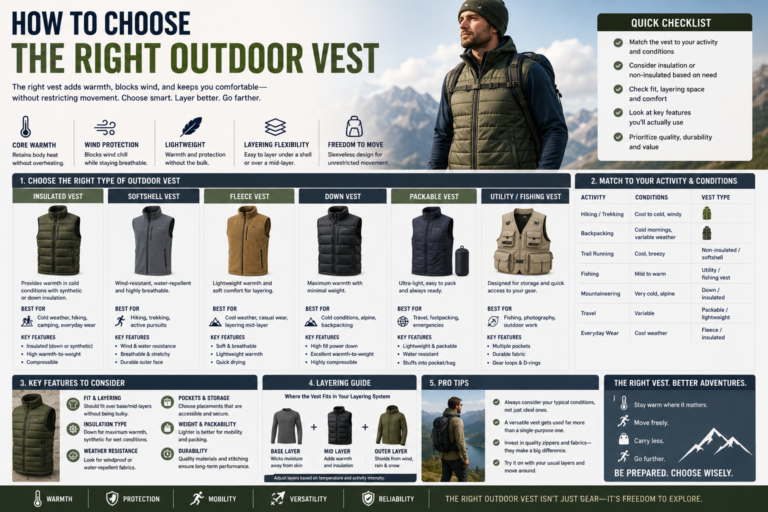
How to Choose the Right Outdoor Vest

The outdoor vest is one of the most underrated garments in any outdoor wardrobe. Sleeveless by design but powerful in function — a well-chosen vest adds meaningful core warmth, wind protection, or storage capacity without restricting arm movement or adding the weight and bulk of a full jacket. But knowing how to choose the right outdoor vest for your specific activity, conditions, and layering system saves you from buying a vest that looks right but performs wrong when you actually need it outdoors.

Here’s everything that matters.

Understand Why You Need a Vest

Before evaluating specific vests, get clear on the functional role you need it to fill. Outdoor vests serve several distinct purposes — and the right choice depends entirely on which purpose matters most for your specific outdoor use.

Core warmth without arm restriction — the most common vest purpose. Adding meaningful torso insulation while keeping arms completely free for technical activities where jacket sleeves would restrict movement or cause overheating.

Wind and weather protection for the core — softshell and hardshell vest constructions protect the core from wind chill and light rain without the warmth addition that insulated alternatives provide — suiting higher-intensity activities where insulation would cause overheating but weather protection genuinely helps.

Storage and organization — fishing, photography, and field activity vests prioritize pocket number and organization over thermal performance — providing dedicated, accessible storage for equipment, tools, and essentials that jacket pockets cannot accommodate in sufficient quantity or accessibility.

Layering versatility — vests add a warmth layer between base and outer shell without adding sleeve bulk that reduces layering system flexibility — particularly valuable for activities involving rapid temperature transitions throughout the day.

Match Vest Type to Your Primary Activity

Different vest constructions suit different activities — and matching correctly prevents the disappointment of discovering your vest’s limitations through experience rather than informed selection.

Insulated vests suit hiking, camping, and general outdoor use where core warmth addition during rest stops, cold mornings, and evening activities improves comfort without the full coverage that conditions might not warrant throughout the entire day.

Puffer jackets and insulated vests use similar fill technologies — down or synthetic insulation — in sleeveless constructions that concentrate warmth where the body loses heat most critically while maintaining full arm freedom for technical tasks.

Fleece vests provide reliable mid-layer warmth with excellent breathability — suiting active hiking, trail running, and climbing where arm freedom and moisture management matter alongside core warmth retention. Outdoor fleece constructions in vest format work particularly well as mid-layers beneath waterproof shells during cold weather hiking where the full sleeve coverage of a fleece jacket would create uncomfortable heat accumulation during sustained uphill effort.

Softshell vests suit high-output activities in cold windy conditions — providing wind resistance and moderate weather protection alongside the stretch and breathability that softshell fabrics deliver. They suit trail running, ski touring approach sections, and fast hiking where wind protection matters but sleeve restriction would impair performance.

Fishing and field vests prioritize multiple accessible pockets over thermal performance — providing dedicated storage for lures, tools, cameras, and field equipment that general outdoor vests don’t accommodate. Hunting apparel specialists build field vests with the specific pocket configurations, game bag constructions, and silent fabric treatments that field activities genuinely demand.

Evaluate Insulation Type and Fill Power

For insulated vests specifically, fill material and specification determine warmth performance, weight efficiency, packability, and wet weather reliability — making these the most important technical decisions within this vest category.

Down insulation delivers exceptional warmth-to-weight ratio — making down vests significantly lighter and more packable than equivalent synthetic alternatives at comparable warmth levels. High fill power ratings — 700 to 900+ — indicate better quality down that creates more insulating air space per gram of fill weight. Hydrophobic down treatments improve wet weather performance by causing individual feathers to repel moisture rather than clumping when dampened.

Synthetic insulation maintains meaningful warmth performance even when wet — making it more reliable than untreated down in environments where internal perspiration or external moisture exposure regularly dampens the insulation layer. Premium synthetic fills — PrimaLoft Gold, Thermore, and equivalent technologies — approach down warmth-to-weight ratios while delivering this wet weather performance advantage that untreated down cannot match.

The right choice depends on your typical conditions — down for dry cold environments where weight efficiency matters most, synthetic for active use or wet environments where maintained wet performance justifies the slight weight premium over equivalent down specifications.

Check Fit for Layering and Activity

Vest fit determines both comfort in isolation and function within your layering system — and getting fit right matters as much as insulation specification for overall vest performance across real outdoor use.

Active fit — close to the body — suits high-intensity activities where excess fabric creates bulk within layering systems and reduces aerodynamic efficiency during running, cycling, and ski touring. Active fit vests layer cleanly over base layers and beneath shells without bunching that creates pressure points under pack straps.

Regular fit — roomier through chest — accommodates mid-layers beneath the vest for maximum cold weather versatility and suits moderate-intensity activities where layering flexibility matters more than aerodynamic efficiency.

Critical fit checkpoints for how to choose the right outdoor vest include hem length covering the lower back during forward lean — preventing cold air entry through the gap that short hems create during uphill hiking positions. Armhole sizing should allow full arm extension and rotation without the armhole binding across the shoulder — a common fit failure in vests that look correct at rest but restrict movement during activity.

Assess Key Features Against Your Needs

Beyond insulation type and fit, specific construction features determine how well a vest serves your particular outdoor application across real daily use.

Features worth evaluating carefully:

  • Collar height — higher collars provide neck warmth that low collars sacrifice for clean aesthetics. Consider whether neck coverage matters for your specific activity and conditions
  • Pocket number and placement — hand warmer pockets serve general warmth needs. Chest pockets provide accessible storage during pack wearing. Internal security pockets protect valuables during active use
  • Packability — stuff-sack compatible vests or those packing into their own pocket suit activities where the vest travels in a pack between deployment opportunities
  • Wind resistance — windproof face fabrics on insulated vests prevent convective heat loss through insulation layers that non-windproof constructions allow in exposed conditions
  • Hood — some insulated vests include hoods for complete head coverage without a jacket. Useful for cold still conditions; less practical for high-intensity activities where hoods create heat accumulation

A professional outdoor vest manufacturer builds these features into vest designs based on intended activity use — ensuring construction details serve genuine functional purposes rather than adding specification complexity without performance justification.

Consider Layering System Compatibility

An outdoor vest performs within a layering system rather than in isolation — and compatibility with your specific base layers and outer shells determines how effectively it functions across the full range of conditions you actually encounter.

Vest hem and collar construction must accommodate outer shell systems cleanly — avoiding the collar conflict between vest zip pulls and jacket zip pulls that creates uncomfortable pressure points during extended wear. Vest body length must work correctly with shell jacket hip pockets — avoiding the hem-over-pocket overlap that prevents jacket pocket access when the vest is worn beneath.

Waterproof jackets and outer shells with internal storm skirts need sufficient internal volume to accommodate vest body bulk cleanly without the shell appearing distorted or restricting through the torso when the full layering system is assembled for cold weather use.

Conclusion

Knowing how to choose the right outdoor vest means matching vest type — insulated, fleece, softshell, or field vest — to your primary activity, choosing the right insulation for your typical conditions, fitting correctly for both standalone wear and layering system integration, and selecting features that serve your specific outdoor use rather than generic specification. A well-chosen outdoor vest becomes one of the most-used garments in any active outdoor wardrobe — deployed constantly for the targeted warmth, wind protection, or storage it delivers without the full coverage commitment of a complete jacket.

FAQs

Is a down or synthetic vest better for outdoor use?

Down suits dry cold environments where weight efficiency and packability matter most. Synthetic suits active use and wet environments where maintained performance when damp justifies the slight weight premium over equivalent down specifications.

Should an outdoor vest fit loosely or closely?

Active and high-intensity activities suit close active fit that layers cleanly and moves freely. General hiking and casual outdoor use suits regular fit that accommodates mid-layers beneath for cold weather versatility.

Can outdoor vests be produced under a private label?

Yes. Professional outdoor apparel manufacturers offer complete private label vest production with custom insulation specifications, fabrics, colors, hardware, labels, and packaging — giving outdoor brands full creative and commercial control.

What is the most versatile outdoor vest type for general use?

A lightweight down or synthetic insulated vest suits the broadest range of outdoor activities — providing meaningful core warmth addition in a packable format that works across hiking, camping, climbing, and casual outdoor use effectively.

Types of Hardshell Jackets for Outdoor Adventures

When conditions get genuinely serious outdoors — sustained rain, alpine storms, blizzard conditions, or exposed ridgeline winds — hardshell jackets are the garments that stand between comfort and genuine discomfort or danger. But not all hardshells are built the same. Understanding the types of hardshell jackets available helps outdoor enthusiasts choose correctly for their specific adventure and helps brands build collections that serve real outdoor needs with genuine technical credibility. Here’s a complete breakdown.

What Makes a Jacket a Hardshell?

Before diving into specific types, understanding what defines hardshell construction clarifies every comparison that follows. Hardshell jackets use rigid waterproof breathable membrane laminates — Gore-Tex, eVent, Pertex Shield, or equivalent technologies — bonded to face fabrics to create complete weather barriers.

They contain no insulation. That deliberate absence makes them extremely temperature-versatile — the same hardshell works across a wide range of conditions depending on what insulating layers are worn beneath it. Fully sealed seams prevent water entry through construction points. Waterproof zippers prevent moisture penetration at closure points. These construction standards together define genuine hardshell performance — distinguishing it from water-resistant softshell or DWR-only windbreaker alternatives.

Three-Layer Hardshell — Maximum Durability and Performance

Three-layer hardshell construction bonds three components into a single unified fabric — face fabric, waterproof breathable membrane, and interior backer — creating the most durable and highest-performing hardshell construction available.

The unified construction eliminates the separate lining fabric found in two-layer constructions — reducing bulk, improving breathability, and extending jacket service life by preventing the delamination that separate-layer constructions eventually experience under hard use. Three-layer hardshells feel slightly stiffer against the body than softer alternatives but deliver unmatched durability for the demanding mechanical stresses that mountaineering, alpine climbing, and backcountry skiing impose.

Hardshell jackets built in three-layer construction represent the premium tier of waterproof outerwear — commanding higher retail prices through genuine performance superiority that serious outdoor users recognize and pay for without hesitation.

Two-Layer Hardshell — Comfortable and Versatile

Two-layer hardshell construction bonds the waterproof membrane to the face fabric interior — leaving a separate hanging lining fabric loose inside the jacket rather than bonded directly to the membrane. This construction feels softer and more comfortable against base layers and mid-layers than three-layer alternatives — at the cost of slightly reduced durability and marginally lower breathability performance.

Two-layer hardshells suit recreational outdoor users who prioritize wearing comfort alongside weather protection — hikers, campers, and general outdoor enthusiasts who encounter serious weather conditions but don’t subject their jackets to the sustained extreme mechanical stresses that professional alpinists and mountaineers impose through daily hard use.

This construction also allows more flexibility in interior lining design — mesh linings, taffeta linings, and printed interior fabrics all work within two-layer constructions — providing opportunities for brand expression and comfort differentiation that three-layer bonded constructions cannot accommodate.

2.5-Layer Hardshell — Ultralight Emergency Protection

2.5-layer constructions bond a waterproof membrane to the face fabric interior and protect the membrane with a printed or embossed pattern coating rather than a separate lining fabric. The result is the lightest and most packable hardshell construction achievable — often producing jackets under 200 grams that compress to fist-sized packed volumes.

The 0.5 layer designation refers to this interior coating — substantial enough to protect the membrane from abrasion during wear but insufficient to qualify as a full interior lining layer. Comfort against the skin is lower than two-layer or three-layer alternatives — the unlined interior feels clammy during sustained wear over base layers.

2.5-layer hardshells suit emergency carry applications — jackets packed and worn only when conditions deteriorate unexpectedly during activities where continuous jacket wearing isn’t anticipated. Trail runners, fast packers, and mountain bikers all benefit from 2.5-layer hardshells that provide genuine weather protection in negligible pack weight and volume.

Alpine and Mountaineering Hardshell — Expedition Grade Performance

Alpine hardshells represent the most technically specified category within hardshell jacket construction — built specifically for the extreme demands of high-altitude mountaineering, technical climbing, and serious alpine adventures where jacket failure creates genuine safety consequences.

These jackets feature the most durable three-layer face fabric constructions available, helmet-compatible hoods with precise adjustment systems, harness-compatible hem and pocket design that maintains functionality when a climbing harness is worn, and reinforced panels at high-wear zones where rope, crampon straps, and pack contact regularly abrades jacket surfaces.

Construction quality tolerances are tighter than general outdoor hardshells — seam taping is more extensive, zipper specifications are higher, and hardware is selected specifically for reliable operation in extreme cold where lubricants freeze and metal components contract. Brands building serious outdoor jackets collections find alpine hardshells anchor their premium product tier — attracting the most technically sophisticated outdoor customers whose recommendations within climbing and mountaineering communities carry significant influence.

Ski and Snowboard Hardshell — Mountain Sport Specific

Ski and snowboard hardshells adapt standard hardshell construction for the specific demands of mountain snow sports — adding features that general outdoor hardshells don’t require but ski and snowboard use genuinely demands.

Internal powder skirts seal against ski pant waistbands — preventing snow entry during falls and deep powder runs. Helmet-compatible hood designs accommodate the specific volume and shape of ski helmets. Lift pass pockets with RFID-transparent windows allow pass scanning without pocket access. Goggle pockets with soft internal lining prevent lens scratching during jacket storage.

Ski wear hardshells often incorporate slightly softer membrane constructions than alpine climbing alternatives — prioritizing the freedom of movement that ski technique demands over the maximum abrasion resistance that rope-work and rock contact requires in climbing applications.

Waterproof Hiking Hardshell — Trail Optimized Performance

Hiking hardshells balance weather protection, breathability, weight, and packability specifically around the demands of trail use — where sustained physical activity generates significant moisture vapor that less breathable constructions trap uncomfortably, and where pack weight directly impacts hiking endurance across long distances.

These jackets use high-breathability membrane specifications — prioritizing moisture vapor transmission rates alongside waterproofing performance — because hikers generate significant perspiration during uphill sections that hardshells with lower breathability ratings handle poorly. Pit zip ventilation systems supplement passive membrane breathability during maximum exertion sections where even high-specification membranes cannot evacuate perspiration heat accumulation fast enough for comfortable sustained effort.

Waterproof clothing designed specifically for hiking trails serves the largest outdoor activity market segment — making hiking hardshells the highest-volume hardshell category for most outdoor apparel brands building broad-market outdoor jacket collections.

Packable Hardshell — Lightweight Weather Insurance

Packable hardshells prioritize compressed volume and weight reduction while maintaining genuine waterproof breathable membrane performance — creating jackets that provide real hardshell protection in packable formats approaching windbreaker compactness.

These jackets use lighter face fabric deniers than durability-focused alternatives — accepting some reduction in abrasion resistance to achieve the packability that emergency carry applications demand. They suit day hikers, travelers, and casual outdoor users who need reliable weather protection available at all times without carrying jacket weight during the majority of outings when conditions remain benign.

The packable hardshell category serves camping apparel markets effectively — campers who need reliable weather protection available for unexpected deterioration without dedicating significant pack space or weight budget to outerwear on every trip.

Softshell-Hardshell Hybrid — Versatility Across Conditions

Hybrid jackets combine hardshell weather protection panels at high-exposure zones — chest, shoulders, and hood — with softshell stretch construction across high-mobility zones — sides, underarms, and back. The result is a jacket that provides meaningful weather protection alongside softshell levels of stretch and breathability during active use.

These hybrid constructions suit activities involving alternating high-intensity movement and exposure to weather — ski touring, trail running in mountain environments, and fast alpine travel where conditions change rapidly and activity intensity fluctuates significantly throughout the day.

Softshell jackets and hardshell hybrid constructions represent premium product innovation within outdoor jacket manufacturing — attracting technically sophisticated customers willing to pay premium prices for performance combinations that single-construction alternatives cannot deliver.

Building a Hardshell Collection That Covers Your Market

The types of hardshell jackets each serve specific outdoor activities and customer needs that other types cannot optimally replace. Brands building outdoor apparel collections benefit from carrying multiple hardshell types — covering entry-level packable styles for casual outdoor consumers alongside premium alpine specifications for serious outdoor enthusiasts.

Working with a professional outdoor apparel manufacturer who understands membrane technology, seam sealing requirements, and construction specifications for each hardshell type ensures your collection delivers the genuine waterproof breathable performance that outdoor customers evaluate through real-world use rather than specification sheets alone.

Conclusion

Understanding the types of hardshell jackets — three-layer, two-layer, 2.5-layer, alpine, ski-specific, hiking-optimized, packable, and hybrid constructions — gives outdoor brands the technical knowledge to build collections that genuinely serve different outdoor customers across different activities and conditions. Each hardshell type makes specific construction choices that optimize performance for particular use cases — and matching the right construction to the right customer creates outdoor jacket collections that build genuine brand reputation through real-world performance that serious outdoor enthusiasts recognize, respect, and recommend.

FAQs

What is the most durable hardshell jacket construction?

Three-layer construction delivers maximum durability — the bonded face fabric, membrane, and backer eliminate the delamination risk of separate-layer constructions and withstand the sustained mechanical stresses that demanding alpine and mountaineering use imposes.

Which hardshell type offers the best breathability for active hiking?

Hiking-specific hardshells with high breathability membrane specifications — prioritizing moisture vapor transmission alongside waterproofing — plus pit zip ventilation systems provide the best active breathability for sustained uphill hiking effort.

Are packable hardshells as waterproof as heavier alternatives?

Yes — waterproof membrane performance is determined by membrane specification rather than jacket weight. Packable hardshells with quality membrane construction deliver equivalent waterproofing to heavier alternatives at reduced face fabric durability rather than reduced weather protection performance.

Can hardshell jackets be produced under a private label for outdoor brands?

Yes. Professional outdoor apparel manufacturers offer complete private label hardshell production with certified membrane technologies, custom fabrics, seam sealing, colors, hardware, labels, and packaging — giving outdoor brands full technical and commercial control over their hardshell jacket collection.

How to Choose the Right Windbreaker Jacket

Windbreaker jackets look deceptively simple. Lightweight shell, zipper, hood — how complicated can the choice be? Quite complicated, actually. The wrong windbreaker leaves you cold, wet, or restricted at exactly the moment you need reliable protection and freedom of movement. Knowing how to choose the right windbreaker jacket for your specific activity, climate, and performance priorities makes the difference between a jacket you reach for constantly and one that sits unused at the back of a drawer. Here’s everything you need to consider.

Start With Your Primary Activity

The single most important windbreaker selection decision is matching the jacket to your primary use case. Windbreakers built for different activities make meaningfully different construction choices — and those choices determine how well the jacket serves you in the specific conditions your activity creates.

Running and high-intensity cardio demand ultralight fabrics, minimal construction details, and maximum breathability. Every unnecessary gram affects running economy across long distances. Reflective details add genuine safety value during low-light training sessions. Thumb loop cuffs maintain sleeve position during arm swing without velcro adjustment mechanisms that add weight.

Hiking and trail use benefit from slightly heavier constructions with better abrasion resistance, more pocket storage, and hood designs that work with or without a pack’s shoulder straps restricting access. Hiking clothing specialists design windbreakers around the specific functional demands trail users face — including hem length that covers the lower back during uphill lean and pocket placement that works correctly with backpack hip belts.

Casual lifestyle and travel use suits packable windbreakers that compress small, look clean, and handle the varied light weather conditions urban and travel environments create without requiring technical performance optimization for any specific activity.

Cycling demands close-fitting aerodynamic construction, extended rear hems covering the exposed lower back during forward riding position, and back pocket access that works without stopping or jacket removal.

Understand the Wind and Weather Protection You Actually Need

Windbreakers exist on a spectrum from simple wind defense to full waterproof weather protection — and matching protection level to your actual conditions prevents both under-specification that leaves you wet and over-specification that adds unnecessary weight and cost.

Wind protection only — DWR-treated face fabrics without membrane construction — suits dry cold and windy conditions where precipitation is genuinely rare. These constructions offer maximum breathability and minimum weight at the cost of meaningful waterproofing that sustained rain exposure quickly defeats.

Water-resistant windbreakers — DWR treatment plus tightly woven face construction — handle light rain and moisture splash adequately for activities in moderately wet environments. They suit camping apparel use, casual hiking, and urban environments where heavy sustained rain is uncommon but light precipitation occurs regularly.

Waterproof windbreakers — lightweight membrane constructions in 2 or 2.5-layer formats — provide genuine rain protection for activities in reliably wet environments without the weight penalty of full hardshell construction. These suit trail running in variable mountain weather, cycling in rain-prone regions, and any activity where getting wet creates significant comfort or safety problems.

Understanding which protection level your specific activity and environment genuinely requires prevents the common mistake of choosing maximum specification when lighter alternatives would serve perfectly — or choosing insufficient protection for conditions that regularly demand more than DWR treatment provides.

Evaluate Weight and Packability Requirements

Windbreakers exist across a wide weight range — from sub-100 gram ultralight emergency layers to 400 gram insulated constructions that prioritize warmth and durability over packability. Matching weight to your activity’s transport requirements ensures the jacket you choose actually gets carried and deployed rather than left behind because it’s too heavy or bulky for your intended use.

For activities where the jacket travels in a pack or pocket — running, cycling, day hiking — packability matters enormously. The jacket’s compressed volume and weight determine whether it genuinely gets carried on every outing or left at home on weight-conscious days. A windbreaker jackets manufacturer who builds proper stuff pocket construction — reinforced, correctly sized, and positioned for quick deployment — creates packable jackets that function reliably across hundreds of pack-and-deploy cycles without stuff pocket failure undermining the packability that justifies the jacket’s inclusion in your kit.

For activities where the jacket is worn continuously — commuting, travel, casual outdoor use — packability matters less than comfort, durability, and weather protection performance across extended wear periods.

Check Hood Design Carefully

Hood design significantly impacts windbreaker performance in real conditions — and the right hood design depends entirely on your specific use case rather than any universal best option.

Helmet-compatible hoods with adjustable volume controls suit cycling, ski wear applications, and climbing where headwear worn beneath the hood creates volume requirements that standard hoods cannot accommodate.

Wire-brim peaks maintain hood shape against wind — preventing the hood from collapsing across the face during high-speed descents or strong gusts that flatten soft-brim alternatives against your goggles or face.

Packable hoods — those that roll into the collar or a pocket — suit fashion and casual applications where hood-free styling suits most conditions but occasional hood access adds genuine value without permanent aesthetic impact.

Hood-free designs suit activities where a separate hat provides preferred head coverage — and create cleaner aesthetics that work more naturally in urban styling contexts where hooded outdoor jackets can look visually heavy.

Assess Fit for Your Specific Use

Windbreaker fit affects both performance and versatility — and the right fit depends on how you plan to wear and layer the jacket across your activities.

Athletic or active fit — close to the body — suits running, cycling, and high-intensity activities where aerodynamic efficiency matters and excess fabric creates drag or billowing that disturbs movement rhythm. Active fit jackets layer correctly over base layers without bunching during arm swing.

Regular fit — slightly roomier through chest and shoulders — accommodates light mid-layers underneath for cold weather use and suits moderate-intensity activities where layering flexibility matters alongside unrestricted movement.

Sleeve length should allow full arm extension without wrist exposure during overhead reach. Hem length should cover the lower back during a forward bend — preventing cold air and moisture entry through the gap that short hems create during uphill hiking positions and cycling forward lean.

Review Key Features Against Your Needs

Beyond construction and fit, specific features determine how well how to choose the right windbreaker jacket translates into genuine daily performance for your specific use case.

Essential features worth evaluating carefully:

  • Zipper quality — YKK or equivalent quality zippers operate smoothly with cold or gloved hands across hundreds of open-close cycles without failure
  • Pocket number and placement — sufficient storage for your specific carry needs positioned where your activity allows access without removing pack straps or stopping movement
  • Cuff design — velcro adjustment seals against cold air; elasticated cuffs provide quick-donning convenience; thumb loops maintain sleeve position during arm movement
  • Reflective details — genuinely useful for low-light running and cycling; irrelevant for most other applications
  • Ventilation — underarm or back venting systems manage heat accumulation during high-intensity activity that passive breathability alone cannot adequately address

Outdoor jackets collections that communicate these feature distinctions clearly — helping customers understand which specific features serve their activity rather than listing every feature as universally desirable — build stronger customer trust and significantly reduce return rates from disappointed buyers whose expectations mismatched actual product performance.

Consider Durability Against Your Use Intensity

Light occasional use demands different durability specifications than daily hard use across demanding outdoor environments. Matching face fabric denier and construction quality to your actual use intensity prevents both over-paying for durability you don’t need and under-buying construction that fails prematurely under your real-world use demands.

20 denier fabrics suit occasional-use packable emergency layers where ultralight weight justifies reduced abrasion resistance. 40 to 70 denier constructions suit regular daily use where pack strap abrasion, branch contact, and repeated compression-deployment cycles impose meaningful mechanical stress that lighter fabrics don’t withstand reliably across extended service life.

Brands building windbreaker collections for hunting apparel and serious outdoor markets must specify higher denier constructions and reinforced stress point construction — because professional and serious recreational users evaluate durability through real field experience and share their assessments powerfully within tight-knit outdoor communities.

Conclusion

Knowing how to choose the right windbreaker jacket comes down to honestly matching jacket construction, protection level, weight, hood design, fit, features, and durability to your specific activity, conditions, and use intensity. A windbreaker chosen correctly for your actual needs becomes one of the most-reached-for garments in your outdoor wardrobe — deployed constantly and relied upon completely. Choose it with genuine consideration for how and where you actually use it — and it rewards you with reliable performance across years of outdoor activity.

FAQs

Do I need a waterproof windbreaker or will a water-resistant one suffice?

If your activity regularly involves sustained rain exposure or wet mountain environments — choose waterproof membrane construction. If you encounter only occasional light rain in generally dry conditions — quality DWR water-resistant construction performs adequately at lower weight and cost.

How important is breathability in a windbreaker jacket?

Breathability importance scales directly with activity intensity. High-intensity running and cycling demand maximum breathability. Casual walking and travel use tolerate lower breathability without significant comfort impact during the lower perspiration rates these activities generate.

What size should I choose for a windbreaker if I plan to layer underneath?

Size up one size from your standard fit if you regularly layer a mid-layer beneath the windbreaker in cold conditions. Standard sizing suits base-layer-only layering for most active use applications without requiring size adjustment.

Can windbreaker jackets be produced under a private label for outdoor brands?

Yes. Professional outdoor apparel manufacturers offer complete private label windbreaker production with custom fabrics, protection levels, colors, hardware, reflective details, labels, and packaging — giving brands full technical and commercial control over their windbreaker collection identity.

Best Materials Used in Windbreaker Jackets

A windbreaker’s entire performance promise depends on one thing — the material it’s built from. The fabric determines how well it blocks wind, how much rain it resists, how light it packs, and how long it lasts across demanding outdoor use. Understanding the best materials used in windbreaker jackets helps brands make informed fabric decisions that translate directly into products customers trust — and helps outdoor enthusiasts choose jackets that genuinely perform rather than just look the part.

Here’s a complete breakdown of every major windbreaker material and what each one delivers.

Ripstop Nylon — The Classic Windbreaker Standard

Ripstop nylon is the most widely used face fabric in windbreaker manufacturing — and its commercial dominance reflects genuine performance merit rather than simply manufacturing convenience. The reinforced grid weave pattern — created by interlacing heavier threads at regular intervals through the base fabric — prevents small tears from propagating across the fabric surface. This distinctive crosshatch pattern is instantly recognizable and genuinely functional.

Nylon’s natural properties make it ideal for windbreaker applications. It is lightweight, packs compactly, dries quickly after moisture exposure, and maintains its structure across temperature extremes that affect other synthetic fabrics more significantly. Denier weight determines the performance balance between durability and packability — 20 denier ripstop nylon produces ultralight packable jackets, while 40 to 70 denier constructions provide meaningful abrasion resistance for more demanding outdoor applications.

A professional windbreaker jackets manufacturer specifies ripstop nylon denier based on intended use — ensuring ultralight running jackets use minimum-weight constructions while hiking and outdoor lifestyle jackets use heavier deniers that justify their slightly increased weight through significantly extended service life.

Polyester — Versatile and Color-Stable

Polyester serves windbreaker applications across multiple performance requirements — appearing in both face fabric and lining constructions depending on jacket design and intended use. Its key advantage over nylon in specific applications is superior color stability — polyester retains vibrant colorways across extended UV exposure and repeated washing significantly better than nylon alternatives.

This color stability makes polyester particularly valuable for fashion windbreakers where visual appeal across the jacket’s lifetime matters as much as technical performance. Bold color blocking, vibrant solid colorways, and printed graphic applications all maintain their visual impact significantly longer on polyester face fabrics than comparable nylon constructions.

Recycled polyester — produced from post-consumer PET plastic waste — delivers identical performance to virgin polyester while significantly reducing environmental impact. Sustainability-focused outdoor and lifestyle brands increasingly specify recycled polyester for windbreaker face fabrics — responding to growing consumer demand for environmentally responsible outdoor clothing without compromising the technical performance characteristics their customers depend on.

DWR Treated Fabrics — Surface Water Repellency

DWR — Durable Water Repellent — treatment isn’t a standalone fabric but an essential surface coating applied to windbreaker face fabrics that transforms their weather resistance performance. DWR causes water to bead and roll off the fabric surface rather than saturating it — maintaining both the fabric’s appearance and its breathability by preventing face fabric saturation that blocks moisture vapor transmission from inside the jacket.

Fresh DWR treatment performs impressively against light rain and moisture splash — keeping wearers comfortable during brief precipitation events without the weight and cost of full waterproof membrane construction. DWR performance degrades progressively through use, abrasion, and washing — requiring periodic refresh through tumble drying heat reactivation or specialist re-treatment products to maintain peak water repellency performance.

Modern fluorocarbon-free DWR formulations replace traditional C8 chemistry with more environmentally responsible alternatives that meet increasingly stringent regulatory requirements across European and North American markets — an important specification consideration for brands building waterproof clothing and windbreaker collections targeting environmentally conscious outdoor consumers.

Waterproof Breathable Membranes — Premium Weather Protection

Waterproof windbreakers bond thin breathable membrane films to lightweight face fabrics — creating jackets that genuinely stop rain penetration while remaining significantly lighter and more packable than full hardshell construction alternatives.

2.5-layer membrane constructions — where a membrane is bonded to the face fabric interior and protected by a printed pattern rather than a full lining fabric — produce the lightest possible waterproof windbreaker constructions. These ultra-compact jackets pack to remarkably small volumes while providing genuine waterproof protection that DWR treatment alone cannot reliably deliver in sustained precipitation.

2-layer constructions bond membrane to face fabric without a full interior lining — slightly heavier than 2.5-layer but more comfortable against the body during extended wear. These constructions suit waterproof jackets positioned between ultralight emergency layers and full hardshell performance — serving outdoor enthusiasts who need reliable waterproofing in a meaningfully lighter package than traditional 3-layer hardshell constructions provide.

Stretch Woven Fabrics — Mobility Meets Wind Defense

Stretch woven fabrics incorporate elastane or mechanical stretch constructions into windbreaker face fabrics — creating materials that provide full windproofing alongside the freedom of movement that high-intensity outdoor activities demand. These fabrics appear primarily in softshell jackets and performance-oriented windbreakers targeting running, climbing, and ski touring markets.

Four-way stretch constructions accommodate simultaneous horizontal and vertical stretch — critical for the multi-directional movement patterns that athletic outdoor activities impose constantly. The stretch performance allows jacket fit optimization for aerodynamic efficiency during running and cycling without restricting the body positions that climbing and skiing demand across varied terrain and technical challenges.

Mesh Linings — Comfort and Pack Structure

Interior mesh linings in windbreakers serve multiple functions simultaneously. They add a smooth, comfortable layer against the skin or mid-layer surface — preventing the clammy face fabric contact that unlined constructions create during movement. They also provide structural support that helps windbreakers maintain their shape during pack-down and deployment cycles.

Lightweight mesh constructions add minimal weight while significantly improving wearing comfort — making them standard construction in quality windbreakers across all but the absolute ultralight weight categories where every gram reduction justifies even slight comfort compromises.

Taffeta Linings — Premium Feel and Easy Donning

Taffeta polyester linings provide a slippery interior surface that allows windbreakers to slide easily over base layers and mid-layers during donning and removal — particularly valuable for quickly deployed emergency layers during activity. The smooth surface also feels premium against the skin — communicating quality that mesh-lined alternatives cannot replicate at first touch.

Outdoor jackets at premium price points often use taffeta lining specifically for the quality perception it creates during customer handling in retail environments — where the interior feel and visual quality of lining fabric significantly influences purchase decisions at the point of sale.

Seam Sealing Tapes — Construction Point Protection

Seam sealing isn’t a fabric but a critical construction material that determines whether waterproof windbreakers actually perform their weather protection promise in real conditions. Waterproof face fabrics and membrane constructions mean nothing if seam needle holes allow water entry through construction points.

Thermally bonded seam sealing tapes cover needle penetration points along critical seams — shoulders, hood attachment points, sleeve insertions, and pocket edges — preventing the moisture entry that unsealed seams allow during sustained rain exposure. Critical seam sealing distinguishes genuinely waterproof windbreakers from water-resistant alternatives that rely solely on DWR treatment for precipitation management.

Building Your Windbreaker Collection Around the Right Materials

The best materials used in windbreaker jackets serve different performance requirements across different windbreaker types and target markets. Ultralight ripstop nylon suits packable performance applications. Polyester suits fashion and color-focused lifestyle markets. Waterproof membranes suit complete weather protection requirements. Stretch wovens suit high-mobility performance applications.

Working with a professional outdoor jackets manufacturer who sources verified performance fabrics — with genuine technical credentials rather than unverified supplier claims — ensures your windbreaker collection delivers the performance promises your brand makes to customers who depend on it in real outdoor conditions.

Conclusion

Understanding the best materials used in windbreaker jackets — ripstop nylon, polyester, DWR treatments, waterproof membranes, stretch wovens, mesh and taffeta linings, and seam sealing systems — gives brands the technical foundation to build windbreaker collections that genuinely perform across their intended use cases. Every material decision communicates something about your brand’s commitment to quality and outdoor performance. Choose verified materials, partner with experienced manufacturers, and build windbreakers that earn the trust of customers who wear them when conditions actually demand reliable protection.

FAQs

What is the most important material property in a windbreaker jacket?

Windproofing is the core functional requirement — achieved through tightly woven face fabric constructions that prevent wind penetration regardless of whether waterproof membrane technology is also present in the construction.

Is ripstop nylon or polyester better for windbreaker manufacturing?

Both serve different needs. Ripstop nylon suits performance applications requiring packability and durability. Polyester suits fashion and lifestyle applications where color stability and sustainability credentials matter more than ultimate weight efficiency.

How long does DWR treatment last on windbreaker jackets?

DWR performance typically lasts 10 to 20 wash cycles before requiring refresh. Tumble drying on low heat reactivates existing DWR treatment. Specialist re-treatment sprays restore water repellency when tumble drying alone no longer maintains adequate beading performance.

Can windbreaker jackets with premium materials be produced under a private label?

Yes. Professional windbreaker manufacturers offer complete private label production with verified performance fabrics, DWR treatments, membrane technologies, custom colors, hardware, labels, and packaging — giving outdoor brands full technical and commercial control over their windbreaker collection.