Home Blog Page 8

Best Fabrics for Hiking Apparel: A Complete Guide

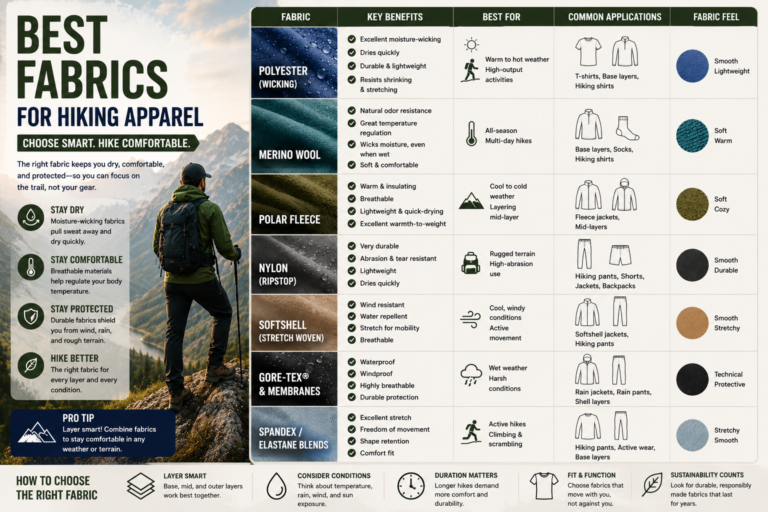
Fabric is the most crucial factor in choosing a hiking garment. If you get it right, the clothing will perform in all weather conditions, including wet and cold, as well as during prolonged physical activity. If you get it wrong, the garment will fail when it counts most – on a trail, far from shelter or in weather that’s changed.

This guide will cover the best fabrics for hiking apparel, including what they are, their performance, and what applications they suit best.

What makes a fabric suitable for hiking?

Clothing for hiking is subject to multiple demands that are not met by most fabrics. Fabrics must be able to dry quickly, manage moisture, move with the body over technical terrain and offer weather protection without being too heavy.

A specialist manufacturer of hiking clothing will understand these requirements and choose fabrics that perform well in actual trail conditions, rather than relying on textile specifications.

Merino Wool

Merino is one of hiking’s most versatile fabrics. Moisture-wicking, it draws sweat from the skin to release as vapour. It regulates the body temperature over a wide range, keeping you cool when exercising and warm while resting. It is also naturally odour resistant, which is important on long hikes when washing isn’t possible.

Merino’s main limitation is its durability. It is less resistant to abrasion than synthetic alternatives, which means that it will wear out faster around the collar edge, underarms and pack contact areas. Merino is a great choice for base layers, and lighter hiking layers.

The use of Polyester

The most popular synthetic fabric for hiking clothing is polyester. Its commercial dominance reflects its performance credentials. It is lightweight and dries quickly. It holds its shape even after repeated washings. And it accepts moisture-wicking treatment well.

Standard polyester fabric is not as comfortable against the skin as merino, but performance polyester fabrics designed for active wear close this gap. Polyester is the best fabric for outdoor T-shirts, hiking mid-layers and other garments that require moisture management.

Nylon

Nylon is stronger and more resistant to abrasion than polyester, making it an ideal fabric for trousers, shorts and other garments that come into contact with the trail surface, vegetation and equipment.

Nylon is also softer to the touch than polyester, which helps reduce friction on the skin when you’re moving for long periods of time. Hiking Pants made of nylon or nylon-spandex are durable, stretchy, and fast-drying, which is what multi-day trails require. The combination of lightweight and durability make nylon the best fabric for outdoor briefs during warm weather hiking.

Stretch fabrics — Polyester-Spandex blends and Nylon-Spandex blends

In technical hiking, freedom of movement is essential, especially for steep ascents and scrambling sections, where full hip and knee range is required. The limited stretch of pure nylon and polyester fabrics can limit movement when it is most important.

Addition of elastane, typically between four and fifteen percent, transforms rigid hiking fabrics into ones that move freely in all directions while returning to their original shape at the end of each movement cycle. Stretch nylon-spandex is the best choice for technical shorts and hiking trousers. Stretch polyester blends are ideal for outdoor cargo trousers, where both multi-directional movement as well as weight from pockets need to be controlled.

Softshell fabrics

Softshell fabrics, which are a stretch-woven outer and a fleece/jersey inner, provide a combination that includes wind resistance, light waterproof repellency, stretch, and breathability in one layer. Softshell is the perfect choice for hiking in cooler or more variable weather conditions, where a waterproof shell would be too heavy or warm.

Softshell Jackets offer enough protection from the weather for windy, dry and cold conditions. They are also stretchy and breathable enough to allow for sustained movement uphill. Softshell garments are produced by a manufacturer who has experience in bonded fabric. The bond between the layers of fabric remains intact even after repeated use on trails and washing.

Membranes Breathable and Waterproof Membrane

Waterproof breathable membranes offer the best protection for hiking in wet conditions, such as sustained rain, mountainous environments with high humidity, or multiday expeditions that require staying dry.

Waterproof clothing With a membrane and taped edges, it keeps out rain while allowing the body to exhale. These jackets are heavier than softshell and less breathable, but they are ideal for wet weather.

Fleece

The standard mid-layer for hiking is fleece. It’s warm, lightweight, quick-drying and works even when wet. It does not provide weather protection but is a very effective insulating layer when it’s cold.

Outdoor fleece is available in a range of weights, from lightweight grid fleece – ideal for high-output sports where breathability is more important than warmth – to heavyweight fleece – perfect for camping and static belays during cold weather. The weight of the fleece should be matched to your intended activity. This will prevent you from overheating and being under-insulated during rest.

Conclusion

Best Fabrics for Hiking Apparel are categorised into merino, polyester, nylon and stretch blends. Softshell, waterproof membranes and fleece all have their own performance requirements. To create hiking apparel that performs well on the trail, it is important to understand which fabrics are best for which applications and conditions.

Explore the range of manufacturing options for hiking clothing and find a production partner that is right for your brand.

FAQs

Which fabric is best for base layers for hiking?

 Wool for its comfort, odour-resistance, and temperature regulation. Synthetic polyester is better for durability and faster drying. The best choice will depend on your hiking situation.

Why are nylon trousers preferred to polyester trousers for hiking?

 Because nylon is more resistant to abrasion and has a softer handfeel, which is important for trousers, as they will be in contact with the trail surface, vegetation and equipment for a whole day.

What are the advantages of stretch fabrics for hiking clothing? 

They allow full ranges of movement on technical terrain, such as steep ascents and scrambling over rocks, without restricting hip and knee movements that trail users require.

Should I opt for a softshell jacket over a waterproof one for hiking?

 A softshell jacket is best for conditions that are cool, dry or slightly wet, and where stretchability and breathability are important. When heavy rain is expected, a waterproof jacket will provide the best protection.
How to Choose the Right Hiking Clothing for Every Season

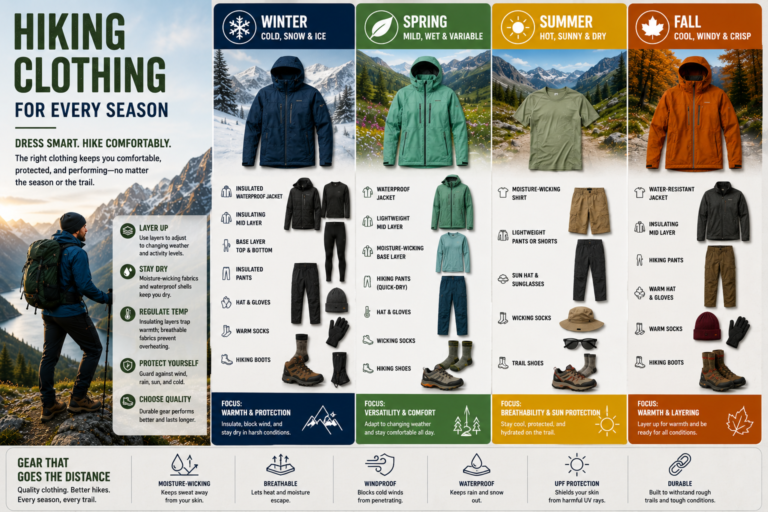
In January, hiking is different from what it looks like in July. Although the trails are the same, the temperatures, weather, daylight hours and physical demands placed on your clothing will be completely different. In winter, a summer hiking outfit will leave you underprepared. In summer, a winter kit can make you too hot before you even reach the summit.

This guide will help you how to choose the right hiking clothing for the season.

The Principle of Layering is applicable to all seasons

It’s important to establish the general principle before tackling each season. Hiking clothing is layered — base, mid, and outer layers — each serving a different purpose. The combination can be changed as the conditions change during the day.

This system isn’t just for winter hiking. Even in the summer, there can be considerable temperature differences between the valley and the summit, morning and noon, and moving and stationary. Knowing which layers to wear and when to remove or add them is just as important as choosing the right clothing.

A manufacturer of hiking clothing that designs for all seasons knows how each garment in a system is related to the other — and builds every piece with the layering context in view.

Spring Hiking Clothing

The spring is a challenging time for hiking clothes, as conditions can be unpredictable and change quickly within a day. Many hiking areas have a variety of weather conditions, including cold mornings, warm middays, and rainy afternoons.

Spring is all about versatility. A lightweight, moisture-wicking base layer in base layers will manage the heat of midday exertion. Packable fleece is ideal for the morning chill and summit chill. A waterproof jacket, which packs small and can be deployed quickly, will cover the spring rain.

Stretch nylon hiking trousers are lightweight and quick drying, and they can handle the moisture and temperature variations that spring brings.

Summer Hiking Clothing

The most important factors to consider when hiking in summer are breathability, moisture control, and sun protection. Summer is not about cold, but rather overheating, sun damage, and dehydration during high-intensity activity in warm weather.

outdoor tees, shirts and shorts are made of lightweight, moisture-wicking fabric to manage sweat when moving uphill for long periods. Outdoor Shorts made of quick-drying Nylon reduce the thermal load on your lower body. In high-altitude and high-UV environments, sun protection is just as important as moisture control.

Even in the summer, it’s worth packing a windbreaker coat. Summit wind chills or unexpected afternoon weather conditions can make even warm summer days feel cold.

Autumn Hiking Gear

Autumn hiking is a combination of the physical conditions and cold bias of spring. Temperatures drop more quickly, weather windows are smaller, and as the season progresses, the likelihood of experiencing genuinely cold temperatures increases.

Autumn is a better time to wear a mid-weight baselayer than the lighter versions that are more suitable for spring and summer. A Softshell Jacket is ideal for autumn weather conditions. It provides wind protection and light rain protection, while still allowing you to move freely. As an emergency layer of insulation, a puffer coat is a great choice for cold weather.

Outdoor cargo trousers made from heavier nylon or stretch polyester provide greater warmth than summer trail shorts, without adding the weight of winter pants. They are the perfect choice for autumn hiking.

Winter Hiking Clothing

Clothing for winter hiking needs to be able to withstand the cold – sustained temperatures below freezing, wind chill at exposed ridges and conditions of snow, ice and rain. Layering becomes crucial, and each layer must perform better than its equivalent three-season garment.

Base layers should be made of merino wool or synthetics in base-layer clothing. This is because wet base-layers in winter can cause dangerous and rapid heat loss. The mid-layer is a heavyweight fleece with significant warmth retention. The outer shell should consist of a Hardshell Jacket, with a waterproofing membrane and sealed seams.

Winter hiking and skiing both require the same protection for exposed skin.

What to always carry irrespective of season

Some items are essential for hiking, no matter what season it is. Packable waterproof layer. Lightweight insulating layer. Base layers with moisture-wicking properties that regulate sweat in any temperature. Lower body protection to handle sudden weather changes.

While the specific weights and levels of warmth of each item vary by season, the general principle of carrying three items — moisture management and insulation — and weather protection is applicable to spring, summer and autumn hiking as well.

Camping clothing designed to be worn overnight shares the same layering requirements. A manufacturer that produces both day hiking apparel and camping apparel knows how to make clothing systems perform over extended outdoor periods rather than only a day.

Conclusion

The best way to pick the right hiking clothes for each season is to understand what each season requires and build a layering scheme around that, rather than relying solely on one all-purpose outfit.

Spring requires versatility. Summer requires sun protection and breathability. Autumn requires wind and rain resistance. Winter requires warmth and waterproofing. The layering principle is beneficial for all seasons.

Explore the hiking apparel manufacturing options when you are ready to develop a seasonal hiking clothing line and find the best production partner for your brand.

FAQs

What’s the most important hiking apparel for each season?

 The moisture-wicking baselayer is essential in all temperatures.

What do I need to bring for sudden weather changes?

 An ultra-compact waterproof jacket that can be carried in a daypack, but provides full protection from the elements when unexpected conditions arise.

Can a softshell jacket be used for winter hiking in cold conditions?

 No. Softshell offers wind resistance and a light rainproofing, but does not provide the insulation and waterproofing that cold winter weather requires.

Which fabrics are best for autumn hiking pants? 

Heavyweight nylon or stretch polyester trousers offer more warmth without adding the bulk of winter bottoms, making them the most versatile option for autumn conditions.

Essential Camping Clothing Checklist for Outdoor Adventures

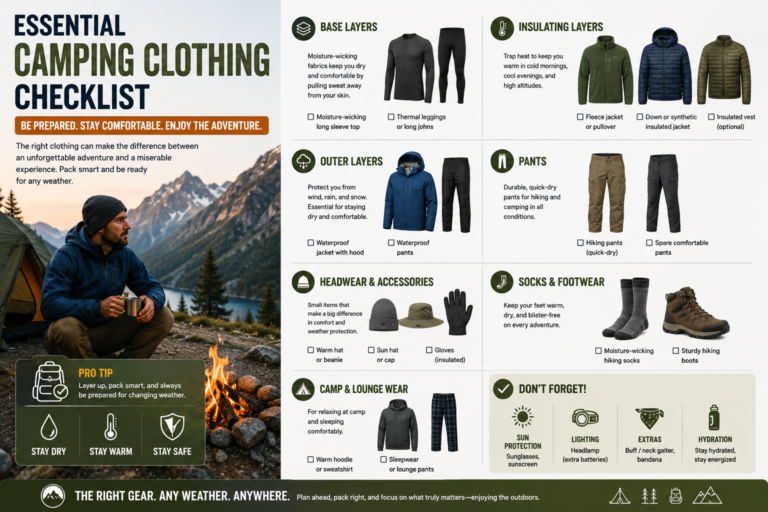
It may seem easy to pack for a camping trip until you realise you forgot your waterproof jacket. You may be sitting around the campfire at night and realise that your summer T-shirt will not keep you warm enough.

It’s much easier to get your camping clothes right before you go than it is to improvise once you are already there. This list covers the essential camping clothing that every adventurer should have, and why it is important.

Camping Clothing: The Basic Principle

Clothing for camping should be able to accommodate two different situations: active use during the day, such as hiking, setting up a camp and outdoor activities; and static use at night, when the body temperature drops, and clothing is needed to maintain warmth, rather than to manage perspiration.

The most common clothing problem on camping trips is that people pack for one scenario but ignore the other. If you only bring active layers for hiking, you’ll be underprepared to face cold evenings. If you only bring warm, static layers to wear during the day, you will end up overheating. The right camping clothing covers both — effectively and without adding excessive weight to your pack.

manufacturers of camping apparel that are specifically designed for camping understand this dual demand and build garments which can be used both actively and in a static position more efficiently than pure hiking or casualwear alternatives.

Base layers — the foundation that cannot be compromised

The base layers are often the most overlooked item of camping clothing. They are worn against the skin to manage moisture. Moisture management and odour control are equally important in camping where clothes may be worn without washing for long periods.

Pack two sets of base layers: one for the active daytime and another for sleeping. Base Layer Clothing is perfect for camping due to its natural odour-resistance, temperature regulation and comfortable handfeel over multiple days.

Mid-Layer Insulation

Every camping trip, regardless of the season, requires a mid-layer insulation piece. Even in the summer, temperatures can drop dramatically at high altitudes or after darkness. A camp night without sufficient insulation is uncomfortable and even dangerous in exposed areas.

Outdoor fleece provides the best warmth to weight ratio for camping. It can be worn as a mid-layer on warm evenings, or underneath a shell jacket when it’s cold. A down jacket with a synthetic or packable fill is a great alternative, especially for cold weather camping.

Waterproof outer layer

Any camping checklist must include a waterproof outer layer. Camping trips can be ruined by rain, especially when the weather changes quickly and without warning.

Waterproof Clothing With a waterproof membrane and taped edges, it provides reliable protection from rain. The Rainwear is compact and fits into its own pocket, so it doesn’t take up much space in your pack.

Hiking Trousers & Shorts

For camping, lower body clothing must balance active performance in the daytime with adequate coverage for changing temperatures at night. hiking trousers in stretch-nylon cover most of the day’s activity needs – durable, quick-drying and free-moving over technical terrain.

Outdoor Shorts can be a good addition to your camping gear for warm weather, especially at lower elevations. The daytime temperatures are too high and full-length pants would make you uncomfortable. Outdoor cargo trousers provide additional carrying capacity on trips when accessing pockets is important during the day.

Camp Footwear and Socks Layers

Camping checklists should include socks because they cause blisters more quickly than any other piece of equipment. Pack at least two pairs of hiking socks each day, and always carry a spare pair in case you encounter unexpected rain.

For evenings at the campsite, a pair of sandals or camp shoes that are lightweight can give your feet a break from the hiking boots. They also prevent the moisture buildup caused by wearing the same footwear day and night.

Protect your hands and head

The most common clothing items to be forgotten are hand and head protection. This is especially true when the weather turns cold. The lightweight beanie, along with a pair or liner gloves, take up very little space in your pack and provide significant warmth on cold mornings and nights.

Ski wear is the same as cold weather camping. Covering exposed extremities will keep you warmer than adding bulk to your torso. For high-altitude or winter camping, a ski masque or balclava can be useful. The face and neck are at risk of heat loss.

Outdoor Jacket for Versatile Coverage

An outdoor Jacket which provides both insulation and protection from light rain gives the camping wardrobe system a real versatility. A hybrid jacket, with insulated panels in the core and softshell or windproof sleeves, covers more conditions than a pure insulation or shell jacket.

A single outdoor jacket, which can be used in multiple situations, will reduce the number of layers required for camping trips.

Conclusion

Essential camping clothing is essential for all outdoor activities. The checklist includes base layers, midlayer insulation, a waterproof outer layer and hiking shorts and trousers. It also includes hand and head protection and a versatile jacket. You can be prepared for the weather by packing clothing that is both warm and active.

Explore the full range of camping clothing manufacturing options to find the best production partner for you.

FAQs

Which item is most important on a checklist for camping clothing?

 An outer waterproof layer, because the weather can change without warning outside and not having rain protection when you need it is one of many reasons why camping trips go wrong.

Is it necessary to pack more than two sets of base layers for camping?

 You should bring at least two sets — one set for active use during the day and another for sleeping. Merino base layers are perfect for multi-day camping trips when washing isn’t possible.

Which is better, a fleece jacket or a puffer?

 A fleece is more versatile – it insulates even when wet and can be used for a wide range of activities. A puffer jacket is warmer per gram and better for camping in cold weather.

Do waterproof trousers come in handy for camping?

 Yes, if you plan to camp over a period of time and are likely to encounter wet or variable conditions. Summer camping in dry conditions may only require quick-drying hiking pants. However, a pair of lightweight waterproof trousers will add minimal weight to your pack and provide significant protection.

Types of Waterproof Jackets for Different Outdoor Activities

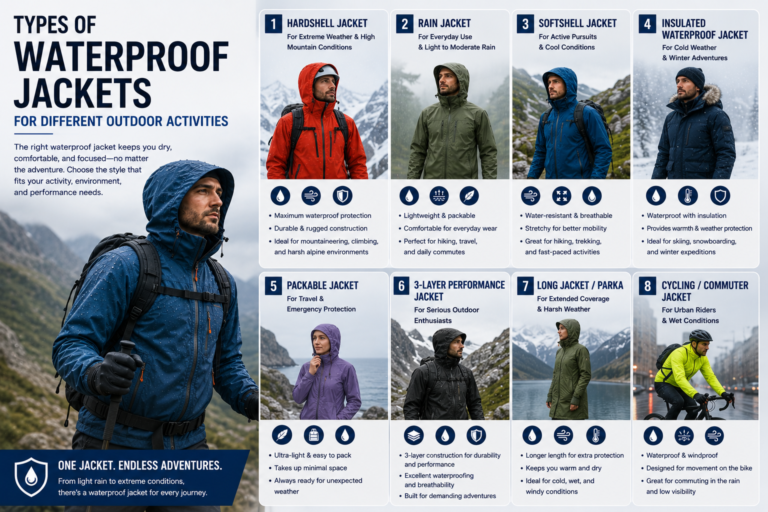
Staying dry and protected against the elements are essential when it comes to outdoor sports. Today, there are many different types of waterproof jackets. Each one is designed for a particular purpose, activity, or environment. The right waterproof jacket is essential for comfort, safety, and performance. Understanding the differences in each style will help you make an informed buying decision and allow brands to build product lines that truly serve their target customers.

Waterproof jackets are not all the same

Most people believe that any jacket labeled waterproof will perform in the same manner regardless of the situation. This assumption can lead to disappointment quickly. Moreover, the design, construction, and fabric technology of each jacket type differs significantly depending on its intended use.

Waterproofing Technology

Three core technologies are used to create waterproof jackets. Waterproof membranes are a thin layer that is bonded to outer fabrics. They block liquid water but allow water vapour escape. Second, a durable water-repellent finish (commonly known as DWR) causes water to bead up and run off of the surface. The third option is a combination, which gives the jacket multiple layers of protection from heavy rain and prolonged rainfall.

The construction of the seams is also important. Seams that are fully taped prevent water from leaking through the needle holes. The main seams are only covered by the critical taped seams. This is a lighter, more affordable option in moderate weather conditions.

What does Breathability Mean in Waterproof Jackets?

The jacket’s breathability refers to its ability to let body heat and moisture vapour escape, while keeping out external water. A waterproof jacket that is not breathable will trap sweat, making it just as wet as rain. For high-intensity activities such as trail running or climbing, breathability is as important as waterproofing.

What are the different types of waterproof jackets?

Brands and buyers can match the jacket with the activity by understanding the types. It also ensures that each garment in a range has a distinct and clear purpose.

Hardshell Jackets

Hardshell jackets offer the highest level of waterproofing. These jackets are designed for extreme weather — heavy rain, strong wind, sleet and snow. They are therefore the preferred choice of mountaineers and backcountry skiers.

The construction of a hardshell jacket typically uses a two-layer, two-and-a-half-layer, or three-layer waterproof membrane system. The most durable and high-performing jackets are made with a three-layer construction, where the membrane is attached to both the outer fabric as well as an inner lining. Hardshell jackets also feature hoods compatible with helmets, ventilation zips under the arms, and reinforced panels in high-wear areas.

Explore our hardshell Jackets Manufacturing and contact our team today.

Softshell Jackets

Softshell jackets are a good compromise between a fleece and an entirely waterproof shell. These jackets are made of stretch-woven composite fabric bonded with a fleece or a jersey inner. They provide wind resistance, rain protection and breathability all in one layer.

Softshell jackets work best for high-output sports like trail running, skiing, and hiking at a fast pace. In these activities, sustained movement creates heat, so breathability is more important than weather protection. Softshell jackets, however, are not designed for prolonged heavy rain. These jackets are intended for conditions that range from cool and dry to slightly wet, where performance is a priority.

Are you ready to create softshell jackets as part of your outdoor collection? Start your production journey by visiting our Softshell Jackets Manufacturing page.

Waterproof Windbreaker Jackets

Windbreaker jackets offer lightweight protection from the wind and light rain. These jackets are made from lightweight nylon or polyester fabric with a DWR finish, making them lighter and easier to pack than other hardshell or softshell options.

Windbreakers are also ideal for activities that place a high priority on weight and pack size, such as trail running, biking, and traveling. The windbreakers are small enough to fit in a pocket and add little weight to your daypack. They can be deployed instantly when the weather changes. They are not intended for heavy rain that lasts a long time. Their water resistance will be compromised in such conditions.

Discover our manufacturing choices and create a range of lightweight outerwear that your customers will love.

Waterproof Insulated Jackets

These jackets are waterproof and insulated, combining weather protection and thermal insulation into one garment. They eliminate the need for an additional mid-layer when it is cold or wet. These jackets are popular for cold weather activities such as skiing, winter hiking and camping.

The insulation inside these jackets is available in two types: down and synthetic. The best insulation for warmth to weight ratio is down, but it loses its insulating properties when wet. Synthetic filling retains its warmth when damp, making it a better choice for environments that are consistently wet.

Our puffer Jackets Manufacturing team is here to help you find the right fabric, fill and construction for any product that your brand may be developing.

Rainwear Jackets

Rainwear jackets have been designed to provide protection from wet weather for a long time. They place a higher priority on waterproofing, coverage and technical performance than breathability. These jackets are usually lighter and cheaper than hardshell jackets, making them a good choice for activities that require weather protection but not high output.

Rainwear jackets can be used for camping, fishing, outdoor recreation in general, and even urban commutes in humid climates. These jackets are more popular with a wider range of customers than hardshell technical jackets, which is why they make a great product for brands that target a lifestyle or general outdoor market.

Today, you can start manufacturing rainwear to promote your brand. Contact our team by visiting our rainwear production page.

Snow and Ski Jackets

Ski jackets are designed to be used on the mountain in cold and snowy conditions. These jackets combine waterproofing and wind resistance with insulation and ski-specific features, such as powder skirts that prevent snow from entering, helmet-compatible sleeves, goggle pockets and pass pockets.

Ski jackets also work well as part of an outerwear layering system, usually over a base-layer and a mid-layer fleece. This means that the fit must accommodate the layers without restricting the movement on the slopes. Ski jackets have some of the highest construction standards in the category of waterproof outerwear.

Our skiwear manufacturing capability covers full ski jackets and pants production — from fabric source to finished garment. Please contact us to discuss the requirements for your ski collection.

Waterproof Jackets For Hiking And Camping

Hiking and camping jackets that are waterproof balance weather protection, packability and versatility. These jackets are lighter than ski or mountaineering gear and can be easily carried in a backpack. They can also be used to adapt to changing conditions on the trail.

These jackets also work as an outer shell for the hiking layering systems — they sit over a moisture wicking base-layer and insulating middle-layer, completing a complete weather protection system. The hood, hem, and pocket placement have been optimized for use on the trail or in camp, rather than skiing and technical climbing.

Waterproof Jackets: What to look for

No matter which type of jacket is best for your sport, there are certain features that separate a good product from one that’s disappointing. Here’s what you should look for:

  • Waterproof Rating — measured by millimetres in water column. 10,000mm is suitable for general outdoor use. 20,000mm or more suits demanding conditions.
  • Breathability Rating — measured by grams of moisture transmitted per square metre in 24 hours. Higher numbers indicate better breathing
  • Seam Construction — Fully taped seams for maximum safety, moderately taped seams
  • Hood design — compatible with helmets for technical use and adjustable for outdoor activities
  • Packability — Lightweight jackets that compact into their own pockets are more versatile when traveling and hiking.
  • DWR Refresh — The outer DWR finish degrades with time, and requires periodic refreshing in order to maintain its water repellency.

Waterproof Jackets For Outdoor Brands – Where To Start?

The quality and commercial success will be determined by the decisions made early on in the process if you plan to add waterproof jackets into your outdoor apparel range. Before sampling can begin, fabric selection, membrane technology and seam construction must be specified.

Working with a manufacturer that specializes in waterproof clothing, rather than an all-purpose factory claiming they can handle outerwear for technical purposes, will give your brand the technical expertise as well as production quality needed to produce waterproof jackets.

If you’re developing an outdoor outerwear line alongside your waterproof jackets then explore the jacket manufacturing options available to you. This will help you build a cohesive collection from a trusted production partner.

Are you ready to begin your waterproof jacket manufacturing? Let us help you create your outdoor outerwear collection. Contact our team now.

Conclusion

There are many different types of waterproof jackets for outdoor activities. They range from lightweight windbreakers that can be packed into a backpack to hardshell mountaineering coats with advanced technology. Each style is designed for a particular activity, customer and weather conditions.

Understanding these differences will help you build an outdoor product line that truly serves your customers — and make smart purchasing decisions when weather is the only variable you can’t control.

If you’re a brand looking to develop your next outdoor collection, or a customer choosing the best jacket for your next trip, you should know which waterproof jacket is right for you.

FAQs

What’s the difference between hardshell and softshell jackets?

 Hardshell jackets use a waterproof membrane with taped seams to provide full weather protection under extreme conditions. A softshell is a stretchy composite fabric that offers wind resistance, light rain protection and better breathability. It’s ideal for high-output sports in moderate weather conditions.

Is windbreaker clothing waterproof?

 No, windbreakers are not waterproof. They can handle rain and wind but they will get wet if the rain is heavy. These jackets are ideal for activities that require a lightweight and compact design.

What is the waterproof rating on a jacket about? 

The rating measures how much pressure water can exert before the fabric leaks, expressed in millimetres. A rating of 10,000mm suits general outdoor use. A rating of 20,000mm or more is suitable for demanding alpine skiing and conditions.

What does DWR stand for and will it wear off?

 DWR is Durable Water Repellent, a coating that is applied to outer fabrics to cause water to bead up and run away. It wears out over time, but it can be revived with specialist spray treatments and tumble drying.

Best Fabrics Used in Waterproof Jackets

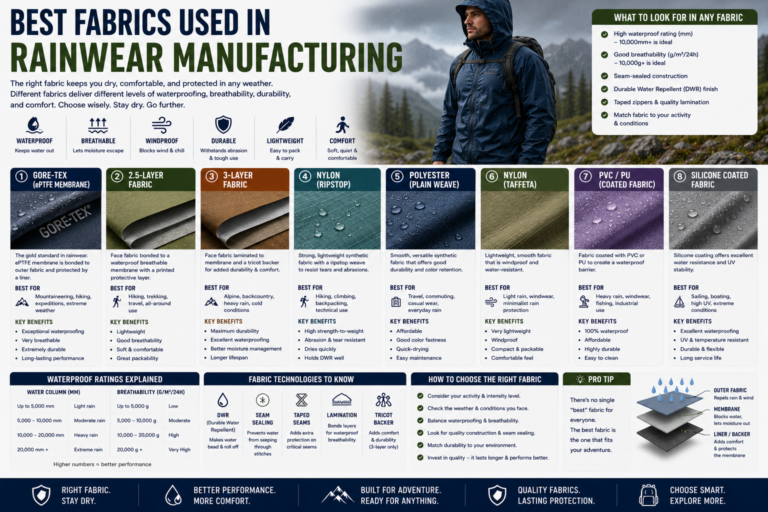
Choosing the best fabrics used in waterproof jackets is critical as they can impact performance in rain, wind, and the cold. Certain fabrics determine the longevity of the respective performance and how the jacket will stand up to the elements and the tests of time (i.e., how the jacket will withstand the effects of repeated, long-term, external, and internal wash cycles, etc.). The materials used to manufacture waterproof jackets have advanced greatly over the years and expanded the boundaries of performance and sustainability. As a result, the options have become incredibly diverse, making it very exciting for brands developing new collections, as well as for buyers as you now have premium options available. The goal of this document is to educate you on what makes a waterproof jacket ultimately superior.


Understanding Waterproof Jacket Construction

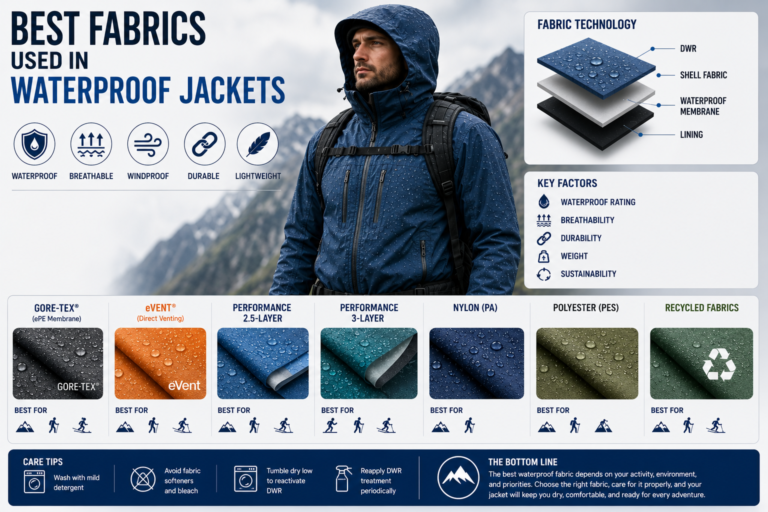
Before we can differentiate the types of fabrics available for waterproof jackets, we need to understand how they’re constructed. Most of today’s dry, technical waterproof fabrics begin with a combination of a 3 component structure, which consists of a face, a membrane, and a lining. These three are combined as a part of a 2, 2.5, or 3 layer laminate.

The Role of the Face Fabric

The outermost layer of a jacket is the face fabric. Treated with a DWR finish, water beads and rolls off. The face fabric also protects not just the waterproof membrane from abrasion, and, damage from the elements but also from UV exposure.

Nylon and polyester are the two most popular face fabric materials. Both are good at accepting DWR treatments and are balanced in strength and weight. Both provide a good variety of choices in different weights and weave structures.

The Role of the Waterproof Membrane

The membrane is the most important part of a waterproof jacket. It is the layer that face fabric and lining jackets the waterproof fabric. It plays the role of blocking water and allowing water vapor to escape in either direction. A good membrane is waterproof and still allows the user to stay dry from the inside.

The Role of the Inner Lining

The inner lining is the layer closest to the membrane and protects it from abrasion from the outer fabric. In two layer jackets, the inner lining is the outer layer and is often made from a lighter mesh or taffeta. In three layer jackets, the inner lining is bonded to the membrane which then forms a single layer. The three layer design is advanced and durable but heavier and more costly.

The Best Fabrics for Waterproof Jackets

Knowing what fabrics contribute to superior performance assist brands in making more informed sourcing decisions as well as helping buyers know why premium waterproof jackets have a higher price tag.

Gore-Tex

Gor-Tex is a premium waterproof fabric and an industry standard. Gore-Tex is a developed a a product of W. L. Gore and Associates. Gore-Tex is comprised of a membrane of expanded polytetrafluoroethylene which has approximately nine billion micropores in a square inch. Each of those pores are 700 times larger than a water vapor molecule yet 20,000 times smaller than a water droplet. Gore-Tex membrane has an extremely thin layer which is an excellent moisture barrier but still lets vapor pass.

Each product in the Gore-Tex line has a tier. Gore-Tex Pro are for the more extreme and rugged pursuits, Gore-Tex Performance Shell is for general outdoor activities, and Gore-Tex Active is for more strenuous activities where breathability is the main concern. Gore-Tex Pro is the standard for alpine hardshell jackets. Gore-Tex Pro is the industry standard for jackets in alpine conditions.

eVent Fabric

eVent is another industry-standard waterproof membrane fabric. It uses a different technology from Gore-Tex which places an coating on the membrane. eVent has a membrane that is breathable and vapor-permeable. Gore-Tex is an industry standard for a reason, and is hard to compete with.

Thus, eVent has more breathability than regular Gore-Tex, which indicates that eVent is better for high-output activities. Gore-Tex cannot manage this level of moisture for continuous exertion. eVent is consistent for a wide range of breathability. eVent breathes even when the environment is cold and dry, and also when it is warm and wet.

For its breathability, eVent is better than competing membranes. This is why many brands making waterproof jackets for trail running, ski touring, and other high-aerobic activities use eVent for their products.

Pertex Shield is a membrane that is lightweight and easy to pack. This membrane is designed to be waterproof and breathable. It is lightweight and easy to pack, meaning it is preferred in ultralight hiking jackets and excellent on the trails. Because it is lightweight, it is an excellent membrane to be used on packable windbreakers.

For additional packable windbreakers, we can utilize Pertex Shield in the various forms, including other high waterproof and breathable forms. Packable waterproof windbreakers are easy to pack in a bag, making them excellent for hiking. If you want a waterproof outerwear for hikers, get in touch with us and we will help you use the best membranes.

Nylon Face Fabrics

When it comes to fabrics used in the construction of waterproof jackets, nylon has a lot going for it. It has a great strength-to-weight ratio. It can easily be treated with durable water repellent (DWR) treatments, and nylon fabrics can be found in a ripstop weave. Ripstop fabrics, as the name suggests, help prevent tears from worsening, and do so at no additional weight expense.

In scenarios where a jacket is subjected to extended periods of rain, the ripstop Nylon fabrics dry the quickest, even after getting completely soaked. For premium outdoor jackets, processed with a higher denier, nylon provides the needed resistance to abrasion from rocky and rugged trails of the utmost concern while maintaining a lightweight jacket.

Ripstop nylon is a woven fabric that has an overbearing reinforcing structure that halts the spread of tears. It is preferred in the construction of waterproof jackets especially the hardshells, as the jackets must balance weight and durability.

Polyester Face Fabrics

Polyester face fabrics are a great value alternative to construction of waterproof jackets using nylon. Since polyester is more UV resistant than nylon, polyester jackets can be used in environments where there is a lot of sun without degrading as quickly as a nylon jacket would.

Brands designing rainwear and waterproof jackets for the more general consumer, as opposed to the specialized outdoor consumer, can use polyester face fabrics as a value alternative that doesn’t sacrifice performance.

Recycled polyester, using post-consumer plastic bottles, is a fabric used by many brands to create waterproof jackets that are environmentally friendly and are of good performance.

Softshell Composite Fabrics

Softshell fabrics do not create a fully waterproof membrane. However, they offer a new waterproof solution that deserves consideration.

Softshell Composite Fabrics combine a woven outside layer and a fleece or jersey inner layer. The result is a single layered fabric that is fast and easy to combine. Softshell Composite Fabrics are also stretch, making them ideal for a variety of activities. Because of this, Softshell Composite Fabrics are highly appropriate for Softshell Jackets that are designed to be used for ski touring, trail running, or fast and aggressive hiking.

Softshell fabrics also eliminate the need for a separate mid-layer in many conditions. This decrease in fabric requirement is convenient and simplifies the layering system.

Recycled and Sustainable Waterproof Fabrics

Recently, sustainability has become more important when selecting fabrics for waterproof jackets. Fortunately, the selection of fabrics has also improved. Both recycled nylon and recycled polyester can now be used to construct waterproof fabric that is both environmentally friendly and non-sustainably sourced.

Additionally, flap and DWR finishes have become more environmentally friendly and can be substituted in the place of traditional, environmentally persistent and harmful, fluorocarbons. Waterproof jackets can be constructed using certified eco-friendly fabrics and membranes, and in doing so can fulfill both a customer and design requirement for high performing fabrics.

If sustainability matters most for your supply of waterproof jackets, our waterproof clothing manufacturing team can help you with your best certified sustainable fabric for specific product requirements. Contact us for more info.


Key Fabric Properties in Production of Waterproof Jackets

Key fabric properties for waterproof jackets

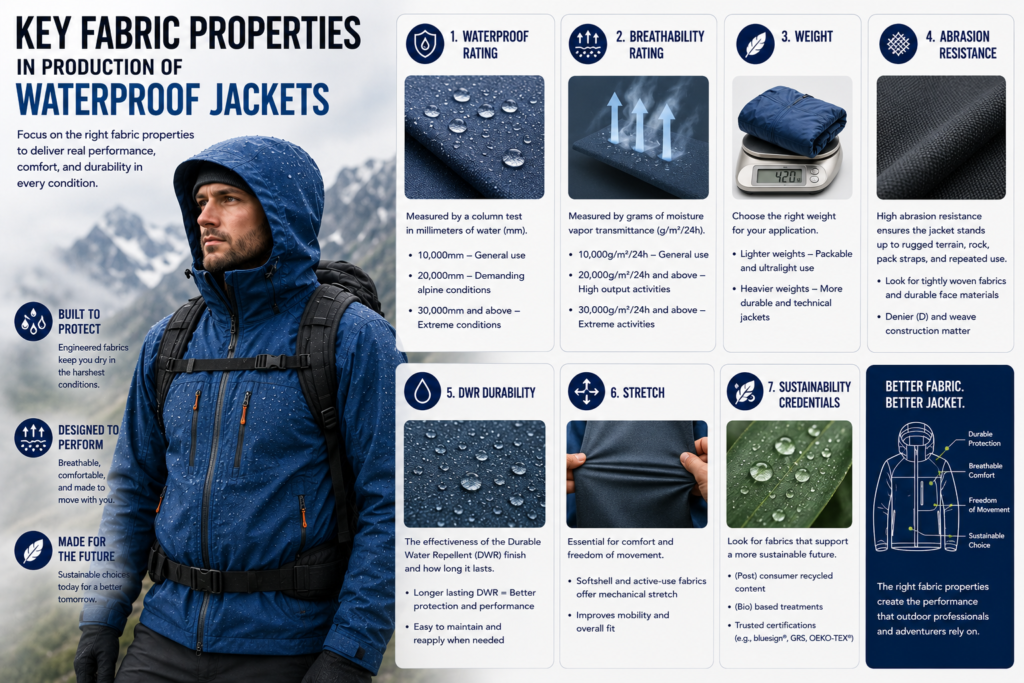
When analyzing fabric options for the production of waterproof jackets, target the following properties for actual performance in the field:

  • Waterproof Rating — Conduct a column test in millimeters of water; loadings of 10,000mm for general use, 20,000mm for demanding alpine conditions and above.
  • Breathability Rating — Conduct a test in grams of moisture vapor transmittance; 10,000g/m²/24h for general use, 20,000g/m²/24h and above for high output activities.
  • Weight— lighter weights for packable and ultralight applications, heavier weights for more durable and technical jackets.
  • Abrasion Resistance— jackets likely to be worn in rugged terrain require good abrasion resistance.
  • DWR Durability— the effectiveness of the durable water repellant (DWR) finish and how long the treatment lasts before needing to be reapplied.
  • Stretch— softshell and active-use fabrics.
  • Sustainability Credentials— (post) consumer content, (bio) based treatment and certifications for brands positioning on sustainability.

The Fabric Building Block of Your Waterproof Jacket Range

Fabric choice is the starting point. However, translating that fabric choice into a waterproof jacket that performs as specified is equally about manufacturing expertise and construction. The wrong construction with the right fabric, results in a sub par product. The right fabric with the right construction, along with seam taping, compatible component construction, and appropriate fit, results in a product that meets all performance requirements for the intended use.

As with any other designs, if you are developing ski wear or technical mountain outerwear with waterproof jackets, similar fabrics can be used throughout the collection. The same face fabric or fabric with the same technology can be used in different styles. This enhances collection cohesion, as well as simplifies the quality control and sourcing processes.

Want to develop a comprehensive collection of waterproof jackets? Our technical team can help you determine the fabrics that will allow you to launch your collection. We partner with brands at any developmental stage to help them select the optimal materials, construct the waterproof jackets with the desired functionality, and employ advanced field-ready waterproof capabilities.


Conclusion

The best fabrics used in waterproof jackets can be designed using a wide variety of advanced fabrics. From Gore-Tex Pro with extreme alpine capability to general-purpose sustainable waterproof jackets using face fabrics of recycled post-consumer polyester, the only limit to the choice of fabrics is the performance needs of the apparel, the target consumer, the intended activity, and the brand. By knowing the differences among the commercially available options, you will be able to design a waterproof jacket collection that will delight and encourage your customers, rather than let them down in the field.

Choosing the best fabrics is the most critical step at the beginning of the process, whether you are sourcing fabrics for an upcoming production run, or establishing your first collection of technical outerwear. This step will ensure that your customers love the end product.


FAQs

Which waterproof fabric is best for outdoor jackets?

Today’s marketplace for waterproof breathable fabrics is quite varied. Yet, many mountaineering professionals believe that Gore-Tex is the benchmark, with Gore-Tex Pro on top for technical alpine and mountaineering applications. For activities with a high rate of energy expenditure, consider eVent as a good alternative, since it is quite breathable.

What is the difference between waterproof membrane and DWR finish?

Waterproof membranes and DWR finishes differ quite a bit in both construction and application. DWR finishes are surface coatings that lead water to bead and roll off. However, they degrade and require reapplication over time. Waterproof membranes, on the other hand, are permanently bonded construction layers that block all water ingress.

Is recycled polyester as good as virgin polyester in waterproof jackets?

Recycled polyester face fabrics in waterproof jackets perform on par with virgin polyester. Therefore, utilizing virgin polyester as opposed to recycled polyester in waterproof jackets serves no functional quality purpose, since production of virgin polyester adds to the environmental burden.

How to Choose the Right Waterproof Jacket

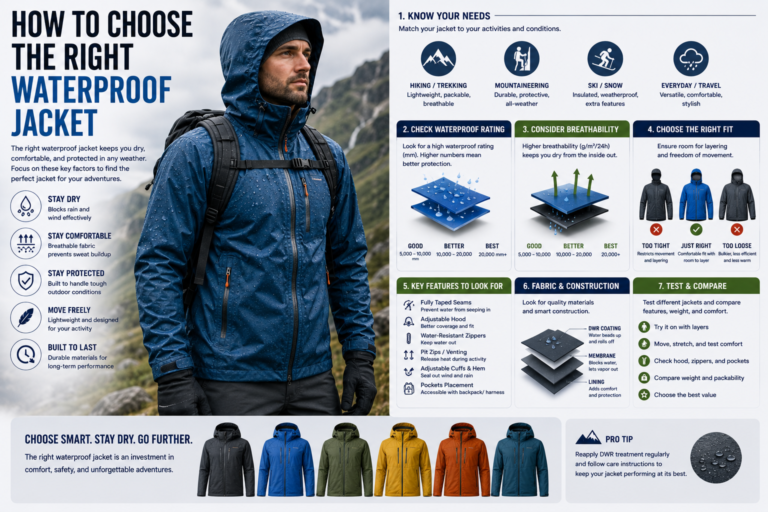
For outdoor enthusiasts, learning How to Choose the Right Waterproof Jacket is an essential skill. With so many waterproof jackets available today, finding the best option can feel overwhelming. This is especially true for brands entering the technical outerwear market or consumers looking for reliable protection in challenging weather conditions. Understanding How to Choose the Right Waterproof Jacket requires evaluating important factors such as fit, fabric construction, waterproof ratings, breathability, and performance features. By focusing on these key elements, you can confidently select a jacket that matches your environment, activity level, and weather protection needs.

Define Your Needs First

The most important aspect of buying a waterproof jacket is knowing exactly what you need it for. Depending on the outdoor activities you choose, the demands on waterproof outerwear vary significantly.

Activities that Require a High Jacket Performance

Activities such as running, ski touring, and fast hiking, produce a lot of body heat and a good deal of perspiration. For these types of activities, specific jacket features are required.

Breathability is the most important factor for any jacket in these situations. If a jacket has a high waterproof rating, but has bad breathability, you’ll just get wet from the sweat on the inside of the jacket. This defeats the purpose of a waterproof jacket.

For high output activities, you should get jackets with a breathability rating of 20,000g/m²/24h or higher. You should also consider jackets made from a lightweight softshell for conditions with little to no heavy rainfall. This is because softshell jackets are far more breathable than hardshell jackets, and are much lighter.

Static and Low-Output Activities

Low-output activities, like camping, fishing, and hiking, require a jacket that is primarily designed to keep water out. This is because the body does not generate as much heat, and moisture from sweat is not as important to manage as the water from the elements.

For activities that involve no body movement, a jacket that is primarily designed to keep water out of the jacket is ideal. These jackets may not have a high breathability rating, but their construction will keep water out. For this style of jacket, you can look for rainwear that is designed to keep the elements out of the jacket and is designed for sustained protection against inclement weather.

Important Technical Specifications

Once the activities are defined, the next step is to evaluate the important technical specifications that impact jacket performance. These specifications will appear on a product or material data sheet, and will help you to differentiate the jackets.

Waterproof Rating

The waterproof rating indicates the amount of water that a fabric can hold before it begins to leak, and is measured in millimeters.

A jacket rated at 10,000mm can stand up to a column of water that is 10,000mm high. In theory, 10,000mm can withstand water intrusion during most outdoor activities. 20,000mm and higher is warranted for extended alpine activities during heavy, continuous rainfall.

The construction of a seam plays a critical role in the waterproof performance of a jacket as does a fabric rating. Fully taped seams cover all stitch lines and prevent water intrusion at the seams. The critical tape seams cover the main structural seams and are adequate for less severe weather conditions at a lower price point. Fabric ratings and construction of seams are equally as important when evaluating a jacket.

Breathability Rating

The breathability rating documents a fabric’s capacity to pass moisture vapor. It is the amount of moisture vapor in grams that the fabric can transmit, measured per square meter, and occurring in a 24 hour period. Ratings of 10,000g are adequate for most outdoor activities and hiking. Breathability ratings of 20,000g and above are suited for activities of such a high degree of output that significant moisture vapor is produced.

Breathability is also performance rated against temperature and humidity. Most membranes perform better when the outside temperature is higher than the inside temperature of the jacket. Knowing what temperature and conditions the jacket will perform best in will aid in determining the breathability ratings.

Layering of Construction

Layering in the construction of waterproof jackets impacts the performance, weight, and durability of the jacket.

The two-layer construction system uses a separate hanging inner lining that bonds the membrane to the outer fabric, building a lighter and cheaper jacket – suited for general outdoor activities. Going a step further, a two and a half layer system aids base membranes with patterns for super lightweight applications, again eliminating the need for a lining.

With a three-layer system, a membrane is bonded with both the outer fabric and lining made of a single composite fabric. This construction builds the most durable jackets and the most technical and highest performance jackets. Every brand building hardshell jackets for demanding alpine or mountaineering applications should insist on three-layer builds for their standard.

How to Get the Right Jacket for Your Needs

Knowing the difference between the jacket types available should assist the buyer greatly as each type is designed for a specific range of activities and conditions.

Hardshell Jackets

Hardshell jackets are designed to handle the worst of the weather. Using waterproof, breathable membrane fabrics with fully taped seams, technical features like hoods that accommodate helmets and underarm ventilation zips are included. Hardshell jackets are designed for the worst weather, so they are heavier and less packable than softshell or windbreaker jackets.

If your brand is designing technical hardshell outerwear, our hardshell jacket manufacturing services will assist you from design to manufacture.

Softshell Jackets

Softshell jackets convenience the stretch and breathability of the fabric, but compromise full weather protection.

They are designed to be used in environments where heavy downpours are not frequent, where continuous sustained physical activity is the norm, and where the system utilizes the outer layer of the system for the cool and dry, or the lightly moist environments.

In addition, softshell jackets are more comfortable than hardshell jackets, during physical activity. This makes softshell jackets the better choice during physical activities where freedom of movement is needed as well as protection from the elements. Our softshell jackets manufacturing capabilities include everything from fabric selection to bulk production — contact us to start your softshell development today.

Windbreaker jackets

By far the lightest and most packable in the line of waterproof outerwear, windbreaker jackets are the best choice where only the most lightweight and waterproof outerwear is needed. They make the perfect addition to gear for any activity that could possibly change along the way, as they effectively fend off wind and light rain and, pack down into their own pocket. They are, however, not meant for prolonged heavy rain.

Windbreakers are the best choice for cycling, trail running, and travel. Our windbreaker jackets manufacturing is the best addition to any lightweight, waterproof outer layering collection.

Waterproof Insulated Jackets

Waterproof insulated jackets provide protection from the elements on the outer layer, and the insulation needed on the mid-layer, simplifying jacket systems for cold and wet environments. They help to fulfill the needs of cold weather camping, winter hiking, and ski day jackets.

They also help to simplify the decision for insulation for cold and wet environments, as they influence the mid-layer insulation choice significantly.

Synthetic fill is more useful in damp environments as it retains heat in wet conditions. Down has a better warmth-to-weight ratio in dry conditions. Our puffer jackets manufacturing team can help you choose the correct insulation and construction solutions for your product. Contact us to begin.

Fit Considerations for Waterproof Jackets

Fit is often the most overlooked aspect when it comes to choosing a waterproof jacket. But it has a big impact on both the effectiveness and comfort of the jacket in the real outdoor environment.

Layering Clearance

Waterproof jackets need space to fit the layers underneath, whether they be base layers and/or mid layers, and must fit without restriction and without the compression being uncomfortable. Therefore, it is normally the case when choosing a waterproof jacket to select a larger size than your normal casual fit jacket.

Hood Design and Fit

Of all the features of a waterproof jacket, the hood has the most importance. A good hood design retains its position when you move, covers the forehead without a total view blockage and seals around the facial opening to keep the elements out. When looking at waterproof outerwear designed specifically for the Alps and skiing, a hood that fits over a helmet is a must. For all other hiking and camping the hoods that provide the best fit and coverage are the adjustable three-point hoods.

Hem, Cuff, and Collar Sealing

Along with the Rocky Mountain Range, the hems, cuffs, and collar are the most popular seepage and leakage points for waterproof jackets.

Adjustable hem draw cords, Velcro or snap cuff closures, along with a high collar and chin guard, help block rain at major entry points. Also, a storm flap over the front zip keeps rain from entering along the zip teeth during torrential rain.

What to Look for in Waterproof Jacket Features

Essential features of a waterproof jacket

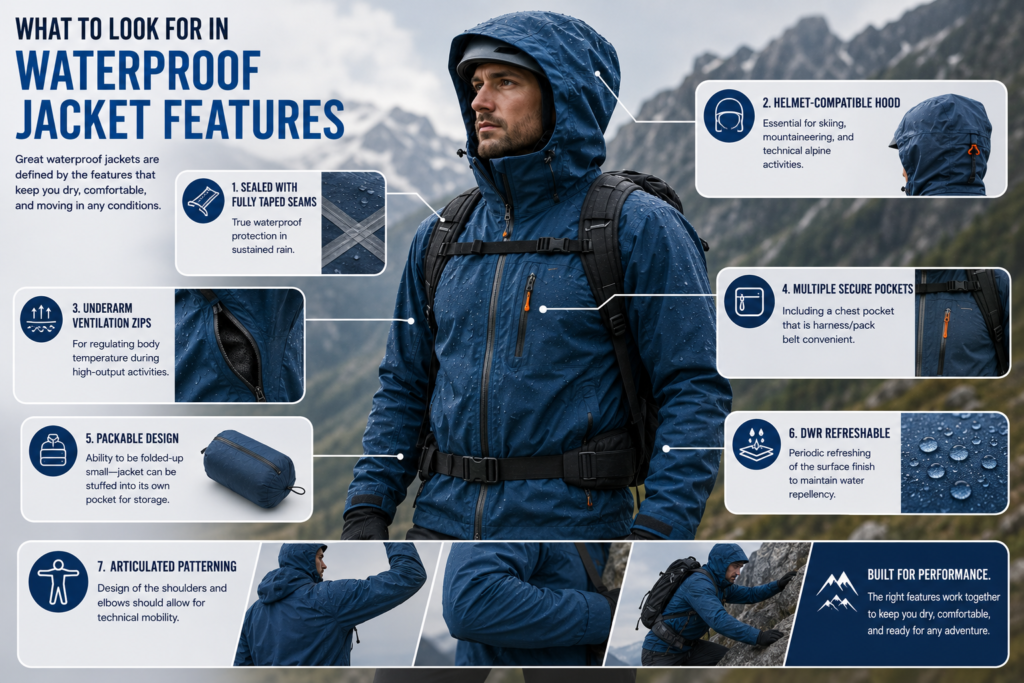
Beyond the technical specifications and fit, there are features that determine the quality of the design of a waterproof jacket. Look for the following:

  • Sealed with Fully Taped Seams — True waterproof protection in sustained rain.
  • A Helmet-Compatible Hood — Essential for Skiing, Mountaineering, and Technical Alpine Activities.
  • Underarm Ventilation Zips — For regulating body temperature during high-output activities
  • A Number of Secure Pockets, including a Chest Pocket that is Harness/Pack Belt Convenient.
  • Ability to be Folded-Up Small — Jacket can be stuffed into its own pocket for storage.
  • Ability to be DWR Refreshed — Periodic refreshing of the surface finish to maintain water repellency.
  • Articulated Patterning — Design of the shoulders and elbows should allow for technical mobility.

Choosing a Waterproof Jacket Manufacturer for Your Brand

If you are building an outdoor apparel brand and adding waterproof jackets to your range, choosing the right manufacturing partner is as important as choosing the right fabric and construction. A specialist waterproof clothing manufacturer brings the technical expertise — membrane sourcing, seam taping, hardware selection, and quality control — that general apparel factories simply cannot match.

Additionally, working with a manufacturer experienced across the full outdoor jacket category — including outdoor jackets production across multiple styles and constructions — gives your brand the production versatility to build a cohesive outdoor outerwear range from a single trusted partner.

Ready to start developing your waterproof jacket range? Contact our team today — we support brands at every stage of the development process, from initial fabric selection and tech pack development through to bulk production and delivery.

Conclusion

Knowing how to choose the right waterproof jacket comes down to four connected decisions — understanding your activity and its specific performance demands, interpreting technical specifications accurately, selecting the right jacket type for your conditions, and evaluating fit and features against your real-world use requirements. When these four decisions align, the result is a waterproof jacket that genuinely performs — keeping you dry, comfortable, and protected through whatever the outdoors delivers.

Whether you are a brand developing your next outdoor collection or a buyer choosing a jacket for your next adventure, starting with these four decisions gives you the clarity and confidence to choose correctly every single time.

FAQs

What waterproof rating do I need for hiking in heavy rain?

A waterproof rating of 20,000mm and above with fully taped seams suits sustained heavy rain during hiking. For general outdoor use in moderate conditions, 10,000mm is adequate.

Is a higher breathability rating always better?

Higher breathability ratings deliver better moisture management during high-output activities — but in low-exertion contexts, the difference is less significant. Match the breathability rating to your activity’s intensity level rather than always choosing the highest available rating.

What is the difference between fully taped and critically taped seams?

Fully taped seams seal every stitch line on the jacket for maximum waterproof protection. Critically taped seams cover only the main structural seams — appropriate for moderate conditions at a lower production cost.

How should a waterproof jacket fit over layers?

A waterproof jacket should have enough room to accommodate a base layer and mid-layer beneath it without restricting movement or creating uncomfortable compression — typically one size larger than a standard casual fit.

Best Fabrics Used in Ski Masks

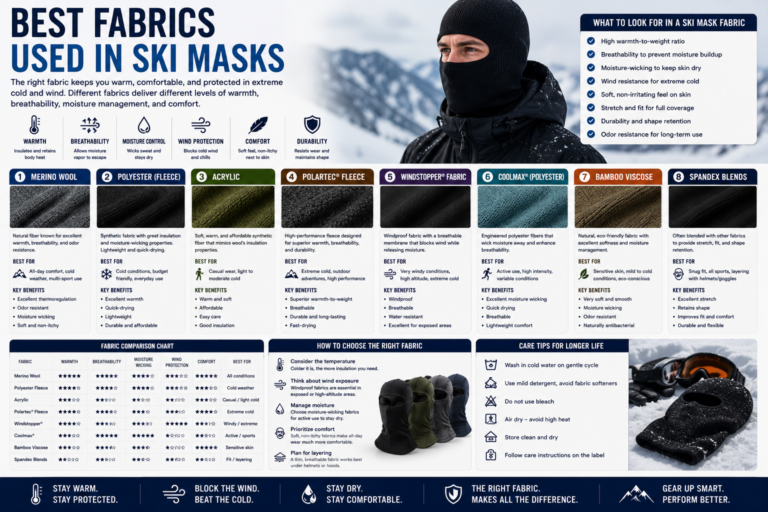
A ski mask sits against the most sensitive skin on your body — covering your face during the exact conditions where wind chill and extreme cold hit hardest. Fabric choice determines whether that mask becomes essential cold-weather gear you reach for constantly or an uncomfortable, itchy item left in a drawer. Understanding the best fabrics used in ski masks helps brands build products that genuinely protect — and helps outdoor enthusiasts choose masks that perform across real winter conditions. Here’s a complete breakdown.

Merino Wool — Natural Warmth and Odor Resistance

Merino wool is one of the finest materials for ski mask construction — delivering natural temperature regulation directly against facial skin where comfort matters most. Its fiber structure traps warm air effectively while managing the moisture that breathing creates inside the mask during physical activity.

Merino’s natural odor resistance is particularly valuable for ski masks — worn close to the mouth and nose where bacterial growth from breath moisture creates persistent odor in synthetic alternatives. Fine merino fibers feel soft against facial skin without the itching that coarser wool grades cause — critical for a garment worn directly against sensitive facial areas for extended periods.

Base layer clothing manufacturers applying merino wool principles to ski mask construction create products that regulate temperature naturally across the variable conditions a full day of skiing or winter activity creates.

Fleece — Reliable Insulation and Softness

Polyester fleece is among the most widely used ski mask fabrics — offering excellent warmth retention through its open fiber structure that traps air effectively while remaining soft against facial skin. Fleece masks provide reliable insulation at accessible price points across the broadest range of winter conditions.

Lightweight fleece suits moderate cold and active use where breathability matters alongside warmth. Heavyweight fleece suits genuinely extreme cold where maximum insulation against facial exposure becomes the primary performance priority. Outdoor fleece constructions in mask format balance warmth and breathability effectively for general winter outdoor use.

Stretch Knit Synthetics — Fit and Mobility

Stretch synthetic knits — typically polyester-spandex or nylon-spandex blends — create ski masks that conform closely to facial contours without restricting jaw movement, breathing, or goggle compatibility. The stretch construction maintains seal against cold air entry around the mask edges even during active facial movement.

These fabrics dry quickly after moisture exposure from breath condensation or snow contact — preventing the prolonged dampness that reduces insulation performance in less breathable alternatives. Ski wear accessories built from stretch knit synthetics suit high-intensity skiing where facial movement and goggle interface matter alongside warmth.

Windproof Membrane Laminates — Maximum Wind Protection

For severe wind chill conditions, ski masks incorporating windproof membrane laminates block wind penetration through the fabric entirely — addressing the primary cause of facial discomfort during high-speed descents and exposed ridgeline conditions where wind chill dramatically lowers effective temperature.

These laminates bond a thin windproof layer to a soft facial-contact fabric — delivering wind protection without the bulk of full waterproof jacket-grade membranes. Windbreaker jackets manufacturers apply similar windproof principles to mask construction for genuinely severe cold applications.

Building Your Ski Mask Collection

The best fabrics used in ski masks serve different conditions and customer priorities. Merino suits natural performance and odor resistance. Fleece suits accessible everyday warmth. Stretch synthetics suit active fit and goggle compatibility. Windproof laminates suit extreme conditions. A professional ski mask manufacturer matches fabric specification to intended use — ensuring masks perform reliably across the conditions customers actually face on the mountain.

Conclusion

Understanding the best fabrics used in ski masks — merino wool, fleece, stretch synthetic knits, and windproof laminates — gives brands the foundation to build masks that genuinely protect against cold and wind. Each fabric serves a specific performance priority, and matching material to customer need creates products skiers reach for on every cold mountain day.

FAQs

Is merino wool better than fleece for ski masks?

Merino offers superior odor resistance and natural temperature regulation. Fleece offers excellent warmth at a more accessible price point. Both perform well depending on budget and priority.

Do ski masks need to be windproof?

For severe wind chill and high-speed conditions, yes. For moderate cold and casual use, fleece or merino alone provides adequate warmth without windproof lamination.

Can ski masks be produced under a private label?

Yes. Manufacturers offer private label production with custom fabrics, colors, branding, and packaging for ski mask collections.

What fabric dries fastest after moisture exposure in a ski mask?

Stretch synthetic knits dry fastest, making them ideal for high-intensity activity where breath moisture and snow contact are frequent.

Types of Camouflage Clothing for Different Environments

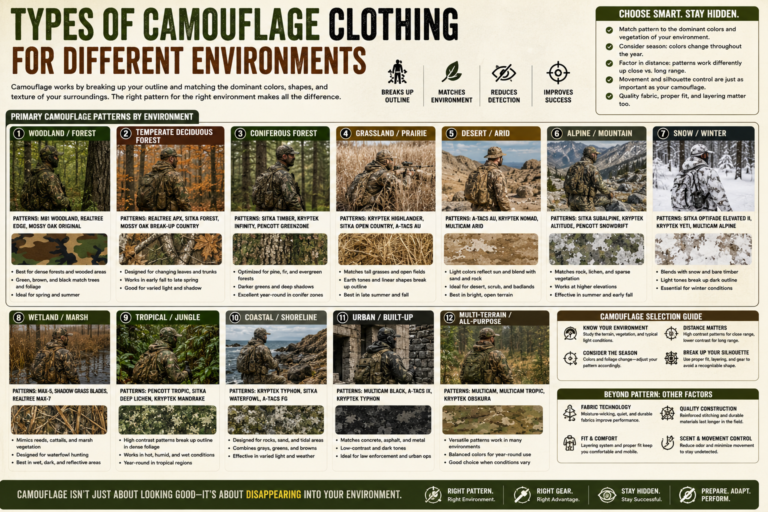
Camouflage clothing serves a specific and serious purpose — making the wearer visually difficult to detect within a specific environment. But not all camouflage patterns perform equally across different terrain types and lighting conditions. Choosing the wrong types of camouflage clothing for a specific environment can be as ineffective as wearing no camouflage at all — and for hunters, military personnel, and tactical professionals, that ineffectiveness carries real consequences. Here’s a complete breakdown of every major camouflage type and where each one genuinely performs.

How Camouflage Works — The Basic Principle

Effective camouflage achieves concealment through two simultaneous mechanisms — color matching to the dominant tones of the specific environment and pattern disruption that breaks up the recognizable human silhouette against natural backgrounds.

Color matching alone doesn’t achieve effective concealment. Pattern disruption alone doesn’t either. Both must work together — matched to the specific visual characteristics of the environment the wearer operates in — for camouflage to deliver genuine concealment performance rather than simply a visual approximation of the surrounding terrain.

Understanding this dual requirement explains why environment-specific camouflage patterns consistently outperform generic alternatives — and why serious hunters, military users, and tactical professionals invest in pattern-specific garments matched to their specific operating environments.

Woodland Camouflage — Forest and Dense Vegetation

Woodland camouflage patterns use combinations of dark green, medium green, brown, and black to match the visual complexity of forested environments — dense canopy, undergrowth, fallen timber, and varied vegetation creating the layered visual environment these patterns replicate.

Classic woodland patterns — including the US military’s original M81 woodland and equivalent patterns from multiple national military traditions — remain highly effective in temperate forest environments globally. Contemporary woodland patterns incorporate digital pixel elements that create more effective visual disruption at varied observation distances than the blended brush stroke elements of classic woodland designs.

Camouflage clothing manufactured in woodland patterns serves deer hunting, turkey hunting, and general woodland field activity across the temperate forest environments that cover significant portions of North America, Europe, and Asia — making woodland pattern one of the highest commercial volume camouflage categories for outdoor apparel brands.

Desert Camouflage — Arid and Semi-Arid Environments

Desert camouflage patterns use combinations of tan, sand, light brown, and muted olive to match the sparse, sun-bleached visual character of desert and semi-arid environments where vegetation is minimal and earth tones dominate the visual landscape.

Three-color desert patterns — using distinct tan, brown, and light green tones — suit transitional desert environments where sparse vegetation introduces green tones alongside dominant earth colors. Six-color desert patterns provide finer visual disruption through more complex color interactions that improve effectiveness at closer observation distances where coarser patterns become visually detectable.

Arid environment hunting — predator hunting, open country big game pursuit — benefits from desert pattern selection over woodland alternatives that would create obvious visual contrast against the light-toned arid backgrounds these hunting environments present.

Snow and Arctic Camouflage — Winter White Environments

Snow camouflage patterns use predominantly white with minimal grey or pale blue tones to match the high-contrast, low-color environments that snow cover creates across winter landscapes. The near-complete whiteness of snow-covered terrain makes non-white garments immediately visually obvious — making correct snow camouflage selection critical for winter hunting and cold weather tactical operations.

Winter hunting applications — particularly snow goose, late-season deer, and coyote hunting in snow-covered terrain — benefit enormously from proper snow camouflage that eliminates the visual contrast that any darker pattern creates against white snow backgrounds. Hunting apparel manufacturers build snow camouflage into lightweight over-garments that layer over base hunting clothing — allowing quick deployment when snow conditions create concealment requirements that standard woodland patterns fail completely.

Digital Camouflage — Pixel Pattern Technology

Digital camouflage patterns replaced traditional brush stroke designs across most modern military organizations — using pixelated pattern elements that create more effective visual disruption at varied observation distances than analog brush stroke patterns achieved across equivalent environments.

The pixel element structure in digital camouflage creates a visual disruption effect that works across multiple observation distances simultaneously — where traditional patterns optimized for one distance often became visually detectable at different ranges. Multiple national military digital patterns — US Marine Corps MARPAT, Canadian CADPAT, and numerous equivalent national systems — demonstrate the broad institutional adoption that validated digital pattern effectiveness over traditional alternatives.

Commercial outdoor brands incorporating digital pattern elements into tactical outdoor apparel collections attract customers who value the proven effectiveness credentials that military adoption provides — distinguishing genuinely functional tactical garments from fashion-inspired alternatives that use camouflage aesthetics without functional performance justification.

Realtree and Mossy Oak — Photorealistic Pattern Technology

Realtree and Mossy Oak represent a distinctly American approach to hunting camouflage — using photorealistic imagery of actual vegetation, bark, branches, and natural elements to create pattern systems that match specific vegetation environments with visual accuracy that geometric pattern alternatives cannot replicate.

These pattern systems are licensed commercial products — Realtree and Mossy Oak each offer multiple pattern variants matched to specific hunting environments and seasons. Realtree AP (All Purpose) suits mixed woodland environments across multiple seasons. Realtree Edge suits late-season open country and agricultural hunting environments. Mossy Oak Break-Up Country suits open terrain and transitional environments between woodland and agricultural land.

The photorealistic visual matching these patterns achieve in their intended environments creates genuinely effective concealment that serious hunters recognize and actively seek — making licensed pattern partnerships commercially valuable for outdoor apparel brands serving dedicated hunting markets.

Urban and Grey Camouflage — Built Environment Concealment

Urban camouflage patterns use combinations of grey, off-white, charcoal, and muted blue-grey to match the visual characteristics of built environments — concrete structures, asphalt surfaces, grey building facades, and the generally desaturated color palette of urban and industrial settings.

These patterns serve law enforcement, security professionals, and military personnel operating in urban environments where woodland and desert patterns create obvious visual contrast against the grey built environment that urban camouflage matches effectively. Urban pattern tactical garments also attract lifestyle and streetwear customers who appreciate the visual aesthetic of grey camouflage beyond its functional concealment applications.

MultiCam — Adaptive Multi-Environment Performance

MultiCam represents a significant evolution in camouflage design philosophy — creating a single pattern that performs effectively across multiple environments rather than optimizing for one specific terrain type at the expense of others.

The pattern uses a complex blend of green, tan, brown, and black tones with carefully designed element distribution that transitions visually between different environments more effectively than single-environment patterns manage when used outside their intended terrain. US military adoption for operations across the environmental diversity of Afghanistan — transitioning between green valleys, brown hillsides, and rocky terrain — validated MultiCam’s multi-environment effectiveness credentials through demanding operational real-world testing.

For outdoor apparel brands building versatile outdoor jackets and tactical collections that serve customers operating across varied environments, MultiCam pattern offers commercial efficiency — a single pattern investment serving multiple terrain types that environment-specific alternatives require separate pattern development to address.

Waterfowl Camouflage — Marsh and Wetland Environments

Waterfowl camouflage patterns incorporate the specific visual elements of marsh and wetland environments — cattails, reeds, water reflections, mud, and the mixed brown-green-grey palette that wetland hunting environments present to waterfowl during flight observation.

Duck and goose hunting in marsh environments creates specific concealment requirements that woodland and desert patterns don’t serve — the horizontal water surface background, reed and cattail vertical elements, and the variable lighting of open water environments all require pattern designs specifically developed around these visual characteristics.

Specialized waterfowl patterns — including dedicated marsh, flooded timber, and open water variants within the Mossy Oak and Realtree pattern families — serve dedicated waterfowl hunters who understand that pattern specificity to their hunting environment directly impacts concealment effectiveness and hunting success.

Military Surplus and Heritage Patterns — Authentic and Commercial

Military surplus camouflage patterns from various national military traditions carry authentic heritage credentials that attract specific commercial markets beyond their original military applications. British DPM, German Flecktarn, French Lizard, and numerous other national patterns are widely recognized and commercially valuable for brands targeting military heritage, tactical fashion, and collector markets.

These patterns transition effectively from genuine functional applications into lifestyle and fashion contexts — carried by military heritage brands, tactical fashion labels, and outdoor brands seeking the authentic credibility that proven military pattern adoption provides over commercially developed alternatives without institutional validation credentials.

Building Your Camouflage Collection

The types of camouflage clothing each serve specific environments and customer applications that other patterns cannot optimally replace. Brands building outdoor and tactical collections benefit from understanding which camouflage types serve their specific target customers most directly — and developing those patterns with genuine construction quality that serious hunting and tactical users evaluate through real-world concealment performance.

Working with a professional camouflage clothing manufacturer ensures pattern printing quality, color accuracy, and garment construction standards that create camouflage products performing as their pattern design intends across real field use conditions.

Conclusion

Understanding the types of camouflage clothing — woodland, desert, snow, digital, photorealistic, urban, multi-environment, waterfowl, and military heritage patterns — gives outdoor brands the commercial knowledge to build camouflage collections that serve specific environments and customer needs with genuine functional credibility. Each pattern type achieves concealment through specific color and pattern combinations matched to particular visual environments — and covering the right combination for your target market creates a camouflage collection that serious outdoor professionals trust and recommend from real-world experience.

FAQs

Which camouflage pattern is most versatile across different environments?

MultiCam performs most effectively across the widest range of environments — its multi-environment design philosophy and proven military operational validation make it the strongest single-pattern choice for brands serving customers who operate across varied terrain types.

Do photorealistic camouflage patterns like Realtree perform better than digital patterns?

Each excels in its intended application. Photorealistic patterns achieve superior visual matching in specific vegetation environments they were designed around. Digital patterns provide more consistent performance across varied observation distances and diverse environment types.

Can camouflage clothing be produced under a private label?

Yes. Professional camouflage clothing manufacturers produce private label garments with custom or licensed pattern printing, construction specifications, and branding — though licensed commercial patterns like Realtree and Mossy Oak require formal licensing agreements before commercial use.

How important is fabric choice alongside camouflage pattern for hunting applications?

Critically important. Silent fabric constructions that don’t rustle during movement, moisture management for all-day field wear, and appropriate warmth specification for the hunting season all matter as much as visual concealment pattern selection for serious hunting apparel performance.

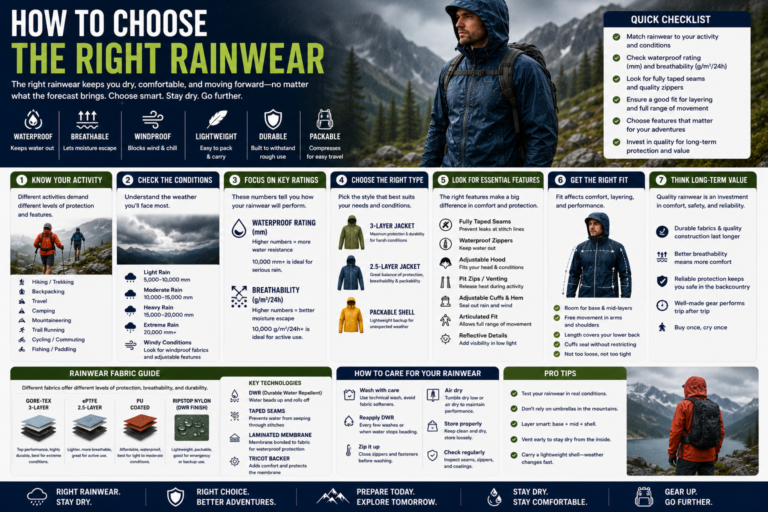
How to Choose the Right Rainwear

Rainwear is one of those purchases that reveals its quality only when conditions get genuinely difficult. A jacket that performs beautifully in light drizzle can fail completely during sustained mountain rain — leaving you cold, wet, and wishing you’d made a different decision before leaving the trailhead. Knowing how to choose the right rainwear for your specific activities, environments, and performance priorities prevents those experiences and ensures the gear you carry genuinely protects you when rain actually arrives outdoors.

Understand the Difference Between Waterproof and Water-Resistant

The single most important distinction in rainwear selection is understanding the difference between genuinely waterproof and merely water-resistant construction — because these terms describe fundamentally different protection levels that marketing language often blurs intentionally.

Waterproof rainwear uses membrane construction — Gore-Tex, eVent, Pertex Shield, or equivalent technologies — that prevents water penetration indefinitely during sustained rain exposure. Properly manufactured waterproof rainwear with sealed seams keeps wearers dry through hours of continuous heavy rain in demanding outdoor environments.

Water-resistant rainwear relies on DWR treatment applied to face fabrics — causing water to bead and roll off initially but eventually wetting out during sustained precipitation. Once the face fabric saturates, moisture penetration begins regardless of how well the DWR treatment performed during brief exposure.

For serious outdoor activities in reliably wet environments — mountain hiking, backcountry camping, ski wear applications — genuine waterproof membrane construction is non-negotiable. For casual outdoor use in environments with infrequent light rain, high-quality water-resistant construction may serve adequately at lower cost and weight.

Match Protection Level to Your Activity and Environment

Different outdoor activities and environments create genuinely different rainwear protection requirements — and matching protection level to actual needs prevents both under-specification that leaves you wet and over-specification that adds unnecessary cost and weight.

High-intensity mountain activities — alpine hiking, mountaineering, backcountry skiing — demand premium waterproof breathable membrane construction with maximum breathability ratings. Hardshell jackets with 20,000mm waterproofing and 20,000+ g/m²/24h breathability serve these applications — providing complete weather protection without the moisture accumulation that lower-breathability alternatives cause during sustained physical effort.

Recreational hiking and camping suit mid-range waterproof jacket constructions — providing genuine membrane waterproofing at more accessible price points than premium hardshell alternatives without sacrificing the reliable rain protection that outdoor use demands. Camping apparel collections built around practical waterproof performance serve this largest outdoor market segment effectively.

Trail running and cycling demand lightweight packable waterproof constructions that minimize weight while maintaining genuine membrane protection — because weight directly impacts performance in these activities and packability determines whether rainwear actually gets carried on every outing.

Hunting and field activities require hunting apparel specific constructions — combining waterproof protection with silent fabric performance and camouflage patterns that general outdoor rainwear doesn’t provide for field use applications.

Evaluate Waterproofing and Breathability Ratings

Understanding waterproofing and breathability ratings helps you compare rainwear options against the performance requirements your specific outdoor activities genuinely create — rather than simply accepting marketing claims without technical context.

Waterproofing is measured in hydrostatic head — the height of water column in millimeters that the fabric withstands before allowing penetration. Ratings above 10,000mm suit most outdoor recreational use. Ratings above 20,000mm suit serious mountain and alpine applications where sustained severe rain and snow create maximum pressure on fabric waterproofing performance.

Breathability is measured in moisture vapor transmission rate — grams of moisture vapor per square meter per 24 hours (g/m²/24h) that the fabric allows to pass outward. Ratings above 10,000 g/m²/24h suit moderate activity levels. Ratings above 20,000 suit high-intensity activities where significant perspiration requires rapid moisture vapor evacuation to maintain internal comfort.

The relationship between these two ratings determines how well rainwear serves active outdoor use — maximum waterproofing means nothing if inadequate breathability creates the internal dampness that external rain would have caused anyway through a different route.

Assess Seam Sealing Quality

Seam sealing quality determines whether waterproof fabric construction actually delivers complete rain protection or simply provides waterproof fabric panels joined by moisture-permeable seam lines. This construction detail separates genuinely waterproof rainwear from products that technically use waterproof fabrics but leak at every seam during sustained rain exposure.

Fully sealed seams cover all construction seam lines with thermally bonded tape — providing complete waterproof seam coverage across the entire garment. Fully sealed construction is the standard for premium technical rainwear and waterproof jackets claiming genuine waterproof performance.

Critically sealed seams cover only the most exposure-prone seam positions — typically shoulders, hood attachment, and sleeve insertions — leaving less-exposed seam positions unsealed. This approach reduces manufacturing cost while maintaining adequate waterproofing for most recreational use conditions where less-exposed seam positions rarely face direct sustained water pressure.

Unsealed seams indicate water-resistant rather than genuinely waterproof construction — regardless of what the face fabric waterproofing specification claims. Any rainwear purchase for serious outdoor wet weather use should specify seam sealing construction explicitly before committing to the purchase.

Check Hood Design for Your Use Case

Hood design significantly impacts how well rainwear actually keeps you dry during active outdoor use — particularly around the face and neck where rain enters if hood design fails to provide proper coverage and adjustment.

Helmet-compatible hoods accommodate ski helmets, climbing helmets, and cycling helmets beneath the hood — essential for activities where headwear is worn throughout the activity rather than just during rain events. Adjustable volume controls allow proper fit adjustment over different helmet sizes and shapes.

Wire-brim peaked hoods maintain hood shape against wind — preventing the hood from collapsing across the face during wind-driven rain that deflects flat-brim alternatives directly into your field of vision during the conditions that adequate hood design should prevent.

Roll-away hoods pack into the collar when not in use — providing clean aesthetics during dry conditions while remaining immediately accessible when rain arrives. This design suits casual and lifestyle rainwear applications where hood-free styling suits most conditions.

Fixed hoods provide permanent coverage without adjustment complexity — suiting simple recreational rainwear where consistent hood availability matters more than packability or styling versatility between conditions.

Evaluate Fit for Layering and Activity

Rainwear fit determines both performance during activity and compatibility with the layering systems it needs to work over in cold wet conditions. Getting fit right prevents the movement restriction that under-sized rainwear creates and the bulk accumulation that over-sized alternatives cause within layering systems.

Active fit — close to the body without restricting movement — suits running, cycling, and high-intensity activities where aerodynamic efficiency and minimal bulk matter alongside rain protection. Active fit rainwear layers correctly over base layers without creating the excess volume that interferes with athletic movement patterns.

Regular fit — roomier through chest and shoulders — accommodates mid-layers beneath the rainwear for cold wet condition use and suits moderate-intensity outdoor activities where layering flexibility matters more than aerodynamic efficiency during the physical demands these activities create.

Sleeve length requires checking specifically — full arm extension overhead should not pull the sleeve cuff up and expose the wrist gap between jacket and glove. This exposure point allows rain entry that undermines complete arm coverage during the sustained rain exposure that outdoor activities regularly create.

Consider Weight and Packability Requirements

Rainwear weight and packability determine whether it actually gets carried on every outing or left behind on days when pack weight optimization removes it from the kit list. A rainwear jacket that doesn’t get carried provides zero protection when unexpected rain arrives — making genuine packability a practical performance requirement rather than a purely convenience feature.

For trail running, cycling, and day hiking applications where the jacket travels in a pack between deployment opportunities — sub-200 gram weight and fist-sized packed volume represent practical targets that ensure the jacket genuinely accompanies every outing regardless of forecast conditions.

For camping, multi-day hiking, and activities where the jacket is worn throughout the day — weight efficiency matters less than durability, breathability, and feature completeness that lighter constructions often sacrifice for their packability advantage. Outdoor jackets collections that communicate these weight and packability trade-offs clearly help customers make genuinely informed choices rather than discovering limitations through experience.

Assess Additional Features Against Your Needs

Beyond waterproofing specification, seam sealing, hood design, and fit — specific construction features determine how well rainwear serves particular outdoor activities across real daily use conditions.

Essential features worth evaluating carefully:

  • Waterproof zipper quality — YKK Aquaguard or equivalent waterproof zippers prevent moisture entry at closure points that standard zippers allow during rain exposure
  • Pit zip ventilation — underarm ventilation systems allow rapid heat dumping during high-intensity activity without jacket removal during sustained rain that would immediately defeat the ventilation purpose
  • Pocket placement and waterproofing — chest pockets with waterproof zippers provide secure dry storage during rain; hip pockets must position correctly for accessibility with pack hip belts during loaded hiking
  • Hem and cuff adjustment — drawcord hems seal against wind-driven rain entry at the lower jacket opening; velcro or elastic cuffs seal against wrist gap rain entry

A professional rainwear manufacturer builds these features into product designs based on intended activity applications — ensuring every construction detail serves genuine functional purposes rather than adding specification complexity without meaningful performance justification for the target customer’s specific outdoor use.

Match Lower Body Protection to Upper Body

Most outdoor enthusiasts focus rainwear attention on jacket selection while neglecting lower body protection that sustained rain quickly penetrates through standard hiking trousers. Complete rain protection requires matching waterproof trouser or overpant specification to jacket waterproofing level — creating consistent protection performance across the entire body rather than a well-protected upper body and inadequately protected legs.

Waterproof clothing system approaches — matching jacket and trouser waterproof specifications, seam sealing standards, and DWR treatments — deliver consistent whole-body protection that mismatched component selections cannot achieve. Brands offering coordinated rainwear jacket and trouser systems serve customers who understand this requirement — and generate significantly higher average order values than brands selling only jacket rainwear without complementary lower body protection solutions.

Conclusion

Knowing how to choose the right rainwear means honestly evaluating waterproofing versus water-resistance needs, matching protection level and breathability to activity intensity, verifying seam sealing construction quality, selecting appropriate hood design, fitting correctly for layering system compatibility, and choosing features that serve your specific outdoor use rather than generic maximum specification. The right rainwear becomes one of the most trusted and consistently used garments in any outdoor kit — deployed confidently whenever conditions deteriorate because you know it genuinely protects rather than simply claiming to.

FAQs

What waterproof rating is sufficient for serious outdoor hiking in wet conditions?

A minimum 20,000mm waterproof rating with fully sealed seams provides reliable protection for serious outdoor hiking in sustained heavy rain — lower ratings may suffice for recreational use in moderately wet environments where sustained heavy precipitation is less common.

Is breathability important in rainwear for casual outdoor use?

Breathability matters less for low-intensity casual outdoor use where perspiration rates are low enough that even poorly breathable constructions don’t create uncomfortable internal moisture accumulation. For active hiking, running, and cycling — high breathability ratings significantly impact wearing comfort during sustained physical effort.

Should I buy rainwear that covers both jacket and trousers?

For activities involving sustained heavy rain where complete body dryness matters — yes. Jacket-only rainwear leaves legs exposed to rain penetration through standard hiking trousers that waterproof construction alone prevents reliably across extended wet weather outdoor use.

Can rainwear be produced under a private label for outdoor brands?

Yes. Professional outdoor apparel manufacturers offer complete private label rainwear production with certified waterproof membranes, seam sealing specifications, sustainable DWR treatments, custom colors, hardware, labels, and packaging — giving outdoor brands full technical and commercial control over their complete rainwear collection identity.

Best Fabrics Used in Rainwear Manufacturing

Rainwear performance lives or dies by the materials it’s built from. A jacket that looks waterproof in a store display can fail completely during the first sustained downpour if its fabric construction doesn’t genuinely deliver what the marketing claims. Understanding the best fabrics used in rainwear manufacturing helps brands make informed decisions that translate into products customers trust — and helps outdoor enthusiasts identify genuine protection from inadequate alternatives that only perform in light drizzle. Here’s a complete breakdown of every major rainwear fabric and what each one truly delivers.

Gore-Tex — The Industry Benchmark

Gore-Tex remains the most recognized and trusted waterproof breathable membrane in rainwear manufacturing globally. Its expanded polytetrafluoroethylene membrane contains billions of microscopic pores — each small enough to block liquid water droplets while large enough to allow moisture vapor molecules to escape. This physical structure delivers genuine waterproofing combined with breathability that keeps wearers dry from both external rain and internal perspiration simultaneously.

Gore-Tex product lines serve different rainwear applications across a performance spectrum. Gore-Tex Pro delivers maximum durability and breathability for demanding mountain and professional applications. Gore-Tex Paclite suits packable lightweight rainwear where weight efficiency matters alongside genuine waterproofing. Gore-Tex Active serves high-intensity athletic applications demanding maximum breathability during sustained physical output.

The Gore-Tex licensing program requires manufacturers to meet specific construction quality standards — including seam sealing requirements and hardware specifications — before using the certification on finished products. This quality assurance makes Gore-Tex labeling a meaningful credential rather than purely a marketing claim for hardshell jackets and serious rainwear products.

eVent Fabric — Direct Venting Breathability

eVent fabric uses a different membrane technology approach than Gore-Tex — an ePTFE membrane with an oil-resistant treatment that allows direct moisture vapor transmission without the polyurethane coating that Gore-Tex traditionally applied over its membrane. This direct venting approach delivers higher breathability performance than comparable Gore-Tex constructions — particularly during high-intensity activity where moisture vapor transmission rate becomes the limiting factor in internal comfort management.

eVent suits high-output athletic rainwear applications where breathability performance matters as much as waterproofing — trail running rain jackets, cycling rainwear, and fast-hiking applications where sustained intense physical effort generates moisture vapor faster than lower-breathability membranes can manage comfortably. Brands building performance-oriented waterproof clothing collections find eVent serves the most athletically demanding customer segments within their outdoor market.

Pertex Shield — Performance at Accessible Price Points

Pertex Shield delivers waterproof breathable membrane performance at more accessible price points than Gore-Tex and eVent licensing costs allow — making it commercially valuable for brands targeting mid-range rainwear price points without compromising on genuine membrane waterproofing performance.

Multiple Pertex Shield variants serve different performance tiers. Pertex Shield Air maximizes breathability for aerobic applications. Pertex Shield+ delivers enhanced durability for demanding outdoor use. The range gives outdoor brands flexibility to specify appropriate membrane performance levels across different rainwear product tiers within their collection — aligning construction cost with retail price point and target customer expectations.

Polyurethane Coating — Accessible Waterproofing

Polyurethane coating applies a waterproof film directly to the interior surface of face fabrics — creating waterproof performance without membrane lamination costs. PU-coated rainwear delivers genuine waterproofing adequate for recreational outdoor use at significantly lower production costs than membrane-laminated alternatives.

The primary limitation of PU coating is breathability — coated constructions breathe significantly less effectively than quality membrane alternatives because the coating covers fabric pores rather than utilizing the selective permeability that membrane structures achieve through controlled pore sizing. This breathability limitation matters most during high-intensity physical activity where moisture vapor accumulation creates uncomfortable internal dampness within the jacket system.

PU-coated rainwear suits light recreational use, casual outdoor activities, and applications where sustained physical intensity is low enough that breathability limitations don’t create meaningful comfort problems during wear. Rainwear manufacturers use PU coating to deliver accessible price point products that serve the largest recreational outdoor market segment effectively without premium membrane construction costs.

Nylon Face Fabrics — Durable and Lightweight Shell Construction

Nylon serves as the primary face fabric in premium rainwear construction — providing the durability, lightweight properties, and smooth surface that waterproof membrane laminates require for optimal performance and longevity. High-tenacity nylon resists abrasion from pack straps, vegetation contact, and terrain exposure that rainwear experiences constantly during outdoor activity.

Ripstop nylon constructions prevent tear propagation from small snags and contact points — maintaining face fabric integrity across the demanding mechanical stresses that serious outdoor rainwear endures throughout extended field use. The tensile strength of nylon significantly exceeds equivalent weight polyester — making it the preferred face fabric for technical rainwear applications where durability alongside weight efficiency creates the optimal performance combination.

Waterproof jackets built on high-tenacity nylon face fabrics with quality membrane lamination deliver the complete performance package that serious outdoor rainwear demands — combining face fabric durability with membrane weather protection for products that maintain both functions across multiple seasons of demanding use.

Polyester Face Fabrics — Color Stability and Sustainability

Polyester face fabrics serve rainwear applications where color stability, sustainability credentials, and specific aesthetic requirements matter alongside waterproof performance. Polyester maintains vibrant colorways across extended UV exposure significantly better than nylon — making it valuable for fashion-oriented rainwear collections where visual longevity across the product’s service life matters commercially.

Recycled polyester — produced from post-consumer PET plastic waste — delivers identical technical performance to virgin polyester while significantly reducing environmental impact. Sustainability-focused outdoor brands increasingly specify recycled polyester for rainwear face fabrics — responding to growing consumer demand for environmentally responsible outdoor clothing without compromising waterproof performance that customers depend on in actual rain.

Three-Layer Laminate Construction — Maximum Durability Integration

Three-layer laminate construction bonds face fabric, waterproof membrane, and interior backer fabric into a single unified material — eliminating the separate hanging lining found in two-layer constructions. This integration creates the most durable and highest-performing rainwear fabric construction available.

The bonded construction prevents the delamination that separate-layer constructions eventually experience under sustained hard use — and eliminates the weight and bulk of separate lining fabrics while improving moisture vapor transmission by removing the additional fabric layer that moisture must penetrate before reaching the exterior. Three-layer construction suits hardshell jackets and serious technical rainwear where durability, weight efficiency, and maximum performance justify premium fabric costs.

2.5-Layer Construction — Ultralight Packable Performance

2.5-layer construction bonds a waterproof membrane to the face fabric interior and protects it with a printed or embossed pattern coating rather than a separate lining fabric — creating the lightest possible waterproof construction in jacket format. The 0.5 designation refers to this interior coating that protects the membrane without qualifying as a full lining layer.

This construction produces the packable rainwear that trail runners, cyclists, and outdoor travelers carry as constant emergency protection — ultralight jackets that compress to minimal volumes while providing genuine membrane waterproofing when conditions deteriorate unexpectedly. The tradeoff is reduced wearing comfort against base layers compared to fully lined alternatives — but for emergency carry applications used occasionally rather than continuously, this compromise is commercially and practically justified.

DWR Treatments — The Essential Surface Layer

DWR treatment applied to rainwear face fabrics causes water to bead and roll off the surface rather than saturating it — maintaining face fabric water repellency that prevents the waterlogging that would block membrane breathability even on correctly functioning waterproof membrane garments. DWR is not a substitute for membrane waterproofing — it’s a complementary treatment that maximizes how effectively the membrane underneath performs by keeping the face fabric dry and permeable to moisture vapor transmission.

Modern fluorocarbon-free DWR formulations — replacing traditional C8 and C6 chemistry — meet increasingly stringent environmental regulations while delivering comparable initial performance. These sustainable DWR alternatives are becoming standard specification across serious outdoor rainwear collections from brands that prioritize environmental credentials alongside performance — a growing market requirement that outdoor jackets manufacturers increasingly build into their standard production specifications.

Seam Sealing Tapes — Construction Point Waterproofing

Seam sealing isn’t fabric — but it’s the critical construction material that determines whether waterproof fabrics actually deliver complete rain protection or simply provide waterproof panels joined by moisture-permeable seam lines. Every needle penetration through waterproof fabric creates potential moisture entry points that thermally bonded seam sealing tape covers and seals permanently.

Critical seam placement — shoulders, hood attachment, sleeve insertions, and pocket edges — requires seam sealing as a non-negotiable construction standard for genuinely waterproof rainwear. Brands building camping apparel and outdoor collections must specify seam sealing requirements explicitly in manufacturing briefs — because seam sealing quality and coverage extent vary significantly between manufacturers and directly determine whether finished products perform as promised in sustained rain.

Building Your Rainwear Collection Around the Right Fabrics

The best fabrics used in rainwear serve different performance requirements across different product tiers and target markets. Gore-Tex and eVent suit premium technical rainwear for serious outdoor users. Pertex Shield and quality PU coatings serve mid-range and recreational markets. Recycled polyester face fabrics serve sustainability-focused brand positioning. Ultralight constructions serve packable emergency protection markets.

Working with a professional outdoor apparel manufacturer who sources verified performance fabrics — with genuine technical credentials and appropriate environmental certifications — ensures your rainwear collection delivers the protection promises your brand makes to customers who evaluate products through real-world use in actual outdoor conditions.

Conclusion

Understanding the best fabrics used in rainwear manufacturing — Gore-Tex membranes, eVent technology, Pertex Shield, polyurethane coatings, nylon and polyester face fabrics, three-layer and 2.5-layer constructions, DWR treatments, and seam sealing systems — gives brands the technical foundation to build rainwear collections that genuinely protect their customers across real outdoor activities in real rain. Every fabric decision communicates your brand’s commitment to genuine outdoor performance quality. Choose verified materials, partner with experienced rainwear manufacturers, and build products that earn lasting customer trust through consistent protection performance every time it rains.

FAQs

Is Gore-Tex worth the premium price in rainwear?

Yes for serious outdoor users who regularly encounter demanding weather conditions. Gore-Tex delivers verified performance consistency backed by rigorous manufacturer quality standards — the reliability and brand trust it provides genuinely justifies premium pricing for frequent outdoor use where rain protection performance directly impacts safety and comfort.

What is the difference between waterproof and water-resistant rainwear fabrics?

Waterproof fabrics use membrane construction that prevents water penetration indefinitely. Water-resistant fabrics rely on DWR treatment that repels light rain initially but eventually wets out during sustained heavy precipitation — allowing moisture penetration that genuine waterproof membrane construction prevents throughout extended rain exposure.

How long do waterproof membrane fabrics maintain their performance?

Quality membrane fabrics maintain waterproof performance across many years of regular outdoor use when properly cared for. DWR treatment requires periodic refresh through tumble drying or re-treatment products — but the membrane itself maintains performance as long as face fabric integrity is maintained and garments are washed correctly using technical fabric wash products.

Can rainwear with premium fabrics be produced under a private label?

Yes. Professional rainwear manufacturers offer complete private label production with certified waterproof membranes, seam sealing, sustainable DWR treatments, custom colors, hardware, labels, and packaging — giving outdoor brands full technical and commercial control over their rainwear collection identity.