Home Blog Page 10

How to Choose the Right Windbreaker Jacket

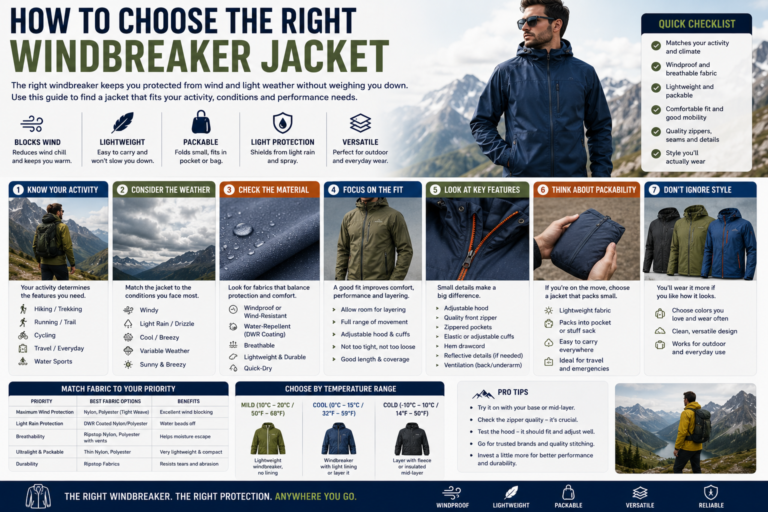
Windbreaker jackets look deceptively simple. Lightweight shell, zipper, hood — how complicated can the choice be? Quite complicated, actually. The wrong windbreaker leaves you cold, wet, or restricted at exactly the moment you need reliable protection and freedom of movement. Knowing how to choose the right windbreaker jacket for your specific activity, climate, and performance priorities makes the difference between a jacket you reach for constantly and one that sits unused at the back of a drawer. Here’s everything you need to consider.

Start With Your Primary Activity

The single most important windbreaker selection decision is matching the jacket to your primary use case. Windbreakers built for different activities make meaningfully different construction choices — and those choices determine how well the jacket serves you in the specific conditions your activity creates.

Running and high-intensity cardio demand ultralight fabrics, minimal construction details, and maximum breathability. Every unnecessary gram affects running economy across long distances. Reflective details add genuine safety value during low-light training sessions. Thumb loop cuffs maintain sleeve position during arm swing without velcro adjustment mechanisms that add weight.

Hiking and trail use benefit from slightly heavier constructions with better abrasion resistance, more pocket storage, and hood designs that work with or without a pack’s shoulder straps restricting access. Hiking clothing specialists design windbreakers around the specific functional demands trail users face — including hem length that covers the lower back during uphill lean and pocket placement that works correctly with backpack hip belts.

Casual lifestyle and travel use suits packable windbreakers that compress small, look clean, and handle the varied light weather conditions urban and travel environments create without requiring technical performance optimization for any specific activity.

Cycling demands close-fitting aerodynamic construction, extended rear hems covering the exposed lower back during forward riding position, and back pocket access that works without stopping or jacket removal.

Understand the Wind and Weather Protection You Actually Need

Windbreakers exist on a spectrum from simple wind defense to full waterproof weather protection — and matching protection level to your actual conditions prevents both under-specification that leaves you wet and over-specification that adds unnecessary weight and cost.

Wind protection only — DWR-treated face fabrics without membrane construction — suits dry cold and windy conditions where precipitation is genuinely rare. These constructions offer maximum breathability and minimum weight at the cost of meaningful waterproofing that sustained rain exposure quickly defeats.

Water-resistant windbreakers — DWR treatment plus tightly woven face construction — handle light rain and moisture splash adequately for activities in moderately wet environments. They suit camping apparel use, casual hiking, and urban environments where heavy sustained rain is uncommon but light precipitation occurs regularly.

Waterproof windbreakers — lightweight membrane constructions in 2 or 2.5-layer formats — provide genuine rain protection for activities in reliably wet environments without the weight penalty of full hardshell construction. These suit trail running in variable mountain weather, cycling in rain-prone regions, and any activity where getting wet creates significant comfort or safety problems.

Understanding which protection level your specific activity and environment genuinely requires prevents the common mistake of choosing maximum specification when lighter alternatives would serve perfectly — or choosing insufficient protection for conditions that regularly demand more than DWR treatment provides.

Evaluate Weight and Packability Requirements

Windbreakers exist across a wide weight range — from sub-100 gram ultralight emergency layers to 400 gram insulated constructions that prioritize warmth and durability over packability. Matching weight to your activity’s transport requirements ensures the jacket you choose actually gets carried and deployed rather than left behind because it’s too heavy or bulky for your intended use.

For activities where the jacket travels in a pack or pocket — running, cycling, day hiking — packability matters enormously. The jacket’s compressed volume and weight determine whether it genuinely gets carried on every outing or left at home on weight-conscious days. A windbreaker jackets manufacturer who builds proper stuff pocket construction — reinforced, correctly sized, and positioned for quick deployment — creates packable jackets that function reliably across hundreds of pack-and-deploy cycles without stuff pocket failure undermining the packability that justifies the jacket’s inclusion in your kit.

For activities where the jacket is worn continuously — commuting, travel, casual outdoor use — packability matters less than comfort, durability, and weather protection performance across extended wear periods.

Check Hood Design Carefully

Hood design significantly impacts windbreaker performance in real conditions — and the right hood design depends entirely on your specific use case rather than any universal best option.

Helmet-compatible hoods with adjustable volume controls suit cycling, ski wear applications, and climbing where headwear worn beneath the hood creates volume requirements that standard hoods cannot accommodate.

Wire-brim peaks maintain hood shape against wind — preventing the hood from collapsing across the face during high-speed descents or strong gusts that flatten soft-brim alternatives against your goggles or face.

Packable hoods — those that roll into the collar or a pocket — suit fashion and casual applications where hood-free styling suits most conditions but occasional hood access adds genuine value without permanent aesthetic impact.

Hood-free designs suit activities where a separate hat provides preferred head coverage — and create cleaner aesthetics that work more naturally in urban styling contexts where hooded outdoor jackets can look visually heavy.

Assess Fit for Your Specific Use

Windbreaker fit affects both performance and versatility — and the right fit depends on how you plan to wear and layer the jacket across your activities.

Athletic or active fit — close to the body — suits running, cycling, and high-intensity activities where aerodynamic efficiency matters and excess fabric creates drag or billowing that disturbs movement rhythm. Active fit jackets layer correctly over base layers without bunching during arm swing.

Regular fit — slightly roomier through chest and shoulders — accommodates light mid-layers underneath for cold weather use and suits moderate-intensity activities where layering flexibility matters alongside unrestricted movement.

Sleeve length should allow full arm extension without wrist exposure during overhead reach. Hem length should cover the lower back during a forward bend — preventing cold air and moisture entry through the gap that short hems create during uphill hiking positions and cycling forward lean.

Review Key Features Against Your Needs

Beyond construction and fit, specific features determine how well how to choose the right windbreaker jacket translates into genuine daily performance for your specific use case.

Essential features worth evaluating carefully:

  • Zipper quality — YKK or equivalent quality zippers operate smoothly with cold or gloved hands across hundreds of open-close cycles without failure
  • Pocket number and placement — sufficient storage for your specific carry needs positioned where your activity allows access without removing pack straps or stopping movement
  • Cuff design — velcro adjustment seals against cold air; elasticated cuffs provide quick-donning convenience; thumb loops maintain sleeve position during arm movement
  • Reflective details — genuinely useful for low-light running and cycling; irrelevant for most other applications
  • Ventilation — underarm or back venting systems manage heat accumulation during high-intensity activity that passive breathability alone cannot adequately address

Outdoor jackets collections that communicate these feature distinctions clearly — helping customers understand which specific features serve their activity rather than listing every feature as universally desirable — build stronger customer trust and significantly reduce return rates from disappointed buyers whose expectations mismatched actual product performance.

Consider Durability Against Your Use Intensity

Light occasional use demands different durability specifications than daily hard use across demanding outdoor environments. Matching face fabric denier and construction quality to your actual use intensity prevents both over-paying for durability you don’t need and under-buying construction that fails prematurely under your real-world use demands.

20 denier fabrics suit occasional-use packable emergency layers where ultralight weight justifies reduced abrasion resistance. 40 to 70 denier constructions suit regular daily use where pack strap abrasion, branch contact, and repeated compression-deployment cycles impose meaningful mechanical stress that lighter fabrics don’t withstand reliably across extended service life.

Brands building windbreaker collections for hunting apparel and serious outdoor markets must specify higher denier constructions and reinforced stress point construction — because professional and serious recreational users evaluate durability through real field experience and share their assessments powerfully within tight-knit outdoor communities.

Conclusion

Knowing how to choose the right windbreaker jacket comes down to honestly matching jacket construction, protection level, weight, hood design, fit, features, and durability to your specific activity, conditions, and use intensity. A windbreaker chosen correctly for your actual needs becomes one of the most-reached-for garments in your outdoor wardrobe — deployed constantly and relied upon completely. Choose it with genuine consideration for how and where you actually use it — and it rewards you with reliable performance across years of outdoor activity.

FAQs

Do I need a waterproof windbreaker or will a water-resistant one suffice?

If your activity regularly involves sustained rain exposure or wet mountain environments — choose waterproof membrane construction. If you encounter only occasional light rain in generally dry conditions — quality DWR water-resistant construction performs adequately at lower weight and cost.

How important is breathability in a windbreaker jacket?

Breathability importance scales directly with activity intensity. High-intensity running and cycling demand maximum breathability. Casual walking and travel use tolerate lower breathability without significant comfort impact during the lower perspiration rates these activities generate.

What size should I choose for a windbreaker if I plan to layer underneath?

Size up one size from your standard fit if you regularly layer a mid-layer beneath the windbreaker in cold conditions. Standard sizing suits base-layer-only layering for most active use applications without requiring size adjustment.

Can windbreaker jackets be produced under a private label for outdoor brands?

Yes. Professional outdoor apparel manufacturers offer complete private label windbreaker production with custom fabrics, protection levels, colors, hardware, reflective details, labels, and packaging — giving brands full technical and commercial control over their windbreaker collection identity.
Best Materials Used in Windbreaker Jackets

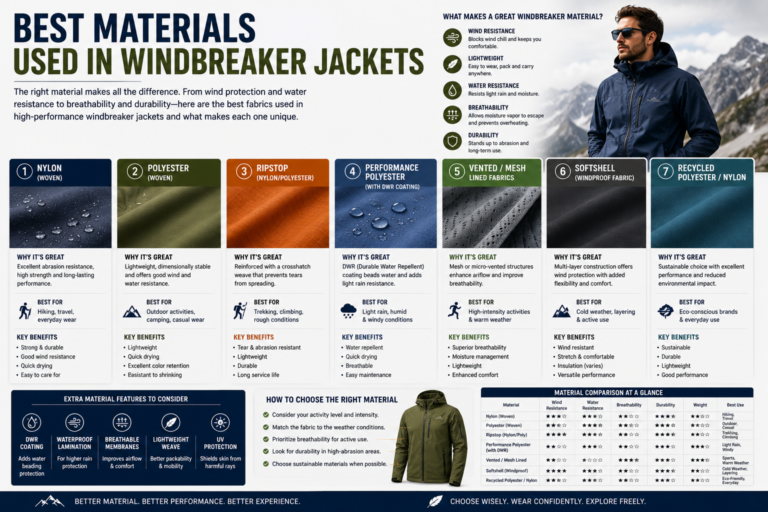
A windbreaker’s entire performance promise depends on one thing — the material it’s built from. The fabric determines how well it blocks wind, how much rain it resists, how light it packs, and how long it lasts across demanding outdoor use. Understanding the best materials used in windbreaker jackets helps brands make informed fabric decisions that translate directly into products customers trust — and helps outdoor enthusiasts choose jackets that genuinely perform rather than just look the part.

Here’s a complete breakdown of every major windbreaker material and what each one delivers.

Ripstop Nylon — The Classic Windbreaker Standard

Ripstop nylon is the most widely used face fabric in windbreaker manufacturing — and its commercial dominance reflects genuine performance merit rather than simply manufacturing convenience. The reinforced grid weave pattern — created by interlacing heavier threads at regular intervals through the base fabric — prevents small tears from propagating across the fabric surface. This distinctive crosshatch pattern is instantly recognizable and genuinely functional.

Nylon’s natural properties make it ideal for windbreaker applications. It is lightweight, packs compactly, dries quickly after moisture exposure, and maintains its structure across temperature extremes that affect other synthetic fabrics more significantly. Denier weight determines the performance balance between durability and packability — 20 denier ripstop nylon produces ultralight packable jackets, while 40 to 70 denier constructions provide meaningful abrasion resistance for more demanding outdoor applications.

A professional windbreaker jackets manufacturer specifies ripstop nylon denier based on intended use — ensuring ultralight running jackets use minimum-weight constructions while hiking and outdoor lifestyle jackets use heavier deniers that justify their slightly increased weight through significantly extended service life.

Polyester — Versatile and Color-Stable

Polyester serves windbreaker applications across multiple performance requirements — appearing in both face fabric and lining constructions depending on jacket design and intended use. Its key advantage over nylon in specific applications is superior color stability — polyester retains vibrant colorways across extended UV exposure and repeated washing significantly better than nylon alternatives.

This color stability makes polyester particularly valuable for fashion windbreakers where visual appeal across the jacket’s lifetime matters as much as technical performance. Bold color blocking, vibrant solid colorways, and printed graphic applications all maintain their visual impact significantly longer on polyester face fabrics than comparable nylon constructions.

Recycled polyester — produced from post-consumer PET plastic waste — delivers identical performance to virgin polyester while significantly reducing environmental impact. Sustainability-focused outdoor and lifestyle brands increasingly specify recycled polyester for windbreaker face fabrics — responding to growing consumer demand for environmentally responsible outdoor clothing without compromising the technical performance characteristics their customers depend on.

DWR Treated Fabrics — Surface Water Repellency

DWR — Durable Water Repellent — treatment isn’t a standalone fabric but an essential surface coating applied to windbreaker face fabrics that transforms their weather resistance performance. DWR causes water to bead and roll off the fabric surface rather than saturating it — maintaining both the fabric’s appearance and its breathability by preventing face fabric saturation that blocks moisture vapor transmission from inside the jacket.

Fresh DWR treatment performs impressively against light rain and moisture splash — keeping wearers comfortable during brief precipitation events without the weight and cost of full waterproof membrane construction. DWR performance degrades progressively through use, abrasion, and washing — requiring periodic refresh through tumble drying heat reactivation or specialist re-treatment products to maintain peak water repellency performance.

Modern fluorocarbon-free DWR formulations replace traditional C8 chemistry with more environmentally responsible alternatives that meet increasingly stringent regulatory requirements across European and North American markets — an important specification consideration for brands building waterproof clothing and windbreaker collections targeting environmentally conscious outdoor consumers.

Waterproof Breathable Membranes — Premium Weather Protection

Waterproof windbreakers bond thin breathable membrane films to lightweight face fabrics — creating jackets that genuinely stop rain penetration while remaining significantly lighter and more packable than full hardshell construction alternatives.

2.5-layer membrane constructions — where a membrane is bonded to the face fabric interior and protected by a printed pattern rather than a full lining fabric — produce the lightest possible waterproof windbreaker constructions. These ultra-compact jackets pack to remarkably small volumes while providing genuine waterproof protection that DWR treatment alone cannot reliably deliver in sustained precipitation.

2-layer constructions bond membrane to face fabric without a full interior lining — slightly heavier than 2.5-layer but more comfortable against the body during extended wear. These constructions suit waterproof jackets positioned between ultralight emergency layers and full hardshell performance — serving outdoor enthusiasts who need reliable waterproofing in a meaningfully lighter package than traditional 3-layer hardshell constructions provide.

Stretch Woven Fabrics — Mobility Meets Wind Defense

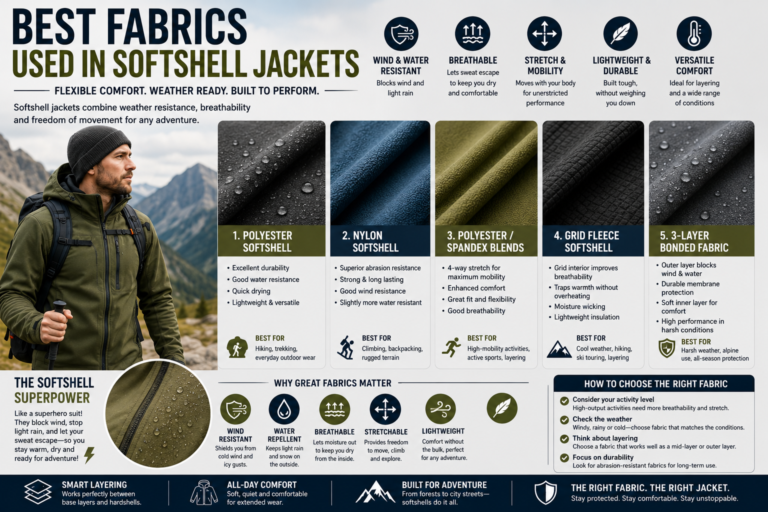
Stretch woven fabrics incorporate elastane or mechanical stretch constructions into windbreaker face fabrics — creating materials that provide full windproofing alongside the freedom of movement that high-intensity outdoor activities demand. These fabrics appear primarily in softshell jackets and performance-oriented windbreakers targeting running, climbing, and ski touring markets.

Four-way stretch constructions accommodate simultaneous horizontal and vertical stretch — critical for the multi-directional movement patterns that athletic outdoor activities impose constantly. The stretch performance allows jacket fit optimization for aerodynamic efficiency during running and cycling without restricting the body positions that climbing and skiing demand across varied terrain and technical challenges.

Mesh Linings — Comfort and Pack Structure

Interior mesh linings in windbreakers serve multiple functions simultaneously. They add a smooth, comfortable layer against the skin or mid-layer surface — preventing the clammy face fabric contact that unlined constructions create during movement. They also provide structural support that helps windbreakers maintain their shape during pack-down and deployment cycles.

Lightweight mesh constructions add minimal weight while significantly improving wearing comfort — making them standard construction in quality windbreakers across all but the absolute ultralight weight categories where every gram reduction justifies even slight comfort compromises.

Taffeta Linings — Premium Feel and Easy Donning

Taffeta polyester linings provide a slippery interior surface that allows windbreakers to slide easily over base layers and mid-layers during donning and removal — particularly valuable for quickly deployed emergency layers during activity. The smooth surface also feels premium against the skin — communicating quality that mesh-lined alternatives cannot replicate at first touch.

Outdoor jackets at premium price points often use taffeta lining specifically for the quality perception it creates during customer handling in retail environments — where the interior feel and visual quality of lining fabric significantly influences purchase decisions at the point of sale.

Seam Sealing Tapes — Construction Point Protection

Seam sealing isn’t a fabric but a critical construction material that determines whether waterproof windbreakers actually perform their weather protection promise in real conditions. Waterproof face fabrics and membrane constructions mean nothing if seam needle holes allow water entry through construction points.

Thermally bonded seam sealing tapes cover needle penetration points along critical seams — shoulders, hood attachment points, sleeve insertions, and pocket edges — preventing the moisture entry that unsealed seams allow during sustained rain exposure. Critical seam sealing distinguishes genuinely waterproof windbreakers from water-resistant alternatives that rely solely on DWR treatment for precipitation management.

Building Your Windbreaker Collection Around the Right Materials

The best materials used in windbreaker jackets serve different performance requirements across different windbreaker types and target markets. Ultralight ripstop nylon suits packable performance applications. Polyester suits fashion and color-focused lifestyle markets. Waterproof membranes suit complete weather protection requirements. Stretch wovens suit high-mobility performance applications.

Working with a professional outdoor jackets manufacturer who sources verified performance fabrics — with genuine technical credentials rather than unverified supplier claims — ensures your windbreaker collection delivers the performance promises your brand makes to customers who depend on it in real outdoor conditions.

Conclusion

Understanding the best materials used in windbreaker jackets — ripstop nylon, polyester, DWR treatments, waterproof membranes, stretch wovens, mesh and taffeta linings, and seam sealing systems — gives brands the technical foundation to build windbreaker collections that genuinely perform across their intended use cases. Every material decision communicates something about your brand’s commitment to quality and outdoor performance. Choose verified materials, partner with experienced manufacturers, and build windbreakers that earn the trust of customers who wear them when conditions actually demand reliable protection.

FAQs

What is the most important material property in a windbreaker jacket?

Windproofing is the core functional requirement — achieved through tightly woven face fabric constructions that prevent wind penetration regardless of whether waterproof membrane technology is also present in the construction.

Is ripstop nylon or polyester better for windbreaker manufacturing?

Both serve different needs. Ripstop nylon suits performance applications requiring packability and durability. Polyester suits fashion and lifestyle applications where color stability and sustainability credentials matter more than ultimate weight efficiency.

How long does DWR treatment last on windbreaker jackets?

DWR performance typically lasts 10 to 20 wash cycles before requiring refresh. Tumble drying on low heat reactivates existing DWR treatment. Specialist re-treatment sprays restore water repellency when tumble drying alone no longer maintains adequate beading performance.

Can windbreaker jackets with premium materials be produced under a private label?

Yes. Professional windbreaker manufacturers offer complete private label production with verified performance fabrics, DWR treatments, membrane technologies, custom colors, hardware, labels, and packaging — giving outdoor brands full technical and commercial control over their windbreaker collection.

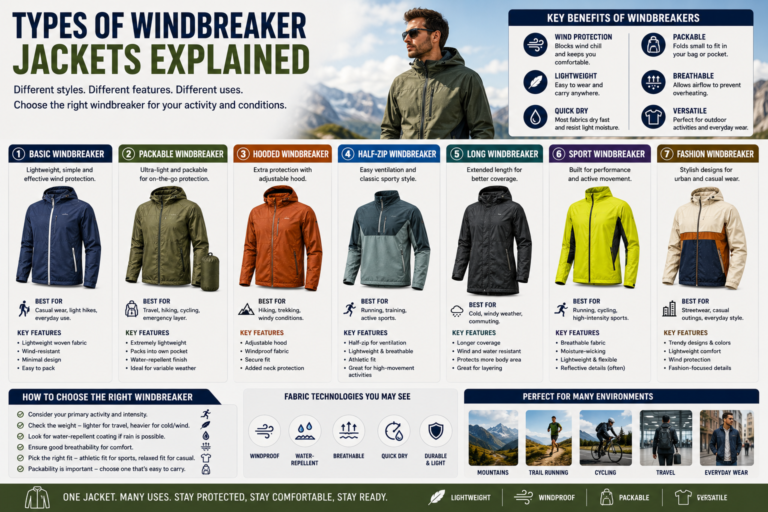
Types of Windbreaker Jackets Explained

Windbreaker jackets are one of the most commercially versatile products in outdoor and fashion apparel simultaneously. They protect against wind chill, pack down compactly, and suit everything from serious trail running to casual streetwear styling. But types of windbreaker jackets vary significantly in construction, performance, and intended use — and understanding these differences helps brands build collections that genuinely serve their customers rather than offering interchangeable products with different colorways.

Here’s a clear breakdown of every major windbreaker type and what makes each one distinct.

Packable Windbreaker — Lightweight and Ultra-Portable

Packable windbreakers are the most popular windbreaker type across both outdoor and lifestyle markets. Constructed from ultra-lightweight nylon or polyester — typically 20 to 40 denier — they compress into their own chest pocket or a small stuff sack, making them genuinely portable in a way heavier jackets cannot match.

Their packability makes them the perfect emergency layer — carried constantly and deployed immediately when wind or light rain conditions demand protection. Runners, hikers, cyclists, and travelers all reach for packable windbreakers because they add meaningful protection without adding meaningful weight or pack volume to any activity.

DWR treatment provides light rain resistance — keeping wearers dry during brief showers without the waterproof membrane construction that adds weight and cost. A professional windbreaker jackets manufacturer produces packable styles with quality YKK zippers and reinforced pack pocket construction — ensuring the self-packing mechanism survives the repeated use it experiences as the jacket’s most-operated feature.

Waterproof Windbreaker — Complete Weather Protection

Waterproof windbreakers combine lightweight windbreaker construction with waterproof membrane technology — delivering complete rain and wind protection in a package significantly lighter and more packable than full hardshell jacket alternatives.

These jackets use either 2.5-layer or 2-layer membrane constructions — bonding waterproof breathable films to lightweight face fabrics without the full interior lining that adds weight to 3-layer hardshell constructions. The result is a jacket that genuinely stops rain penetration while remaining light enough for running, fast hiking, and cycling applications where weight efficiency matters critically.

Seam taping at critical construction points — shoulders, hood attachment, and sleeve insertions — prevents water entry through needle holes that waterproof face fabrics alone cannot seal. Waterproof jackets built to windbreaker weight and packability standards serve outdoor enthusiasts who need genuine waterproofing without the weight penalty of traditional hardshell alternatives.

Running Windbreaker — Performance Optimized

Running windbreakers are engineered specifically around the performance demands of runners — where weight, breathability, and freedom of movement matter more than any other performance characteristic. They use the lightest available face fabrics, minimize construction details that add unnecessary weight, and position pockets specifically for running use rather than general outdoor storage needs.

Reflective details on running windbreakers serve the genuine safety function of increasing low-light visibility during early morning and evening runs — a feature that distinguishes purpose-built running jackets from general windbreakers adapted for running use.

Stretch panels across the back and underarms allow the full arm swing motion that running requires without fabric pulling or restricting the natural movement rhythm. Brands building hiking clothing and running apparel collections find that running-specific windbreakers attract intensely loyal customers — because runners immediately feel the performance difference between jackets built specifically for their activity and general-purpose alternatives that technically work but don’t truly serve.

Insulated Windbreaker — Wind Protection With Added Warmth

Insulated windbreakers combine the lightweight wind-blocking construction of standard windbreakers with a thin layer of synthetic insulation fill — providing meaningful warmth addition without transitioning into the significantly heavier puffer jacket category.

Thin insulation fills — typically 40 to 60g synthetic batting — add noticeable warmth in cold windy conditions without the bulk and weight that heavier insulation creates. These jackets suit cool weather outdoor activities where wind chill is the primary thermal challenge — hikers in exposed mountain terrain, cyclists in cold headwinds, and outdoor workers in cold breezy environments all benefit from insulated windbreaker construction.

Puffer jackets serve genuinely cold static conditions. Insulated windbreakers serve active cold and windy conditions where full puffer warmth would cause overheating — filling the commercial gap between these two jacket categories effectively.

Softshell Windbreaker — Stretch Performance and Wind Defense

Softshell windbreakers blur the line between traditional windbreaker and softshell jacket categories — using stretch woven fabrics that provide full windproofing alongside the mobility and breathability that softshell construction delivers.

These jackets suit climbing, ski touring, and technical hiking applications where wind protection must coexist with unrestricted body movement across demanding terrain. The stretch face fabrics move naturally with athletic body positions — removing the restrictive sensation that rigid windbreaker constructions create during technically demanding activities.

Softshell jackets in windbreaker weight represent premium products within the windbreaker category — commanding higher retail prices through their performance sophistication and broader use case versatility compared to standard non-stretch alternatives.

Fashion Windbreaker — Style Meets Function

Fashion windbreakers prioritize aesthetic appeal alongside functional wind protection — making them commercially powerful products that sell across outdoor and lifestyle markets simultaneously. Bold colorways, retro-inspired color blocking, branded tape detailing, and oversized silhouettes create visually distinctive jackets that perform their wind-blocking function while making genuine style statements.

The 90s and Y2K aesthetic revival has dramatically increased fashion windbreaker demand across streetwear, youth fashion, and lifestyle markets — creating strong commercial opportunity for brands that combine genuine windbreaker performance with contemporary fashion design intelligence. Fashion windbreakers sell to customers who may never encounter serious outdoor conditions — but who want the visual language of outdoor performance clothing as part of their everyday style identity.

Cycling Windbreaker — Aerodynamic and Functional

Cycling windbreakers address the specific aerodynamic and functional demands that road and trail cycling creates. Close-fitting silhouettes minimize wind resistance during high-speed descents. Extended rear hems cover the lower back exposed by the forward-leaning cycling position that standard jacket hems leave unprotected.

Back ventilation panels manage the heat accumulation that cycling effort generates — preventing the overheating that standard windbreaker constructions cause during sustained pedaling intensity. Rear pockets positioned for jersey-style access allow storage retrieval without stopping or removing the jacket during active riding.

Hooded vs Hood-Free Windbreakers

Beyond these specific types, windbreakers divide into hooded and hood-free configurations that serve different use cases and styling preferences within every category above.

Hooded windbreakers provide complete head protection during wind and rain conditions — making them more functional for genuine outdoor use where full weather protection matters. Adjustable hoods with wire-brim peaks maintain shape in wind and improve peripheral vision compared to simple tunnel hoods.

Hood-free windbreakers suit fashion applications, mild condition outdoor use, and activities where a separate hat provides preferred head coverage. They pack more compactly and offer cleaner aesthetics that work more naturally in urban and lifestyle styling contexts.

Outdoor jackets collections that include both hooded and hood-free windbreaker options serve broader customer bases — covering customers whose primary use case demands hood functionality alongside customers whose preference or activity makes hood-free designs more appropriate.

Building a Windbreaker Collection for Your Brand

The types of windbreaker jackets each serve specific customer needs and activity requirements. Brands building windbreaker collections don’t need to cover every type simultaneously — they need to identify which types serve their specific target customer most effectively and build those styles with genuine performance credentials and strong brand identity.

Working with an experienced outdoor apparel manufacturer ensures fabric performance verification, construction quality, and feature execution that creates windbreakers customers depend on rather than simply wear occasionally when nothing better is available.

Conclusion

Understanding the types of windbreaker jackets — packable, waterproof, running-specific, insulated, softshell, fashion, cycling, and hooded versus hood-free configurations — gives brands the knowledge to build windbreaker collections with genuine commercial and performance intelligence behind every product decision. Each type serves real customers with real needs — and covering the right combination for your specific market creates a windbreaker range that performs, sells, and builds the brand reputation that keeps customers returning season after season.

FAQs

What is the most versatile windbreaker type for general outdoor use?

Packable waterproof windbreakers offer the broadest versatility — providing genuine rain and wind protection in a lightweight, portable format that suits hiking, travel, running, and casual outdoor use across the widest range of conditions.

Are fashion windbreakers functional for real outdoor use?

Quality fashion windbreakers built with genuine DWR treatment and windproof face fabrics provide meaningful wind and light rain protection — they perform adequately for casual outdoor conditions while prioritizing aesthetic appeal alongside functional performance.

What fabric weight suits most windbreaker applications?

20 to 40 denier nylon or polyester suits lightweight packable applications. 50 to 75 denier suits more durable windbreakers where abrasion resistance matters alongside weight efficiency across active outdoor use.

Can windbreaker jackets be produced under a private label?

Yes. Professional outdoor apparel manufacturers offer complete private label windbreaker production with custom fabrics, DWR treatments, colors, hardware, reflective details, labels, and packaging — giving brands full control over their windbreaker collection identity.
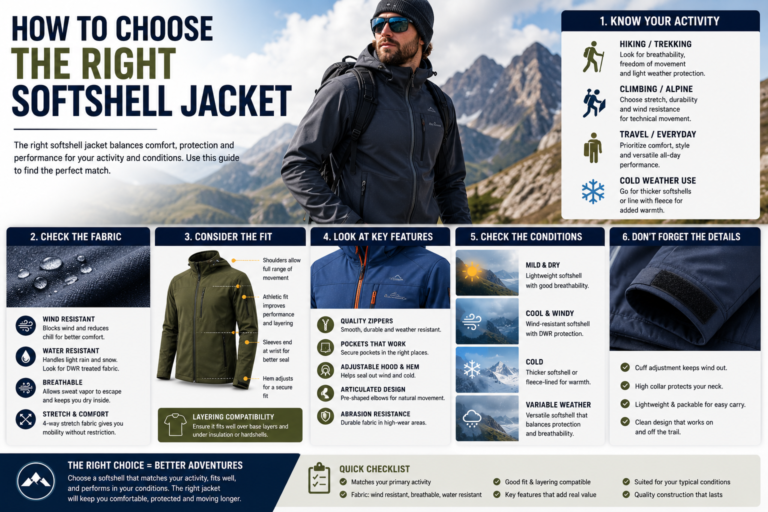
How to Choose the Right Softshell Jacket

Softshell jackets look similar on the hanger. They feel similar at first touch. But take two different softshells into the mountains and the performance gap between a well-chosen and poorly-chosen jacket becomes immediately obvious. Knowing how to choose the right softshell jacket for your specific activity, conditions, and performance priorities saves you from expensive mistakes and genuinely improves your outdoor experience from the very first use. Here’s exactly what to consider.

Understand What a Softshell Actually Does

Before evaluating specific jackets, get clear on what softshells are designed for — and where they fall short. Softshell jackets optimize for stretch, breathability, and comfort during high-intensity physical activity in dry to lightly wet outdoor conditions. They provide genuine windproofing and water resistance — but they are not waterproof in sustained heavy rain.

This performance profile suits trail running, fast hiking, ski touring, climbing, and cycling in cold dry or lightly wet conditions where breathability and freedom of movement matter more than complete weather protection. Understanding this helps you evaluate softshells against the right criteria rather than judging them against hardshell waterproofing standards they were never designed to meet.

Match the Jacket to Your Primary Activity

The most important softshell selection decision is matching construction and weight to your primary use case. Different activities demand different performance priorities — and softshell manufacturers build specific designs around these different requirements.

High-intensity aerobic activities — trail running, ski touring, fast hiking — demand maximum breathability and minimal weight. Lightweight single-layer softshells with highly breathable face fabrics suit these applications. Heavier, fleece-lined constructions would cause overheating that undermines the entire performance purpose of choosing a softshell over a hardshell alternative.

Moderate-intensity activities — regular hiking, climbing, camping — suit mid-weight softshells with fleece or gridback linings that add comfort and mild warmth alongside wind and weather resistance. These constructions work as standalone outer layers across a wider temperature range than ultralight versions.

Hiking clothing specialists build softshells specifically around trail use requirements — with articulated knees, hem length optimized for pack hip belt compatibility, and pocket placement that works correctly with harnesses and backpack straps rather than being blocked by them.

Evaluate Fabric Construction and Weight

Softshell fabrics vary significantly in construction — and these differences directly impact performance across your specific activity and conditions.

Single-layer softshell fabrics — stretch woven face without interior lining — offer maximum breathability and minimal weight. They suit the highest-intensity applications where moisture management matters more than warmth or comfort against the skin.

Two-layer softshell fabrics — stretch woven face bonded to a grid fleece or smooth lining — add comfort and mild insulation while maintaining good breathability. They suit moderate-intensity activities across a wider temperature range.

Three-layer softshell constructions — face fabric, membrane, and interior backer bonded together — provide the closest softshell performance to hardshell weather resistance while retaining meaningful stretch and comfort advantages over rigid membrane jackets.

Fabric weight typically ranges from 200 to 400 g/m² across quality softshell constructions. Lighter weights suit warm-weather and high-intensity applications. Heavier weights suit cold conditions where the softshell functions as a primary warmth and wind protection layer.

Assess Stretch and Mobility

The stretch performance of a softshell fabric directly determines how freely you move during demanding physical activity — and this matters enormously for choosing how to choose the right softshell jacket for activities requiring full range of motion.

Four-way stretch fabrics allow simultaneous stretch in both horizontal and vertical directions — accommodating the multi-directional movement demands of climbing, skiing, and trail running without fabric pulling or binding at shoulders, elbows, and back. Two-way stretch provides horizontal stretch only — adequate for hiking and general outdoor use but limiting for technically demanding activities requiring overhead reaching and complex body positioning.

Test jacket mobility deliberately before purchasing — raise both arms fully overhead, swing arms across the body, and simulate a crouching position. Any pulling or restriction indicates either insufficient fabric stretch or incorrect fit for your body proportions.

Check Wind and Water Resistance Performance

All quality softshells provide meaningful windproofing — but water resistance varies significantly between constructions and price points. Understanding the water resistance level you need prevents choosing a jacket that disappoints in the conditions you actually encounter.

DWR treatments cause water to bead and roll off the face fabric surface rather than saturating it. Fresh DWR performs well in light rain — maintaining breathability by preventing face fabric saturation that blocks moisture vapor transmission from inside the jacket. DWR performance degrades with use and washing — requiring periodic refresh through tumble drying or specialist re-treatment products.

For activities in environments with frequent light rain — trail hiking, camping apparel use, general mountain activities — choosing a softshell with membrane lamination provides significantly more reliable light rain protection than DWR treatment alone. For severe or sustained rain, carry a packable waterproof jacket as emergency backup regardless of softshell quality.

Evaluate Fit for Layering and Activity

Softshell fit affects both performance and layering capability — and getting fit right matters as much as fabric choice for overall jacket performance.

Active fit — close to the body without restricting movement — suits high-intensity activities where excess fabric creates aerodynamic drag and thermal inefficiency. Active fit jackets layer cleanly over base layers without bunching during movement.

Regular fit — slightly roomier through the chest and shoulders — accommodates mid-layers underneath for cold weather use and suits moderate-intensity activities where pack weight and movement demands are lower than high-intensity applications.

Sleeve length should allow full arm extension without the cuff riding up and exposing wrist skin during overhead reaching. Hem length should cover the lower back during a forward bend — preventing cold air entry during uphill hiking and climbing positions that shorter hems fail to cover adequately.

Review Key Features for Your Use Case

Beyond fabric and fit, specific construction features determine how well a softshell serves your particular outdoor use case:

Hood design — helmet-compatible hoods suit climbing and ski wear applications. Packable hoods suit hiking and running where helmet compatibility isn’t needed. Some softshells offer no hood — suitable for activities where a separate hat provides adequate head coverage.

Pocket placement and quantity — chest pockets suit harness-wearing activities. Hip pockets work for general hiking and casual use. Internal pockets provide security for valuables during high-movement activities.

Cuff design — velcro adjustable cuffs seal against cold air entry. Elasticated cuffs provide quick-donning convenience without adjustment. Thumb loops maintain sleeve position during high-arm-reach activities.

Ventilation — pit zip vents allow rapid heat dumping during intense climbing or skiing ascents without jacket removal. Not all softshells include ventilation — relevant primarily for high-intensity applications where body heat generation significantly exceeds the jacket’s passive breathability capacity.

A professional softshell jackets manufacturer builds these features into specific jacket designs based on intended activity use — ensuring every construction detail serves the performance requirements of the target outdoor user rather than adding features without functional justification.

Consider Durability and Long-Term Value

Softshell face fabrics face significant abrasion from pack straps, rope contact, rock surfaces, and general outdoor use. Face fabric durability — measured in abrasion resistance cycles — determines how long the jacket maintains its performance and appearance across repeated demanding use.

Denier weight of face fabric yarns indicates durability — higher denier fabrics resist abrasion more effectively at the cost of slightly reduced stretch and breathability. Reinforced panels at high-wear zones — shoulders, elbows, and forearms — extend jacket lifespan significantly for activities involving regular contact with abrasive surfaces.

Brands building complete outdoor apparel ranges alongside outdoor jackets and hardshell jackets benefit from applying consistent durability standards across their entire jacket collection — because customers who trust one jacket from your brand extend that trust to every other product you produce.

Conclusion

Knowing how to choose the right softshell jacket comes down to matching fabric construction, stretch performance, water resistance level, fit, and specific features to your primary activity and the conditions you regularly encounter. A well-chosen softshell becomes one of the most-reached-for garments in any outdoor wardrobe — worn constantly across the conditions where its breathability and mobility advantages genuinely shine. Choose it thoughtfully and it rewards you with exceptional performance across hundreds of demanding outdoor days.

FAQs

How do I know if I need a softshell or hardshell jacket for my activity?

If your activity involves sustained heavy rain or severe mountain weather — choose a hardshell. If breathability and freedom of movement during high-intensity activity in dry or lightly wet conditions matter most — a softshell is the better choice.

Can a softshell jacket replace a waterproof jacket entirely?

For light rain and wind protection during high-intensity activity in moderate conditions — yes. For sustained heavy rain, serious mountain weather, or activities where getting wet creates safety risk — no. Always carry waterproof backup in unpredictable environments.

How should I care for my softshell jacket to maintain performance?

Wash according to manufacturer instructions using technical fabric wash products. Tumble dry on low heat to refresh DWR treatment. Avoid fabric softeners that block fiber breathability and degrade DWR coating performance over time.

Can softshell jackets be produced under a private label for outdoor brands?

Yes. Professional softshell manufacturers offer complete private label production with custom fabrics, stretch constructions, colors, hardware, labels, and packaging — giving outdoor brands full creative and commercial control over their softshell jacket collection.

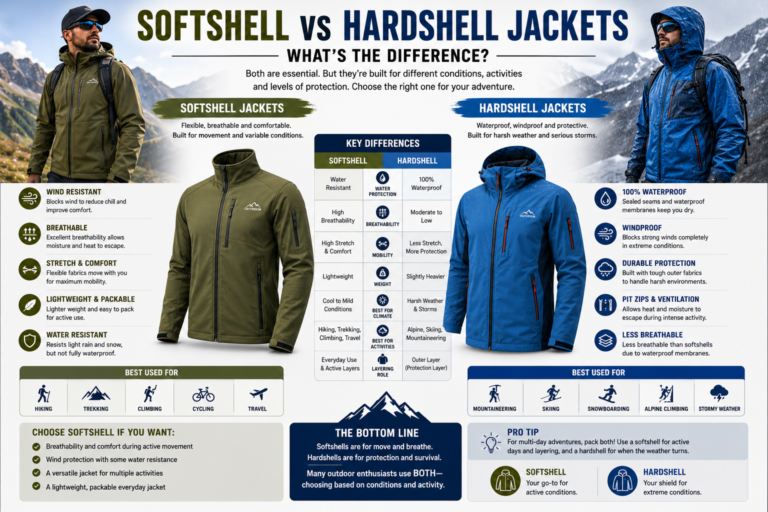
Softshell vs Hardshell Jackets: What’s the Difference?

Walk into any serious outdoor retailer and you’ll find both sitting side by side — softshell and hardshell jackets at different price points, with different technical specifications, and designed for genuinely different purposes. The softshell vs hardshell jackets question confuses a significant number of outdoor enthusiasts and brand buyers alike — because both look similar at a glance but perform very differently when conditions get serious. Understanding exactly what separates these two jacket types makes you a smarter buyer and a better brand builder.

What Is a Hardshell Jacket?

A hardshell jacket is the most technically advanced weather protection garment in outdoor apparel. It uses rigid waterproof breathable membrane laminates — Gore-Tex, eVent, or equivalent technologies — bonded directly to the face fabric to create an impenetrable barrier against rain, snow, and wind.

Hardshells contain no insulation. They function purely as weather barriers — worn over base layers and insulating mid-layers in cold conditions, or directly over base layers during high-intensity warm weather activity where insulation isn’t needed but weather protection is.

The defining performance characteristics of quality hardshell jackets are:

  • Full waterproofing — typically 20,000mm hydrostatic head rating and above
  • Complete windproofing across all fabric panels and construction points
  • Breathable membrane performance allowing moisture vapor escape during activity
  • Fully sealed seams preventing water entry through construction points
  • Durable face fabric resisting abrasion from pack straps, rope contact, and terrain

Hardshells suit mountaineering, alpine climbing, backcountry skiing, and serious mountain hiking — activities where complete, reliable weather protection matters more than any other performance characteristic.

What Is a Softshell Jacket?

A softshell jacket takes a fundamentally different design approach. Rather than prioritizing maximum weather protection, softshells optimize for freedom of movement, breathability, and comfort during sustained high-output physical activity.

Softshell fabrics typically combine a stretch woven face — providing moderate wind and light rain resistance — with a fleece or gridback interior lining that adds comfort and mild insulation. The result is a jacket that moves freely with the body, manages temperature effectively during intense activity, and feels significantly more comfortable against the body than rigid hardshell alternatives.

Softshell jackets are genuinely windproof and water-resistant — but they are not waterproof in the way hardshells are. Sustained heavy rain will eventually penetrate a softshell fabric. In genuinely wet conditions, softshells require a waterproof layer over the top — or should be replaced entirely by a hardshell for complete protection.

Softshell vs Hardshell: Core Performance Differences

FeatureSoftshellHardshell
WaterproofingWater-resistant onlyFully waterproof
WindproofingFullFull
BreathabilityVery highHigh
Stretch and MobilityExcellentModerate
WeightLight to moderateLight to moderate
PackabilityGoodExcellent
Comfort Against BodyVery highModerate
InsulationMild — fleece liningNone
Best ConditionsActive dry/cold/windyWet, snow, severe weather
Layering RequirementBase layer sufficientBase plus mid-layer in cold

When to Choose a Hardshell

Choose a hardshell jacket when weather protection is the primary requirement. If your activity involves sustained rain, heavy snow, high alpine conditions, or any environment where getting wet creates genuine safety risk — hardshell is the correct choice. No amount of softshell breathability advantage justifies choosing a water-resistant jacket when waterproof protection is genuinely needed.

Hardshells are the correct outer layer for:

  • Mountain hiking in changeable alpine weather
  • Ski wear applications in heavy snow conditions
  • Backcountry and expedition use where conditions deteriorate unpredictably
  • Waterproof clothing needs in sustained wet lowland environments
  • Any situation where the consequences of getting wet are serious

When to Choose a Softshell

Choose a softshell jacket when activity intensity and freedom of movement matter more than maximum weather protection. Softshells genuinely outperform hardshells in dry but cold and windy conditions — providing better comfort, more natural movement, and superior temperature regulation during sustained physical output.

Softshells are the correct choice for:

  • Trail running and fast hiking in predominantly dry conditions
  • Ski touring and uphill skinning where sweating is constant
  • Hiking clothing applications on clear weather days with light wind
  • Climbing and bouldering where stretch and mobility matter critically
  • Any high-intensity activity in cold dry conditions where breathability matters most

Can You Use Both Together?

Absolutely — and many serious outdoor enthusiasts do exactly this. A softshell worn as an active layer during high-intensity uphill sections, with a packable hardshell available for deployment when weather deteriorates, provides the complete flexibility that demanding outdoor activities across changing conditions genuinely require.

This combination approach — softshell for comfort and mobility, hardshell for weather emergencies — gives outdoor users the best of both performance philosophies without being locked into the compromises each individual jacket type makes.

Brands building complete outdoor jackets collections serve customers best when they carry both types — with clear communication about when each jacket performs optimally rather than leaving customers to discover the limitations themselves through experience.

What About Three-in-One Jackets?

Three-in-one jackets combine a hardshell outer with a removable insulated or fleece inner — connecting through a zip system that allows all three configurations. They offer versatility at the cost of optimal performance in any single configuration — the hardshell outer is typically less breathable than a dedicated shell, and the inner layer is less warm than a dedicated insulated jacket.

Three-in-one designs suit outdoor lifestyle and casual use markets where versatility matters more than technical performance optimization — particularly strong for camping apparel collections targeting recreational users who want simplified gear choices over technical performance precision.

Building Both Into Your Outdoor Brand

For outdoor apparel brands, carrying both softshell and hardshell jackets isn’t optional — it’s commercially essential. Different customers, different activities, and different conditions all create genuine demand for both types. Brands that offer only one type consistently lose customers whose specific activity requirements the available jacket doesn’t serve correctly.

Working with a professional outdoor apparel manufacturer who produces both jacket types with equal technical expertise ensures fabric performance credentials, construction quality, and feature execution meet the real-world demands each jacket type faces across genuine outdoor use in demanding environments.

Conclusion

The softshell vs hardshell jackets decision isn’t about which jacket is better — it’s about which jacket is better for the specific activity, conditions, and performance priorities at hand. Hardshells protect completely in wet and severe conditions. Softshells move freely and breathe excellently during high-intensity dry weather activity. Understanding this distinction clearly — and communicating it effectively to customers — is what separates outdoor brands that genuinely serve their market from brands that sell jackets without helping customers make the right choices for their specific outdoor needs.

FAQs

Is a softshell jacket waterproof?

No. Softshell jackets are water-resistant — they handle light rain and moisture splash effectively but will eventually wet out in sustained heavy rain. Genuinely waterproof protection requires a hardshell membrane jacket.

Can I wear a softshell jacket skiing?

Softshells suit ski touring and uphill skinning in dry conditions where breathability matters. For resort skiing and any conditions involving snow or rain, a waterproof hardshell provides the weather protection that skiing in mountain environments reliably demands.

Are hardshell jackets uncomfortable during high-intensity activity?

Quality hardshells with premium breathable membranes manage moisture vapor effectively during sustained activity. However, softshells do breathe more freely — making them more comfortable during extended high-intensity output in dry conditions where weather protection isn’t the primary need.

Can softshell and hardshell jackets be produced under a private label?

Yes. Professional outdoor apparel manufacturers produce both jacket types under private label with custom fabrics, performance membranes, colors, hardware, and branding — giving outdoor brands complete control over their technical jacket collection identity.

Best Fabrics Used in Hardshell Jackets

A good hardshell jacket keeps you warm and dry from the elements. There are several advantages Best Fabrics Used in Hardshell Jackets have from the layering of their fabric. In the Best Fabrics Used in Hardshell Jackets the fabrics are nominated to keeps you dry and to let sweat evaporate. You would not want to feel cold and clammy after a strenuous hike. These fabrics are tested for there functionality to keep you warm and dry in dense forest and even in city. A 7th grader would agree there is a magical superpower in these jackets with the fabrics they use.

Gore-Tex – The Most Trusted Fabric

Gore-Tex is a thin membrane with billions of tiny pores. These pores are too small for water drops but large enough for water vapor (sweat) to pass through. That is why Gore-Tex hardshell jackets are used by mountaineers on Everest. The fabric is completely waterproof and windproof. However, it is expensive. But if you go hiking in heavy rain, Gore-Tex is worth every penny.

EVent – For High-Energy Activities

For sports that require even more energy and effort, eVent fabrics are even better. Why you ask? Because they are faster at sweating than their competitors. With direct venting as you ski and sweat, eVent continues to be one of the Best Fabrics Used in Hardshell Jackets. For its lightweight, and stretchy fabrics, eVent is a favorite with skiers and trail runners. eVent gets dirty faster, like every other fabric, but a good wash and they’re as good as new.

NeoShell – The Soft and Stretchy Option

Most hardshell fabrics feel stiff and noisy. NeoShell changes that. It is a soft, stretchy, and quiet fabric that still blocks rain and wind. NeoShell hardshell jackets are perfect for climbing and trekking because they move with your body. They are not as durable as Gore-Tex, but they are much more comfortable. If you hate the “crunchy” feeling of old rain jackets, try NeoShell.

Dry.Q Elite – Built for Extreme Weather

Dry.Q Elite is a fabric from Mountain Hardwear. It uses an active breathability system. The warmer you get, the more it vents moisture. Dry.Q Elite hardshell jackets are popular among hunters and tactical users because they are silent and strong. They also pack down very small. This fabric is best for cold, wet winters.

Summary Key Features of Top Hardshell Fabrics

  • Gore-Tex: Best durability and full waterproofing.
  • eVent: Best breathability for high-output sports.
  • NeoShell: Best soft, stretch and quiet.
  • Dry.Q Elite: Best for cold and quiet.
  • Pertex Shield: Best for weight vs. durability in backpacking.

All these fabrics are tested to keep you safe in storms.

Pertex Shield – The Ultralight Choice

Pertex Shield is very thin and packable. It uses a micro-porous coating instead of a heavy membrane. Pertex Shield hardshell jackets weigh less than 300 grams. That is lighter than an apple! However, it is not as tough as Gore-Tex. It is great for emergency rain gear or summer hiking. If you carry your jacket in a backpack for miles, Pertex Shield is ideal.

Hardshell vs. Softshell – What’s the Difference?

Many people confuse hardshell and softshell fabrics. Hardshell fabrics (like Gore-Tex) are fully waterproof and non-stretchy. Softshell fabrics (like fleece-backed nylon) are water-resistant and stretchy. For heavy rain, choose a true hardshell jacket. For light drizzle and active sports, choose a softshell. Check the label carefully before buying.

How to Care for Hardshell Fabrics

When you spend good money on a hardshell jacket, you want to keep it around as long as possible, right? Use a tech wash to clean hardshell jackets. Don’t use regular detergent to clean Best Fabrics Used in Hardshell Jackets, as it will ruin the waterproof barrier. It’s best to use the lowest setting on your dryer to dry the jacket. This will also reactivate the treated DWR. A good hardshell jacket can last between 5 and 10 years with proper care, and a care tag will tell you the rest.

Which Fabric Should You Choose?

You really can’t go wrong with a good Best Fabrics Used in Hardshell Jackets using Gore-Tex for an all-around jacket. When you think about comfort and climbing, you want to go with NeoShell. For the cold, go with Dry Q Elite. Lastly, go with Pertex Shield for lightweight backpacking. There really isn’t a best fabric for the best hardshell jackets, but you should choose the right fabric for the activity you want to do.For all-around use, buy Gore-Tex. For running or skiing, buy eVent. For climbing and comfort, buy NeoShell. For extreme cold, buy Dry.Q Elite. Think about your main activity. Then pick the Best Fabrics Used in Hardshell Jackets that matches your needs.

Conclusion

The Best Fabrics Used in Hardshell Jackets influence safety and comfort for outdoor enthusiasts. Strong materials such as nylon and polyester and waterproof membranes protect against precipitation in the form of rain and snow and wind while remaining lightweight and breathable. A jacket made with quality fabric has a longer lifespan and sustained performance. Outdoor lovers of diverse activities, such as hiking, camping, and skiing, need the right fabric to stay dry and gear up for whatever comes next.

FAQs

Is Gore-Tex the only good fabric for hardshell jackets?

No. eVent, NeoShell, Dry.Q Elite, and Pertex Shield are also excellent. Each has a different strength.

Can a 7th grader understand these fabrics?

Yes. Think of Gore-Tex as a raincoat with a million tiny umbrellas. Sweat goes out, but rain stays out.

Are hardshell jackets noisy?

Some are. Gore-Tex and Pertex can be crinkly. NeoShell and Dry.Q Elite are much quieter.

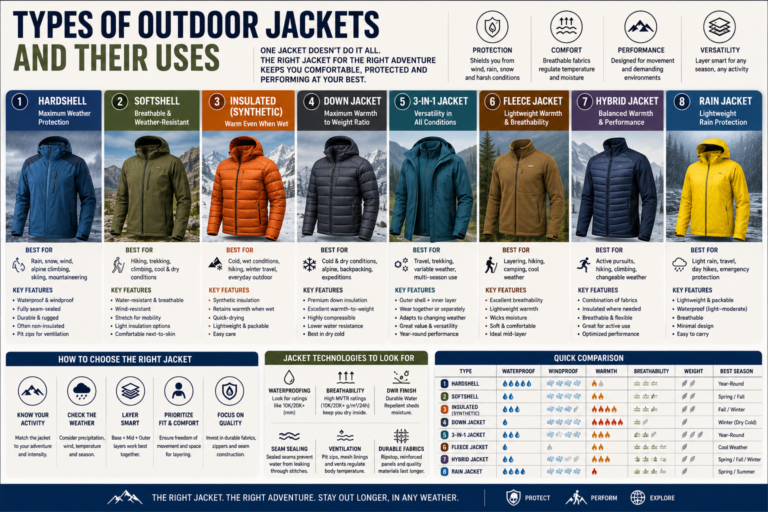
Types of Outdoor Jackets and Their Uses

The outdoor jacket market is one of the most commercially diverse categories in apparel manufacturing. Different activities, different environments, and different weather conditions all demand different jacket solutions — and understanding the types of outdoor jackets and what each one genuinely does helps brands build collections that serve real outdoor needs rather than simply filling shelves with similar-looking products. Here’s a complete breakdown of every major outdoor jacket type and its specific use case.

Hardshell Jacket — Maximum Weather Protection

Hardshell jackets represent the pinnacle of weather protection in outdoor apparel. Built from rigid waterproof breathable membrane laminates — Gore-Tex, eVent, or equivalent technologies — hardshells provide complete protection against rain, snow, and wind without compromising breathability during high-intensity activity.

Hardshells contain no insulation — they function purely as weather barriers worn over insulating mid-layers. This design philosophy makes them extremely versatile across wide temperature ranges — the same hardshell serves both cold alpine environments and warm wet lowland hiking depending on the layers worn beneath it.

Hardshell jackets suit mountaineering, alpine climbing, backcountry skiing, and any activity where maximum weather protection and pack weight efficiency matter more than built-in warmth.

Softshell Jacket — Versatile Active Layer

Softshell jackets sacrifice some weather protection in exchange for significantly improved stretch, breathability, and comfort during high-output physical activity. Their fabric construction — typically a stretch woven face bonded to a fleece or gridback lining — provides moderate wind and light rain resistance while moving freely with the body and regulating temperature effectively during sustained effort.

Softshell jackets suit trail running, fast hiking, ski touring, and any activity where the intensity of movement generates significant body heat — making breathability and freedom of movement more important than maximum weather protection. They work exceptionally well as outer layers in dry but cold and windy conditions.

Waterproof Jacket — Reliable Rain Protection

Waterproof jackets cover a broad category between entry-level rain protection and premium membrane performance. They use DWR-treated face fabrics combined with either membrane lamination or polyurethane coating to prevent water penetration during rain and wet conditions.

The key distinction between waterproof jackets lies in breathability performance. Membrane-laminated waterproof jackets breathe significantly better than coated alternatives — making them more comfortable during active use where body heat and perspiration accumulate. For outdoor brands building versatile jacket ranges, waterproof styles serve the broadest possible customer base across hiking, camping, travel, and everyday wet weather use.

Windbreaker Jacket — Lightweight Wind Defence

Windbreaker jackets prioritize wind protection and packability above all other performance properties. Constructed from tightly woven lightweight nylon or polyester with DWR treatment, they block wind chill effectively while packing down to remarkably compact sizes — often fitting into their own chest pocket for effortless transport.

Windbreaker jackets suit running, cycling, casual hiking, and any activity where lightweight wind protection matters but serious weather protection isn’t required. They also serve as the lightest possible outer layer during warm but breezy conditions where any heavier jacket would cause overheating.

Puffer Jacket — Insulated Warmth Champion

Puffer jackets use either down or synthetic insulation trapped within baffle constructions to provide exceptional warmth retention across cold conditions. Their distinctive quilted appearance comes from the stitching or welding that separates insulation baffles — preventing fill migration that would create cold spots across the jacket surface.

Down puffer jackets deliver unmatched warmth-to-weight ratios for dry cold conditions. Synthetic versions maintain performance when wet — making them more reliable for damp outdoor environments. Puffer jackets suit cold weather hiking, camping, ski resort use, and urban cold weather environments — making them one of the most commercially versatile types of outdoor jackets across both technical and lifestyle markets simultaneously.

Fleece Jacket — Comfortable Mid-Layer Essential

Fleece jackets provide reliable warmth through trapped air within their fiber structure — functioning primarily as mid-layers worn beneath waterproof shells in wet conditions and as standalone outer layers in dry cold environments. Their open fiber construction allows excellent moisture vapor transmission — preventing dampness accumulation within layering systems during active outdoor use.

Outdoor fleece jackets in varying weights — 100, 200, and 300-weight constructions — serve different temperature ranges and activity intensities. Lightweight fleece suits active hiking as a standalone layer. Heavyweight fleece serves as serious insulation in cold camping and mountain environments where maximum warmth retention matters above all other performance considerations.

Insulated Jacket — Combined Warmth and Protection

Insulated jackets combine waterproof or water-resistant outer shells with internal insulation fill — delivering warmth retention and weather protection in a single garment without requiring separate shell and mid-layer combinations. They suit recreational outdoor users who prefer simpler layering approaches and activities where temperature conditions remain relatively stable throughout the day.

Outdoor jackets that combine insulation with weather protection serve the largest casual outdoor market segment — hikers, campers, and outdoor lifestyle consumers who want reliable all-condition performance without the complexity of separate technical layering systems.

Rain Jacket — Dedicated Wet Weather Protection

Rain jackets focus specifically on precipitation protection — designed primarily for walking, hiking, and outdoor activities in wet lowland environments where wind chill and cold temperatures are less demanding than waterproofing performance. Packable construction, taped seams, and waterproof zippers provide reliable wet weather protection across sustained rainfall without the premium weight and cost of full mountain hardshell construction.

Rainwear suits outdoor brands targeting walkers, travellers, festival-goers, and casual outdoor enthusiasts who need reliable rain protection for moderate use rather than extreme mountain conditions.

Hunting Jacket — Specialized Field Performance

Hunting jackets combine specific performance requirements that general outdoor jackets don’t address — camouflage patterns for concealment, scent-control treatments, silent fabric constructions that don’t rustle during stealthy movement, and reinforced panels for brush and terrain contact resistance.

Hunting apparel manufacturers understand these specialized requirements deeply — building jackets that serve active hunters across varied terrain, weather conditions, and specific game hunting scenarios where standard outdoor performance simply doesn’t meet the precise functional demands that field hunting imposes.

Hiking Jacket — Trail-Optimized Performance

Hiking jackets balance weight, packability, weather protection, and freedom of movement specifically for trail use. They typically feature articulated construction for uphill climbing mobility, pit zip ventilation for heat management during ascents, and multiple accessible pockets for trail essentials. Weight efficiency matters enormously for multi-day hiking applications where every gram of pack weight impacts endurance across long distances.

Hiking clothing specialists build hiking jackets with the specific functional priorities that trail users depend on — distinguishing genuinely trail-optimized products from general outdoor jackets that technically work on trails but don’t serve hikers with the same precision.

Building a Complete Outdoor Jacket Collection

Understanding the types of outdoor jackets and their distinct uses helps outdoor brands build collections that genuinely serve different customers rather than producing variations of the same product with different colorways. Each jacket type attracts a specific outdoor enthusiast with specific activity needs — and covering the right combination for your target market creates a collection with genuine commercial depth.

Working with a professional outdoor apparel manufacturer ensures fabric performance credentials, construction quality, and technical feature execution meet the real-world demands each jacket type faces across genuine outdoor use.

Conclusion

The types of outdoor jackets — hardshells, softshells, waterproofs, windbreakers, puffers, fleece, insulated, rain jackets, hunting jackets, and hiking jackets — each serve distinct outdoor needs that no single jacket type can replicate across all situations. Brands that understand these distinctions build outdoor jacket collections with genuine commercial intelligence — serving specific customers, specific activities, and specific conditions with products that perform exactly as promised every time they’re needed in the field.

FAQs

What is the most versatile outdoor jacket type for general use?

Waterproof insulated jackets offer the broadest versatility — combining weather protection and warmth in one garment that serves casual hikers, campers, and outdoor lifestyle consumers across the widest range of conditions and activities.

What is the difference between a hardshell and softshell jacket?

Hardshells provide maximum waterproof weather protection with no insulation. Softshells prioritize stretch, breathability, and comfort during high-output activity — offering moderate wind and light rain resistance rather than full waterproof performance.

Can all outdoor jacket types be produced under a private label?

Yes. Professional outdoor apparel manufacturers offer complete private label production across all jacket types — with custom fabrics, performance treatments, colors, hardware, labels, and packaging giving brands full creative and commercial control.

How many outdoor jacket types should a new brand launch with initially?

Start with two to three core types that serve your specific target customer most directly — typically a waterproof jacket, an insulated puffer, and one activity-specific style relevant to your brand’s outdoor focus. Expand strategically as revenue and market understanding develop.

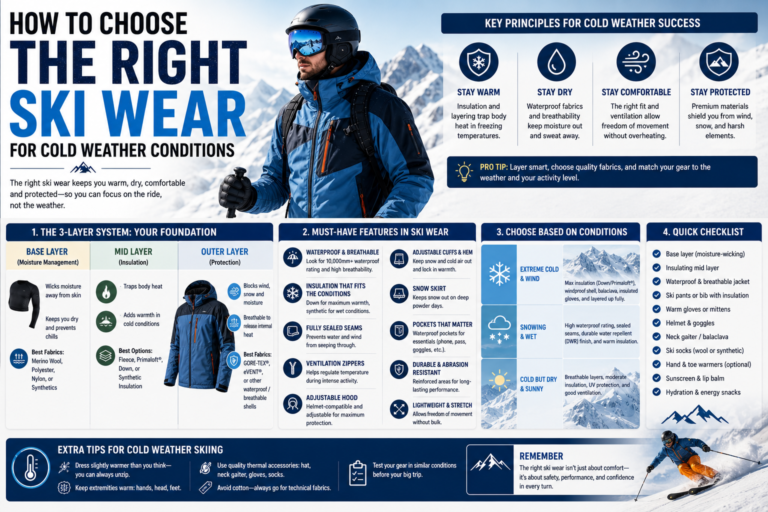
How to Choose the Right Ski Wear for Cold Weather Conditions

Cold weather skiing is an entirely different challenge from mild-condition resort days. When temperatures drop seriously, wind chill intensifies, and snow conditions become more demanding — the clothing decisions you make before stepping onto the mountain directly determine how long you last, how well you perform, and how safe you stay. Choosing the right ski wear for cold weather requires understanding layering principles, fabric technology, and specific garment features that work together as a complete protective system. Here’s exactly how to get it right.

Start With the Layering Principle

Every effective cold weather ski outfit builds from the same foundational principle — multiple functional layers that work together rather than one thick garment attempting to do everything alone. Each layer serves a specific purpose, and understanding those purposes drives every clothing decision from base layer selection through outer shell choice.

The three-layer system works as follows:

  • Base layer — manages moisture directly against skin, keeping you dry from sweat
  • Mid-layer — retains body heat and provides insulation against cold temperatures
  • Outer shell — protects against wind, snow, and external weather conditions

Getting each layer right — and choosing layers that work together as a compatible system — is the foundation of choosing right ski wear for cold weather conditions that genuinely perform from first lift to last run.

Choosing the Right Base Layer for Cold Conditions

In genuinely cold temperatures, base layer choice matters more than most skiers realize. The base layer sits directly against your skin — and its moisture management performance determines whether every layer above it stays effective or becomes compromised by accumulated internal dampness.

Merino wool base layers suit cold weather skiing exceptionally well. Natural temperature regulation, moisture absorption into fiber rather than against skin, and natural odor resistance make merino the preferred cold weather base layer for skiers who prioritize comfort alongside performance. Heavyweight merino — 250gsm and above — provides additional warmth retention that lightweight versions cannot match in genuinely cold mountain conditions.

Base layer clothing built from quality merino or high-performance synthetic fabrics keeps skin dry and warm simultaneously — creating the stable thermal foundation that mid-layers and outer shells build their protection on top of effectively.

Mid-Layer Selection for Maximum Warmth

The mid-layer provides the primary warmth retention that cold weather skiing demands. Several options serve different performance needs depending on skiing intensity and temperature conditions.

Fleece mid-layers provide reliable warmth with excellent breathability — allowing moisture vapor from the base layer to continue moving outward rather than accumulating within the layering system. Outdoor fleece in heavyweight 300-weight construction suits genuinely cold conditions where maximum warmth retention matters more than minimal bulk.

Down or synthetic insulated mid-layers provide higher warmth-to-weight ratios than fleece — making them valuable for extremely cold conditions or for less active skiing styles where body heat generation is lower. Puffer jackets worn as mid-layers under waterproof shells deliver exceptional warmth without the bulk that multiple fleece layers would create.

Softshell mid-layers suit moderately cold conditions where wind resistance and stretch performance matter alongside warmth — providing a single layer that handles multiple environmental demands simultaneously without requiring additional outer shell coverage in lighter wind and snow conditions.

Outer Shell Requirements for Cold Weather

The outer shell is your primary defence against cold weather’s most damaging elements — wind chill, snow penetration, and external moisture. In genuinely cold conditions, outer shell performance requirements become significantly more demanding than mild-weather skiing needs.

Waterproof rating must be sufficient for sustained snow and occasional wet conditions. 20,000mm waterproofing and above ensures reliable protection across the varied precipitation that cold mountain environments regularly produce. Waterproof jackets with fully sealed seams prevent moisture penetration through every construction point — not just through the face fabric itself.

Wind protection is particularly critical in cold weather skiing. Wind chill at speed dramatically lowers effective temperature — making wind-resistant outer fabrics a non-negotiable requirement rather than an optional performance upgrade. Hardshell jackets provide maximum wind and weather protection for the most demanding cold weather skiing conditions.

Insulated ski jackets — combining outer shell and insulation in a single garment — suit recreational cold weather skiers who prefer simpler layering systems over separate shell and mid-layer combinations. A professional ski wear manufacturer builds insulated ski jackets with strategic insulation placement — heavier fill in core zones and lighter panels across high-mobility areas — delivering warmth without sacrificing the freedom of movement skiing demands.

Essential Cold Weather Ski Wear Features

Beyond the layering system, specific garment features significantly impact cold weather performance. Choosing ski wear without these features creates preventable comfort and safety vulnerabilities:

  • Helmet-compatible hood with adjustable volume and cinch controls for complete head coverage in severe cold and wind conditions
  • Snow gaiter system — internal powder skirts at jacket waist and ankle gaiters in pants — preventing snow entry during falls and powder runs
  • Insulated collar and neck zone — high collar construction that seals neck warmth without requiring additional neckwear in moderate cold conditions
  • Thermal cuffs — inner cuffs that seal around wrist and glove interfaces preventing cold air entry through sleeve openings
  • Ventilation systems — underarm zip vents allowing heat dumping during high-intensity runs without removing the jacket entirely

Don’t Neglect Extremities

Cold weather skiing demands attention to extremities that core clothing alone cannot protect. Hands, feet, and face lose heat fastest in cold conditions — and inadequate protection for these areas undermines overall comfort and safety regardless of how well the main clothing system performs.

Ski masks protect the face against wind chill and cold air during high-speed descents — preventing the facial exposure that creates genuine discomfort and frostbite risk in severely cold mountain conditions. Quality ski masks use stretch fabrics that conform closely to facial contours without restricting breathing or goggle interface.

Waterproof insulated gloves, warm ski socks, and properly fitted ski boots with adequate thermal insulation complete the cold weather protection system that right ski wear for cold weather conditions demands across every exposed body area.

Matching Ski Wear to Temperature Conditions

Different cold temperature ranges demand different layering approaches. Understanding these ranges helps skiers and brands build appropriately matched systems:

Mild cold — 0°C to -10°C: Lightweight merino base, 200-weight fleece mid-layer, waterproof breathable shell provides comfortable all-day protection.

Moderate cold — -10°C to -20°C: Heavyweight merino base, 300-weight fleece or light insulated mid-layer, insulated waterproof shell delivers reliable warmth retention.

Severe cold — below -20°C: Heavyweight thermal base, premium down or synthetic insulated mid-layer, maximum-specification insulated hardshell outer provides the serious protection extreme cold demands.

A complete outdoor apparel collection built around these temperature ranges gives customers the guidance to select appropriate combinations — reducing return rates and increasing customer satisfaction by matching product performance to real-world conditions accurately.

Conclusion

Choosing the right ski wear for cold weather conditions comes down to building a complete, compatible layering system — quality base layer managing moisture, effective mid-layer retaining warmth, and protective outer shell blocking wind and weather — then adding the specific features that cold mountain environments demand. Every layer and every feature serves a purpose in genuinely cold conditions. Get the system right and cold weather skiing becomes an exhilarating, comfortable experience. Get it wrong and the mountain wins every time.

FAQs

How many layers do I need for seriously cold weather skiing?

Three layers — moisture-wicking base, insulating mid-layer, and waterproof wind-resistant outer shell — provides the complete protection system that genuinely cold mountain conditions demand for comfortable, safe skiing.

Is an insulated ski jacket better than a shell jacket with separate mid-layer for cold weather?

Both work effectively. Insulated jackets suit recreational skiers preferring simplicity. Shell jackets with separate mid-layers offer greater versatility for skiers across varied temperature conditions and activity intensity levels throughout the day.

What temperature rating should cold weather ski gloves have?

Cold weather ski gloves should be rated to at least -20°C for serious mountain use — ensuring hand warmth is maintained across the temperature drops that wind chill and high-altitude conditions regularly create on mountain environments.

Can cold weather ski wear collections be produced under a private label?

Yes. Professional ski wear manufacturers offer complete private label production with premium fabrics, certified membrane technologies, insulation systems, hardware, and packaging — giving outdoor brands complete control over their cold weather ski apparel identity.

Best Fabrics Used in Tactical Clothing Manufacturing

Fabric selection is the first step in achieving the performance of any tactical clothing. Material selection determines how a garment will handle abrasion, weather, moisture, and prolonged wear. Understanding the Best Fabrics Used in Tactical Clothing is crucial for brands and businesses that source tactical apparel, as the right fabric directly impacts durability, comfort, weather protection, and long-term performance in demanding outdoor environments.

Nylon Ripstop

The most common fabric used in the manufacture of tactical clothing is nylon ripstop. The grid-weave design prevents tears from spreading and is ideal for clothing that will be exposed to rough terrain and equipment friction. This is the ideal choice for outdoor pants and tactical jackets.

Polyester-Cotton blend (Polycotton)

Blends of poly-cotton combine the durability of polyester and the breathability of cotton to create a fabric that is both durable and comfortable. They are a great choice for uniforms, and everyday-wear garments in the field where comfort is important. The polyester component is wrinkle-resistant, retains color and dries quicker than pure cotton. This makes it a good choice for both branded uniforms and private label tactical line.

High-Performance Poly with Moisture Wicking Finish

Standard fabric for base layer and active tactic garments is high-performance polyester treated with moisture-wicking. The fabric pulls sweat from the skin, moves it to an outer surface and evaporates it. This keeps the wearer cool and regulates body temperature when they are doing intense physical activities. The fabric is lightweight and fast-drying. It also retains its structure after washing, making it an excellent foundation for tactical clothing.

Softshell Fabric

Softshell fabric is made up of two or three layers that are bonded together to provide stretch, wind resistance and light water repellency. It is used for softshell coats in tactical and outdoor applications, as it moves with the user without the noise or bulk of hardshell fabrics. Softshell is a flexible fabric that makes it a great choice for garments in situations where there are both static and dynamic movements, like security operations or training exercises.

Hardshell Laminate Fabric (2L & 3L)

Hardshell laminate fabrics are the best choice for weather protection. They provide the most reliable barrier to rain and wind. Hardshell Jackets with 2-layer and 3-layer membrane constructions keep moisture out through bonded fabric and taped seams. Three-layer laminates offer a durable, packable option for professional-grade water-resistant clothing used in outdoor and tactical applications.

Fleece (Polar & Micro Fleece).

Fleece is a popular choice for the mid-layer of insulation in tactical layering. The lightweight, quick-drying and warm fleece fabrics regulate temperature without adding bulk to traditional insulation. Outdoor fleece can be worn as a standalone piece in mild weather or as a mid-layer beneath waterproof coats when temperatures are colder. Polar fleece provides greater warmth in static conditions while micro fleece works better for active wear where overheating may be a problem.

Camouflage Knit and Woven Fabrics

Camouflage clothing and balaclavas are made from low-sheen fabrics that minimize sound. Camouflage clothing, and camouflage balaclavas are produced on low-sheen fabrics to reduce sound and reflectivity in the field. The camouflage pattern is printed on woven or knit fabrics, depending on the type of garment. Fabric weights are selected according to the terrain — urban, woodland, desert or alpine.

Recycled Performance Fabrics

Brands of outdoor and tactical clothing that target environmentally-conscious markets are increasingly required to be sustainable. Recycled Polyester — derived from recycled plastic bottles — can now match the performance of virgin polyester, at a competitive price. We source Eco Jersey from certified mills in order to offer recycled fabrics for brands creating outdoor clothing collections that meet performance and sustainability requirements.

Conclusion

Fabric selection is key to creating a high-performing tactical garment. Material decisions are crucial to the success of any tactical garment. Our sourcing team at Eco Jersey works closely with our clients to find the best technical fabrics for each product, from hiking trousers to outdoor tops. We also offer full tactical clothing programs. Requesting a quote will allow you to discuss fabric options and manufacturing.

FAQs

What is the toughest fabric to use for tactical apparel? 

The most durable fabric is nylon ripstop, due to its grid reinforced construction which resists tearing and wear. It is used extensively in outdoor pants and tactical coats.

Does it matter if the jacket is softshell or hardshell? 

That depends on your operational environment. Softshell Jackets are better for activities that require a lot of movement and flexibility. Hardshell Jackets offer superior waterproofing in severe weather conditions. Both softshell and hardshell are used in many tactical programs. Softshell is often worn for active operations, while the latter is worn as a layer during storms.

What is the best fabric for base layers?

 High performance polyester with moisture wicking treatment. It is a fabric that manages moisture efficiently, dries fast, and retains its


Types of Fleece Clothing and Their Uses

Understanding the different types of fleece clothing is important for anyone who wants to build a brand for outdoor clothing or choose the best insulating layer according to their activity. Fleece fabrics, which are usually made of polyester, mimic the insulation properties of wool. They also offer many practical benefits, including being lighter, quicker drying and more resistant to moisture absorption. The variety of fleece clothing has also increased significantly. From lightweight grid fleece baselayers to heavyweight expedition jackets, each type is engineered to meet a particular activity level, temperature range and performance requirement. This guide covers all major types of fleece clothing. It explains the differences between each type and gives examples for outdoor and everyday uses.

Fleece clothing is different from other insulation layers

It is important to know what fleece is and why it plays such an integral role in the layering of outdoor clothing. The fleece fabric is made by brushing a knitted polyester base into a raised fibrous surface. This traps air in the fabric and creates an insulating barrier for the wearer.

Fleece fabric: its core properties

Fleece has four important performance characteristics that make it a valuable addition to outdoor layering systems. It is more efficient in terms of warmth to weight than most natural fibres at the same thickness, so lighter garments are able to provide equivalent insulation. It continues to provide insulation even when damp, unlike down insulation which collapses and loses thermal properties when saturated with moisture. It dries much faster than cotton or wool after being exposed to moisture, allowing it to quickly recover its full insulation performance. It is also highly breathable, allowing moisture vapour to escape from the fabric rather than condensing on the skin.

How Fleece Fits into the Layering System

Most commonly, fleece clothing is used as a middle layer in outdoor apparel layering systems. It sits between a moisture wicking bottom layer, and an outer shell that protects against wind and weather. Certain fleece types, particularly those with heavyweight constructions, can be used as an outer layer in cold dry conditions. Understanding the place of each fleece type in the layering scheme is key to choosing the right type.

Fleece Clothing Types and their Specific Uses

Each fleece garment is optimised to a particular performance level, activity, or temperature range. Each type has its own commercial positioning, making fleece clothing one of the most diverse and versatile categories available to outdoor apparel brands.

Microfleece

Microfleece, the lightest fleece available (typically in the range of 100-150 GSM), provides a minimal layer of insulation that adds warmth while avoiding significant bulk and weight. The microfleece fibres are finer than those in standard fleece constructions, creating a smoother and softer surface. They also have better moisture-wicking qualities than heavier alternatives.

Microfleece can also be used as a mid-layer or base layer for high-output sports where comfort and moisture management are more important than warmth. It is a great next-to skin layer for activities like hiking, trail-running, and skiing, where moisture management and comfort are more important than warmth.

Microfleece, with its softness, moisture management, and light insulation, is also widely used as a liner in gloves, hats and jackets.

Grid Fleece

Grid fleece, also called thermal grid fleece and waffle fleece, has a grid pattern created on the inside surface by removing material in regular intervals. The grid structure is a way to reduce fabric weight and maintain insulation performance. This is because the air pockets that are created by the grid pattern trap heat as well as a continuous surface of fleece at a fraction the weight.

Grid fleece is one of the most efficient fleeces for its weight and warmth. Grid fleece is popular for base layers, which are designed to keep you warm and dry in cold weather.

Grid fleece is also increasingly being used for ultralight midlayers, packable fleece jackets, and other lightweight outdoor pursuits. Every gram counts when it comes to a light pack. Contact our outdoor wool manufacturing team to discuss your requirements if your brand is looking to develop lightweight technical fleeces for high-performance markets.

Midweight Fleece

The most versatile and popular type of fleece is midweight fleece, which has a GSM between 200-280. It provides warmth in cool to cold weather conditions, while still remaining lightweight enough for active wear as a middle layer beneath an outer jacket.

Midweight fleece jackets also make the best mid-layers for most outdoor activities, including hiking, camping and skiing. They balance breathability and insulation better than lighter or heavier options, regardless of the conditions.

Midweight fleece is also a popular fleece type for brands that target both outdoor enthusiasts and lifestyle customers. We have outdoor jackets manufacturing capabilities that cover midweight fleece production in a range of styles and constructions. Contact us today to begin your development process.

Heavyweight Fleece

The maximum amount of insulation is provided by heavyweight fleece, which typically ranges from 300 to 400 GSM. It can be worn as an outer layer alone in cold, dry conditions.

Heavyweight fleece is also well-suited for static outdoor uses — such as belaying on a climbing crag or sitting in a tent, or standing on the ski slope lift. The body produces minimal heat, and insulation is more important than breathability. The fleece is widely used for cold climate and expedition applications, where the maximum weight insulation is more appropriate.

Heavyweight fleece, however, is not suitable for high-output sports. Its weight and reduced breathability can cause overheating when doing sustained aerobic exercise. It is therefore most effective when used as part of a layering scheme that includes a lightweight active layer during movement phases, and heavyweight fleece during rest and static exposure.

Stretch Fleece

Stretch fleece is a fleece fabric that incorporates elastane to provide the same insulation and breathability as standard fleece, but with a four-way stretch for unrestricted motion during dynamic physical activities. It is therefore the best choice for sports where warmth and freedom of movement are equally important. This includes skiing, climbing and other technical alpine pursuits, where the body is in complex positions. Standard fleece constructions may restrict this.

Stretch fleece garments are also more athletic in fit, as the fabric’s stretch allows for a cut that is tighter and moves without restriction. The athletic fit reduces the bulk of an outer shell jacket. Stretch fleece is therefore the mid-layer fabric of choice for technical applications, where layering efficiency and insulation performance are equally important.

Our skiwear manufacturing team can produce stretch fleece base pieces and mid-layers in a variety of weights and constructions. Contact us to discuss the development of your ski or alpine polar fleece.

Windproof Fleece

The windproof fleece is a combination of a fleece with a thin membrane that blocks wind. It has the warmth, breathability and wind-blocking performance of fleece. Windproof fleece jackets can be worn as an outer layer in windy cold conditions, where a shell jacket is not required.

Windproof fleece is also a great choice for mountainous and exposed ridge environments, where wind chill can be more challenging than rain. This eliminates the need for a separate jacket to protect against wind — reducing the total weight of the pack and simplifying layering for activities when the weather is cool, windy and not too wet.

The softshell jacket, and the windproof fleece are adjacent layers in an outdoor layering system. Windproof fleece is more important for warmth while softshell is more important for stretch and active ventilation. This distinction allows brands to position their products clearly within the outdoor range.

Sherpa Fleece

Sherpa is a popular fleece that mimics the look and feel of sheepskin. It has a curly, dense pile that provides warmth and an appealing tactile appearance.

Sherpa fleece can also be used in standalone jackets and vests. Its warmth and aesthetic appeal give the garment a premium look. Sherpa fleece is produced in standalone styles such as sherpa jackets, outdoor vest, which have enjoyed great commercial success on the outdoor, heritage and fashion markets.

Sherpa fleece is also a growing trend in sustainable apparel. Recycled sherpa fabrics made from recycled plastic bottles are comparable to virgin sherpa and offer a performance and aesthetic that’s comparable to virgin alternatives, while still delivering significant sustainability credentials. Are you ready to create sherpa outerwear for your company? Let our manufacturing team help you create a product that your customers will love.

Polar Fleece

Polar fleece is a standard weight, brushed poly fabric that ranges from 200 to 300 GSM. It offers reliable insulation and easy care.

Polar fleece is used in a wide range of garments, from jackets and pullovers to fleece-lined hiking pants, winter accessories, and more. The fabric is used in a wide range of garments, from outdoor jackets to fleece-lined hike pants.

Polar fleece comes in virgin and recycled versions, so brands can easily transition to sustainable production while maintaining their product specifications.

Comparison of Fleece Clothing: Key Features

These properties are important when evaluating fleece fabrics to be used in clothing production and for commercial purposes.

  • Fabric Weight — 100-150 GSM microfleece, grid fleece and midweight base layers. 200-280 GSM midweight layers. 300-400 GSM heavyweight outer layers.
  • Heat-to-weight ratio — Grid fleece and stretch fleece provide the most efficiency, while heavyweight and Sherpa provides maximum absolute warmth
  • Breathability — Microfleece, grid fleece and windproof fleece have the lowest breathability within the category.
  • Stretch — stretch fabric with elastane for technical applications. Standard fleece constructions have minimal stretch.
  • Wind Resistance — windproof flannel adds a membrane to block the wind, standard flannel offers minimal wind resistance.
  • Sustainability credentials — recycled Polyester constructions are available in all fleece types with no performance compromise
  • Aesthetic – Sherpa fleece has the most distinct visual character. Polar and midweight fleece has the most neutral appearance.

How to Create a Fleece Clothing Range For Your Outdoor Brand

A well-structured range of fleece clothing can cover multiple customer segments, activities, and temperatures from one product category. In addition, fleece clothing is typically priced at a high retail level relative to its production costs. This makes it an attractive base for outdoor and casual lifestyle brands.

In addition, by developing fleece clothing in conjunction with complementary outerwear — water-resistant jackets to provide outer shell protection — and technical base layers that manage moisture, you can create a complete outdoor layering solution for your customers.

Are you ready to create your own fleece clothing line? Contact our manufacturing team to discuss your project. We work with outdoor brands and lifestyle brands from the initial fabric selection, tech pack preparation, through bulk production, quality assurance, and on time delivery.

Conclusion

Today’s fleece clothing covers a wide range of styles, from lightweight grid fleece baselayers for alpine pursuits with high output to heavier sherpa outerwear for the lifestyle and heritage markets. Understanding the differences between each type helps brands create more targeted and commercially successful outdoor ranges. It also helps buyers select fleece clothing that is suitable for their activity and weather conditions.

If you’re looking for fleece to use on your next adventure, or creating a range of fleeces for your clothing line, it is important that you understand the different types. This will help ensure that your decision is always the right one.

Explore the outdoor wool manufacturing options when you’re ready to create your fleece clothing collection. Contact our team today to begin your production journey.

FAQs

Which type of fleece clothing is the warmest?

 The heavyweight fleece ranges from 300 to 400 GSM and provides the maximum warmth in the category. It can be used as an outer layer for dry, cold weather or as a mid-layer with maximum insulation in cold climates.

What exactly is grid fleece, and why is it so effective?

 Grid-fleece has a grid pattern that allows material to be removed at regular intervals. This creates air pockets which trap heat while reducing the fabric weight. It has an excellent warmth-to weight ratio, making it one of most efficient fleece constructions.

Can you wear fleece as an outer layer in cold, dry conditions? 

Both heavyweight and windproof fleece work well as outer layers. Midweight fleece works best as a midlayer under a shell jacket that protects you from the wind and weather.

What’s the difference between polar fleece and sherpa?

 The surface of polar fleece is smoother and has a curly, dense pile that resembles sheepskin. Sherpa provides substantial warmth with a distinct tactile aesthetic. Polar fleece has a standard brushed surface with a smoother finish. It is more versatile for outdoor, casual, and workwear markets.