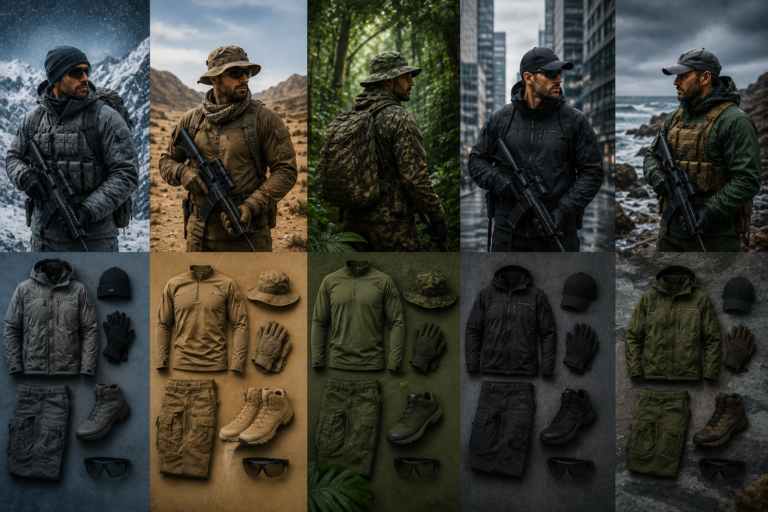
The same size does not fit all when it comes to tactical clothing. A jacket designed for cold mountain environments may not be the best choice for a humid, hot jungle. Understanding the environment is the first step in choose the right tactical apparel. Then, match each garment to the demands of that environment.
The Environment is the Driver of Every Tactical Apparel Choice
Most tactical clothing is selected based on aesthetics or brand reputation rather than environmental fit. Each environment is unique, combining factors such as temperature, terrain, weather, and operational requirements. Fabrics, constructions and features will be determined by each factor.
The manufacturer of tactical outdoor clothing creates apparel for specific environments, rather than generic aesthetics. This specificity is evident in the materials and construction decisions they make.
Cold and Alpine Environments
Layering is essential in cold and alpine conditions to manage the extreme temperature variations between prolonged physical exertion, and static exposure. If the clothing system is not designed to cover both situations, a climber can be dangerously cold after stopping.
Base layer clothing should prioritize moisture management. Base-layer clothing made of merino or synthetic fabrics that wick away sweat during exercise while still maintaining insulation value when damp. outdoor flannel is a good mid-layer because it provides warmth for its weight and can continue to provide insulation even when damp. For alpine or cold mountain conditions, the outer shell should provide full weather protection. A hardshell with sealed seams is ideal.
Environments that are Wet or Rainy
Weather protection is needed in environments that are constantly wet. This goes beyond the standard DWR. When a DWR-treated coat gets wet in heavy rain it loses its breathability and the wearer is dampened by both external moisture as well as trapped perspiration.
A full waterproof protection is a waterproof membrane that has fully taped seams. Rainwear and waterproof jackets have seam tape on every stitch line to prevent water from entering the areas where standard waterproof fabrics can be most vulnerable. Wet trousers can cause rapid heat loss in prolonged field operations.
Heat and humid environments
In humid and hot environments, breathability and moisture control are the top priorities. Heavyweight fabrics trap moisture and heat, which can lead to overheating during prolonged physical activity.
The best choice is lightweight, breathable fabrics with moisture-wicking properties. Outdoor Tees, lightweight tactical shirts and lightweight tees with mesh ventilation panels will maintain your body temperature better than heavier alternatives. Outdoor Shorts are a real performance consideration, allowing for air circulation and reducing the thermal load on your lower body when you’re active.
Forest and Woodland Environments
The forest and woodland environment is characterized by a wide range of temperatures, frequent rainfall, dense vegetation and terrain, which can create a significant tearing and ripping risk. Clothing is easily damaged by branches, bark and rocky surfaces. Abrasion-resistant fabrics are essential.
This environment requires ripstop fabrics that are reinforced at the knees and elbows. Camouflage Clothing In Woodland Patterns — Green, Brown, and Black Disruption Designs for Tree and Vegetation Backgrounds — Manages Visual Signature in This Terrain. Camouflage Balaclavas with matching patterns complete the system of low-visibility protection for head and face.
Desert and Arid Environments
Desert environments are characterized by extremes on both sides — intense heat in the daytime and cold temperatures at night. The tactical clothing used in desert environments must be able to handle this range of temperatures without the added weight and bulk of a cold-weather system.
The foundation is made up of lightweight, breathable fabrics with earth tones, sand and tan. Airy cuts that allow for good circulation of air protect skin exposed to the sun without trapping heat. Hunting clothing for open terrain has similar characteristics: light weight, suitable colour and construction which manages solar heat gain as well as cold exposure in the morning and evening.
Urban and Transitional Environments
Clothing that is suitable for urban tactical environments must be able to perform tactically while not attracting unwanted attention. Priority is given to low-profile performance – weather protection, equipment carrying capacity and aesthetics without obvious tactical aesthetics.
Windbreaker Jackets provide weather protection with a low-profile. Outdoor vests provide equipment-carrying capability without the bulkiness of a full tactical coat — useful in urban contexts, where concealability and mobility are important.
Conclusion
To choose the best tactical clothing, you must first understand your environment. Then, select fabrics, constructions and features that are directly in line with the needs that this environment presents. Cold environments require layering, and hardshell protection. Waterproof membranes are needed in wet environments. Heat environments require lightweights that breathe. Woodland environments require abrasion-resistant materials and camouflage that is appropriate.
What is the importance of selecting tactical clothing based on your operating environment?
Each environment has its own demands for temperature control, weather protection and abrasion resistance.
Which is the best outer-layer for cold alpine environments?
Hardshell jackets with waterproof membranes and fully sealed seams provide the weather protection, breathability and durability that cold mountain conditions require.
Which waterproofing is required for wet environments that are serious?
An actual waterproof membrane with fully-taped seams – not just a DWR treatment. DWR treatments become saturated in prolonged rain, and they lose their breathability.
Which fabrics are best for hot, humid tactical environments.
Lightweight blends of polyester and polycotton with moisture-wicking qualities — heavyweight fabrics can trap heat in prolonged hot conditions.
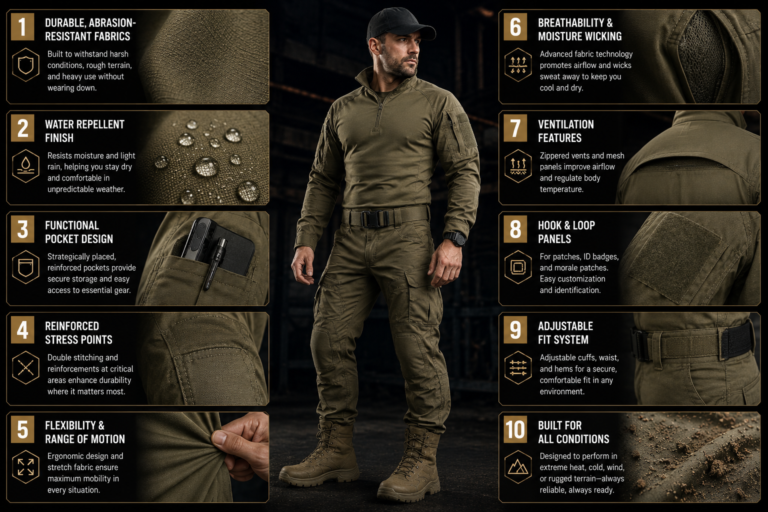
Tactical apparel doesn’t get a second chance. When professionals and outdoor enthusiasts depend on their clothing in demanding environments — law enforcement, military operations, hunting, hiking, or extreme outdoor conditions — every feature either performs or fails. There is no middle ground. Understanding the 10 features of tactical apparel that separate genuinely high-quality gear from inadequate alternatives helps brands build products that professionals trust and customers recommend without hesitation.
Durable Fabric Construction
High-quality tactical apparel starts with fabric that withstands serious punishment. Ripstop nylon, reinforced polyester blends, and Cordura fabrics resist tearing, abrasion, and puncture across demanding daily use. The ripstop weave pattern specifically prevents small tears from spreading — maintaining garment integrity even when fabric contacts sharp surfaces repeatedly.
A professional tactical outdoor apparel manufacturer selects fabric weight and construction specifically for the intended use environment — lighter weight for mobility-focused applications, heavier construction for maximum protection and durability requirements.
Moisture Management and Breathability
Tactical users generate significant body heat during physical activity — and staying dry directly impacts both comfort and operational performance. Quality tactical apparel uses moisture-wicking fabric constructions that pull sweat away from the skin surface and transfer it toward the outer fabric layer for rapid evaporation.
Breathable membrane technologies — including Gore-Tex and similar constructions — allow moisture vapor to escape while preventing external moisture from penetrating. This combination keeps wearers dry from both inside and outside simultaneously — a critical performance requirement for waterproof clothing used across demanding outdoor environments.
Freedom of Movement
Tactical apparel must never restrict the movement its wearer depends on. Articulated knees, gusseted crotches, stretch panels, and strategic seam placement all contribute to freedom of movement that allows running, climbing, crouching, and reaching without fabric pulling, binding, or restricting.
Four-way stretch fabric panels in high-movement zones — shoulders, elbows, knees — are particularly valuable for hiking pants and tactical bottoms where lower body mobility is constantly demanded across varied terrain and physical activity levels.
Strategic Pocket Placement and Organization
Tactical users need quick, reliable access to equipment, tools, and supplies without breaking operational focus. Quality tactical apparel features thoughtfully positioned pockets — chest pockets, thigh cargo pockets, hidden internal pockets, and sleeve pockets — each designed for specific storage purposes with secure closure systems.
Zipper pockets, button flaps, and Velcro closures each serve different security and access speed requirements. Outdoor cargo pants with properly designed pocket systems allow users to carry essential equipment without requiring external bags or pouches that reduce mobility and operational efficiency.
Weather Protection
Tactical apparel must perform across unpredictable weather conditions without requiring complete outfit changes mid-operation. Water resistance, wind protection, and thermal regulation work together to protect wearers across changing environmental conditions.
DWR (Durable Water Repellent) treatments cause water to bead and roll off fabric surfaces rather than saturating the material. Waterproof jackets with fully seam-sealed construction and waterproof zippers provide complete weather protection for tactical users operating in wet environments where saturated clothing creates serious performance and safety risks.
Camouflage and Low-Visibility Options
Tactical users in hunting, military, and law enforcement applications frequently require clothing that minimizes visual detection across specific environments. Quality camouflage clothing uses scientifically developed pattern designs that break up the human silhouette against specific terrain backgrounds — woodland, desert, arctic, and urban environments each requiring distinct pattern approaches.
Beyond visual camouflage, advanced tactical apparel increasingly incorporates infrared-reducing treatments that minimize detection by night vision equipment — a critical requirement for professional military and law enforcement applications.
Reinforced High-Stress Points
Tactical apparel experiences significantly more stress at specific construction points than standard clothing. Knee areas, elbow patches, seat panels, pocket openings, and belt loops all receive concentrated wear and force during tactical activity. Quality manufacturers reinforce these points with additional fabric layers, bartack stitching, and abrasion-resistant material patches.
Pre-shaped knee panels with internal padding pockets — allowing users to insert protective pads — add genuine functional value for users who spend extended periods kneeling on hard or rough surfaces during operations or outdoor activities.
Temperature Regulation Across Conditions
Tactical users often transition rapidly between high-intensity physical activity and stationary observation or waiting — creating significant body temperature fluctuation that poor clothing management handles badly. Quality tactical apparel addresses this through layering system compatibility and smart thermal regulation features.
Base layer clothing works with softshell jackets and outdoor fleece to create adaptable layering systems that users adjust quickly as activity levels and environmental temperatures change — maintaining comfortable core temperatures without carrying excessive clothing weight.
Secure and Silent Closure Systems
Velcro closures offer quick access but generate significant noise during operation — unacceptable in situations requiring silence. Quality tactical apparel balances security, speed, and silence across its closure systems — using YKK zippers for durability and smooth operation, button snaps for silent secure closure, and strategic Velcro placement only where noise impact is acceptable.
Magnetic closures represent emerging technology in tactical apparel — offering silent, quick-release functionality that neither traditional Velcro nor zipper systems can match for specific tactical applications.
Durability Through Repeated Use and Washing
Tactical apparel gets worn hard and washed frequently. Construction quality that maintains performance through hundreds of wash cycles — retaining DWR treatments, shape, color, and structural integrity — separates genuinely durable tactical gear from products that look impressive in showrooms but deteriorate rapidly under real operational conditions.
Brands building comprehensive outdoor apparel ranges that include hunting apparel and hardshell jackets benefit from working with manufacturers who test garments through accelerated wear and wash cycles — verifying performance durability before products reach customers who depend on them in genuinely demanding environments.
Conclusion
The 10 features of tactical apparel that define genuine quality — durable fabric, moisture management, freedom of movement, strategic pockets, weather protection, camouflage capability, reinforced stress points, temperature regulation, silent closures, and wash durability — work together to create garments that professionals trust completely. Brands building tactical apparel collections must deliver all ten features consistently — because tactical customers evaluate gear through real-world performance rather than marketing claims, and their recommendations or criticisms travel powerfully through the tight-knit communities they belong to.
FAQs
What fabric is most commonly used in high-quality tactical apparel?
Ripstop nylon and Cordura polyester blends are most common — both offering excellent tear resistance, abrasion durability, and fabric weight efficiency critical for demanding tactical applications.
How important is waterproofing in tactical apparel?
Extremely important. Wet clothing reduces performance, comfort, and in extreme conditions creates genuine safety risks — making proper waterproof membrane construction and DWR treatment essential features in quality tactical gear.
Can tactical apparel be produced under a private label?
Yes. Professional tactical apparel manufacturers offer full private label production including custom fabrics, camouflage patterns, hardware, labels, and packaging — giving brands complete control over their tactical product identity.
What certifications should quality tactical apparel meet?
Quality tactical apparel should meet relevant performance standards for waterproofing, breathability, and abrasion resistance — specific certifications vary by application but ISO, ASTM, and EN standards cover most professional tactical apparel performance requirements.
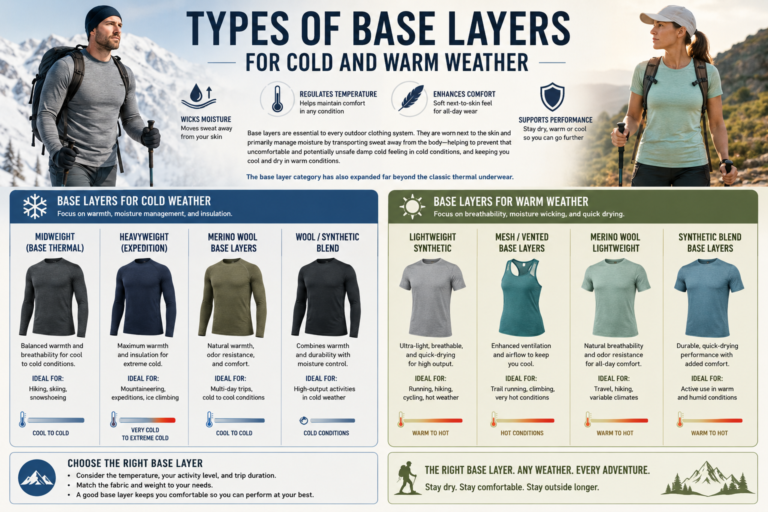
Base layers are essential to every outdoor clothing system. For any company designing outdoor apparel, and for any buyer selecting the most appropriate next-to-skin layer for a given activity and context, knowledge about base layers for different cold and warm climates is critical. Types of base layers are the layers worn next to the skin. The primary purpose of a base layer is to manage moisture by transporting sweat from the body to avoid the uncomfortable and potentially unsafe damp cold perception that limits outdoor activity. The base layer category has also expanded far beyond the classic thermal underwear.
Why the Right Base Layer is the Most Important Layer for Outdoor Activities
Manufacturers of shells and mid layers invest significant time and money producing a variety of options. Outdoor enthusiasts purchase shells and mid layers but compromise the integrity of the entire system by wearing substandard base layers. The following provides the rationale for why base layers should be the primary concern when selecting outdoor layers.
The Base Layer
The base layer is the first layer applied to the skin and therefore has the most significant impact on comfort and the system’s ability to regulate temperature and manage moisture. Base layers are the most impactful garment in an outdoor system. They are the most commercially and functionally viable layer of all the outdoor layers available. The drier the base layer, the drier every layer built upon it. Base layers are particularly important when the system is exposed to cold. The combined moisture of the mid and outer layers compromises the insulating and protective nature of the system.
Why Cotton is an Unacceptable Base Layer Option
Cotton traps moisture, which is not ideal for base layers. During your climb, cotton base layers will trap moisture and remain cold during the descent and while you are at rest. It cannot be substituted by mid layers or a shell jacket. It will lead to huge amounts of heat loss. This is why all base layers are made from either natural or synthetic fibers that have the ability to dry and pull moisture away from the skin. If your brand would like to bring to market base layers that are made for the outdoors, speak with our base layer clothing manufacturing team right away.
Base Layer Types by Fabric
When considering base layers, the most important distinction is the fabric and determines the base layers ability to handle moisture, manage odors, dry quickly, and be worn for multiple days. The base layer fabric options are Merino wool, synthetics and natural-synthetic blends.
Merino Wool Base Layers
Merino wool provides moisture management, odor resistance, and the ability to be worn for days on end, faster drying, and superior natural performance quality. It is for these reasons that Merino wool base layers have achieved the reputation of being the best of the best of all base layers. Versatile base layer options with performance properties that other alternatives do not have can be found in Merino wool base layers.
The moisture management and temperature regulation qualities of merino wool are especially important for activities with high temperatures, like alpine hiking and backcountry skiing. For multi-day treks with high body temperature fluctuations during the physical exertion and body temperature cooling during the rest, merino wool has natural odor resistance. This makes merino wool best for outdoor trips where washing is not easily accessible. A merino wool base layer can be worn for three to four multi-day treks and remain odor free, while a synthetic base layer would be odor free after a single day.
Synthetic Base Layers
Synthetic Base Layers are made from polyester, polypropylene, or nylon that is modified to manage moisture. Base layers that are made this way pull sweat away from the skin and, through capillary action, spread the sweat over a large surface area and then dry quickly.
While merino wool is known for its wool management, synthetic base layers actually dry much faster after getting wet. Synthetic base layers are also a more efficient choice at drying speed vs. odor management for activities like trail running, mountain biking, skiing, and fast hiking. These activities also manage moisture at an optimal level.
For brands focused on performance-oriented and cost-effective base layer clothing, synthetic base layers are a great option.
Merino-Synthetic Blend Base Layers
These base layers strike the perfect balance with Merino wool with its quality natural odor control, temperature control, and combined with the strength and faster drying of synthetic fibers. Merino-synthetic blends achieve this balance by manufacturing layers with either merino-polyester or merino-nylon in an 80%-20% and 60%-40% ratio. The result is a base layer that is stronger, faster drying, and still smells fresh and maintains the natural soft touch that Merino has in its pure form.
Finally, merino-synthetic blends offer good value by using less merino wool. The blends also help keep the cost more reasonable. The blends also help keep the cost more reasonable. Merino-synthetic blends help create base layers with a special blend of performance characteristics that help them be more versatile and usable for a larger range of outdoor activities. The blends are especially useful for extended backpacking and skiing trips.
Types of Base Layers by Weight
A base layer’s weight also has a large impact on the temperature and performance level of the base layer. Typically, the heavier the base layer, the warmer and higher the impact the base layer can be used at. Knowing the weight categories of base layers, helps brands and customers identify the right base layers for the right conditions.
Lightweight Base Layers
Lightweight base layers are made in the 120 to 160 GSM range and designed for cool to mild weather activities that involve a lot of physical exertion like cycling and ski touring. Because they lack thermal insulation, they help transport moisture away from the body.
Lightweight base layers can also be used in warmer weather as a moisture wicking, active, and breathable top. Because additional layers during this season can lead to the body overheating, lightweight base layers are the outermost layer. This also provides a strong selling point to both the outdoor and general lifestyle markets.
As part of our outdoor tees manufacturing, we provide base layer tees and outdoor tees. If you have a need for lightweight base layers, contact us.
Midweight Base Layers
Midweight base layers, manufactured in the 180 to 230 GSM range, are the most commercially versatile base layers because they offer a balance of insulation and moisture management. They are the most widely purchased base layers because they can be used in most outdoor activities and across most weather conditions.
In addition, midweight layers are preferred for most three-season outdoor activities. They are warm enough for cool weather but are breathable enough for most activities. For companies developing a base layer line, midweight is the most important weight to start, as it caters to the largest customer base and the most consistent activities.
For companies developing a base layer line as a core component of a complete ski apparel line, midweight base layers, particularly in merino or merino-synthetic blends, are ideal for most resort and backcountry ski trips.
Heavyweight Base Layers
Heavyweight base layers are in the 250 to 350 GSM range, and are the best for insulation in extreme cold. They are intended for low-output activities for very cold conditions. These include high altitude winter mountaineering, winter ice climbing, sub-zero winter camping, and static cold exposure for winter outdoor activities.
Additionally, heavyweight base layers are not intended for high-output activities. Their weight and decreased breathability cause overheating. Therefore, heavyweight base layers cater to a more specialized customer segment than lightweight or midweight. However, they are critical for outdoor activities in very cold conditions, as no other weight provides the necessary insulation.
In extreme cold layering systems, heavyweight base layers fit seamlessly with outdoor fleece mid-layers and hardshell jackets. Insulation and weather protection come together with all three layers. Additional Outdoor Fleece insulation, combined with Hardshell protection, fulfills the extreme thermal needs of truly cold conditions.
Base Layers for Warm Weather Activities
The purposes of warm weather base layers and base layers for cold weather differ tremendously. While cold weather base layers are primarily about the insulation of the body, warm weather base layers are about moisture and temperature management, UV protection, and the absence of insulation. Being aware of the warm weather base layers available helps outdoor brands realize the potential of differentiated summer outdoor collections and helps outdoor users remain comfortable during demanding outdoor activities in warm weather.
Active Cooling Base Layers
Active base layers create evaporative cooling by moving sweat away from the skin, then quickly spreading it across the entire fabric to maximize evaporation. Rapid evaporative cooling helps maintain skin temperature. There is a noticeable cooling effect during evaporative cooling for treating phase-change materials that move heat during the evaporation process.
Warm weather cooling base layers are ideal for trail running and fast hiking, as they help manage sweat and prevent skin temperature from rising. Skin temperature elevation can impair endurance performance during outdoor activities in warm weather.
UPF Sun Protection Base Layers
With ratings of UPF 30 to UPF 50, sun protection base layers are designed to protect against ultraviolet radiation during outdoor activities that experience higher sun exposure at altitude or in open terrain. These base layers are designed to provide coverage of the torso and arms and block the UV rays that sunscreen cannot.
In addition, these base layers are great for higher elevation hiking, mountaineering, desert trekking, and virtually any outdoor activity that experiences higher sun exposure and UV levels that are significantly higher than in normal city environments. For brands creating camping apparel collections aimed at warm climate markets, UPF sun protection base layers are a great opportunity to have a new product that is significantly different from other offerings in the market.
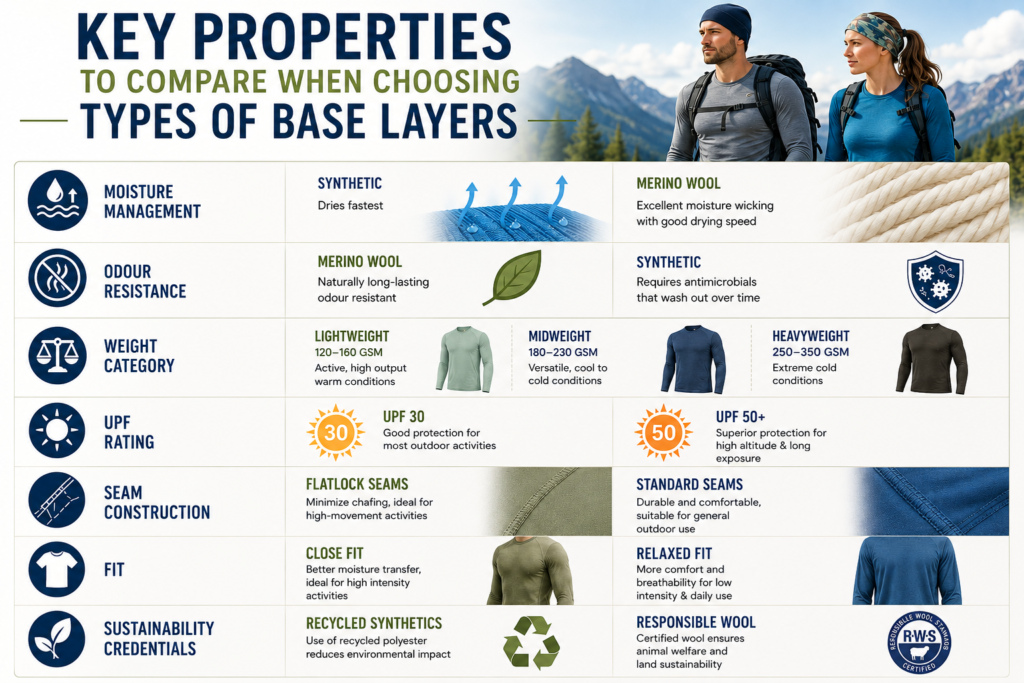
Key Properties to Compare When Choosing Types of Base Layers
The following traits, when looking for base layers to buy or manufacture, identify base layers’ performance and their commercial viability, across the entire spectrum of base layers, regardless of type, fabric, or weight:
Moisture management — use of base layers at high output levels of activity is limited to the wicking and drying speeds. Synthetics dry fastest, merino is best for odor management on multi-day uses.
Odour resistance — merino is naturally long-lasting odour resistant, whereas synthetics require antimicrobials that wash out over time.
UPF rating — baseline protection for outdoor activities is UPF 30, whereas greater protection for higher altitudes and extended outdoor activities is UPF 50.
Seam construction — flatlock seams eliminate chafing during trail running and dynamic activity, typical seams construction are adequate for general outdoors use.
Fit — construction that is close-fitting, allows moisture transfer from skin to fabric quicker, looser construction is better for low intensity and every day outdoor activities.
Sustainability credentials — other than the use of synthetic recycled polyester, responsible wool certified base layers are an indication of brands that are conscious of their environmental impact.
Building a Base Layer Range for Your Outdoor Brand
The commercially diverse base layer types have a wealth of technical properties. A base layer range that is structured to include lightweight active, versatile midweight, heavyweight cold weather, and warm weather base layers that include UPF protection, covers all customer base segments across all seasons, from one product category.
Also, base layers tend to create more loyalty and repeat purchases than outer layers do, as they are more likely to be ruined and worn out, achieving a future revenue stream post customer acquisition.
Moreover, creating a base layer, mid-layer, and outer layer combination — outdoor fleece and softshell jackets — integrates insulation and a layering system to protect against the elements. This combination helps market your brand as a full outdoor clothing provider, rather than a one-layer apparel company.
Ready to expand your outdoor base layer line? Our manufacturing team are ready to help! We assist outdoor brands at all levels with initial fabric and design, all the way through to bulk production.
Conclusion
A good range of base layers that can be used for a variety of outdoor activities in both warm and cold weather, as well as different levels of intensity, requires a good understanding of the trade and the market. Examples of this are lightweight synthetic tees for warm-weather trail runs or heavyweight merino wool thermals for cold-weather outdoor activities. Knowing the differences in material and weight will help you design base layers that will serve your customers for every outdoor activity. This is true whether you are sourcing base layers for your own outdoor adventures or for your own base layer line.
If you are interested in beginning your base layer collection, take the time to see the complete line of base layer clothing manufacturing services available and speak to our team to launch your production!
FAQs
What is the best base layer for cold-weather activities?
For cold weather activities, midweight merino would be on top of the options available for warmth, moisture management and too for less lingering odor. For extremely cold, low activity, heavyweight merino or a merino-synthetic blend would be the better option.
Why is cotton not suitable as an outdoor base layer?
Cotton, unlike merino baselayers, retains moisture and can make the wearer cold. Performance base layers are primarily made of fibers that will wick and release moisture, unlike cotton.
What base layer weight should I choose for skiing?
Midweight base layers (180 to 230 GSM) are for most skiing (both resort and backcountry) because of the balance of warmth and breathability.
What advantages do merino-synthetic base layers have over pure merino base layers?
Merino-synthetic base layers would be a better option for durability and drying time, but still retain some natural odor resistance and temperature regulation. This makes them a good option for brands that want to sell a more affordable outdoor base layer that will be used for multi-day activities.
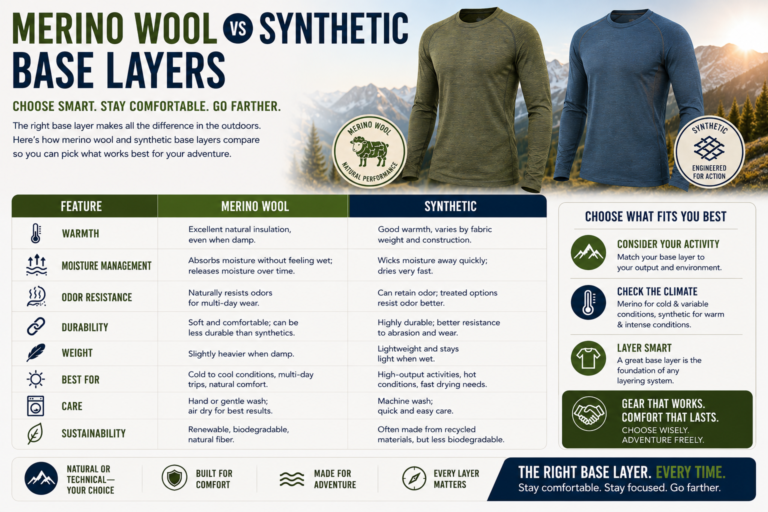
Choosing the right base layer can shape how comfortable you feel during an entire outdoor trip, and the debate between merino wool vs synthetic base layers comes up often among hikers, skiers, and campers. Both materials offer distinct advantages, so understanding their differences helps you select the option that best matches your activity, climate, and personal preferences. Therefore, this guide compares merino wool vs synthetic base layers across warmth, moisture management, durability, and care, so you can make an informed decision for your next adventure.
Why Base Layer Material Matters
For outdoor enthusiasts who love hiking, skiing, and camping, a suitable outdoor base layer directly impacts their comfort throughout their entire trip. The two common base layer materials each have distinct strengths, and people often disagree over whether to choose a base layer made of merino wool or synthetic fiber. This guide compares the two materials across four dimensions—warmth retention, moisture management, durability, and care requirements—to help you select the option that fits your specific needs.
Merino Wool Base Layers
The form-fitting base layer, which sits directly against the skin, is the core layer of outdoor apparel responsible for regulating temperature and controlling moisture throughout the day. A well-chosen base layer can wick sweat, maintain a comfortable body temperature, and reduce exercise-related chafing, while a poorly selected one will leave the wearer damp, cold, and uncomfortable. Therefore, before purchasing gear for hiking, skiing, or multi-day trips, it is necessary to compare base layers made of merino wool and synthetic fibers.
Benefits of Merino Wool
Merino wool originates from a specific breed of sheep, and its fibers are finer and softer than those of traditional wool. The close-fitting base layers made from this material sit comfortably against the skin, and do not cause the itchy irritation that is common with old-style wool garments.
Drawbacks of Merino Wool
Merino wool can naturally regulate body temperature: it retains heat to keep the wearer warm in cold environments, while offering breathability during moderate-intensity activity. Furthermore, its odor-resistant capacity far outperforms that of synthetic fabrics, making it suitable for multi-day trips where laundry is unavailable. In addition, it maintains its heat-insulating properties even when wet, allowing it to sustain consistent warmth even in rainy environments.
Synthetic Base Layers
Compared with synthetic alternative fabrics, merino wool is priced higher, dries slowly after washing or heavy sweating, and is prone to wear and tear; its durability must be assessed when used for high-intensity activities.
Benefits of Synthetic Base Layers
Most of the mainstream synthetic base layer fabrics currently available on the market are made of polyester or polyester-spandex blends, and they dominate the market thanks to their reliable performance and high cost-effectiveness.
Drawbacks of Synthetic Base Layers
Synthetic fabrics boast prominent advantages that make them well-suited for outdoor use: they dry quickly, capable of coping with scenarios involving sweat or sudden weather changes; furthermore, their cost is lower than merino wool, which lowers the entry threshold for outdoor participation; in addition, they are wear-resistant and durable, making them suitable for high-intensity activities such as running and rock climbing.
Merino Wool vs Synthetic Base Layers: Quick Comparison
Compared with merino wool, synthetic fabrics are more prone to retaining odors, as bacteria easily multiply in their fibers, and their antimicrobial treatments lose effectiveness after repeated washing; when activity levels fluctuate, these fabrics perform worse in thermoregulation when used as a base layer.
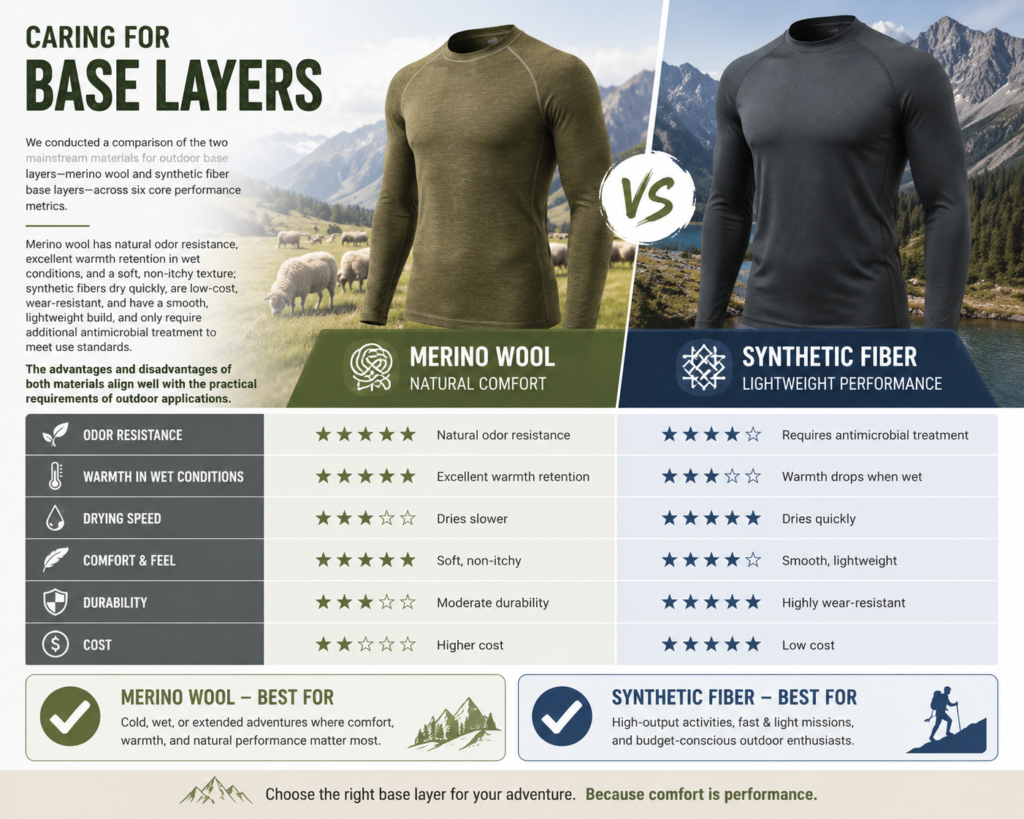
Odor resistance: Merino wool resists odor naturally, while synthetic fabrics often require antimicrobial treatments.
Drying time: Synthetic base layers dry faster than merino wool after washing or sweating.
Warmth when wet: Merino wool retains warmth even when damp, whereas synthetic fabrics lose insulation more quickly.
Cost: Synthetic base layers typically cost less than merino wool options.
Durability: Synthetic fabrics resist abrasion better, making them suitable for high-intensity activities.
Comfort: Merino wool offers a soft, non-itchy feel, while synthetic fabrics provide a smooth, lightweight texture.
This paper will unpack the performance differences between merino wool and synthetic fiber base layers across multiple core dimensions.
Choosing Base Layers for Different Activities
The right choice between merino wool vs synthetic base layers often depends on the specific activity and trip length. For example, hiking clothing for multi-day treks often favors merino wool base layers because of their odor resistance and temperature regulation. Similarly, camping apparel benefits from merino wool layers that stay comfortable across changing campsite temperatures.
On the other hand, high-intensity activities often call for synthetic options. Brands producing ski wear frequently pair synthetic base layers with insulated outerwear, since synthetic fabrics manage moisture well during active descents. Likewise, outdoor fleece layers often pair with synthetic base layers to create a moisture-wicking, fast-drying system. For demanding environments, tactical outdoor apparel and hunting apparel often rely on synthetic or merino blends, depending on whether scent control or durability takes priority. For a closer look at base layer options across both materials, dedicated base layer clothing collections allow you to compare fabrics side by side.
Caring for Base Layers
We conducted a comparison of the two mainstream materials for outdoor base layers—merino wool and synthetic fiber base layers—across six core performance metrics. Merino wool has natural odor resistance, excellent warmth retention in wet conditions, and a soft, non-itchy texture; synthetic fibers dry quickly, are low-cost, wear-resistant, and have a smooth, lightweight build, and only require additional antimicrobial treatment to meet use standards. The advantages and disadvantages of both materials align well with the practical requirements of outdoor applications.
Partner with a Trusted Manufacturer for Base Layers
You may sort out the differences among all available options, and match them to your needs for odor control, quick-drying performance, or high cost-effectiveness in order of priority.
Choose base layers made of merino wool or synthetic materials. The optimal option is determined by activity type and trip duration. Merino wool is recommended for multi-day hikes, as it prevents odors and regulates body temperature; when worn for camping, it adapts to variable air temperatures to maintain consistent comfort.
Coclusion
The choice between merino wool vs synthetic base layers ultimately depends on your priorities, whether that’s odor resistance, drying time, durability, or cost. Merino wool excels in temperature regulation and odor control, making it ideal for multi-day trips, while synthetic base layers offer fast drying and durability for high-intensity activities. Additionally, blended options provide a middle ground for those who want benefits from both materials. By weighing these factors against your specific needs, you can choose a base layer that keeps you comfortable throughout your outdoor adventures.
Frequently Asked Questions
Is merino wool better than synthetic for cold weather?
The core guideline for selecting apparel for high-intensity outdoor activities is to prioritize synthetic fabrics. Ski suits adopt a synthetic base layer paired with a warm outer layer to meet the moisture-wicking needs of downhill skiing; outdoor fleece layers are also paired with synthetic base layers to build a moisture-wicking and quick-drying system.
Which dries faster, merino wool or synthetic base layers?
Proper care can extend the service life of base layers made of merino wool and synthetic fibers, and the two types have only slightly different care requirements: Merino wool must be washed in cold water with a wool-specific detergent, and laid flat to dry to prevent shrinkage; synthetic fibers can also be washed in cold water, but fabric softeners that damage their moisture-wicking properties must never be used.
Do synthetic base layers smell more than merino wool?
If apparel brands face selection challenges when choosing between merino wool and synthetic material base layers, they can rely on established manufacturing partners. The former material meets odor prevention needs, while the latter meets the requirements of quick-drying performance and durability; these partners can secure a full supply of all necessary raw materials and maintain stable production quality.
Are merino wool base layers worth the higher cost?
We are a professional custom apparel manufacturer. We can develop base-layer garments suited for specific events for brands, and supply fabrics including merino wool, synthetic fibers, and blended fabrics. We are able to align on fabric selection, customized services, and production cycles to co-create products that meet the needs of brands’ end consumers.
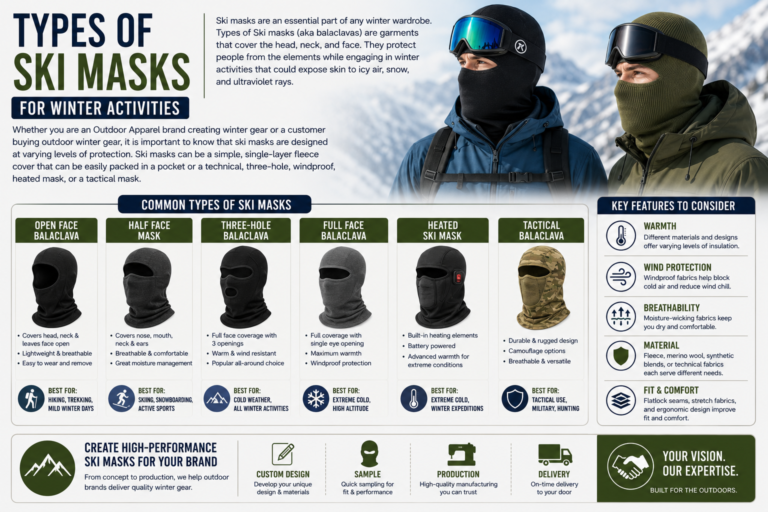
Ski masks are an essential part of any winter wardrobe. Types of Ski masks (aka balaclavas) are garments that cover the head, neck, and face. They protect people from the elements while engaging in winter activities that could expose skin to icy air, snow, and ultraviolet rays. Whether you are an Outdoor Apparel brand creating winter gear or a customer buying outdoor winter gear, it is important to know that ski masks are designed at varying levels of protection. Ski masks can be a simple, single-layer fleece cover that can be easily packed in a pocket or a technical, three-hole, windproof, heated mask, or a tactical mask.
Why Ski Masks are Important Outdoor Apparel
When considering what outdoor gear to purchase for winter activities, most people think the most important items are the jackets and pants. However, heads, faces, and necks are the body’s biggest heat protectors during the cold, and compromises in those areas put your safety and comfort at risk, no matter how good the clothing system is overall.
Face and Head Protection Study
Faces and heads have lots of blood vessels which are located close to the surface of the skin, which makes them great at losing heat, but ultimately it’s inefficient in the cold. To make things worse, the wind makes the cold even worse. Something that is minus five degrees in still air, can feel significantly colder at five degrees when the wind is blowing. This is even worse for exposed skin.
Therefore, protecting your face and head during the colder months has huge benefits that far outweigh the bulk and weight of winter clothing. For this reason, ski masks are the best investment in your outdoor winter clothing. The right type of ski mask will add great warmth and protection with minimal cost to your gear.
Ski Masks in a Winter Layering System
Ski masks are like a base layer for heads and faces, and are the first layer against the skin. Like a base layer, ski masks are the first layer that create a primary barrier against cold air and winds, and help manage face moisture.
They coordinate with helmet and goggle combinations for on-slope skiing and snowboarding, with hat and buff combinations for lower intensity winter activities, and as stand-alone head and face protection in tactical and extreme cold environments.
Knowing where each type of ski mask fits in the winter clothing layer helps brands build coherent winter protection lines and helps buyers put together complete cold-weather systems that cover every exposed area. If your brand is producing ski masks for your winter outdoor range, feel free to reach out to our ski mask manufacturing team to talk about your product ideas.
Ski Masks and Their Specific Use Cases
What falls under ski masks is a vast array of construction methods, coverage, fabric technology, and features all optimized for specific winter activities, temperature ranges, and protection requirements. Each type also fills a different commercial gap. Because of this, ski masks are a commercially versatile product category for outdoor brands to create differentiated winter apparel.
Full Balaclava Ski Masks
These ski masks are the most protective of all the ski masks. They give the head the most coverage along with the neck and face. Full balaclava ski masks are the right choice for extreme cold environments.
Other types of ski masks leave gaps in the coverage of the clothing, allowing the cold air to hit the face, chin and neck. This version provides 100% coverage, not leaving gaps in coverage, even when the wind is howling.
Full balaclavas also go great under helmets while alpine skiing or snowboarding. Full balaclavas that are manufactured by our ski mask manufacturing team are available in several different fabric weights and technologies. These balaclavas integrate easily with the neck coverage of the base layer or mid layer that lies beneath the collar of your jacket. If you’re interested in developing a balaclava, we are ready to assist you.
Three Hole Ski Masks
As the name implies, three hole ski masks feature three separate openings, two for the eyes and one for the mouth. They provide full coverage of the head and face. Because of the opening for the mouth, they also provide the ability to breathe. This design eliminates the need for a single eye opening, because the masks allow full vision. This design is so popular, as it provides almost full face coverage while allowing the breathing and vision comfort that is needed for the most active of winter sports.
Ski masks that feature a three hole design also integrate well with ski goggles. When ski goggles are placed over the mask, they create an airtight seal that prevents cold air from hitting the face. This design allows full coverage of the face while providing the clarity of vision and the protection from the sun that ski goggles provide.
Contact our manufacturing team to design custom three-hole ski masks for your brand.
Open Face Ski Masks
Open face ski masks leave the face entirely exposed. They cover the head and neck, and, although they leave the face exposed, they provide fantastic warmth at the head and neck. They are very popular for moderate cold and low intensity winter activities because they do not restrict breath and do not require adjustments around frame goggles.
Open face ski masks work very well for cross country skiing, hiking, and snow shoeing. These activities create enough aerobic exertion to heat the face and make full ski masks and balaclavas restrictive and uncomfortable. Open face ski masks provide the convenience of head and neck warmth during the activity, while allowing the face to breathe freely during high-output winter activities.
Open face ski masks are also great for covering the head and neck in mild winter conditions, while sitting under a winter hat or helmet. They also do not provide the full balaclava cover of the winter helmet. Eco Jersey, our outdoor fleece manufacturing gives us the ability to manufacture open face ski masks and neck warmers. Please contact us for your open face mask production needs.
Windproof Ski Masks
Windproof Ski Masks use a windproof membrane or tightly woven windproof face fabric for mask construction. They provide a breathing face fabric with excellent wind blocking compared to traditional fleece and knit ski masks.
They’re ideal for alpine ski racing, riding fast on snowmobiles, ski touring on exposed ridges, and any outdoor winter activity where sustained high velocity winds lead to extreme wind chill.
Generally, windproof ski masks combine a windproof outer layer and a soft inner layer that wicks moisture and, thus, leaves the face dry. The inner layer pulls sweat away from the face during an activity and the outer windproof layer protects from the cruel elements.
A suitable ski wear manufacturing partner knows about ski masks and the lamination and bonding of membranes that windproof ski masks require. A ski mask manufactured by them most probably has a windproof layer that maintains its windproofing ability during multiple outdoor uses and washings. With the help of our team, you can have windproof ski masks in your technical winter range.
Fleece Ski Masks
Fleece ski masks are the softest, warmest, and most breathable ski masks available to the general public. They tend to use brushed polyester fleece of 150 to 250 GSM construction. Because of the balance between warmth, next-to-skin comfort, care, and price, they are the most popular and most commercially available ski masks. They provide comfort under helmets without the pressure points of traditional materials. Their construction allows them to breathe during moderate levels of activity without trapping moisture.
Fleece ski masks are a great option for brands looking to provide entry to mid-range outdoor offerings. They are warm and comfortable and are price accessible for the majority of consumers. Our ski mask manufacturing team makes a variety of fleece ski masks, contact us for your fleece mask innovations.
Merino Wool Ski Masks
Merino Wool Ski Masks use the natural performance qualities of merino wool to provide a moisture managing mask that regulates temperature and is odour-free. They provide the highest comfort for those undertaking multi-day winter trips where frequent washing is not an option.
Merino ski masks also offer a superior temperature range to fleece masks. This is especially important for those undertaking the wide ranging conditions that are encountered during an alpine day with activities ranging from frigid to warm. Merino masks are especially useful for ski touring, winter mountaineering and backcountry skiing.
We’re excited to present your brand with merino ski mask options.
Tactical and Camouflage Ski Masks
Tactical and camouflage ski masks protect against winter weather like traditional ski masks but are constructed to have low visual signatures. These masks include camouflage patterns, and use dark or earth tone colors, and matte finish fabrics in order to prevent visual detection in winter and woodland environments.
Additionally, tactical ski masks include features that are useful in military and law enforcement fields. These features include reinforced fabric, matte finishes, and fabrics that meet military standards. These ski masks are made to work with an entire tactical clothing system. Tactical ski masks work with camouflage balaclavas and tactical clothing to provide winter field operations.
Tactical ski masks are also useful in civilian hunting and winter sports. In these activities, like winter wildlife photography, protection from the cold while remaining concealed is critical.
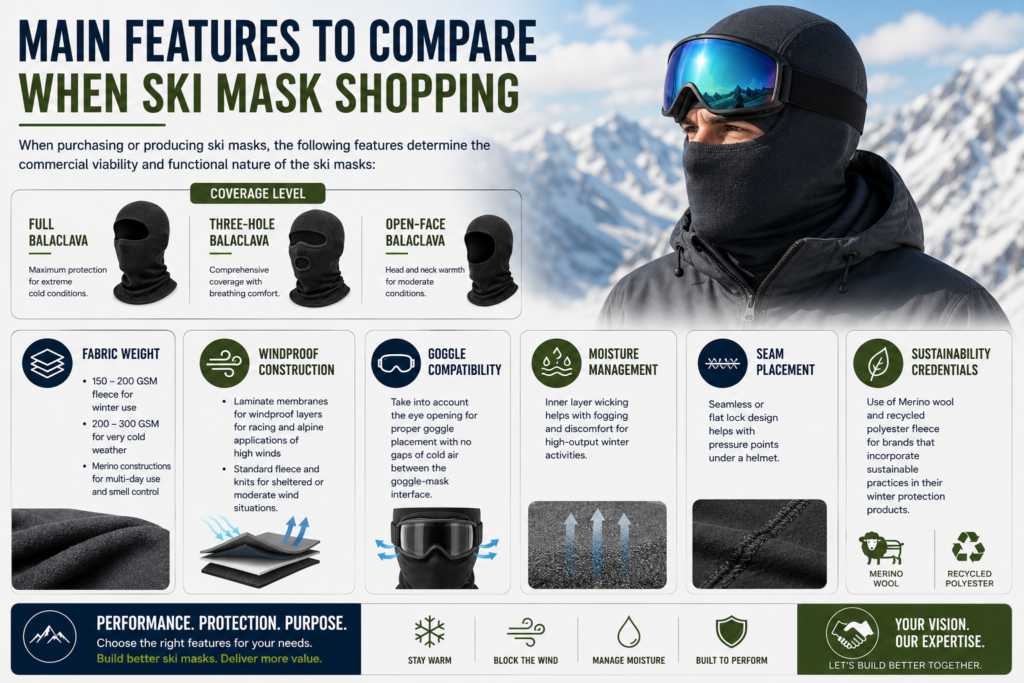
Main Features to Compare when Ski Mask Shopping
When purchasing or producing ski masks, the following features determine the commercial viability and functional nature of the ski masks:
Coverage level: full balaclava for maximum protection in extreme cold, three-hole for comprehensive coverage with breathing comfort, open-face for head and neck warmth in moderate conditions
Fabric weight – 150 – 200 GSM fleece for winter use and 200 – 300 GSM for very cold weather and for constructions of merino for multi-day use and smell control
Windproof construction – laminate membranes for windproof layers for racing and alpine applications of high winds and standard fleece and knits for sheltered or moderate wind situations.
Goggle compatibility – Take into account the eye opening for proper goggle placement with no gaps of cold air between the goggle-mask interface.
Moisture management – Inner layer wicking helps with fogging and discomfort for high-output winter activities.
Seam placement – Seamless or flat lock design helps with pressure points under a helmet.
Sustainability credentials – use of Merino wool and recycled polyester fleece for brands that incorporate sustainable practices in their winter protection products.
Building a Ski Mask Range for Your Winter Outdoor Brand
There are many types of ski masks for basic fleece balaclavas that offer affordable pricing all the way to premium constructions of merino and multi-day backcountry use and technical windproof masks for racing and extreme cold. This makes for a strong ski mask category that is commercially viable.
In addition, if ski masks are designed with face and winter head protection, ski wear jackets and pants (to cover the entire body), and outdoor fleece (to provide insulation for the core) mid-layers, a full winter protection suite for the customer to use all winter to do all their outdoor pursuits is created.
Cohesive construction and color coordination of ski masks and all winter apparel items in your range help create a strong collection with high average order values and integration of your brand identity across all items in your winter outdoor range.
Looking to add ski masks to your winter line? Our manufacturing team can help you every step of the way, from choosing the right fabric to outdoor brand specific bulk manufacturing and quality control processes.
Conclusion
Winter ski masks are a diverse product line. For example, there are full balaclavas for cold expeditions or tactical camo ski masks for winter hunting and field sports. Ski masks come in many designs based on activity, fabric, level of wind resistance, and coverage. Knowing the distinctions will help you build a ski mask line that will help your customers tackle any winter challenge.
No matter if you need ski masks for winter adventures or want to build an outdoor apparel line with a face protection range, knowing the distinctions of ski masks and their cold weather use cases will help you make informed product decisions and purchases.
Looking for a ski mask line? Check out our ski mask manufacturing services and contact our team to help you begin your outdoor protective winter apparel line today!
FAQs
What is the warmest type of ski mask for extreme cold conditions?
The warmest option is a full balaclava made of heavyweight fleece or merino wool. This covers the full head, face, and neck, leaving only a small eye slit.
What type of ski mask works best with ski goggles?
Three-hole ski masks are designed specifically for goggle compatibility — the separate eye openings allow the goggle frame to seal against the surrounding mask fabric without creating cold air gaps between the goggle and the mask.
What is the difference between a fleece ski mask and a merino wool ski mask?
Fleece ski masks dry faster and suit single-day use at accessible price points. Merino wool ski masks provide superior temperature regulation and natural odour resistance — making them the preferred choice for multi-day backcountry trips where washing between uses is not possible.
When should I choose a windproof ski mask over a standard fleece mask?
Choose a windproof ski mask for activities involving sustained high wind exposure — alpine ski racing, ski touring on exposed ridges, and snowmobile riding at speed where wind chill at the face is the dominant cold challenge.
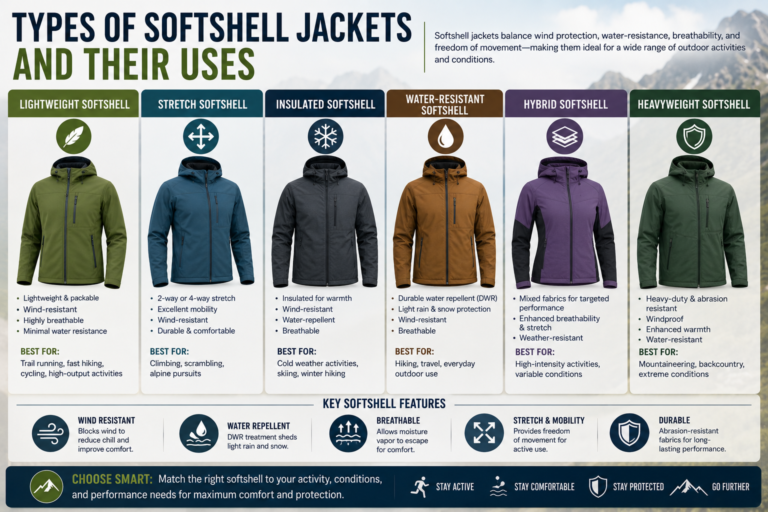
Understanding the various types of softshell jackets is crucial for building successful commercial ranges or selecting the most appropriate outdoor garments for your activities. While hardshell jackets focus on maximum protection from the elements, softshell jackets balance wind protection, water-resistance, breathability, and range of motion. This balance of function is one of the reasons softshell jackets are so popular. Additionally, the softshell category has been one of the most rapidly expanding. This variety and expanding constructions, weights, fabrics, and features have been designed for a range of activities, performance requirements, and conditions. This guide provides information on the different types of softshell jackets, what the features and construction methods mean, and practical application to help select the right softshell jacket.
What is Unique About Softshell Jackets?
Before exploring the different softshell types, it is important to understand the softshell category and what separates it from other jackets. The construction of softshell fabrics is a composite construction. This is typically a bonded fleece or jersey knit and stretch outer woven and bonded.
As a result, softshell jackets typically do not require a mid-layer. They are designed to move better with your body than conventional shells do. Consisting of a softshell fabric, these jackets combine all the previously discussed properties with highly breathable insulation. This fabric is not only more breathable than standard hardshells, but also stretches and thus, allows more freedom of movement. The fleece lining allows softshell jackets to be warm enough on their own for moderately cool weather. No mid-layer is required.
It is also essential to understand the limitations of softshell jackets. As previously mentioned, softshell jackets, like all other water-resistant jackets, are not entirely waterproof. Because of this, a hardshell jacket is a better choice for prolonged, heavy rain. As a result, softshell jackets are better for mostly dry to very lightly wet weather where breathability and stretch are more important than their relatively low waterproofing.
The choice between softshell and hardshell, really comes down to the intensity of the activity and the expected weather conditions. In hardshells, breathability and movement are greatly restricted, but absolute waterproofing is achieved. In lightweight, variable weather softshells are optimum, but for prolonged heavy rain or very extreme alpine conditions, hardshells are imperative. Understanding this choice is important for both the designer and the consumer.
Different Types of Softshell Jackets and Their Uses
Each type of softshell jacket is tailored for a certain level of activity, weather, and performance. It is also positioned differently in the outdoor apparel market. Because of these factors, the softshell category offers brands a great business opportunity for versatile outdoor apparel.
Softshell Jackets for Active Users
Active softshell jackets are designed to be breathable and lightweight, perfect for sustaining activities like running that create lots of body heat and sweat. They have thin, stretchy jackets (200-280 GSM) and have little to no insulation to combat body heat.
Active softshell jackets also have close, flexible fits to the body and little to no exterior features. They are best for high pace activities like trail running, ski touring and cycling.
They also have a wide market for many different activities, making them the first jacket of a technical outdoor apparel line. If you are looking for active softshell jackets, check out our softshell jackets manufacturing to see what we can offer and to contact our team.
Softshell Jackets with Insulation
These types of softshell jackets have an added layer of insulation. They also have a bonded fleece inner to offer more warmth, in addition to the wind resistance.
More versatile when it comes to varying temperature ranges, they are heavier than the active softshell jacket. Therefore, they are suitable for moderately active people in the cool to cold outdoors, such as people who are winter hiking, cold weather camping, working outdoors in the cold, and those who spend the day at ski resorts. Insulated softshells are great at keeping you warm when you are inactive, and they also help prevent overheating when you are moderately active.
Insulated softshells can also help reduce the number of layers needed. From a consumer perspective, this jacket can serve the purpose of both a mid-layer and an outer layer. Because of this versatility and purpose, our team of outdoor jackets manufacturing specialists are excited to produce a wide range of styles for this softshell jacket. We encourage you to reach out about your unique product ideas and requirements.
Windproof Softshell Jackets
Windproof softshell jackets are designed to provide wind blockage. To achieve this, they utilize a face fabric that is woven tightly and a windproof membrane which provides a treatment that allows for no penetration of cold air through the jacket, even during long exposure to wind and wind chill.
Windproof softshells are an excellent choice for outdoors activities where the main challenge is wind chill, and rain is not as much of a concern. Because of this, softshell jackets that are windproof use a fabric that is more rigid than the fabric found in active softshells. Because of this change, there is a trade off of a little bit of stretch and breathability. However, this trade off allows for a better ability to block wind.
Windproof softshell jackets can serve as the outer layer in a clothing system with a base layer and mid-layer fleece. In this system, a softshell jacket completes the system with the ability to block wind, resist light precipitation, and is much lighter and less rigid than a full hard shell jacket.
Stretch Softshells
Stretch softshells can be made to have as much freedom of movement as a high elastane jacket. Stretch softshells can be made with four-way stretch fabric. Stretch softshells are made to be used on technical pursuits, like climbing, mountaineering, ski racing, and fast running.
Because stretch softshells are made with some of the most advanced fabric constructions, they often have a high price point. Stretch properties are made with elastane in both the warp and weft directions of the face fabric. As a result, the fabric does not lose its elasticity after repeated use.
Stretch softshells are the best options to use for climbing and alpine outerwear. If you are looking to develop stretch softshells for technical outdoor apparel, reach out to our manufacturing team to help you with your design.
Softshells for Skiing and Snow Sports.
Like softshells, ski softshell jackets have ski specific construction and design like helmet compatible hoods, powder skirts, sleeve pass pockets, and articulated design for ski movement.
Ski softshells also have softshells and fabrics for heavier and thicker softshells, around 320 to 400 GSM. They have better wind and weather resistance and insulation than lighter softshells. These softshells are great for resort skiing, freestyle skiing, and ski touring for moderate weather conditions. These softshells are better than a full hardshell which can be too heavy and restrictive for the conditions.
We cover all production steps of ski specific softshells from fabric selection to bulk production in our ski wear manufacturing services. Contact us to make your ski outerwear designs.
Hiking softshell jackets provide the breathability needed for movement and the weather resistance timber hiking requires. They are usually mid-weight and range from 260 to 320 GSM.
Hiking softshell jackets have useful design features for the trails like, many pockets, hoods and hems that can be adjusted, articulated elbows, and design that allows for a natural range of movement. These softshells for hiking systems and provide the outer layer that helps the system to the elements.
If your hiking or trekking outerwear brand needs support with hiking apparel manufacturing, we can help you with every step of the process from the creation of the tech pack to the manufacturing of garments in bulk and the finishing step of quality control.
Urban and Lifestyle Softshell Jackets
Urban and lifestyle softshell jackets integrate softshell technology into fashion-oriented designs with refined shapes, a minimalist approach to design, and hues that fit urban and outdoor color palettes. These jackets can easily fit the city or the outdoors and provide softshell construction protection from the wind and light precipitation. Urban softshell jackets have a wider market appeal than strictly technical outdoor jackets. These jackets serve customers who prefer the style of urban apparel to outdoor apparel, but want the protection and comfort that urban softshell jackets provide. The lifestyle softshell market is growing due to the merging of outdoor performance design and daily wear apparel.
Venturing Into New Markets
When it comes to softshell jackets, here are a few features that impact their performance and appeal as a product that you should consider.
The weight of the fabric. For active use jackets, the fabric should weigh between 200 and 280 GSM. For hiking softshell jackets, the weight should be in the range of 280 to 320 GSM and for ski softshell jackets, 320 to 400 GSM.
Stretch. For general outdoor use, a softshell fabric with 2-way stretch is adequate. For technical climbing applications, 4-way stretch is required.
Wind resistance. Exposed softshell windproof constructions are required for mountain environments. For general outdoor applications, a wind-resistant, DWR softshell is adequate.
Hood Design – With helmet-friendly hoods for skiing and adjustable hoods for hiking and everyday use.
Breathability – Consider breathability ratings for high-intensity activities, as well as more moderate ratings for everyday use.
Insulation – Typically, softshells are uninsulated for high-output active use or bonded fleece/synthetic insulation for cool, static activities.
Pockets – Can be tailored with hand pockets, chest pockets, or specific pass pockets for ski use.
Building a Softshell Jacket Range for Your Outdoor Brand
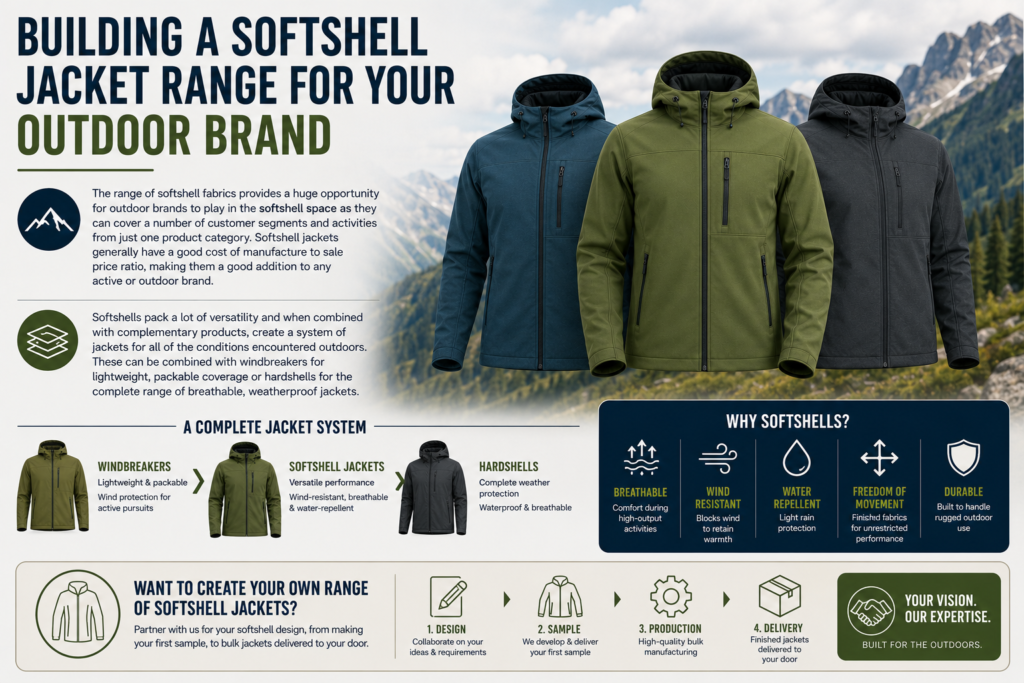
The range of softshell fabrics provides a huge opportunity for outdoor brands to play in the softshell space as they can cover a number of customer segments and activities from just one product category. Softshell jackets generally have a good cost of manufacture to sale price ratio, making them a good addition to any active or outdoor brand.
Softshells pack a lot of versatility and when combined with complementary products, create a system of jackets for all of the conditions encountered outdoors. These can be combined with windbreakers for lightweight, packable coverage or hardshells for the complete range of breathable, weatherproof jackets.
Want to create your own range of softshell jackets? Partner with us for your softshell design, from making your first sample, to bulk jackets delivered to your door.
Conclusion
The range of softshell jackets now covers significant performance and price ranges from active, ultralight softshells for trail running to full, insulated constructions for softshells designed for skiing.
Different types of softshell jackets can be built through these distinctions and consumers can choose jackets based on their functional needs and optimal use case.
If you’re going on an adventure and need a reliable softshell jacket, or you’re a designer and need to develop a new softshell line, knowing the options that are available as well as the purposes that these variations serve, will help you make the best choice.
When you are ready to develop your softshell jackets, check the complete softshell jackets manufacturing options and contact to start the process now.
FAQs
What is a softshell jacket and how does it differ from a hardshell?
Softshell jackets utilize a single fabric layer that stretches, and that fabric offers breathability, light water repellency, and wind resistance. Hardshell jackets prioritize a waterproof and fully sealed fabric, avoiding a stretch and breathability.
Are softshell jackets waterproof?
Softshell jackets are fabric water repellant, and can only withstand light water. In steady or heavy rain, a hardshell jacket must be utilized.
What is the best softshell jacket for skiing?
For comfort while skiing In softshell jackets, look for heavy fabric jackets with built-in hoods that can fit over a helmet, built-in powder skirts, and that offer articulated patterning to allow enhanced freedom of movement.
Can softshell jackets replace a mid-layer and outer shell?
In insulated softshell jackets that are fabric water repellant, a basic outer shell can be combined with a mid-layer and the jacket will suffice in cool to moderately damp climates.
For people choosing between outdoor jackets or people designing their own outdoor jackets, a major ingredient to evaluate is the fabric. Softshell jackets vs hard jackets is a good comparison to show this importance. Best fabrics used in softshell jackets are composite constructions that provide wind and weather protection with the right combination of face fabric and inner layer, while hard jackets use a waterproof membrane. The options for softshell fabrics construction are better than ever before. This guide has all the major types of softshell fabrics, the performance characteristics of each, and helps you decide the best option for your composite construction jacket.
How Performance Characteristics are Achieved in Softshell Fabrics
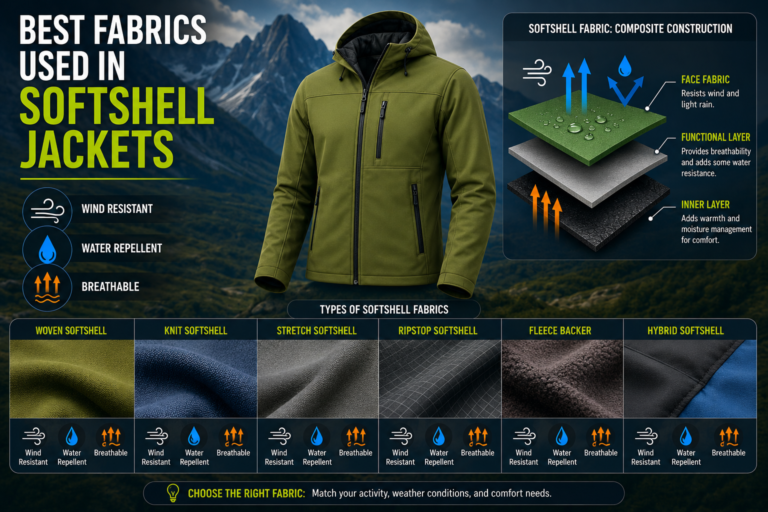
Most of the fabrics in a softshell jacket are composite constructions. This means multiple layers are bonded to each other through lamination or knitting to create a single fabric. This bonding process provides multiple functional performance characteristics.
Face Fabric Layer
The outermost layer, or the layer that is directly in contact with the elements, is the face fabric layer.
Typically, a DWR finish is applied to the outer fabric so water forms beads and rolls off the surface. Therefore, the outer fabric forms the face of the garment and the fabric’s resistance to water, wind, and abrasion as well as its appearance and handfeel are determined by the face fabric.
Softshell jackets typically use one of three types of outer face fabrics: stretch woven nylon, stretch woven polyester, or stretch fabrics that use woven mechanics to construct the stretch, eliminating the need for elastane. These fabrics provide varying stretches, weights, and durability.
Inner Layer
The bonded layer of a softshell fabric layer covers the face fabric and is positioned against the base layer or skin. It provides thermal insulation and moisture control, complimenting the fabric’s handfeel. Comfortable fabrics will influence a jacket’s wearability. Cold conditions will only accentuate a fabric’s performance if it has a soft, inner brushed fleece, as opposed to a fleece jersey.
Brushed fleece and flat knit jersey are the two most commonly used inner layer fabrics. Fleece offers a bulky and warm trade off for lighter active performance and a flat knit jersey.
Bonding Technology
Washing, durability, and the stretch of the composite fabric, are all influenced by the bonding of the face and inner fabrics. For the best stretch and a composite fabric with reliable performance, use a thin adhesive layer for the bonding of the fabrics.
Stitch bonding is when fine stitching is used to join layers. Although it is not commonly used in premium constructions of softshells, it produces a more breathable softshell.
The Best Fabrics Used in Softshell Jackets
Knowing the best performing fabrics used in different softshells helps brands with their sourcing decisions. It also helps the consumers know why some softshell jackets are more expensive.
Polartec Power Shield
Regarded as one of the best softshell fabrics in the outdoor industry, Polartec Power Shield is highly engineered. It offers a face that is highly wind resistant and water repellent with a soft fleece inner. With this face, Polartec Power Shield offers excellent wind resistance, moisture management, and the warmth and breathability that are characteristic of softshells.
Moreover, Polartec Power Shield offers different variants. Power Shield Pro offers more stretch and is designed for advanced climbing and alpine activities. Power Shield High Loft offers a heavier fleece face for additional warmth. The variant of the fabric changes the inner construction to serve different needs while the face fabric remains the same.
Polartec Power Shield is recognized as the benchmark for wind resistant and highly breathable fabrics for softshells and for extremely demanding mountain environments. Reach out to our team for more information on Polartec fabrics for your softshells.
Schoeller Softshell Fabrics
Schoeller is a Swiss company that produces softshells that are widely used for premium outdoor and technical apparel.
In the construction of their fabrics, Schoeller uses a combination of materials that provides an excellent balance of stretch, abrasion resistance, and wind resistance, and they maintain their performance attributes after extended use outdoors and repeated washings.
In addition, Schoeller fabrics have a variety of their own proprietary technologies that embellish the base performance of softshell fabrics. For example, their NanoSphere technology is an advanced water repellency treatment that uses a topographical surface treatment to metamorphose water and oil from a flat to a rolling bead, signficantly enhancing the durability of water repellency compared to a standard DWR finish. Likewise, their 3XDry technology combines a surface treatment that is water repellant with an inner fabric treatment that is moisture wicking, thus combining the effects of external moisture and internal perspiration in one treatment.
For these reasons, their fabrics softshells fabrics are particularly advantageous in the design of high performance outdoor softshells fabrics that require abrasion resistance and long-lasting durability of materials.
Stretch Woven Nylon-Spandex Softshell
One of the most popular fabrics used in the manufacturing of softshells is stretch woven nylon-spandex that combines the durability and abrasion resistance of woven nylon with the stretch of elastane.
In woven fabrics, the stretch of woven nylon and spandex is generally a result of the inclusion of spandex in the fabric in a proportion that is usually between 4 and 15%. Depending on the weave, this can translate into simple two-way stretch, or in some constructions, four-way stretch. Furthermore, fabrics of woven nylon and spandex combined with a DWR finish dry rapidly after becoming wet, an important feature for fabrics used to construct jackets that are to be used outdoors and in a variety of conditions.
Also, a variety of fabrics of spandex and nylon woven softshells are available from a range of 180 GSM up to 380 GSM, making them versatile and lightweight for various uses in the construction of softshells.
Our outdoor jackets manufacturing team uses a variety of stretch woven nylon-spandex, available across different weights. Reach out to see what we can do for your product.
Stretch Woven Polyester-Spandex Softshell
Stretch woven polyester-spandex constructions are an alternative to nylon-spandex face fabrics. They have similar stretch and recovery characteristics while also being less expensive. Fabrics containing polyester are more UV-resistant than those using nylon and therefore are more likely to hold up in softshells during outdoor usage in the sun.
Additionally, face fabrics of softshells containing post-consumer recycled spolyester-spandex (made from recycled post-consumer plastic water bottles) are available now and perform similarly to the non-recycled versions. This offers a great opportunity for brands to integrate more sustainable and recycled fabrics into their outdoor offerings.
For the brands that are looking to develop softshell spolyester-spandex for hiking clothing and softshell jackets, these fabrics are an excellent option for hiking apparel, given their cost and manufacturing sustainability. If sustainability is your brand’s key focus, our team can provide a range of options using certified recycled fabrics for your softshell range.
Mechanical Stretch Woven Fabrics
Mechanical stretch woven fabrics achieve stretch through a design of a stretchable weave, and therefore do not contain elastane. This gives these fabrics a different character to elastane stretch fabrics, as they are generally more rigid and have less range of stretch, but excellent recovery. Also, in many cases, woven mechanical stretch fabrics are more breathable than elastane stretch fabrics.
Because elastane tends to stiffen and lose stretch at lower temperatures, it becomes difficult to maintain necessary performance and flexibility at the most critical times and areas of movement. Thankfully, Mechanical Stretch Softshell fabrics retain their flexibility at the lowest of temperatures and are advantageous when designing ski wear and other cold weather apparel.
Bonded Fleece Softshell Fabrics
Softshell fabrics that are bonded to fleece integrate a woven or knit face, bonded directly to fleece, creating a face fabric that provides wind and weather resistance, as well as fleece warm and comfortable. Unlike standard softshells, bonded fleece fabrics have a fleece rather than a thin jersey or brushed finish.
These fabrics are denser in comparison to standard Softshells, and range from 320 to 450 GSM. With their lightweight and warm design, they are ideal in staving off wind and other light precipitation. They are a preferred choice for designing apparel that serves the purpose of intermediate warm insulation, such as a Puffer Jacket, for various outdoor activities like Camping, Skiing, and winter hiking.
They also eliminate the need for a mid-layer in cold conditions, which benefits the end-user by providing a more versatile apparel option for various cold conditions.
Recycled and Sustainable Softshell Fabrics
The fabrics used in softshell jackets have more recently become more easily available in a wider variety of sustainable options. Sustainability has become a more important consideration in softshell jacket fabrics.
The face fabrics of softshell jackets now feature recycled nylon and recycled polyester, which perform similarly to their virgin counterparts. The post-industrial softshell jackets recycling system provides access to recycled elastane and stretch textiles.
Additionally, softshell fabrics certified by bluesign offer an opportunity to support brand values. softshell fabrication processes are bluesign certified to ensure safe working conditions, and an environmentally and socially responsible supply chain is maintained. For brands that focus on selling outdoor apparel with a commitment to a genuinely sustainable focus, bluesign certification and the presence of recycled materials offer genuine and measurable stories.
Likewise, traditional persistent organic pollutants (POPs) fluorocarbon finishes are being substituted with bio-based, environmentally sustainable DWR. These finishes will provide softshell face fabrics with DWR of full seasonal, outdoor, and continuous performance. If your company is dedicated to producing sustainable outdoor apparel, our waterproof clothing manufacturing team will help you choose certified sustainable softshell fabrics.
What to Consider When Choosing a Softshell Fabric
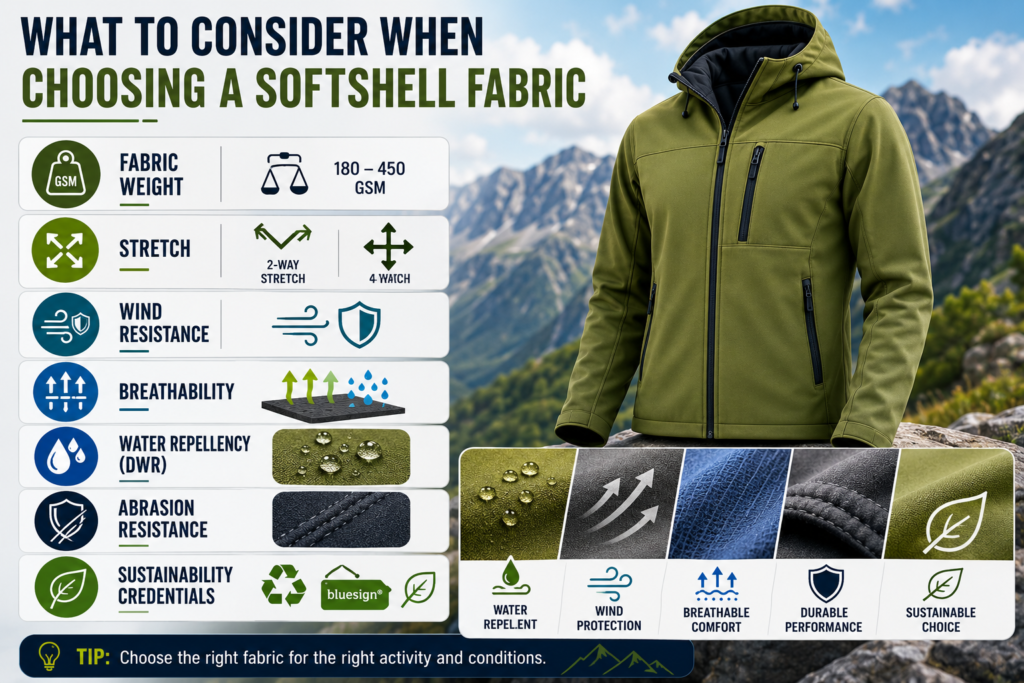
When choosing softshell fabrics for the production of jackets, consider each of the following properties, as they will affect the real performance of the jacket and its commercial viability:
Fabric Weight: 180 to 280 GSM for softshells designed for active and running applications; 280 to 320 GSM for softshells designed for hiking and general outdoor applications; 320 to 450 GSM for softshells designed for skiing and insulated softshells for use in cold weather.
Stretch: For softshells designed for general outdoor applications, two-way stretch; for softshells designed for technical climbing and alpine applications, four-way stretch.
Wind Resistance: For softshells designed for general outdoor applications, wind-resistant with DWR; for softshells designed for use in exposed mountain and alpine applications, windproof.
Breathability — fabrics that air permeability ratings for breathability that are maximized for high-output activities and moderately rated for general outdoor activities and lifestyle applications.
Durable Water Repellency (DWR) — durability of a DWR treatment is improved with nano-surface treatments and fluorocarbon-free alternatives.
Abrasion Resistance — vital for fabrics that are in contact with rock & other vegetation, and pack & equipment abrasion during a variety of activities outdoors.
Sustainability Credientials — fabrics with recycled content, bluesign certification, and bio-based DWR treatments for brands caring about sustainability.
Softshell Fabrics Balance for Your Brand Outdoors
Selecting the right fabric is just the first step in designing a softshell jacket. jacket. A company’s ability to transform a fabric into a finished softshell jacket that performs as specified relies on their manufacturing expertise. An example of this is how the right fabric selected for a jacket may fall short of expectations if the fabric is bonded incorrectly. The right fabric bonded the right way with the right DWR treatment and features will ensure that all performance expectations are met for the jacket and this will create softshell jackets that build a loyal customer base.
Expanding on the above, designing softshell jackets in conjunction with the other outerwear jackets in a brands lineup, such as windbreaker jackets for lightweight coverage and hardshell jackets for coverage from extreme weather, will create a cohesive line of outdoor outerwear. Using the same face fabrics across all jackets will ease the sourcing, fabric consistency and will also ease the quality control across all the jackets.
Are you interested in starting your fabric selections for your softshell jacket designs? Reach out to our technical manufacturing team. We support brands, from outdoor softshell jacket designs, selections of raw materials, all the through to softshell jackets ready for distribution inclusive of all quality control.
Conclusion
High performing softshell jackets can essentially be constructed from numerous technical and advanced fabrics. Examples of these include constructions derived from Polartec Power Shield and Schoeller and recycled polyester-spandex which can be used in eco-friendly collections.
Each kind of fabric offers its own unique balance of breathability, warmth, stretch, wind resistance, and just how suited to a certain climate/brand you can expect it to be. Knowing this can help determine at every step how it builds out certain ranges of softshell jackets and how each of these ranges build out softshell jackets that perform. The extent to which you see the utility of each of these fabrics helps determine how far along you can get in the other steps of the development process.
When you start your new technical softshell collection, ensure each step of the process you pay special attention to your choice of materials. Doing this helps ensure you have a product your customers trust and love when the product is complete.
If you want to build a collection of softshell jackets, look at our full softshell jackets manufacturing capabilities, and contact our team to start your production journey today!
FAQs
What is the best fabric for a premium technical softshell jacket?
Both Polartec Power Shield and Schoeller fabrics win out for premium technical softshell jackets. They help make a jacket really really good at resisting wind and softshell abrasion. These fabrics are great for softshell jackets that are being made for use in the Alps.
What is the difference between stretch woven and mechanical stretch softshell fabrics?
Stretch woven fabrics get their stretch through the use of elastane in the weaving. Mechanical stretch softshell fabrics get their stretch solely through the structure of the weave. They have a firmer stretch and a better articulation of stretch but are much more breathable and have better performance in colder conditions.
Are recycled softshell fabrics as good as virgin alternatives?
Yes, brands that prioritize sustainability no longer need to compromise with performance. New technologies leveled the gap between performance for virgin and recycled nylon and polyester. Now, recycled nylon and polyester perform the same as virgin nylon and polyester for softshell jackets.
Which fabric weight is ideal for a hiking softshell jacket?
Softshell fabrics in the weight range from 280 to 320 GSM is ideal for most hiking activities—light enough to not impede an individual’s movement while providing adequate protection from the elements.
Selecting the correct knit fabric is vital to the various stages of fashion manufacturing and design. Different weights in knit fabric can yield various looks, comfort levels, and impacts based on the season. This is especially the case with respect to the understanding of Chunky Knit vs. Fine Knit. Such an understanding aids fashion brands in curating collections that cater better to their customers.
Knitwear can be found in almost all clothing from winter fashion to knitwear to even lavish luxury apparel and everyday wear. But not all knit fabrics can be used for all designs, some require heavy textures and warm fabrics, others require lightweight fabrics that are soft and flexible. For this reason, brands must understand the differences of chunky knit versus fine knit fabrics in order to start production.
Many fashion businesses now work with professional services like Knitwear Manufacturer to create high-quality knitwear collections that match modern market trends.
What Is Chunky Knit Fabric?
Chunky knit won’t be as stretchy or pliable as regular knit, but it is softer and warmer. Plain or simple patterns won’t be as popular as more textured ones. These will be more effectively knitted at a larger scale. Because of how warm and cozy it looks, chunky knits are a sought after knitwear style in colder seasons.
Looking at Chunky Knit vs Fine Knit, as you would imagine, Chunky Knit is more popular for the usage of bold aesthetics and oversized fashion appeal. Streetwear cardigans, oversized knit sweaters, and scarves are a must-have for the winter season.
Chunky knit garments are especially popular because they create:
Better warmth during winter
A relaxed oversized appearance
Strong texture and visual depth
Additionally, chunky knitwear often works well in layered fashion trends. Many streetwear brands combine chunky sweaters with oversized pants and outerwear for modern seasonal collections.
Brands creating winter streetwear collections often work alongside Streetwear Manufacturer services to produce fashionable oversized knitwear designs.
What Is Fine Knit Fabric?
Fine-knit fabrics, constructed using tighter stitches and thinner yarns, result in a lighter, more flexible, and smoother final garment. When comparing Chunky Knit vs. Fine Knit, fine knits are typically preferred for styles that are elegant, fitted, and breathable.
Fine knit fabrics are commonly used in:
Lightweight sweaters
Premium t-shirts
Layering garments
Fashion tops and fitted apparel
Fine knit fabrics are less bulky and work perfectly for indoor and transitional weather clothing. Also, they have a more refined and polished look compared to thick knitwear.
Many brands producing lightweight fashion collections use Casual Wear Manufacturer solutions for modern fine-knit apparel production.
Chunky Knit vs. Fine Knit: Main Differences
Choosing between Chunky Knit and Fine Knit is essential when selecting fabric options for a collection.
Fine Knit is softer and more lightweight, while Chunky Knit is heavier and warmer. Fine Knit is better for sleek designs, while Chunky Knit is better for bold statements.
Chunky Knit fabric usually gets used during the colder months. Fine Knit fabric usually is used during the warmer months.
Casualness also differs with fine and chunky knits. Chunky knits usually are more casual, oversized, and chunkier. Fine knits are usually more refined and premium.
Fashion brands expanding seasonal apparel collections often combine knitwear production with Fashionwear Manufacturer services to develop balanced product ranges.
Which Knit Fabric Is Better for Streetwear?
Wearing big and knitted clothing has become more fashionable in streetwear. This is because modern fashion now approaches stylings of oversized silhouettes and textured fabrics.
Chunky knitted sweaters and hoodies are suitable oversized clothing inspirations for the winter. Chunky knits add background depth to social media posts, creating a better fabric textural appeal.
Modern streetwear also requires the use of fine knits in lightweight urban fashion. This leads to the consideration of fitted layering and knit tops.
Brands often combine knitwear collections with products developed through Hoodies Manufacturer because layered streetwear continues growing globally.
Choosing the Right Fabric Weight for Your Brand
When comparing Chunky Knit vs. Fine Knit, the best option depends on your target market and collection goals.
If your brand focuses on winter fashion, oversized clothing, or cozy seasonal collections, chunky knit may be the better choice. It offers warmth, comfort, and a fashionable oversized look that customers love.
Meanwhile, if your brand focuses on lightweight luxury, minimal fashion, or everyday layering pieces, fine knit may work better. Its smooth finish and flexibility make it suitable for versatile apparel collections.
Before selecting knit fabric weight, brands should consider:
Seasonal demand
Customer preferences
Garment functionality
Production costs
Fashion trends
Careful planning helps brands create collections that match both customer expectations and current market demand.
Why Knitwear Continues Growing in Fashion
Knitwear remains popular because consumers now prioritize comfort and versatility. Both chunky and fine knit fabrics support modern fashion needs in different ways.
Chunky knitwear offers warmth and bold styling, while fine knit provides lightweight elegance and flexibility. As a result, many successful brands include both fabric types in their collections.
Eco Jersey continues supporting fashion businesses with modern knitwear manufacturing solutions designed for changing apparel trends and customer expectations.
Conclusion
The debate around Chunky Knit vs. Fine Knit depends largely on fashion goals, climate, and customer preferences. Chunky knit fabrics work best for warmth, texture, and oversized winter fashion. Meanwhile, fine knit fabrics are ideal for lightweight, breathable, and polished clothing styles.
Both fabric weights offer unique advantages, which is why many brands include both options in their collections. Understanding these differences helps fashion businesses create stronger, trend-focused knitwear products for today’s market.
FAQs
What is the difference between Chunky Knit vs. Fine Knit?
Chunky knit uses thicker yarns for warmth and texture, while fine knit uses thinner yarns for lightweight and smooth garments.
Which is warmer, chunky knit or fine knit?
In Chunky Knit vs. Fine Knit, chunky knit is warmer because of its heavier construction and thicker yarns.
Is chunky knit good for streetwear fashion?
Yes, chunky knit is highly popular in oversized streetwear and winter fashion collections.
When should brands use fine knit fabrics?
Brands should use fine knit fabrics for lightweight sweaters, layering pieces, and elegant casual apparel.
Why is knitwear popular in modern fashion?
Knitwear remains popular because it offers comfort, flexibility, warmth, and versatile styling options for different seasons.
Men’s and women’s fashion jackets immediately show the demand from separate body shapes, style preferences, and fashion needs. Manufacturing in the modern world has brands focusing on practical, artistic cuts to achieve both comfort and design. You can explore a wide range of production styles at Eco Jersey Fashion Wear Manufacturer where different jacket categories are developed with distinct gender-based patterns.
Cut Differences in Men’s vs. Women’s Fashion Jackets
The cut shows the most men’s vs. women’s fashion jacket differences because men’s jackets are boxy and straighter, while women’s jackets are molded to be tapered for curvature. These structural differences highlight and build the body’s natural proportions.In modern apparel production like Casual Wear Manufacturer, cutting techniques are carefully adjusted to maintain gender-specific fitting standards.
Style Variations
Style is essential to specifying the differences in men’s vs. women’s fashion jackets. Men’s designs favor minimalism and rugged aesthetics, while women’s incorporate decorative styles, vivid color palettes, and fashion-forward detailing. These reflect the market demands and seasonal trends. Manufacturers such as Streetwear Manufacturer focus on evolving urban styles that influence both categories.
Fabric Selection
The sagacity of fabric Men’s vs. Women’s Fashion Jackets is clear because men’s jackets utilize hardy, more durable materials like denim or thick cotton blends, while women’s jackets may incorporate lighter fabrics like wool synesthetic blends for ease and comfort. Textile innovation is widely used in production facilities like Knitwear Manufacturer to ensure fabric diversity and performance.
Design Elements
The differences in Men’s vs. Women’s Fashion Jackets reveal men’s designs favor functionality with larger pockets, straight zippers, and practical layouts. Women’s styles are more decorative with asymmetrical cuts, belts, and stitching, while retaining functionality and appeal. Production lines such as Hoodies Manufacturer often influence modern jacket design trends.
Seasonal Adaptability
In designing Men’s and Women’s jackets, there are significant differences between winter and summer collections. For winter collections, jackets are designed with materials that combine insulation and layering. For summer collections, jackets are designed with the use of lightweight and breathable materials. Fashion adaptability is necessary for the different requirements of global markets. Many brands working with Fashion Jacket Manufacturer develop season-specific collections to meet diverse consumer needs.
Key Features Summary
Here are some important highlights of Men’s vs. Women’s Fashion Jackets:
Men’s jackets are constructed with straight cuts and structured shoulders.
Women’s Jackets
Women’s jackets taper to the waist and sport fitted silhouettes.
Jackets for both Men and Women
Manufacturers like Tracksuits Manufacturer also apply similar design principles across other apparel categories.
Conclusion
In summary, Men’s and Women’s fashion jackets have different cuts, fabrics, and styling. However, they all fulfill the needs for comfort and aesthetics. These differences help fashion brands and manufacturers to create products for different specific audiences.Even categories like cargo or utility wear from Cargo Pants Manufacturer reflect similar design logic across apparel segments.
FAQs
What is the main difference in Men’s vs. Women’s Fashion Jackets?
The main difference is the cut and fit, where men’s jackets are straighter and women’s are more fitted.
Are fabrics different in Men’s vs. Women’s Fashion Jackets?
men’s jackets often use heavier fabrics, while women’s jackets may use lighter, softer materials.
Can styles overlap in Men’s vs. Women’s Fashion Jackets?
Yes, modern fashion trends often blur the lines between both categories.
Choosing the right material is the foundation of premium outerwear production. The demand for Best Fabrics for Custom Fashion Jackets continues to grow as brands focus on durability, comfort, and style. Different fabrics define the identity of a jacket, from rugged denim looks to lightweight nylon performance wear. Manufacturers like Eco Jersey Fashionwear Manufacturer play a key role in supplying high-quality materials that align with global fashion standards. Understanding fabric properties helps brands create long-lasting and market-ready apparel. The keyword Best Fabrics for Custom Fashion Jackets is essential for designers aiming to balance aesthetics with functionality.
Denim as a Timeless Jacket Fabric Choice
Denim is a top contender in the Best Fabrics for Custom Fashion Jackets. Casual and street-style jackets require long-term wear resistance and structure, and denim delivers. With a durable, classic look, denim is an excellent choice for custom jackets. Brands sourcing from Streetwear Jacket Production often prefer denim for its versatility in both vintage and modern designs. The keyword Best Fabrics for Custom Fashion Jackets applies strongly here because denim continues to dominate seasonal fashion collections worldwide.
Leather for Premium and Luxury Outerwear
Leather is a big fabric for outerwear in the Best Fabrics Custom Fashion leather Jackets. This fabric has a premium finish, great durability, and a luxury, appealing look. This leather fabric increases brand value and customer perception. It is common for manufacturers to use organized production systems. Many manufacturers utilize structured production systems like Casual Wear Manufacturing Solutions to ensure high-quality leather jacket production. The keyword Best Fabrics for Custom Fashion Jackets highlights leather as a top-tier option for high-end fashion markets and statement pieces.
Nylon for Lightweight and Performance Jackets
Nylon is used in the Best Fabrics for Custom Fashion Jackets, and this is largely due to its low weight and high weather resistance. This fabric is excellent for sports fashion, windbreakers, and outerwear. Brands working with Islamic Fashionwear Manufacturing also explore nylon blends for modest yet functional outerwear. The keyword Best Fabrics for Custom Fashion Jackets is highly relevant in performance fashion segments where comfort and protection are essential.
Hoodies and Fleece-Based Jacket Materials
Fleece has the highest comfort in fabrics for Custom Fashion Jackets and is perfect for casual wear jackets and winter hoodies. Fleece has excellent properties:
Fabric has a super soft texture
Great insulation for cold fashion
Easily blends with cotton and poly
Popular in athleisure and streetwear
Manufacturers like Hoodies Manufacturing Experts rely heavily on fleece-based materials. The keyword Best Fabrics for Custom Fashion Jackets is especially important in this category due to increasing demand for cozy fashion apparel.
Joggers and Sweatshirt Fabric Blends in Modern Fashion
Modern fashion puts a lot of value on joggers and sweatpants. Jacket style blended fabrics are key in Best Fabrics for Custom Fashion Jackets. A common practice is the use of a cotton-polyester blend for flexibility and durability.Production facilities such as Joggers Manufacturing Unit help brands develop coordinated sets that match jackets with lower garments. The keyword Best Fabrics for Custom Fashion Jackets also extends into athleisure trends where comfort meets street fashion.
Sweatshirts and Heavyweight Fabric Innovation
When it comes to Best Fabrics for Custom Fashion Jackets, especially with winter collections and layering outfits, the materials used in sweatshirts become very important. These fabrics provide warmth and structure while still being breathable. Advanced production techniques at Sweatshirts Manufacturing Factory ensure consistency in quality and texture. The keyword Best Fabrics for Custom Fashion Jackets remains central in creating balanced designs that combine fashion with functionality.
Final Thoughts
When it comes to the Best Fabrics for Custom Fashion Jackets, striking a good balance between long lasting, comfortable, and visually appealing fabrics is a definite surefire way for success. Fabrics and materials such as denim, leather, nylon, and fleece serve their own unique purpose for jacket styles and designs. Even cargo-style innovations from Cargo Pants Manufacturing Line influence modern jacket design trends. The keyword Best Fabrics for Custom Fashion Jackets should always guide designers and brands toward making informed, market-driven decisions.More read Jacket for Men’s Stylish
FAQs
What are the Best Fabrics for Custom Fashion Jackets?
The most popular fabrics include denim, leather, nylon, fleece, cotton, and polyester blends depending on style and use.
Which fabric is most durable for jackets?
Leather and heavy-duty denim are considered the most durable options for long-lasting jackets.
What is the best fabric for lightweight jackets?
Nylon and polyester blends are best for lightweight, breathable, and weather-resistant jackets.