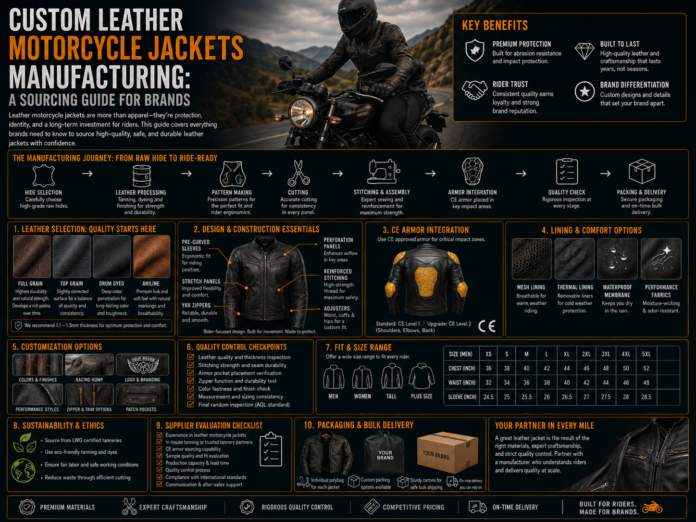
Leather motorcycle jackets are a major and lasting product category in motorcycle apparel. They combine protective performance, cultural elements, and premium fashion. Riders take these jackets seriously and wear them for years. Brands manufacturing leather motorcycle jackets need serious product knowledge to navigate hide selection, construction quality, CE armor integration, and supplier assessment. This knowledge helps them understand if the jacket will earn rider trust or sell below expectations. This sourcing guide elaborates everything brands need to understand about the leather motorcycle jackets manufacturing process for better judgment from the selection of raw materials to quality control and bulk delivery.
Why Leather Motorcycle Jackets Manufacturing Need High Standards of Sourcing
Leather motorcycle jackets are positioned uniquely in the market. Riders understand that motorcycle leather jackets need to be constructed of genuine protective leather. This requires specific standards of construction and armor integration. Leaving out any of these standards will have serious safety implications. Brands sourcing leather motorcycle jackets manufacturing without knowledge of these standards will end up with jackets that sell premium on the surface, but will be evaluated and found lacking by experienced riders. Brands that have high standards of sourcing in making leather motorcycle jackets manufacturing will have loyal riders, premium pricing, and the repeat customers and community word-of-mouth that will ensure long-term growth in this market.
Hide Selection: Leather Motorcycle Jacket Manufacturing Basics
When manufacturing leather motorcycle jackets, the most important thing to consider is the hide selection, as the type of leather used informs the protective capability of the jackets more than any other factor.
Hide Species and Grade
Cowhide is the most popular outer shell material in the manufacturing of leather motorcycle jackets, and for good reasons. It is tough, resists abrasion, and is readily available in a variety of weights and finishes. For protective jackets designed for the sport and track, heavy grade racing-cowhide is specified. On the other hand, cowhides that are softer and of a lighter grade are used in jackets designed for urban and touring applications, as these jackets must be more comfortable and flexible. Leather is also available in kangaroo hides, which are lighter and thinner than cowhides, but have a higher abrasion-resistance. Because of this, kangaroo leather is often used in racing suits and in high-end sport jackets.
Hide Weight and Thickness Guidelines
The thickness of leather used in jackets can determine the levels of protection that the jackets can provide. Motorcycle jackets can have their leather thickness range from 1.0mm to 1.4mm. Heavier leathers can provide better protection from abrasion and tearing, but can be less comfortable for the consumer. Motorcycle jackets are often worn for long periods of time. It’s important to communicate leather thickness in the manufacturing briefing and verify the thickness in the samples, to align the jacket’s protective capabilities with the expectations based on the positioning and pricing of the product.
Tannage and Finishing Processes
Different tanning methods such as chrome tanning and vegetable tanning can impact the leather’s protective capabilities and aging characteristics. Chrome tanned leather is more consistent and recommended for motorcycle jackets. Vegetable tanned leather can be more appealing, but may not be as suitable for protective applications. There can be other surface finishes that affect the aging of the leather, dyeing and top coats. These can alter the water resistance of the leather and should be specified in the manufacturing brief. It can be difficult to determine these characteristics from just product photos.
Leather Sourcing Transparency
Good manufacturers of leather motorcycle jackets can name their leather suppliers, state the countries of origin of the hides, and show the tannage and performance documentation of the leather they use in their jackets. Brands that accept leather sourcing assurances at this level put their supply chain at risk for inconsistent quality, since unverified leather can have inconsistent thickness, finish, and protective performance from one production batch to another. For this reason, leather sourcing transparency requirements are one of the first things to consider when sourcing leather motorcycle jackets from a manufacturer.
CE Armor Integration in Leather Motorcycle Jackets Manufacturing
When it comes to the safety performance of leather motorcycle jackets, integrating protective armor is important. This must be done to the highest standards of quality given the various situations that a motorcycle rider may encounter that could result in a crash.
Shoulder and Elbow Armor Standards
In serious leather motorcycle jackets,CE certified armor is the minimum acceptable standard of protection for shoulder and elbow armor. CE Level 1 armor provides adequate protection for road riding armor. CE Level 2 armor is required for armor designed for sport riding and track use. The armor pockets must position armor inserts in the anatomical impact zones and be designed to do so for all rider body sizes. Armor that is positioned improperly due to poorly designed armor pockets will, in fact, armor impact zones, and will compromise protection, regardless of its CE certification.
Back Protector Integration Options
Back protector accommodation options in leather motorcycle jackets vary from a simple pocket to fully integrated CE-certified, externally supplied spinal protection back armor. When deciding where to position their back protection options, brands should consider what their competition is offering and what their target riders expect. For example, premium jacket categories are beginning to include CE-certified back protection as standard rather than as an optional feature. Moreover, back armor integration must address the external silhouette of the jacket and eliminate armor outlines that may detract from the leather jacket’s premium aesthetic character.
Chest Armor Considerations
Integration of armor for the chest in leather motorcycle jackets has also gained significantly from the developing awareness of rider safety. Some premium categories of leather motorcycle jackets include protection for the chest as standard, while others provide a pocket that enables riders to add protection if they so desire. Armor for the chest adds thickness and stiffness to the front panels of a jacket and therefore must be accounted for in construction without altering the external proportions of the jacket or creating pressure points while riding.
Construction Standards in Leather Motorcycle Jackets Manufacturing
Construction quality in leather motorcycle jackets determines how well the jacket maintains its protective integrity and aesthetic character across years of regular riding use, making build quality evaluation as important as material specification in the sourcing process.
Seam Construction and Thread Specification
Seams in leather motorcycle jackets can use either saddle stitch or machine stitch, using thread chosen based on strength and resistance to abrasions and UV rays. Simple machine stitches exposed to external elements weaken quicker than hand done saddle stitches due to the tighter and more complex nature of the stitch. The seams of quality leather motorcycle jackets endure because of double stitching in seams that hold the jacket together, Bartack stitches at the openings of pockets that hold armor and at the base of zippers, and reinforcing tape at seams that experience the most tension.
Zipper Specification and Sourcing
Zippers are the most prominent and the most functional part of a motorcycle jacket. The part quality is the minimum standard to manufacture serious leather motorcycle jackets. YKK grade quality zippers are a standard. The pull and slider design of zippers should also be considered to ensure the zipper is functional while the rider is wearing gloves. Snaps, buckles, rings and other hardware also require consideration of finishes that are resistant to corrosion and UV degradation. Hardware quality impacts the character of the jacket long before leather quality is of any concern.
LINING CONSTRUCTION AND COMFORT ENGINEERING
Good lining construction addresses friction in leather motorcycle jackets. Smooth and strong lining fabrics with the addition of stretch lining panels reduce friction and increase comfort. Stretch panels can be used in areas that experience the greatest range of motion during riding. FRiction is also present against the base layers. Therefore, the attachments of the lining also need to accommodate friction and motion. Poor lining attachment is also addressed during sampling, since it is an attachment that provides comfort for the rider.
THE MOST IMPORTANT THINGS TO CONSIDER WHEN SOURCING LEATHER MOTORCYCLE JACKETS MANUFACTURING
When sourcing leather motorcycle jackets construction for the first time, or for a new range, the following manufacturing considerations or requirements help identify manufacturing partners who can construct jackets with the required quality at the expected quantity and range:
Leather sourcing transparency: manufacturers’ ability to identify the source of the leather, the tannery, and leather thickness for the hides used in manufacturing.
CE armor sourcing and certification: ability of the manufacturer to provide CE armor pocketing systems and armor that is verifiably sourced and certified.
Sample quality and construction: the quality of the sample is assessed based on the quality and placement of stitching, the quality of hardware, and the construction of the armor pocketing systems.
Production consistency: the consistency of the quality of production is due to the manufacturers’ quality controls during production, managing the quality of the hides used and inspecting the finished garments.
Lead time reliability: manufacturers’ ability to achieve the expected lead times for production.
Riding position testing: Diagnose if patterns are drawn from actual riders and real riding positions, or are simply standard outerwear patterns with minimal adjustments.
By systematically assessing potential manufacturing partners against these, brands can establish relationships for the manufacturing of leather motorcycle jackets that produce quality and consistent results for several seasons.
Customization Options for Leather Motorcycle Jacket Brands
Custom development capability across materials and design details allows leather motorcycle jacket brands to build product ranges with genuine identity that cannot be replicated from generic wholesale supply:
- Proprietary leather specifications: Custom hide weights, tannage programs, color developments, and surface treatments that create distinctive material identities across the brand’s jacket range.
- Custom hardware programs: Bespoke zipper pulls, buckle designs, snap plates, and ring hardware developed with custom tooling that competitors cannot source from standard supply channels.
- Branded lining fabrics: Custom print linings, luxury lining materials, and coordinated interior label programs that create a premium experience reinforcing brand identity inside every jacket.
- Decorative construction details: Panel piping, contrast stitching, quilted panel inserts, leather appliqué programs, and embossed brand emblems that function as immediate visual brand identifiers.
- Custom fit programs: Extended size ranges, fit-forward pattern adjustments for specific rider body types, and modular adjustment systems that address rider fit preferences standard sizing cannot accommodate.
Expanding Your Leather Motorcycle Jacket Range
Brands building leather motorcycle jacket ranges naturally extend into complementary categories that serve the same rider communities across different product needs. Custom motorbike pants and motorcycle riding jeans coordinate with leather jacket ranges to create complete outfit protection systems that drive higher average order values and stronger brand associations. Additionally, motorcycle vests serve rider communities where vest culture carries strong identity significance alongside the jacket, while motorbike gloves allow brands to extend their leather craftsmanship into the accessories category.
For brands serving diverse riding segments beyond core leather jacket buyers, textile motorcycle jackets manufacturing capability allows weather-versatile alternatives to sit alongside leather options within a coherent brand range. Additionally, motorcycle suits and racing suits extend leather craftsmanship into the track and competition segment for brands whose positioning supports this extension. For the complete range of motorcycle apparel manufacturing capabilities, reviewing the full motorcycle apparel collection helps brands identify manufacturing partners with the breadth of category expertise needed to support multi-product development programs.
Partner with a Trusted Manufacturer for Leather Motorcycle Jackets Manufacturing
Finding a manufacturing partner for leather motorcycle jackets who can ensure a consistent supply of high quality premium leather motorcycle jackets with protective structures and design elements for authentic riders is a tall order. Such a partner would need to have an understanding of leather craft and motorcycle design, as well as the ability to incorporate CE armor.
Whether your company is about to launch its first leather motorcycle jackets, or is expanding an existing collection in different riding segments, or is looking for tailor made solutions to develop products that are different from those on the market, choosing the right manufacturer will determine if your investment in this category achieves the financial return and the brand recognition that you are striving for.
Conclusion
Manufacturers equipped with the best resources, CE armor, and high standards will be rewarded for their efforts. Custom full-grain leather and CE armor, riding position patterns, and high-quality hardware and customization will allow jackets to be positioned high in the market because of the loyalty of the riders and the strong market position. The integrity of construction and authenticity in the leather motorcycle jackets will allow manufacturers to position jackets even higher in the market. Riders validate gear using multiple perspectives, including technical and cultural. This results in gear that has quality, integrity and craftsmanship being rewarded while gear that relies on superficial craftsmanship will be punished.
Frequently Asked Questions
What leather is used in quality motorcycle jackets manufacturing?
Quality motorcycle jackets use full-grain or top-grain cowhide in weights between 1.0mm and 1.4mm for most road riding applications, with heavier grades used in sport and racing-oriented constructions and lighter, softer grades prioritized for cruiser and urban riding comfort.
How do I verify leather quality when sourcing motorcycle jackets manufacturing?
Request physical hide samples and confirm thickness through measurement rather than supplier specification alone, ask for documentation of tannage processes and hide origin, and evaluate finished sample jackets for surface consistency, flexibility, and stitching quality.
How do I evaluate leather motorcycle jacket construction quality?
Evaluate seam stitching density and consistency, thread specification and UV stability, hardware grade and finish durability, lining attachment quality, armor pocket retention systems, and bartack reinforcement at all high-stress construction points.