Custom motorcycle Riding Jeans are highly advanced denim products as they include standard denim products with added features for protection. They have the standard denim products aesthetically pleasing to the riders while giving the riders protection on the road. Motorcycle riding jeans have the protective features built in during the engineering and construction process, setting them apart from standard fashion jeans. Understanding the construction process, and the different protective features that can be added to Motorcycle riding jeans will help riders and companies make better and more informed product and protective equipment decisions.
Why Motorcycle Riding Jeans Are Constructed Differently from Standard Denim
Construction of Motorcycle riding jeans and standard denim differs in protective features. Standard Denim, even those constructed with the heaviest weight, is still inadequate during sliding on motorcycle. Contact with the road can result in the construction of a standard fabric being destroyed in mere seconds.
The Abrasion Protection of Motorcycle Denim
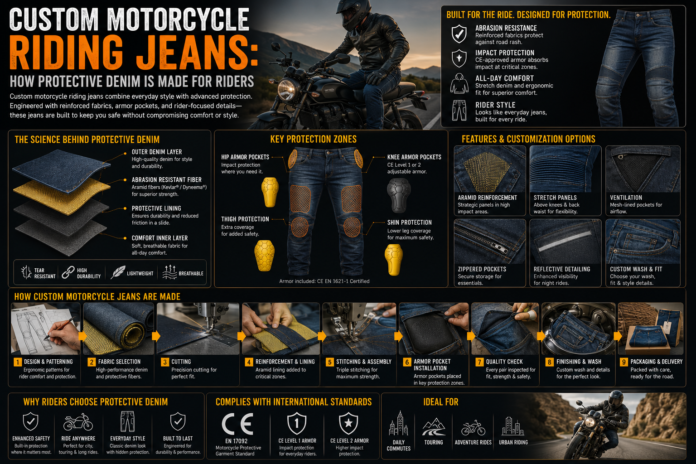
The protection features built into motorcycle denim must satisfy the abrasion protection requirements of the European standard EN 17092 for motorcycle protective apparel. Standard denim fails these completely. The standard measures how long a fabric withstands simulated road surface abrasion before tearing and the majority of standard denim constructions fail within seconds at the speeds relevant to typical motorcycle accidents.
For custom motorcycle riding jeans to provide rider protection meaningfully and meet the CE certification, they should have more than just a denim shell. They need additional protective materials. But these materials should be added in a way that does not change how denim looks and its ease to wear. This is important because the selling feature for motorcycle riding jeans is that they look like regular jeans that can be worn in any setting.
What CE Certification Means for Motorcycle Riding Jeans
CE certification allows for the classification of motorcycle protective trousers as protective clothing EN 17092, and therefore, as protective clothing that is classified by performance levels. As an example, Class A would be for lower-speed, urban use with lower requirements, whereas Class AAA would be for higher, more demanding uses. Each such class would define specific requirements for impact protection and for the abrasion resistance of the complete garment.
Moreover, CE certification would be for the complete garment system (in this case the outer denim shell and all protective liners and armor pockets) and not for the individual components in isolation. This means the construction method that joins the protective liner to the denim shell is as important to the certification outcome as the protective liner material itself. If your brand is ready to develop CE-certified motorcycle riding jeans, contact our motorcycle riding jeans manufacturing team today — we can guide you through the full certification process from material selection to final testing.
Materials Used in Custom Motorcycle Riding Jeans Construction
The integrated materials in custom motorcycle riding jeans provide key protective and useful layers that help motorcycle riding jeans attain their commercial value. Materials help brands ensure their custom motorcycle riding jeans target a particular CE certification class. Here is a description of the components of motorcycle jeans.
Outer Denim Shell Fabrics
The outer denim shell is the most conspicuous and the most revealing layer of how jeans are custom made to be indistinguishable from ‘regular’ jeans. The most common weight range for motorcycle riding jeans shell denims is 11 – 14 oz. denims. This weight range provides denims that are light enough for comfortable all-day wear on and off the bike, while providing a weight range that provides enough weight to be seen as reasonably authentic denim yet light enough to comfortable all day wear.
The color of the Denim shell or wash and a treatment to the denim shell, help the riding jeans in revealing their protective construction to the casual observer. Dark black and shaded indigos of denim help conceal the the protective construction, especially in helping conceal the liner and armor pocket stitching. Our custom motorbike pants manufacturing team sources denim across a full range of weights, washes, and stretch contents — contact us today to discuss shell fabric options for your riding jean development.
Abrasion-Resistant Liner
Of all the components involved in the construction of custom motorcycle riding jeans, the protective liner is the most important. It provides protection against abrasion, something the outer denim shell is not able to do. The three most common protective liner material families each offer varying levels of abrasion protection, weight, and comfort.
Ceramic reinforced fabrics offer a good balance of cost, comfort, and weight (much lighter than Aramid) while offering good abrasion resistance. Fabrics that utilize ultra-high-molecular-weight polyethylene (e.g. Dyneema, Spectra) offer excellent abrasion resistance and, because of the balance of weight and protection, are being used more and more in the production of motorcycle riding jeans.
Armour and Impact Protection Systems
Armour pockets in the custom motorcycle riding jeans house CE certified knee and hip protection, which is impact protection. The construction, location, and retention of the armour pockets are equally important to the protective nature of the jeans as the armour insert is. Armour that shifts during a fall will not provide the protection needed.
In addition, the CE certification of Level 2 armour vs Level 1 armour means vastly different performance of the armour in terms of impact protection, with Level 2 armour providing a higher degree of impact protection. The choice of armour is also a choice concerning the protection the jeans will offer and the price at which the jeans will be sold.
Construction Methods of Custom Motorcycle Riding Jeans
The construction methods found in custom motorcycle riding jeans provide insight into the effectiveness of the integration of the protective liner and armor system with the denim shell and whether the fully constructed garment will meet CE certification testing requirements at the protection class level.
Protective Liner Attachment Methods
The protective liner in motorcycle riding jeans may be joined with the denim shell via several construction methods. Each of these has an impact on the level of protection offered, the comfort of the garment when worn and the complexity of the construction.
With partial liner construction, protective liner panels are only placed in the high risk areas, usually the hip, thigh and knee, while the remainder of the jeans are left liner free. This construction method may be used in jeans designed to meet Class A CE certification because it is not a requirement for the jeans to have full liner coverage. Partial liner construction also allows for a greater level of comfort and wearability, as it reduces the weight and stiffness in comparison to a fully lined construction.
Seam and Stitch Construction
Seam construction in motorcycle riding jeans has an effect on safety beyond what is typically considered in other apparel. In areas that are impacted and subjected to abrasion, seams must be constructed to withstand the tensile load of a road surface contact. Standard construction of seams of fashion denim will fail in this instance.
Double or triple stitching at critical seams — particularly the inseam, outseam, and seat seam — provides the seam strength needed to maintain garment integrity during abrasion events. Furthermore, seam placement at high-abrasion zones should be minimised where possible — moving seam lines away from the outer thigh and knee areas where road contact is most likely during a slide. Our motorcycle apparel manufacturing team applies motorcycle-specific construction standards to every seam in our riding jean production — contact us today to discuss construction specifications for your brand.
Key Features That Define Quality Custom Motorcycle Riding Jeans
When developing or evaluating custom motorcycle riding jeans, these specific features determine both protective performance and commercial appeal across the target rider market:
- CE certification class — Class A for urban commuting, Class AA for general road use, Class AAA for high-performance and touring applications
- Liner material — aramid fibre for proven abrasion resistance, UHMWPE for lightweight premium protection, ceramic reinforced for mid-range performance
- Armour specification — Level 1 for general use at accessible price points, Level 2 for premium protection at higher retail price positioning
- Stretch content — two to four percent elastane in the denim shell for riding comfort and everyday wearability
- Hip armour pocket placement — outer hip positioning with adequate retention depth to prevent displacement during impact
- Seam construction — double or triple stitching at critical seams, minimised seam placement at high-abrasion outer thigh and knee zones
- Everyday aesthetic — wash, surface treatment, and visible construction details that allow the jeans to read as standard denim in non-riding contexts
Developing Custom Motorcycle Riding Jeans for Your Brand
Custom motorcycle riding jeans are a commercially strong product for brands entering or expanding in the motorcycle apparel market — because they serve the largest single rider demographic, those who want genuine protection without the visual statement of dedicated motorcycle trousers. Furthermore, the wearability advantage of riding jeans over traditional motorcycle trousers means they are used more frequently and across more contexts — generating stronger repeat purchase and brand loyalty than more specialised protective riding products.
Additionally, developing motorcycle riding jeans alongside complementary products — motorbike jackets for upper body protection and motorcycle base layers for thermal management — creates a complete riding wardrobe that serves your customer across every aspect of their riding life and builds stronger brand engagement across the full motorcycle apparel category.
For brands considering a broader motorcycle apparel range, motorcycle suits manufacturing alongside riding jeans creates a product range that covers both dedicated track and competitive riding use and everyday commuting and leisure riding — serving the complete spectrum of motorcycle rider needs from a single manufacturing partner.
Conclusion
Custom motorcycle riding jeans are likely one of the most valuable and difficult products to make in this segment of the clothing industry. To make these products, you need to be able to construct motorcycle apparel and understand the ins and outs of hazardous materials, specialist materials, and CE certification. To make this type of denim truly protective, you need to understand the engineering and construction of protective denim. This starts from aramid fibre selection to the construction of armour pockets and seams, to the CE testing. This construction is what allows you to create riding jeans that protect riders and allow you to create a credible brand in this segment of the market.
When you are ready to develop your custom motorcycle riding jeans collection, explore the full range of motorcycle riding jeans manufacturing options and connect with our team to start your production journey today.
FAQs
What makes motorcycle riding jeans different from standard denim jeans?
Motorcycle riding jeans incorporate CE-certified abrasion-resistant liners, impact armour pockets at the knees and hips, and reinforced seam construction — delivering protective performance that standard fashion denim cannot provide while maintaining a visual appearance similar to regular jeans.
What is CE certification for motorcycle riding jeans?
CE certification under EN 17092 classifies motorcycle protective trousers into Class A, AA, and AAA performance levels based on abrasion resistance and impact protection testing.
What liner materials are used in motorcycle riding jeans?
Aramid fibres — including Kevlar and Dyneema — are the most widely specified liner materials. Ultra-high-molecular-weight polyethylene fibres offer premium protection at lighter weight.
What is the difference between Level 1 and Level 2 armour in riding jeans?
Level 2 armour provides substantially better impact attenuation than Level 1 — absorbing more energy during impact at the cost of slightly more bulk and higher retail price positioning.