Home Blog Page 27

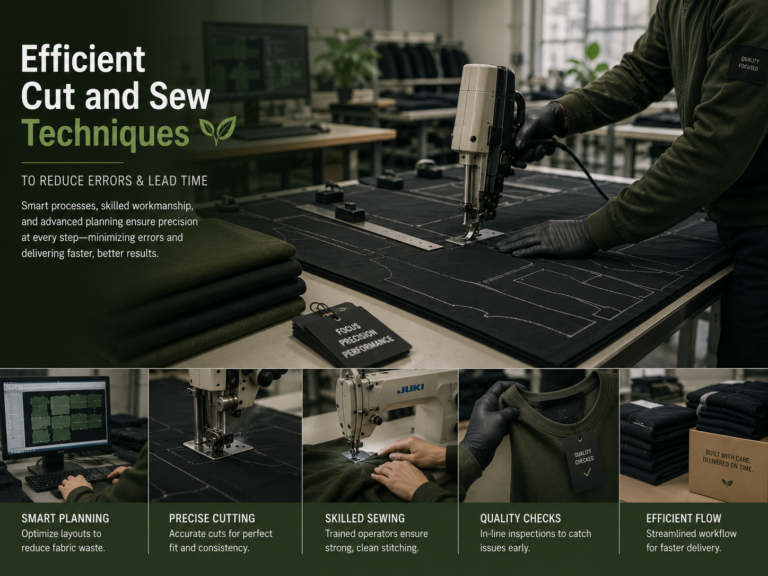
Efficient Cut and Sew Techniques to Reduce Errors & Lead Time

For any budding, established, or active business delivering quality goods in the present garment sector, reliable cut and sew strategies are critical. For everyone producing uniforms, team kits, or personalized clothing, efficient cut and sew techniques minimize mistakes, enhance consistency, and reduce deadlines. By using the right techniques and utilizing professional services, businesses can balance quality and tight delivery timeframes.

Why Efficient Cut and Sew Techniques Matter

Cut and sew is the most important part of garment production. Mistakes at this stage result in loss of fabric, increased costs, and production delays. The application of cut and sew strategies guarantees that each part is cut, sewn, and ready for assembly. Companies adopting such a strategy enjoy:

  • Reduced waste of materials
  • Better consistency of garments
  • Shortened production time
  • Reduced costs of production

For businesses interested in upgrading their processes, our Cut and Sew Manufacturing Capability service provides the expertise and equipment to optimize production workflows. By combining technology with skilled craftsmanship, we ensure that every garment meets your specifications while minimizing errors.

Common Errors in Cut and Sew and How to Avoid Them

Even experienced manufacturers can face challenges if processes are not streamlined. Common errors include misaligned seams, incorrect measurements, inconsistent stitching, and fabric distortion. To overcome these challenges, consider implementing the following practices:

  • Accurate pattern alignment – Always ensure patterns are properly positioned on the fabric before cutting.
  • Precision cutting tools – Use high-quality cutting machines to reduce human error.
  • Regular quality checks – Inspect each piece at multiple stages, from cutting to stitching.
  • Standardized procedures – Follow documented workflows to maintain consistency.
  • Skilled workforce training – Continuous training helps workers execute precise cuts and stitches.

These strategies are reinforced through our Sampling & Pattern Making and Development & Size Grading services, which help businesses minimize errors even before mass production begins.

Tips to Reduce Lead Time

Reducing lead time is essential for businesses that need to respond quickly to market demands. Here are some tips to accelerate production without compromising quality:

  1. Digital Tech Packs – Prepare detailed tech packs to communicate design and measurements clearly. Our Tech Packs Development service helps streamline this process.
  2. Integrated Fabric Sourcing – Source materials efficiently through Fabric Sourcing & Development to avoid delays.
  3. Parallel Processes – Conduct cutting, sewing, and finishing operations in parallel whenever possible.
  4. Use of Automated Equipment – Invest in machinery for precise cuts and stitches to save time.
  5. In-House Quality Checks – Detect errors early to prevent rework.

By applying these strategies, startups and businesses can meet tight deadlines while ensuring their apparel maintains professional standards.

How Startups, Teams, and Businesses Benefit

For startups and teams entering the apparel market, mastering efficient cut and sew techniques is a game-changer. It allows small businesses to scale without sacrificing quality. Similarly, large organizations benefit from reduced errors and faster production cycles. Partnering with experienced manufacturers provides access to advanced Manufacturing Solutions and Production Capabilities that can support everything from private label manufacturing to custom apparel for corporate teams.

Additionally, integrating resources like our Cost Estimator, Fabric Catalog, and Quality Control Standards can further optimize workflows, reduce mistakes, and provide better budgeting for each project.

Conclusion

Businesses looking to produce high quality garments quickly must adopt effective cut and sew methods. Incorporating best practices, advanced tools, and professional assistance can minimize mistakes, reduce lead times, and increase customer satisfaction.

FAQs

What are efficient cut and sew techniques?

Methods that optimize cutting, stitching, and workflow to reduce errors, save time, and improve garment consistency.

How do these techniques reduce lead time in production?

By streamlining processes, using precise patterns, and integrating quality checks, production becomes faster and more reliable.

Who should use efficient cut and sew techniques?

Startups, small teams, and large businesses all benefit by increasing efficiency, maintaining quality, and lowering production costs.
Denim Finishing Techniques for Perfect Quality Control

Denim production may look simple, but maintaining the same quality in every garment is a difficult process. When brands manufacture denim at scale, even a small variation in washing or finishing can affect the final appearance, softness, and durability of the product.

That is why denim finishing techniques are extremely important in modern apparel manufacturing. These techniques help brands maintain consistent quality while creating denim finishing techniques that feels comfortable and looks premium.

Many fashion brands work with professional Washing & Dyeing Services to achieve reliable finishing results across large production runs.

Why Denim Finishing Matters for Brands

Denim finishing techniques is much more than a final production step. It directly affects how the garment looks, feels, and performs after production.

Customers expect every denim piece to have the same color, texture, softness, and fitting. If there are differences between batches, it can reduce customer trust and damage brand reputation.

That is why strong finishing processes help brands maintain quality consistency, improve customer satisfaction, and reduce manufacturing defects. Brands with advanced Production Capabilities usually achieve more stable and professional results during large-scale production.

How Brands Achieve Perfect Denim Finishes at Scale

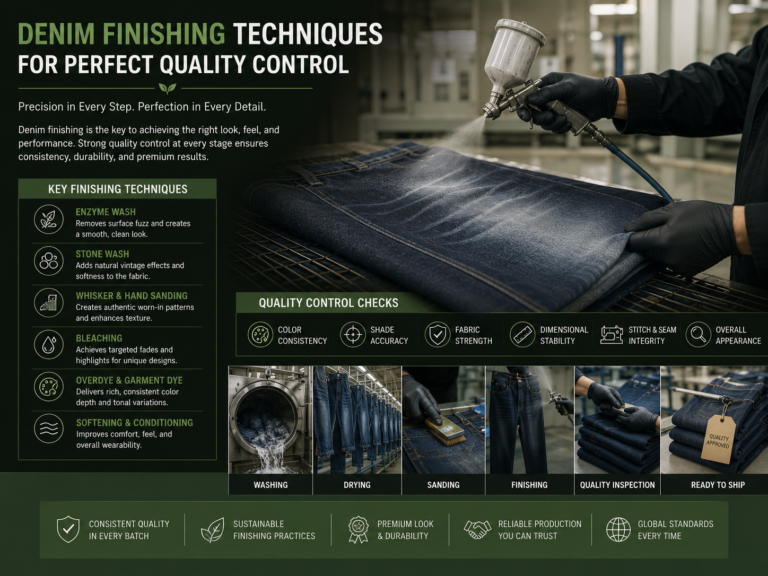
Controlled Industrial Washing

Industrial washing is one of the most important denim finishing techniques used in apparel manufacturing. This process removes stiffness from raw denim and creates a softer and more wearable fabric.

Manufacturers carefully control machine speed, washing duration, and water temperature to make sure every garment receives the same treatment. This level of control helps brands maintain consistent quality across large production volumes.

Different washing methods are used depending on the desired result, including enzyme washing, rinse washing, and stone washing.

Enzyme Finishing for Uniform Results

Enzyme finishing is widely used because it creates a soft and smooth texture without damaging the fabric. It works gently on denim fibers and delivers more controlled results compared to traditional methods.

This technique helps brands maintain uniform softness, stable color tone, and consistent comfort in every garment. For this reason, many manufacturers offering advanced Manufacturing Process systems prefer enzyme-based finishing methods for premium denim finishing techniques production.

Stone Washing for Vintage Effects

Stone washing remains popular because it creates a natural faded and vintage appearance. In this process, denim garments are washed with pumice stones inside industrial machines to create worn effects.

However, large-scale stone washing requires careful management because small changes in timing or stone quantity can affect the final outcome. When handled properly, it produces a consistent vintage finish across the entire production batch.

How Brands Maintain Consistency in Production

Fabric Selection

Fabric quality plays a major role in denim finishing techniques consistency. If the base fabric is unstable, the final garment will also show inconsistent results after washing and finishing.

That is why brands invest heavily in professional Fabric Sourcing & Development before mass production begins.

Strong fabric sourcing helps manufacturers maintain:

  • Stable color results
  • Better durability
  • Uniform washing response
  • Consistent garment finishing

Process Control

Large-scale denim production requires strict process control because even small variations can affect thousands of garments.

Manufacturers carefully monitor machine settings, chemical usage, washing time, drying conditions, and water temperature to maintain stable results throughout production.

Brands that follow structured QC Standards Resources can reduce quality issues and maintain consistency more effectively.

Skilled Production Teams

Even with advanced machinery, experienced technicians are still essential for maintaining stable production quality. Skilled teams monitor every stage of denim finishing and quickly adjust processes whenever needed.

Their expertise helps reduce production errors and ensures consistent results across all manufacturing batches.

Quality Control in Denim Finishing

Quality control is one of the most important parts of denim manufacturing. Every garment must pass detailed inspections before shipment to ensure it meets brand standards.

Manufacturers inspect color consistency, fabric softness, shrinkage levels, surface quality, and garment durability during the finishing process.

Strong quality systems help brands reduce defects, improve customer satisfaction, and maintain long-term reliability in the market.

Sustainable Denim Finishing

Modern fashion brands are also focusing on sustainable denim finishing techniques. Eco-friendly production methods help reduce environmental impact while maintaining high product quality.

Popular sustainable solutions include ozone washing, enzyme treatments, water recycling systems, and low-impact dyeing methods.

Many brands combine sustainable practices with professional Production Capabilities to maintain both quality and environmental responsibility during large-scale production.

Conclusion

Denim finishing techniques are essential for achieving consistent quality in modern apparel manufacturing. From controlled washing to fabric selection and quality inspections, every step plays an important role in the final result.

Brands that invest in advanced finishing systems, skilled production teams, and proper quality control can produce denim garments that look professional, feel comfortable, and maintain consistent standards across every production batch.

What are denim finishing techniques?

They are processes used to improve denim’s look, feel, and durability after production.

Why is consistency important in denim finishing?

Because customers expect the same quality in every product they buy.

Which denim finishing methods are commonly used?

Enzyme washing and stone washing are widely used techniques.

How do brands maintain quality at scale?

They use controlled processes, skilled teams, and strict quality checks.

Are eco-friendly finishing methods effective?

Yes, they maintain quality while reducing environmental impact.

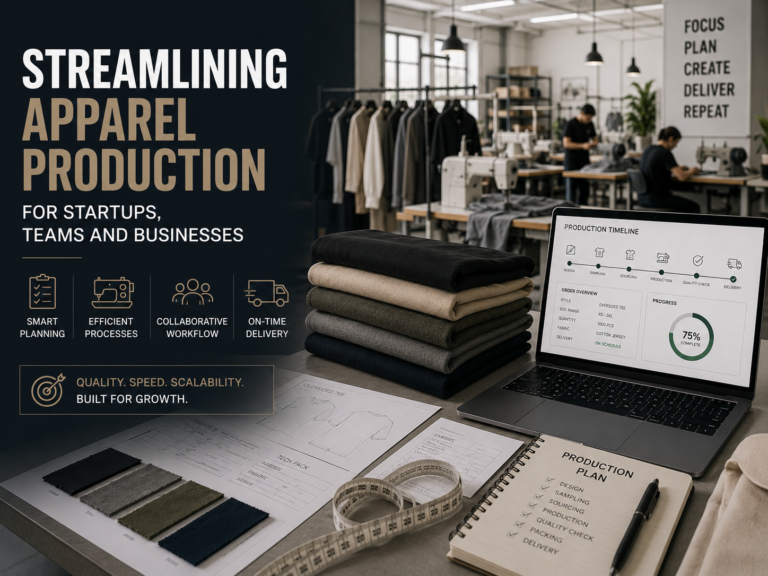
Streamlining Apparel Production for Startups Teams and Businesses

Managing team uniforms remains a thrill and a challenge. Sports teams and businesses struggle with streamlining apparel production delays and inconsistent quality while managing the complex web of logistics. The good news is that production of apparel has been streamlining apparel production and simplified. Advanced planning, structured workflows, and the best expert manufacturing services will help run your team uniforms business more effectively.

Understanding Your Apparel Production Needs

Before production begins, it’s essential to clearly define your requirements. Are you creating a small batch for a startup, custom uniforms for a team, or large-scale business apparel? Knowing your needs helps in selecting the right production method. Services like Bulk Apparel Manufacturing and CMT Clothing Manufacturing offer scalable solutions for different order sizes.

Leveraging Tech Packs and Production Planning

One key to efficient production is having detailed tech packs, which outline all design specifications. This step ensures your manufacturer understands your vision and reduces errors. Services like Tech Packs Development and Development Size Grading provide professional support for accurate production planning.

Choosing the Right Manufacturing Partner

Selecting the right manufacturing partner is crucial. For startups, services like Low MOQ Clothing Manufacturer or Made-to-Order Apparel Manufacturer allow flexibility without overstocking. For larger businesses, OEM and ODM Clothing Factory ensures high-quality output at scale.

Quality Control and Finishing

Even with efficient production, quality control is non-negotiable. Services like Garment Finishing & Packaging and QC Standards help maintain consistency, ensuring every garment meets your expectations. Regular inspections during production prevent costly errors and enhance customer satisfaction.

Printing, Branding, and Customization

Customization adds value and identity to your apparel. Services like Custom Printing and Embroidery Branding enable unique designs, logos, or team numbers. Additionally, Custom Labeling and Branding Services make your apparel ready for retail or corporate use.

Transition words: Furthermore, moreover

Fast Sampling and Feedback Loops

Before committing to large production, small sample runs allow testing for fit, quality, and design accuracy. Services like Sampling & Pattern Making and Performance Garment Construction ensure samples reflect the final product, reducing risks.

Conclusion

To simplify streamlining apparel production, you need to plan, choose the right partners, and utilize expert services throughout the process. Workflows, quality manufacturing, and trusted production partners can all be found. By adopting the strategies outlined here, your apparel projects will be completed faster and ready for a successful launch with consistent quality.

FAQs

What is the most important step in streamlining apparel production?

A detailed tech pack is critical as it communicates all design and production details clearly to your manufacturer.

Can startups produce small orders efficiently?

Yes! Made-to-order and low-MOQ manufacturers allow startups to produce limited quantities without overstocking.

How do I ensure quality across all products?

Regular QC checks and working with experienced manufacturers who follow strict standards will maintain consistency.

How to Choose the Right Length for Your Custom Leather Coats

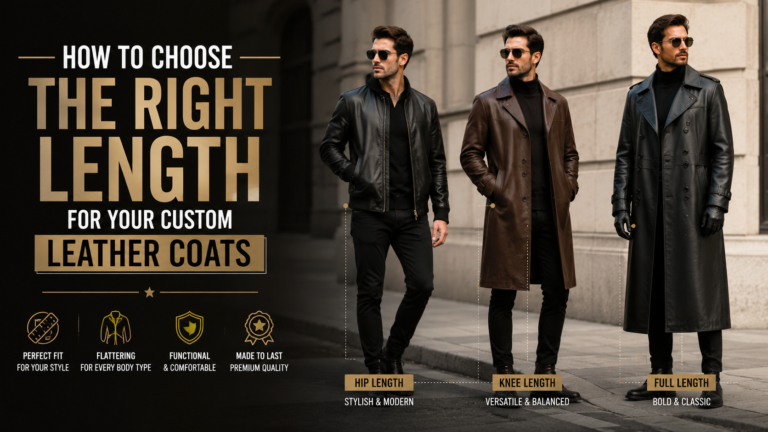
Length is one of those details that looks simple on paper but makes an enormous difference in how a leather coat actually feels, moves, and sells. Get it right and the coat looks intentional, polished, and wearable. Get it wrong and even the best leather and stitching won’t save it. Choosing the right length for custom leather coats isn’t just a style decision — it’s a practical one that affects production, fit across different body types, and how your customers actually use the garment. If you’re working with a leather apparel manufacturer on a custom coat line, length should be one of the very first conversations you have — not an afterthought.

Here’s everything you need to think about before you finalize that spec sheet.

Why the Right Length for Custom Leather Coats Matters More Than You Think

Creating a custom leather coat is far more difficult than crafting a simple t-shirt, tank top, or other casual clothing. The longer the coat, the more leather is required, the more complicated the design gets, and the more cumbersome the coat becomes. A coat that is longer than its intended length by even just a couple inches can feel constricting and uncomfortable. In contrast, creating a coat that is shorter than its intended length removes the elegance and warmth (the purpose) of a coat. The right length for custom leather coats is the length that satisfies the proportion of the design while fulfilling its purpose and being comfortable to wear. This balance looks different for every person, so be sure to keep this in mind when creating your coat. This is why experienced leather coats manufacturers always ask about your target customer before they cut a single pattern. A coat built for a tall man has very different length considerations than one designed for petite women.

The Four Main Length Categories

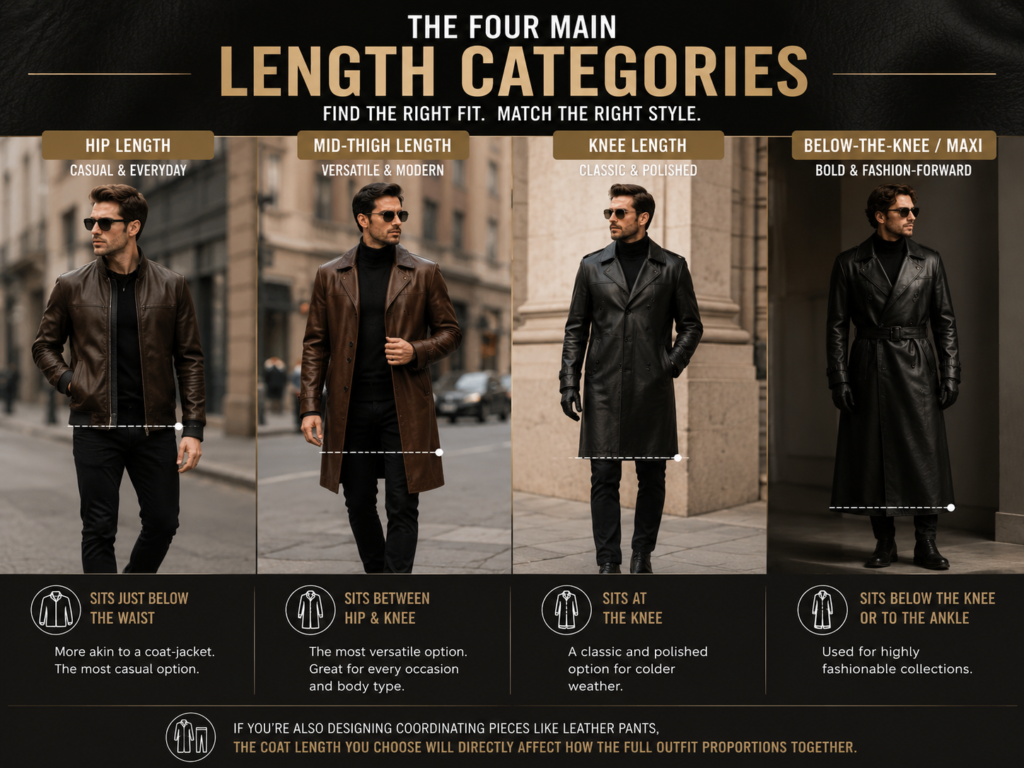
Comparison of hip-length, mid-thigh, knee-length, and maxi leather coats for custom fashion collections.
Understanding coat length categories helps brands design leather outerwear for different styles, seasons, and target markets.

Before diving into the custom coat design process, understanding the four main leather coat length categories is essential:

  • Pro Tip — If you are also designing coordinating pieces like leather pants, the coat length you choose will directly affect how the full outfit proportions together.
  • Hip-Length Coats — The most casual option, sitting just below the waist. They have a coat-jacket feel and work best for relaxed, everyday styling.
  • Mid-Thigh Coats — The most versatile option, falling between hip and knee length. They suit every occasion and every body type with ease.
  • Knee-Length Coats — A classic and polished choice, ideal for colder weather and more formal settings.
  • Below-the-Knee & Maxi Coats — Reserved for highly fashionable and statement collections, offering a bold and dramatic silhouette.

Consider the Customer’s Body Type First

Not accounting for different body types causes major issues when adjusting patterns for different sizes. Custom company leather coats differ when purchased for the customer. For shorter customers, longer coats hitting below the knee become overwhelming by shortening the legs and adding heaviness to the overall body frame. For taller customers, longer coats are flattering and add length. If your brand sells to a wider range of body types, consider offering the same coat in multiple lengths or grading your pattern carefully across sizes. A manufacturer producing leather jackets alongside your coats will already understand this — jackets require the same kind of fit thinking, just on a shorter scale.

Think About How the Coat Will Actually Be Worn

When making style decisions, consider function. Depending on city traffic, coats can be an inconvenience to quick, short runs. Mid-thigh coats are not too long to make jumping in and out of a coat cumbersome, nor too short to make them look styling and good. Long coats are perfect to help you make an entrance. If your customers are also buying leather skirts or leather vests to layer underneath, the coat length needs to work with those pieces — not compete with them visually.

The Right Length for Custom Leather Coats and Fabric Weight

Something that truly amazes many owners of new brands is the relationship between the length of a coat and the type of leather you need to use. The longer the coat, the weight of the leather matters, since you want the coat to hang without collapsing or bunching. If you use lightweight leather on a coat that reaches the floor, the coat will drape unevenly, and will look extremely unprofessional. The shorter the length of the coat, the more flexibility you have with leather weight, since the coat will have less length to control. This is why you can’t design the length of a leather coat and choose the leather for the coat at different times. The manufacturer you pick will use the weight and finish of leather to match the level of control you need to the silhouette of the coat. This also ties into your accessories line — the leather used in leather belts that come with the coat needs to complement rather than clash with the coat’s leather in both texture and finish.

Gender Differences in Coat Length

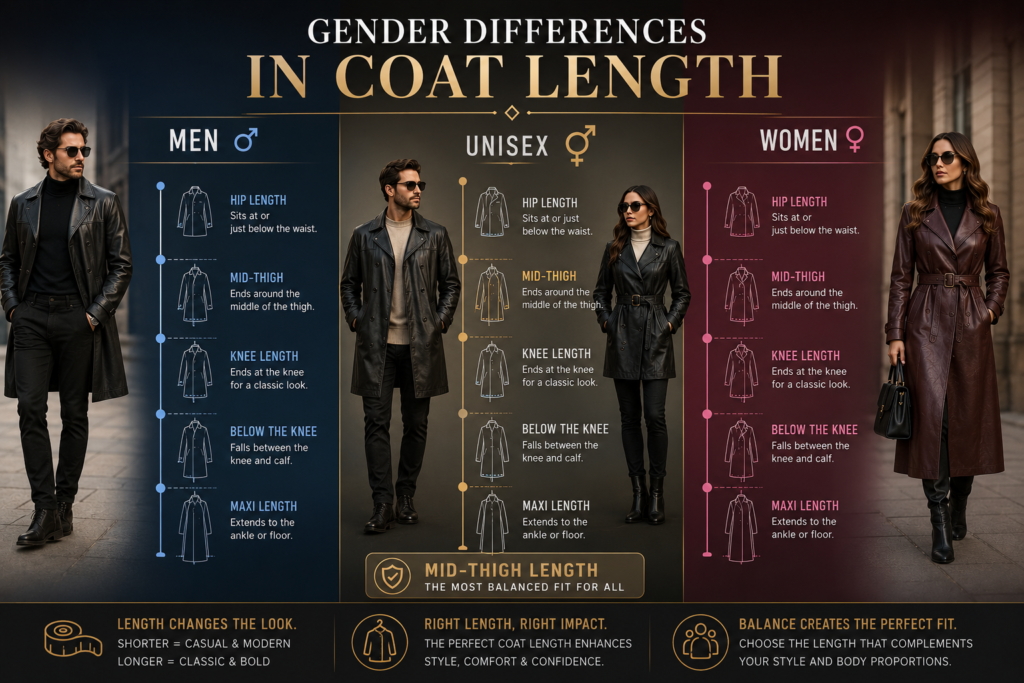
Men’s, women’s, and unisex leather coat length comparison chart showing hip, mid-thigh, knee, and maxi styles.
Leather coat lengths vary across men’s, women’s, and unisex fashion collections to create balanced and cohesive styling.

Men’s and women’s leather coats exist on completely different ends of the spectrum when it comes to length, and ignoring this can lead to a product that feels off, even if the customer can’t explain why. Historically, men’s leather coats have always landed at thigh to knee length. Any styles that are longer than that are very fashion-forward for men and require a more confident carry. Women’s leather coats can have more variety and range, from right at the hip to all the way to the floor. Longer styles are usually more expected across different style categories. Building a unisex line presents its own challenges, however, finding a length that works across genders is not impossible — mid-thigh with an easy fit is typically the safest option. Brands that also produce leather gloves and leather bags as part of the same collection should keep coat length in mind when styling the full look — everything needs to feel cohesive.

Practical Tips Before You Finalize Your Coat Length

Before you sign off on your final spec sheet, do these things. First, make a physical toile or muslin in your intended length before cutting into actual leather to avoid costly mistakes — this surefire way to save money. In the second place, do not solely rely on fit models to show how your actual customer would look. You should try your coat length on actual customers instead of fit models. Finally, try to simulate as many real-life scenarios that you can. This can include walking, sitting or even getting in and out of a car. More movement than a static fitting is the best way to catch fitting issues. Lengths that are even good for standing can feel very restricting in a normal movement. If you’re also producing leather aprons or other long leather pieces alongside your coat line, the same principle applies — test every length in motion, not just on a hanger.

Final Thoughts

Choosing the right length for custom leather coats is one of those decisions that looks straightforward until you start factoring in body types, leather weight, end use, and how the cape coat works alongside the rest of your collection. There’s no single correct answer — only the answer that’s right for your customer and your brand. Work closely with your manufacturer from the sampling stage, test lengths on real bodies, and don’t rush the process. A well-proportioned custom leather coat built to the right length will sell itself. One that’s even slightly off will come back as a return with a vague complaint about fit — and that’s always more expensive than getting it right the first time.

FAQs

What is the most versatile length for a custom leather coat?

Mid-thigh length is generally the most versatile option. It flatters a wide range of body types, works across casual and semi-formal occasions, and is practical for everyday wear. If you’re launching your first leather coat and want it to appeal to the widest audience, mid-thigh is the safest and smartest choice.

How does coat length affect the cost of production?

Longer coats use significantly more leather, require heavier lining, and involve more complex pattern-making to ensure the silhouette hangs correctly. This means a below-the-knee coat will cost noticeably more to produce per unit than a hip-length coat, even if everything else — leather type, hardware, stitching — is identical.

Should I offer multiple lengths in the same coat style?

If your budget allows, yes. Offering the same coat design in two lengths — for example mid-thigh and knee-length — gives customers more options and can significantly increase conversions. Just make sure the pattern is properly graded for each length rather than simply hemmed, as proportions shift when you change the length.

Pro Size Grading Techniques for Scaling Your Apparel Line

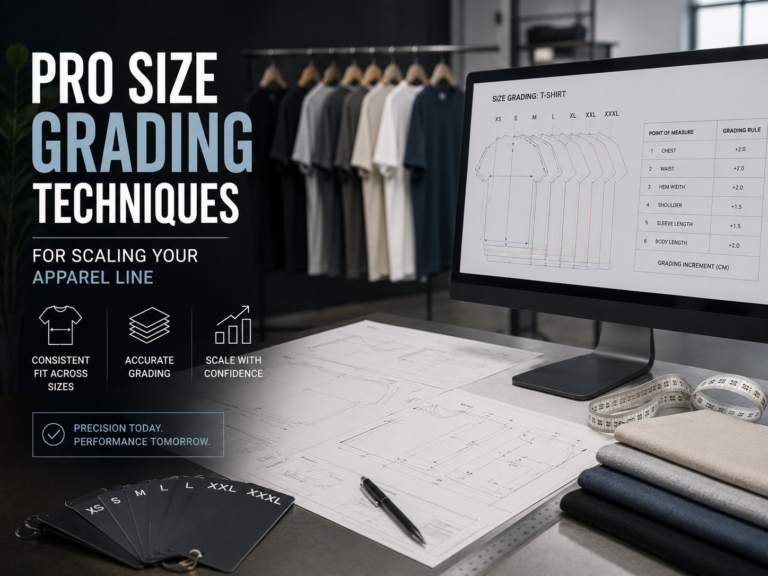
Growing your apparel business from a handful of sizes to a full size range that customers trust is a big step — and size grading techniques are the bridge that makes it possible. Whether you’re launching your first collection or scaling into new markets, consistent grading ensures your products feel right on real people, not just on paper.

In this post, we’ll walk through practical, easy‑to‑understand size grading techniques for apparel brands — in a way that helps you scale wisely, reduce fit returns, and build customer confidence.

What Is Size Grading and Why It Matters

Size grading is the process of transforming a perfected pattern in one size into multiple sizes while keeping the garment’s design and fit consistent across the range. It’s not just making things bigger or smaller — it’s about proportion, balance, and understanding how the human body changes from size to size.

For brands that plan to scale their lines, mastering grading early on avoids common pitfalls like inconsistent fit, distorted silhouettes, and customer dissatisfaction — all of which can lead to returns and lost sales.

Top Size Grading Techniques for Apparel Brands

Here are the most effective techniques businesses use to develop dependable size ranges:

1. Start with a Perfect Base Pattern

The foundation of good grading is a strong base pattern. Before you scale up or down:

  • Ensure your base size fits exactly how you want the garment to look.
  • Confirm ease, silhouette shape, and stitch placement.

Your base pattern is essentially the “template” from which every other size will be derived. A bad base makes all size grading harder.

To turn that pattern into production‑ready specs, use size grading and development services.

2. Apply Consistent Grading Rules

Grading rules are the increment values that determine how much each measurement increases or decreases between sizes. For example, bust width might increase by a certain amount per size, while sleeve length changes at a different rate.

Good grading keeps the garment balanced instead of just uniformly scaled — so it looks and wears well in every size.

3. Use Digital Tools for Precision Grading

Today, many brands and manufacturers rely on CAD (Computer‑Aided Design) grading tools. These tools allow you to:

  • Scale patterns quickly and accurately
  • Store grading rules for future collections
  • Compare and adjust sizes digitally before making samples

While manual grading still works for simple styles, digital methods improve efficiency and repeatability — especially for larger size spreads. When you work with a production partner, they often have access to these grading tools as part of their production capabilities.

4. Test Graded Sizes Through Sampling

Once grading rules are applied, sampling across the range is critical. You want to:

  • Fit each size on a model or dress form
  • Assess how design lines fall on different body types
  • Note any distortions or imbalance

Sampling helps you catch issues early — before running full production.

5. Adjust for Fabric Behavior

Different fabrics behave differently. Stretch knits might require larger grading increments than woven fabrics, and structured garments may need subtle adjustments to maintain silhouette. Good graders consider:

  • Fabric stretch and recovery
  • Ease and movement requirements
  • Style intent (relaxed vs fitted look)

This fabric‑aware grading reduces year‑round fit inconsistencies

Where Size Grading Fits in Your Workflow

Effective size grading is part of a bigger process that connects concept to production. A good workflow looks like:

  1. Design and sketch your style
  2. Create the base pattern
  3. Develop tech specs for production — e.g., tech pack development
  4. Apply grading rules to build the full size set
  5. Sample and refine fits before bulk production
  6. Produce at scale with confidence

By following this system, your grading supports both quality and scalability.

Get Professional Support for Scalable Sizing

If you’re exploring ways to improve sizing and fit for your apparel line but want expert support to make it happen, we’re here to help you every step of the way. Whether you’re still refining your grading techniques or ready to kick off full production, let’s make your vision a reality — Get Quote Now to start planning your project or Contact Us Now if you have questions and want personalized guidance.


Conclusion

Size grading is a core technique that separates amateur apparel efforts from professionally scaled fashion lines. By using consistent grading rules, digital tools, and thoughtful sampling, you can deliver dependable fit across every size you offer.

Investing time in grading early translates into happier customers, fewer returns, and a stronger reputation for quality — helping your brand grow confidently.


FAQs

What’s the difference between size grading and pattern making?

Pattern making creates the original design size, while grading spreads that design into a size range that fits different body types.

How many sizes should a brand grade for?

That depends on your market. Many brands start with XS–XL and expand based on customer feedback and sales data.

Can small brands handle grading themselves?

Yes, especially with digital tools and skilled graders, but many choose to outsource to production partners to ensure technical precision and consistency.


Textile for Teams and Clubs: Boost Performance & Comfort

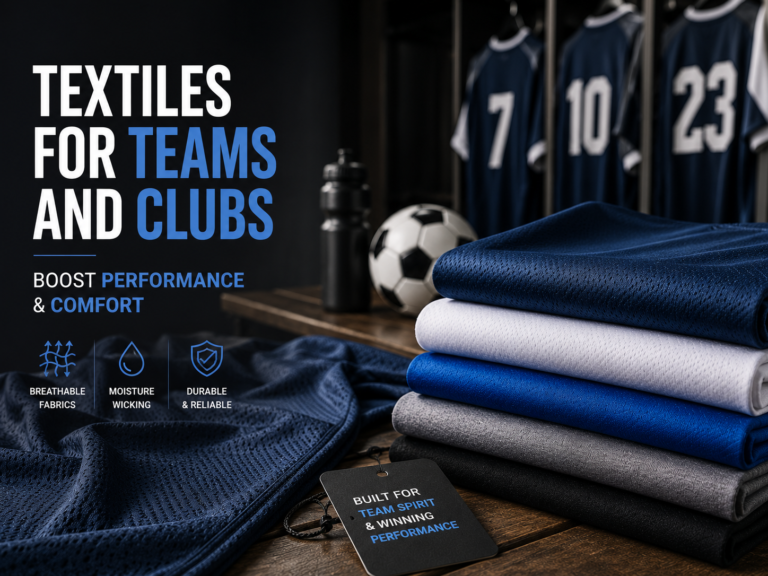
Choosing the correct fabric for your team, club, or business uniforms goes beyond materials. Involvement in wearers’ comfort, durability, and effectiveness is mandatory. This choice matters whether you sponsor a sports team, employ a corporate team, or serve a club. A good choice influences satisfaction and innovates your brand.

In this guide, we’ll walk you through the key factors to consider when choosing textiles, how different fabrics perform, and how to link your selections to high-quality fabric sourcing and development solutions.

Why Choosing the Right Textile Matters

Uniforms are influenced by an array of elements ranging from the fabric’s look and texture to their functional benefits. Consider the following examples:

  • Comfort: Overheating and chafing can be eliminated with the right choice of breathable fabric.
  • Durability: Fabric that can withstand the rigors of repeated laundering and wear will promote longevity.
  • Performance: For improved performance in an athletic and work capacity, opt for moisture-wicking fabric that stretches.

Choosing the proper fabric will help employees feel valued, confident, and dignified.Partnering with a manufacturer who offers cut and sew manufacturing capabilities guarantees consistent quality and precision in your uniforms.

Popular Textile Options for Teams and Clubs

Polyester

Polyester is lightweight, durable, and moisture-wicking, making it ideal for sports teams and active clubs. It holds up well to repeated washing and maintains color vibrancy, perfect for uniforms that need to look sharp consistently. You can explore high-quality polyester options through our fabric sourcing and development services.

Cotton

Cotton is soft, breathable, and comfortable for long wear. While it may not wick moisture as efficiently as polyester, blended cotton fabrics combine comfort with performance. For tailored club or corporate uniforms, our cut and sew manufacturing capability ensures precision and quality, making your cotton or blended fabrics fit perfectly.

Blends (Polyester-Cotton or Performance Fabrics)

Blended fabrics offer enhanced durability, stretch, and moisture management, perfect for teams needing both style and functionality. Our performance garment construction service transforms these fabrics into high-performance uniforms that look professional and last longer.

Factors to Consider When Choosing Your Textile

When evaluating fabrics, consider:

  • Activity Level: High-intensity sports require moisture-wicking and flexible fabrics.
  • Climate: Hot or humid conditions call for breathable materials; cooler climates may require heavier weaves.
  • Branding Needs: Vibrant colors or custom prints demand fabrics that maintain color integrity.
  • Budget: Balance cost with durability and comfort to get the most value.

Before production, using our tech packs development service ensures your design, material, and sizing specifications are captured accurately.

Benefits of Working with a Professional Manufacturer

Partnering with an experienced manufacturer ensures:

  • Consistent Quality: Facilities following strictQC standards guarantee superior fabrics and finished garments.
  • Custom Options: From custom printing to embroidery, your textiles can reflect your unique design vision.
  • Sustainability: Modern manufacturers offer eco-friendly fabric options via our sustainable apparel manufacturing solutions.

Actionable Tips for Teams and Businesses

  • Test Small Batches: Try a few sample uniforms before full production to assess comfort and performance.
  • Consider Longevity: Prioritize fabrics that withstand frequent washing and wear.
  • Involve Your Team: Feedback from players or staff ensures the textile meets real-world needs.

Our sampling and pattern making service allows you to prototype uniforms before committing to full-scale production, helping you avoid costly mistakes.

Conclusion

Choosing the right textile isn’t just about aesthetics—it’s about comfort, performance, and durability. By selecting the right material, leveraging professional manufacturing services, and considering your team’s specific needs, you can create uniforms that look great, feel great, and last long.

FAQs

What fabric is best for sports teams?

Polyester and performance blends are ideal for moisture-wicking and flexibility.

Can cotton be used for team uniforms?

Yes, especially in blended fabrics for comfort and durability.

How do I maintain uniform color and quality?

Choose durable fabrics and work with a professional manufacturer who follows QC standards.

Can I customize fabrics for branding?

Absolutely! Services like custom printing, embroidery, and labeling can bring your designs to life.

Fabric Development Strategies for Startups

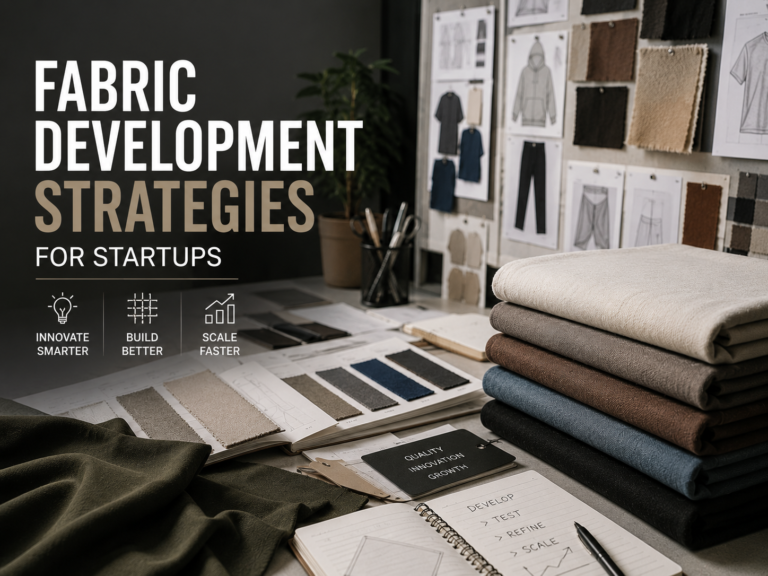
For new businesses and industrial clothing lines, developing fabric involves designing a product which satisfies quality, durability, and aesthetic requirements. Using the right strategies can even save time and costs, while improving the customer experience. We will review strategies to advance the fabric development process, including fabric selection and production ready fabrics.

Understanding Your Apparel Needs

You should establish the purpose of the clothing line before determining what kind of fabric best suits your needs. Startup companies often target the brand’s identity and comfort, whereas industrial apparel focuses on Fabric Sourcing & Development services. durability, protection, and performance.

Performance wear can incorporate fabrics that are moisture-wicking, resistant to abrasion, and have an ability to stretch.

For everyday apparel, fabric should be focused on comfort and have good drape and color retention.

To learn about the right types of materials, check out our Fabric Sourcing and Development services.

Collaborate Early with Manufacturers

Engaging with a reliable manufacturer early ensures your fabric choices align with production capabilities. This collaboration allows for:

  • Efficient sampling and prototyping
  • Accurate cost estimation
  • Early identification of fabric performance issues

Startups can especially benefit from Low MOQ Clothing Manufacturer solutions, reducing upfront investment while testing new designs.

Implement Testing & Quality Checks

Quality is key in both startups and industrial apparel. Conducting fabric testing helps avoid costly mistakes:

  • Stretch & durability tests for industrial garments
  • Colorfastness and shrinkage tests for casual or QC Standards branded apparel
  • Performance testing for moisture management, thermal comfort, and breathability

Optimize Fabric for Brand & Performance

The right fabric enhances both the look and functionality of your apparel. Consider:

  • Blends vs. single fibers: Blends can balance Sustainable Apparel Manufacturer comfort and durability
  • Surface finishes: Matte, glossy, or textured finishes can elevate brand perception
  • Sustainability: Eco-friendly fabrics appeal to conscious consumers and industrial clients

Conclusion

Implementing effective fabric development strategies ensures your apparel line is market-ready, high-quality, and cost-efficient. By understanding fabric requirements, collaborating with reliable suppliers, leveraging tech-packs, and integrating sustainable practices, startups and industrial apparel lines alike can produce garments that meet customer expectations.

FAQs

What are fabric development strategies in apparel manufacturing?

Fabric development strategies involve selecting, testing, and sourcing fabrics to ensure quality, durability, and suitability for specific apparel lines.

Why are fabric development strategies important for startups?

Startups benefit by reducing costs, minimizing production errors, and ensuring the garments meet quality and brand standards from the start.

How do industrial apparel lines use fabric development strategies?

Industrial lines focus on large-scale consistency, performance testing, and standardized production processes to maintain uniformity across bulk orders.

How can tech-packs help in fabric development?

Tech-packs provide detailed specifications for fabric, color, stitching, and finishing, reducing errors during manufacturing and ensuring design accuracy.

Scaling Production with Cut and Sew Manufacturing for Brands

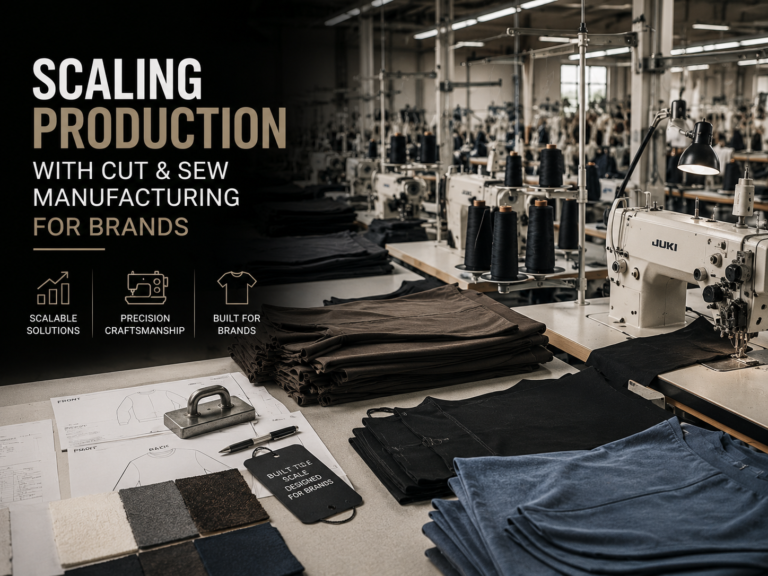
Cut and Sew Manufacturing for Brand must keep up in an ever-changing fashion industry. The best way to gain a competitive edge is with high-quality cut and sew manufacturing for brand. High-quality garments can be efficiently delivered to the market with professional services.

However, cut and sew is more than simply stitching. It is a one-stop shop for fashion businesses. From cutting to stitching to finishing, every aspect is handled with professionalism and reflects the standards of the brand.

Why Rely on Cut and Sew Manufacturing For Brand

More companies have come to rely on cut and sew manufacturing for brand because of their efficient production and commitment to quality. When garments are made to specifications, errors are much less frequent and returns can be avoided.

Advantages of Professional Cut and Sew Manufacturing for brand

  • Quality Consistency – Precise cutting leads to perfectly stitched garments every time.
  • Flexible Scale – Orders of any size can be fulfilled on target deadlines.
  • Brand Vitality – A strong brand focus is achieved when customers select their fabrics, designs, and labels.

For more on how this works, check our Cut and Sew Manufacturing Capability service page.

Integrating Fabric Sourcing and Development

A crucial part of scaling is sourcing the right materials. Fabric sourcing and development ensures your designs are supported by high-quality fabrics suitable for the final garment. Professional partners help:

  • Select fabrics that meet durability and aesthetic requirements
  • Develop unique textiles for brand differentiation
  • Coordinate supply chain to avoid delays

Brands looking to streamline this step can explore our Fabric Sourcing & Development services.

The Role of Sampling and Pattern Making

Sampling and pattern making must be performed before large scale manufacturing. This practice allows the manufacturer to

  • Test and size the required fit
  • Determine if there are any issues with the planned design and how it will be constructed
  • Reduce production costs and eliminate errors

Check out our Sampling & Pattern Making page for detailed insights.

Finishing Touches with Garment Finishing & Packaging

Even with perfect seams, garments are far from ready to be sold. Services include

  • Pressing, folding, and packaging for retail/e-commerce
  • Quality inspections to maintain brand standards
  • Custom labeling for brand consistency

Learn more at Garment Finishing & Packaging.

Conclusion

Scaling production doesn’t have to be a hassle. Partnering with a professional cut and sew service allows brands to produce high-quality garments with efficiency and brand consistency. This method helps both startup and established companies maintain operational efficiency while meeting the market needs.

FAQs

What is cut and sew manufacturing?

It’s a process where fabrics are cut and sewn into finished garments, ensuring quality and consistency.

Can small brands benefit from this service?

Absolutely! Cut and sew manufacturing is scalable and suitable for both small batches and bulk production.

How long does it take to scale production with cut and sew?

Timeline depends on order size, fabric sourcing, and complexity, but professional services optimize efficiency to minimize delays.

Premium Fabrics For Scalable Production

0

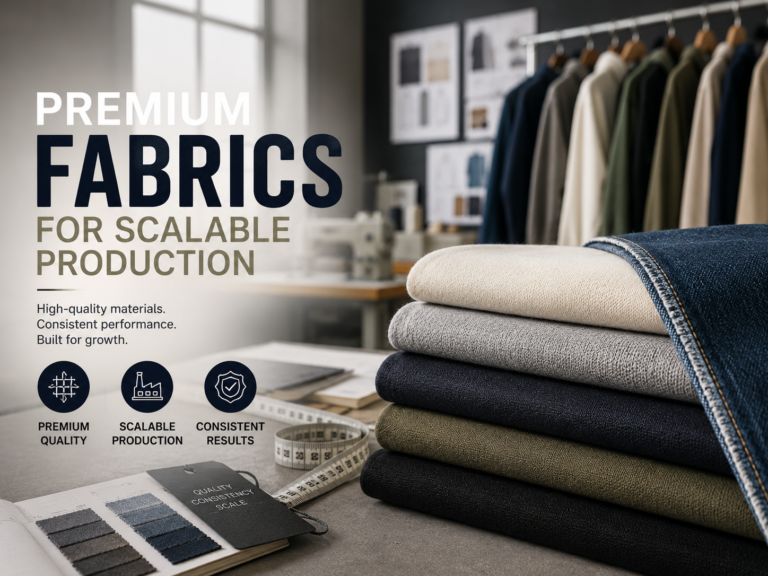
When starting a clothing line, the quality of the fabrics can help associate the line with quality, or with value. Strategic fabric sourcing enables scalable production, allowing brands to elevate their offerings to customers and expand sales without sacrificing quality. Leveraging professional Fabric Sourcing & Development services ensures that every material meets industry standards and aligns with your product vision.

Why Fabric Sourcing Matters For Brands

Premium fabrics elevate the customer and end-user experience with durable, comfortable, and high-end products. Avoiding delays in production, and being able to generate brand loyalty with repeat large orders begins with the identification of a quality supplier early in the design phase. Sourcing and Development services guarantee products meet and exceed customers’ expectations.

As a brand matures and considers scalable manufacturing, the use of high-quality fabrics withstand the rigors of the manufacturing process. Poor sourcing transforms the most elegant design into disappointment.

Steps to Efficient Fabric Sourcing For Scalable Production

Research and Identify Trusted Suppliers

High quality fabric sourced from a supply chain partner who guarantees production contract performance and quality control protects brands from losing value. Consider a trusted partner to guarantee sustainable practices.

Requesting Samples and Testing Fabrics

In assessing the texture and durability of the fabric, sampling provides extensive knowledge about color durability. Many brands will use professional sampling and pattern making services, confident that the fabrics will be able to perform prior to committing to the bulk order. Testing fabric samples saves time for all in the production line and will help avoid costly mistakes.

Align Fabric Choice with Production Needs

Fabric selection must also consider how fabric works with the intended manufacturing process. For example, materials used in sportswear would prioritize technical performance, and fabrics in traditional fashion garments would prioritize lightness and a good drape. Aligning fabric selection with Cut and Sew Manufacturing Capability would assist in efficiently managing production and provide consistency across products.

Negotiate and Secure Supply Agreements

Best practice would be to close contracts with fabric suppliers who wish to ensure fabrics pass testing positively. To scale production, the time it takes to manufacture and deliver the minimum order is directly related to the contractual terms. Brands often use their relationships with OEM and ODM Clothing Factories, to avoid stock-outs.

Benefits of Professional Fabric Sourcing

  • Consistent Quality – Maintaining a uniform look and feel across all units.
  • Cost Effectiveness – Avoiding waste and defective production.
  • Scalability – Improving production levels without sacrificing material and fabric quality.
  • Sustainability – Partnering with suppliers who have eco-friendly practices breaks value classing from the conscious consumer.

Professional assistance through Manufacturing Solutions provides an effective blend of creativity and the operational backbone to sustain a brand.

Conclusion

Finding fabrics for large quantity production is the easy part. Constructing a dependable base for your brand’s growth is essential. Beautiful fabrics are of no use without the knowledge and skill to produce them. Quality, consistency, and scalability are the cornerstones of satisfying your market needs without sacrificing your brand’s integrity.

If you want quality fabrics for your next line, check out our Fabric Sourcing and Development services to build highly quality and purposeful garments.

FAQs

What is fabric sourcing for scalable production?

Fabric sourcing for scalable production is selecting high-quality fabrics that maintain consistency as production increases.

Why is professional fabric sourcing important?

It ensures garment quality, reduces defects, and supports reliable scaling for larger orders.

How do brands test fabrics before mass production?

Brands request samples, evaluate texture, durability, and color fastness, often using professional sampling services.

Which services help with efficient fabric sourcing?

Services like Fabric Sourcing & Development and Production Capabilities streamline the process.

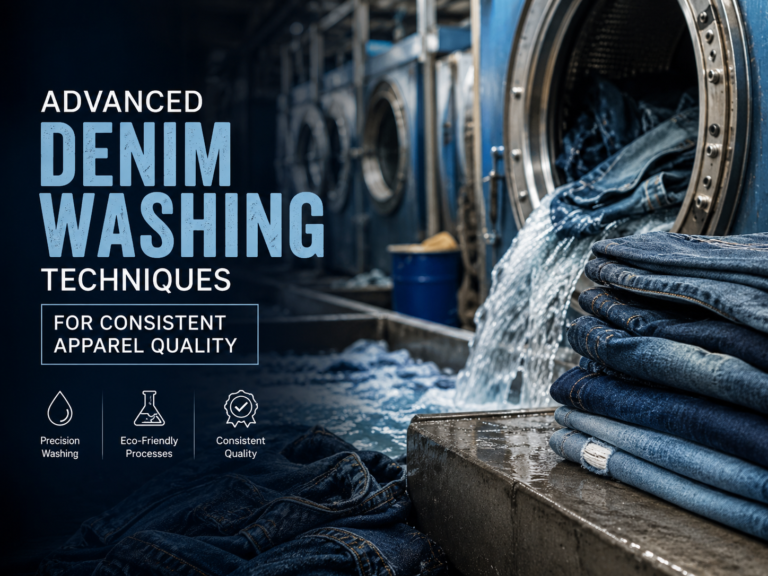
Advanced Denim Washing Techniques for Consistent Apparel Quality

Denim has always been a key part of the fashion industry. However, creating denim garments with the same color, texture, softness, and finish in every production batch can be challenging. Even a small difference during the washing process can affect the final product quality.

That is why professional Denim Washing Techniques are so important in apparel manufacturing. These techniques help brands maintain consistency while also creating the desired look and feel customers expect. From achieving a vintage fade to improving fabric softness, every washing method plays a different role in the final appearance of denim garments.

Brands that work with experienced Washing & Dyeing Services can maintain better quality standards and deliver more reliable products to the market.

Why Consistent Denim Quality Matters

Customers notice quality differences very quickly. If one batch of denim looks darker, feels rougher, or fits differently than another, it can reduce customer confidence in the brand.

For this reason, manufacturers focus heavily on maintaining consistency throughout the washing process. Consistent denim quality not only improves customer satisfaction but also helps brands reduce production issues and maintain a professional image in the market.

A controlled washing process helps manufacturers:

  • Maintain uniform color and texture
  • Improve fabric durability
  • Reduce production defects
  • Deliver consistent garment finishing
  • Build long-term customer trust
  • Minimize product returns and complaints

In addition, consistent production helps factories operate more efficiently and reduce unnecessary material waste.

Popular Denim Washing Techniques Used in Manufacturing

Stone Washing

Stone washing is one of the most widely used Denim Washing Techniques in apparel manufacturing. In this process, manufacturers place pumice stones inside industrial washing machines with denim garments. As the machine rotates, the stones rub against the fabric and create a naturally faded appearance.

This method gives Denim Washing Techniques a soft feel and a timeless vintage look that remains popular in fashion collections. However, manufacturers must carefully control the process because excessive abrasion can damage the fabric and reduce garment durability.

When managed correctly, stone washing creates stylish denim products with a comfortable finish.

Benefits of Stone Washing

  • Creates a classic faded appearance
  • Makes denim softer and more comfortable
  • Adds a fashionable vintage effect
  • Improves the overall garment feel

Factories usually monitor machine speed, washing time, and stone quantity to maintain consistent results during production.

Enzyme Washing

Enzyme washing has become increasingly popular because it provides a softer finish without causing heavy fabric damage. Instead of using stones, manufacturers use biological enzymes to break down surface fibers gently and create a clean washed effect.

Compared to traditional methods, enzyme washing delivers better consistency and supports more sustainable production practices. It also reduces machine wear and minimizes excessive abrasion on the fabric.

Many apparel brands prefer advanced Production Capabilities because controlled enzyme washing helps maintain premium fabric quality across large production runs.

Advantages of Enzyme Washing

  • Produces a soft fabric texture
  • Reduces fabric stress and damage
  • Improves color consistency
  • Supports eco-friendly manufacturing
  • Creates cleaner finishing results

Because of these advantages, enzyme washing is commonly used for premium-quality Denim Washing Techniques collections.

Acid Washing

Acid washing is known for creating bold contrast patterns and dramatic fading effects on denim garments. Manufacturers use special chemicals during this process to produce strong visual textures that stand out in fashion markets.

This technique became highly popular because it creates unique and eye-catching Denim Washing Techniques styles. However, the process requires careful chemical control and proper safety management to protect both the fabric and production staff.

Manufacturers must closely monitor every stage of acid washing to maintain product quality and avoid uneven finishing results.

Factors That Affect Denim Washing Consistency

Fabric Quality and Development

The washing result always depends on the original fabric quality. Different cotton blends, yarn structures, and dyeing methods react differently during washing and finishing processes. Manufacturers that focus on professional Fabric Sourcing & Development can achieve more stable and predictable washing outcomes.

High-quality fabric sourcing helps brands:

  • Maintain even color results
  • Improve garment durability
  • Reduce shrinkage issues
  • Achieve balanced fading effects

Strong fabric development creates a better foundation for every washing technique used during production.

Chemical Management

Chemical control plays a major role in denim washing consistency. Incorrect chemical measurements can lead to uneven fading, shade variations, or weakened fabric strength.

For this reason, experienced manufacturers carefully monitor chemical usage throughout the washing process. Controlled chemical application helps maintain stable production quality while reducing unnecessary fabric damage.

Machine Settings and Process Timing

Industrial washing machines require precise settings to achieve consistent results. Even small changes in washing duration or temperature can create noticeable differences between garments.

Manufacturers usually control:

  • Water temperature
  • Machine rotation speed
  • Washing duration
  • Drying conditions
  • Chemical dosage levels

Accurate process management helps factories maintain consistency across large production volumes.

Skilled Production Teams

Experienced technicians play an important role in denim manufacturing. Skilled teams understand how fabrics respond to different washing treatments and can quickly adjust processes when needed.

Manufacturers that follow structured Manufacturing Process systems often produce more reliable and consistent denim products.

Sustainable Denim Washing Solutions

Sustainability has become a major focus in modern apparel manufacturing. As a result, many brands now prefer eco-friendly denim washing techniques that reduce water usage and minimize chemical waste.

Several sustainable washing solutions are becoming more common in the industry, including:

  • Ozone washing
  • Laser finishing
  • Eco enzyme treatments
  • Water recycling systems
  • Low-impact dyeing methods

These advanced solutions help manufacturers improve environmental performance while still maintaining high-quality garment finishing.

Many factories also follow strict QC Standards Resources to ensure consistency throughout sustainable production processes.

Image Prompt

Eco-friendly denim washing facility with advanced water recycling systems and sustainable textile manufacturing equipment

Quality Control in Denim Washing

Quality control is essential in denim manufacturing because it helps maintain consistency across every production batch. Manufacturers inspect garments throughout the washing process to identify issues before products reach the market.

Common quality inspections include:

  • Shade consistency testing
  • Shrinkage evaluation
  • Fabric strength checks
  • Softness inspection
  • Chemical residue testing

Strong quality management systems help brands reduce production errors, improve customer satisfaction, and maintain long-term product reliability.

Conclusion

Professional denim washing techniques play a critical role in modern apparel manufacturing. From stone washing to enzyme treatments, every process affects the final appearance, softness, and durability of denim garments.

Brands that invest in advanced washing technologies, skilled production teams, and proper quality control can maintain consistent product standards while meeting customer expectations. As the denim industry continues to evolve, controlled and sustainable washing processes will remain essential for producing premium-quality apparel.

What are denim washing techniques?

Denim washing techniques are manufacturing processes used to improve the appearance, softness, texture, and finish of denim garments.

Which denim washing method is considered eco-friendly?

Enzyme washing and ozone washing are considered more sustainable because they reduce water usage and minimize fabric damage.

Why is consistency important in denim washing?

Consistency helps brands maintain the same color, softness, durability, and garment quality across all production batches.

Can stone washing damage denim fabric?

Yes, excessive stone washing can weaken denim fabric if the process is not properly controlled.

How do manufacturers maintain denim washing quality?

Manufacturers maintain quality through controlled machine settings, proper chemical management, skilled technicians, and detailed inspections.