Motorcycle pants are one of the more specialized items on the spectrum of motorcycle apparel. There is a lot of challenge associated in the design and manufacture of motorcycle pants features, accommodate the ergonomics of sitting for extended periods of time, and satisfy the design preferences casual situations. The custom design and manufacture of motorcycle pants means that brands have to make a lot of trade-offs and directional decisions in areas of textile selection, armor pocket construction, sizing, and the overall construction of the garment to segment the market for motorcycle riders who want motorcycle pants that offer protection, and pants that are comfortable to wear on a daily basis.
The Need for Expertise in Manufacturing Custom Motorbike Pants
No other type of lower-body clothing on the market can replicate the unique set of demands that motorbike pants are required to satisfy. They need to be comfortable for the rider over long periods of time.They also have to be aesthetically pleasing, as more riders are starting to favor pants that look good on the bike and in everyday life, as opposed to requiring a complete change of clothes. Custom motorbike pants manufacturing also requires the manufacturing partners to understand all of the requirements that motorbike pants have and cannot sacrifice one for the other.
Considerations for Fabric in Custom Motorbike Pants Manufacturing
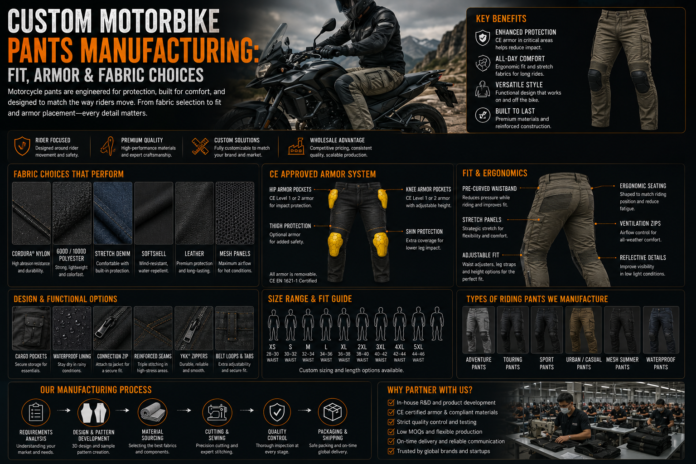
In custom motorbike pants manufacturing, the type of fabric that is chosen is one of the biggest decisions that have to be made. The type of fabric will affect the comfort of the pants, how aesthetically pleasing the pants are, and how protective the pants are. It will also affect the pants’ ability to withstand the weather.
Leather
Compared to other materials leather is the most abrasion resistant which is appealing to many riders making leather pants one of the most popular choices. Racing leather pants are usually made of cowhide because they provide the best protection during high speed impacts. Cruiser leather pants are usually made of soft hides to maximize comfort and may provide protection greater than traditional textile pants. Lastly, leather pants are great for systems with leather jackets and have consistent material and design across the collection and packaging.
Cordura and High-Tenacity Textile Fabrics
Two of the biggest materials for making custom motorbike pants are Cordura nylon and high-tenacity polyester and dominate among adventure and touring pants for their ability to incorporate waterproof membranes, removable liners, and ventilation among other features that leather does not facilitate easily. In addition, these pants use higher denier Cordura grades which are lightweight and provide better abrasion resistance than leather making it a better choice for long distance rides. Therefore, for brands developing adventure motorcycle apparel or touring motorcycle apparel ranges are likely to use these materials as the outer shell for their pants.
Denim and Aramid Fiber Reinforced Fabrics
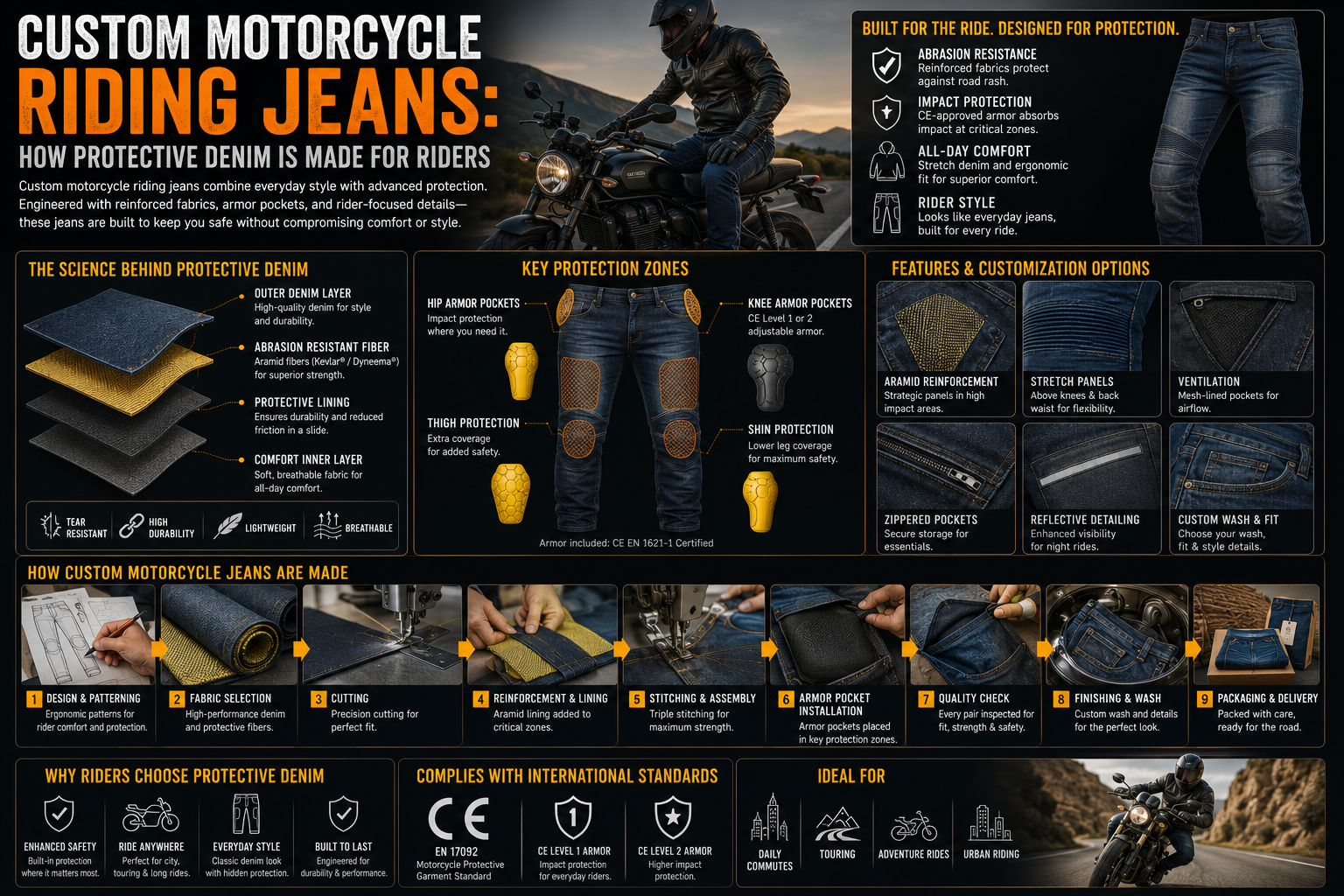
Denim-inspired riding pants are becoming one of the most popular fabrics used in the creation of bespoke motorcycle pants. This is because denim-inspired riding pants solve the problem that urban and cruiser riders have with pants that look like traditional denim jeans while also offering riders a high level of protection. Furthermore, motorcycle riding jeans with integrated hip and knee armor pockets extend this protection approach into a complete protective garment that serves urban and cruiser riders across both riding and everyday lifestyle contexts.
Softshell and Stretch Technical Fabrics
Softshell and Stretch Technical Fabrics used in manufacturing custom motorbike pants apply to urban and touring settings where comfort and ease of movement are of primary importance and basic protection and weather resistance are secondary. These fabrics accommodate 4-way stretch to allow the full range of motion of the riding body without the stiffness of Cordura constructions, resulting in a wearing experience closer to premium lifestyle trousers than to regular motorcycle trousers. Also, softshell construction traditionally has wind resistance and light water repellency without the need for separate membranes, which not only prevents the weight of the garment from increasing, but simplifies the construction of the garment when compared to the construction of fully waterproof textile pants.
CE Armor Integration in Custom Motorbike Pants Manufacturing
Integration of protective armor more directly influences the safety performance of custom motorbike pants than any other construction element, and at this level of quality the standards must accommodate the real impact scenarios that a rider could encounter in a crash or incident.
Designing Knee Armor Pockets
The knee armor is an essential feature of motorcycle pants because the knee is the most likely area of the body to sustain an impact in a motorcycle crash, regardless of crash speed or type of riding. Protection offered by CE Level 1 knee armor is generally sufficient for most road riding. CE Level 2 armor is appropriate for faster riding and riding on the track. Pocket designs need to position knee armor at the knee joint for each range of riding pant length and rider height and leg length. Therefore, the design of the knee armor pocket in riding pants must show placement of the knee pocket design on a sufficient range of riders during the sampling phase.
Integrating Hip Armor
Integrating hip armor into custom motorcycle pants accounts for the significant risk of hip injury from direct impact during a motorcycle crash, as does the design of hip armor pockets. However, there is more variability in how riding pants sit on the body during riding, as a result of rider hip width, waist size, and riding posture when compared to the design of knee armor pockets. Considerable design trade-offs of varying the depth of the armor pocket and the weight of the outer fabric of the pants are required to fulfill the design needs of riders who are style conscious.
Back and Calf Protection Options
Certain tailored motorbike pant programs go beyond offering knee and hip padding to provide back-of-knee and calf padding. These coverings are designed to address particular riding injuries. While back-of-knee and calf padding are not prescribed in most riding categories, track and sport riding pants are including these as padding, as riders are beginning to recognize the danger of lower leg injuries in high-speed riding. Therefore, brands that design pants for sport and competitive riding should consider the extended armor coverage and the protection expectations of the clients in the riding community as well as the safety regulations in the markets where they operate.
Fit Engineering in Custom Motorbike Pants Manufacturing
Fit development in custom motorbike pants manufacturing must address the ergonomic demands of the seated riding position while maintaining comfort, appropriate coverage, and aesthetic character across the full range of body types the pants are designed to serve.
Riding Position Ergonomic Adjustment
The seated motorcycle riding position bends the knees significantly, raises the thighs, and tilts the pelvis forward in ways that create specific fit challenges for pants patterns developed from standard trouser templates without riding-specific adjustments. Back rise must extend sufficiently to maintain waistband coverage during the seated position without creating uncomfortable bunching at the waist when the rider stands upright. Additionally, thigh and calf circumference measurements must account for the additional volume required for armor panels and lining systems while maintaining a silhouette appropriate for the pants’ aesthetic positioning.
Knee Armor Alignment Across Rider Heights
Because knee joint height varies significantly across the rider height range that any given pants size serves, knee armor pocket placement cannot be optimized for a single rider height without producing misalignment at the extremes of the size range. Quality custom motorbike pants manufacturing addresses this through adjustable knee pocket systems that allow riders to position armor vertically within the pocket to align correctly with their individual knee joint height, or through closely spaced size grading that reduces the knee height variation within each size. Consequently, brands developing pants across comprehensive size ranges must address knee alignment variability explicitly in their manufacturing brief rather than assuming a single pocket placement serves all riders within a size.
Waistband and Adjustment Systems
Waistband construction in custom motorbike pants manufacturing must maintain secure pants positioning during riding without creating discomfort during extended seated use. Elasticated waistband sections, external adjustment straps, and internal lacing systems each offer different comfort and security profiles across different rider body shapes and riding styles. Furthermore, jacket-to-pants connection systems using perimeter zip connections or hook-and-loop overlap systems at the waistband significantly improve lower back coverage during riding and prevent gap exposure at the jacket-pants transition zone that unreinforced waistbands allow.
Construction Features That Define Quality Custom Motorbike Pants
Beyond fabric and armor choices, specific construction details determine how well custom motorbike pants perform across the combined demands of rider protection, long-duration comfort, and everyday wearability:
- Gusseted crotch construction: Reinforced gusset panels at the crotch seam significantly improve comfort during the spread-leg riding position while preventing premature seam failure at the highest-stress construction point in motorbike pants.
- Inner leg abrasion reinforcement: Abrasion-resistant reinforcement panels along the inner leg and seat areas protect against friction from the saddle surface during extended riding and prevent premature outer fabric wear in the highest-contact zones.
- Stretch panel placement: Four-way stretch panels at the back of the knee, inner thigh, and across the lower back allow dynamic movement freedom without compromising the structural integrity of protective outer shell panels.
- Reflective element integration: Reflective ankle, knee, and hip details improve rider visibility during night riding without requiring separate high-visibility garments.
- Waterproof hem and ankle systems: Sealed hems and adjustable ankle closures prevent water ingress along the trouser leg during rain riding, complementing membrane waterproofing in fully weatherproofed constructions.
- Cargo and utility pocket engineering: Functional pocket placement that remains accessible during riding without interfering with armor pocket positions or creating pressure points during the seated position.
Coordinating Custom Motorbike Pants Across a Complete Product Range
Custom motorbike pants rarely function as standalone products in successful motorcycle apparel ranges, since riders typically purchase pants as part of a coordinated jacket and pants system that provides consistent protection and aesthetic character across both garments. Brands developing motorbike jackets manufacturing programs should develop coordinated pants ranges that match jacket materials, colorways, and armor specifications to create complete outfit systems. Additionally, leather motorcycle jackets naturally coordinate with leather motorbike pants, while textile motorcycle jackets pair effectively with Cordura or high-tenacity textile pants in matching technical fabric constructions.
For brands serving diverse rider segments, motorcycle riding jeans extend the pants range into urban and cruiser riding segments that prefer denim aesthetics alongside basic protection. Additionally, motorcycle suits and racing suits represent the performance extension of the motorbike pants category for brands whose positioning supports track and competition applications. For the complete range of motorcycle apparel manufacturing capabilities, the full motorcycle apparel collection helps brands identify manufacturing partners with comprehensive category expertise across all lower-body protection products.
Engage a Reliable Manufacturer for Tailored Motorcycle Pants
To produce tailored motorcycle pants that combine protective features, comfort, and style, a skilled manufacturing partner is necessary. Protective engineering and rider ergonomics are the bare minimum required for the manufacturing partner to have the capability to undertake large scale, complex customization of armor integration, and fit refinement for the comfort of everyday use. No matter if your brand focuses on developing leather sports pants, Cordura touring pants, urban riding jeans in denim, or plans to launch a complete, multiple category range of pants, the right manufacturer will help ensure that all the construction details of each product feature addresses and solves the real needs of motorcycle riders.
Conclusion
A pants range for motorcycle riders needs to offer a high level of protection and comfort during long rides. To achieve this, a manufacturing partner that has mastered the art of combining technical stretch options, Leather, Cordura, and Aramid fabrics, along with reinforced Denim is needed. Comfort and protection will also be determined by construction details such as a gusseted crotch, adjustable armor pockets, and a fit refinement framework. Developing a matching range of jackets for the pants will help create a packaged outfit which will also improve the range of products a brand offers.
FAQs
What fabric is best for custom motorbike pants manufacturing?
The best fabric depends on your target riding category. Leather provides maximum abrasion resistance for sport and cruiser riding, Cordura nylon suits adventure and touring applications that require weather versatility, and aramid-reinforced denim serves urban and casual riders who prefer everyday aesthetic integration alongside meaningful protection.
What CE armor is required in motorbike pants?
CE Level 1 knee and hip armor represents the minimum standard for serious motorbike pants, with CE Level 2 appropriate for sport and track-oriented constructions where higher-severity impacts are more likely.
How do manufacturers ensure knee armor aligns correctly across different rider heights?
Quality manufacturers address knee alignment variability through adjustable knee pocket systems that allow riders to position armor vertically, or through closely spaced size grading that limits knee height variation within each size.
How important is gusseted crotch construction in motorbike pants?
Gusseted crotch construction is critically important because the spread-leg riding position places extreme stress on the crotch seam that standard trouser construction cannot withstand reliably across regular riding use.