Developing protective riding gear manufacturing apparel is among the most complicated and highly regulated segments in any segment of the global apparel industry. For wholesale buyers, understanding CE armor standards, design and material approvals, and production requirements is critical to ensure their purchasing strategy is aligned with their brand’s competitive positioning, especially when making bulk purchases. Unlike typical apparel manufacturing—where visual appeal and quality are the main determining factors—manufacturing motorcycle protective apparel involves the design and construction of a garment that is legally compliant to marketed safety testing (i.e., specialized safety garment compliance) within, particularly, the EU and UK regulated markets.
CE Certification in Protective Riding Gear Explained
More than any other protective apparel category, the CE mark is the legal safety compliance certification for the protective riding apparel and protective riding gear landscape in the regulated markets. For any wholesale buyer looking to enter this category of protective riding apparel, this will be the most critical step in determining the safety compliance certification of protective riding gear.
Requirements for Motorcycle Apparel per EN 17092
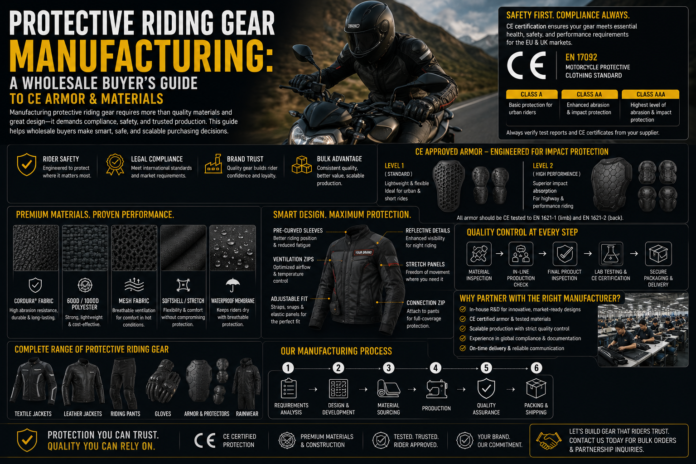
EN 17092 is the European standard for assessing the performance of motorcycle protective clothing. The standard covers garments used to make protective jackets or trousers or full suits, as well as upper and lower body garments. Each of these is assigned a performance level based on the results of tests for seam strength, impact protection, and abrasion resistance.
The standard identifies three major classes of motorcycle garments. Class A applies to garments used to cover protective clothing used for urban or lower speed riding, and require the base level of seam strength and abrasion resistance. Class AA includes garments used for general commuting or road use, requiring full garments of higher seam construction and abrasion resistance. Finally, Class AAA includes garments used for high performance touring or track riding, requiring the full construction of the greatest seam integrity and abrasion resistance.
Furthermore, CE certification applies to the complete finished garment — not individual materials or components in isolation. Consequently, a jacket constructed from a certified fabric but assembled with inadequate seam construction will fail CE testing regardless of the material’s individual certification status. Our protective riding gear supplier team manages the complete CE certification process for wholesale buyers — contact us today to discuss your certification requirements.
What’s The Difference between CE Level 1 and Level 2 Armor?
CE certified armor inserts come in Levels 1 and 2. Differentiation is based upon the performance of the armor in the context of impact attenuation and how much energy is absorbed during a standardized impact test.
Level 1 armor inserts take some impact energy and have a transmitted force of 35 kilonewtons. Level 1 armor is adequate for armor used in general road and urban commuting scenarios. Level 2 armor inserts take impact energy to a transmitted force of 20 kilonewtons. Level 2 armor provides better protection for more risky and high speed riding scenarios.
In addition, armor inserts are certified to specific body locations (knee, hip, shoulder, elbow; back) as the geometry and thickness, as well as retention, vary at every protection zone. Potential buyers should ensure that armor level and location are provided as requirements in a product brief, and should do so prior to any product sampling.
Approved Construction Materials for Protective Riding Gear
CE certified protective riding gear relies heavily upon material selection. Each of the material layers (shell, liner and armor) has to be constructed from materials that will meet required standards and provide the protective characteristics for that layer.
Outer Shell Materials
An outer shell makes initial contact when a rider slides on the road. The material that makes up the outer shell impacts the CE classification. While full grain leather, grading 1.0 to 1.4 millimeters in thickness, is the industry standard, full grain leather, due to its structure, does a better job of heat control during an extended contact with the road.
Additionally, premium outer shells made from high-tenacity nylon or polyester that are 500 to 1000 denier constructions both provide CE compliant abrasion resistance and are lighter, more easily packable than leather outer shells. Of all the technical fabrics, Cordura is the most popular and most used outer shell material. in protective riding gear — offering an established track record of CE test performance across jacket, trouser, and suit applications.
For brands developing leather motorcycle jacket manufacturing alongside textile alternatives, the material selection determines not just the protection level but the entire product positioning — leather for premium traditional motorcycle aesthetics, textile for touring and adventure riding versatility. Contact our team today to discuss outer shell material options for your riding gear range.
Protective Liner Materials
Liners are positioned between the outer shell and the wearer and provide abrasion resistance where the outer shell contacts the wearer’s skin. Most textile, and some leather, outer shells, do not provide sufficient abrasion resistance for skin-contact zones.
Aramid fibers, including Kevlar, Twaron, and para-aramid, are the most common liner materials found in certified protective riding apparel. They are highly resistant to abrasion and heat, and they maintain protective integrity at the friction and heat of prolonged contact with the road.
Armor Insert Materials
CE certified armor inserts are predominantly composed of two families of materials, hard shell composites and soft viscoelastic foams. These two families of materials provide different wearing characteristics and fulfillment of the requirements of certified impact protection.
Soft armor inserts, which can be made of viscoelastic polyurethane or D3O, are body conforming in the normal state. This provides a flexible and comfortable wearing experience. Upon impact, these inserts foam and fortify armor. Because they are thinner, lighter, and more comfortable, soft armor has dominated motorcycle riding jeans, hoodies, and apparel designed for everyday use with riding protection.
Our motorcycle suits manufacturer team sources CE-certified Level 1 and Level 2 armor inserts across both hard shell and soft viscoelastic constructions — contact us to discuss armor specifications for your wholesale protective riding gear order.
Construction Standards That Determine CE Compliance
While material selection plays an essential role in meeting CE requirements, it is not enough on its own. The construction methods of protective riding gear determine whether assembled garments meet junior class CE requirements for seam strength and protective coverage.
Seam Strength
EN 17092 offers a set of minimum requirements for the strength of seams found in motorcycle protective garments which must be defined with a measurement in Newtons. Most seam constructions for traditional apparel fall below these requirements, thus the wholesale buyer should demand seam constructions specific to motorcycle protective garments, as opposed to assuming standard seam constructions would be sufficient.
In the majority of constructions of protective clothing, structural seams (inseam, outseam, shoulder seams, sleeve attachment seams, etc.) of clothing may be stitched two or three times and meet EN 17092 seam strength requirements. Along with the number of stitches, the type of thread used is also important, as high tenacity nylon or polyester must be used as opposed to the standard thread used in clothing construction.
Protective Coverage Zones
According to EN 17092, there are certain defined body zones that must be covered by materials resistant to abrasion in a given class, and in the finished garment, the liner and outer shell may not exceed the boundaries of these defined zones.
Pattern grading across sizes should maintain the protective coverage zones the correct positions relative to the rider’s body, not just keep the protective coverage zones the aesthetic silhouette of the protective coverage zones of the garment. Pattern grading across sizes should be a specialist area of expertise. Brands should confirm their manufacturing partner has this expertise before committing to bulk production. Our racing motorcycle apparel manufacturing team applies EN 17092 coverage zone requirements across all protection classes — reach out today to discuss your CE compliance requirements.
What Wholesale Buyers Must Evaluate Before Ordering
When placing wholesale orders for protective riding gear, these critical factors determine both the compliance of the finished product and the commercial success of the range in regulated markets:
- CE certification class — confirm Class A, AA, or AAA requirement for your target market and riding application before any sampling begins
- Armor level specification — Level 1 or Level 2 at each protection zone must be confirmed in the product brief and verified in the finished garment
- Outer shell material certification — confirm that the specified shell material has been tested and achieves the abrasion resistance required for the target CE class
- Liner material and coverage — confirm aramid or UHMWPE liner material and verify that liner coverage reaches EN 17092 zone boundaries across the full size range
- Seam construction specification — confirm double or triple stitching with high-tenacity thread at all structural seams before sampling begins
- Testing laboratory — confirm which notified body will conduct CE testing and ensure the manufacturer has an established relationship with an approved testing organisation
- Documentation package — CE-marked products require a technical file including test reports, material specifications, and quality management records that must accompany every wholesale shipment
Building a Protective Riding Gear Range for Wholesale
Wholesale buyers developing a protective riding gear range achieve the strongest commercial results when they build across complementary product types that serve the complete rider wardrobe. A riding jean that meets Class AA certification pairs naturally with a motorbike jacket at equivalent certification level — giving the rider a complete upper and lower body protection system from a single brand.
Furthermore, extending the range into textile motorcycle jackets alongside leather alternatives, and adding motorcycle rainwear for weather protection over the base protective layer, creates a comprehensive riding apparel system that serves riders across every riding context and weather condition.
Additionally, incorporating motorcycle base layers into the range provides the thermal management layer that serious riders need beneath their protective outer garments — completing the full riding apparel system from next-to-skin comfort through to outer weather protection.
Ready to develop your protective riding gear range for wholesale? Contact our manufacturing team today — we support wholesale buyers at every stage from CE certification planning and material selection through sampling, bulk production, quality control, and documentation package preparation.
Conclusion
Riding gear manufacturers have to be more knowledgeable than manufacturers of other types of apparel because they have to understand the details of protective and certified materials and technical construction of apparel, and CE certification standards. The most important thing you can do to bring a technologically and legally advanced range of protective riding gear to the market is to work with a partner who understands EN 17092, uses certified materials, and implements CE compliance at every stage of the manufacturing process.
When you are ready to develop your protective riding gear collection, explore the full range of protective riding gear manufacturing options and connect with our team to start your wholesale production journey today.
FAQs
What is CE certification in protective riding gear manufacturing?
CE certification under EN 17092 is the legal standard governing motorcycle protective clothing in the European Union and United Kingdom — classifying garments into Class A, AA, and AAA performance levels based on abrasion resistance, seam strength, and impact protection testing.
What is the difference between CE Level 1 and Level 2 armor?
Level 1 armor transmits a maximum force of 35 kilonewtons during standardised impact testing — suitable for general road use. Level 2 armor transmits a maximum of 20 kilonewtons — providing substantially better impact protection for higher-speed and more demanding riding applications.
What outer shell materials are used in CE-certified motorcycle apparel?
Full-grain leather in 1.0 to 1.4 millimetre thickness and high-tenacity Cordura nylon in 500 to 1000 denier constructions are the most widely used outer shell materials — each delivering CE-compliant abrasion resistance for different product positioning and riding style applications.
What liner materials meet CE abrasion resistance requirements?
Aramid fibres including Kevlar and Twaron and ultra-high-molecular-weight polyethylene fibres including Dyneema are the most widely certified liner materials — both delivering the abrasion resistance and heat management required for CE compliance across Class A through AAA certification levels.