Home Blog Page 30

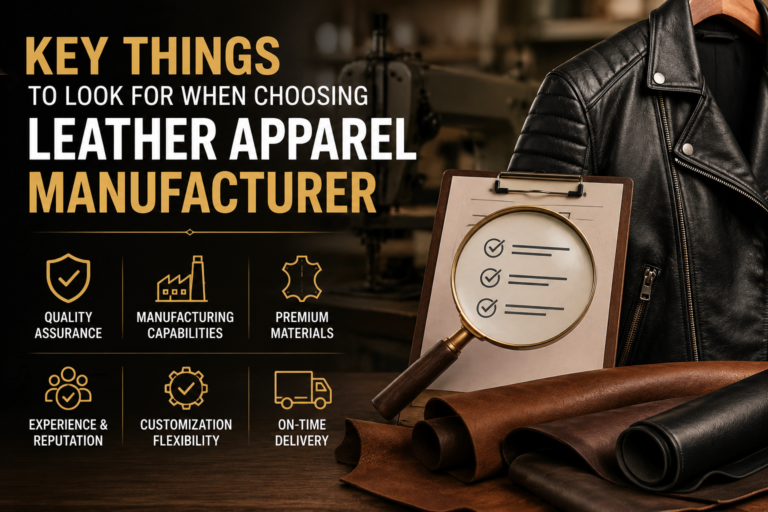
Key Things to Look for When Choosing Leather Apparel Manufacturer

0

Leather mistakes are permanent. Unlike textiles, leather offers little room for error. A wrong cut, uneven seam, inferior hide, or poor craftsmanship can ruin the entire product with no easy fix.

That is why choosing leather apparel manufacturer carefully is one of the most important decisions for any brand. The right manufacturer becomes a reliable partner that delivers consistent leather quality, expert craftsmanship, and dependable production standards. A poor manufacturing choice, however, can lead to costly mistakes, product delays, and major financial losses.

This guide is meant to help you select a leather manufacturer and make that decision with confidence.

Leather differs from fabric.
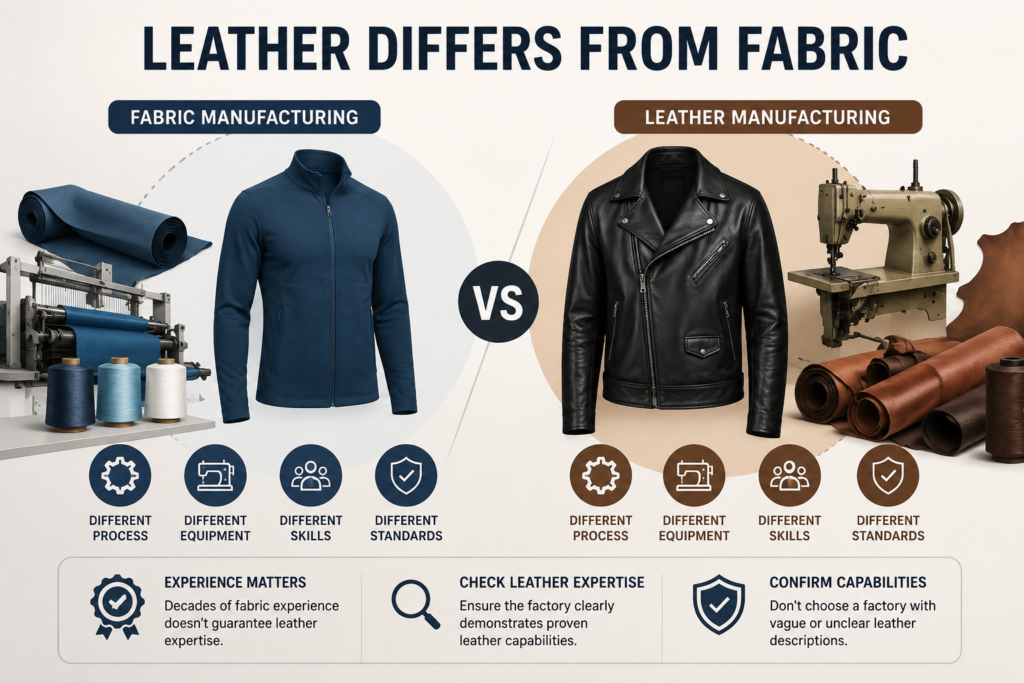
Comparison between fabric and leather manufacturing showing different equipment, production methods, stitching skills, and leather jacket construction processes.
Leather apparel manufacturing requires specialized equipment, craftsmanship, and production expertise different from standard fabric garment manufacturing.

Manufacturing leather as opposed to fabric is completely different. When it comes to fabric, you have a different process, different equipment, different skills and different standards of quality.

Just because the same factory is making polyester activewear doesn’t mean they can also make leather jackets. There are many kinds of cutting, stitching and finishing. While some equipment for making jackets is also applicable for leather, that factory will probably have decades of experience in fabric.

This is why you should place extreme importance on experience. The first thing you should confirm is that the factory you are evaluating does not have a vague description of its capabilities in leather.

Verify Leather Sourcing and Hide Quality

The quality of leather can be highly variable.

The pinnacle of leather quality is full-grain leather.

Full-grain leather retains the natural imperfections or markings in the hide and ages to a deep, rich colour. Then you have top-grain leather. Top-grain leather is altered the most and gets sanded and finished to provide a smoother surface. Genuine is a lower quality leather and is produced from the remaining layers after the top grades are taken off. Lastly, we have bonded leather, which is commonly used in apparel.

A credible leather apparel manufacturer will be completely transparent about which grade of leather they source, where it comes from, and how it is tanned. Ask specifically about tanning method — chrome tanning is faster and more common, while vegetable tanning is slower, more expensive, and more environmentally responsible.

If a manufacturer is vague about their leather sourcing, that’s a serious red flag.


Assess Their Range of Leather Products

A manufacturer’s product range tells you a lot about their actual capabilities. A factory that only produces leather belts and bags is a very different operation from one that produces full leather jackets, coats, and pants.

Look for a manufacturer who covers the full spectrum of leather apparel. Experience across leather jackets, leather coats, leather pants, and leather vests indicates a factory with broad technical capability — one that can handle the complexity of full garment construction, not just simple accessories.

Ask to see samples across their product range. A factory confident in its work will show you examples without hesitation.


Evaluate Stitching and Construction Quality
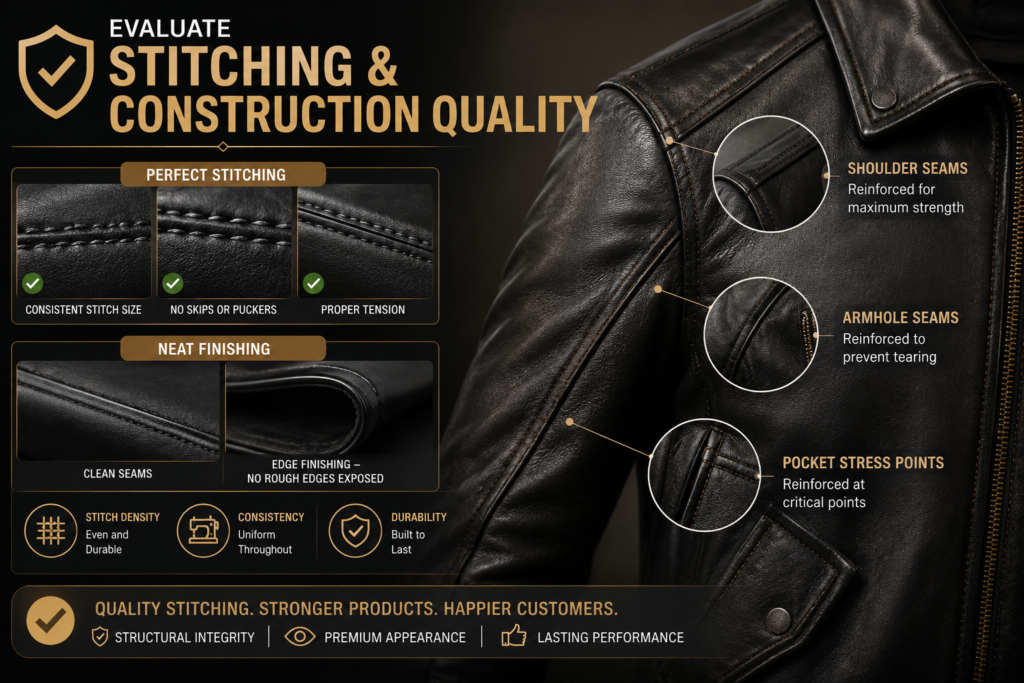
Close-up leather jacket stitching quality inspection showing reinforced seams, clean edge finishing, consistent stitch density, and durable leather construction details.
High-quality leather apparel depends on precise stitching, reinforced stress points, and clean seam finishing for durability and premium construction.

Stitching is quite literally everything with leather. It’s structural yet also aesthetic. It’s a clear indicator of a factory’s ability.

Stitch density, consistency, and tension are important. Stitches need to be the same size and have no skips or puckers. Seam and edge finishing need to be performed neatly and the rough edges should not be exposed.

Evaluate the reinforcement of sewing at points of stitch stress. This is typically the shoulder seams, the seams of armholes, and the seam points of pockets.

Check Hardware and Finishing Standards

A quality leather product will have quality zippers, buttons, buckles, and snaps.

Ask you about the sourcing of the hardware. YKK brand zippers are typically a good sign of quality. Ensure all zipper, button, and snap hardware is functioning and the snaps are closing. Also, ensure all the buttons and snaps are even.

A manufacturer producing leather bags and leather belts alongside apparel often has stronger hardware sourcing relationships — because accessories demand consistent hardware quality across every unit.


Understand Their Quality Control Process

Quality control in leather production is more complex than in standard fabric manufacturing. Every hide is unique, which means variation in texture, thickness, and colour is inherent to the material. A good manufacturer manages this variation systematically rather than hoping it won’t matter.

Ask how they inspect hides before cutting. How do they manage colour and texture matching across a single garment? What happens to panels cut from hides with natural imperfections? How is each finished garment checked before packing?

A leather gloves manufacturer or accessories producer with strong QC systems — where consistency across pairs and sets is critical — brings that same rigour to apparel production.


Sample Before You Commit to Anything

There’s no need to purchase an entire bulk order just to see how well a factory meets your needs. You owe it to yourself to sample first.

Place your order per the particulars of your desired leather grade, your construction requirements, and your chosen hardware. You must examine every element. Consistency of the leather surface must be tested. Evaluate the surface of the stitching and the alignment. Wear the finished product to see how well the garment fits, how the lining feels, and how the hardware works.

You should be prepared to justify the sampling process. Anyone trying to undue the sampling process and skip to bulk production is letting you see how they feel about quality.

Conclusion

Choosing leather apparel manufacturer are committed to producing quality leather apparel. They are flexible when it comes to providing samples.

You need to judge leather apparel manufacturers by how well they meet leather quality. Fulfill your requirements by maintaining the highest standards.

When you’re ready to move forward, explore the full range of leather apparel manufacturing options and find the right partner for your brand.


FAQs

What makes leather apparel manufacturing different from fabric garment production?

Leather requires specialist cutting techniques, different stitching methods, and specific finishing processes — as well as hide quality management that doesn’t exist in fabric production.

What leather grades should I look for in apparel manufacturing?

Full-grain and top-grain leather are the most suitable for quality apparel. Avoid bonded leather for anything beyond very budget-oriented products.

How do I evaluate stitching quality on leather samples?

Look for uniform stitch length, consistent tension, clean edge finishing, and reinforcement at stress points like shoulder seams and pocket attachments.

Why does hardware quality matter in leather garments?

Hardware is both functional and aesthetic. Cheap zippers, snaps, and rivets undermine even the best leather — and fail faster under regular use.
How OEM Clothing Manufacturing Works Step by Step

0

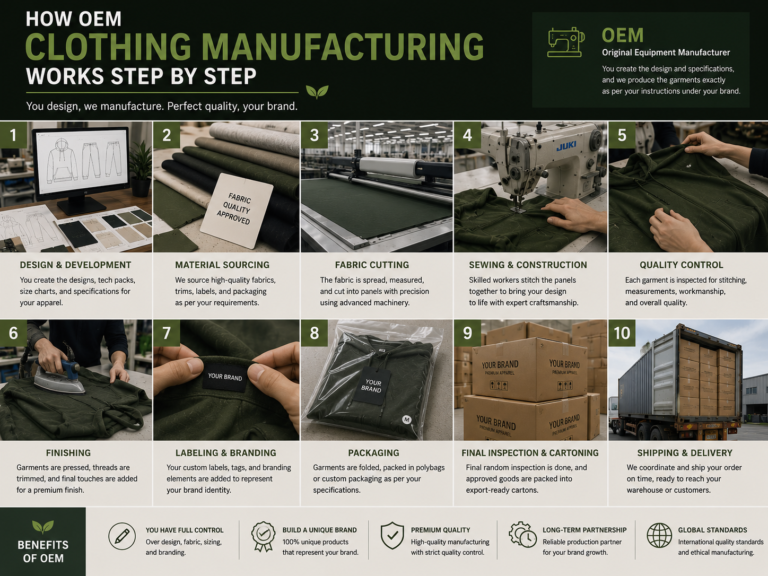
OEM clothing manufacturing offers a way to completely control your designs and what’s in your clothing line. Factories construct your designs using your sketches and specifications. There are multiple steps to OEM manufacturing that are not needed with ready-made clothing. However, those steps help build more brand value, and partners like ECO JERSEY help you move smoothly through them.

Create Your Design Concept

Creating your own designs and sketches is how OEM clothing manufacturing starts. OEM sketches are more than just images as they combine shapes of necklines and pockets. Consider using an app or a sketchpad. Then select a color palette and the aesthetic to help build the mood for your collection as the idea will help factory workers stay on course.

Build Detailed Tech Pack

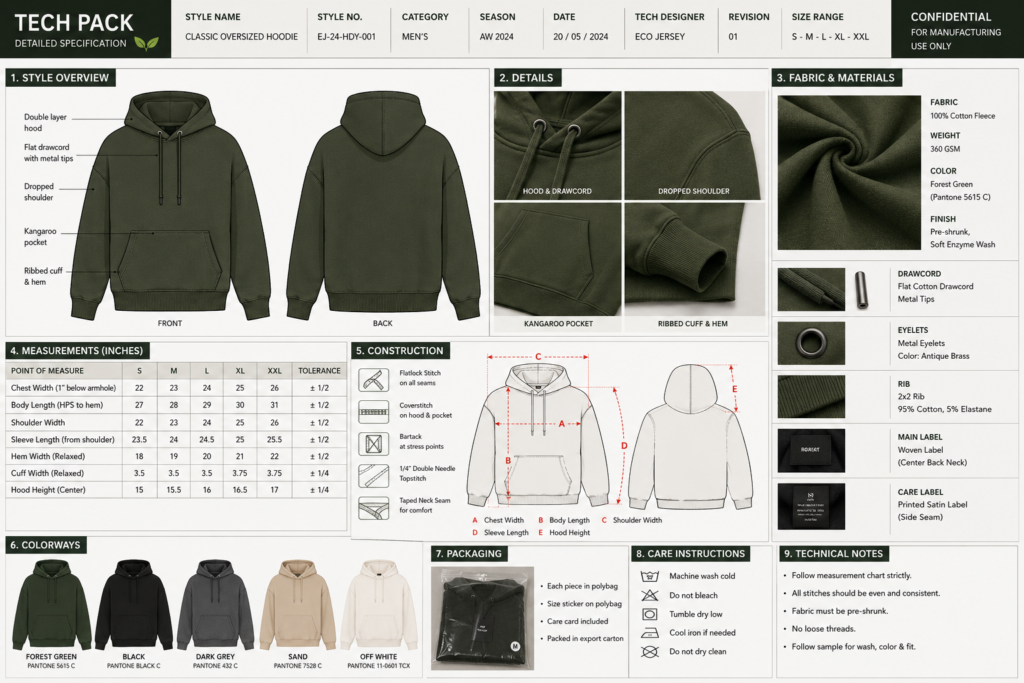
Detailed hoodie tech pack layout showing garment specifications, measurements, construction details, and design callouts for apparel production.
A detailed hoodie tech pack layout used to communicate design, sizing, and production specifications for manufacturing.

The next step of how OEM clothing manufacturing works is creating a detailed tech packs. Tech packets must include everything specific to the design like the weight of fabric along with the type of stitches and seams, as well as the measurements. For the factory to build a design, it must be a blueprint to the design. One of the ways you can organize your tech packet is through the use of Tec packer.

Source Fabrics and Materials

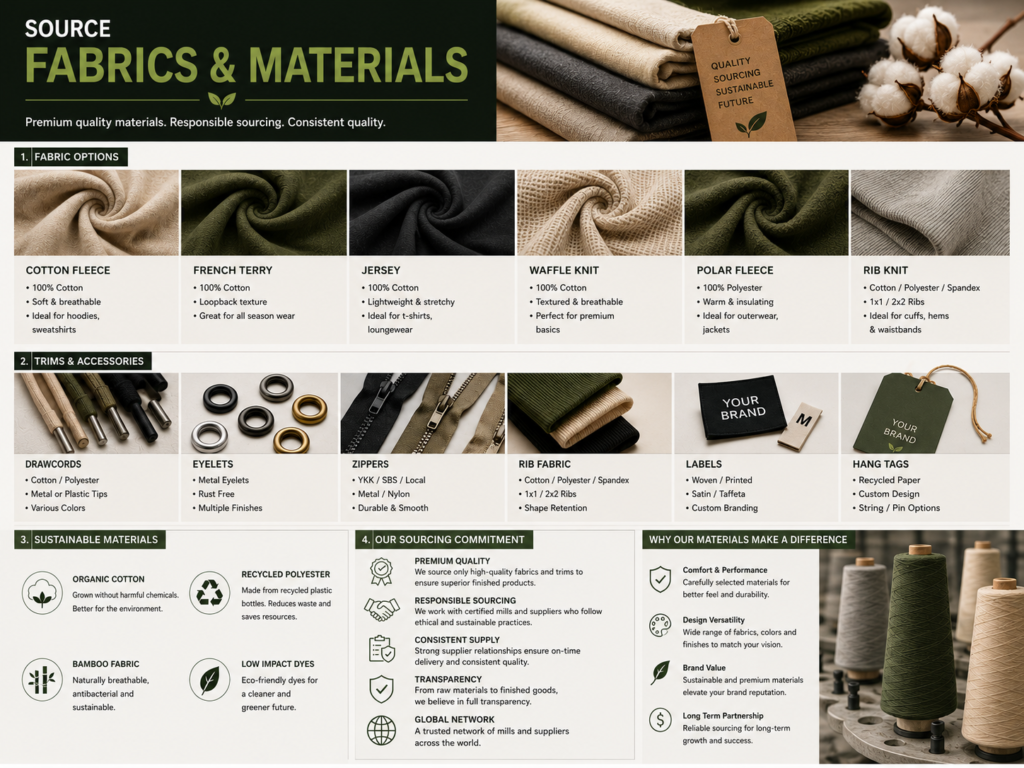
Premium fabric and material sourcing for clothing manufacturing, highlighting quality textiles selected for apparel production.
A visual guide to sourcing premium fabrics and materials for high-quality clothing manufacturing.

To fully bring your OEM vision to life, fabric must be chosen. Swatches for the fabrics must first be ordered and then tested yourself as cotton and blends stand to create a large amount of performance. Factors like softness, stretch, and how well the fabric holds up in the wash to prove its reliability before a bulk order can be placed. ECO JERSEY has always suggested reliable sources and having them improves quality time and again.

Choose Your OEM Factory Partner

Choose factories that understand how OEM clothing manufacturing works. Look at their previous work and who their clients were. Ask what machines are best suited for your style. If you need to hem a pair of activewear, for example, you need a coverstitch. It’s also important to try and visit or video call to see manufacturing in real time. Great partners are willing to talk to you every day.

Make First Sample Garments

These prototypes are the perfect example of how OEM clothing manufacturing works. Factories will use a tech pack to cut and sew your very first pieces. It’s important to try the samples and check what needs falling right. For example, the sleeves may need to be shorter to avoid riding. This is a great time to test out some washes to check for shrinkage.

Approve and Refine Samples

When looking at samples of how OEM clothing manufacturing works, it’s important to review everything to call out every little flaw, like uneven collars or loose threads. Most factories will accept these sketches, so it’s important to send them quickly. To get the perfect sample, you must repeat the process as many times as needed. This step is important to avoid batch disasters.

Final Pre-Production Approval

Before how OEM clothing manufacturing works ramps up, check that the color matches in different lighting. You should check that all measurements match your specifications. This is the last time you will have to approve the label, tags, and packaging. ECO JERSEY provides great service for top quality products. If you need a change, you will need to start again from step one.

Full Production Run Begins

After 8 steps in how OEM clothing manufacturing works comes the factory phase. Lines are set up to cut hundreds of pieces and sew them together in an assembly style. The quality team checks every tenth piece to keep standards high. All reports show your production progress, which takes 2 – 6 weeks.

Quality Control and Final Inspection

Final good inspections are part of how OEM clothing manufacturing works. Third parties inspect and measure garments to check the prints, threads, and hardware. Bad batches are rejected. Garments packed in your labels mean your customers only get the best.

Shipping and Delivery

How OEM clothing manufacturing works helps with the easy part, the deliveries. All goods are securely packed, and you can track everything from when it leaves the factory to when it arrives at your business. All customs documents are pre-filled and signed. The factories deliver an exact shipment, so your designs arrive lawfully.

Conclusion

How OEM clothing manufacturing works encompasses everything from sketches to shipping, enabling a brand to create a unique collection. Careful hiring, especially ECO JERSEY, makes it easy and ensures your designs are perfect when they reach your customers. Start your OEM journey to get products and designs in record time.

FAQs

How long does the full OEM process take?

4-6 weeks from first sketch to delivery typically.

What exactly goes in a tech pack?

Every tech pack needs to include materials, construction details, size specifications, and the measurement specs.

Why make multiple samples?

This helps catch any fit issues and helps refine any details prior to a large production run.

Can small brands use OEM manufacturing?

Absolutely, small brands should try working with a lot of different minimum partners which helps in doing initial runs and tests.

What’s the biggest OEM advantage?

With OEM manufacturing, brands have total design control which helps in creating unique company styles.

Which Is Better for Your Fashion Brand: OEM or ODM Clothing?

0

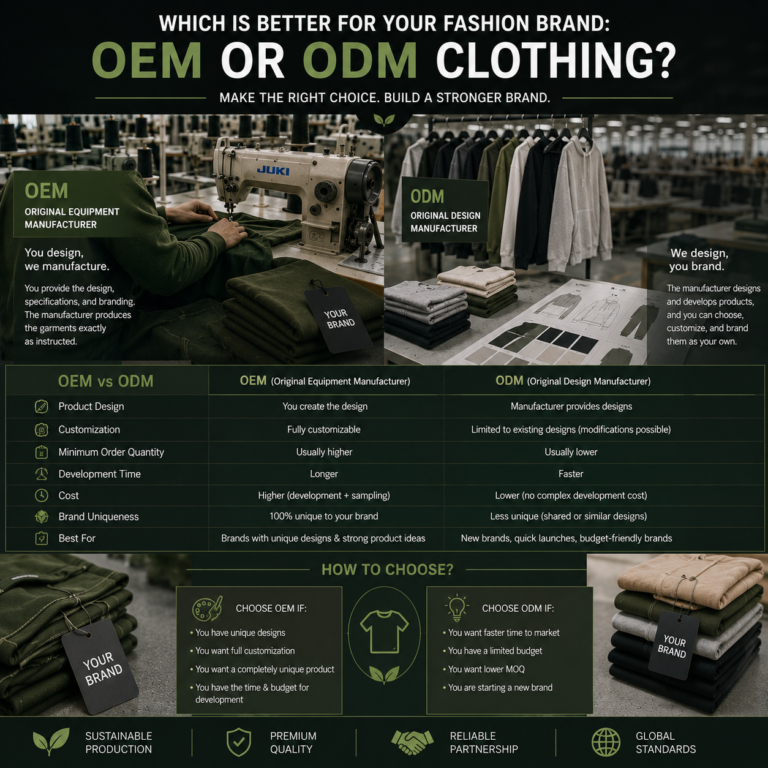
The goals and stage of your fashion brand will determine whether OEM or ODM clothing is best for you. OEM allows you to have full control over the design. ODM is a quick way to brand. New brands are often launched in one direction, then switched later. Both can help you grow if they are matched correctly.

Understanding OEM for Fashion Brands

What is better OEM or ODM? You provide all the materials, including fabrics and tech packs. Only your blueprint is followed by factories. For example, create signature hoodies nobody copies. This builds unique style customers remember long-term.

Understanding ODM for Fashion Brands

ODM is a good option for those who want to decide quickly whether OEM or ODM is best. Factory displays seasonal catalogs that have been tested. Pick tees or joggers, add your logo, ship quick. There is no need to wait for the design. Trends are available in stores as soon as they become popular. Ideal for streetwear brands that move quickly.

ODM wins for quick launches

Launching tips Which is better, OEM or ODM clothing clearly towards ODM. OEM requires months to create samples and tweak patterns. Design iterations are slow and deliberate. ODM can ship in a few weeks, with production lines ready. Seasonal drops are a great way to make sales before the trends disappear.

ODM saves money early

When brands ask if ODM or OEM is better, budgets tend to favor ODM. First, OEM is hit with high sample and design costs. Even small runs are more expensive per piece. ODM shares development across clients so prices drop low. Startups can also test the market without taking big risks.

Design Control: OEM Builds Uniqueness

Compare OEM and ODM to see which is best for creative brands. You can control every stitch, fit and fabric. Custom pockets for pants that no one else can match. ODM only allows you to choose from factory-style options. OEM, on the other hand, creates a brand identity that nobody can copy.

The Risk Levels of Both Methods

OEM or ODM? also includes risk calculations. OEM risks high if designs flop after big spends. The wrong fit can quickly wipe out entire investments. ODM reduces risk by using factory styles that are already proven. Test sales first, then only scale winners.

Scalability for growing brands

Answer the question: “What is better OEM or ODM ?” ODM can scale quickly for large orders. OEM shines once designs prove sales success. Over time, repeat runs will reduce costs. For best results, brands with a long history of success combine both.

Brand identity and long-term value

Future value tips OEM or ODM? slowly move towards OEM. Custom designs create IP that is hard to steal. Your signature fit becomes your trademark. ODM styles can sometimes blend with competitor looks. Luxury brands tend to be OEM-heavy.

FactorOEM WinsODM Wins
Speed upSlow downFasten your seatbelts
CostHigh-quality upfrontLow Front
UniquenessFull controlLimited Options
RiskHigherLower Prices
Best StageEstablishedStartup

Why Choose OEM over ODM

Choose OEM over ODM when is better OEM or ODM refers to unique collections. Custom fabrics are essential for luxury lines. Your brand will be forever defined by your signature fits. Exclusiveness is also a premium that high-end clients pay. This creates loyalty that no one can break.

Why Choose ODM over OEM

Start with OEM when is it better to start with OEM or ODM? Fast streetwear refreshes are needed every week. Try out colors and sizes with little money. Always be ready to enter the market quickly. Growing shops can scale up without waiting for design.

Conclusion

OEM or ODM? The right choice for your brand. Startups take advantage of ODM’s speed and safety as early as possible. Growing shops combine both in a smart way every day. Long-term, established brands are unique OEMs. Choose based on the stage you are in and sales will rise quickly.

FAQ

Which method is faster to launch collections?

ODM can get clothes on the market in a matter of weeks, while OEM takes months.

Can startups afford OEM manufacturing?

ODMs usually save money by testing the market first.

Does OEM create unique brand looks?

Yes, full design control builds signature styles nobody copies.

When does a brand switch to ODM?

Once you have proven sales, consider exclusive collections.

Can you mix the two manufacturing types?

Use ODM for the basics and OEM for signature pieces.

OEM vs ODM Clothing Manufacturing: Complete Comparison

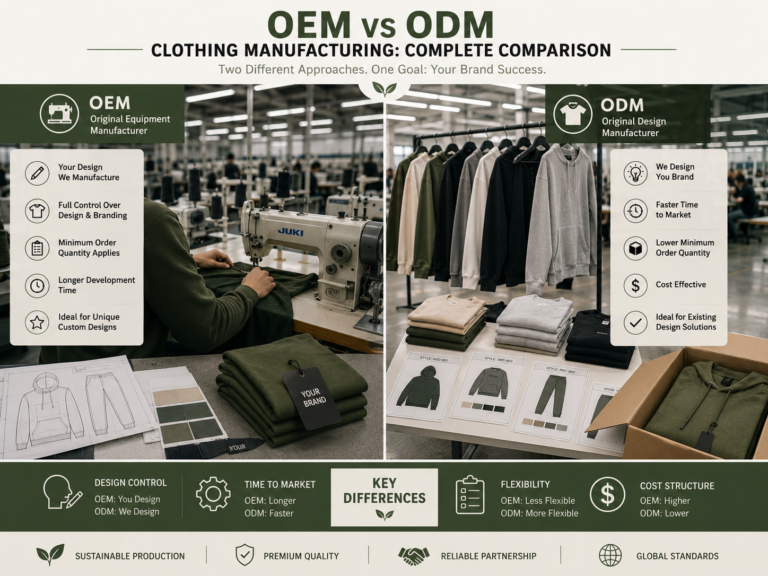
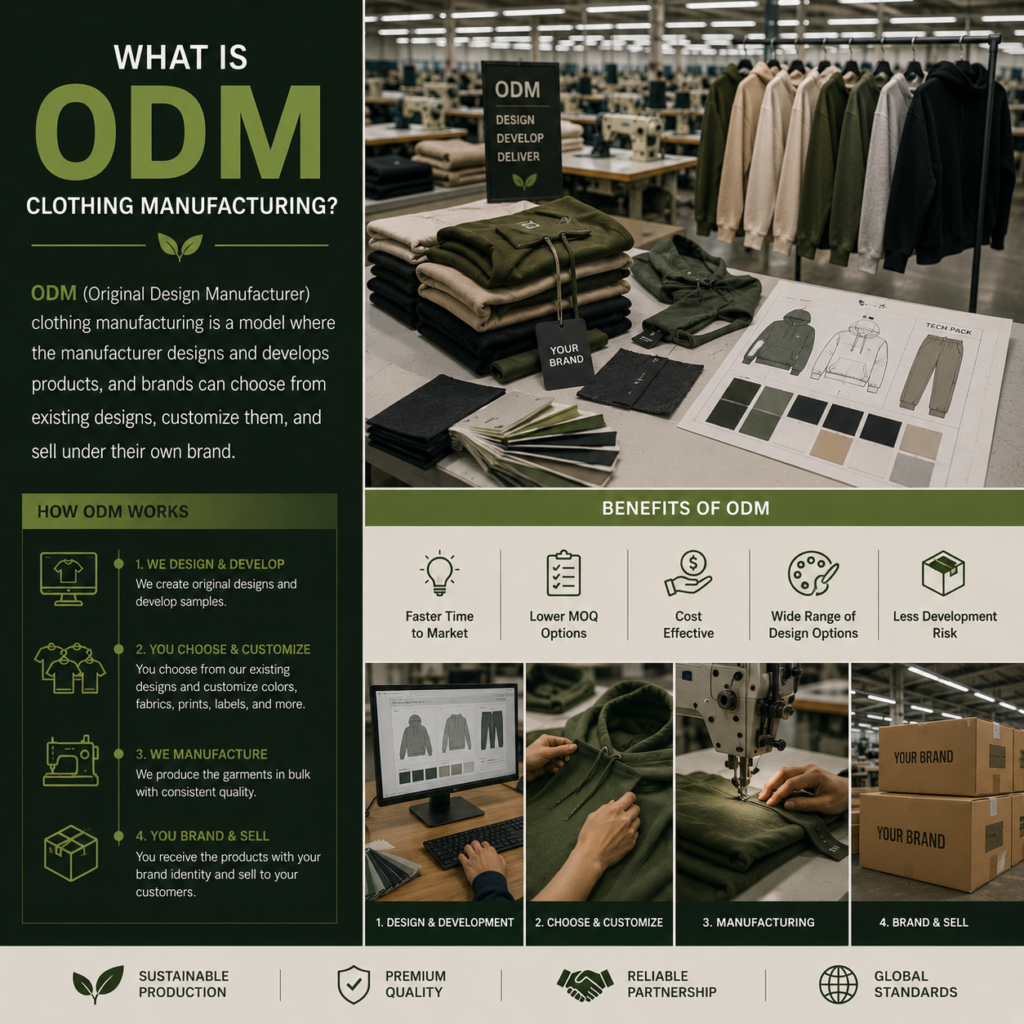
OEM and ODM clothing production can help brands choose the best production path. OEM is when you provide the full design and factories produce it. ODM is a ready-made design that you can brand. Each is tailored to different budgets and needs. Knowing these differences can save you time and money.

What is OEM Clothing Manufacturing?

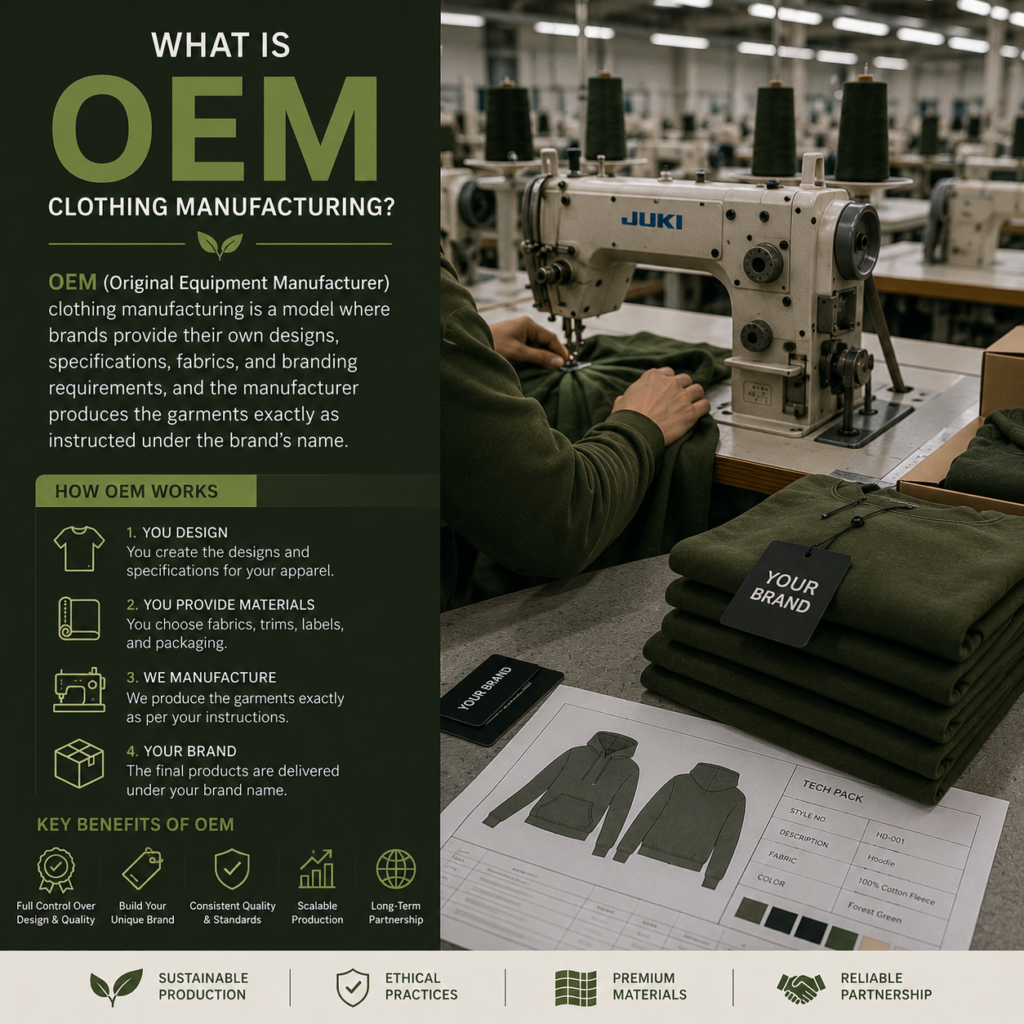
Infographic explaining what OEM clothing manufacturing is, showing how a brand designs the product while the manufacturer produces it.
A simple overview of OEM clothing manufacturing, where the brand provides the design and the factory handles production.

Your blueprints are followed to the letter in OEM clothing production. Sketches, tech packs and fabric selections are completely yours. The factories produce only according to your vision. For example, design unique sleeve cuts yourself. You can also control each stitch and every seam detail. You have complete creative freedom.

What is ODM Clothing Manufacturing?

Infographic explaining ODM clothing manufacturing, where the manufacturer designs and produces the product for a brand to sell under its own label.
A simple overview of ODM clothing manufacturing and how it lets brands use factory-made designs with their own branding.

ODM clothing production begins with factory designs. Style catalogs are available with the latest seasonal trends. Choose the items, add your brand, and then sell them fast. You can, for example, brand their hoodie collection. The factories will handle the design and production smoothly. Here, speed beats custom work.

Design Control in OEM Clothing Manufacturing vs ODM Clothing Production

OEM clothing manufacturing is different from ODM clothing production in terms of creativity. OEM allows you to control every aspect of the product, from the fabric to the fit. You can change patterns whenever you like. ODM restricts choices to only factory collections. ODM designs are already trend tested. OEM is best for unique visions, while ODM is better for quick launches.

Production Speed Comparison

OEM and ODM clothing production show clear time gaps. Samples and approvals for OEM take months. You iterate designs multiple rounds slow. ODM can ship in a few weeks, since the patterns are already available. There is no need to wait for development. ODM is the winner of all races to market.

Cost Structure Differences

OEM and ODM clothing manufacturers affect wallets in different ways. The upfront costs of OEM are higher for the design work and sample production. Even small runs can increase the price per piece. ODM is cheaper when development costs are shared. Factories spread design expenses across clients. Startups can save a lot with ODM.

Minimum Order Requirements

OEM and ODM clothing manufacturers have different order sizes. Custom setups are more expensive in OEM factories. Expect to see 500+ pieces per design. ODM offers lower starting prices since patterns are ready. Most manufacturers are willing to accept orders of 100 pieces. ODM is a cheaper way to test markets.

The level of quality and consistency

OEM and ODM clothing production both deliver high-quality work. You are the one who guides everything. ODM maintains standard across all their proven lines. OEM risks can sometimes increase with complex designs. ODM has a proven track record.

FeaturesOEM ManufacturingODM Manufacturing
Design ControlOwnershipCatalogue of Factory Products
Production Time3-6 MonthsTwo to four weeks
The Cost of Upfront PaymentHigh-qualityLow-cost
Minimum Orders500+ pieces100+ pieces
Best forUnique stylesFast market entry

Risk and Flexibility Factors

OEM clothing production vs ODM apparel manufacturing. OEM carries higher design failure chances. The wrong fit can quickly waste large investments. ODM reduces risk by using styles that have been tested. OEM, on the other hand, builds brand identity over time. ODM allows you to switch styles easily next season.

The Best Use Cases of Each

Choose OEM for your signature pieces. Luxury brands make custom fits that nobody can copy. ODM is the best choice for seasonal releases and testing. Weekly, streetwear shops introduce factory-designed products. Mix both to achieve a balanced growth.

Scalability and Long-term growth

OEM and ODM clothing manufacturers have different growth paths. OEM scales perfect once designs prove sales. Repeat orders drop costs steady. ODM grows quickly, but the style options are limited. OEM, on the other hand, builds IP over time. Established brands tend to be OEM-heavy.

Conclusion

OEM clothing manufacturing vs ODM fits your brand perfectly. Startups are first to take advantage of ODM’s speed and low-risk. Smartly, growing shops combine both. Big brands have their own OEM to give them a unique edge. Choose wisely by understanding the differences. This will help your clothing line to grow faster.

FAQs

What can give you more control over your design?

ODM is a factory design, while OEM allows you to create all the details.

Which method is faster?

ODM’s ready-made patterns and shorter production time are a win for ODM.

How do costs compare?

ODM distributes costs among clients, while OEM requires a higher initial investment.

Can startups use either method?

ODM is a good option for those with low budgets, while OEM designs are more proven and can grow.

When should brands switch to a new method?

Start with ODM pieces for testing, then move to OEM for the signature collection.

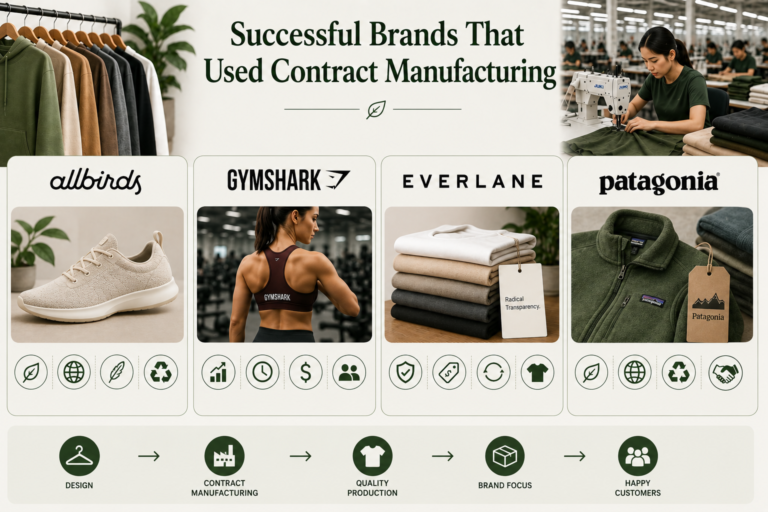
Case Study: Successful Brands That Used Contract Manufacturing

In today’s competitive fashion and apparel market, many brands rely on contract clothing manufacturers to scale production contract clothing manufacturer. without compromising quality. By partnering with experienced manufacturers, brands can focus on design, marketing, and brand growth while leaving the production complexities to experts. This approach has enabled several brands to streamline operations, reduce costs, and quickly adapt to changing market demands.

Scaling Activewear with Contract Manufacturing

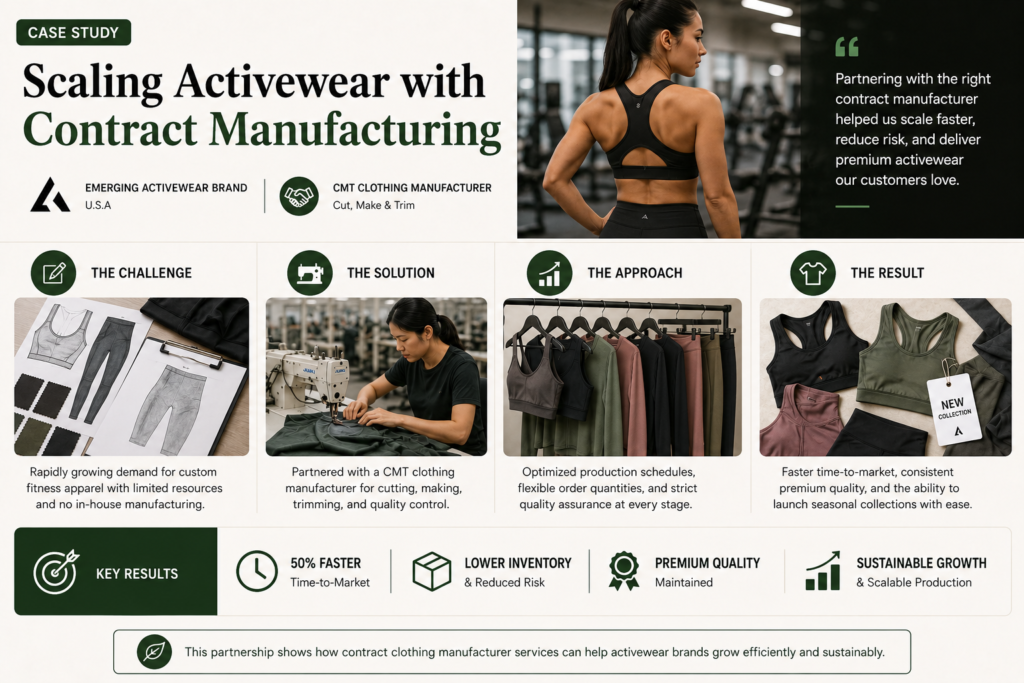
Case study infographic showing an activewear brand scaling through contract clothing manufacturing with garment development, production workflow, quality control, and apparel collections.
Contract manufacturing helps activewear brands scale faster by improving production efficiency, maintaining quality standards, and reducing inventory risks.

ne emerging activewear brand in the U.S. partnered with a CMT clothing manufacturer to meet growing demand for custom fitness apparel. Leveraging the manufacturer’s expertise in cutting, sewing, and quality control, the brand was able to release seasonal collections faster while maintaining premium quality standards.

Through this collaboration, they optimized production schedules and minimized inventory risks. This example highlights how brands using contract clothing manufacturer services can scale efficiently without building in-house factories. CMT clothing manufacturing services

Luxury Fashion Brand Streamlines Production

A European luxury fashion label faced challenges in managing small-batch, high-end production. By engaging a made-to-order apparel manufacturer, they could produce intricate designs on demand. This partnership allowed them to maintain exclusivity while expanding their product range.

Startups Launch Quickly with Low MOQ Manufacturing

Startups often struggle with inventory and budget limitations. By partnering with a low MOQ clothing manufacturer, new brands can test their products in the market without committing to large quantities. This approach allows rapid experimentation, faster time-to-market, and reduced financial risk.

One startup successfully launched its initial line of casual wear using this model, receiving immediate customer feedback and adjusting designs before full-scale production. It’s a testament to the advantages that brands using contract clothing manufacturer strategies can enjoy.

Conclusion

From scaling production to testing new products, brands using contract clothing manufacturer solutions gain the flexibility and expertise necessary to thrive in a competitive market. Partnering with a trusted manufacturer ensures quality, speed, and cost-efficiency, whether for activewear, luxury fashion, or startup lines.

FAQs

What types of brands benefit from contract manufacturing?

All brands—from startups to established luxury labels—can leverage contract manufacturing to scale efficiently.

How does a low MOQ manufacturer help startups?

It allows small-batch production, reducing financial risk while testing new designs in the market.

Can luxury brands maintain quality using contract manufacturers?

Yes, partnering with specialized manufacturers ensures consistency and premium craftsmanship.

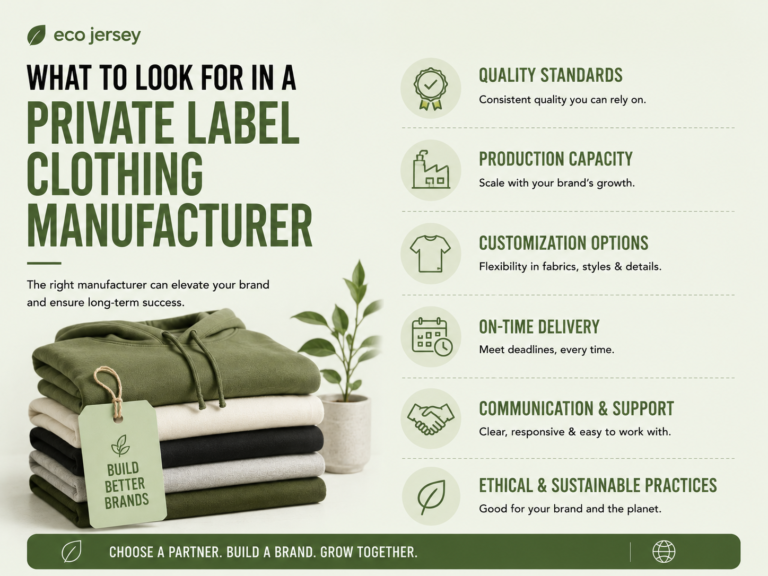
What to Look for in a Private Label Clothing Manufacturer

The future of your brand is determined by the private label clothing manufacturer you choose. It is important to find a company that can handle custom designs, from the sketch all the way through to the final product. Poor choices waste money due to delays or poor product quality. The best ones will deliver clothing that customers will love. The right partner will grow with your company over time.

Strong Quality Control Systems

The top private labels clothing manufacturers are all inspected for quality. Fabric strength, colorfastness, and stitching durability are tested. You can ask to see the inspection process. Each garment, for example, is subjected to multiple inspections before shipment. They also fix any defects quickly and without additional charges. Your brand will build trust by providing perfect products.

Rapid and Reliable Production Speed

When choosing a clothing manufacturer, speed is important. It takes time to create custom designs, but a good manufacturer can turn them around in as little as 4-6 weeks. Always share their timelines up front. They also handle rush orders smoothly during peak season. You will hit the market trends on time if there are no surprises.

Minimum order quantities are low and flexible

private Label Clothing Manufacturer search for partners that have small minimums is important to startups for bulk apparel. Do not go for orders of thousands, but 100-300 pieces. You can test your products without worrying about cash flow. They can also be scaled up easily as your sales increase. Start with samples and then double your orders the next season. So, the risk is always low.

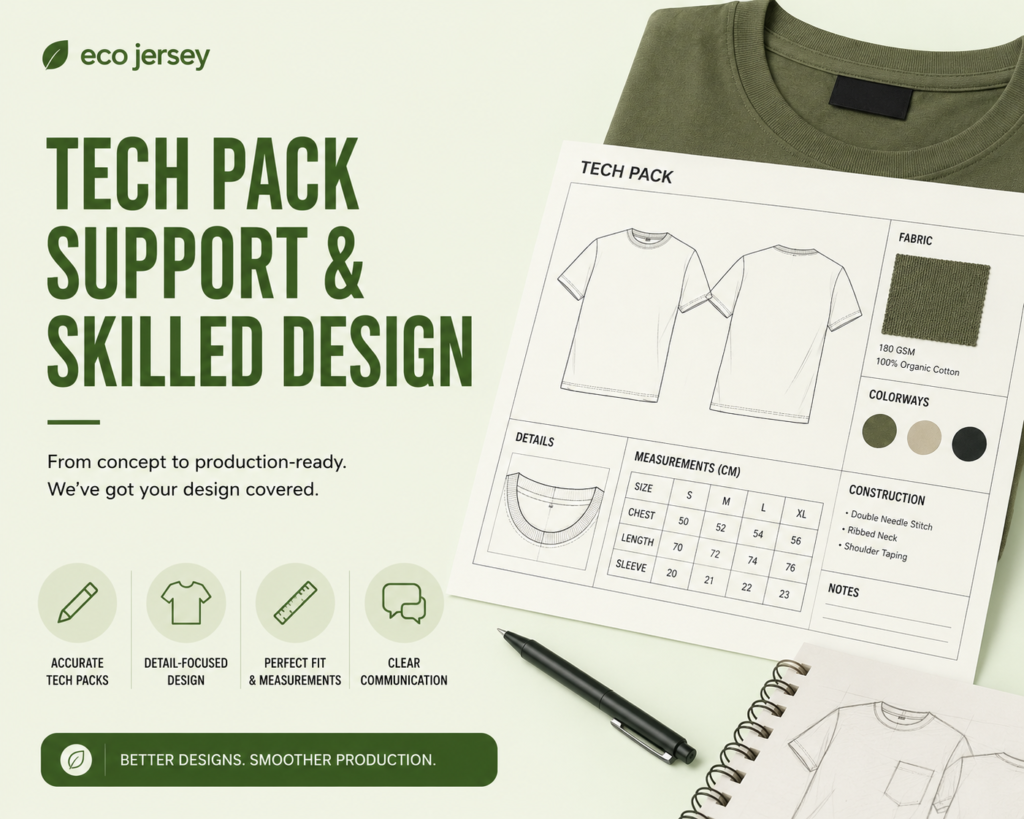
Tech Pack Support and Skilled Design

Tech pack support and skilled design for custom clothing manufacturing, showing the role of detailed specifications and expert design in apparel production.
A visual highlighting the importance of tech pack support and skilled design in creating accurate, well-produced custom clothing.

The private brand clothing manufacturer can help you refine your sketches. Fit issues are identified before production begins. Their pattern experts make tech packs more clear. They also suggest fabrics that will match your vision. It saves you a lot of money on expensive samples and rework.

Clear Communication Channels

Choose private brand clothing manufacturers who respond quickly. Stress is reduced by receiving daily updates on the status of your order. English-speaking account managers make the process easier. They also use WhatsApp, emails, and portals to track easily. Launches are always on time when there is no guesswork.

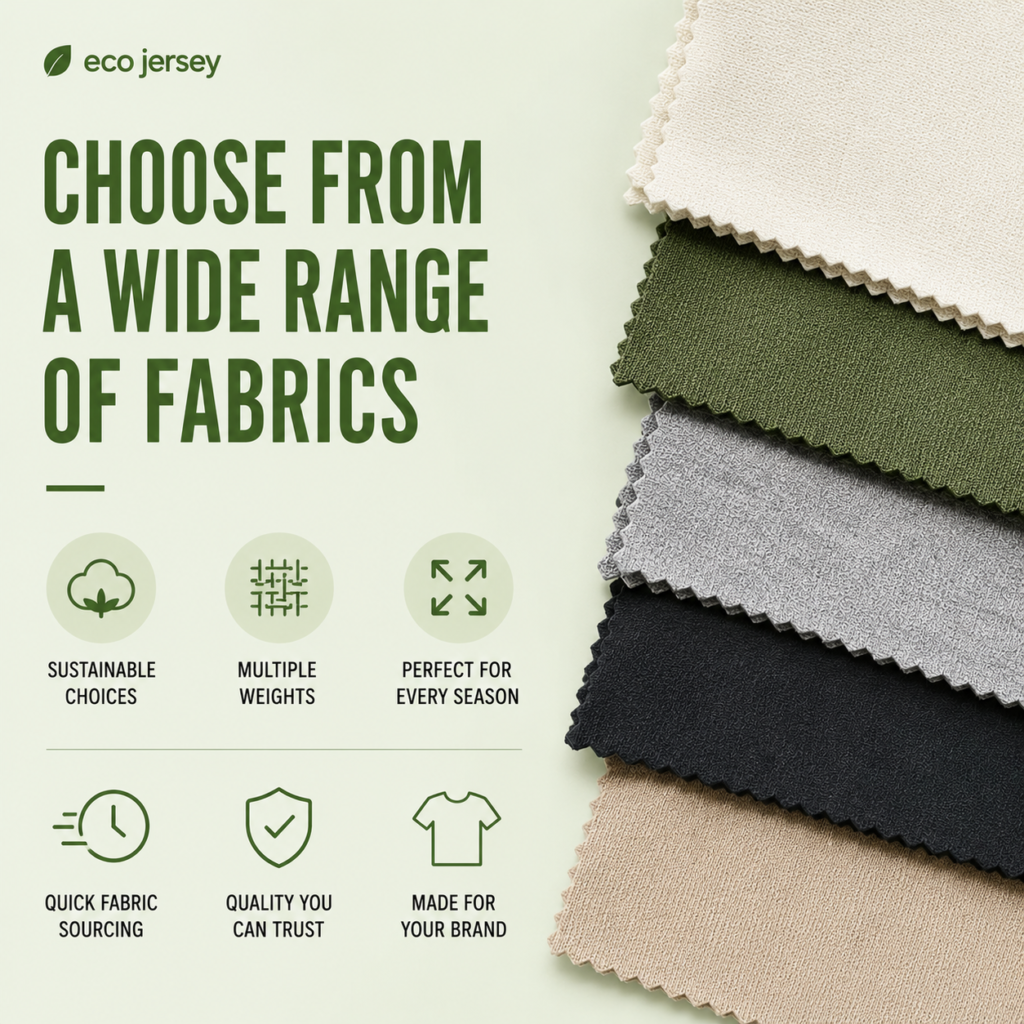
Choose from a wide range of fabrics

A wide range of fabrics shown as a selection guide for clothing manufacturing, highlighting different material options for apparel production.
A visual guide to choosing from a wide range of fabrics for clothing manufacturing, from everyday basics to premium and specialty materials.

The choice of materials shows that is a private label clothing manufacturer. They carry organic cotton, recycled polymers, and performance blends. Choose the perfect weight for each season. For example, 180gsm tees for summer, 300gsm for winter. They can also source fabrics quickly when required.

Ethical and Sustainable Business Practices

Green certifications are evident in the clothing choices of private label clothing manufacturers . Check for GOTS organic standards or OEKOTEX safety standards. Brand trust is also built by fair wage factories. Every year, customers ask more questions about ethics. Reduced waste also saves the planet and reduces your costs.

Global Shipping Experience

Top private-label clothing manufacturers are characterized by their ability to deliver worldwide. DHL, FedEx and sea freight are handled smoothly. Taxes and duties are clearly quoted to prevent surprises. They also track all packages in real time. Your clothes will reach the market quickly and safely.

Key FactorWhat makes them the best?
QualityInspections in stages
Speed upTurnarounds of 4-6 weeks
Minimums100-300 piece starts
FabricsOrganic + performance
CommunicationStatus updates every day

Transparent Pricing Structure

The right private brand clothing manufacturer can be identified by honest quotes. Fabric, labor and shipping costs are clearly broken down. You won’t be surprised by hidden fees. Also, volume discounts reward growth fair. Planning is easy all year round.

Conclusion

You can save your brand a lot of headaches by knowing what to look out for when choosing a clothing manufacturer. Prioritize quality assurance, rapid production and clear communication. Partners like ECO JERSEY tick all the boxes. They will grow with you, from your startup to your big success. Start smartly searching today.

FAQs

What are the most important quality checks?

Inspections in multiple stages for fabric strength, stitching and color fastness.

How quickly should custom production be completed?

Normally, it takes 4-6 weeks to get finished products from the approved samples.

Why do minimum orders vary?

The smaller ones are great for startups, while the larger ones reduce costs for established brands.

Should they be involved in the design process?

Good factories refine tech packs, and suggest improvements to fit.

How do you judge communication?

Professional service is reflected in the daily updates and fast replies.

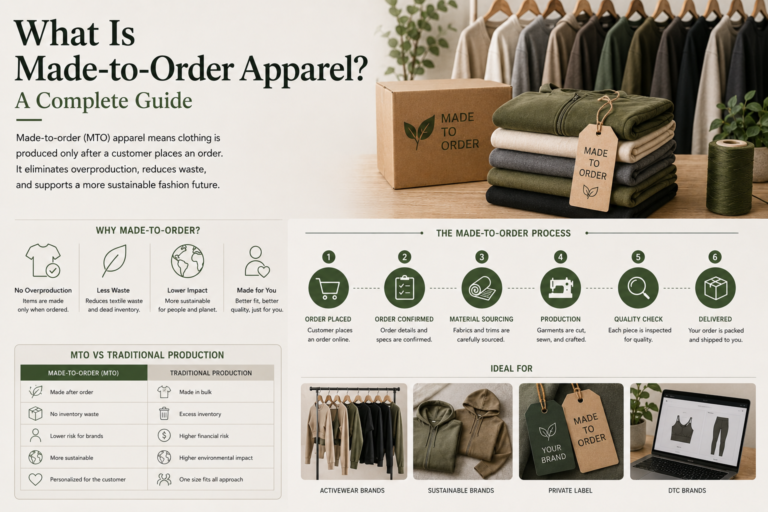
What Is Made-to-Order Apparel? A Complete Guide

Made-to-order apparel is a production model where clothing items are manufactured only after a customer or brand places a confirmed order. In other words, nothing gets produced until demand exists. This approach stands in sharp contrast to traditional bulk manufacturing, where factories produce thousands of units upfront and then hope the market absorbs them.

As a result, what is made-to-order apparelhas gained strong momentum among fashion brands, startups, and wholesalers who want more control over their supply chain.

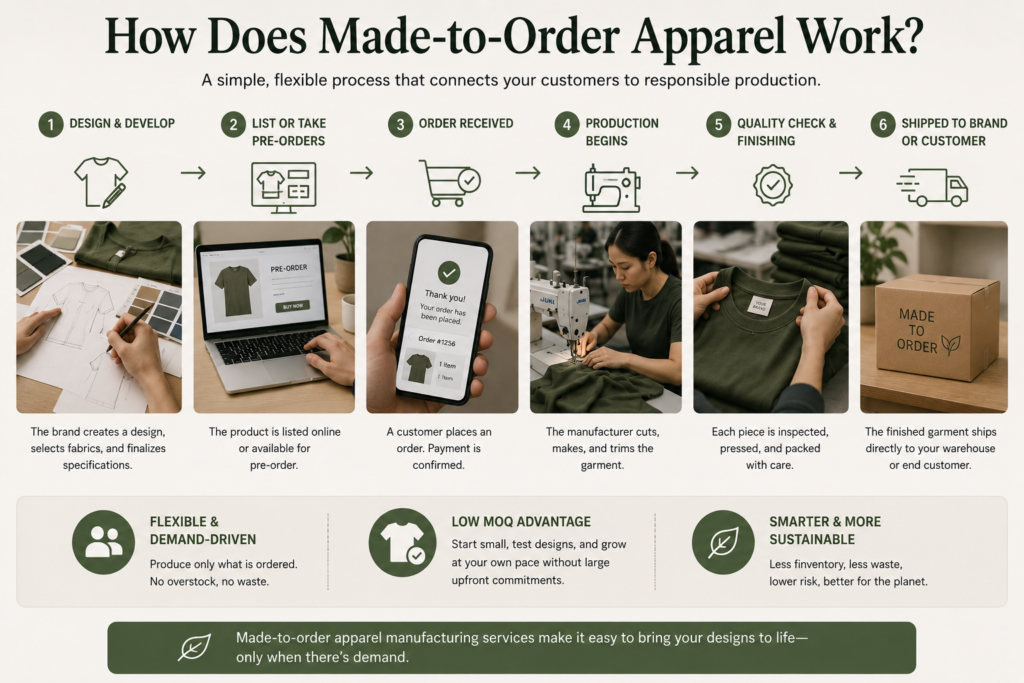
How Does Made-to-Order Apparel Work?

Made-to-order apparel workflow showing clothing design, pre-orders, garment production, quality inspection, and direct shipping process.
Made-to-order apparel production follows a demand-driven workflow where garments are produced only after customer orders are received.

The process is straightforward. First, a brand designs a product and lists it for sale or takes pre-orders. Then, once orders come in, the manufacturer begins production. Finally, the finished garments ship directly to the brand or end customer.

This workflow connects closely with what is made-to-order apparel manufacturing services, where factories are equipped to handle flexible, demand-driven production runs efficiently.

Furthermore, this model works hand in hand with low MOQ clothing manufacturing, because brands do not need to commit to large quantities upfront. They simply produce what they sell.

Key Benefits of Made-to-Order Apparel

Made-to-order offers real, practical advantages for brands at every stage. Here are the most important ones:

  • Zero or minimal overstock: Because production only begins after an order, unsold inventory becomes a much smaller problem. Brands save money, reduce storage costs, and avoid end-of-season markdowns. This is especially valuable for small brands and new product launches.
  • Full customization on demand: Every garment can be made to exact specifications — specific sizes, colors, fabrics, and branding details — without committing to a fixed catalog. This makes the model a natural fit for contract clothing manufacturing arrangements where brands need tailored production agreements.

Made-to-Order vs. Bulk Manufacturing

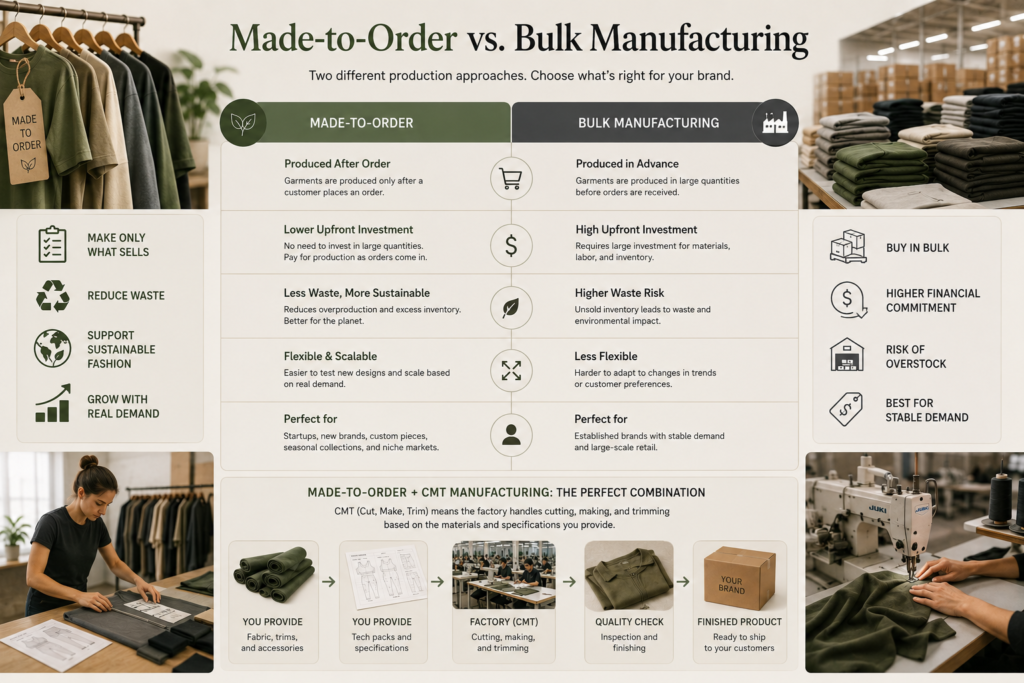
Comparison between made-to-order apparel manufacturing and bulk clothing production showing differences in inventory, flexibility, sustainability, and production workflow.
Made-to-order manufacturing helps brands reduce waste, lower inventory risk, and produce apparel based on real customer demand.

Many brands wonder whether to choose what is made-to-order apparel or traditional bulk apparel manufacturing. The answer depends on your business goals.

Bulk manufacturing works well when demand is predictable and consistent. On the other hand, what is made-to-order suits brands that want flexibility, lower upfront investment, and the ability to test new designs without financial risk.

Additionally, what is made-to-order apparel pairs naturally with CMT clothing manufacturing — where the factory handles cutting, making, and trimming based on materials and specifications the brand supplies. This gives brands creative control while keeping production lean.

The Sustainability Advantage

Made-to-order is also one of the most environmentally responsible production models available today. Because factories only produce what is needed, fabric waste drops significantly. Energy use decreases. Excess inventory — which often ends up in landfills — is largely eliminated.

This directly supports the goals of sustainable apparel manufacturing, making made-to-order an ideal choice for eco-conscious brands. Consequently, it appeals strongly to modern consumers who prefer brands with transparent, responsible supply chains.

Moreover, combining made-to-order with FPP apparel manufacturing — where the factory handles full package production including fabric sourcing, production, and finishing — creates a seamless, sustainable workflow from concept to delivery.

Who Should Use Made-to-Order Apparel?

Made-to-order works exceptionally well for:

  • Independent fashion designers launching limited collections
  • E-commerce brands testing new product lines before scaling
  • Wholesalers and retailers seeking flexible restocking options
  • Brands building sustainable, low-waste business models

In short, if your brand values agility, customization, and sustainability over mass-market speed, made-to-order is worth serious consideration.

Final Thoughts

Made-to-order apparel is not just a production method — it is a smarter way to build a brand. It reduces financial risk, supports sustainability, and gives you full control over your product. Whether you are a startup or an established brand exploring new strategies, this model offers a clear path to more intentional, efficient manufacturing.

FAQs

What is made-to-order apparel?

Made-to-order apparel refers to clothing that is produced only after a confirmed order is placed. Nothing is manufactured in advance, which reduces waste and overproduction.

Is made-to-order the same as custom clothing?

Not exactly. Custom clothing typically refers to garments made to an individual’s personal measurements. Made-to-order means production starts after an order is received, but the items may still follow standard sizing

What is the minimum order quantity for made-to-order apparel?

quantities vary by manufacturer. Many factories offer low MOQ options specifically for made-to-order production, making it accessible even for small brands.

How long does made-to-order production take?

Lead times typically range from two to six weeks, depending on the complexity of the garment, fabric availability, and the factory’s current capacity.

Is made-to-order apparel more expensive than bulk production?

Per-unit costs can be slightly higher than bulk manufacturing. However, brands save significantly on storage, unsold inventory, and markdowns — so the overall cost is often lower.

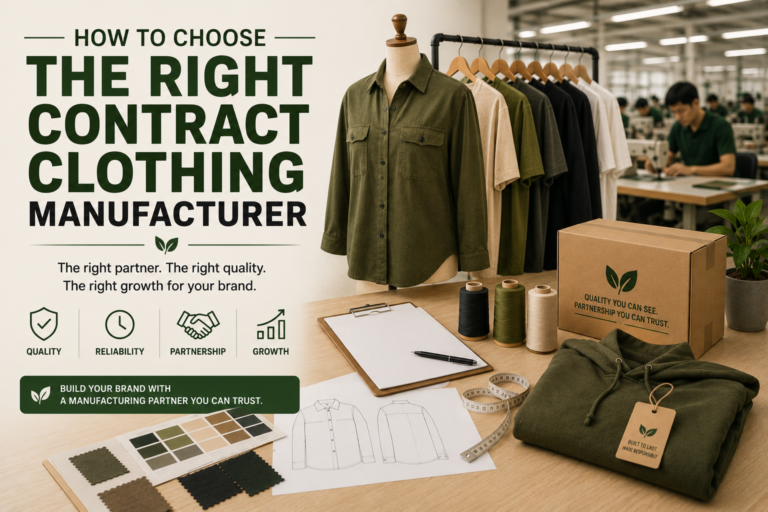
How to Choose the Right Contract Clothing Manufacturer

Selecting the appropriate partner for apparel production is essential to your brand’s success. The right contract clothing manufacturer is also the right partner: they understand your standards and can expand along with your business. From sports and fashion wear to customized work and functional wear, the right manufacturer is timely, ethical, and consistent.

Understand Your Production Needs

Before evaluating manufacturers, clearly define your requirements:

Order Volume: Determine your initial and future order quantities. Some manufacturers specialize in bulk orders, while others support smaller runs.

Product Type: Different manufacturers excel in sportswear, fashion apparel, or workwear.

Customization: Assess whether you need full design services, Low MOQ Clothing Manufacturer services private labeling, or simple cut-make-trim (CMT) production.

Sample Development and Lead Times

When evaluating the right contract clothing manufacturer, always assess their sample development process and lead time commitments. A reliable manufacturer will produce pre-production samples that accurately reflect your tech pack before bulk production begins. Request a clear timeline for sample delivery, revisions, and final approval — delays at this stage often cascade into missed launch deadlines.

The right contract clothing manufacturer maintains transparent production schedules and proactively communicates any adjustments caused by fabric sourcing or capacity changes. Ask potential partners about their average turnaround times for both samples and bulk orders, and verify these claims through client references or case studies. Brands that invest time evaluating lead time reliability during the selection process consistently experience smoother production cycles and stronger retail performance throughout the season.


Pricing Transparency and Long-Term Value

Cost is always a consideration, but choosing the right contract clothing manufacturer should never be based on price alone. A manufacturer offering unusually low quotes may compromise on fabric quality, stitching standards, or ethical labor practices — all of which damage your brand reputation in the long run. Instead, look for clear, itemized pricing that covers fabric, trims, cutting, stitching, finishing, and packaging separately. This transparency allows you to identify where costs can be optimized without sacrificing quality.

The right contract clothing manufacturer will also offer long-term value through consistent quality, repeat-order discounts, and dedicated account support as your brand scales. At Eco Jersey, we provide competitive and fully transparent pricing structures, ensuring every brand — from startups to established labels — receives exceptional value at every production stage.

Evaluate Manufacturing Capabilities

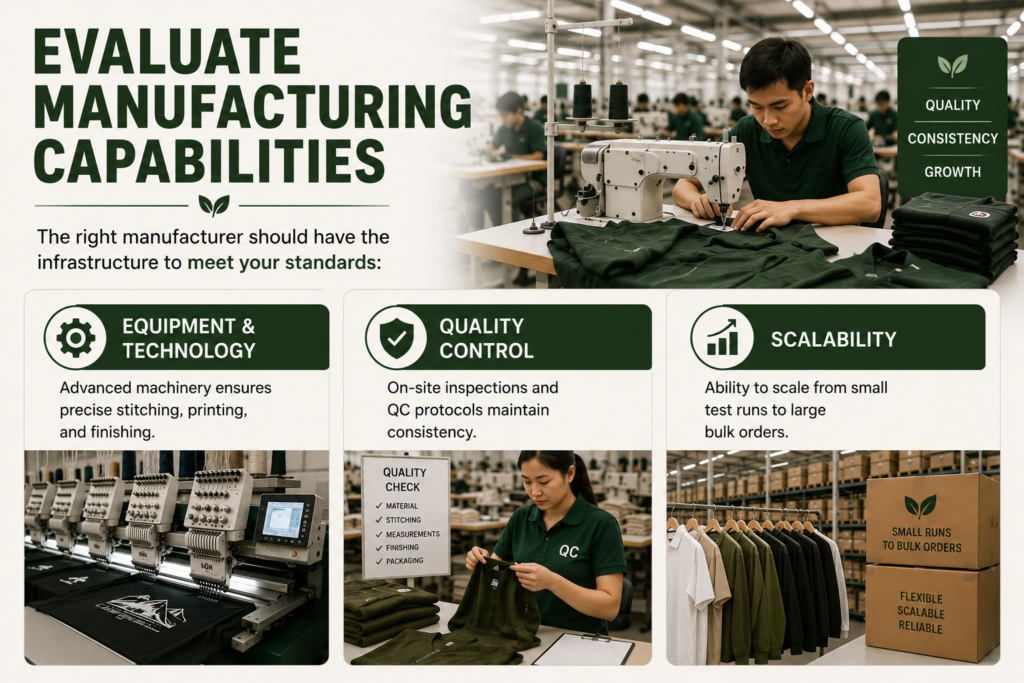
Infographic highlighting apparel manufacturing capabilities including advanced production equipment, quality control inspections, scalable garment production, and modern factory operations.
Strong manufacturing capabilities ensure consistent garment quality, advanced production efficiency, and the flexibility to scale from small test runs to bulk apparel orders.

The right manufacturer should have the infrastructure to meet your standards:

Equipment & Technology: Advanced machinery ensures precise stitching, printing, and finishing.

Quality Control: On-site inspections and QC protocols maintain consistency.

Scalability: Ability Made-to-Order Apparel Manufacturing scale from small test runs to large bulk orders.

Check Compliance & Ethical Standards

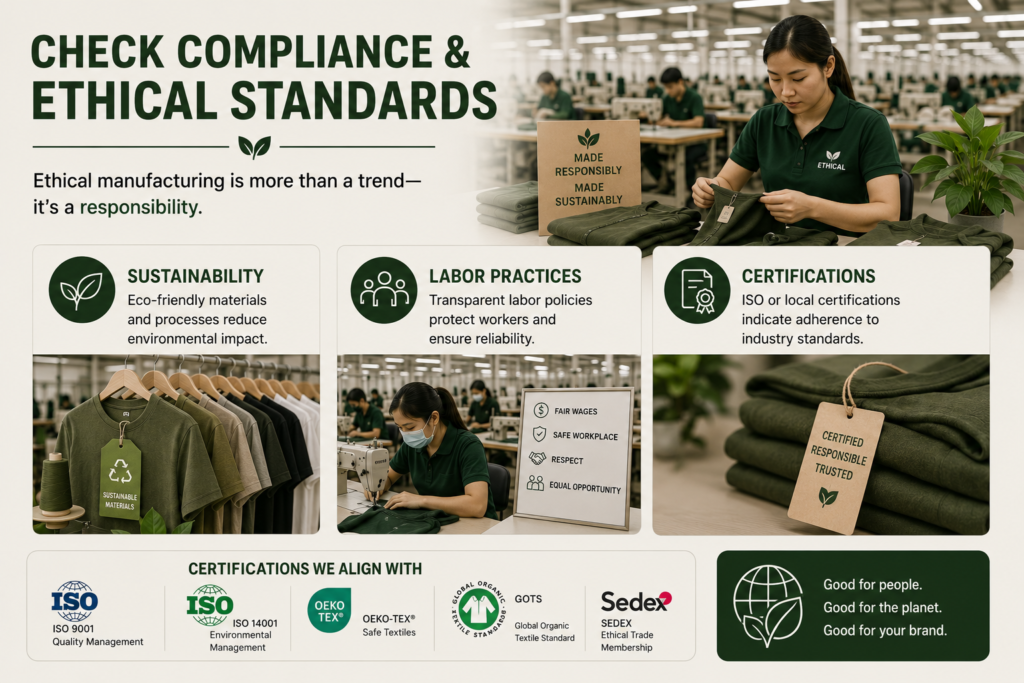
Infographic illustrating ethical apparel manufacturing practices including sustainable materials, responsible labor standards, environmental compliance, and industry certifications in clothing production.
Ethical and compliant apparel manufacturing supports sustainable production, responsible labor practices, certified quality standards, and long-term brand reliability.

Ethical manufacturing is more than a trend—it’s a responsibility:

Sustainability: Eco-friendly materials and processes reduce environmental impact.

Labor Practices: Transparent labor policies protect workers and ensure reliability.

Certifications: ISO or local certifications indicate adherence to industry standards.

Communication & Support

Strong communication prevents production issues:

Responsiveness: Quick replies and regular updates keep your project on track.

Technical Assistance: A manufacturer who guides on fabric selection, tech packs, and production timelines adds value. Contract Clothing Manufacturer

Problem Solving: Flexibility to adjust designs or address unforeseen challenges is key.

Conclusion

Choosing the right contract clothing manufacturer is a strategic decision. By assessing production capabilities, ethical standards, communication, and pricing, you set your brand up for quality, scalability, and growth. At Eco Jersey, our team ensures that your apparel manufacturing experience is seamless and tailored to your unique needs

FAQs

What is the difference between CMT and made-to-order manufacturing?

CMT focuses on cutting, sewing, and trimming existing designs, while made-to-order includes complete customization and design services.

How do I know if a manufacturer can handle my order volume?

Check their production capacity, scalability options, and request previous client examples.

Can help with small-batch orders?

Yes, our Low MOQ Clothing Manufacturer services cater to brands needing smaller quantities without compromising quality.

Tech Packs and Specs for Made-to-Order Production

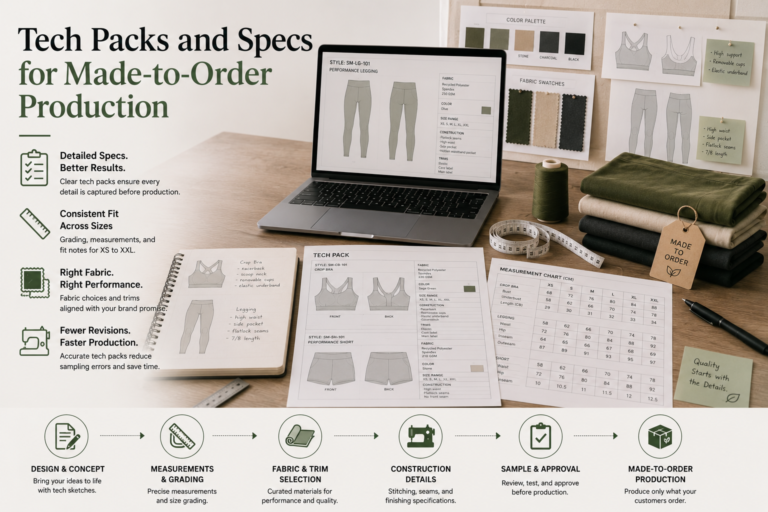
If you have ever wondered why some garments come out perfect every single time — while others miss the mark completely — the answer usually comes down to one thing: tech packs and specs. In made-to-order production especially, a clear and detailed tech pack is not optional. It is the foundation of everything.

Without it, factories guess. And when factories guess, brands pay the price in errors, delays, and costly rework.

What Exactly Is a Tech Pack?

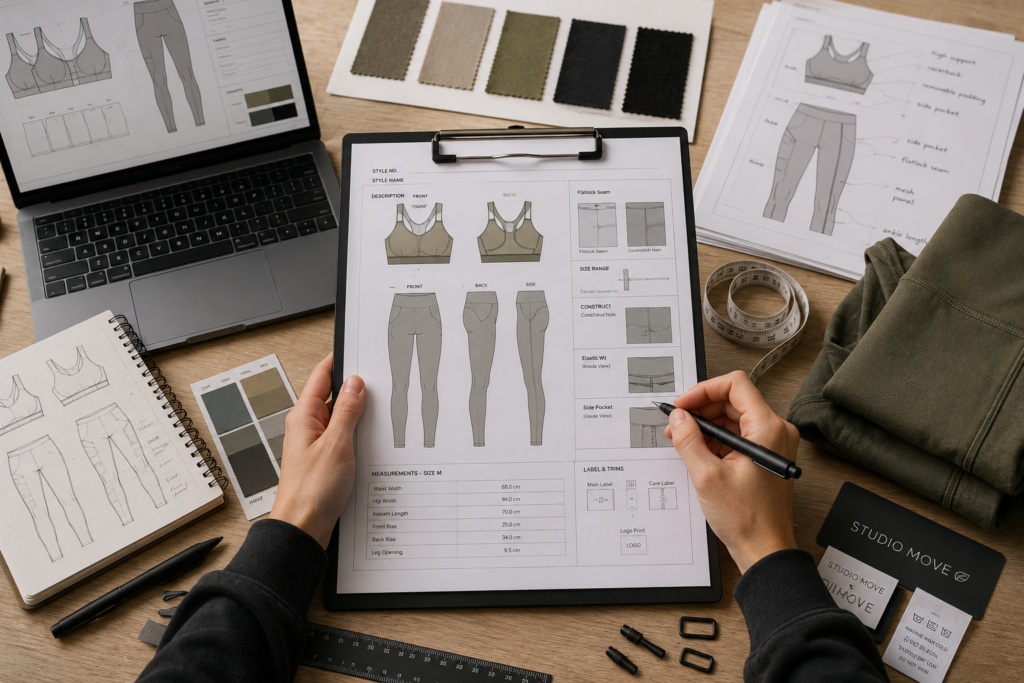
Fashion designer reviewing apparel tech pack with garment sketches, measurements, construction details, fabric swatches, and production specifications.
A tech pack acts as the blueprint for garment manufacturing by organizing all design, sizing, fabric, and construction details in one place.

A tech pack — short for technical package — is a detailed document that tells a factory exactly how to build your garment. Think of it as a blueprint. Just as a construction crew cannot build a house from a rough sketch, a factory cannot produce a garment accurately from just a mood board or a photo reference.

A well-prepared tech pack covers every single detail. It removes guesswork and creates a shared language between your design team and the production floor. This is especially critical when working with a made-to-order apparel manufacturer, where each order is produced fresh and must match exact specifications every time.

What Goes Inside a Tech Pack?

A complete tech pack contains several key components. Here is what every solid tech pack should include:

  • Flat technical sketches: Front, back, and side views of the garment with construction notes. These give the factory a clear visual reference. They also highlight seam placements, pocket positions, zipper placement, and any other design details that words alone cannot capture.
  • Measurement specifications and grading: Exact measurements for every size in the range, along with grading increments between sizes. This section connects directly with proper fit development and size grading, which ensures the garment fits correctly across all sizes — not just the sample size.

Additionally, a complete tech pack includes fabric details, trim lists, stitching types, seam allowances, label placement diagrams, finishing instructions, and quality checkpoints. In short, nothing is left to interpretation.

Why Tech Packs Matter More in Made-to-Order

In bulk production, factories produce large quantities and have room to adjust minor inconsistencies across thousands of units. Made-to-order production works differently. Because each batch is produced only after an order arrives, there is much less margin for error.

Furthermore, made-to-order relies heavily on speed. Orders come in and production begins quickly. Therefore, the factory must have all the information upfront. A missing measurement or an unclear fabric spec can stall the entire order.

This is why tech pack development is considered the first and most important step before any garment goes into production. It sets the standard for every unit that follows.

How Tech Packs Connect to the Broader Production Process

A tech pack does not exist in isolation. Instead, it feeds directly into every downstream production step. Once the tech pack is finalized, the factory moves to sampling and pattern making. The pattern maker uses the tech pack specifications to create the first physical version of the garment.

After sampling, the production team references the same tech pack during cutting, sewing, and finishing. This means every department works from the same document — which dramatically reduces miscommunication between teams.

Moreover, tech packs play a key role in CMT clothing manufacturing arrangements, where the factory handles cutting, making, and trimming based on materials and specs provided by the brand. In this model, the tech pack is essentially the entire instruction set the factory works from.

Specs That Brands Often Overlook

Many brands focus on fabric and style details but forget some critical specs. Here are the ones most commonly missed:

  • Seam allowances and stitch density: These directly affect how the garment feels, holds together under stress, and passes quality control. Forgetting to specify them can result in seams that fray or unravel after a few washes.
  • Label placement and branding details: Where exactly the woven label sits, the hang tag position, and care label requirements are all part of a complete spec sheet. Brands that want contract clothing manufacturing should always include full branding specs inside the tech pack to avoid back-and-forth revisions.

Tech Packs and Sustainable Production

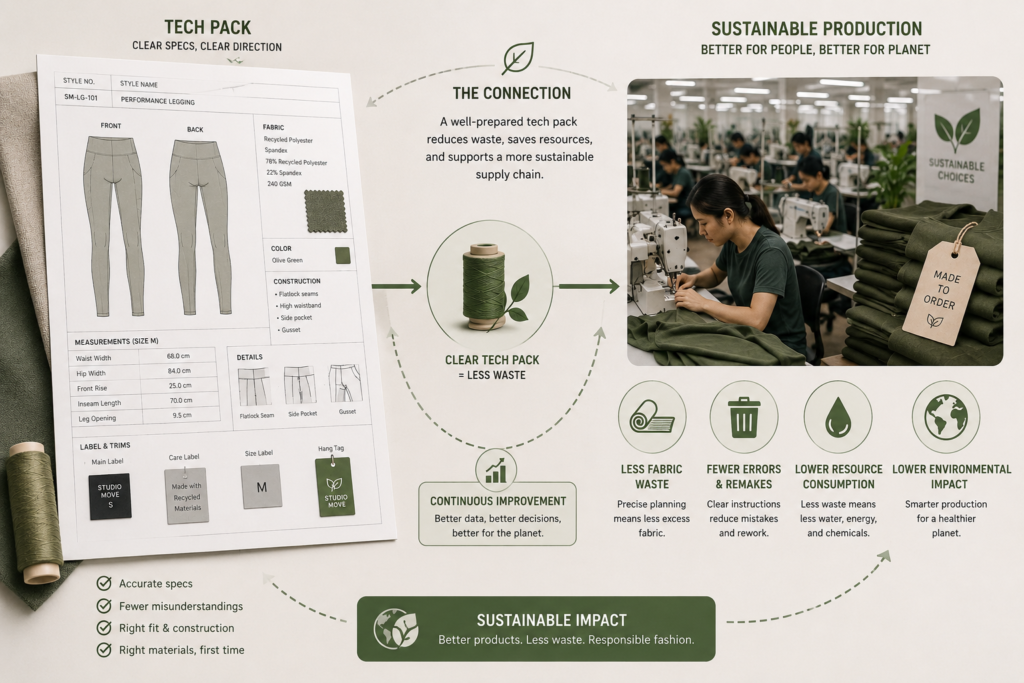
Tech pack document connected to sustainable apparel manufacturing process with garment specifications, fabric planning, reduced waste workflow, and eco-friendly production system.
Detailed tech packs help sustainable apparel manufacturers reduce material waste, improve production accuracy, and create more efficient made-to-order workflows.

There is also an environmental benefit to thorough tech packs. When specifications are clear from the start, factories waste far less fabric during sampling and production. Fewer errors mean fewer remakes. Fewer remakes mean less material waste.

This aligns naturally with sustainable apparel manufacturing, where reducing waste at every stage of production is a core goal. In that sense, a well-written tech pack is also a sustainability tool.

Final Thoughts

Tech packs and specs are not just paperwork. They are the single most powerful tool a brand has to protect its quality, speed up production, and reduce costly mistakes. In made-to-order production especially, they make the difference between a garment that lands exactly right and one that goes back to the factory floor.

Invest in your tech packs first. Everything else in production follows from them.

FAQs

What are tech packs and specs in apparel manufacturing?

Tech packs are detailed production documents that contain all specifications a factory needs to produce a garment — including measurements, materials, stitching details, trims, and finishing instructions.

Why are tech packs especially important for made-to-order production?

In made-to-order production, garments are manufactured immediately after an order arrives. There is no room to adjust errors across large quantities, so precise specs from the start are essential.

Can a brand submit rough sketches instead of a full tech pack?

Rough sketches are a starting point, but they are not enough for accurate production. A professional tech pack translates those sketches into actionable manufacturing instructions.

What happens if a tech pack is incomplete?

Incomplete tech packs lead to factory guesswork, production errors, sampling delays, and costly rework — all of which increase lead times and overall costs.

How do tech packs support size consistency across a range?

Tech packs include grading specifications that define exact measurement differences between each size. This ensures consistency in fit across the full size range, not just the sample size.

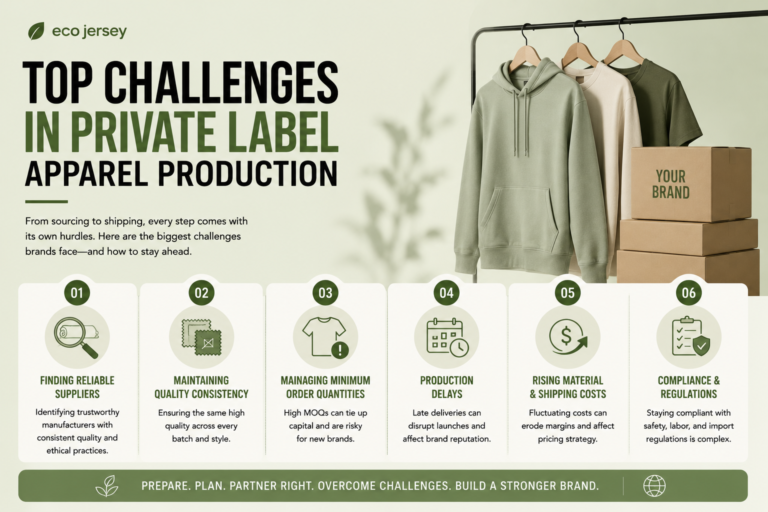
Top Challenges in Private Label Apparel Production

Private label apparel production brings unique hurdles for brands creating custom clothes. Since you design everything from the ground up, delays and high prices are common. A small mistake in sizing can ruin entire batches. Good planning can help you overcome these problems. ECO JERSEY and other partners make the process easier.

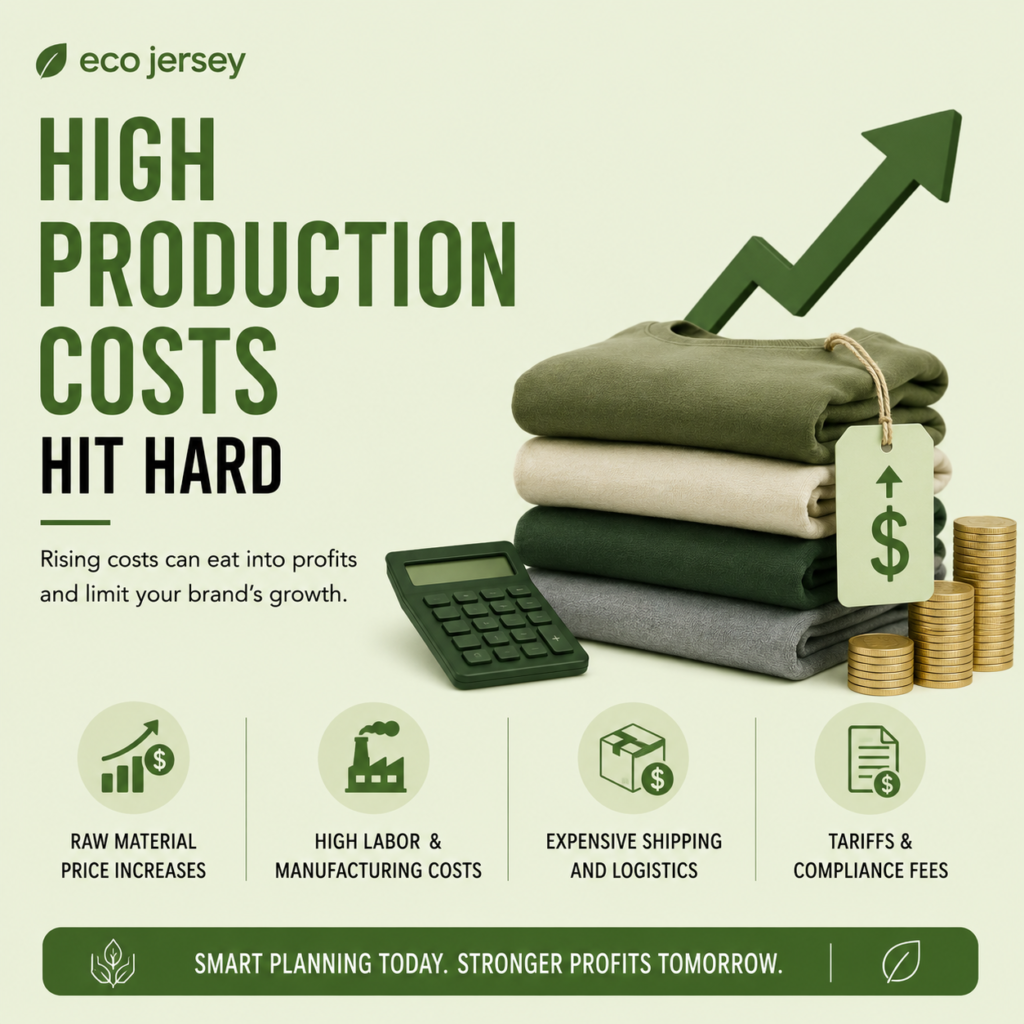
High production costs hit hard

Infographic showing how high production costs affect apparel manufacturing, highlighting budget pressure, pricing challenges, and reduced profit margins.
A visual summary of how high production costs can impact clothing manufacturers through tighter budgets, higher prices, and lower profitability.

Custom designs drive up expenses in private label apparel production. Special fabrics and patterns are more expensive than standard items. Small runs are also charged extra by factories, since they set up machines for you. Samples can add up to your bill even before you sell a single piece. Budgets can quickly balloon without careful cost checking upfront.

Long lead times slow launches

Private label apparel production is plagued by long waiting periods. The approval process, fabric sourcing and sample rounds can take a long time. While your clothing is in the factories, trends change. Summer styles, for example, are often completely out of season. During peak periods, backlogs in factories can also build up. Timing becomes a constant struggle.

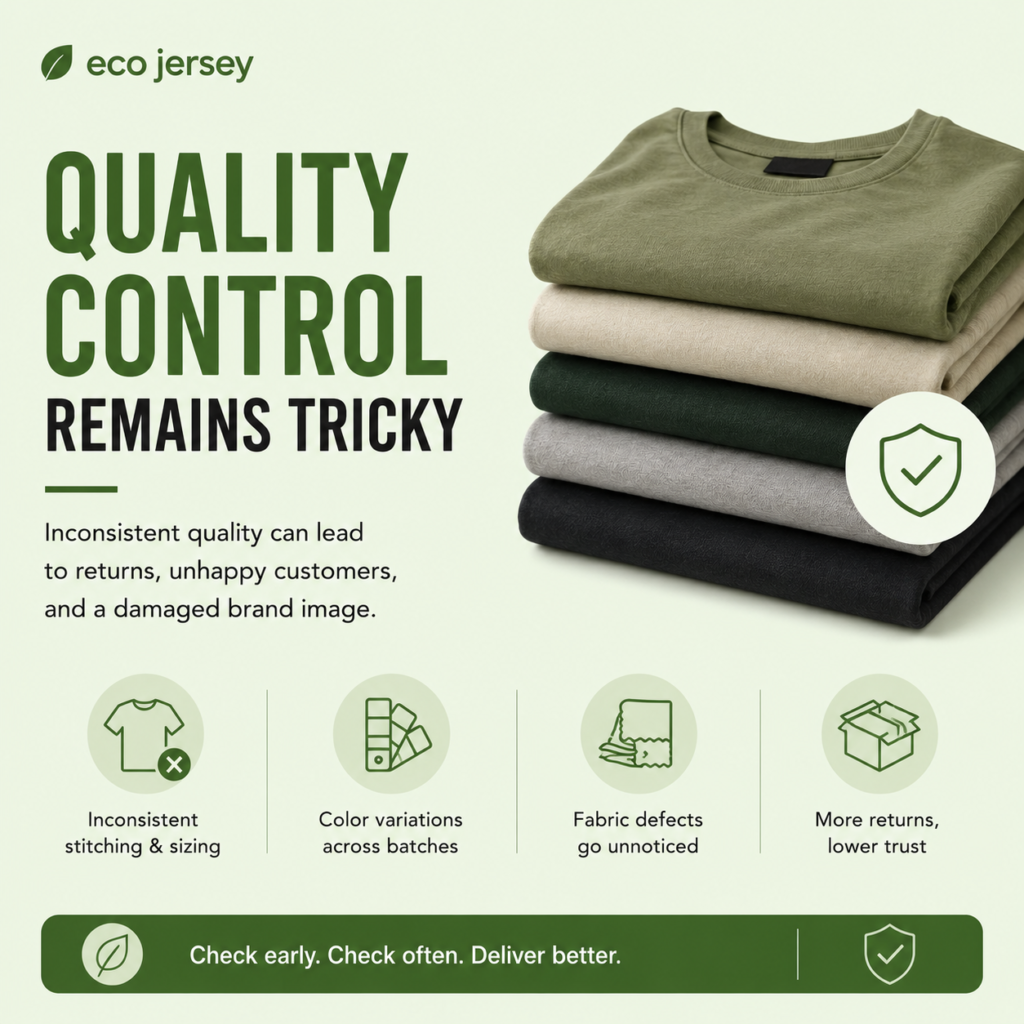
Quality Control Remains Tricky

Infographic showing why quality control remains tricky in private label production, highlighting inconsistent standards, inspection challenges, and supplier coordination issues.
A visual summary of the quality control challenges brands often face in private label production

Private label clothing production often fails quality tests on new designs. After one wash, the workers may have different batches because they are learning your patterns. Customers stop buying immediately when they notice any flaws. Fixing errors also means additional delays and costs. Multiple sample rounds can save you headaches in the future.

Supply chain breakdowns cause chaos

Global sourcing can cause supply problems in the private label apparel industry. Fabric mills can delay shipments, or suddenly run out of stock. Containers are backed up in ports for weeks. Cotton prices can spike overnight. One late fabric roll can stop your entire order. Local partners reduce these risks in a smart way.

Start-ups are snared by large minimum orders

Private label apparel producers are challenged by the high minimums demanded by manufacturers. You can’t spend the money you need to market your brand if you order 500 shirts. Stock that is not sold sits in storage, resulting in expensive storage fees. Also, if you get the sizes wrong, you will always have extra stock. Negotiate smaller starting quantities whenever possible.

Design Mistakes Waste Resources

Tech packs are often confusing for factories in the private label clothing production. Sketches depict one sleeve, but the samples are shorter. The chart measurements are not the same as their tools. The colors also appear different in the factory lighting. Clear communication is essential to avoid costly reworks.

The demand for skilled workers is high

Private label clothing production is plagued by labor shortages. Stitchers with experience move to larger factories in search of better wages. New workers stitch poorly on complicated designs. Without consistent skills, quality drops in batches. Training is time-consuming, which factories are rarely willing to give.

Final Thoughts

Private label apparel production is a test for brands, as it can be costly, delayed, and contested on quality. To win, plan carefully, test frequently, and choose reliable partners such as ECO JERSEY. You can create clothes that customers will love, despite all the obstacles. Solving these challenges will also help you build a stronger brand in the long run. Start small and grow steadily.

FAQs

What are the main causes of cost problems?

Costs are high due to custom fabrics, low run fees and multiple samples.

How do delays hurt new collections?

Approvals and sourcing for months can miss trends.

Why is there such a wide variation in quality?

Workers learn from your batches and new patterns.

Can local partners solve supply issues?

They can reduce shipping delays and fabric waiting times by a significant amount.

How do you handle large minimum order?

Negotiate smaller production starts and test the demand before scaling up.