Home Blog Page 31

What Is a Contract Clothing Manufacturing? Explained

Contract clothing manufacturing is a business model where apparel brands or designers outsource their production to specialized manufacturers. Instead of setting up in-house factories, brands rely on contract clothing manufacturers to produce high-quality garments efficiently, cost-effectively, and at scale.

we provide tailored solutions for brands, startups, and corporations who want to focus on design, branding, and sales while leaving production to experts.

How Contract Clothing Manufacturing Works
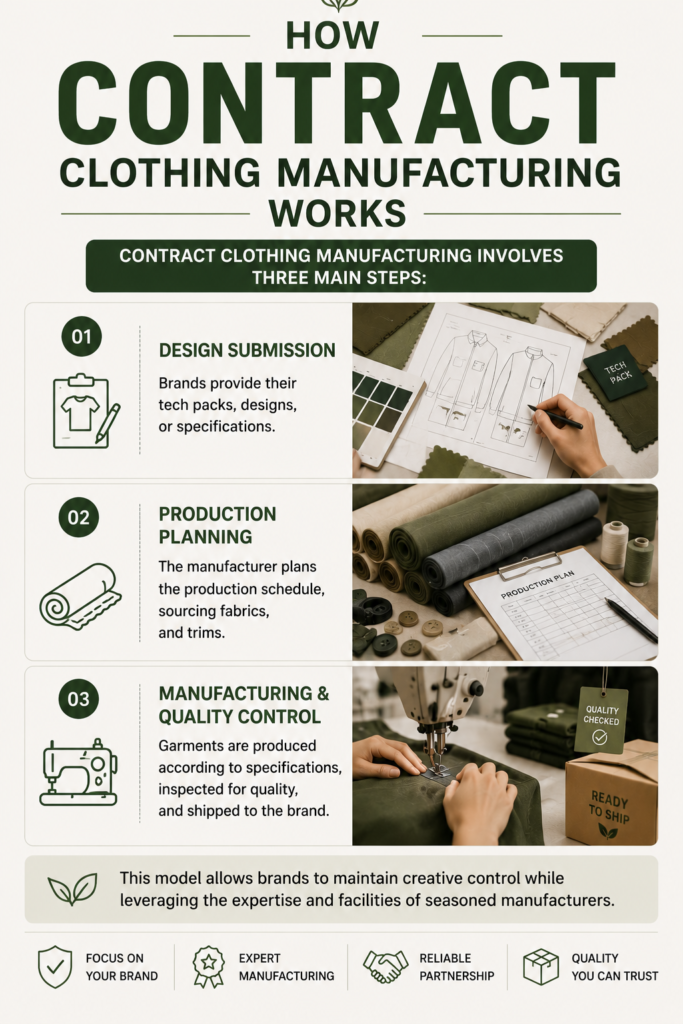
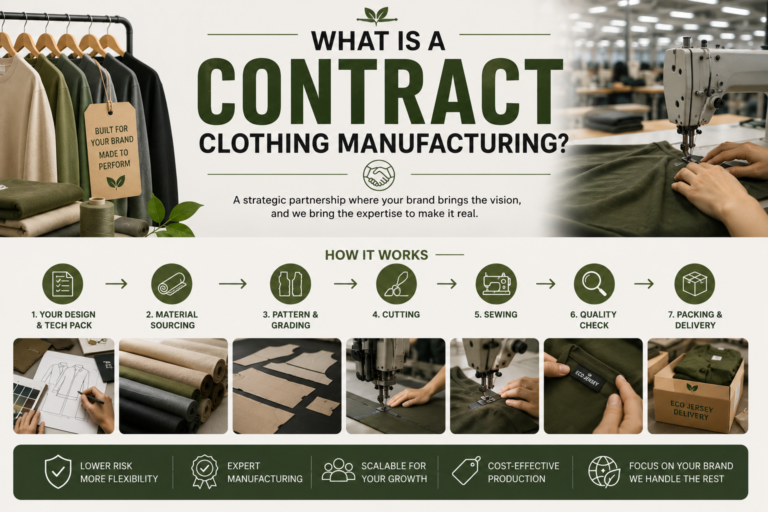
Portrait infographic illustrating the contract clothing manufacturing process, including design submission, production planning, fabric sourcing, garment manufacturing, quality control inspections, and final apparel delivery.
Contract clothing manufacturing follows a structured process from tech pack submission and production planning to garment manufacturing, quality control, and delivery.

Contract clothing manufacturing involves three main steps:

Design Submission: Brands provide their tech packs, designs, or specifications.

Production Planning: The manufacturer plans the production schedule, sourcing fabrics, and trims.

Manufacturing & Quality Control: Garments are produced according to specifications, inspected for quality, and shipped to the brand.

This model allows brands to maintain creative control while leveraging the expertise and facilities of seasoned manufacturers.

Benefits of Contract Clothing Manufacturing

Outsourcing production brings multiple advantages:

Cost-Efficient: Avoids large capital investments in machinery and labor.

Scalable Production: Easily scale from small batches to large volumes.

Expertise Access: Gain access to skilled workforce and specialized production techniques.

Faster Time-to-Market: Reduce production delays with professional management.

Quality Assurance in Contract Clothing Manufacturing

One of the biggest concerns brands have when outsourcing production is maintaining consistent garment quality. Reputable contract clothing manufacturers address this through multi-stage quality assurance processes built into every production run. At Eco Jersey, quality control begins at the fabric inspection stage, where materials are checked for weight, color consistency, and structural integrity before cutting begins.

Mid-production checks ensure stitching, sizing, and construction meet the approved specifications from the brand’s tech pack. A final pre-shipment inspection confirms every unit meets the required standard before packaging and dispatch. This rigorous approach eliminates costly reworks, returns, and customer complaints. Brands benefit from receiving production reports and sample approvals at every key milestone, ensuring complete transparency. With professional quality control in place, contract manufacturing becomes a reliable and consistent extension of your brand’s standards.


How to Get Started with Contract Clothing Manufacturing

Starting your contract clothing manufacturing journey is more straightforward than most brands expect. The first step is preparing a detailed tech pack — a document containing your garment’s measurements, fabric specifications, construction details, and branding requirements. The more precise your tech pack, the more accurate your samples and final production will be. Next, identify a manufacturer whose capabilities align with your product category, order volumes, and quality expectations.

Request samples early to evaluate craftsmanship, fabric quality, and turnaround time before committing to bulk production. Establish clear communication around pricing, lead times, minimum order quantities, and revision policies. At Eco Jersey, we guide new clients through every stage of onboarding, ensuring a smooth transition from concept to finished garment. Whether you are launching your first collection or scaling an existing line, the right contract manufacturing partner makes all the difference.

Who Uses Contract Clothing Manufacturing?

This model suits various clients:

Fashion Brands & Retailers: For seasonal collections and mass-market production.

Sports Teams & Clubs: For jerseys, kits, and custom apparel.

Corporate & Startups: For branded uniforms, workwear, or promotional apparel.

By working with made-to-order manufacturers, even small brands can benefit from professional-grade production without large inventory risks.

Contract Clothing Manufacturing vs. Traditional Manufacturing
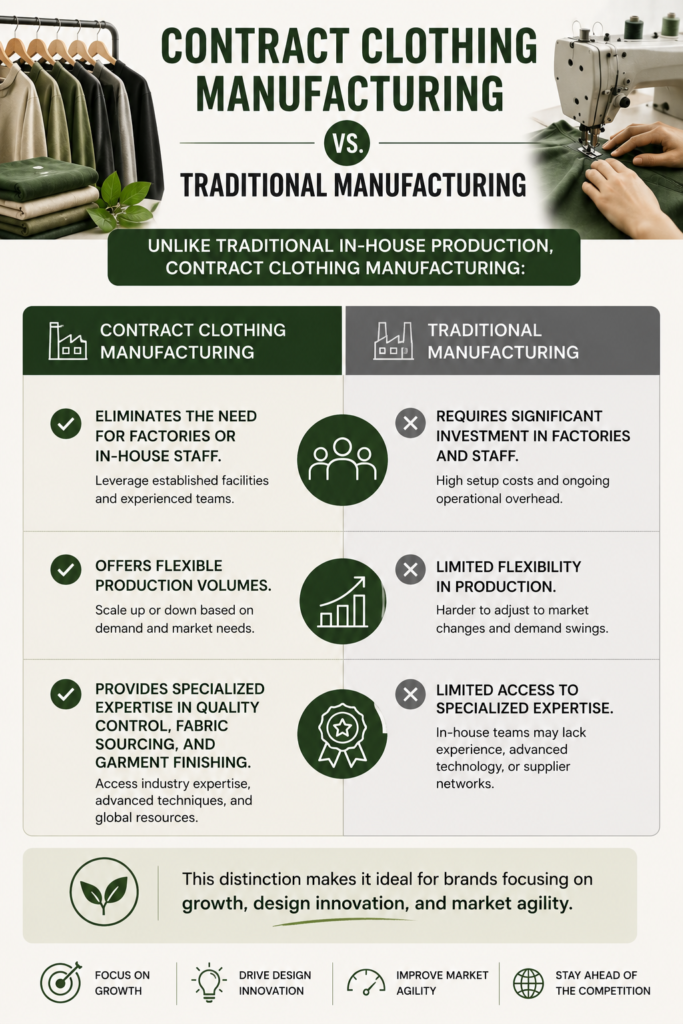
Comparison infographic showing the differences between contract clothing manufacturing and traditional in-house apparel production, highlighting flexibility, lower operational costs, expert manufacturing support, and scalable production.
Contract clothing manufacturing offers apparel brands flexible production, specialized expertise, and lower operational complexity compared to traditional in-house manufacturing models.

Unlike traditional in-house production, contract clothing manufacturing:

Eliminates the need for factories or in-house staff.

Offers flexible production volumes.

Provides specialized expertise in quality control, fabric sourcing, and garment finishing.

This distinction makes it ideal for brands focusing on growth, design innovation, and market agility.


Conclusion

Contract clothing manufacturing offers flexibility, efficiency, and expertise to brands of all sizes. By leveraging professional contract manufacturers like Eco Jersey, businesses can focus on design, marketing, and expansion, leaving production to seasoned experts.

FAQs

What is contract clothing manufacturing?

It is outsourcing garment production to a professional manufacturer who handles all aspects of creating apparel from design to delivery.

Can small brands use contract manufacturing?

Yes. With made-to-order services, even small businesses can produce professional-grade garments without large inventory.

How do I start with contract clothing manufacturing at Eco Jersey?

Simply submit your designs or tech packs, and our team will guide you through production planning, manufacturing, and delivery.
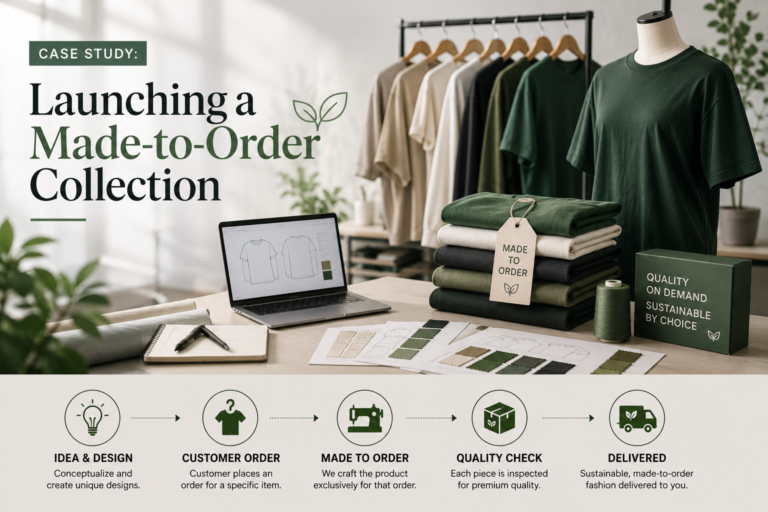
Case Study: Launching a Made-to-Order Collection

Launching a made-to-order collection sounds exciting. However, for many brands, the reality of turning that idea into physical garments feels overwhelming. Where do you start? What does the production process actually look like? And what decisions make or break the launch?

This case study walks through a realistic, step-by-step example of how a small fashion brand successfully launched a made-to-order collection — from the very first design conversation to the final delivery.

The Brand: Starting from Scratch

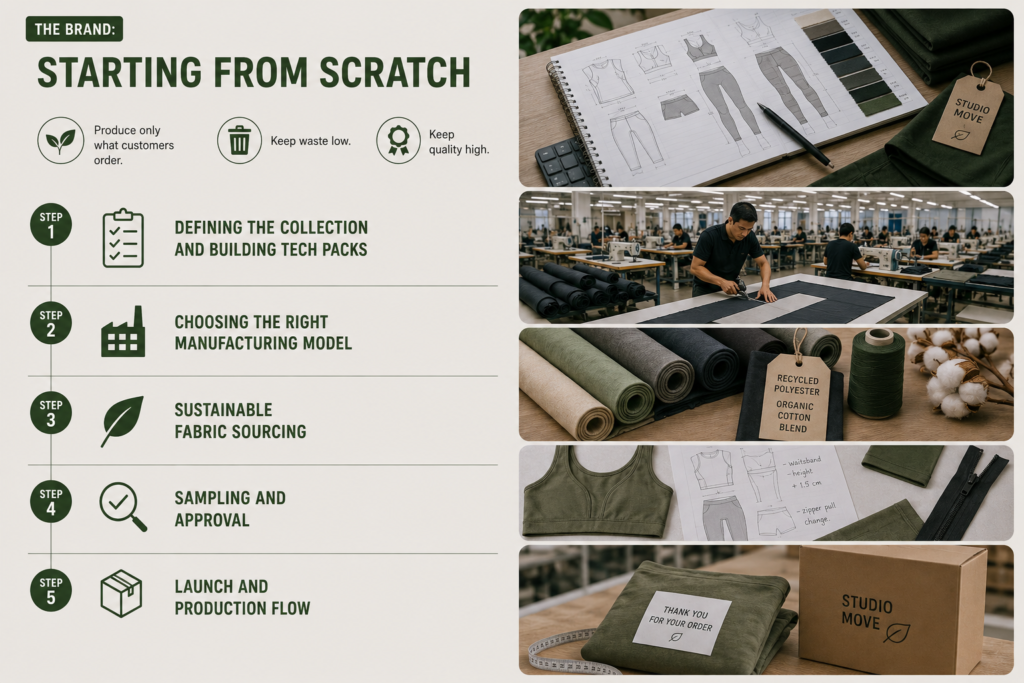
Made-to-order activewear brand workflow showing collection planning, sustainable fabric sourcing, garment production, sampling, and apparel packaging process.
Launching a made-to-order apparel brand requires structured planning, sustainable sourcing, sampling, and efficient production management.

Meet a small activewear brand — let us call them Studio Move. They had a clear vision: a six-piece performance collection built around sustainable fabrics, flexible sizing, and zero excess inventory. They did not want to produce 500 units upfront and gamble on what would sell. Instead, they chose to launch a made-to-order apparel model from day one.

Their goal was simple. Produce only what customers order. Keep waste low. Keep quality high.

Step 1 — Defining the Collection and Building Tech Packs

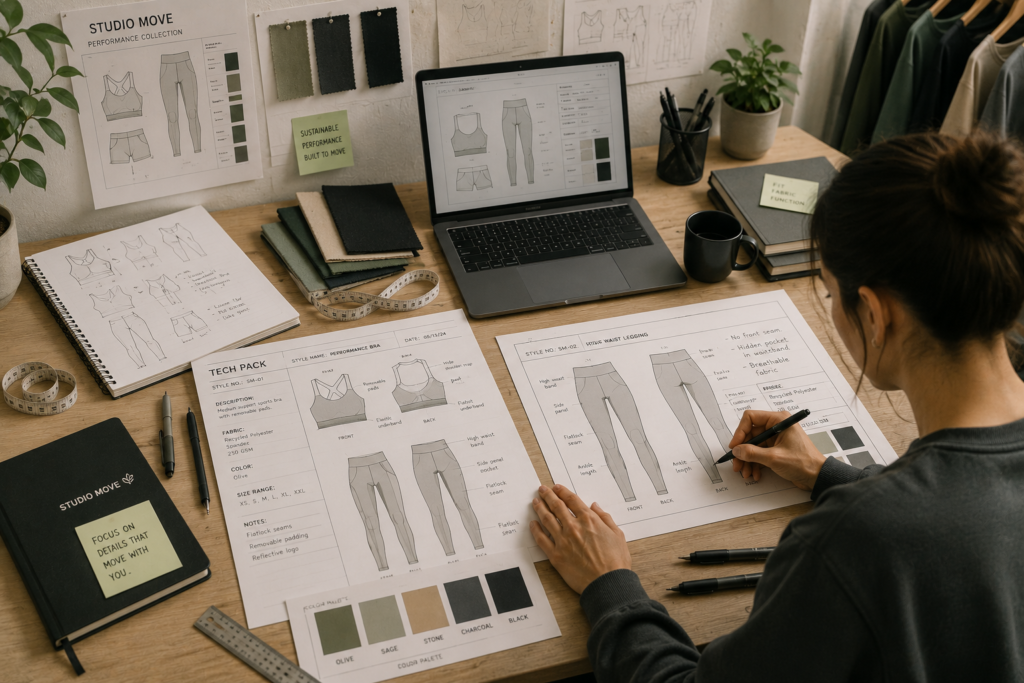
Fashion designer creating activewear tech packs with garment sketches, fabric swatches, sizing details, and apparel development documents on a studio desk.
Detailed tech pack development helps apparel brands streamline production, reduce revisions, and maintain consistent garment quality.

Before anything went into production, Studio Move spent three weeks nailing down their specifications. They worked with a manufacturer to develop detailed tech packs for all six styles — covering measurements, fabric choices, stitching types, and branding details.

This step turned out to be the most valuable part of the entire process. Because they had clear specs from the start, every later stage moved faster and with far fewer revisions. A thorough tech pack eliminates guesswork on the factory floor and protects the brand from costly sampling errors.

Additionally, they connected their sizing specs with proper fit development to ensure the collection worked across XS through XXL — not just in their hero size.

Step 2 — Choosing the Right Manufacturing Model

Studio Move considered a few different production models before committing. They looked at bulk production, but the minimum quantities felt too risky for a first launch. They explored low MOQ clothing manufacturing, which gave them the flexibility to produce small runs without inflating per-unit costs.

Furthermore, they structured their agreement as a contract clothing manufacturing arrangement. This meant the factory committed to producing each style on demand, within a fixed lead time, at agreed pricing. That structure gave the brand predictability — which is essential when you are promising customers a specific delivery window.

[Image Placement: A production floor showing fabric being cut and sewn into activewear garments with workers at sewing machines] Alt Text: Garment factory production floor during made-to-order collection manufacturing with fabric cutting and sewing in progress

Step 3 — Sustainable Fabric Sourcing

One of Studio Move’s non-negotiables was sustainability. They chose recycled polyester for their performance pieces and organic cotton blends for their lifestyle styles. Working with a sustainable apparel manufacturer made this straightforward, because the factory already had relationships with certified fabric suppliers.

Moreover, because they were producing made-to-order, they only purchased fabric after orders came in. As a result, they had virtually no leftover fabric at the end of the launch window — a significant win for both their sustainability goals and their cash flow.

Step 4 — Sampling and Approval

Once the tech packs were approved, the factory produced one sample per style. Studio Move reviewed each sample carefully against their specifications. They checked measurements, fabric feel, stitching quality, label placement, and overall finish.

Two styles needed minor adjustments — one needed the waistband height increased by 1.5 cm, and another needed a different zipper pull. Both changes went back into the tech pack. Consequently, when bulk production started, those corrections were already locked in.

This is why sampling matters so much. It is far cheaper to fix a problem on one sample than to discover it across fifty finished units.

Step 5 — Launch and Production Flow

Studio Move opened their pre-order window for two weeks. Orders came in steadily — not in a single rush, but in a manageable flow. Because they had structured their production as FPP apparel manufacturing — where the factory handled full package production including fabric sourcing, cutting, sewing, finishing, and packaging — the brand did not need to manage multiple suppliers or logistics chains.

Orders batched together every few days and went into production. Within four weeks of the pre-order window closing, all orders shipped.

What Worked — Key Takeaways

Here is what made this launch successful:

  • Strong tech packs from the beginning: Every production decision flowed from clear, complete specs. Without them, the sampling stage would have taken twice as long and cost significantly more.
  • Choosing the right production partner: Working with a manufacturer experienced in demand-driven, flexible production made it possible to batch orders efficiently and hit delivery windows consistently. Brands that try to force a bulk-focused factory into a made-to-order workflow often run into problems with minimum quantities and rigid scheduling.

Final Thoughts

Launching a made-to-order collection is absolutely achievable — even for a small or first-time brand. However, success depends on preparation. Solid tech packs, the right manufacturing partner, and a clear production structure make all the difference.

The brands that struggle with made-to-order launches are usually the ones who skip the foundational steps and jump straight to production. The brands that succeed take their time upfront, get their specs right, and then let the manufacturing process do its job.

FAQs

What is a made-to-order collection launch?

A made-to-order collection launch means a brand accepts orders first and then produces garments only after those orders are confirmed — eliminating unsold inventory and reducing upfront financial risk.

How long does it take to launch a made-to-order collection?

From tech pack development to first delivery, most small collections take between eight and fourteen weeks — depending on sampling rounds, fabric sourcing, and order volume.

Do I need a large budget to launch a made-to-order collection?

Not necessarily. Made-to-order is actually one of the more accessible launch models because you do not need to finance large upfront inventory. You produce what you sell.

What is the biggest mistake brands make when launching made-to-order?

Skipping or rushing the tech pack stage. Incomplete specs cause sampling delays, production errors, and costly rework — all of which push back your delivery dates.

Can made-to-order work for activewear and performance garments?

Absolutely. Made-to-order works well across all garment categories, including activewear, where fit precision and fabric performance specs are especially important to get right from the start.

How to Design a Successful Private Label Apparel Collection

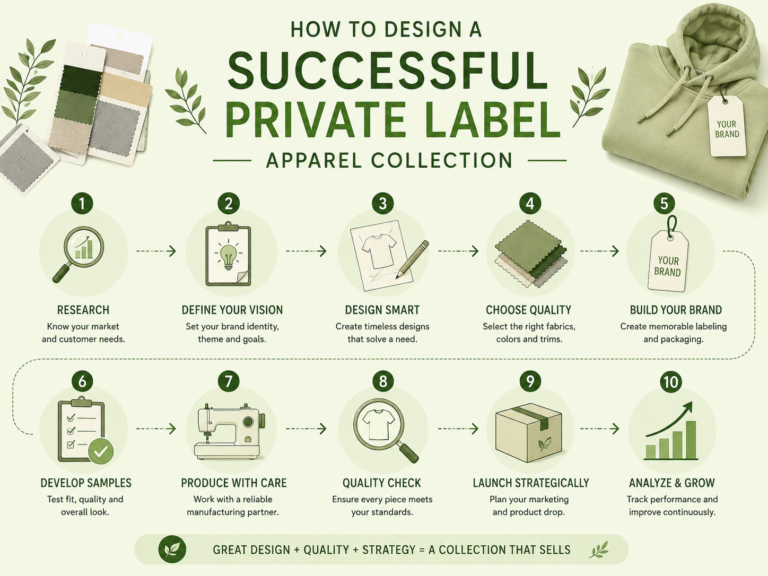
Create a successful apparel collection is custom clothing made just for your brand. Working with factories, you create unique designs. Your style will be unique. Create unique t-shirts or dresses that no one else owns. It also helps you to stand out from the crowd and grow your business quickly.

Research your target market

First, study your buyers to design a successful private label apparel collection. You can ask them what they like to wear, such as casual or formal clothing. Trends can be found on social media or in shops. Young fans, for example, want bold prints right now. You can also ask friends for suggestions or look at online groups. Your collection will then be a perfect match for your real needs.

Sketch Your Unique Designs

Draw ideas for your private-label apparel collection. Create looks on paper or with apps. Smartly mix colors, fabrics, and cuts. Design slim-fit shirts, for example, to create a modern look. Always keep sketches clear and simple. Show them to others so that they can give you quick feedback. So, the designs can be improved before any factory work begins.

Selecting Quality Fabrics & Materials

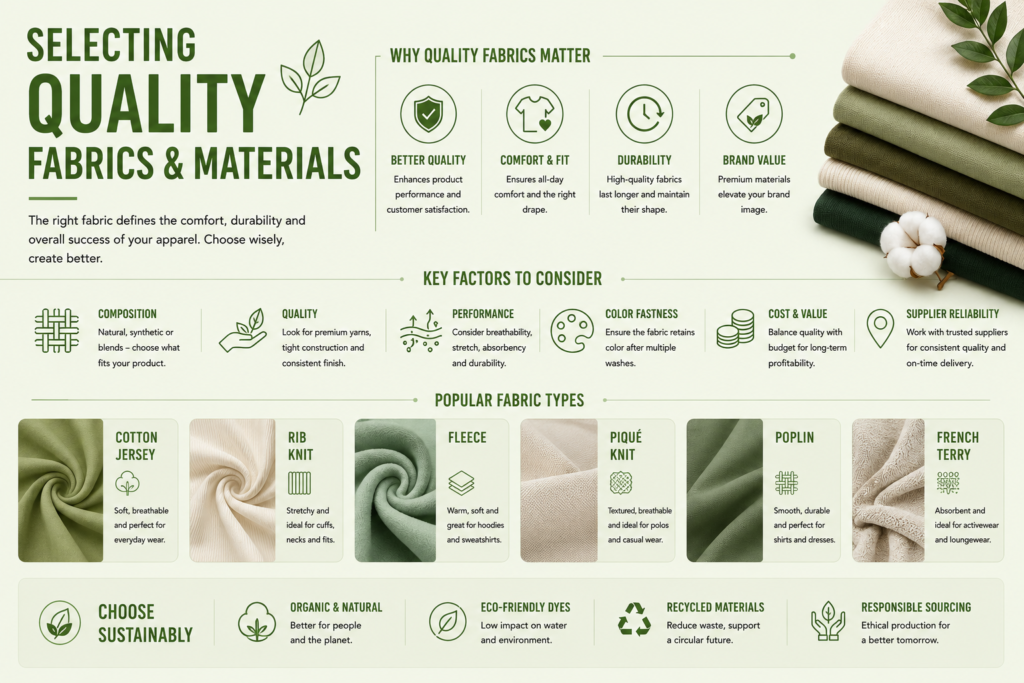
Fabric selection guide showing how to choose quality and sustainable materials for clothing manufacturing.
A guide to selecting fabrics based on quality, durability, and sustainability for better apparel production decisions.

Choose strong fabrics to design a successful private label apparel collection. In the stores, you can feel cotton, blends, and polyester. Choose soft fabrics that will last through many washes. Consider the season, for example, light colors in summer. Test the samples for color and stretch. Customers will love your clothing more if you do this.

Create tech packs for factories

Create tech packs if you create a successful apparel collection. They show measurements, seams and other details. Include color codes and size charts. Note the exact placement of pockets, for example. The factories follow them perfectly. This also reduces errors.

Partner with Reliable Manufacturers

Look for good factories to manufacture your private label clothing collection. Verify their previous work and speed. If they offer custom runs, ask ECO JERSEY about them. If you are close, visit or watch a video tour. Start with small orders. So, the quality is high right from the start.

Test and prototype samples

Make samples to design a successful private label apparel collection. Fit checks can be done by wearing them. Stretch and wash to find weak points. Ask your friends for honest feedback. For example, fix loose sleeves quick. If necessary, you can also change the colors. Thus, final pieces shine perfect.

Determine pricing and production scale

Set smart prices for your private label apparel collection. Include factory costs, shipping and profit margin. Prices should be fair to buyers. Plan how many you will make at first. Start small and then increase sales. This will also keep your cash flow secure.

Promote Your Launch with Strong Marketing

Sell your private label apparel collection large. Daily, use Instagram stories and photos. Advertise to the right fans. Launch deals such as buy one, get a discount. What sells quickly? Buzz spreads quickly because of this.

Conclusion

To create a successful apparel collection, you need to make smart decisions and follow clear steps. Research buyers, sketch boldly, and test everything with partners such as ECO JERSEY. You create unique clothes customers love. This will also help your brand grow. Launch your collection today by starting to design.

FAQs

How do I start a private label apparel collection?

Research market, sketch designs, pick fabrics, make tech packs, test samples.

What makes a apparel collection a success?

Unique styles, quality materials, perfect fit, smart pricing, strong marketing.

Why test samples of private Label Apparel Collection

Fixing errors and finding fit issues before production can save money.

Can beginners design private label apparel collection?

Yes, use simple sketches, good factories, start small always.

How does ECO JERSEY help private label apparel collection?

You can get your designs produced quickly, with quality assurance, and custom runs.

CMT vs FPP: Which Clothing Model Fits Your Brand?

0

Whether you’re looking to launch a clothing brand or expand an existing one, a big decision you will have to make is how do I get my clothes manufactured?

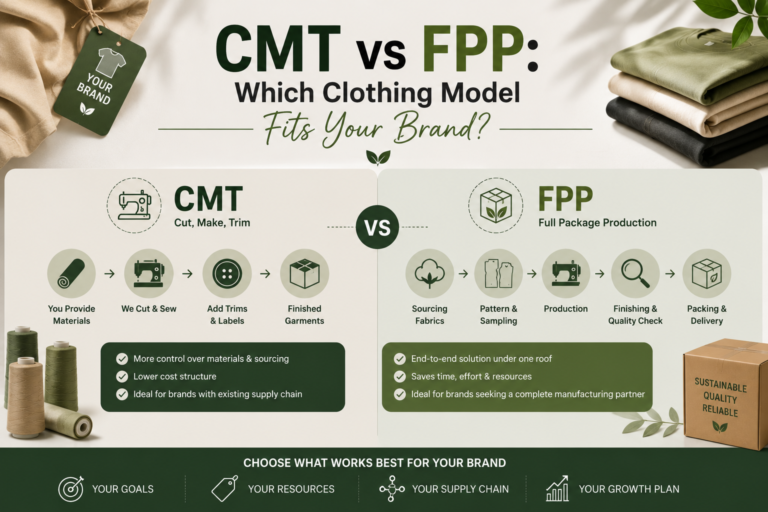
Cut, Make & Trim (CMT) and Full Package Production (FPP) are two common methods of production. CMT and FPP are both great methods of production, but you should be careful in choosing which one to go with. Choosing the wrong one can cost your brand a lot of time, money, and unnecessary headaches.

This guide will help you identify which method is appropriate for you by breaking both of them down and doing an honest comparison.


What Does CMT Mean?

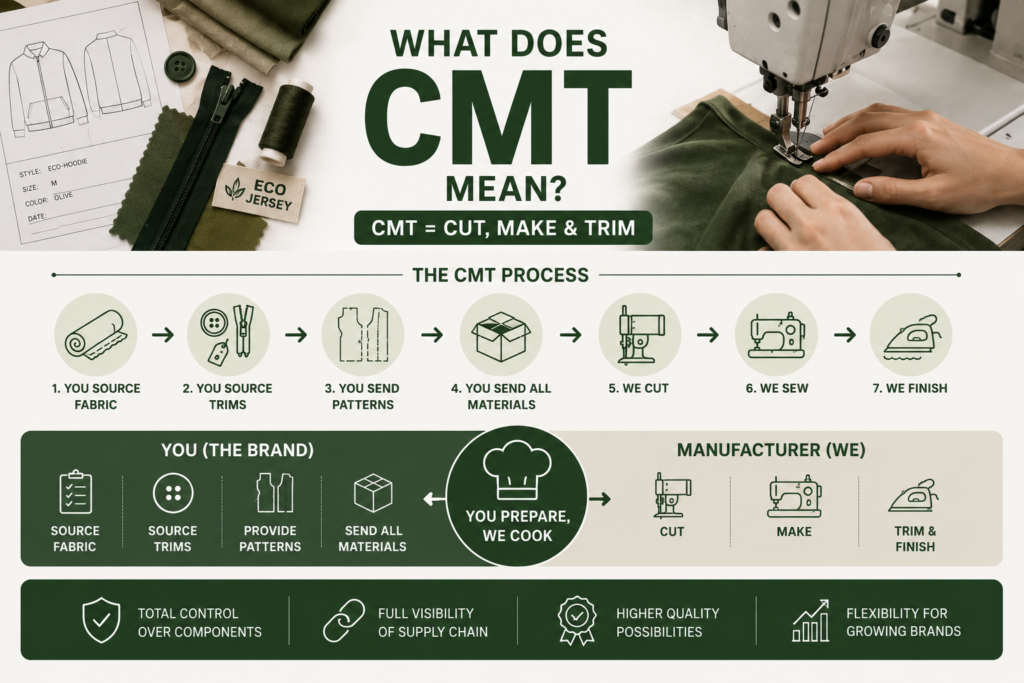
Infographic explaining the CMT clothing manufacturing process, including fabric sourcing, trims, pattern preparation, cutting, sewing, and garment finishing handled between the brand and manufacturer.
CMT manufacturing gives apparel brands greater control over fabrics, trims, and sourcing while the factory focuses on cutting, sewing, and finishing production.

CMT is the abbreviation for Cut, Make & Trim.

With the CMT method, the brand is in charge of all the sourcing, whether that be the sourcing of the fabric, the sourcing of the trims (which can include the sourcing of buttons, zippers, labels, threads, etc.), or the sourcing of the patterns. After everything is sourced, the brand will send all of the pieces to the manufacturer. The manufacturer will only cut the fabric, sew the pieces together, and do the finishing touches.

Think of it as the brand is in charge of meal prep, and the manufacturer is in charge of the cooking.

With this method, you have total control of the garment components, but you have to put in more of the work.

If you are interested in the CMT method, Eco Jersey has a CMT clothing manufacturing service designed for the brands that care most about control of the supply chain.


Meaning of FPP

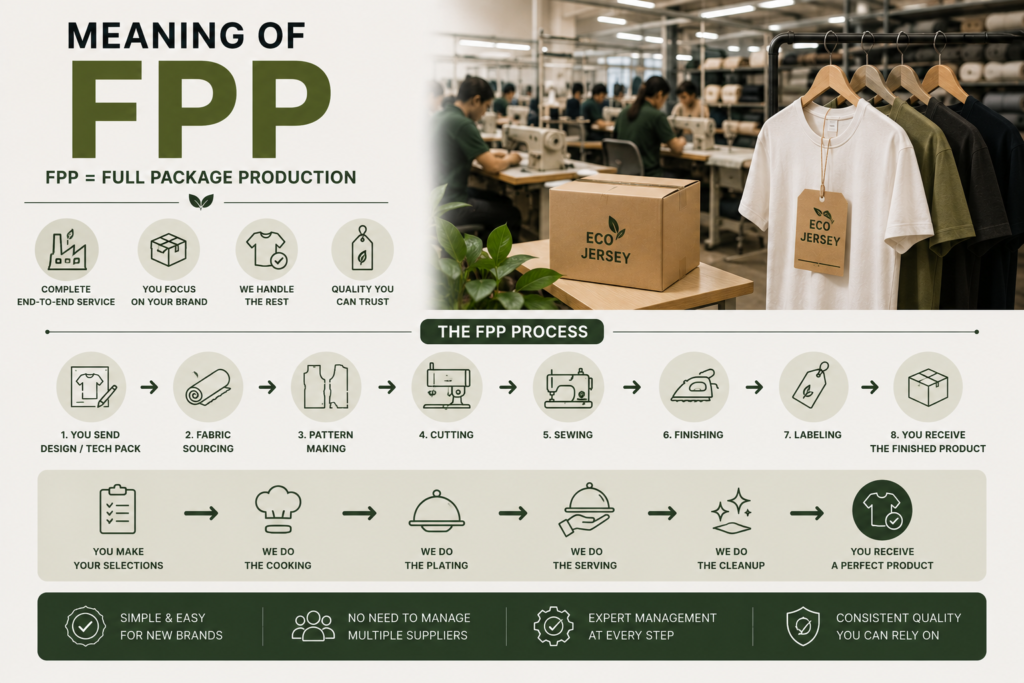
Infographic illustrating the full package production process from design submission and fabric sourcing to cutting, sewing, finishing, labeling, and final garment delivery.
FPP manufacturing provides a complete end-to-end apparel production solution where the factory manages sourcing, production, finishing, and delivery for the brand.

FPP means Full Package Production.

Under this arrangement, the factory handles the entire process, from start to finish. You send the factory the design idea or the tech pack, and the factory takes care of the fabric sourcing, the patterns, the cutting, the sewing, the finishing, and the labeling. You simply receive the completed product.

You can think of this as being similar to the way a restaurant operates. You make your selections, and then the restaurant takes care of the cooking, the plating, the serving, and the cleanup.

This approach is much easier for a new brand or business that lacks a deep understanding of fabric sourcing and supply chains.

Eco Jersey’s FPP apparel manufacturing service is perfect for brands seeking a complete end-to-end service solution without the hassle of dealing with multiple suppliers.


CMT vs. FPP: Side by Side Overview

CMTFPP
Who sources the fabric?You (the brand)The factory
Who sources the trims?You (the brand)The factory
ControlVery highModerate
Effort required from brandHighLow
Is this option good for beginners?Not alwaysYes
Is this option good for experienced brands?YesYes
Are the per unit costs better?Can beSlightly higher
Time to productionLonger (sourcing phase)Faster

When to Use CMT?

You can use CMT if:

  • You have established relationships with fabric suppliers
  • You have a preferred fabric or material
  • You want to maintain control and visibility of every component of your product
  • You’re operating a sustainable apparel brand and want to make sure the source of your eco-friendly materials
  • You have a knowledge of garment production and the supply chain

CMT is for brands that want to have full visibility and control over their production and the sourcing of materials. This option is best for brands who have the time and knowledge of the manufacturing process and have connections to reliable suppliers.


When Should You Choose FPP?

FPP is a good option if:

  • You are starting your first clothing line
  • You prefer designing and branding over worrying about supply chain logistics
  • You don’t have the time needed to deal with multiple suppliers
  • You are looking for a made-to-order production model where everything is done for you
  • You are engaging with a low MOQ clothing manufacturer and prefer having flexible full-service support

FPP takes a big chunk of work off your hands. Factories Function as production partners, and not simply as sewing factories.


What About Cost?

“You’d probably think a cost-related question would be the most common, but it’s typically this: is it cheaper?”

The blunt response is: it depends.

With CMT, you bring your own materials so you may have cheaper unit costs. However, you will have to spend to source materials, do logistics and supplier management. If you have any issues with your supply chain, that will also fall on your burden.

With FPP, you may actually be paying more per unit because the factory is doing more work via integrated supply chain services. However, you are getting a time savings, and risk and headache savings that come with not managing your own suppliers.

For bulk apparel manufacturing, both models work so it simply depends on your volume and how much effort you want to put in.


Can You Combine Both Models?

Yes and this is something a lot of growing brands do as well.

You might use FPP (full package production) for a product launch in order to have the factory manage everything. After that, once you’ve determined which fabrics are best for your brand, you can switch to CMT (cut, make, trim) for those specific products to achieve more control at better costs.

This flexibility in contracts is an advantage of working with a contract clothing manufacturer. A contract manufacturer will work under either model or a combination of both, depending on the product and your needs.

What Role Does MOQ Play?

MOQ means Minimum Order Quantity — the least amount of clothing that a factory will produce for one order.

The CMT model typically involves bigger MOQs due to the setup time for the process, whereas FPP can be more flexible, since the factory organizes the production flow and controls the processes.

If you are an emerging brand, partnering with a low MOQ manufacturer through an FPP model is one of the best options to produce your first collection without the burden of ordering a large quantity.

Is Sustainability Affected by Your Decision?

Yes. More and more brands are recognizing this.

With CMT, you have full control over which fabrics and materials to use. This means you can ensure that your garments are made from organic, recycled or responsibly sourced materials.

When utilizing an FPP model, you’re putting faith in the factory to use sustainable materials. As such, you need to choose manufacturers that value sustainability.

Eco Jersey maintains environmental standards regardless of whether you source your fabrics or if we source them. Thus, Eco Jersey has a sustainable apparel manufacturing service for companies choosing either production model.


Which Option is Right for a Growing Brand?

To understand which model to choose, keep the following in mind:

Pick CMT if you’re ready to take on your supply chain. This model rewards you with perhaps the greatest quality as well as the materials.

Pick FPP if you’re ready to go fast. This model emphasizes scaling your product line the quickest.

FPP is the choice of most brands quickly fulfilling demand and then choosing CMT once they learn how to supply.

If you’re looking for a dependable partner to fulfill bulk orders while working within the two models, Eco Jersey has your back.


How Eco Jersey Supports Both Models

At Eco Jersey, we support brands at every stage of the process — from the first collection all the way to large runs.

You can rely on us for a skilled CMT clothing manufacturer if you’re supplying your own fabric, or if you would like us to take care of everything with an FPP solution, we have the capability and experience to fulfill your requirements.

We also promote:

  • Contract manufacturing for collaborative production agreements
  • Made-to-order services for production based on imminent demand
  • Low MOQ options for emerging businesses
  • Sustainable manufacturing for environmentally-friendly collections
  • Bulk production for brands planning on growth

Final Thoughts

There is no absolute ‘right’ answer to these production models. The appropriate options are determined by the level of experience, target timelines, available budget, and the desire of control on the production process.

When needed, a manufacturer knowledgeable in both practices will educate the brand to answer their questions and help them reach their goals. An excellent production partner will do more than push the brand toward the easiest option.

For help determining the most appropriate option for your upcoming collection, contact the Eco Jersey team today.


FAQs

What is the difference between CMT and FPP?

In CMT (Cut, Make, Trim), brands provide their own fabrics, and designs are created, whereas, FPP (Full-Package Production) oversees material sourcing and garment assistance.

Which model is better for small brands?

The flexibility and cost control offered by CMT is popular among small brands, making it a good option; on the other hand, FPP works well when brands are looking for a comprehensive solution to their production needs.

Can I switch between CMT and FPP?

Definitely. Brands may opt to utilize CMT for smaller production runs, and as demands increase, switch to the full one-stop factory solution offered through FPP.

Sustainability Options in CMT Clothing Production

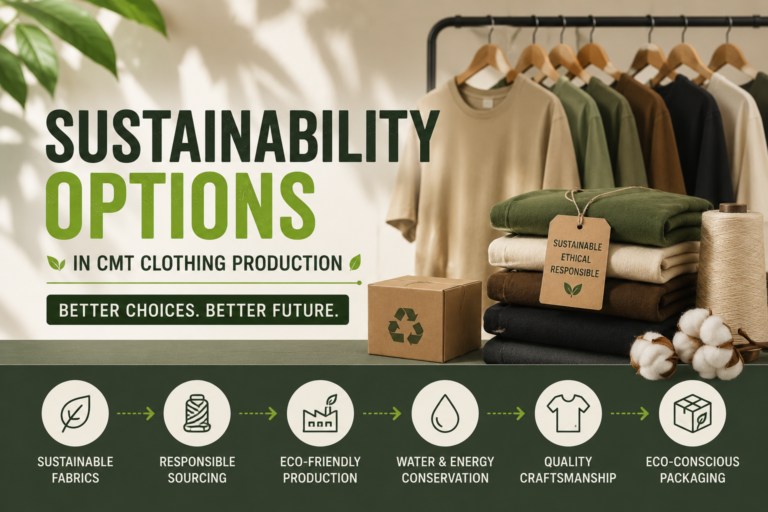
Sustainability is becoming a priority for fashion brands everywhere, and CMT Clothing Production is no exception. CMT, which stands for Cut, Make, Trim, allows brands to supply their own fabrics and designs while factories handle the production. This gives brands full control over materials, making it easier to introduce eco-friendly practices.

For businesses seeking professional support, partnering with a CMT Clothing Manufacturer is an ideal first step. These manufacturers can guide brands in reducing waste, optimizing fabric use, and maintaining high-quality standards while being eco-conscious.


Eco-Friendly Fabrics and Materials

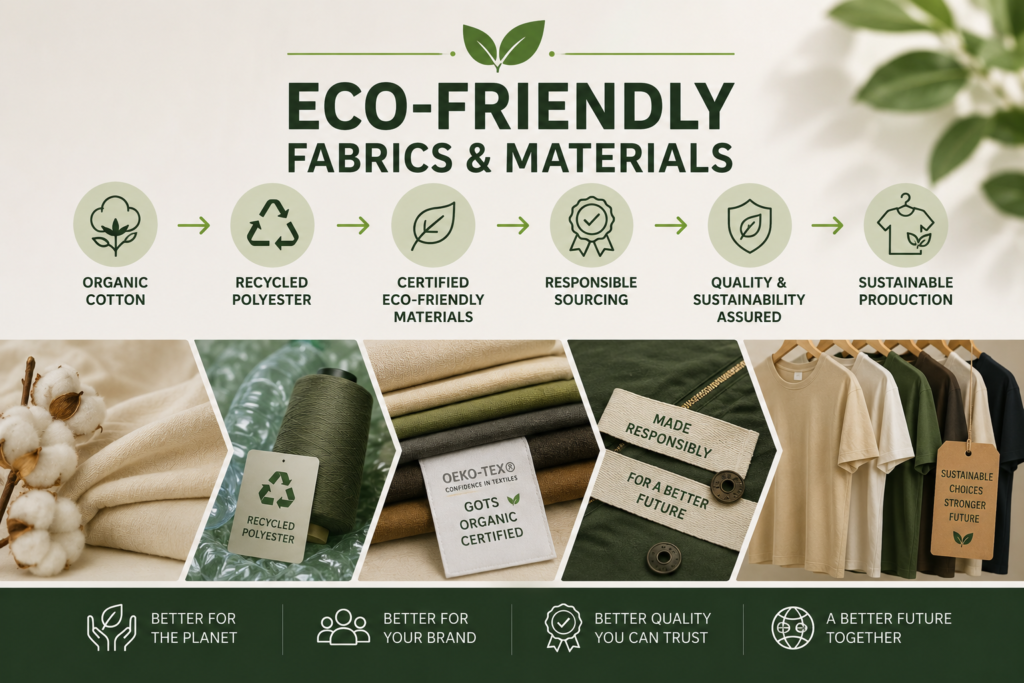
Infographic showing eco-friendly fabrics and sustainable apparel materials including organic cotton, recycled polyester, certified textiles, responsible sourcing, and sustainable garment production.
Eco-friendly fabrics and responsibly sourced materials help clothing brands improve sustainability while maintaining quality and efficient apparel production.

One of the simplest ways to make CMT Clothing Production sustainable is by carefully choosing fabrics. Brands can opt for organic cotton, recycled polyester, or other certified eco-friendly materials. Providing your own fabrics allows you to control quality and sustainability from the start.

Many factories also offer advice on sourcing materials responsibly. For example, a Sustainable Apparel Manufacturer can suggest fabrics and trims that are both high-quality and eco-conscious, while a Bulk Apparel Manufacturer helps scale production efficiently without compromising sustainability.

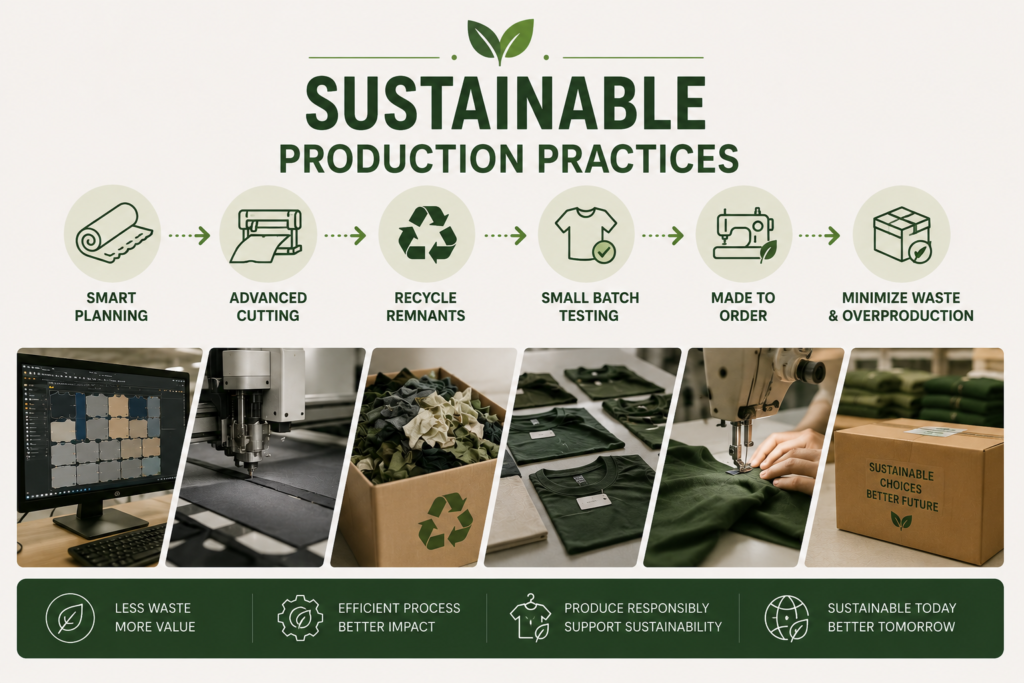
Sustainable Production Practices

Infographic illustrating sustainable production practices in apparel manufacturing, including smart planning, advanced cutting layouts, recycling fabric remnants, small batch testing, and minimizing overproduction waste.
Sustainable production practices reduce material waste, improve manufacturing efficiency, and support low MOQ and made-to-order apparel production models.

A major factor in sustainable CMT production is waste management. Sustainable production is really only achieved when the raw materials are used and consumed fully.

Mistakes in cutting or overproducing clothing leads to wasted time and material. To avoid this, brands can partner with manufacturers to:

  • Implement advanced cutting layouts.
  • Recycle remnants.
  • Produce smaller testing runs.

Brands can rely on the Low MOQ Clothing Manufacturer to produce only what they need to minimize overproduction, thus maintaining flexibility and preventing excessive inventory. If brands want to create custom designs while maintaining sustainability, they might work with a Made-to-Order Apparel Manufacturer, thereby saving material and energy.


Energy Efficiency and Responsible Practices

To be truly sustainable, CMT Clothing Production needs to keep its fabrics and sustainable, but so does the overall factory. Factories that use energy-efficient sewing machines, renewables, and low-water finishing processes let brands minimize even more of their footprint.

Some brands use FPP Apparel Manufacturers for big production runs, knowing the machines and processes are eco-conscious. Getting the right factory on the side also helps brands see energy/water consumption, so the factory can become more sustainable.


Benefits of Sustainable CMT Clothing Production

There are many CMT Clothing Production benefits to sustainable practices. Once brands adopt sustainability in fabrics and production, they can

  1. Ensure the quality and materials they choose.
  2. Ease their environmental footprint with minimal waste and efficient energy consumption.
  3. Attract eco-sensitive consumers while enhancing their brand’s image.
  4. Prevent losses from overproduction.

For brands needing support in meeting sustainability targets while managing their production, a Contract Clothing Manufacturer is the right partner.


Conclusion

Sustainable CMT Clothing Production provides brands a means to control their creativity in a mindful way.

Selecting green fabrics and streamlining energy use and waste are just a few steps to create a brand that is more environmentally friendly.

Whether you are launching a new collection or expanding an existing one, working with manufacturers such as CMT Clothing Manufacturer and Sustainable Apparel Manufacturer allows you to maintain the production’s efficient, flexible, and sustainable production goals.

FAQs

What is CMT Clothing Production?

CMT Clothing Production is an acronym for Cut, Make, Trim. In this case, a brand provides its own fabric and designs, while the factory takes care of the cutting, sewing, and finishing of the garments.

In what way is CMT production sustainable?

It can be more sustainable by employing eco-friendly fabrics, cutting for less waste, and when using energy-efficient factories that work on smaller production runs.

Which companies should consider sustainable CMT production?

This is a viable option for independent brands, fashion starts, and designers that want to retain control over the materials and want to integrate environmentally friendly processes into their business.

What Is Low MOQ Clothing Manufacturing? Explained

In the Low MOQ Clothing Manufacturing of clothing, a critical consideration is how much inventory to produce at once. This is particularly true for smaller brands, start-ups, or even designers that are piloting new ideas. Producing larger quantities of a product often comes with a great deal of risk and an associated financial cost. This is where Low MOQ Clothing Manufacturing becomes relevant in terms of flexibility and cost for an evolving business model for modern apparel.

Understanding Low MOQ Clothing Manufacturing

MOQ stands for minimum order quantity. It refers to the number of units that a manufacturer will produce in a single order. At the traditional level of manufacturing, this means hundreds, if not thousands, of units and is likely prohibitive to a smaller brand. Low MOQ Manufacturing means that a brand can order a smaller quantity of units, sometimes in the order of 50 to 100, as is the case with various manufacturers.

Why does this help?

  • Less financial liability, as you’re not ordering a larger inventory.
  • Test and go – more styles and/or collections at a rapid pace.
  • The flexibility to create and deliver more custom and niche designs.

EcoJersey specializes in providing solutions tailored to such needs, including their Low MOQ Clothing Manufacturing services that help brands scale efficiently.

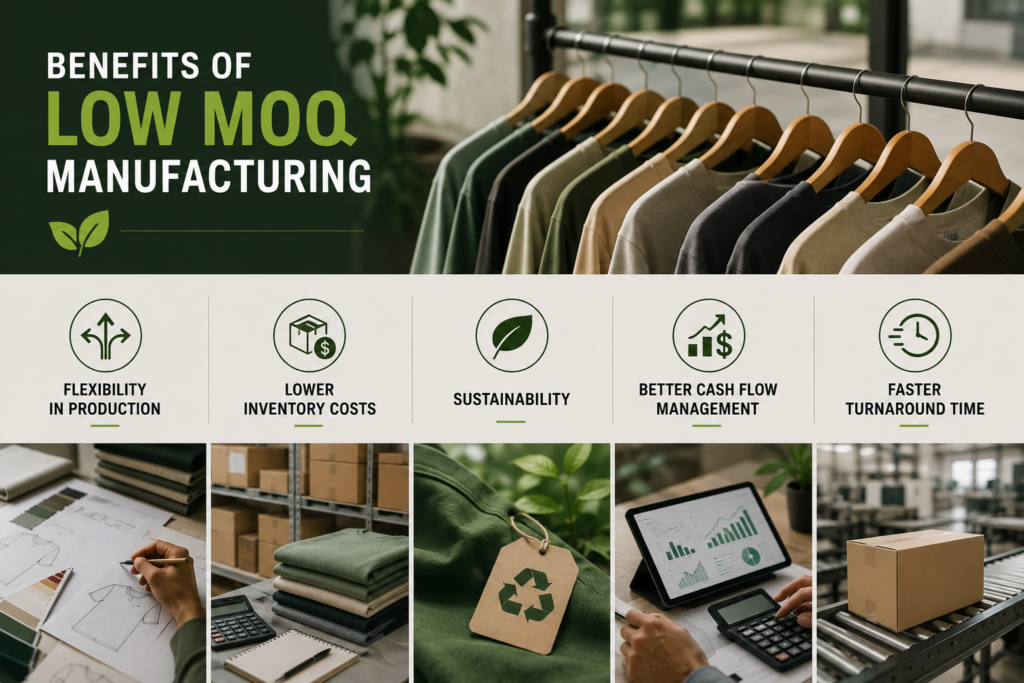
Benefits of Low MOQ Manufacturing

Benefits of low MOQ manufacturing shown through flexible apparel production, sustainable clothing practices, inventory management, and faster order fulfillment. Low MOQ Clothing Manufacturing
Low MOQ manufacturing helps brands reduce inventory costs, improve cash flow, test new designs, and support sustainable apparel production.
  1. Flexibility in Production
    Low MOQ allows brands to adapt quickly to changing trends. You can test designs, colors, and fabrics with limited stock before committing to larger production runs.
  2. Lower Inventory Costs
    Small batch production reduces the need for extensive storage space and minimizes overstock risks.
  3. Sustainability
    Producing only what is needed reduces waste and promotes eco-friendly practices. Companies like EcoJersey also offer Sustainable Apparel Manufacturing, ensuring that your small-batch production aligns with environmentally responsible methods.
  4. Better Cash Flow Management
    Smaller orders mean less capital tied up in stock, freeing funds for marketing, design, or other operational needs.
  5. Faster Turnaround Time
    Small orders often move quicker through production cycles, letting your products reach the market faster.

How Low MOQ Fits Into Modern Apparel Manufacturing

Low MOQ is part of a broader shift in the apparel industry toward customized, agile, and demand-driven production. Whether you are a small fashion startup or an established brand experimenting with new lines, low MOQ services offer a strategic advantage.

EcoJersey provides several solutions that integrate low MOQ with other production models:

By combining these services, brands can strategically manage production volumes, reduce risk, and maintain consistent quality, even with smaller orders.

Who Should Consider Low MOQ Manufacturing?

  • Startups and Small Businesses: Test the market without heavy investments.
  • Fashion Designers: Experiment with new collections or seasonal products.
  • E-commerce Brands: Avoid overstocking while responding to trends.
  • Eco-conscious Brands: Produce responsibly, minimizing waste and environmental impact.

Conclusion

Low MOQ Clothing Manufacturing is a game-changer for modern apparel businesses. It provides financial flexibility, faster market response, and sustainable production options. By leveraging EcoJersey’s diverse manufacturing solutions—from Low MOQ to Sustainable Apparel and Made-to-Order Apparel—brands can scale intelligently, reduce risk, and remain competitive in an ever-changing market.

FAQs

What is the minimum order for low MOQ manufacturing?

It varies by manufacturer, but typically it starts from 50–100 pieces per design.

Can I customize designs in low MOQ production?

Yes! Many manufacturers, including EcoJersey, offer customization options for fabrics, colors, and patterns.

Is low MOQ more expensive per unit?

Unit costs may be slightly higher than bulk production, but the benefits of flexibility, reduced inventory risk, and faster market entry often outweigh the extra cost.

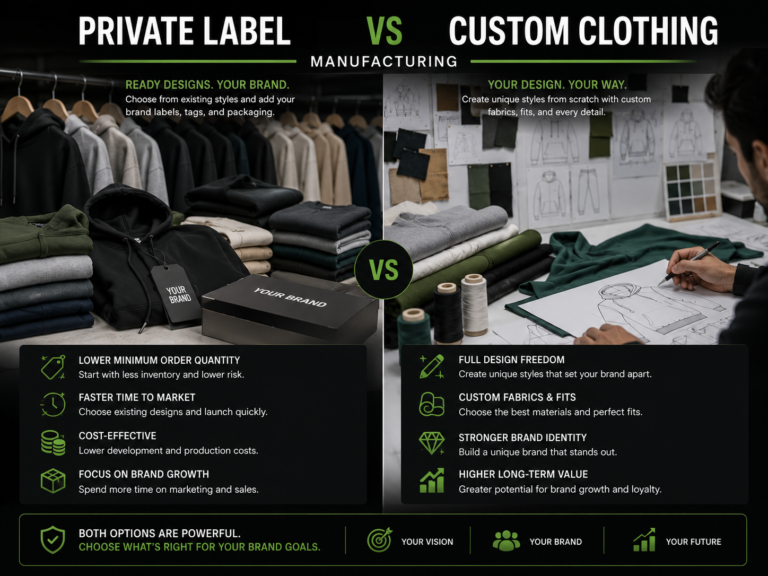
Private Label vs Custom Clothing Manufacturing

When establishing your clothing line, one of the first critical decisions you must make is selecting the right manufacturing model. Private labels and custom clothing manufacturing vary greatly, and to choose the best option for your business, you must understand these differences. Each model has distinct advantages, but only they can be aligned with specific goals, budgets, and time frames.

At Eco-Jersey, we provide support for international brands in both models. Here, we present all the information, so you can make an informed decision.


What is Private Label Clothing Manufacturing?

Diagram explaining private label manufacturing, where a business sources products from a manufacturer and sells them under its own brand name.

Private label manufacturing is a model in which the manufacturer produces garments using the brand owner’s label, logo, and branding. In this case, the brand owner has full control of the identity of the product and logos. The control of the manufacturing process is done by the manufacturer.

This model is faster and more cost efficient, as well as easier to scale. Consequently, it is the preferred model for startup and growing brands who wish to launch quickly and with a smaller capital outlay.


What Is Custom Clothing Manufacturing?

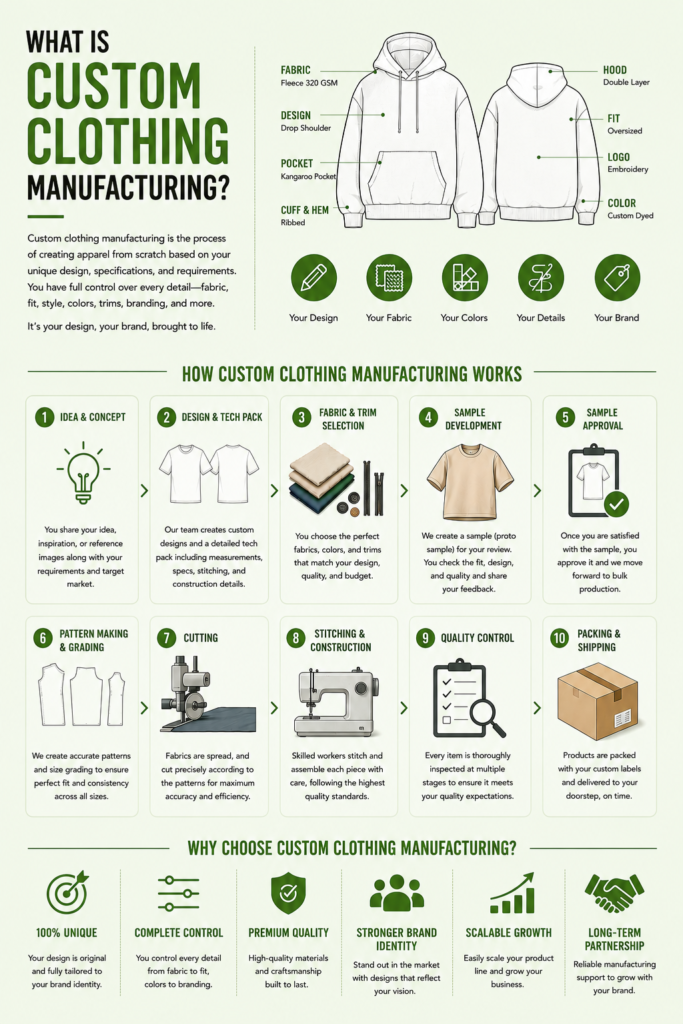
Illustration explaining custom clothing manufacturing, showing the process of designing, producing, and branding apparel for a specific business or customer.

Custom clothing manufacturing involves a clothing brand owner being involved in the design process such as fabric selection, pattern creation, and stitch methods/techniques. Every piece of clothing made under this process is built according to the desires of the brand owner.

This model allows a high degree of originality and creative freedom. However, it requires a high level of investment, time, and a detailed knowledge of the processes and techniques involved in clothing production.


Private Label vs Custom Clothing Manufacturing: Key Differences

FactorPrivate LabelCustom Manufacturing
Design FreedomModerate — works within existing frameworksFull — built entirely from scratch
Production CostLower — more budget friendlyHigher — due to pattern and material development
Minimum Order QuantityLower MOQs — accessible for startupsHigher MOQs — setup costs need to be spread
Production TimelineFaster — established systems speed up productionSlower — every element developed from scratch
Brand ExclusivityModerate — branded exclusively to youHigh — fully original and unique products
ScalabilityEasy and efficient to scaleMore complex and costly to scale

Which Model Is Right for Your Brand?

Select Private Label Manufacturing If:

You need to develop a brand quickly to start The goal is to minimize the risk and costs of using capital The goal is to develop products that can be expanded quickly to maximize the value of the product line Your goal is to control costs and focus on the marketing of the product.

Select Custom Manufacturing If:

Your brand is well-known with a strong identity Your goal is to have unique one-of-a-kind products Your goal is to have a perceived premium unique product with high value and low costs of acceptance Your goal is to fund and have a custom product developed fully.


Is It Possible to Integrate Both Methods?

Yes; it is what many successful brands do. It starts with private label manufacturing to generate assets and brand control. The custom-manufactured pieces are introduced to add unique and differentiated products as the brand expands into longer manufacturing. This provides a basis for a custom brand to identify and control costs for the value, making it a premium product.


Why Eco-Jersey for Private Label and Custom Manufacturing

Eco-Jersey is a Pakistan-centered clothing company that supplies internationally with regional offices in locations ranging from North America to Europe, the Middle East, and Australia. We manufacture custom clothing and private-label garments. We value the individuality of our customers and their specific needs. Our skilled and experienced team handles your order with care, assuring you quality performance, strict quality standards, and reliable international shipping services.


Conclusion

The question is not whether private-label manufacturing is superior to custom clothing manufacturing; it is which model is correct for your brand at this moment in time. Private-label manufacturing is faster, cheaper, and allows for scalability. On the other hand, custom manufacturing allows for original and creative designs that are unique to the brand. Therefore, the most successful brands are able to use both methods.

Frequently Asked Questions

Is private-label tailoring cheaper and of lower quality than custom tailoring?

No. In this case, the production process does not determine the quality. It is an independent factor. Many successful and established premium brands are catered to private-label manufacturing.

Am I able to switch from private-label manufacturing to custom manufacturing?

Yes, many brands begin with private-label catering in order to establish their presence in the market. This allows them to grow and mature their identity, and as a result, their budget allows them to switch to custom manufacturing.

How can I shield my designs from custom manufacturing?

This can be done through the use of non-disclosure agreements with your manufacturer, in addition to brand trademarks. Make sure you are dealing with a manufacturer who is considerate of intellectual property rights.

Case Study: Successful Brand Launch Using FPP Manufacturing

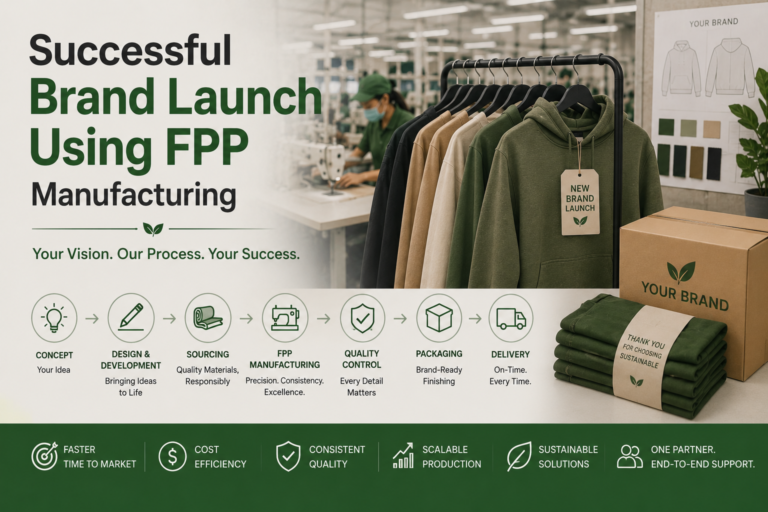
Building a clothing brand from the ground up is exhilarating, but there are a lot of challenges that most founders are not ready for. Sourcing, Manufacturing, Quality control. An FPP manufacturing model takes the guesswork out of building a brand because it provides a professional team from day one.

Here is how one activewear brand successfully launched with Eco Jersey’s FPP.


The Challenge: A Brand With a Vision but No Factory

The customer wanted us to create an activewear line targeting customers in Europe. The customer already had some details prepared like the brand, the audience, and the budget. What they lacked was an end-to-end manufacturing partner.

The customer needed a partner who could bring their vision to life with speed and cost-effectiveness without sacrificing quality.


Why They Choose FPP Manufacturing

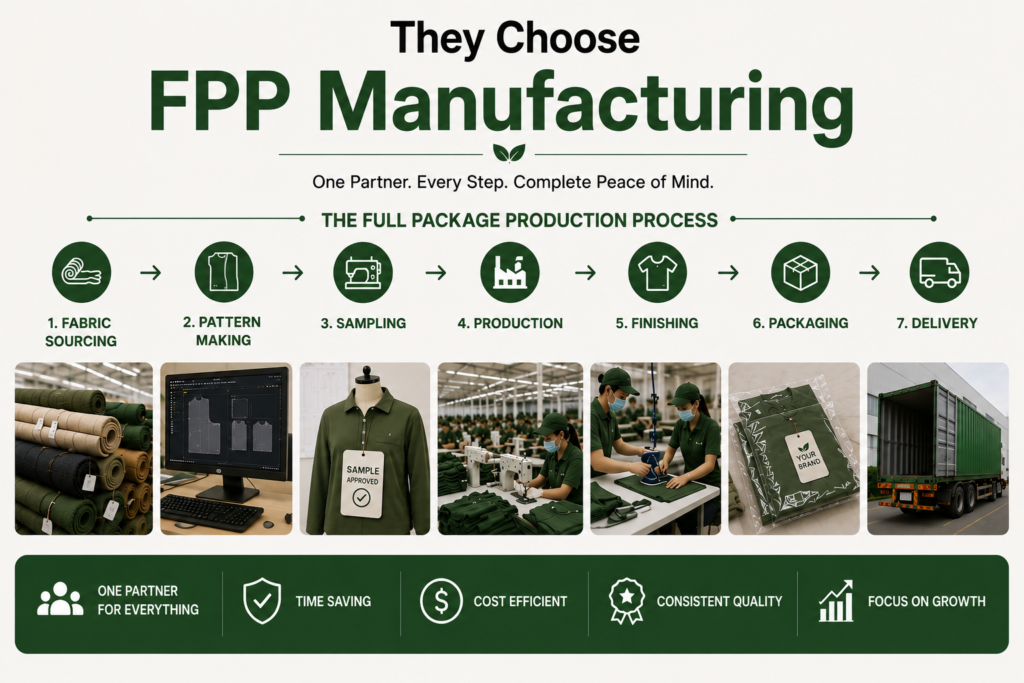
Infographic explaining the full package production manufacturing process, including fabric sourcing, pattern making, sampling, garment production, finishing, packaging, and delivery services for clothing brands.
Full package production simplifies apparel manufacturing by managing sourcing, development, production, finishing, packaging, and delivery under one reliable manufacturing partner.

FPP, or Full Package Production, means the manufacturer handles everything — fabric sourcing, pattern making, sampling, production, finishing, and packaging. The brand owner doesn’t need to coordinate with multiple suppliers or chase different vendors separately.

Our FPP Apparel Manufacturer service was the perfect fit. The client handed over their tech packs and design references, and we took full ownership of the production process from there.

This is what made the brand launch using FPP manufacturing the right call:

  • Single point of contact — no juggling between vendors
  • Faster turnaround — no delays from supplier coordination
  • Cost control — consolidated production keeps pricing transparent
  • Consistent quality — one team, one standard, throughout

How the Production Unfolded

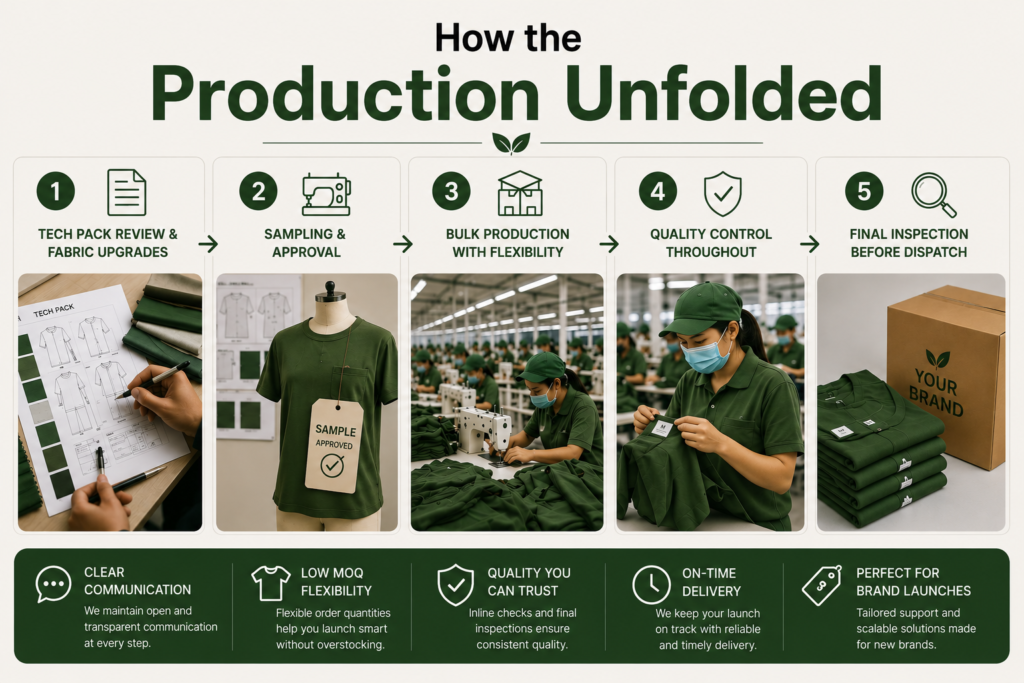
Infographic showing the apparel production workflow from tech pack review and sample approval to bulk garment manufacturing, quality control inspections, and final packaging for a clothing brand launch.
A step-by-step overview of the apparel production process including sampling, low MOQ manufacturing, inline quality checks, and final inspection before shipment.

First, our team reviewed the tech packs and suggested fabric upgrades for better performance and durability. Then we moved into sampling. The client approved the first sample with only minor revisions — a result of solid communication upfront.

Once sampling was approved, we moved into bulk production. Since this was a brand launch, the quantities weren’t massive. That’s where our flexibility as a low MOQ clothing manufacturer came into play — the client didn’t need to overstock just to meet a minimum order requirement.

Throughout production, our quality control team ran inline checks and final inspections before anything left the facility.


The Results

The brand launched on schedule. The client received market-ready garments — branded labels, polished packaging, and all. They sold out their first collection within six weeks of launch.

More importantly, they found a manufacturing partner they trusted. They’ve since placed two additional orders, this time working with us as their contract clothing manufacturer for ongoing production runs.


Conclusion

Starting a clothing line can actually be very simple! We can help take your amazing clothing idea to a marketable product with minimal hassle, if you partner with our manufacturing group and combine our FPP model.

This case study using FPP for brand launches shows that new founders can have fast, simple and quality outcomes, all combined. Eco Jersey did it all, the brand was on time and the outcome was impressive.

Our team is ready to help you build your dream brand! We’ve got your back all the way.


FAQs About Brand Launch Using FPP Manufacturing

What does FPP manufacturing include?

FPP stands for Full Package Production. It covers everything from fabric sourcing and pattern making to sampling, bulk production, finishing, and packaging. You hand over your design — we deliver market-ready garments.

Is FPP suitable for first-time brand founders?

Absolutely. FPP is actually the best model for new brands because you don’t need in-house production knowledge. Your manufacturing partner handles the technical side entirely.

What is the minimum order quantity for FPP at Eco Jersey?

We work with flexible MOQs to support growing brands. Whether you need a small test run or larger volumes, our made to order apparel manufacturer service scales with your needs.

How long does it take to launch with FPP manufacturing?

Timelines vary based on complexity, but a typical brand launch using FPP manufacturing — from approved tech pack to final delivery — takes 6 to 10 weeks.

Can I scale up after my first FPP order?

Yes. Many of our clients start with a small launch order and then move into full bulk apparel manufacturing as their brand grows. We support you at every stage.

How Private Label Clothing Manufacturing Works

Starting your own clothing label takes time, energy, and money. But when you learn how Private Label Clothing Manufacturing Works, you will discover how this process can be rewarding while also simplifying the process. By partnering with a manufacturer, you can skip the time-consuming steps of setting up a factory and sourcing model the raw materials to make samples. This model has revolutionized the ability to launch fashion lines for both new and seasoned companies.

Eco-Jersey has pioneered the Private Label Apparel Manufacturing model with international brands from small businesses to large retailers. This guide explains how Private Label Clothing Manufacturing Works, step by step, so you can choose the best path forward for your brand.

What Is Private Label Clothing Manufacturing?

Private Label Clothing Manufacturing is a process that takes care of each step of production for a clothing label for a specific brand. The brand owner will provide a label and logo, as well as some design front work, and then leave the bulk of the work to the factory. When this process is complete, the clothing will be branded and the manufacturer’s name will not be visible.

Most brands in the fashion business can utilize this model. It allows brands to manage their product lines without managing a factory. It brings down the cost of production and time needed to bring the product to the market. It has also proven valuable to businesses in their early and growth stages.

How Private Label Clothing Manufacturing Works: Step by Step

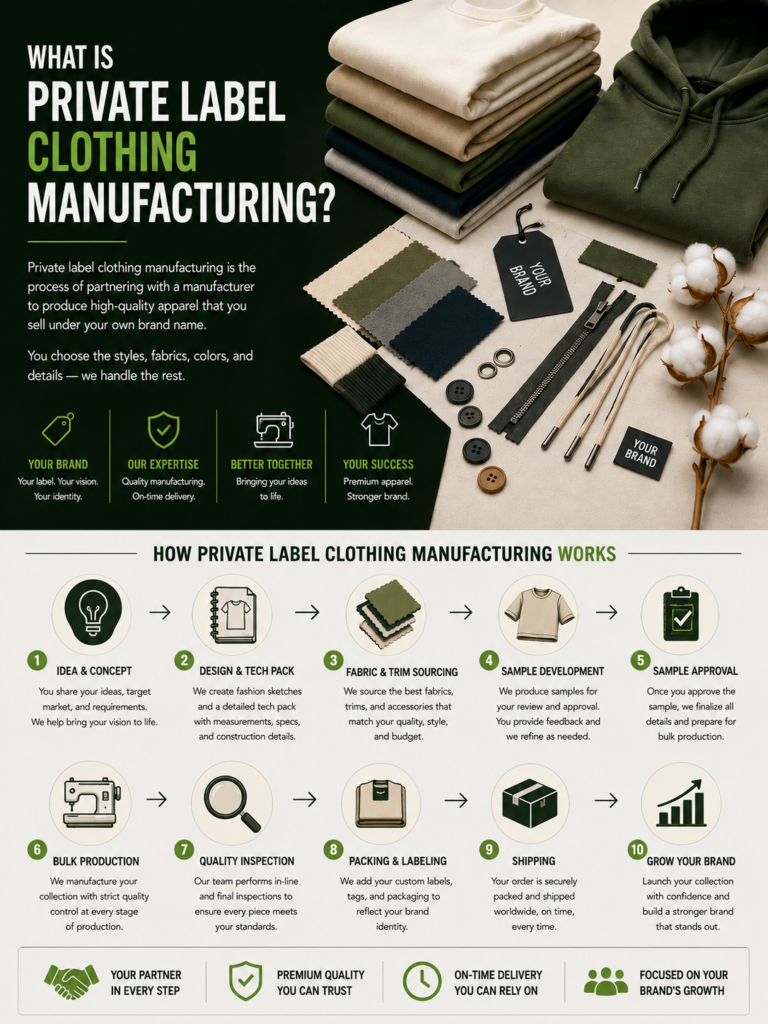
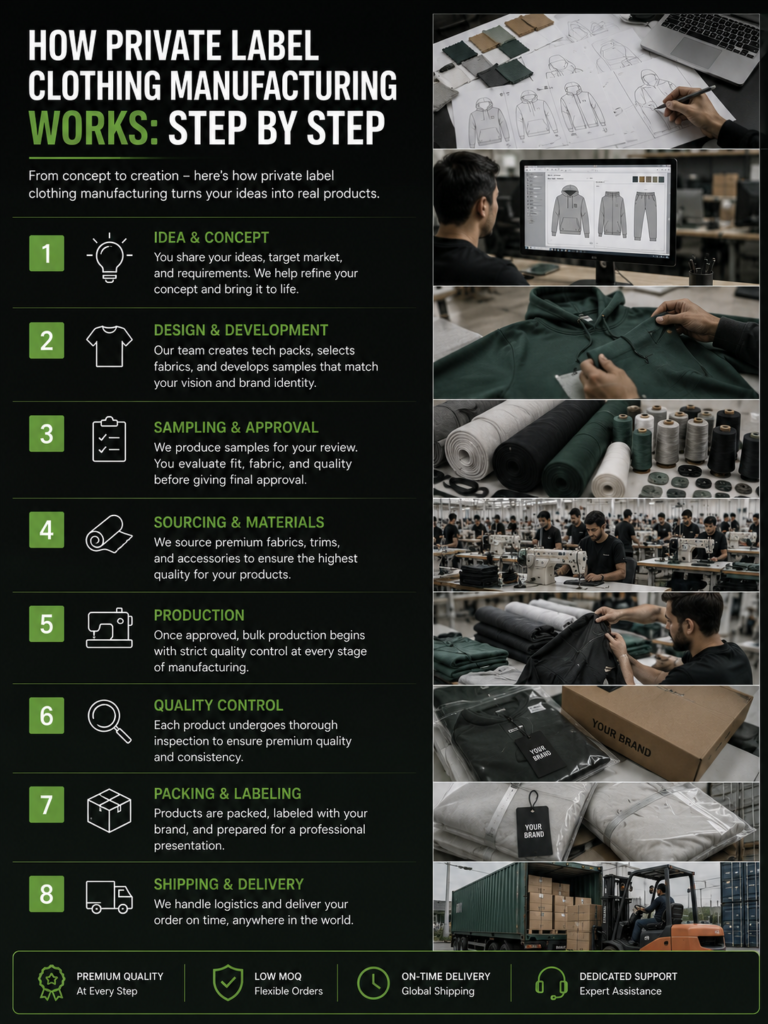
How private label clothing manufacturing works step by step full guide

The best way to learn about private label clothing development is to study the production process in its entirety from idea to fulfillment.

Brand Briefing

The first step of private label clothing manufacturing is when the brand owner relays a series of requirements to the manufacturer.

This includes the following:

  • Type of clothing
  • Target consumer and purpose of the garment
  • Specific fabrics and materials
  • Colors, cuts, and styles of the design
  • The owner’s brand identification in the form of clothing tags, product labels, and packaging.

Our staff at Eco-Jersey looks at each brief before continuing on to the next stage so we can quickly and accurately address the needs of our customers.

Design and Tech Pack

The design stage is only activated once the brief has been signed off. Our design team takes the customer’s design files to work from. However, if a customer does not have design files, our design staff works from a detailed Tech Pack. A Tech Pack is a technical document of garment construction. It includes detailed notes of measurement, stitching, and fabric construction.

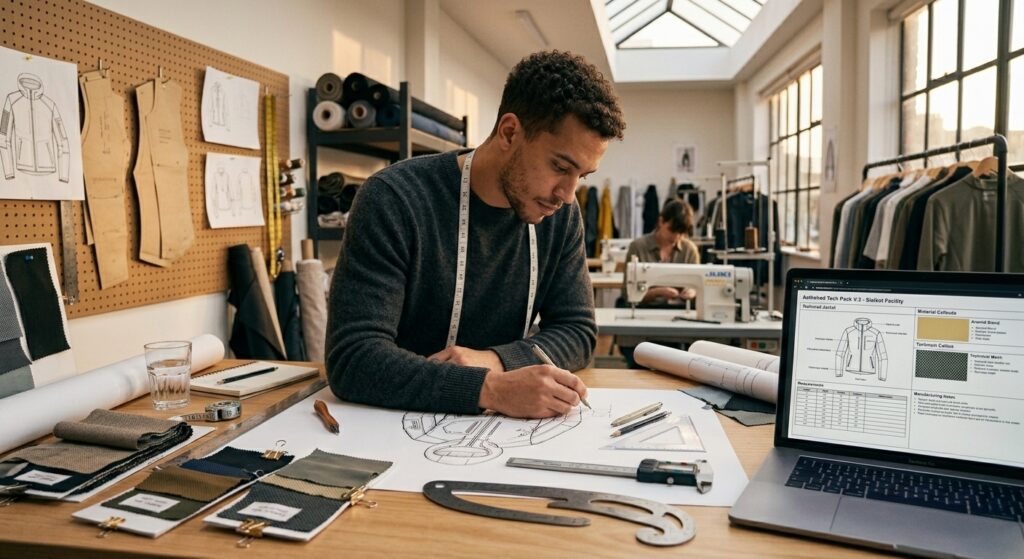
Fashion designer creating a clothing tech pack and garment sketch in a modern apparel studio surrounded by fabric swatches, sewing tools, and production samples.

An adequately constructed tech pack is the blueprint for every step in the production process. Without this document, there is a high chance there will be a lack of cohesion which can delay production and compromise the quality of the product.

Fabric Sourcing and Material Selection

Once the design is complete, the next step in private label clothing manufacturing is sourcing the fabric. The manufacturer chooses and buys the fabric in line with your specifications which can range from the type of fabric to the GSM (grams per square meter), how much it can stretch, the color, and the quality of the finish.

Eco-Jersey is a top supplier of high-quality products at an international standard and we have options for sustainable products for brands with a preference for environmentally friendly products.

Sampling / Prototype Development

Prior to commencing mass production, a sample garment is produced. This allows you to touch and feel the product before deciding on it and allows you to inspect the quality of the stitching, the sample garment, the placement of the label, and lastly, the overall finish.

Sampling is the most important step in manufacturing as it allows you to make the most changes to the product because once mass production starts it is extremely expensive to make changes. For this reason, multiple revisions of the sample are done at Eco-Jersey until you are satisfied.

Sample Approval

Once the sample arrives, you must scrutinize the sample. If the sample is not up to your specifications, the production team is notified and the sample undergoes the required changes and is sent back for review. This process is repeated until the sample is approved.

The manufacturer only begins bulk production after the first article sample is approved. This is a necessary step for every professional private label clothing manufacturer as it guarantees that the manufacturer is meeting your expectations for the final deliverables.

Bulk Production

Full-scale production begins after the sample is approved. The production team will cut the fabric and construct the pieces, add any decorative items, and apply the branding, woven tags, hang tags, care labels, and branded boxes.

Eco-Jersey has optimized production processes that help us remain consistent and maintain quality at every stage. Our quality control team oversees the production to ensure that any issues are flagged at the earliest.

Quality Control and Inspection

quality control

Quality control (QC) is a perpetual process during production, but a final distinct inspection occurs just before shipping orders. At this stage, each production batch is compared with the client’s approved production sample and tech pack to confirm the following:

  • Accuracy in measurements
  • Stitching integrity
  • Color uniformity
  • Correct placement of labels and brand identifiers
  • Satisfaction of packaging requirements

Eco-Jersey strictly implements quality control processes that meet international export standards, which means that we deliver clothing items that are fully saleable with no need for rework.

Private Label Branding and Packaging

The private label clothing manufacturing process is differentiated by the branding stage. At this stage, your custom tags and packaging are affixed to the finished clothing items, thus converting the clothing item into a product that represents your brand.

We place your brand name, logo, and care and origin information during this step. Depending on your needs, we can also provide polybags, hangers, or branded boxes.

Documentation and Shipment

Our company takes care of all your export documentation and works with international freight companies to get your merchandise delivered.

Our logistics teams work to make international shipping very simple and easy, no matter if you’re in Europe, North America, the Middle East or Australia.

What Private Label Clothing Manufacturing Works for Your Brand

It’s no wonder, considering the process, that so many brands opt for this model. Here are the key reasons:

  • Full Brand Ownership. Your name goes on the product, not the manufacturer’s. Cost Efficiency, eliminate the enormous capital cost of owning or operating a factory. Pay for production.
  • Scalability, decide how many units to manufacture.
  • Speed to Market, provision of export documentation and a reliable partner works to get your product delivered.
  • Flexibility. The option to design the product, collection and category of product to be manufactured without a long term commitment.

Conclusion

By learning what goes into private label clothing manufacturing gives you a leg up when launching or growing your clothing brand. The method is simple, straightforward and gives you total control of your clothing line, all without the headaches of running a factory.

With Eco Jersey, you get experts in manufacturing and exports and source quality for every project. It doesn’t matter if you’re launching your first collection or expanding your already established collection. We are prepared to help your brand grow.

Frequently Asked Questions

Is private label clothing manufacturing only suited for big companies?

Definitely not. All sizes of companies, including small companies, independent designers, and startups, can benefit from private label clothing manufacturing. Many manufacturers have flexible order quantities, allowing more companies to utilize this option.

Can I retain ownership of the designs I make to sell with private label manufacturing?

Absolutely. When you create designs for private label manufacturing, you own the designs. A good manufacturer will never offer your designs to another customer or client.

Does private label manufacturing offer the use of sustainable or eco-friendly fabrics?

Yes. In fact, some private label manufacturers only offer the use of organic, recycled, or sustainably sourced fabrics. If your company supports sustainability, you can make a specific request to use sustainable fabrics.

What will occur if the bulk order does not match the sample I approved?

If the bulk production does not match the approved sample, the manufacturer will have to make the necessary changes at their cost as it will not be your responsibility. This is why companies will have a tech pack along with a signed sample approval, as it serves to protect both parties.

Benefits of Starting a Private Label Clothing Brand

The fashion industry is convoluted, and starting an independent clothing brand seems impossible. Despite the challenges, private label clothing brands are exploding in the market. If you want to manufacture your own clothing, then understanding the Benefits of Starting a Private Label Clothing Brand will promote ease in the decision process.

You’ll be able to sell your line without needing a factory, funding an expensive operation, or managing difficult production steps. You’ll be able to focus completely on your brand, and Eco-Jersey will be your partner supplying everything from the first piece of fabric to the last packaged box. This has become a perfect way to step into the fashion industry.

What is a Private Label Clothing Brand?

Before we gain a profit, we have to spend some resources to understand what a private label clothing brand is. It is a clothing brand that sells clothes to the public. The garments are manufactured with an outside supply chain, and the clothing is branded with the name of the label. The brand that sells the merch is in charge of what the clothing looks like and what the merc is. The company that sells the clothes to the public is in charge of the production process.

This model is perfect for pioneering fashion startups and growing retail and e-commerce brands, as well as established businesses and brands that want to launch new verticals. It is also among the most affordable and sustainable options for launching your clothing business.

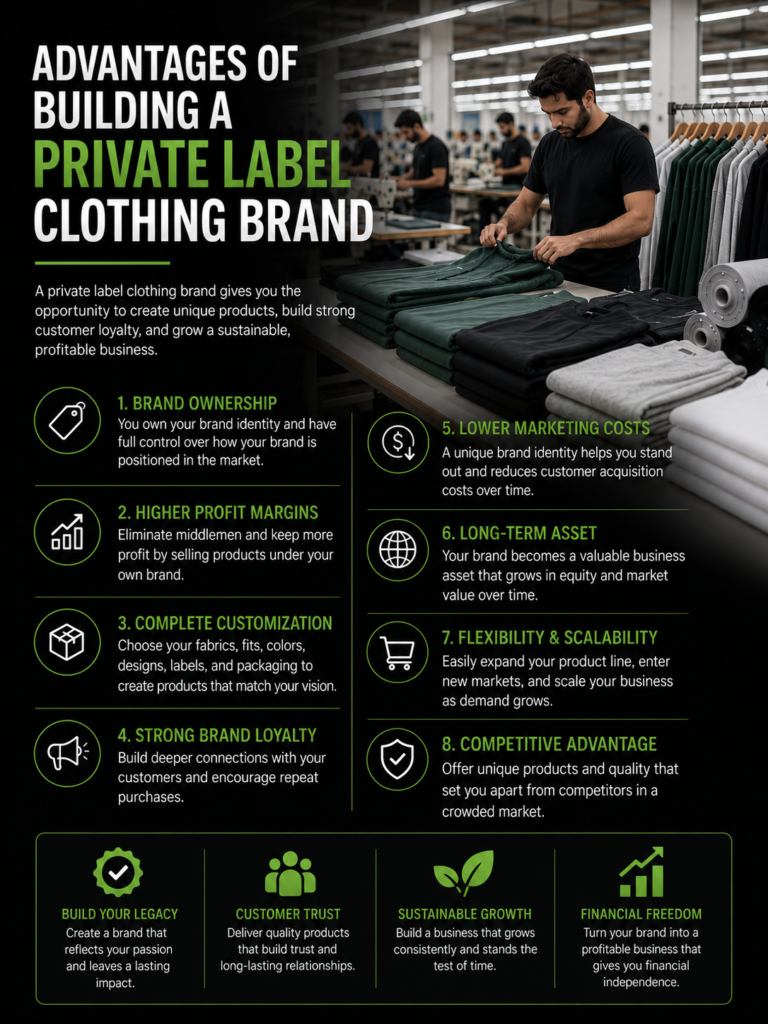
Advantages of Building a Private Label Clothing Brand

Infographic illustrating the advantages of building a private clothing brand, highlighting benefits like stronger brand identity, higher profit margins, product control, and long-term customer loyalty.

You Control Your Brand Identity

Going private label means full ownership of your brand identity. With your label, logo, and your story on your garments, communication and expression are completely in your hands. This is a huge advantage over reselling a brand’s products.

This ownership goes a long way in brand loyalty. Customers who are satisfied with your products will choose your brand or your label over the manufacturer’s label and supplier’s label. Positive brand loyalty over time grows your brand’s reputation in the market.

Save Your Capital

Opening your own production facility can mean potential millions spent on factories, equipment, workforce, and other infrastructure costs. With private label clothing brands, the major expense is the cost of the garments.

This eliminates financial pressure and allows for spending on branding and advertising. You can enter new markets with adequate financial resources.

Complete Control of Product Design and Quality

Private label manufacturing offers total control over every aspect of your product. This includes the choice of material, the fit, the colors, the stitching, and the finishing touches. You also have the authority to set the required quality standards of every garment before it is shipped.

This type of control is unattainable when you resell others’ products. Private label brands deliver more refined, consistent products and experiences to their customers. This leads to better reviews, fewer returns, and a stronger reputation.

Increased Profit Margins

Building a private label clothing brand means no middleman’s markup. You source directly from the manufacturer. As a result, your costs per unit decrease.

Your profit margins increase. You have control of your lot prices based on the brand perception you plan to build, be it affordable, mid-range, or premium. This control is attractive, making a private label clothing brand a great option for novice and expert entrepreneurs alike.

Growth Control

Your business growth determines how private label manufacturing scales. You are able to start with a small order and grow to tens of thousands of units, while manufacturing adjusts to your growth. You are not forced to commit to volumes that would negatively impact your cash flow.

As your brand flourishes, you can add new product lines, collections, and drops with more versatility using the same private label system. Practical and straightforward scaling is part of the label system.

Speedier Launches

With traditional in-house manufacturing, the commonly accepted timeline for new product lines is measured in months or years. However, the private label system, especially the Eco-Jersey Champion system, improves this lead time tremendously.

Using a manufacturing partner like Eco-Jersey, the lead time is reduced to a matter of weeks. The steps of the manufacturing system are brief, design, sample, approve, manufacture, and ship. This competitive edge allows you to meet the pace of a rapidly changing industry.

Allows for The Testing of Ideas

With private label manufacturing, you can test ideas with little risk. Using small test orders to launch a new style or new category, you can evaluate the response, and then manufacture to the selling level.

This is especially important in the fashion industry, where trends move quickly. You can keep your offerings up to date and even innovate in a risk-controlled way.

Access to Specialized Knowledge in Manufacturing

Deciding to work alongside a professional private label manufacturer means benefiting from their many years of expertise in the manufacturing world. Manufacturers like Eco-Jersey come with a wealth of knowledge in fabric sourcing, garment construction, and quality assurance. Furthermore, they possess a strong understanding and compliance with the international rules and regulations on exporting.

Having a knowledgeable manufacturer like Eco-Jersey means that your products will meet international standards right from the beginning. Also, there is support provided throughout the entire process, from sourcing the right fabric to ensuring that your packaging is appropriate for retail sales.

Access to Global Markets

Because of Eco-Jersey’s international exporting ability, private label clothing brands are not limited to local sales. Your brand has the potential to gain customers in Europe, North America, the Middle East, and Australia, among many other locations, without you having to handle any of the international shipment yourself.

With our connected world, this benefit is one of the most prominent when starting a private label clothing brand. Selling internationally is easier than ever, and with the power of a good private label product, you have the edge to successfully enter these previously uncharted markets.

Real Business Value

A private label clothing brand is different from dropshipping or reselling in that it has the potential to create real, lasting value. With a private label brand you have an asset that includes a brand, loyal customers, and exclusive products in this ever-growing marketplace. The value of this asset can increase, and it can be sold, licensed, or extended into new markets.

Starting a private-label clothing brand is a long-term commitment that builds something meaningful to you.

Why Choose Eco-Jersey for Your Private Label Brand

With a decade of experience in private label clothing production, Eco-Jersey is a Pakistan-based international apparel manufacturer that has built strong brand relationships across Europe, North America, the Middle East, and beyond, producing garments that meet international quality standards.

When you partner with Eco-Jersey, you get:

Comprehensive private label manufacturer assistance
adaptable order volume for flexible support during growth
diligent quality assurance at each manufacturing process stage
availability of sustainable and eco-friendly fabric
thoughtful export and shipping assistance for each order

Eco-Jersey has the knowledge and resources to support your private label apparel business and ease your journey.

Conclusion

The ownership and margin benefits along with a permanent global market presence are clear advantages for starting a private label clothing brand. The private label business model benefits all businesses interested in the fashion industry without the cost and headache of running a factory.

If you’re ready to get started, Eco-Jersey is dedicated to providing a fantastic service for all parts of the private label process from the initial design to the final delivery.

Frequently Asked Questions

Do I need fashion design experience to start a private label clothing brand?

Not at all. Most private label clothing production manufacturers also help with design and tech pack preparation. You need to have a product idea and the target market.

Is a private label clothing brand profitable for small businesses?

Yes. You gain pricing control as a result of the vertical integration and the elimination of middlemen. The right manufacturer and a distinct market promotion can also give small business brands a strong profit margin.

Can private label clothing brands be sold on Amazon or Shopify?

Yes, private label clothing brands can be sold on Amazon and Shopify, along with other e-commerce platforms. Amazon and Shopify private label sellers build successful businesses based on manufacturing private labels.

How risky is starting a private label clothing brand?

The risks include bad manufacturing, ordering excess stock without testing the market, and poor branding. While this sounds bad, it’s manageable with research, small initial orders, and a trustworthy manufacturing partner.

What are the differences between a private label clothing brand and a fashion franchise?

A private label brand is brand ownership and control, while a franchise requires controlling a brand with a fee. Private label is complete control.