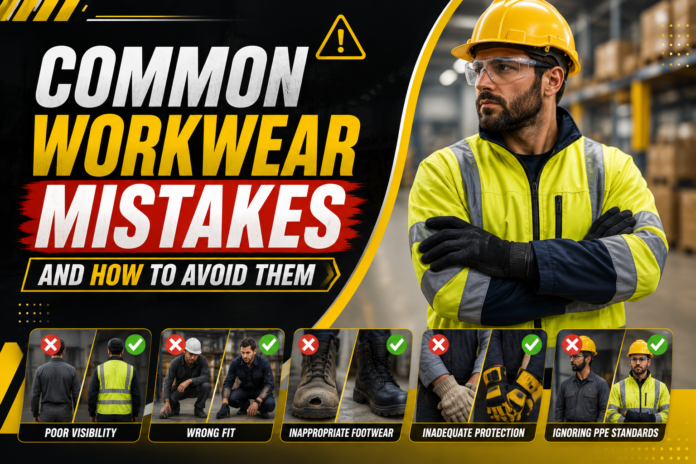
Common workwear mistakes can affect safety, comfort, appearance of the team, and daily performance. Workwear is more than just clothing for work. Workwear helps workers to move better, be more visible, manage weather, adhere to safety requirements, and represent their company professionally.
Most businesses make a hasty decision when it comes to workwear. Many businesses choose workwear based on price, style, or color before considering job role, fabric quality, fit, weather, and workplace hazards. It is better to select garments from workwear collections that are based on the actual tasks workers perform every day.
What are common mistakes made when it comes to workwear?
Businesses make common mistakes when selecting, wearing, laundering, or managing work clothing. Some of these mistakes include poor fabric choice, incorrect sizing and stitching, lack of safety features, improper layering or using a uniform for all workers.
Workwear should be appropriate for the work environment. Visibility may be needed by a warehouse worker. An outdoor worker may need waterproof protection. Professional uniforms may be required by a corporate employee. A worker in an industrial setting may require tougher clothing designed to withstand the conditions.
Choose Workwear Based on Price Only
The most common mistake in choosing workwear is to choose clothing based on price alone. Cheap garments might look good at first but can shrink, fade or tear after washing.
Workwear that is durable and functional will last a long time. Over time, a stronger fabric, better stitching and pockets that are useful, as well as secure closures and a proper fit, can help reduce the cost of replacement. If cheap workwear fails quickly, it is not always cheaper.
Negating worker safety needs
The type of workwear chosen should depend on the job’s risks. Some workers require protection against poor visibility, foul weather, dirt, fire hazards, sharp materials or outdoor exposure. The garments may look good but not perform well in the real world if safety is ignored.
hi vis workwear is recommended for teams that are working in areas with vehicles, loading bays, construction sites, and other high-visibility equipment. Reflective details and bright colors help workers to be more visible in busy work environments.
Use One uniform for all roles
Clothing requirements can vary greatly between departments. The clothing required by a warehouse picker, a delivery driver, an office employee, an oil and gas worker or site supervisor and an outdoor maintenance worker will differ.
workwear that is industry-specific is very useful. It allows businesses to choose clothing according to the actual job tasks, rather than forcing a uniform on all teams.
Poor Fabric Selection
Fabrics affect comfort, durability and breathability. They also impact worker performance. A thin fabric can tear easily. Fabrics that are too heavy can feel hot and tiresome. Fabric that is wrinkled badly can make the team appear unprofessional.
The type of fabric you need depends on your work environment. Indoor teams might need fabrics that breathe. Outdoor teams may need stronger layers. Teams in the industrial sector may require heavy-duty or protective fabrics. Office teams might need materials that are smooth and look clean.
Ignoring weather conditions
Workwear for outdoor work must be able to withstand rain, wind, changing weather, and cold. Workers’ focus and movements can be affected if they are uncomfortable or wet. For outdoor work, such as loading, delivery, transport or construction, regular clothing may not suffice.
Waterproof Workwear can be useful in wet conditions. Waterproof garments that are designed to protect workers from rain should still allow them to bend, lift and work comfortably.
The Wrong Workwear For Industrial Jobs
Industrial environments need stronger planning. Safety risks can be present when working on oil and gas sites, in manufacturing, or with heavy equipment. Basic clothing is not always durable or protective.
Oil-and-gas workwear must be chosen with consideration for fabric strength, comfort and durability, as well as workplace requirements. The garment must match the worker’s daily movement and risk level.
The wrong size and poor fit
Uncomfortable and dangerous workwear can be caused by a poor fit. Clothing that is too snug can limit movement. Clothing that is too loose may catch on equipment or look messy. It can also make work more difficult.
The right size for each body type is important in a good uniform program. The workers should be able bend, reach, lift, climb, walk and sit without discomfort. Fit testing can help prevent many problems.
Weak Stitching & Low-Quality Construction
It is not enough to have a strong fabric if the construction is poor. Seams and hems should be constructed to withstand repeated use. Weak stitching will cause garments to fail very quickly.
Check high-pressure areas like shoulders, elbows and knees. Also, check pockets, seat seams and hems. These areas are subjected to daily rubbing and movement.
Neglecting Corporate Image
The workwear you wear can also influence how your customers perceive the company. Uniforms that are dirty, faded, poorly fitted or mismatched can make an entire team appear careless. A uniformed, clean look creates an impression of professionalism.
Corporate Uniforms can be used by office staff, retail staff, customer-facing employees, and receptionists. The uniform should be comfortable and match the brand.
Bad branding and logo placement
Branding should not be too loud, but it should still be distinct. Uniforms can look cheap if they have large logos, too much color, or a messy placement. Small, clean logos on the chest or sleeve area, badge, pocket, and/or pocket often look more professional.
The placement of the logo should match that of the garment. Branding positions may differ depending on whether the garment is a blazer or jacket, a shirt, sleeveless vest, coat, or a vest. The branding should not overwhelm the uniform.
Washing and Care Planning Poor
Regular washing is necessary for workwear. Ignoring care instructions can cause garments to shrink, fade, lose waterproofing, damage reflective tape or lose shape. It reduces the garment’s appearance and function.
Employers should educate their employees on how to properly care for specific garments. Different washing methods may be required for waterproof clothing, hi-vis clothing and protective workwear. Planning your care helps you get the most out of your garments.
Keep Damaged Workwear for Too Long
Workwear that is damaged or old can affect safety and brand image. It is important to pay attention to worn seams, ripped fabric, broken zippers and faded colors.
It is crucial to replace damaged clothing as soon as possible. While it may be tempting to keep poor quality clothing, this can lead to bigger problems for safety, comfort and professional appearance.
Checklist of Common Workwear Mistakes
Check this list of common mistakes when choosing or reviewing your work clothing before you make a purchase.
- Don’t choose clothing based on price alone.
- Workwear should be matched to the job.
- Wear hi-vis clothing when visibility is important.
- Wear waterproof clothing in wet weather conditions.
- Choose stronger clothing when working in the industrial sector.
- Check the fabric’s strength and wash life.
- Test for fit and movement prior to bulk orders.
- Keep your branding professional and clean.
- Care labels are available for specific garments.
- Replace worn-out or damaged workwear as soon as possible.
What to do to avoid Workwear Problems
Start by identifying the actual task of each worker. Before selecting clothing, consider the following: environment, movement, weather conditions, safety requirements, washing frequency and customer-facing requirements.
It is important to test the samples on real people. The feedback of staff can reveal whether the fabric is too hot, the sleeves are restrictive, the trousers do not fit correctly, or the jacket does not work in rainy weather.
Conclusion
The choice of workwear is important because it impacts safety, comfort and durability as well as the company’s image. A good garment must match the worker’s role, workplace, weather conditions, movement requirements, and branding style.
Don’t choose clothing based on price or appearance. Concentrate on fabric quality and construction. Also, consider visibility, waterproof protection, the industry’s needs, and how long it will last. Workwear that is properly planned can be a smart investment both for workers and employers.
FAQs
Why do companies make mistakes when choosing workwear?
Most mistakes occur because companies choose clothing based on price or appearance, before considering safety, comfort, durability, and job role.
Is it a good idea to buy cheap workwear?
Very cheap workwear can wear out, shrink, fade or be uncomfortable for long shifts.
Should all workers wear uniforms?
Different roles will require different clothing depending on the visibility, weather conditions, safety, workplace conditions, and movement.
Why is it important to have the right fit in your workwear?
Fit is important for comfort, safety and appearance. A poor fit can limit work or make a team appear untidy.