Motorcycle gear standards are specifically designed to ensure that gloves and riding accessories provide real protection, not just look like protective equipment. It doesn’t matter if a glove looks reinforced unless it is certified to perform under actual impact and abrasion situations.
Understanding motorcycle safety standards is important for clothing brands or retailers who are sourcing accessories. This will help them market any accessory, glove or gear as being truly protective. This guide explains what CE certification means for motorcycle gear, accessories and how the testing process works. It also outlines what buyers need to verify prior to sourcing.
Motorcycle Gear Safety Standards: Why Do They Exist?
Many riders assume their jackets and trousers are the most important safety accessories, but they don’t realize how protective smaller accessories such as gloves need to be. The motorcycle gear standards directly address this issue, as hands are often the first to contact the ground in a crash. Glove-specific compliance is just as critical as clothing-level certification.
As a result, regulators developed separate testing standards for accessories, rather than assume that certification at the garment level would automatically apply to boots, gloves or smaller items. The distinction is important for consumers, as a general claim of “CE certified”, by a manufacturer does not necessarily mean that the gloves meet specific requirements.
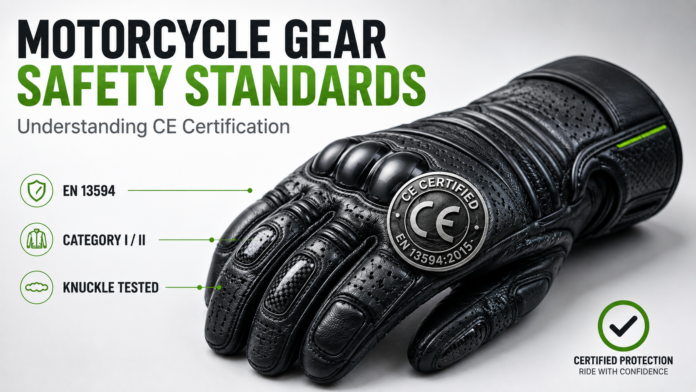
Glove Specific Standard: Understanding EN 13594
EN 13594 sets motorcycle safety standards for gloves. It tests abrasion resistance and tear strength as well as impact protection on the knuckles. The standard divides gloves into two groups: Category I, which is for low-risk riding applications; and Category II, for high-performance protection for more demanding conditions.
The Category II gloves are subjected to more stringent testing, and they often include certified knuckle protection that meets additional impact standards. They’re the best choice for genuine riding. When sourcing women’s motorcycle gloves or men’s motorcycle gloves, buyers should verify the category of each product. This classification reflects the real level of protection.
Glove Testing: How Does It Work?
Tests for the motorcycle safety standard include controlled abrasion tests that simulate contact with pavement and tear strength testing, as well as impact testing rigs to measure performance of knuckle armour under specified force thresholds. Sample gloves are submitted by manufacturers to approved testing bodies. These only issue certification after they have met the EN 13594 specific requirements.
The testing also looks at seam construction, as gloves are subjected to concentrated pressures in the palm and fingers that can be difficult for standard garment stitching. The certification of gloves is based on the entire assembled glove, and not only the fabric. This means that the quality of the seams as well as the choice in fabrics are equally important when it comes to genuine compliance testing.
The Certification of Specialized Gloves
Buyers should be aware that not all glove categories follow the same certification pathway. Off-road dirt bike gloves prioritize different zones of protection than road gloves due to the increased fall frequency and impact patterns that are typical for off-road riding.
Heated gloves add to the certification process, as integrated electrical components are required to meet different safety standards in addition with the core certification. When sourcing heated accessories, buyers should verify both the EN 13594 certification of the glove and its electrical safety certification. These are separate requirements which a certification does not automatically cover.
The Features of Genuinely Certified Gear
When evaluating whether motorcycle accessories are safe, brands should check the following.
- Classification EN 13594, indicating whether the glove is certified Category I or II
- Certified Knuckle Armor that meets defined impact absorption levels rather than relying solely on padding claims
- Tested for seam integrity and stitching integrity as part of a complete product
- Test documentation accredited by an independent testing agency, rather than the manufacturer’s own internal claims
- Separate electrical safety certification, confirmed for any heated or technology-integrated accessories
- Marketing that is appropriate to the category, and ensures product descriptions accurately reflect certification levels achieved
Applicable Safety Standards Across the Gear Catalog
The catalog should not present all accessory types uniformly, but rather based on the certification expectations. The standard road glove should indicate clearly whether it is a Category I or II, so that riders can understand what level of protection they are purchasing.
Buyers should not just lump all “protective gears” together. They need to communicate the specific certification requirements for specialized categories, such as off-road or heated gloves. Buyers can stock the accessories they need by reviewing both category-specific documentation and the motorcycle equipment catalog.
Checklist for Buyers Before Sourcing
It is not enough to rely on a listing of a motorcycle product that says “CE Certified” as if it were merely mentioning the safety standard. The buyer should ask for the EN 13594 specific category and documentation from the testing agency that certified it rather than accept a generic safety claim.
Asking directly about the manufacturer’s certification process for special features such as heating elements and off-road reinforcement is also helpful, because these require additional verification beyond the base glove certification. Credible partners should have category-specific documentation available for each accessory in their catalogue, and not only a company-wide statement of compliance.
Last Thoughts
Safety standards for motorcycle gear ensures that accessories and gloves provide a measurable level of protection, rather than just looking like protective gear. Understanding EN 13594’s categories system can help brands find gear that performs well when the situation demands it. By requesting real documentation of certification, as well as separate verifications for specific features, buyers can avoid liability risks associated with uncertified accessory claims.
Eco-Jersey produces motorcycle gear that is tested to recognized safety standards. This includes standard, heated and off-road gloves for both men and women. Browse the catalog of motorcycle gear, or contact us to request a consultation for certification documents.
FAQs
How do Category I gloves differ from Category II?
Category 2 gloves are subjected to more stringent testing, and they include certified knuckle protection for greater performance. Category 1 gloves suit lower-risk and less-demanding applications.
Are heated gloves required to be certified separately from normal gloves?
Heat gloves must have both EN 13594 certification and electrical safety certification.
Do off-road glove safety standards match road gloves’?
Although off-road gloves must still comply with relevant impact and wear requirements, their testing and protection zones can vary depending on fall patterns that are typical of off-road riding.
What is the best way for a buyer to confirm that a glove’s certification is authentic?
The buyer should ask for documentation stating the EN 13594 classification achieved, and the testing agency accredited by the EN.