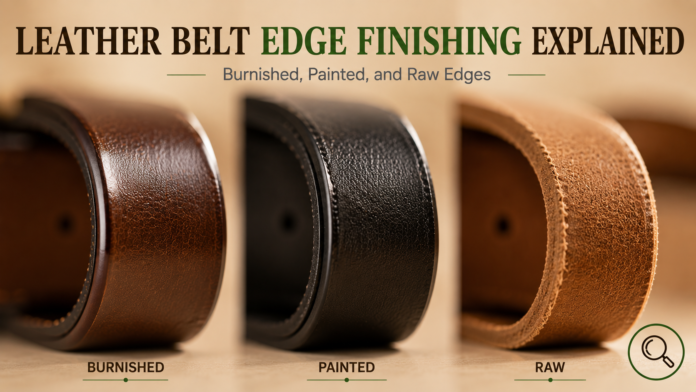
Although most customers focus on the front leather and buckle, the edge finishing on belts is actually one of the best indication of craftsmanship and detail. The edges on the belts are the most frequently used surface and are prone to wear and fraying. Edge finishing on belts can also be geared towards reducing the absorption of moisture as well as protecting them from wear.
Edge finishing on leather belts is important for retailers sourcing leather accessories. It provides a level of detail to assess the manufacturing quality beyond the front-facing leather. This guide will break down the different finishing techniques and help buying teams understand what they need to consider when sourcing belts.
Leather Belt Edge Finishing
Edge finishing is vital to resist the effects of wear, moisture absorption and fraying. Poorly finished belts will begin to fray first and will quickly deteriorate.
Aside from short and blunt tips, a belt edge will also experience daily wear from rubbing, friction, and contact from the buckle. The finish on the leather edge will determine the longevity of the belt.
Because edge finishing is something casual buyers can easily overlook, it shows the care a manufacturer has put into a product. From a consumer’s perspective, edge finishing is something that you may only notice if your belt starts fraying after just a few months. Customers that understand edge finishing can see through this quick and convenient manufacturing practice that skips this part of product finishing.
Traditional Craftsmanship: Burnished Edges
Burnishing involves the application of heat and friction via wax to a belt’s edge to compress the fibers to a seamless, shined, and finished edge. This process can only be done to quality leather that will elastically respond to the compression. Quality leather that is dense retains its shape better over time; therefore, the edge resists tearing and retains its shape better.
Burnishing also takes time and leads to a higher price point products. As a result, many higher quality leather products that burnish their edges also charge more for the product.
Edge Painting: Fast and Consistent
Edge painting is the application of a colored coating on the raw edge of the leather to provide a uniform edge. This process is more efficient for large-scale production than burnishing, which has a higher reliance on skilled technicians.
Scratch an industrial belt’s surface, and beneath the chains typically lies painted edges. Scale production balances the cost-to-value ratio by employing the painted coating on the edge. Everything from the quality of the paint/coating to the thickness of the leather is of high importance. Even the lowest quality edge paint/coating tends to result in an ultimately poor finish because the protective coating is likely to begin flaking and peeling much more quickly.
A Minimalist Choice
Some belts use zero edge finishing treatments or burnished edge finishes and paint. For belts of this nature, Leather’s natural qualities are the edge finish. In certain minimalist and vernacular styles, the natural leather grain complements the edge finish.
Raw edge leather belts require a high quality, thick leather to retain an edge finish. All other edge finishes seal the leather and protect the leather from the moisture that would cause the edge to fray. If you are looking at belts with raw edge finishes, make sure you are looking at a high quality leather.
Considerations for Women’s Leather Belts
Edge finishing is just as important for any women’s leather belt as it is for men’s leather belts. Women’s leather belts, in particular, tend to benefit from a burnished or painted edge treatment. The smaller edge surface is much more noticeable than a wider belt edge, so the finish is much more noticeable.
Manufacturers making women’s belts should use the same edge finishing techniques used for premium men’s belts even though women’s belts are generally thinner. Women’s belt buyers should ask about finishing. Finishing is sometimes overlooked in women’s belts made from resized men’s belts.
Edge Finishing for Work Belts
Edge finishing is more important for utility belts because of the wear they are exposed to from work. In that case, a leather tool belt is best served by burnished or heavily sealed edges. Painted edges also work well for this type of belt as long as the paint coating can withstand the wear and abuse of work tools and site conditions.
Edge finishing for utility belts should be thought of as a function of a work belt and should be prioritized, not as a finishing esthetic, since poorly finished edges will deteriorate much faster on a work belt than on a dress belt that is only worn occasionally.
Evaluating Edge Finishing Types
Things that brands should consider when evaluating edge finishing:
- Finish appropriateness in terms of the edge finishing method and the price point and usage of the product.
- Leather grade also matters, particularly for raw edges, where finishing is essentially going to provide the product with its only durability.
- Paint or coating quality should be assessed for painted edge belts by ensuring that the finish is crack and peel resistant.
- The length of the edge should be examined to make sure finishing is consistent across the entire length versus just finishing a few inches of the edge.
- Attention to detail is key, wherein finishing should be the same for the women’s and utility belt lines as the men’s belts.
- Finish durability should be assessed by examining finishing that holds up to real world use and not just an initial evaluation.
Communicating Edge Finishing Quality to Customers
Detailing edge finishing for a product description is something that retailers should strongly consider. Although most customers are unable to notice the difference between quality and mass market finishing, edge finishing is a good place to start to help customers recognize the differences. Burnishing and edge finishing are good examples that you could describe to a customer to justify increased product pricing.
Looking at the full leather belts catalog and the manufacturing documentation for edge treatments provides buyers will all the information they need to confirm the finishing of the product that was claimed in the marketing matches the finishing method used in production.
Final Thoughts
While many customers may not notice edge finishing detail, it is a crucial factor in the longevity and appearance of a leather belt. Thoughtful edge finishing helps bring value to the product, instead of opting for a cheap alternative in an area where craftsmanship is easily overlooked.
Eco-Jersey offers high-quality edge finishing for full grain, men’s, women’s, and utility belts. Browse our leather belt catalog or get in touch for a sourcing consultation to discuss our finishing options for your next order.
Frequently Asked Questions
Which edge finishing method is most durable?
Burnished edges typically provide the most durability since the leather fiber is sealed and compressed and thereby resists moisture, fraying and fuleshing.
Are painted edges lower quality than burnished edges?
Not always. Although burnishing may reflect a greater investment in craftsmanship, using high-quality edge paint has operational efficiencies at the manufacturing scale.
Is a raw edge always a sign of lower quality?
Raw edges are not always a sign of lower quality. In fact, raw edges may be intentional design elements of certain styles. Raw edges require very high-quality leather, however, to be reasonably wear-resistant with no protective finishes.
Does edge finishing matter more for certain belt categories?
Edge finishing is especially important for utility belts. In all other categories of belts, from formal to casual to work belts, finishing also matters.