The custom motorcycle suits manufacturing suits is one the most technologically sophisticated and commercially lucrative segments in the motorcycle clothing industry. It combines advanced protective materials engineering, CE certification compliance and precise garment construction to produce products for both serious road riding and competitive racing. It is important for wholesale buyers or brands developing motorcycle apparel to understand the manufacturing process of custom motorcycle suits. This includes understanding one-piece and 2-piece options, materials systems, armor integration and construction standards. This guide covers all aspects of the manufacturing process, from material selection to CE compliance and construction techniques. It also includes wholesale buyer and brand developer considerations.
Understanding Two-Piece Vs One-Piece Suits
Every brand that enters this market must first decide whether they want to produce a two-piece suit or a one-piece suit.
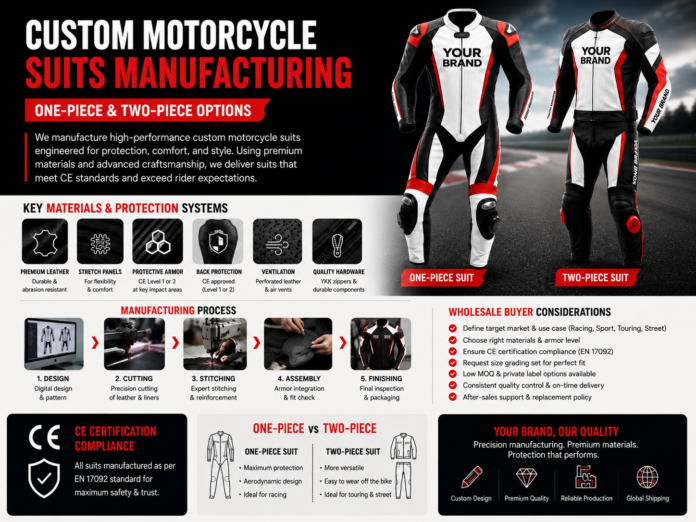
One-Piece Motorcycle Outfits
One-piece motorcycle suit, also known as leathers or racesuits, are single garments that cover the entire body from wrists to ankles. One-piece motorcycle suits are ideal for high-performance road and circuit racing where protection and aerodynamic fit is the main requirement.
One-piece suits also allow for a more aggressive fit engineering compared to two-piece options. They can be designed with pre-curved arms and legs, stretch panels in high-flex zones and aerodynamic shaping on the shoulders and back that fits the riding positions required by circuit and sport riding. Contact us to discuss the development of your one-piece suit. Our racing suit manufacturing team manufactures one-piece suits that cover all requirements, from club racing to professional racing specifications.
Two-Piece Motorcycle Outfits
Two-piece motorcycle suit consist of separate jackets and trousers that are connected at the waist. This is usually done through a full circumference zip that provides a near-complete coverage. These suits are more versatile than the one-piece options, as they can be worn separately or for commuting and then combined for full suit protection when riding is required.
Two-piece suits are also more suitable for touring, adventure riding and daily road use than single-piece options, because they can be removed independently, making them more convenient to use at petrol stations, rest stops and destinations. Two-piece construction is popular because of its versatility.
Two-piece suit construction also allows brands to sell jackets and trousers separately, as well as the entire suit. This creates multiple entry points for the product line at different price points. It also lets customers gradually build up a full suit system. Contact our motorcycle suit manufacturing today to discuss two-piece suits for your brand.
Materials used in Custom Motorcycle Suits Manufacturing
The material selection for custom motorcycle suits is important because it determines the protective performance of the suit, the CE certification class and wearing comfort. It also defines its commercial positioning. Material layers — outer shells, protective liners, and armor systems — must be specified for the intended riding applications and CE targets.
Leather outer shells
Full-grain Leather remains the standard outer shell material for motorcycle suits — and this is due to compelling technical reasons. Leather’s natural fiber structure provides exceptional abrasion resistant during road slide events. It can withstand the heat and friction from sustained road contact better than any synthetic material of equivalent thickness.
Leather also develops and maintains structural integrity when exposed to the stresses of motorcycle riding. It conforms to the body of the rider over time, while maintaining the protective properties which make it the preferred material for racing suits. The leather used in premium motorcycle suits is usually full-grain, ranging from 1.0 to 1.5 millimetres thick. This provides the protection, flexibility and weight that riders demand.
Brands developing leather jacket manufacturing along with complete suits can create a premium range by ensuring leather consistency. Our team can help you with leather specifications for your custom suit. Contact us today.
Outer shells made of textile
Textile motorcycle suits are made from high-tenacity, synthetic fabrics, primarily Cordura nylon, in 500-1000 denier constructions. They provide CE-compliant abrasion resistant in a lighter, more packable and weather-resistant construction than leather alternatives.
Textile suits are also ideal for adventure and touring riding, where riders may encounter a variety of weather conditions, requiring waterproof membranes, or multiple temperatures that can be accommodated by removable liner systems. They’re also better suited to long distance riding, which requires greater comfort and mobility than leather suits.
Textile outer shells also accept stretch panels more easily than leather, allowing brands the ability to include four-way stretch zones in critical protection zones such as knees, elbows and backs for increased riding mobility. Contact our adventure motorbike apparel manufacturing to discuss the textile suit specifications you need for your wholesale order.
Protective Liner Systems
The protective liners of motorcycle suits are designed to provide abrasion protection at the skin-contact areas, completing the protective system between outer shells and wearers. The most popular liner materials for leather and textile suits are Aramid fibres, which can be made from Kevlar or Twaron.
Stretch aramid knits, where the aramid fibers are knitted instead of woven, provide significantly greater comfort and mobility than rigid woven aramid options. Stretch aramid is particularly useful in suits for long-distance touring and road usage where comfort over long distances is important alongside protection performance.
Ultra-high-molecular-weight polyethylene liners — Dyneema and Spectra constructions — deliver comparable abrasion resistance to aramid at considerably lower weight — making them the premium liner choice for racing suits where every gram of garment weight affects rider performance.
Custom Motorcycle Suits with Armor
The most difficult part of manufacturing custom motorcycle suits is the integration of armor. This is because the armor needs to provide CE-certified protection in every body zone, while still maintaining the fit, comfort, and flexibility that riders demand from a premium motorcycle jacket.
Standard Armor Zones on Motorcycle Suits
The CE-certified armor is installed at specific body locations, including shoulders, elbows and knees. A back protector may be included as a standard feature or an optional one, depending on the CE class. Each armor zone needs a pocket precisely designed to position the insert correctly and retain it securely while in normal use. It also maintains its protective coverage when compressed and distorted by a fall.
The fit of the suit over each armor pocket also determines how well the insert will protect the body area underneath during an impact. A pocket that allows an insert to move laterally when impact occurs reduces the effectiveness of the protection provided.
Back Protector Integration
The integration of back protectors into custom motorcycle suits is a critical component, as the requirements for back protection differ by CE class and the format of back protectors affects suit fitment and comfort.
CE Class AA or AAA suits must include a back protector that is certified. This can be either a Level 2 or Level 1 back protector. Back protectors come in two different formats: contoured foam constructions which follow the spine to distribute the impact energy over the entire back area and hard shell constructions for high-performance racing.
Back protector specifications are a key differentiator for brands creating racing apparel along with road-focused suits. Level 2 back protection positions the suit towards the premium end on the spectrum of protection. Call our protective gear team to discuss your suit’s back protector specifications.
Race Suits with Hump Integration
In competitive motorcycle racing, suits often feature an aerodynamic hump on the upper back. The hump is aerodynamically designed to reduce drag at high speeds by smoothing airflow across the back of the rider. The internal space of the hump is functional, as it can be used to house a hydration unit or add additional volume for back protection.
The hump’s design and method of attachment affects both the aerodynamic performance as well as the suit’s CE certificate outcome. This is because the hump cannot interfere with the back protection’s coverage during a fall or its displacement resistance.
Custom Motorcycle Suits: Key Construction Standards
These standards are used to determine CE compliance when developing motorcycle suits for brand or wholesale production. They also affect the perception of quality that will build long-term brand recognition in the highly competitive motorcycle apparel market.
- Seam Construction — Double or triple stitching using high-tensile thread on all structural seams to meet EN 17092 seam strength standards
- CE Certification Class — class A for urban applications, class AA for road and touring use, and Class AAA for high performance and track-adjacent uses
- Armor Level Specification — Level 1, for general-use positioning, and Level 2, for premium protection.
- Coverage zones for liner — coverage of the entire size range with aramid or UHMWPE liners, reaching EN 17092 zone borders.
- Placement of stretch panels — Four-way stretch zones in high-flex zones maintaining CE coverage at borders with protective panels
- Zip Quality — Certified heavy-duty zippers YKK or comparable at the suit entry, ventilation and connection points, rated for repeated use
- Reflective Details — retroreflective piping or panels at specified locations to ensure night visibility in regulated markets
Custom Motorcycle Suits for Wholesale Markets
Wholesale buyers who create differentiated suit products that have clear CE certification credentials, brand-specific design elements and are able to achieve strong commercial results through specialist motorcycle retail channels.
A complete riding wardrobe can be created by developing motorcycle suits along with complementary protective products. The manufacturing of motorbike gloves along with suits completes the body protective system.
motorcycle base layer is also incorporated into the wholesale range to provide the thermal management and moisture wicking performance layers that riders wear underneath the suit. This completes the system, from the next-to-skin level of comfort all the way through to the outer protective coverage. It also builds deeper brand engagement throughout the entire motorcycle apparel wardrobe.
Off-road Motorcycle Apparel Manufacturing along with road-focused suit developments creates a range for wholesale buyers who are considering the entire scope of the motorcycle clothing market. This includes track day enthusiasts, road tourers, motocross riders and enduro rider’s suits that require different construction and protection approaches.
Are you ready to create your wholesale custom motorcycle suits? Contact our manufacturing team to learn more. We support motorcycle apparel brands in every phase of development, from CE certification planning, material selection, tech pack preparation and bulk production through quality control and documentation packages for regulated markets.
Conclusion
Wholesale buyers who are familiar with CE requirements, armor integration standards, material systems and construction standards will be better equipped to deliver successful products on the market.
Working with a manufacturer who can provide genuine CE certification, approved material sourcing and motorcycle-specific standards at every stage of production is key to achieving commercial success as well as rider safety.
Explore the full range motorcycle suit manufacturing options when you’re ready to create your own custom motorcycle suits collection. Contact our team today to begin your production journey.
FAQs
What’s the difference between two-piece and one-piece motorcycle suits?
One-piece suits cover the entire body with a single garment, providing seamless protection and continuity. They are preferred for track and racing.
Which CE certification class must motorcycle suits meet?
Class AA suits are designed for urban riding and low-speed riding. Class AA suits are for general road use and touring. Class AAA suits are designed for high-performance racing and track-adjacent applications.
Why does leather over textile make the best choice for racing motorcycle suits.
Full grain leather offers superior abrasion resistant during road slide events. It can withstand heat and friction from sustained road surface contact better than synthetic textile alternatives of equivalent thickness.
Why is there a hump at the back of a racing suit?
It reduces drag by allowing air to flow over the back of the rider when racing. It can accommodate hydration and back protection systems. However, its design and installation must not interfere during a fall with the protective coverage of the back protector.