Home Blog Page 3

Volleyball Uniform Fabric: Built for Movement

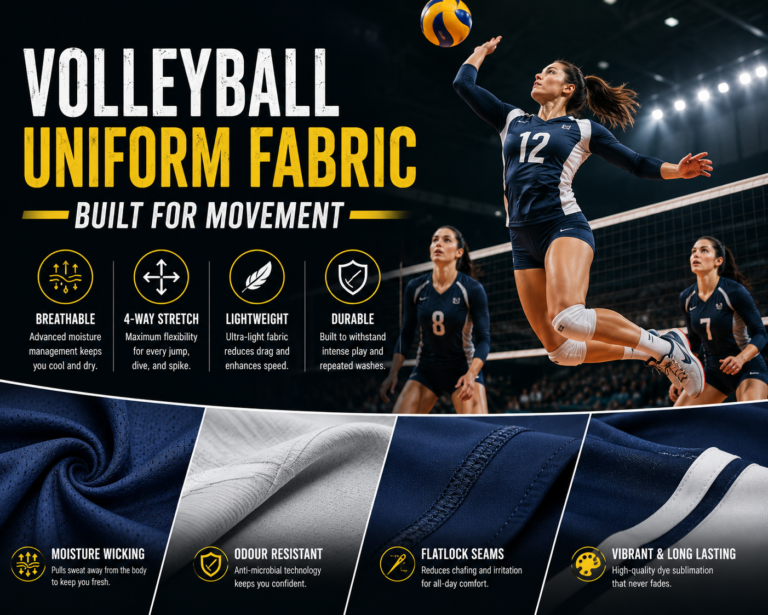
Volleyball is a sport built on explosive movement. Every dig, spike, and jump demands a uniform that moves with the player — not against them. That’s why volleyball uniform fabric is one of the most important decisions in designing a great volleyball kit.

The right fabric keeps players comfortable, supports peak performance, and holds up through a full season of intense play. Whether you’re a coach, a club manager, or a brand building volleyball apparel, understanding fabric is where it all starts.

What Is Volleyball Uniform Fabric?

Volleyball uniform fabric refers to the specific materials used to construct jerseys, shorts, and full uniform sets worn during volleyball matches and training. These fabrics are purpose-built for athletic performance — engineered to handle sweat, rapid movement, and repeated washing without losing shape or color.

The most commonly used volleyball uniform fabric includes polyester, spandex blends, and moisture-wicking mesh. Each material brings something unique to the uniform — and the best volleyball kits combine them strategically to deliver comfort, flexibility, and durability in every rally.

Why It Matters — Key Benefits

Choosing the right volleyball uniform fabric has a direct impact on how players perform and feel on the court. Here’s why it matters:

  • Superior breathability — Performance fabrics allow air to flow freely, keeping players cool during long matches and tournaments.
  • Moisture-wicking properties — Sweat is drawn away from the skin quickly, keeping players dry and focused throughout the game.
  • Stretch and flexibility — Spandex blends allow full freedom of movement — diving, jumping, and spiking without any restriction.
  • Lightweight construction — Good volleyball fabric feels barely there, so players stay focused on the game rather than their uniform.
  • Durability through heavy use — Quality fabrics maintain their shape, color, and performance through an entire season of matches and training.
  • Colorfastness — Team colors stay vivid and consistent across every wash and every game of the season.
  • Skin-friendly comfort — Soft, non-irritating materials prevent chafing during high-intensity play and extended training sessions.

How Volleyball Uniform Fabric Is Selected

Selecting the right volleyball uniform fabric starts with understanding the demands of the game. Volleyball involves constant explosive movement — which means the fabric needs to stretch in every direction without resistance. Lightweight materials are preferred because they don’t add unnecessary weight or bulk during play.

Manufacturers also consider the environment in which the team plays. Indoor volleyball typically calls for lighter, more breathable fabrics, while outdoor beach volleyball uniforms often need fabrics with UV protection and quick-dry properties. The right combination of fabric weight, stretch percentage, and weave type is what separates a good volleyball uniform from a great one.

Who Needs to Understand Volleyball Uniform Fabric?

Understanding volleyball uniform fabric matters to everyone involved in outfitting a volleyball team. Coaches and club managers need to make smart fabric choices when placing bulk uniform orders — because the right fabric directly affects how their players perform and feel during matches.

Sports retailers benefit from understanding fabric quality too — it helps them stock uniforms that serious players and teams actually want to buy. Activewear brands entering the volleyball market need fabric knowledge to create products that compete on quality and performance. If you’re also sourcing uniforms for other team sports, you can conveniently explore basketball apparel, tennis apparel, or badminton apparel alongside your volleyball order.

Standards of Quality in Volleyball Uniform Fabric

Not every fabric that looks the part actually performs on the court. Quality volleyball uniform fabric needs to meet specific performance standards to truly deliver for players. Breathability comes first — the fabric must allow heat and moisture to escape quickly during high-intensity rallies and long tournament days.

Stretch recovery is equally critical. The fabric must return to its original shape after every movement — no sagging, no bagging, and no loss of structure mid-match. Seam strength also plays a major role — reinforced stitching at key stress points prevents failure during the explosive movements volleyball demands. Finally, consistent sizing and weight across every piece in a bulk order ensures every player on the team gets the same quality experience from the first game to the last.

Why Choose Eco Jersey for Volleyball Uniforms?

Eco Jersey manufactures premium volleyball apparel using carefully selected volleyball uniform fabric that meets the demands of serious players and teams. We combine high-performance materials with precise construction to deliver uniforms that truly move with the athlete.

Our sublimation printing works seamlessly with our performance fabrics — producing vibrant, detailed designs that stay sharp through an entire season of matches and washing. We work with clubs, schools, retailers, and brands of all sizes, offering flexible order quantities and reliable production timelines. Beyond volleyball, we also manufacture soccer apparel, rugby apparel, golf apparel, and more — all under one roof. Browse our full sportswear collection to explore everything we offer.

Conclusion

The right volleyball uniform fabric is the foundation of every high-performance volleyball kit. It affects how players move, how they feel, and how they perform when every point counts.

At Eco Jersey, we take fabric selection seriously because we know it makes a real difference on the court. If you’re ready to order custom volleyball uniforms built on premium materials, explore our volleyball apparel options and get in touch with our team today.

FAQs

What is the best fabric for volleyball uniforms?

Polyester and spandex blends are the top choices for volleyball uniforms. They offer the ideal combination of breathability, stretch, and durability — keeping players comfortable and unrestricted throughout the match.

Is volleyball uniform fabric different from regular sportswear fabric?

Yes. Volleyball uniform fabric is specifically engineered for explosive, multidirectional movement. It is lighter, stretchier, and more breathable than standard sportswear materials — designed to perform under the unique demands of volleyball.

Can I customize the fabric and design of my volleyball uniforms?

Absolutely. At Eco Jersey, you can choose your preferred fabric type, design, colors, and branding. We handle everything from the initial sample through to full production and delivery.

How durable is volleyball uniform fabric after a full season of use?

High-quality volleyball uniform fabric is built to last. With the right materials and construction, uniforms maintain their shape, color, and performance properties through an entire season of regular matches, training, and washing.
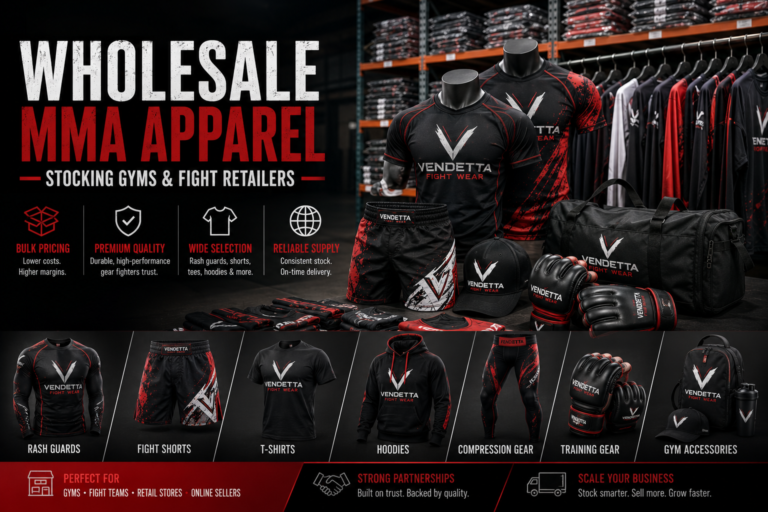
Wholesale MMA Apparel: Stocking Gyms and Fight Retailers

The demand for MMA apparel has never been higher. As the sport grows globally, gyms are expanding, fight teams are professionalizing, and retailers are looking for reliable sources to keep their shelves stocked. That’s where wholesale MMA apparel becomes a game-changer.

Buying in bulk gives gyms and retailers the flexibility to meet demand, control costs, and offer consistent quality to their customers and athletes. Whether you’re stocking a gym pro shop or running a full-scale fight gear retail business, wholesale is the smartest way to operate.

What Is Wholesale MMA Apparel?

Wholesale MMA apparel refers to purchasing MMA training and fight gear in bulk quantities directly from a manufacturer at a reduced per-unit cost. Instead of buying individual pieces at retail prices, you order in volume and benefit from significantly lower costs across the entire order.

Wholesale MMA apparel covers a wide range of products — rash guards, fight shorts, compression tights, training tops, board shorts, and more. Every piece can be customized with your gym’s branding or stocked as ready-to-sell products for your retail business.

Why It Matters — Key Benefits

Wholesale MMA apparel is a smart move for gyms and fight retailers. Here’s what makes it such a powerful option:

  • Lower cost per unit — Bulk pricing brings the cost per piece down significantly, protecting your margins and freeing up budget elsewhere.
  • Consistent product quality — Every piece in a wholesale order meets the same standard — no variation in fabric, fit, or finish.
  • Custom branding options — Add your gym name, logo, and colors to every piece for a fully branded product line.
  • Wide product range — Cover everything from rash guards and fight shorts to compression gear and training tops in one order.
  • Faster restocking — Working directly with a manufacturer means you can restock quickly without waiting on third-party suppliers.
  • Flexible order quantities — Good wholesale suppliers work with your scale — whether you need 50 pieces or 500.
  • Stronger profit margins — Lower unit costs mean higher margins on every product you sell or distribute through your gym.

How Wholesale MMA Apparel Ordering Works

The process of ordering wholesale MMA apparel is straightforward when you work with the right manufacturer. It starts with defining your product range — which items you need, in what quantities, and with what design or branding requirements. From there, you share your logo files, color preferences, and any specific design details.

The manufacturer then produces a sample for your review and approval. Once you’re happy with the quality and design, full production begins across your entire order. After thorough quality checks, your wholesale MMA apparel is packed and shipped directly to your gym or retail location. The right manufacturer makes this entire process smooth, transparent, and on schedule from day one.

Who Orders Wholesale MMA Apparel?

Wholesale MMA apparel serves a diverse range of buyers across the combat sports industry. MMA gyms and training academies are the most common buyers — they use wholesale orders to outfit their members, coaches, and fight teams in consistent, branded gear throughout the season.

Fight gear retailers stock wholesale MMA apparel to meet the growing demand from local fighters and training enthusiasts. Sports distributors source wholesale products to supply multiple retailers and gyms across a region. Activewear brands also use wholesale manufacturing to launch or expand their MMA product lines with full customization. If your business also supplies other combat or team sports, you can conveniently source rugby apparel, American football apparel, or basketball apparel alongside your MMA order.

Standards of Quality in Wholesale MMA Apparel

Quality is non-negotiable when you’re buying wholesale MMA apparel in bulk. Every piece that goes out under your brand or onto your shelves represents your reputation — and fighters notice quality immediately. Performance fabrics are the foundation — lightweight, breathable, moisture-wicking materials that handle the intensity of MMA training without breaking down.

Construction quality matters just as much as fabric. Reinforced seams, strong waistband stitching, and durable closures are essential for gear that survives grappling, striking, and daily heavy use. Print quality must also hold up — sublimation printing that bonds color into the fabric rather than sitting on the surface ensures designs stay vivid through hundreds of training sessions and washes. Consistency across every piece in the order is the final mark of a reliable wholesale supplier.

Why Choose Eco Jersey for Wholesale MMA Apparel?

Eco Jersey is a dedicated manufacturer of high-performance MMA apparel built for bulk buyers. We understand what gyms and fight retailers need — consistent quality, reliable delivery, and full customization on every piece of wholesale MMA apparel we produce.

Our sublimation printing delivers bold, detailed designs that stay sharp through intense training and repeated washing. We use carefully selected performance fabrics that meet the specific demands of MMA — flexible, durable, and comfortable against the skin. We work with gyms, retailers, and brands of all sizes, offering flexible MOQs and clear production timelines. We also manufacture soccer apparel, ice hockey apparel, Formula 1 racing apparel, and more. Browse our full sportswear collection to explore everything we offer.

Conclusion

Wholesale MMA apparel is the foundation of a well-stocked gym or a thriving fight gear retail business. It gives you the cost advantages, product consistency, and branding flexibility that buying retail simply cannot match.

At Eco Jersey, we make wholesale simple, reliable, and fully tailored to your needs. Whether you’re outfitting a single gym or stocking an entire retail store, we’re ready to deliver. Explore our MMA apparel options and reach out to our team today to get your order started.

FAQs

What is the minimum order quantity for wholesale MMA apparel?

Minimum order quantities depend on the product type and manufacturer. At Eco Jersey, we offer flexible MOQs designed to work for both small gyms and large-scale retailers. Get in touch with us to discuss your specific order requirements.

Can I brand the wholesale MMA apparel with my gym or store logo?

Absolutely. Full custom branding is one of the biggest advantages of going wholesale with Eco Jersey. You can add your logo, gym name, colors, and any other branding details across every piece in your order.

What types of MMA apparel are available for wholesale ordering?

We offer a full range including rash guards, fight shorts, compression tights, board shorts, and training tops. Every product type is available for bulk ordering with full customization options.

How long does production and delivery take for a wholesale MMA apparel order?

Production timelines vary based on order size and design complexity. In most cases, you can expect delivery within 2–4 weeks from sample approval. We always confirm the timeline with you before production begins.

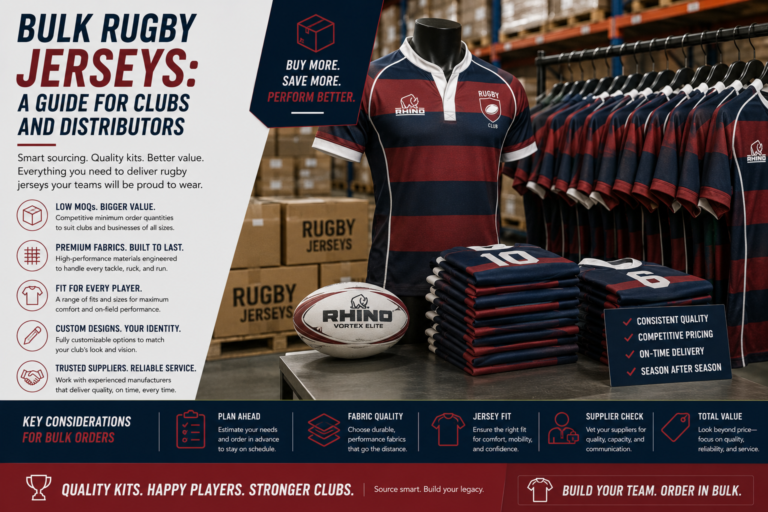
Bulk Rugby Jerseys: A Guide for Clubs and Distributors

Whether bulk rugby jerseys are for clubs, leagues, or distribution businesses, sourcing requires planning with MOQs, fabric quality, jersey fit, and reliable suppliers. The right choices provide jerseys that allow players to perform throughout the entire rugby season. The wrong choices can lead to longer wait times, poor fit, and jerseys that can be damaged by the physical nature of rugby. Because of the importance of sourcing rugby jerseys, this guide is designed to provide clubs and distributors with the planning components to sourcing quality rugby jerseys and rugby jersey distributors at a great value over and over again.

Planning Is Essential When Sourcing Bulk Rugby Jerseys

Considering the bulk nature of the order, there are rugby jersey sourcing decisions that must be planned to be of high quality. If a fabric is not high quality, every member of the rugby team suffers. Sizing issues will be repeated throughout the bulk rugby jersey order. If the bulk rugby jerseys do not arrive on time, the whole season will be impacted. When sourcing in bulk for distributors who are supplying multiple clubs, a high level of quality and consistent rugby jersey sourcing is also required. For all of the consequences of poor sourcing for bulk rugby jerseys, clubs and distributors need to have an extensive sourcing strategy. This will avoid the costly consequences of poor sourcing decisions.

MOQ, or minimum order quantity, refers to the least amount of product a supplier will allow to be purchased. MOQ can significantly impact the order quantities and financial planning for bulk rugby jersey purchases.

How Design Complexity Impacts MOQ

Generally speaking, simpler designs with less production complexity like bulk color blocks or basic logos will have lower MOQs. More complex designs with a greater production cost, such as fully sublimated jerseys, will have higher MOQs. Complex designs can contain multiple color zones or a variety of sponsor logos, which also impact sublimated jerseys’ MOQ. Clubs working with tight budgets can avoid higher MOQs while preserving their club’s identity by opting for jerseys with less complex designs.

Merging Orders to Meet MOQ

Clubs with small teams can combine jersey orders with other merchandise like shorts or training tops to meet the supplier’s MOQ. A greater total MOQ can also be achieved for Distributors with multiple clubs by merging merchandise production for a greater total MOQ, which usually results in better prices and greater flexibility in scheduling. A more combined approach to ordering rugby jerseys can benefit all clubs that are ordering as well as the Distributors.

MOQ Negotiations with Seasonal Orders

Suppliers are generally willing to be more flexible with their MOQ for buyers that place multiple orders during a set season. Less commercial risk means bulk orders of lower quantity can be offered and a greater financial incentive can be placed on repeat orders. Generally speaking, less restrictions on MOQ and better pricing for clients will come from negotiations to place multiple orders, while clients will receive a greater benefit from prioritizing these orders.

The Ability of Fabric on Bulk Rugby Jerseys

Fabric selection impacts both performance of bulk rugby jerseys on the field as well as their longevity throughout the season.

Essential Fabric Elements of Rugby Jerseys

Quality rugby jerseys are made from polyester blends with moisture-wicking capabilities and durability to withstand contact. Specifically at the shoulder and chest, fabric panels assist during set-piece challenges while stretch fabric under the arms and on the sides allows for ease of movement. Therefore, verifying these fabric properties in a written format as well as in physical samples protects clubs from receiving jerseys that do not perform to the required standards.

Obtaining and Assessing Fabric Samples

Obtaining physical samples of fabric provides the opportunity to assess weight, stretch, durability, and overall feel of the fabric as opposed to only relying on the written standards. During the assessment, stretch fabric samples to assess strength of the seams as well as the texture of the grip panels, and moisture-wicking capabilities can be evaluated by placing moisture on the fabric to see how quickly it is released. Although obtaining samples may add some time to the sourcing of jerseys, this step is crucial to preventing the occurrence of costlier problems once the jerseys have been manufactured and delivered.

Dealing with Sizing in Bulk Rugby Jersey Orders

The need for sizing accuracy increases with the volume in bulk rugby jersey orders because mistakes become cumulative over larger orders.

Obtaining Accurate Player Measurements

Given that most rugby teams consist of a variety of different body types across all the player positions, the best approach is to obtain individual measurements as opposed to relying on self-reported measurements.

Presenting measurement data to manufacturers in a neat and tidy manner minimizes the chance for problems when producing the garments. In addition to this, contrasting the data against the size chart and grading scheme published by the manufacturer before the order is placed helps to locate issues that can be resolved before the order is placed and the production schedule is impacted.

Testing Sizing Across Multiple Samples

Requesting samples in multiple sizes (at least 3) helps create a more accurate picture of grading consistency across the sample range than relying on a sample in a single size. Large gradation errors can impact sample size balance as well, and requesting both smaller and larger graded size samples can prevent issues before they are finalized in a large order. Therefore, requesting and verifying multiple samples can help reduce, and likely eliminate, fit issues after delivery.

Customization Options for Bulk Rugby Jerseys

Customization is the only way a large order of bulk rugby jerseys can become club branded rugby jerseys, which is a requirement of most rugby jersey sponsors.

Here are some options for customization based on your budget:

  • Sublimation printing: a great choice for match-grade jerseys as fabric bulk is designed to be avoided.
  • Screen printing: a good option for large orders as a limited color scheme is easier to work with for large orders.
  • Embroidery: great for a more premium finish that is highly durable.
  • Heat transfer: Offers the option for detailed graphics or player numbering that medium-sized orders typically allow. Since medium-sized orders lack durability when heat transfer is washed repeatedly, durability when heat transfer is applied should be confirmed before using it frequently.
  • Custom labeling: Provides clubs and distributors the option to add branded care labels or hang tags and neck labels to that particular item.

Leveraging the right customization option for each design element, enables clubs and distributors to achieve the best combination for their bulk rugby jersey orders in terms of cost, impact, and longevity.

Choosing the Right Bulk Rugby Jersey Supplier

The right selection for the jersey manufacturing partner impacts the quality, consistency, and reliability of all bulk rugby jersey orders made for the entire season.

Important Criteria for the Supplier

Assess the capability of the bulk rugby jersey supplier for the large orders, their quality control, the time it would take to receive a sample, and the supplier’s responsiveness to communication and inquiries before making a decision. Also, ensure that the supplier has experience making contact sport Racing apparel. Rugby jersey requirements differ greatly from  sportswear, and a supplier who does not know reinforced seams, grip fabrics, or collar construction may be able to provide jerseys that appear acceptable but will not withstand match conditions.

Establishing a Supplier Relationship

For clubs and distributors who have regular and consistent needs, establishing a relationship with the right supplier for large orders of bulk rugby jerseys is consistently more beneficial than having multiple suppliers. Good supplier relationships create more efficient contact and lower the time it takes to obtain samples for future orders and often improve pricing and production scheduling on the basis of orders previously made. For upcoming seasons of bulk rugby jersey sourcing, having the right supplier is more beneficial than having multiple suppliers.

Beyond Jersey Sourcing

Many clubs and distributors have started sourcing a complete kit package that extends beyond just the jersey. Sourcing a full  Rugby apparel package provides the buyer with match day jerseys, shorts, socks, training tops, and warm-up jackets that are all made from the same materials and designed in the same style. Furthermore, distributors that deal with multiple sports can look to the complete sportswear range to provide rugby, Soccer apparel, and other sports apparel to the same clients while keeping the same standards across all sports.

Work with an Experienced Manufacturer for Rugby Jerseys in Bulk

When looking for rugby jerseys in bulk, dealing with an experienced manufacturer that understands rugby and its requirements makes the sourcing process a lot easier. Whether the requirement is for one club or the entire league, an experienced manufacturer allows the buyer to be confident in the jersey quality, the sizing offered, and the jersey customizations in relation to the minimum order quantities.

As a custom apparel manufacturer, we assist clubs and distributors in sourcing bulk rugby jerseys across all levels of competition that meet their budget, branding, and performance needs. If you would like to place an order, contact our team to discuss your options for fabrics, construction, timelines for production, and more.

Conclusion

Understand supplier limitations and requirements while paying attention to fabric quality, sizing, and customization options when sourcing bulk rugby jerseys.

Familiarizing clubs and distributors with Minimum Order Quantities helps them better prepare budgets and negotiations. Evaluating fabric samples and construction specs guarantees that all jerseys hold true to match-day performance standards. Moreover, implementing realistic timelines with a responsive, experienced supplier brings much better value and results than a rushed, last-minute decision. This guide offers clubs and distributors a robust strategy for sourcing bulk rugby jerseys that ensures reliable use for their players and customers season after season.

FAQs

What is the MOQ for bulk rugby jerseys?

The MOQ (Minimum Order Quantity) is typically between 50 and 200 jerseys, and is mostly dependent on the supplier and how complex the design is.
More simplistic designs with fewer colors and logo elements generally allow match jerseys to be fully sublimated with lower minimums.

How can I maintain the quality of a large bulk rugby jersey order?

Order samples before the bulk order, and detail the construction specifications in writing. Also, request quality control during the construction with photos. This makes sure the bulk order matches the approved samples before shipment.

Can orders from different clubs be merged into one bulk production run?

Definitely. Orders from various clubs can be merged into a single production run to meet MOQ requirements and better pricing. This does require different design and labeling per club, and can lower the cost significantly.

What features of construction should I focus on for competitive rugby jerseys?

For competitive match jerseys, focus on reinforced seams, panel grip fabrics on the shoulders and chest, and construction through flatlock seams and reinforced collars. These features help with scrummaging, contact, and the tackling that is part of the game.

Custom Rugby Kit: From Design to Match Day

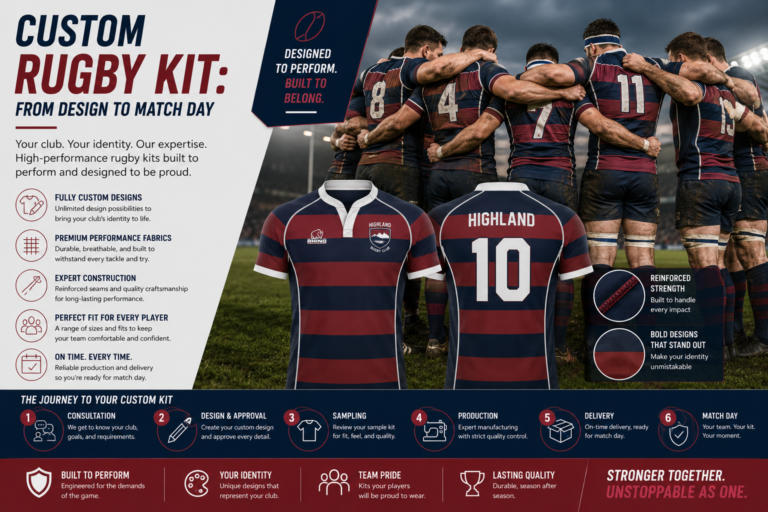
Every rugby club needs a fully functional kit that withstands the demands of match day and a full season of play, while also reflecting the identity of the club. Creating a custom rugby kit is a lot more than a design brief with some color selections and a club logo with a print. Each step of the process from initial design to final delivery is a dedicated effort with a manufacturing partner of choice. It provides each group with the knowledge and the understanding for each step of the process, and how to make the best possible choices for a kit that the team is going to be proud to wear.

Why a Custom Rugby Kit Matters for Your Club

A good quality, custom rugby kit showcases the identity of a club on and off the pitch. It also builds team unity, improves confidence, and holds the professional presence the club needs in each competitive engagement. Quality custom kits also improve performance, as they hold up to the various pulls, scrums, and tackles that wear down inferior jerseys and kits. Failing to plan a custom rugby kit can end up in a several poor quality custom kits that are a mismatch in color, size, and the worst of all a kit that is delivered after the start of the season which can leave a team with no kit during the season.

Stage One: Outlining Your Personal Rugby Kit Requirements

The first step of any custom rugby kit project is the outline of a brief capturing your design expectations, required level of performance and any constraints your club may have. An effective rugby kit brief will have the following sections: your design expectations, performance requirements, and budget and time constraints. This section will provide you guidance on what to include when drafting each of these sections.

Design Expectations

The first section of your kit brief is design expectations. Start by including your club’s colors, any logos or branding your club may have, and final decisions on kit components (i.e. socks, shorts, jerseys). The design expectations section will also capture any club kit design preferences (i.e. vertical stripes, horizontal stripes, sublimated, etc.). Having a thorough design preferences section will eliminate any costly design revisions during development and ensure a design reference is available for all stakeholders.

Performance Requirements

In addition to aesthetics, the project brief should also capture required performance standards for the custom rugby kit. Some things to consider are which fabrics and textiles will be required and which construction methods will be appropriate based on the intended performance level of the kit. For instance, are reinforced seams and grip fabrics required for the kits, or will a basic construction be acceptable? Performance fabrics are also helpful in getting the desired effect of a high performance kit (i.e. moisture management).

Budget & Time Constraints

Setting a realistic budget and confirming a delivery date will make a manufacturer’s job much easier. Since design and order requirements dictate how busy a manufacturer will be, a project deadline will determine how realistic your requirements are.

Aligning budget and timeline expectations ensures preferred suppliers are able to meet your requirements and avoids the frustration of realizing your preferred supplier cannot meet your season start date.

Stage Two: Design Development and Digital Mockups

Design Development takes the approved brief and creates visual representations of the concept for stakeholder feedback and approval.

Creating Technical Design Files

Before a manufacturer can start production, they need technical design files. These files need to specify color codes, the size of logos, and details of patterns. Designers who understand  sportswear can help ensure your digital mockups are translated to garments. To help ensure your printed mockups are the correct size and resolution, provide your digital mockups in vector format and to scale.

Reviewing and Approving Mockups

Digital mockups show clubs what their kits will look like. These mockups are shown in front, back, and sleeve views. Before production, kits can be changed; changes to mockups are reviewed for color, proportion, and placement of branding. These mockups are reviewed and approved by design stakeholders to help ensure support for the design. These stakeholders can include club members and sponsors.

Stage Three: Fabric Selection and Construction Specifications

Design approvals require the selection of fabrics and construction details to help realize the vision of the kits on the pitch.

Choosing the Right Fabric for Your Level of Play

Elite fabrics are heavy-duty fabrics that have resistive construction and grip fabric panels. Community and youth clubs may prioritize fabrics that are durable and cost efficient.

Furthermore, fabric panels that stretch in the side and underarm panels enhance players’ movement and are worth their inclusion regardless of budget. Thus, fabric specifications of the apparel should be matched to the level of competition to ensure the right investment in the apparel, without overspending or underspending on the specifications of the Racing apparel.

Construction Specifications

Besides the fabric specifications, outlining construction specifications of the apparel, such as type of seams, collar, and stitching of the stress points, determines the durability and comfort of the apparel. For instance, Flatlock seams provide comfort during contact and a reinforced collar is constructed so that it does not stretch from being grabbed repeatedly. Hence, giving construction specifications in addition to the design of the apparel aids the manufacturers in fabricating the apparel that provides the right functionality from the first match.

Step 4: Sampling and Fit

Review
Sampling provides the first opportunity in the custom rugby kit development process for clubs to physically check the accuracy of their design and the fit before the bulk production occurs.

Sending Out Request for Physical Samples

You must always request physical samples in 2 or 3 sizes at a minimum before agreeing to bulk production, as digital mockups will not accurately show the final product as fabric, color, and construction details will on a finished garment. During this step, check color accuracy against provided design approval files, check seam construction and collar finishes, check GSM of fabric, and weigh the fabric. During this step, it is important to keep in mind that this step adds time to the process; however, it is better to add this time than to incur the expense of a subpar production run.

Player Fit Tests

Rugby players are a heterogeneous group due to the number of different positions and body types that exist, so sampling and player fit tests are the first opportunity to get fit feedback from actual players.

We request players replicate match movements, including scrumming, lineout lifts, and passing, during fit tests to ensure kits accommodate movement. Player feedback, particularly by position, helps us refine fit prior to beginning mass production, which will finalize production specifications.

Stage Five: Mass Production and Quality Assurance

Following sample approval, mass production is initiated. Quality assurance takes the following form:

  • Color Checks: Assurance the correct and matching colors are used across the fabric and prints.
  • Seam Checks: Assurance samples and orders have seams that are reinforced and constructed to the standards.
  • Size Checks: Assurance samples and orders are constructed to the correct size.
  • Stress Checks: Assurance samples and orders have the correct line construction on the stress points and the collar.
  • Grip Checks: Assurance match wear jerseys have the correct construction and coverage of grip panels.
  • Damage Prevention: Assurance the orders have been prepared for transit and arrive in the correct condition.

Adhering to these steps provides confidence to clubs and kit managers that the completed orders can be distributed to the squad.

Stage Six: Delivery and Pre-Season Distribution

Custom rugby kits are distributed to players for use prior to the commencement of the season.

Ensure the quantity of jerseys received matches the order and examine a sample for defects. Take concerns to the manufacturer before the schedule is released. It is also wise to set the delivery date before the first game in order to avoid disruption to the first matches if unexpected problems occur.

If your club is looking to broaden the range of custom kits beyond jerseys, you can explore  Rugby apparel to find training shorts and warm up tops as well as supporter merch that can all be customized to match your design. You can also find sportswear that helps clubs and organizations that sponsor multiple sports to customize apparel for rugby, Soccer apparel and others while maintaining the same look and feel.

Custom Rugby Kits You Can Trust

Getting a custom rugby kit on to the pitch from the first brief is only possible if the manufacturer has a lot of experience making contact sport apparel. Whether your club is elite or community based, a manufacturer who knows about grip fabrics, reinforced seams and the right type of performance fabrics will help you create a kit that will see you through a full season.

We are a custom kit manufacturer and we help clubs and brands create custom rugby kits that consider the budget and quality. If you are interested in starting a kit project, contact us with details on design, fabrics and when you would like to have the kits by.

Conclusion

There are many stages involved when creating a custom rugby kit. After the design brief stage, the journey consists of choosing the concepts, fabrics, and samples, and then planning the bulk production, and then the final commutation. Each stage is vital in ensuring the kit matches the club’s identity and withstands match conditions for the full competitive season. The relationship with a qualified manufacturing partner is vital. A partner who understands the construction requirements of contact sports will make every stage of the process much more assured and of a much higher quality.

FAQs

How long does it take to develop a custom rugby kit?

The full development process from initial brief to final delivery typically takes two to four months, depending on design complexity, sampling rounds, and production volume. Starting the process well before your season launch date helps avoid timing pressure.

What fabric works best for a custom rugby kit?

Heavy-duty polyester blends offer the best combination of durability, moisture management, and shape retention for competitive rugby. Adding stretch panels in the underarm and side sections improves movement without compromising the fabric’s resistance to contact forces.

Should I always request samples before bulk production?

Yes, requesting physical samples before bulk production allows you to verify color accuracy, construction quality, and fit before the full order is committed. Skipping this step frequently leads to costly issues that are difficult and expensive to resolve after bulk production is complete.

Can I include sponsor logos on a custom rugby kit?

Yes, sublimation printing, embroidery, and screen printing all allow for sponsor logo placement on jerseys, shorts, and training wear. Confirming logo placement and sizing with sponsors before finalizing your design files helps avoid revision delays during production.

Rugby Jersey Construction: Built to Survive the Scrum

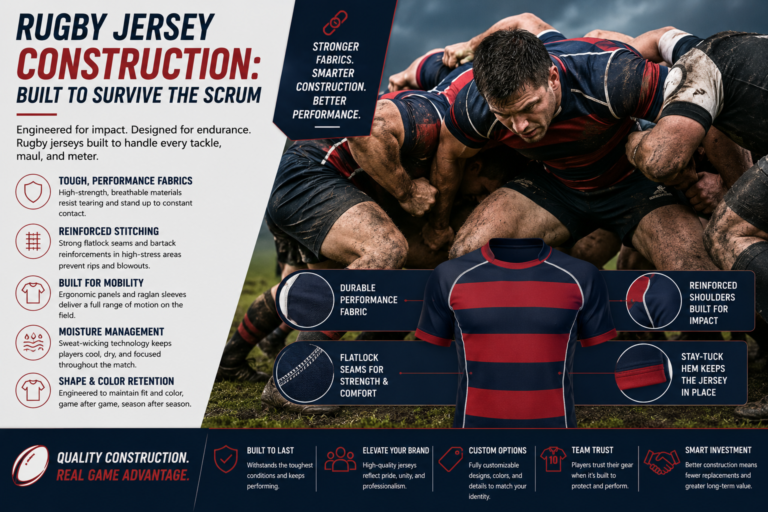
The sport of rugby is mainly recognized for being one of the most brutal team sports, and there is constant contact during scrums and tackles against an opponent, and the jerseys must be built to endure this constant contact without breaking, ripping, or stretching out of shape. Rugby jersey construction goes beyond the typical sportswear manufacturing process. This construction guide outlines the materials, construction methods, and design elements of a rugby jersey. This guide will assist clubs, brands, and buyers in recognizing the significant value added to a rugby jersey by quality construction as compared to a typical piece of sportswear.

Why Rugby Jerseys Need Special Construction

Rugby imposes specific challenges to apparel unlike any other team sport. During tackles and scrums, jerseys are torn and ripped, and significant stress is applied to seams and collars. Additionally, the jersey must be able to stretch freely during the game. If a jersey has poor construction, it will tear during contact, and the construction will lose its shape and restrict movement during the game. Because of this, rugby jersey construction focuses on the apparel’s flexibility and strength.

Rugby jersey design starts from a foundational knowledge of the best materials available. Construction details are then created from this knowledge. What fabric selection informs us is critical to design construction and selection of materials from the right base elements.

Heavy-Duty Polyester Blends

Heavy-duty polyester blends are used in most match-grade rugby jerseys. These fabrics blend durability with good moisture management and shape retention. The lightweight polyester found in most sports jerseys does not have the strength to sustain rugby’s repeated tearing and pulling. Rugby- specific fabrics use dense weaves with higher denier counts to resist tearing. These fabrics also employ a blend of high denier count, durable polyester, and moisture-wicking fabrics. This serves to keep players drier and more comfortable while engaged in high-activity play. Because of the above properties, heavy-duty polyester is the most important material in quality rugby jersey construction.

Cotton-Polyester Blends

Cotton-polyester blends are used in some traditional and training rugby jerseys. Cotton-polyester blends soften the jersey’s feel and give a more classic aesthetic. However, pure cotton has poor moisture management and durability. When blended with polyester, cotton improves moisture management and provides a comfortable texture. Due to the above properties, cotton-polyester jerseys are found in mainly training jerseys, supporter jerseys, and heritage style jerseys. They are not commonly used in elite rugby match wear.

Stretch Fabric Panels

Some areas of a rugby jersey require different construction methods than the jersey’s main body. For example, rugby jerseys require unrestricted movement for reaching, tackling, and passing. Stretch fabric is a blended construction method using spandex and elastane, which is incorporated in the underarm gussets and side and sleeve panels. Stretch fabric recovers its shape quickly, allowing rugby jerseys to maintain their shape and fit throughout the match.

Grip Fabric Technology

Grip fabric is found in most modern rugby jersey construction. Grip fabrics are created to assist team members in securing grip during rugby lineout lifts and scrummaging. They are used in the shoulder and chest areas of rugby jerseys.

This fabric surface makes it easier to grip without adding weight. As a result, this technology has established a noticeable edge during rugby set pieces. Because of this, fabric grip technology has become a signature characteristic of high-end rugby jerseys.

Further, a well-designed collar will retain its shape and fit through the season, rather than becoming warped after just a few matches.

Bonded and Taped Seams

A small number of elite rugby jerseys have incorporated bonded seams or heat-taped seams, which fill needle holes and create a stronger, smoother seam than stitched seams. This construction method increases sewing seam strength and reduces the chance of moisture getting through the seams when playing in wet conditions. Because of this, bonded seam technology is being used more often in high-end rugby jerseys designed for professional and semi-professional rugby clubs.

Key Features of a Match-Grade Rugby Jersey

In terms of construction quality, there are a few elements that illustrate a rugby jersey will stand up to the demands of the match day:

  • Reinforced collar: Look for double-layer or bonded collar construction that helps resist stretching during tackles and scrums.
  • Grip fabric panels: Ensure that the fabric used for the shoulder and chest panels is textured grip fabric.
  • Reinforced stress points: Look for bartack stitching at sleeve joins, seam and collar joins.
  • Stretch panels: Check that the underarm and side panels are constructed from a stretch fabric.
  • Moisture-wicking fabric: Confirm that the fabric used for the main body of the jersey aids in moisture control under match conditions of high intensity.
  • Flatlock seaming: Construction of smooth flat seams that helps to reduce irritation during sustained contact play.

Combining all of these elements, clubs and the end-users of the jersey will have a high level of confidence that the jersey has truly been constructed to match-play standards.

Matching Rugby Jersey Construction to Competition Level

It is clear that each level of competition has different demands on jersey construction. Therefore, matching the demands placed on your jersey specifications to the level of competition that your team is playing in is a logical and cost-effective approach.

Professional clubs at the highest level gain the most from premium features like grip panels, bonded seams, and premium stretch fabric because the finer details yield the most benefits during an elite match. However, for many amateur and youth clubs, the trade-off for performance features tends to be durability and price. These clubs forgo all the features found in elite gear and opt for reinforced polyester construction.

For clubs and brands that go beyond the jersey in the complete kit, the  Rugby apparel range provides the construction match jersey quality to coordinate shorts and socks, as well as training apparel. For organizations that run multiple sports, the sportswear range provides the quality match jersey construction for Soccer apparel and all the other sports in the program.

For Match-Grade Rugby Jerseys

Care for rugby jerseys match-grade rugby jerseys is very important as it extends the life of the jersey and preserves the integrity of the construction. When washing jerseys, use a mild detergent and a wash on a cool cycle. Fabric softeners should be avoided as they can leave a resin on the fibers that can reduce the jerseys ability to wick away moisture. Moreover, to protect printed details and reduce the pilling of the jersey, turn the jersey inside before a wash. To maintain the integrity of the jersey, use air-dry the jersey or use a low temperature setting.

To construct Rugby Jerseys Match-Grade Rugby Jerseys, you need a Partner you can Trust.

No matter if you’re outfitting a professional club or an amateur league, a good manufacturer will make sure reinforced seaming, grip fabric panels, or bonded collar construction are part of a detail-driven process that will achieve high standards of performance for the sewn products.

We understand the demands of competitive rugby and partner with clubs and brands to develop quality singlets. If you want to discuss the detail that goes in to making kits for your team, please contact us to discuss your options for fabrics, construction, and how we plan to work with you to meet the level of competition you face.

Conclusion

Building a rugby jersey is a fine art.  sportswear has to keep contact players safe, and every fabric, seam, technique, and detail have to be considered. High levels of intense activity are to be expected in a match that runs for 80 minutes and features multiple scrums and tackles. Flatlock construction, grip fabric panels, reinforced seaming, and heavy-duty polyester blends all combine to ensure a jersey stands the test of time. Taking into consideration the level of competition and the construction of the jersey, clubs are less likely to spend money on jerseys that have too many features for recreational play.

How does the construction of a rugby jersey differ from other sports jerseys?

Rugby jerseys need reinforced seams, tough fabrics, grip construction, bonded collars, and a few more features that other sports jerseys do not. Because of the nature of the game (tackles, scrums, rucks, etc.), rugby puts a lot of stress on all the jerseys. Very different stresses from other sports.

Why do rugby jerseys have grip fabric panels?

Grip fabric panels in the rugby jersey help players maintain a secure grip on teammates during a lineout lift or scrum. This helps increase the friction between two players and does not add bulk to the jersey.

How long should a rugby jersey last?

If a match-grade rugby jersey is constructed well and is built with the right materials, it can last a full season of rugby. Standard jerseys do not have reinforced seams and rugby jerseys do.

Can rugby jerseys be customized with club branding?

Rugby jerseys can be customized and can include club crests and sponsor logos with custom colorways. This can be achieved through a number of different methods like sublimation printing, embroidery, and screen printing.

Wholesale Golf Clothing for Pro Shops and Corporate Buyers

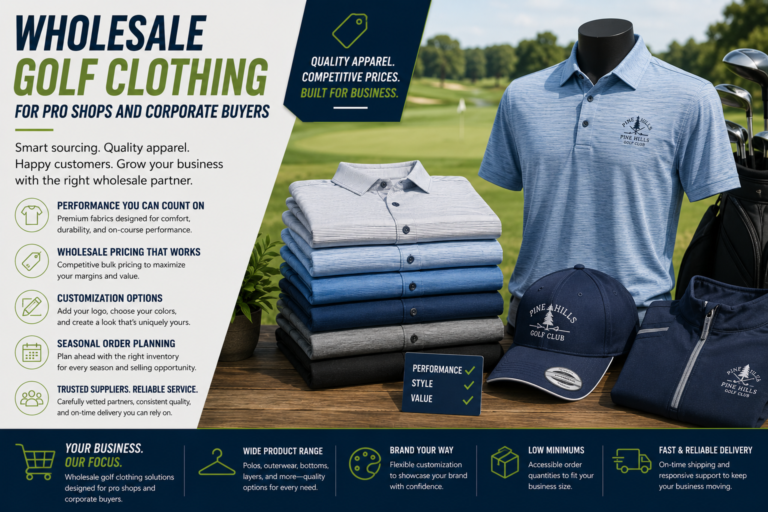
Golf clothing wholesalers provide pro shops and corporate buyers an affordable way to buy and sell performance golf clothing in volume. There are multiple suppliers, customization options, and minimum order quantities to consider. This guide assists pro shops and corporate buyers to better understand seasonal orders and supplier evaluation.

Why Pro Shops and Corporate Buyers Use Wholesale Golf Clothing

Golf clothing wholesalers supply shops and businesses with affordable options to buy quality clothing. Retail shops are able to provide clothing to customers with higher profit margins, and corporate buyers are able to purchase clothing to furnish tournaments and gifts for clients, as well as clothing for employees. Wholesale clothing also provides buyers the option to customize and design with logos and crests. This gives buyers a different and unique clothing option to purchase.

Key Considerations Before Sourcing Wholesale Golf Clothing

Having a plan before sourcing wholesale golf clothing helps buyers avoid problems and helps to create beneficial relationships with suppliers.

Defining Your Product Requirements

To help expedite sourcing and purchasing, potential suppliers should be given a clear understanding of the product being sought.

Consider garment categories (polo shows, retention/outerwear, shorts, etc.) and fabric, sizing, and branding/performance requirements. A target price also helps narrow the suppliers to the ones who can meet your quality and financial requirements. With these requirements, supplier discussions can be quicker and more efficient.

Know Your Order Volume and Frequency

Companies get better prices and more flexible terms when committing to orders of larger volume and more frequent orders. Having an estimate of your annual order volume helps you claim your business as a long-term client. Seasonal vs year-round needs help suppliers predict and prepare for more reliable delivery and production.

Cost vs Quality

When sourcing wholesale golf clothing, cost and quality of fabrics will be prioritized based on the target consumer. For a pro shop serving a premium club, quality fabrics and lower costs will be prioritized. For corporate buyers serving an event, cost of the clothing will be prioritized as long as a decent quality is met. So, clarify this cost vs quality balance to direct all sourcing decisions.

What’s An MOQ?

Minimum order quantity, or MOQ, defines the amount a buyer must order to get a custom clothing order. It has a large impact on what shops buy.

MOQs for Different Categories

Polos and basic layering pieces have lower MOQs than outerwear or fully custom designs and layered pieces.

Moreover, buyers selecting standard color options over fully customized options often enjoy lower MOQs. This is because suppliers are able to fulfill more than one client’s order. With an understanding of how design complexity translates to MOQ, buyers can place orders that are more economical by being less design-oriented.

MOQs and Order Consolidation

Pro shops that manage several different product categories may find it easy to fulfil a supplier’s overall MOQ by combining orders that include polos, outerwear, and shorts. Likewise, corporate buyers that hold several different events during the year may find it tactically advantageous to place orders for that year that are of greater volume and less frequent rather than placing several different orders that are of lower volume and more frequent. This is because consolidating orders often results in more favorable pricing and production constraints that are more elastic.

Wholesale Golf Clothing Customization

Customization options help wholesale golf clothing stand out as being branded to your club or your company.

Embroidery

Embroidery is a great option for club logos or branded text especially on polos and jackets. Unlike other types of branding, embroidered logos and text are a long lasting investment to product quality because they are impervious to the effects of washing. Also, golf clubs and corporate clients alike appreciate the professional look of embroidery.

Screen Printing and Heat Transfer

For larger wholesale golf clothing orders that are more of a corporate promotion or golf tournament, screen printing is a great option to consider. For smaller to medium orders, heat transfer offers an even greater flexibility for more intricate logos or artwork. However, this choice may be less durable than embroidery and may show signs of wear sooner particularly if the clothing is washed frequently.

Thus, understanding the decorating method and considering how frequently a garment will be laundered and the garment’s end use will help the customer select the best option available.

Full Sublimation

Full sublimation allows for creativity and unlimited, unique color combinations and design placement. While sublimation typically entails a higher MOQ and cost, it is ideal for buyers looking to design and launch a branded collection with a unique style and color. Because of this, many pro shops who release club collections use sublimation to set their collection apart from a wholesale collection.

What to Look for in a Wholesale Golf Clothing Supplier

Choosing the right supplier will have the largest impact on the quality and success of your wholesale golf clothing collection. Here are some areas to consider.

  • Golf Clothing Range: Look for a supplier that has a full offering of golf clothing from polos to outerwear and accessories.
  • Fabric Quality: Look for a supplier that can offer samples to you and that is proactive in sharing information related to their fabric.
  • MOQ: Look at what minimum order the supplier is offering compared to their competition.
  • Personalization: Check what personalization options the supplier has available such as embroidery, screen printing, and sublimation.
  • Lead Times: Ensure the supplier can meet your delivery dates and deadlines for each season.
  • After Sales: Consider how issues with quality and order fulfillment will be handled after the order has been completed.

Evaluating each area will help pro shops and buyers ensure their suppliers have the best interest of their business in mind and that the suppliers will deliver high-quality golf apparel collections consistently each season.

Seasonal Planning for Golf Apparel Orders

Predictable patterns govern the sales cycle for golf apparel. With the right planning, buyers can better manage stock levels and reduce the risk of buying less or more than needed for peak sales.

Orders Should Be Timed with the Golf Season

Peak demand for golf apparel in pro shops is usually during spring and summer. Therefore, the best time to place orders for bulk golf apparel is several months before stock needs to be available for peak season sales. A smaller order for autumn should be planned to procure golf outerwear and layering items, which will help cover the demand for the cooler months while avoiding the excess purchase of summer golf apparel. A more efficient use of inventory will be the result of a two-season approach to ordering from suppliers.

Orders Should Be Timed with the Golf Events

Corporate buyers who are organizing golf events or who wish to purchase golf apparel as gifts for employees should place bulk orders for golf apparel as soon as dates for events are confirmed, instead of waiting until the last moment to make a purchase. To ensure the best results, buyers should incorporate padding for sampling, revisions, and shipping times to avoid a last-minute rush. This approach has proven successful for buyers who order golf apparel for corporate branding purposes.

Broader Golf Clothing Lines

Once the basic range of wholesale golf clothing is established, adding other elements that complement the existing offer for club members and corporate clients will strengthen the offer. The golf apparel line will help in identifying options such as golf performance outerwear, golf base layers, and golf accessories. Other buyers who manage multi-sport programs can look at the broader  sportswear line for golf apparel that will offer uniformity in  Soccer apparel and tennis along with other sports, which are popular at clubs.

Partner with a Reliable Manufacturer of Wholesale Golf Clothing

Working with a reliable manufacturing partner takes the stress out of sourcing wholesale golf clothing. With the know-how of various pro shops and corporate customers, a good manufacturer can easily produce items like embroidered club polos, tournament shirts, and even outerwear collections, all while offering great quality, reasonable MOQs, and reliable timeframes. With a solid understanding of performance and branding for golf apparel and the budget restrictions that typically accompany it, we are able to assist corporate customers and pro shops with sourcing wholesale golf apparel.

Conclusion

Golf clothing at wholesale prices gives pro shops and corporate buyers a viable and flexible option to quickly and competitively outfit their shop and staff with quality branded apparel. By setting clear product standards, understanding the order minimums, and choosing the right customization option, buyers have the potential to source apparel that meets their expectations for both purpose and promotion. When golf apparel wholesalers are chosen strategically, trustworthy, and reasonably responsive, and have golf as a focus, quality will remain consistent for all orders throughout the season. With the correct sourcing and golf apparel wholesalers, Pro Shops and Corporate Brand Programs will use golf apparel as a foundational income source year after year.

FAQs

What is the usual MOQ for wholesale golf apparel?

MOQs are dictated by the supplier and how much customization is involved, but in general, most wholesale golf apparel orders begin with a quantity of 50 to 200 per style. If a supplier offers a customization option that is simple and colorways are standard, the supplier usually is able to justify a lower MOQ compared to a supplier that is offering a fully custom design.

How do I decide which customization option to choose for wholesale golf polos?

The club environment and the type of apparel that is being custom Golf Apparel also can dictate the selection. Screen printing is a great option for value golf apparel needed for corporate events, and usually is a faster option. Sublimation can be a great option when working with golf apparel that has unique designs with full, all over prints.

Can corporate customers purchase wholesale golf clothing in lower quantities?

Lower MOQs are often given to corporate customers, especially when the customization is of low complexity, screen printing being a good example. When discussing order volume and frequency, you can better determine the suppliers who may consider smaller starting orders.

How far in advance should wholesale golf clothing orders be placed?

Most shops should place orders at least a few months in advance of the golf season to accommodate lead times for sampling, production, and shipping. Additional buffer time should be added for necessary revisions and unforeseen delays to ensure stock is available before peak season.

Private Label Golf Apparel: Building Your Own Brand Line

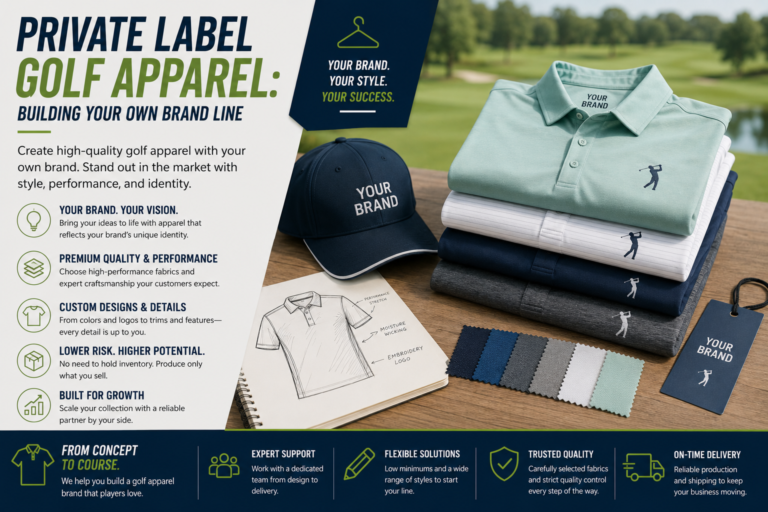
Golf apparel is an expanding market as more golfers desire clothing with style and performance on and off the golf course. Private label golf apparel gives brands, retailers, and entrepreneurs the opportunity to begin selling golf apparel with their own brand as opposed to a third-party label. This guide will help you understand private label golf apparel, how to begin the development process, and the main components that will help you build your brand line from concept to market.

What Is Private Label Golf Apparel?

Private label golf apparel is the designing, branding, and selling of golf apparel in your brand name, while the production is done by a third-party manufacturer. With this model, brands have the opportunity to design the apparel and set their own standards for quality and pricing with no investment on their end for production. Compared to resale of brands in the market, private label options also provide the most flexibility. Because of this, private label golf apparel is a great option for both market entrepreneurs and established brands.

Why Private Label Golf Apparel Makes Business Sense

In contrast to reselling established brands of golf apparel or buying and selling golf apparel from wholsalers, creating a private label golf apparel line has many benefits.

Greater Brand Control

Private label golf apparel allows brands the most control of their product as they have direct influence on the fabric, silhouettes, colors, and even the label design.

So, what does this customized golf apparel line mean for your customers? Understanding your customers and designing a line that meets their needs is critical for engaging premium club members, casual weekend golfers, and even the consumers who  tennis wear fashionable, golf-inspired apparel off the course. A private label golf apparel line creates more brand loyalty than retailing sports apparel that is easily accessible.

Better Margin Opportunities

Private label golf apparel lines create greater profit margins than selling exterior golf clothing brands. Every private label line eliminates the wholesale markup. If you partner with a manufacturer, pricing is variable based on your order and the fabric you choose. Compared to other golf apparel lines, private label golf apparel offers a sustainable margin.

Design and Development Flexibility

Once a private label contract is signed, golf apparel brands are more easily able to adapt designs to satisfy customer requests and industry trends. These adaptations are much more difficult, if not impossible, to make within the confines of a pre-designed collection. If customers are expressing a preference for a particular color or fabric, you can easily adjust production.

Private Label Golf Apparel: A Step-By-Step Guide

Private label golf apparel is a multi-dimensional process. Each phase is critical to the quality and positioning of the line.

Step One: Identify Your Brand and the Customers You Serve

Before you begin catering to your clientele by selecting fabrics or drafting sketches, establish your brand identity so that you can align the other decisions with your brand’s vision.

Reflect on your target customer, including their anticipated price point and their expected level of performance and/or style from your offering. Analyzing other golf apparel brands will also help unearth opportunities in the marketplace that your line can capitalize on. Taking this step will help your private label golf apparel line launch with a clear, distinct focus.

Step Two: Choose Your Garment Categories

Most private label golf apparel lines launch with a selected few categories of garments, as opposed to a fully comprehensive collection, and golf polos, quarter zip pullovers, golf jackets, and shorts are the building blocks of a golf focused line. This helps brands with a limited line stay focused and helps them manage time and resources.

Step Three: Choose Your Fabrics

The fabrics you use for your line will communicate the level of seriousness your brand has to your customer. A line that has cotton blenz as their base offering will have a more casual positioning, while a line that has a more performance offering will have a serious and premium offering. Typical draw fabrics for base layers are polyester and polyester + spandex blends for wovens. A golf market that is increasing in clientele with eco-conscious values will appreciate a line that has sustainable options like recycled polyester. Be sure to review your options carefully and request the necessary information regarding your line’s performance prior to your commitment.

Step Four: Refine Your Designs and Branding

Once you have settled your fabrics and garment categories, you will move to the design stage of drawing your Soccer apparel and specifying your brand with details such as label placements, embroidered logos, and hangtags.

Bold designs with full coverage benefit most from sublimation printing. Meanwhile, embroidery leaves a better quality finish. Choosing the right methods in tandem with the right fabrics will ensure your products hold up to your brand’s standards and price tier.

Step Five: Sampling and Revision

Sampling is the only way to check the design, fabric, and construction in bulk. Be sure you request samples in all sizes to check that the fit is consistent across sizes. Brands can suffer significantly due to ungraded fit samples and returns will only make the situation worse. Though it adds time initially, Sampling prevents negative impacts to the brand from bulk errors. Be sure your feedback is constructive and your samples are checked.

Step Six: Bulk Production and Quality Control

When all samples are approved, the bulk order will be completed with quality checks at each step. Good manufacturers will check their own work at each step and provide your brand confidence with documents and pictures. Confirm your packaging and labeling with the manufacturer well in advance to avoid unnecessary delays in shipping.

Key Considerations When Choosing a Manufacturing Partner

Choosing the right supplier will be one of the most important parts of launching your private label golf apparel line. The most important are:

  • Golf-specific experience: Choose a manufacturer familiar with golf apparel construction and performance fabric requirements.
  • MOQ flexibility: Check that minim order quantities suit your budget and your delivery and launch plans.
  • Sample quality and turnaround: How quickly and accurately does the manufacturer produce samples?
  • Fabric sourcing capabilities: Can the manufacturer source performance fabrics that meet golf’s specific requirements?
  • Customization range: Does the manufacturer have the embroidery, sublimation, and labeling options that your brand needs?
  • Communication reliability: Look at their communication responsiveness and clarity in the early phases. These traits carry through to the rest of the partnership.

Taking these aspects into consideration can help a brand develop a trustworthy manufacturing partnership to aid in developing product lines for more than one season.

Taking Your Private Label Golf Apparel Beyond A Single Line

Once your first line is successful, adding other related lines bolsters your brand’s position in the golf apparel market. Examining the entire golf apparel collection can help you visualize options for complimentary product lines that mesh with the offering you currently sell, such as outerwear, footwear, and performance layers. Additionally, brands that span multiple sports can look at the other  sportswear offerings to keep the quality and performance standards the brand has established outside of golf.

Golf Apparel Private Label Partners You Can Count On

Launching a private label golf apparel line requires a strategic partner who understands not only the performance needs of golf apparel, but the branding aspects of a new line.

Whether introducing a premium golf club brand, a retail golf apparel collection, or golf-related lifestyle products, engaging a skilled manufacturer will help you accurately realize your idea.

As a manufacturer of custom apparel, we offer a solution to brands for their private label golf apparel by combining our expertise in design and development of golf apparel with our understanding of the market. If you want to develop a golf apparel collection, feel free to contact us for more information on your options in fabrics, design, and time frames for your project.

Conclusion

Private label golf apparel provides a great opportunity for all players interested in entering the golf market and providing their own products. With the right design and performance fabrics paired with dependable manufacturing, brands can create a product line that resonates with golfers. Providing ample samples and practicing quality assurance when checking the apparel’s design and sizing helps ensures the line caters to the brand’s quality expectations. Private label golf apparel has the potential to form a strong and successful basis for any brand with the right partners.

FAQs

What is the difference between private label and white label golf apparel?

Private label golf apparel is developed specifically for your brand, often with custom design input, while white label products are pre-made garments that multiple brands can purchase and rebrand. Private label typically offers more design flexibility and a stronger brand identity.

How many pieces do I need to start a private label golf apparel line?

Most manufacturers require a minimum order per style, which varies depending on customization complexity. Starting with a focused range of three to five core garments helps manage initial investment while testing market response.

How long does it take to develop a private label golf apparel line?

The full development process, from initial design to final delivery, typically takes several months when accounting for sampling, revisions, bulk production, and shipping. Planning well in advance of your intended launch date helps avoid timing pressure.

Do I need to create original designs for private label golf apparel?

Yes, creating original designs distinguishes your private label line from generic products and strengthens brand identity. Working with a designer or providing detailed direction to your manufacturer helps ensure the finished garments accurately reflect your brand vision.

Custom MMA Gear: Rash Guards, Shorts, and Gym Branding

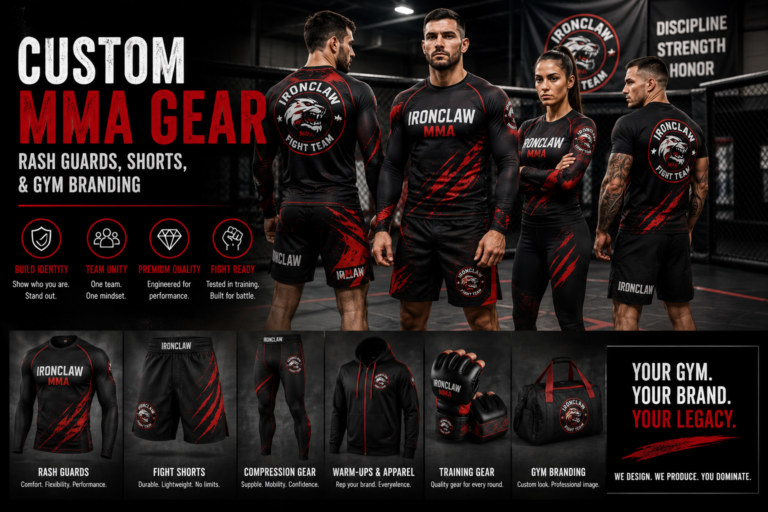
MMA gyms are more than just training spaces. They are brands. The gear your fighters wear inside the gym and on fight night says everything about who you are as a team. That’s why custom MMA gear has become a must-have for serious gyms, fight teams, and MMA brands around the world.

From rash guards to shorts and everything in between, custom gear builds identity, unity, and professionalism — all at the same time. Let’s break down what custom MMA gear covers and why it matters for your gym.

What Is Custom MMA Gear?

Custom MMA gear refers to fight and training apparel that is designed and manufactured specifically for a gym, team, or brand. Instead of buying off-the-shelf products, you get gear built around your identity — your colors, your logo, your name, and your style.

Custom MMA gear typically includes rash guards, fight shorts, compression tights, board shorts, and training tops. Each piece can be fully customized — from the fabric choice and cut to the print design and branding details. The result is a cohesive, professional look that sets your gym apart from everyone else.

Why It Matters — Key Benefits

Investing in custom MMA gear delivers real value for gyms, fight teams, and brands. Here’s why it’s worth it:

  • Unique gym identity — Custom gear puts your logo, colors, and name on every piece — building a strong, recognizable brand inside and outside the gym.
  • Team unity — When every fighter trains in matching gear, it creates a sense of belonging and shared purpose that motivates the whole team.
  • Professional appearance — Custom gear signals to competitors, sponsors, and fans that your gym is serious and well-organized.
  • Full design control — You choose every detail — colors, graphics, fonts, cuts, and fabric — so the final product is exactly what you envisioned.
  • Bulk pricing advantages — Ordering custom gear in volume brings the cost per piece down significantly compared to retail.
  • Sponsorship visibility — Custom gear gives sponsors a professional platform to display their logos — making your team more attractive to potential partners.
  • Versatility across training — Custom rash guards, shorts, and tops work together as a complete training kit for every discipline within MMA.

How Custom MMA Gear Is Made

The process of creating custom MMA gear starts with your vision. You share your design ideas, brand colors, logo files, and any specific requirements with the manufacturer. From there, the design team brings your concept to life in a digital mockup for your approval.

Once the design is confirmed, fabric selection and cutting begin. Sublimation printing is applied to the fabric panels before the garment is assembled — ensuring colors are vivid and consistent across every piece. After assembly, quality checks are carried out before the completed gear is packed and shipped to your gym. The process is collaborative from start to finish — and a good manufacturer makes it feel seamless.

Who Is Custom MMA Gear For?

Custom MMA gear serves a wide range of people in the combat sports world. MMA gyms and training academies are the biggest buyers — they use custom gear to outfit their fighters, coaches, and students in a unified, branded kit that represents the gym at every level.

Fight teams competing at regional and national level use custom gear to look professional and attract sponsors. MMA brands and activewear companies use custom manufacturing to launch or expand their product lines with full control over design and quality. Sports retailers also stock custom MMA gear to serve local gyms and fighters who want branded training apparel. If you’re sourcing gear beyond MMA, you can also explore rugby apparel, American football apparel, or ice hockey apparel for your other sporting needs.

Standards of Quality in Custom MMA Gear

Quality in custom MMA gear goes beyond how it looks. The gear needs to perform under the most physically demanding conditions in sport. Rash guards must be stretchy enough to move with the fighter while staying firmly in place during grappling exchanges. Fight shorts need reinforced seams and strong waistband construction to handle kicks, takedowns, and ground scrambles without giving way.

Print quality is equally critical. Sublimation printing must penetrate the fabric fully — not just sit on the surface — so colors stay vivid and designs don’t crack or peel during training. Every piece in a custom order should feel consistent in fabric weight, fit, and finish. That consistency is what makes the difference between gear that looks good in photos and gear that actually holds up in the gym.

Why Choose Eco Jersey for Custom MMA Gear?

Eco Jersey is a specialist in manufacturing high-performance MMA apparel that delivers on both design and durability. We work closely with gyms, fight teams, and brands to produce custom MMA gear that truly represents who you are.

Our sublimation printing covers every inch of the garment — giving you unlimited design possibilities with colors that stay sharp through heavy training and repeated washing. We use performance fabrics selected specifically for MMA — stretchy, lightweight, moisture-wicking, and built to last. We accommodate orders of all sizes, from small gym kits to large bulk runs for retailers and brands. We also manufacture basketball apparel, soccer apparel, baseball apparel, and more. Explore our full sportswear collection to see everything we offer.

Conclusion

Custom MMA gear is one of the most powerful investments a gym or fight team can make. It builds identity, creates unity, attracts sponsors, and signals professionalism to everyone watching — inside the gym and on fight night.

At Eco Jersey, we bring your vision to life with precision manufacturing, premium fabrics, and full customization on every piece. Ready to gear up your team? Explore our MMA apparel options and get in touch with us today — let’s build something your gym will be proud to wear.

FAQs

What types of custom MMA gear can I order?

You can order a full range of custom MMA gear including rash guards, fight shorts, compression tights, board shorts, and training tops. Every piece can be fully customized with your gym’s colors, logo, and design.

What is the minimum order quantity for custom MMA gear?

Minimum order quantities vary depending on the product and manufacturer. At Eco Jersey, we offer flexible MOQs to work with gyms of all sizes — from small training academies to large fight teams. Contact us to discuss your needs.

How long does it take to produce custom MMA gear?

Production timelines depend on the complexity of the design and the size of the order. In most cases, you can expect delivery within 2–4 weeks from sample approval. We provide a clear production timeline before we begin.

Will the print quality hold up through heavy training?

Absolutely. We use sublimation printing which bonds the color directly into the fabric — not just on the surface. This means designs stay vivid, sharp, and crack-free through intense daily training and repeated washing.

Bulk Volleyball Kits: Outfitting Teams and Tournaments

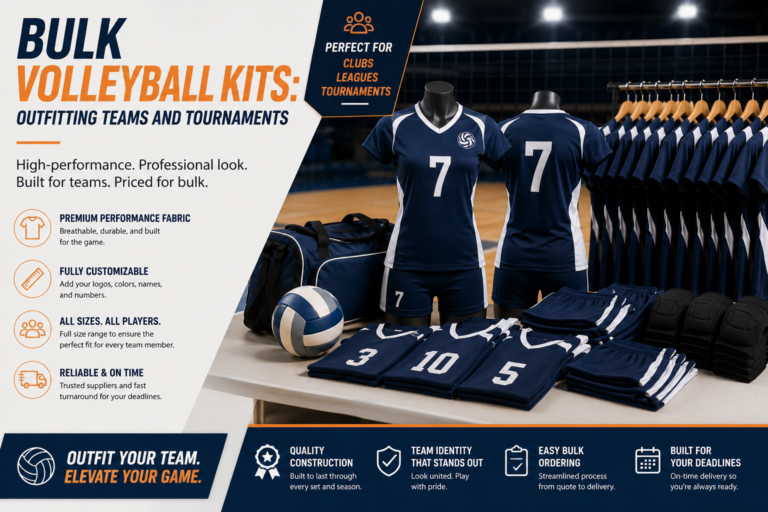
When buying in bulk for a volleyball tournament, choosing a color and placing an order doesn’t cover all the bases. Bulk volleyball kits source reliable suppliers and incorporate fabric with the right performance, sizing, and customization, so every player can hit the court in gear that represents the team with a professional fit and finish. This guide helps clubs, league organizers, and tournament directors to properly source bulk volleyball kits with the right order size, and the quality construction along with the right performance fabric to meet their goals within the time constraints they are working under.

Sourcing Bulk Volleyball Kits with Strategy

Along with the needs of the sport, like quick recovery and freedom of stretch, each type of volleyball, court or beach, has its own unique requirements of fabric weight and coverage with regard to ventilation. Without strategy, bulk volleyball kits can easily end up with none of these, along with a host of other fitting complications, especially when the kits are needed by a certain date. Sourcing with a strategy truly benefits clubs and teams the most.

High Performance Volleyball Kits and Fabric

The materials in bulk volleyball kits will define their comfort and functionality during play, and knowing the main performance traits of each fabric will help buyers strategically place the right materials from the beginning.

Moisture Wicking Polyester Blends

The base material of most quality volleyball kits is moisture-wicking polyester. It pulls and spreads sweat from the skin to the surface of the fabric where it can quickly evaporate. Since volleyball is an exertive sport, players sweat a lot during the match or tournament. Sweat evaporating fabric helps keep players dryer and more comfortable for multiple sets and tournament matches.

Four-Way Stretch Fabric

Four-way stretch fabric helps volleyball kits provide the ease of movement required for the sport. In addition to stretching to allow movements, the fabric has to recover quickly to help the kits maintain a uniform look throughout the long day of the tournament. Four-way stretch fabric gives players the unrestricted movement required to allow them to perform on the court.

Light and Breathable

Being light and breathable offers volleyball kits the ability to shed the bulk that prevents the movement required during an exertive sport. Combining the right materials helps volleyball kits shed the heavy and sweat soaked fabric used in traditional volleyball clothing during play.

Sublimation-Compatible Fabric

Sublimation-compatible Polyester is the base material of most quality bulk volleyball kits. It offers the ability to print full color and all over the garment with no added bulk or stiffness.

Volleyball kits normally have a lot of coloring and a lot of a team’s brand. Sublimation printing is perfect for printing on fabric that has that coloring and breathability. Because of this, this type of fabric is usually the only type of fabric found in a good quality volleyball kit.

Understanding MOQs for Bulk Volleyball Kits

MOQs, which are minimum order quantities, show how many kits a supplier is willing to sell. This is important for clubs and tournament organizers for obvious reasons.

Design Complexity and MOQs

A simple design with just blocks of color with maybe a few logos will tend to have a lower MOQ than a design with a lot of color zones and a lot of patterns. Also, fully custom sizing can lead to a higher MOQ, as suppliers must fully grade each kit for that order. If a team is on a tight budget, they can opt for a simpler design that contains color, logos, and patterns, and also opt for a custom fit and a fully graded custom sizing.

Combining Kit Components to Meet MOQs

In order to efficiently meet MOQs for bulk volleyball kits, a tournament organizer or club manager can order kits with both jerseys and shorts in the same order. In addition, combining warm up gear and supporter merchandise in that same bulk order provides MOQs and often a better price for each unit.

Customization Options for Bulk Volleyball Kits

Customization is what makes a standard bulk volleyball kit look less standard and like a branded team kit that shows the team’s identity and their sponsors.

Consider the following customization methods based on design needs and budget.

  • Sublimation printing: This method creates lightweight customized fabric that creates no bulk that can display sponsor branding. Full color graphics can be printed with no limit to design or color.
  • Screen printing: This is the best method when you’re on a budget in exchange for color choice. It is best for large orders of apparel with simple graphics and large block coloring.
  • Embroidery: This method has a more expensive cost with a much better finish for club branding on polos and outerwear.
  • Heat transfer: This method is best for small orders requiring a sponsor logo or large graphics, as it requires a lower investment than other printing methods.
  • Custom labeling: This method involves printing standard care labels or hang tags, which are customized for specific events, to help promote a clubs identity on the  ice-hockey apparel.

Using the right printing method for each design element gives the best results for the cost of the custom apparel, durability, and graphics.

Managing Sizing Across a Bulk Volleyball Kit Order

When ordering apparel in bulk for a team or large field of participants, getting the right size is very important. Sizing errors affect the whole order.

Collecting Accurate Team Measurements

Using self-reported sizes gives poor results for fitted jersey style apparel. Using the measurements of players along with the manufacturer’s size chart helps give the best fit results with the least risk of errors.

Requesting Samples Across Multiple Sizes

Requesting samples of the custom apparel in at least 3 sizes helps check the fit and accuracy of the apparel order.

To identify problems with size grading, it’s best to inspect a sample of both the smaller and the larger sizes. Problems with grading will typically show up on just the smaller or larger sample. Inspecting both samples will help catch those problems before the entire bulk order is produced, and as a result, will lower the number of complaints that are received after the order is delivered.

Timelines for Tournaments and Orders for the Season

The orders that are the most time sensitive are the bulk orders for specific tournaments. Delays in orders for club kits may be tolerable, but delays for orders for a tournament would be unacceptable.

Realistic Production Schedules

Most orders for bulk kits can take weeks to be produced. The order and design complexity can change the time lines. A large time block should be included in the orders for kits. Sourcing orders for bulk kits should begin up to three to four months before a planned tournament. The ordering of the bulk kits should be a planned activity. Late orders should be avoided as they can lead to quality issues.

Deliveries for Multiple Teams in a Tournament

Kit orders from multiple clubs will require the tournament organizer to plan a delivery schedule. Coordinating orders with a single manufacturer will usually ensure that all the club orders are of the same quality and will help reduce the logistical issues. Working with a manufacturer that has experience with multiple clubs will help the tournament organizers a great deal.

Additional Product Offerings

Once your core kit program is established, expanding into complementary apparel categories strengthens your offering for clubs and tournament participants alike.

Natural extensions to your match kits can include training apparel, warm-up jackets, and supporter merch after reviewing the full volleyball apparel category. Likewise, organizations with multi-sport programs can utilize the full  sportswear category for volleyball,  basketball clothing, and other court sports to ensure quality and branding across sports within their programs.

Partner with a Trusted Manufacturer for Bulk Volleyball Kits

The demands and logistics of large scale tournaments make finding a manufacturing partner for bulk volleyball kits a challenge. Regardless of whether you are kitting out one club team, a regional league, or a multi-team national tournament, the right partner will make the process simple through their expertise, while maintaining quality and setting expectations throughout the process.

We are custom apparel manufacturers that help clubs, leagues, and tournament organizers find bulk volleyball kits throughout the competition tiers that meet their demands and budgets for each of the markets. If you are ready to place your next order for kits, let us know, and we will discuss your event needs with an emphasis on your available options and the restrictions for each of our areas.

Conclusion

Careful consideration of requirements and lead times is necessary for bulk volleyball kit sourcing. These kits are typically constructed from tournament-grade fabrics and require design approvals, production, and shipping timelines. Incorporating detailed sampling and extensive sizing procedures helps avoid fit issues. Selecting a trusted manufacturing partner and starting the process well in advance always results in better quality products and a more pleasant experience.

This guide allows clubs and tournament organizers to procure large orders of competitive volleyball kits, ensuring that all players are provided and ready to compete.

FAQs

What is a typical MOQ for bulk volleyball kits?

Most suppliers have an MOQ for bulk volleyball kits of 50-200 kits with the same design. Simple designs and standard sizing tend to have a lower MOQ than fully sublimated tournament kits.

What fabric works best for competitive volleyball kits?

Moisture-wicking, four-way stretch polyester is the best choice for competitive volleyball kits because of the movement and sweat management demands. Lightweight, breathable construction enhances comfort for extended match play.

How do I get accurate sizing for a large volleyball team order?

Obtain players’ actual measurements instead of relying on self-reported sizes, and compare this to the size chart of the manufacturer. To avoid fit issues, request samples in at least three sizes before committing to a bulk order.

Can tournament organizers request kits for multiple teams from one supplier?

Yes. Placing a multi-team order for one tournament supplier simplifies team order management and creates cost efficiencies. It also simplifies delivery.

Moisture Wicking Golf Polo: Why Fabric Performance Matters

A day of golf can take several hours, taking players across direct exposure to the sun, changing weather, and an active schedule. This makes fabric performance as essential as swing technique. For example, a moisture wicking golf polo helps players stay comfortable by removing the effect of sweat, managing internal temperature, and allowing players to look fresh for the entire round. This guide addresses the functionality of moisture-wicking technology, the importance of this technology and associated features when selecting a high-performance golf polo, and the design elements players can incorporate.

Why is Moisture Management on the Golf Course Important?

Although golf does not require the constant movement that sports like basketball do, golfing does require players to remain active while exposed to the sun for long hours. This causes players to generate a lot of sweat. Standard golf polos made of cotton absorb and cling to moisture, and leave players feeling damp and uncomfortable during the round. In contrast, a moisture wicking golf polo pulls moisture away from the body and spreads it across the surface of the fabric for evaporation. With this technology, players are able to stay dry and comfortable while also remaining focused on the game for each hole of the round.

How Moisture-Wicking Technology Works in a Golf Polo

In order to understand the difference in fabric performance when using moisture-wicking technology for golf polos versus traditional golf polos, it is important to understand the mechanics of moisture-wicking technology.

Capillary Action and Fabric Structure

Moisture-wicking fabric utilizes capillary action, which is a phenomenon that occurs when sweat is drawn away from the skin and moves through tiny channels in the fabric fibers.

Because of the looseness of the weave, the fabric can absorb moisture better and dissipate faster. Hence, it can keep the skin dry even after prolonged activity in warm weather. In contrast, cotton would keep the skin damp if used during the same activities as the fabric in question.

Synthetic Fiber Composition

Most golf polos that have inbuilt moisture management systems are made of polyester or polyester and spandex blends. This is because of the construction of synthetic fibers. Furthermore, the use of microfibers in polyester increases the surface area of the weave and improves the fabric compared to other looms of polyester. Thus, the construction of the fiber is key in determining how well the polo manages moisture for the duration of the tournament.

Fabric Finishing Treatments

Most manufacturers use treatments to finish the fabric that enhance the moisture management of the fabric and can be used for antimicrobial treatments as well. This would help combat the odor that is caused by the bacteria during a long and hot tournament. However, these treatments diminish with washing the fabric. Good manufacturers would treat the fabric from fiber production to prolong the efficacy.

Key Features of a High-Performance Golf Polo

There are other features in addition to moisture management that are important in determining how a polo performs on the course.

Breathable Construction

Fabrics that have breathable construction allow heat to escape from the skin. This is really important for polos used during heat in the summer. Breathability is enhanced by using lightly woven or loosely woven fabrics. These can create ventilation panels that help airflow and do not compromise the construction of the polo.

UV Protection

Performance polos that have a built in UV protection system are helpful to golfers who are in the sun for long periods of time.

This feature is valuable for golfers who play often, especially in sunny locations, because of the features beyond the abilities of typical moisture management.

Four-Way Stretch for Swing Mechanics

Four-way stretch fabric accommodates the ease of motion golfers need to play without restrictions, especially during the torso rotation needed in a golf clothing swing. Additionally, fabric that stretches but returns to its original dimensions helps the polo look neat for the entire round of golf.

Wrinkle Resistance

Polyester-based, moisture-wicking, golf polos help keep the golfer looking professional during and after long hours spent on the golf course, including travel to and from golf tournaments. This combination of style and performance helps golfers who want a good looking polo that performs well.

Moisture Wicking Golf Polo vs Traditional Cotton Polo

The comparison points of moisture-wicking polos versus traditional cotton polos demonstrate the reason serious golfers avoid using cotton fabric for golf apparel on the course:

  • Moisture Management: Moisture-wicking polos actively transport sweat away from the skin, while cotton absorbs and retains it.
  • Drying Time: Performance fabric dries significantly faster than cotton after sweating or rain exposure.
  • Comfort in Heat: Breathable synthetic fabric regulates temperature better than cotton during hot, sunny rounds.
  • Appearance Over Time: Moisture-wicking fabric resists wrinkles, while cotton wrinkles more easily.
  • Odor Control: Many moisture-wicking polos include antimicrobial treatments, while cotton lacks this built-in odor resistance.

These factors help golfers choose moisture-wicking polos over cotton polos that consistently perform better than traditional cotton options.

Choosing or Designing a Moisture Wicking Golf Polo

Considering climate, how often you play, and even personal preference all factor into choosing the right polo. Golfers, however, who play often in hot and/or humid climates benefit most from moisture-wicking fabrics, which can be supplemented with added UV protective and ventilation elements. Companies developing their own golf apparel lines should do moisture-wicking fabric tests and samples before committing to larger production runs. For any use cases, fabric quality is the number one consideration for a polo’s comfort and performance. Fully developed golf apparel lines can also consider the wider golf apparel category for polos, shorts,  tennis wear, and accessories that are designed to work together. Brands that are looking to develop  Soccer apparel for a variety of sports can see the full  sportswear collection, which will help maintain quality and fabric performance.

Caring for a Moisture Wicking Golf Polo

A moisture-wicking polo has performance features that can last with proper care. Washing with mild detergent (no fabric softeners) in cold water, and air drying or using low heat to dry will help avoid shrinking and losing the fabric’s elasticity. If golfers care for their polos, the polos will perform for many rounds of golf.

Partner with a Trusted Manufacturer for Moisture Wicking Golf Polos

To make a moisture wicking golf polo that is high-performance, you need to partner with a manufacturer that has knowledge of fabric technology and the requirements for golf-specific design.

Experience with a manufacturer makes a difference in comfort and performance for your end product. This remains true no matter whether you are designing apparel for a golf club, a retail line, or just for a tournament.

At our company, we manufacture apparel and assist in designing golf club apparel. Our golf polos incorporate the moisture-wicking feature, while also considering performance and design. Get in touch and we can get started on your golf apparel project. We can discuss the options for fabric, design, and decide how soon we can begin production.

Conclusion

There are numerous advantages to having a moisture wicking golf polo that help even during exhausting rounds of golf in the sun. The way synthetic fibers are constructed with special treatments dry and keep the player comfortable and focused. The fabric also has other benefits on and off the course, such as a protection against the sun, a four way stretch, and no wrinkles. Knowing and understanding fabric performance helps golfers and businesses better select or create golf polos that help enhance the golfing experience.

FAQs

What is the best fabric for moisture wicking golf polos?

The best fabric for moisture wicking golf polos is a blend of polyester and spandex. These will dry quickly and wick the sweat away from the skin. A great option for this fabric is microfiber polyester because it will increase the surface area of the fabric.

Is a moisture wicking golf polo better than cotton for hot weather?

Definitely. In heat, cotton will trap moisture whereas a performance fabric will pull the sweat away and dry leaving the golfer cool and comfortable.

Do moisture wicking golf polos offer sun protection?

Many of the moisture wicking golf polos offer sun protection in the form of a rating of UPF. This is beneficial for golfers who play often in the sun.

How do I keep a moisture wicking golf polo in working condition?

Washing in cold water with mild detergent will keep the polo in working condition, but stay away from fabric softeners since these will affect the moisture-wicking ability.