Home Blog Page 22

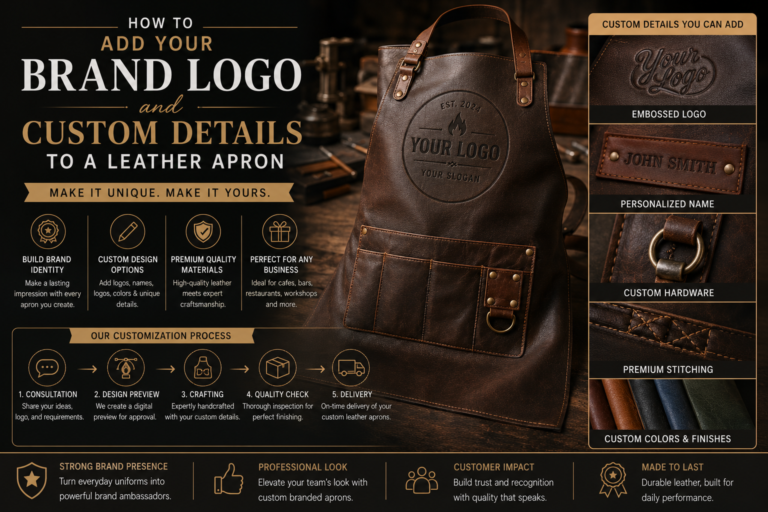
How to Add Your Brand Logo and Custom Details to a Leather Apron

Beyond being protective clothing, leather aprons hold incredible value as a branding tool for many businesses. Barbershops, craft breweries, restaurants, and every retail business fall under this category. Customized leather aprons showcase your brand before a word is spoken. Knowing how to add brand details to a leather apron elevates the experience from a generic product to a significant brand experience.

Why Custom Branding on Leather Aprons Matters

Your employees represent your brand daily. Your apron is present in their every customer engagement, every product photo, every posted update. A branded leather apron is an investment in your brand. It builds credibility, professionalism, and brand identity cohesiveness that is noticed and remembered by your customers.

Businesses investing in custom leather aprons see real returns — not just in aesthetics but in customer perception and staff pride too.

Branding Techniques for Leather Aprons

The most appropriate branding method depends on your budget, leather type, and logo style. The options listed here are the most effective available.

Embossing — Classic and Premium

Embossing is the process whereby a logo or design is imprinted directly onto a leather surface. This method provides a quality finish that leaves a permanent design which can be raised or recessed. This technique can be applied to the different types of leather and gives them an impression of being a high quality artisanal product.

This method is appropriate for brands looking for understated designs that are decorative without the usage of color.

Debossing — Deep and Defined

Debossing is just like embossing with the main difference being that the design is pushed into the leather rather than raised. The end result leaves a clear impression that reflects light in different ways and has a very defined depth. Debossing aprons gives a high quality artisanal look that is perfect for craft brands, barbers, and barbers in the luxury hospitality business.

Screen Printing — Bold and Colorful
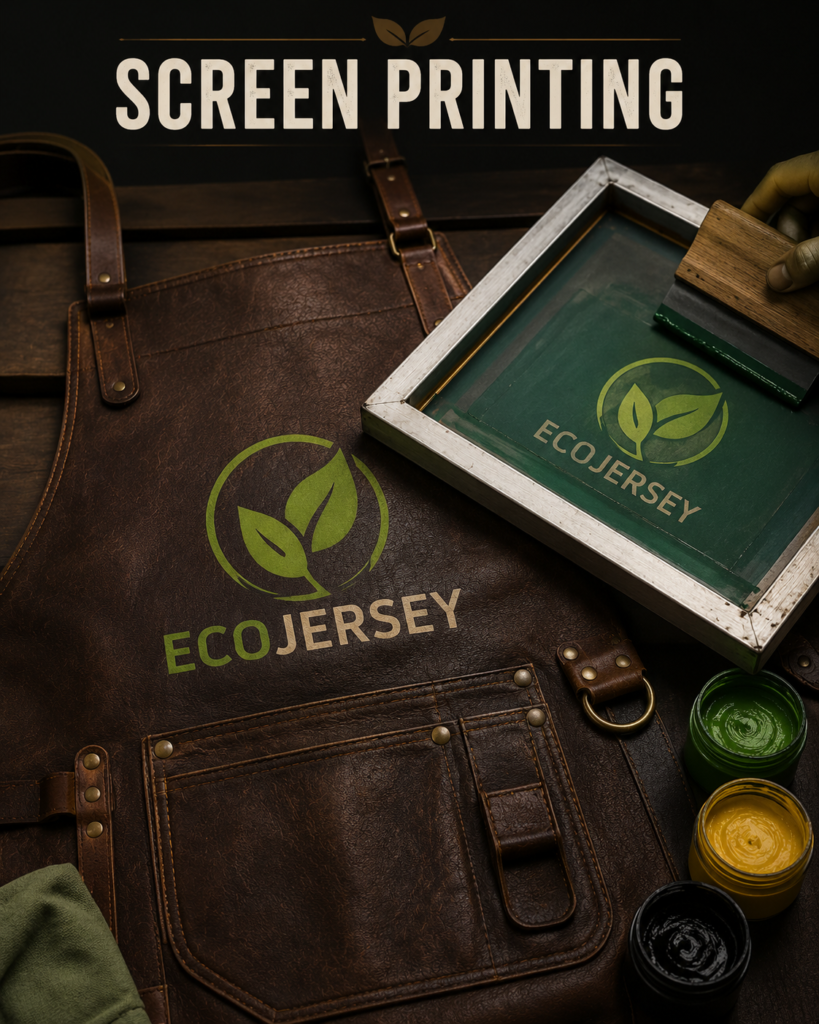
Screen printing process on a leather apron featuring ECOJERSEY logo printing, screen frame, ink containers, and premium leather workshop setup.
Screen printing creates bold, colorful, and high-visibility branding on leather aprons using flexible leather-compatible inks for lasting results.

By applying ink directly to the leather, screen printing is ideal for logos with detailed multicolored designs. It offers bright, attention grabbing results and is perfect for brands that want their aprons to stand out with high visibility advertising.

The key is using leather-compatible inks that flex with the material without cracking over time. A professional leather apparel manufacturer ensures the right ink and process for lasting, vibrant results.


Laser Engraving — Precise and Modern

Laser engraving burns logos into the leather with precision. It handles details, complex text, and intricate designs better than any other method. Depending on the leather, the engraved area takes on a slightly ligher or darker tone, creating a striking contrast.
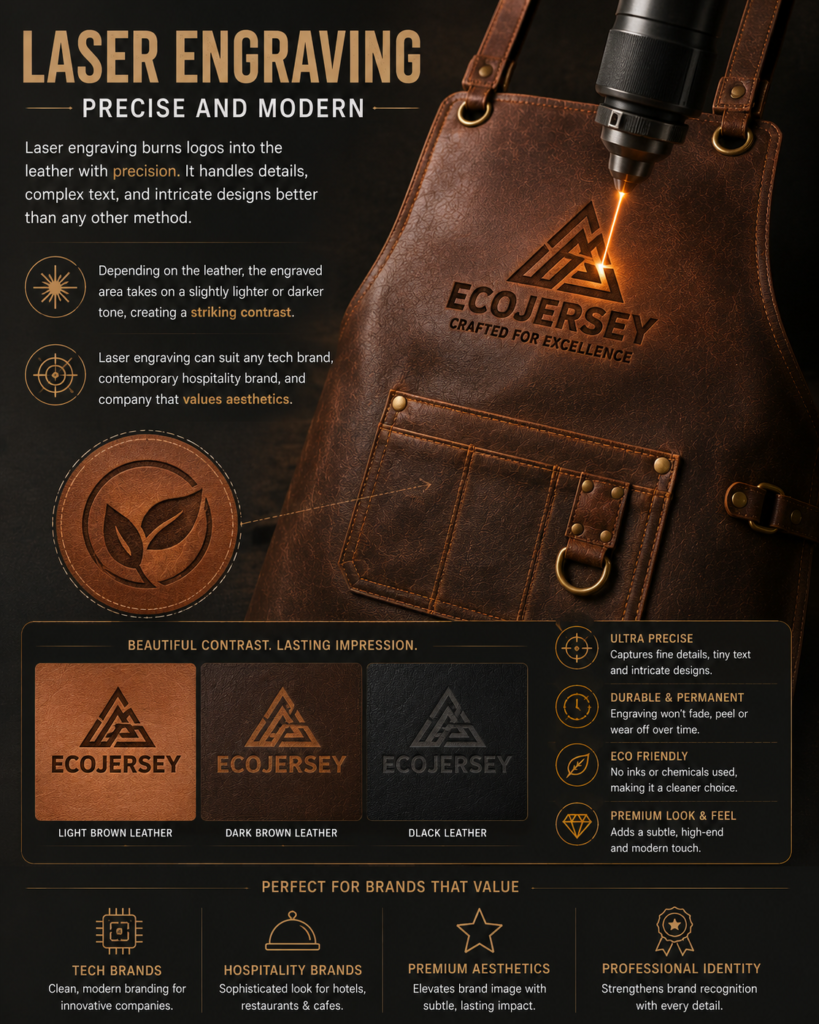
Laser engraving process on a leather apron featuring ECOJERSEY logo engraving, precision laser detailing, and premium engraved leather branding samples.
Laser engraving delivers precise and modern leather branding with clean detail, permanent contrast, and premium visual appeal for contemporary brands.

Laser engraving can suit any tech brand, contemporary hospitality brand, and company that values aesthetics.

Metal Hardware and Rivets — Functional Branding

Metal hardware, like buckles, rivets, and clasps, give your brand’s gear a unique appeal with a 3D component to the branding element, something that is impossible to achieve with printing and embossed branding. Custom stamped metal pieces that include your brand’s logo immediately capture your customer’s eye and add a distinguished and lasting detail to your brand.

Brands building full leather product ranges that include leather belts and leather bags often use consistent branded hardware across their entire collection — creating a unified, recognizable brand identity.

Additional Custom Details Worth Considering

In addition to your logo, these custom features enhance the branding on your leather apron:

  • Adjustable strap colors
  • Sewn pocket formations and dimensions
  • Bespoke branding fabric/stitching or interior linings
  • Leather color branding
  • Interior branded fabrics or stitched with staff name

Working With the Right Manufacturer

Perfecting custom branding on leather requires the right tools, skill, and experience. Different leather manufacturers all have different levels of skill. Go for a manufacturer who shows every sample of their branding techniques before going into mass production.

A reliable partner who also produces leather jackets and leather vests understands leather behavior across different techniques — ensuring your branding looks exactly as intended on the final product.

Conclusion

Learning how to incorporate your branding on leather aprons turns a basic workwear item into a true brand component. Each branding method, either embossing, debossing, laser engraving, screen printing, or even custom hardware, results in a different appearance and is chosen based on brand style and customer preferences. Spending money on proper branding, along with the right manufacturer, allows your leather apron to tell your brand story day in and day out through quality and well thought out branding.

FAQs

Which branding method lasts longest on leather aprons?

Debossing, embossing, and laser engraving are the most durable branding options. Having the least amount of tarnishing or fading.

Multiple branding styles can be used, including custom hardware?

Labeling styles may include contrast stitching and logos.

What is the MOQ for custom branded leather aprons?

An MOQ of 50 pieces is the industry standard for most custom branded orders.

How long does custom leather apron production take?

It usually takes 2 to 4 weeks after sample approval.
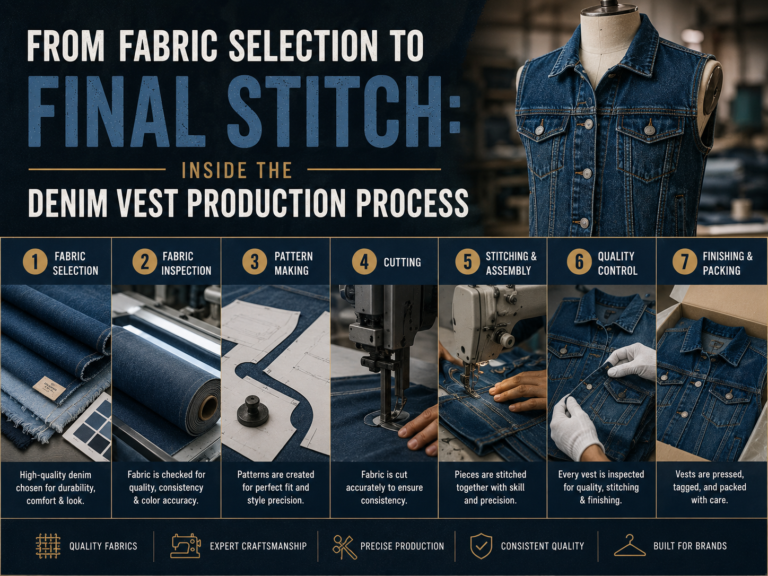
From Fabric Selection to Final Stitch: Inside the Denim Vest Production Process

Every great denim vest starts long before a single stitch is placed. Behind every finished product sits a carefully managed denim vest production process — one that determines how the vest looks, feels, performs, and holds up over years of wear. For brands serious about building quality denim collections, understanding what happens inside production gives you the knowledge to ask the right questions, catch potential problems early, and make confident manufacturing decisions.

Fabric Selection

Everything begins with fabric. Denim comes in a wide range of weights, compositions, and constructions — and the choice made here shapes every decision that follows.

For denim vests, fabric weight matters significantly. Lightweight denim — 6 to 8 oz — produces a softer, more relaxed vest suited to casual and layering styles. Mid-weight denim — 10 to 12 oz — delivers the structure most vest styles require. Heavyweight denim — 12 to 14 oz and above — suits workwear-inspired and heavily constructed styles that need serious durability.

Fabric composition matters equally. Pure cotton denim offers authentic feel and excellent wash response. Cotton-elastane blends add stretch for improved comfort. Recycled denim blends serve brands with sustainability commitments — a growing priority across the denim apparel industry right now.

Pattern Making and Grading

Once fabric is confirmed, pattern makers develop the technical blueprint for the vest. Every panel, seam, pocket placement, and armhole curve gets mapped precisely at this stage. Accuracy here determines how the finished vest fits across all size ranges.

Pattern grading then scales the base pattern up and down across your full size run — ensuring proportions remain correct and consistent whether the vest is an XS or a 3XL. Poor grading at this stage creates fit problems across sizes that are expensive and time-consuming to fix in bulk production.

Sampling

Before bulk production begins, manufacturers produce samples for brand approval. The first sample — called a proto sample — tests the basic construction, fit, and proportions. It rarely looks exactly like the finished product but confirms the fundamental design direction.

A fit sample follows — refined based on brand feedback and worn to test real-world movement and comfort. Finally, a pre-production sample matches bulk production materials exactly. This is the sample that signs off the entire production run.

A professional denim vest manufacturer manages this sampling process transparently — communicating clearly at each stage and incorporating brand feedback accurately before moving forward.

Cutting

Approved samples move production into cutting. Fabric is spread across long cutting tables in multiple layers — maximizing efficiency while minimizing fabric waste. Computerized cutting systems ensure precise panel shapes across every layer simultaneously.

Accurate cutting is critical for denim specifically. Denim has a natural grain direction that affects how panels behave through washing and wearing. Cutting off-grain creates twisting seams and distorted fits that no amount of finishing can correct after the fact.

Construction and Stitching

Cut panels move to the sewing floor where specialized machines assemble the vest. Denim construction requires heavy-duty chain stitch and lock stitch machines capable of handling multiple fabric layers without skipping or breaking.

Key construction details that define vest quality include:

  • Double-needle stitching on stress points — armholes, side seams, shoulder seams
  • Bartack reinforcement at pocket corners and button placements
  • Clean internal seam finishing that prevents fraying over time
  • Accurate pocket placement and consistent topstitching throughout

Brands building streetwear denim collections often specify custom stitch colors, contrast thread, and decorative stitching details at this stage — turning construction details into deliberate brand signatures.

Washing and Finishing

Washing transforms raw constructed denim into the finished aesthetic your brand intends. This stage dramatically changes how the vest looks and feels — and it’s where denim manufacturing truly becomes an art form.

Common washing techniques include:

  • Stone washing: creates soft texture and natural fading through tumbling with pumice stones
  • Acid washing: produces high-contrast, bleached surface patterns
  • Enzyme washing: softens the fabric surface while retaining color depth
  • Raw or dry finish: preserves the original dark indigo for a clean, structured look

Distressing — manual or laser-guided — adds rips, abrasion, and worn edges after washing. The placement and intensity of distressing defines the vest’s character and market positioning. Private label denim brands often develop signature distressing maps that become recognizable brand identifiers across their entire collection.

Hardware Application

Buttons, rivets, snaps, and any decorative metal hardware get applied after washing — protecting the hardware finish from chemical and mechanical damage during the wash process. Hardware quality matters enormously at this stage. Cheap rivets corrode. Weak buttons snap under pressure. Quality hardware holds firmly and ages gracefully alongside the denim itself.

Brands expanding their collections into denim jackets and denim jeans benefit from maintaining consistent hardware finishes across all products — creating a cohesive brand identity that customers recognize across every piece in the range.

Quality Control and Final Inspection

Every finished vest passes through quality control before packaging. Inspectors check measurement accuracy against approved specifications, stitching consistency, wash uniformity, hardware security, and overall presentation.

Any vest falling outside approved tolerances gets flagged for correction or rejection. Professional manufacturers maintain inspection records and share quality reports with brands — providing full visibility into what leaves their facility.

Labeling, Packaging, and Dispatch

Approved vests receive brand labels, hang tags, size stickers, and packaging according to brand specifications. For brands selling across multiple retail channels, proper labeling and packaging compliance at this stage prevents costly rejections from retail buyers and e-commerce fulfillment centers.

Finished products then move to dispatch — either shipped directly to the brand’s warehouse or fulfilled according to agreed logistics terms.

Conclusion

The denim vest production process is more detailed and demanding than most brands initially realize. From fabric selection through pattern making, sampling, cutting, construction, washing, hardware, quality control, and final packaging — every stage requires expertise, precision, and clear communication between brand and manufacturer. Understanding this process makes you a smarter buyer, a better creative director, and ultimately helps you build denim vest products that your customers genuinely love wearing.

FAQs

How many sample rounds should I expect before bulk production?

Most brands go through two to three sample rounds — proto, fit, and pre-production samples — before approving bulk production with confidence.

Does washing affect the final measurements of denim vests?

Yes. Denim shrinks during washing — typically 3% to 8% depending on fabric composition. Professional manufacturers account for shrinkage in pattern measurements before cutting.

Can I specify custom distressing placement for my denim vest collection?

Absolutely. Private label brands regularly develop custom distressing maps that manufacturers follow precisely across every piece in the bulk production run.

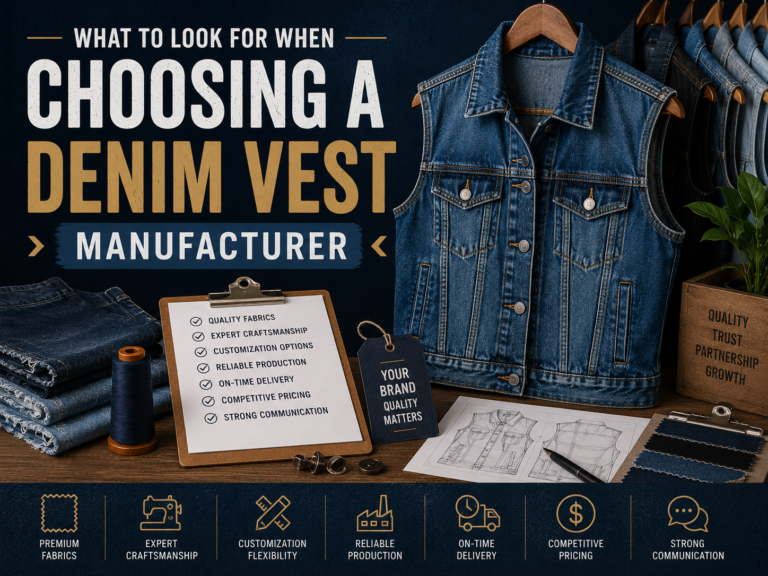
What to Look for When Choosing a Denim Vest Manufacturer

The denim vest is having a major fashion moment. The demand for denim vests is increasing fast, from streetwear to vintage-inspired collections and festival fashion. It takes more than just a Google search to find the denim shirt manufacturer that can bring your product to life. You can lose money, time and your brand’s reputation if you choose the wrong manufacturing partner. When you find the right partner, they become one of your greatest assets.

Start With Denim Expertise — Not Just General Apparel Experience

Not every garment manufacturer understands denim. Denim has specific construction requirements — heavy-weight stitching, proper seam reinforcement, accurate wash and distressing techniques, and hardware application that holds up through repeated wear and washing.

A manufacturer with genuine denim expertise handles all of these requirements confidently. They understand how different denim weights behave through construction, how washes affect final sizing, and how to maintain consistency across bulk production runs. Always ask specifically about their denim experience — not just their general apparel capabilities.

Evaluate Customization Capabilities Thoroughly

Your denim vest needs to represent your brand — not look like a generic product any other label could sell. A strong denim vest manufacturer offers full customization across every detail that defines your product.

Look for customization across:

  • Denim weight and fabric composition
  • Wash types — acid wash, stone wash, enzyme wash, raw finish
  • Distressing levels and placement
  • Pocket styles, button types, and hardware finishes
  • Custom embroidery, patches, and printed details
  • Private label branding — labels, tags, and packaging

If a manufacturer limits your options significantly, move on. Full creative control is what separates a branded product from a commodity

Check Their Full Denim Range

A manufacturer who only produces vests in isolation raises questions. The strongest manufacturing partners produce across a full denim range — which signals genuine denim expertise and production capability.

Look for manufacturers who also produce denim jackets, denim jeans, and denim shirts with equal confidence. This matters for two reasons — it confirms real denim manufacturing depth, and it opens the door for you to expand your collection with the same trusted partner as your brand grows.

Assess Communication and Production Transparency

Poor communication is the single most common complaint brands have about manufacturers — and it causes serious damage. Missed updates, unclear timelines, and unreturned messages mid-production create enormous stress and financial risk.

Before placing any bulk order, test your manufacturer’s communication thoroughly during the sampling stage. Do they respond promptly? Do they proactively update you on progress? Do they flag potential issues early rather than hiding problems until delivery? A manufacturer building streetwear denim collections understands that brands operate on tight seasonal deadlines — and that reliable communication is as important as product quality for keeping those deadlines intact.

Look for Long-Term Partnership Potential

The best manufacturing relationships grow over time. Your vest manufacturer today should become your full denim collection partner tomorrow. As your brand expands into denim shorts, denim skirts, or private label denim development — having a manufacturer who already knows your standards, preferences, and brand vision makes every new product launch faster, smoother, and more cost-effective. Choose a partner from a trusted denim apparel manufacturer who thinks about your brand’s future — not just your current order.

Conclusion

Choosing the right denim vest manufacturer requires careful evaluation across expertise, customization, MOQ flexibility, sampling clarity, communication quality, and long-term partnership potential. Each factor protects your brand from costly mistakes and sets your collection up for consistent success. Take your time during the selection process — because the right manufacturing partner doesn’t just produce your vests. They help build your brand one quality product at a time.

FAQs

What denim weight works best for vests?

Mid to heavyweight denim between 10 and 14 oz works best for vests — providing the structure and durability the style requires while holding distressing and hardware securely.

Can denim vests be produced with custom washes and distressing?

Yes. Professional denim vest manufacturers offer a full range of wash and distressing options — from clean raw finishes to heavily distressed and acid-washed styles.

What is a reasonable MOQ for custom denim vests?

Reasonable MOQs for custom denim vests typically start between 50 and 150 pieces per style — though this varies by manufacturer and customization complexity.

How long does denim vest production take from sample to delivery?

From sample approval to bulk delivery, production typically takes four to eight weeks depending on order size, customization level, and wash processes required.

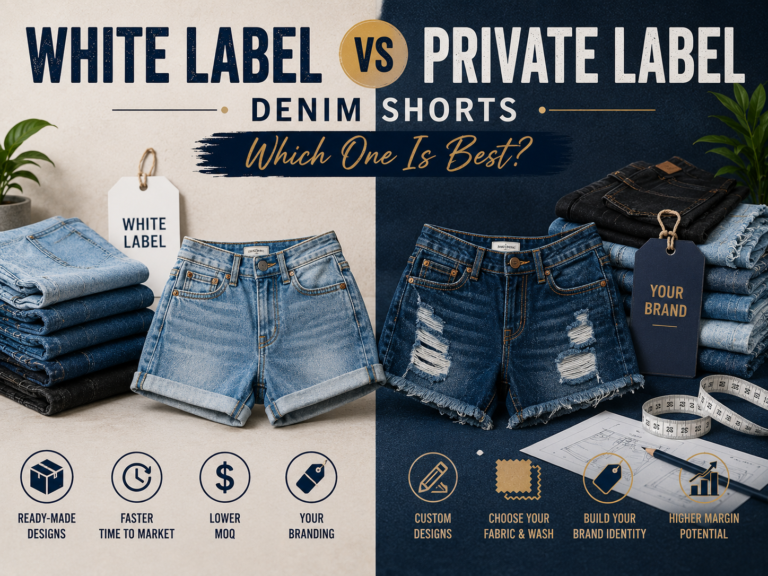
White Label vs Private Label Denim Shorts: Which One Is Best?

Every clothing brand reaches a point where this question becomes unavoidable — do I go white label or private label? Both manufacturing models work. Both have real advantages. But they serve very different brand goals, budgets, and growth strategies. Understanding white label vs private label denim shorts properly before you commit saves you significant time, money, and frustration down the line.

What Is White Label Denim?

White label means a manufacturer produces a standard, pre-designed denim short that multiple brands can purchase and sell under their own branding. The product itself stays the same across buyers — only the label, tags, and packaging change.

White label suits brands that need to:

  • Launch quickly without a long development process
  • Keep upfront costs and MOQs low
  • Test the denim shorts market before committing to custom development
  • Operate with a smaller team and limited production management capacity

The core limitation is differentiation. If another brand buys the same white label short, your products look identical on the rack — and only your branding separates them.

What Is Private Label Denim?

Private label means the manufacturer develops a denim short exclusively for your brand. The fit, fabric, wash, distressing, hardware, and finishing are all custom — built specifically around your brand identity and customer needs.

A professional private label denim manufacturer gives your brand complete creative control from the very first sample. Nothing about your product exists anywhere else on the market — because it was built entirely for you.

White Label vs Private Label: Key Differences

FeatureWhite LabelPrivate Label
Product UniquenessShared across multiple brandsExclusive to your brand
Development TimeFast — product already existsLonger — built from scratch
Upfront CostLowerHigher
Customization LevelLabel and packaging onlyFull — fabric, fit, wash, hardware
Brand DifferentiationLowHigh
ScalabilityLimitedUnlimited
Long-Term Brand ValueModerateSignificantly higher

Which Model Builds a Stronger Denim Brand

Private label wins on brand building — every single time. When your denim shorts have a unique fit, a signature wash, and custom hardware that nobody else sells, your brand owns something real. Customers come back for your specific product — not just any denim short they could find elsewhere.

White label works as a starting point. It gets product in front of customers fast while your brand finds its footing. But brands that stay white label long-term struggle to build loyalty because their products are never truly theirs.

The strongest approach is to start white label if budget demands it — then transition to private label as revenue grows. Many successful denim apparel brands follow exactly this path.

Expanding Beyond Shorts With Private Label

The real power of private label manufacturing shows when you expand your collection. Once you establish a private label relationship with a manufacturer, developing additional products becomes significantly faster and more cost-effective.

Your manufacturer already understands your brand standards, fit preferences, and quality expectations. Adding denim jeans, denim jackets, or denim skirts to your range becomes a smooth, efficient process rather than starting from scratch with every new product category.

Brands targeting specific markets — like streetwear denim or kids denim — benefit most from private label because these customers actively seek distinctive, brand-specific products rather than generic alternatives available everywhere.

Conclusion

White label vs private label denim shorts comes down to where your brand is today and where you want it to go. White label launches fast and costs less upfront. Private label builds real brand equity, product exclusivity, and long-term customer loyalty that no white label model can replicate. Choose the model that fits your current reality — but always build toward private label. That’s where lasting denim brands are built and where serious growth begins.

FAQs

Can I switch from white label to private label later?

Absolutely. Many brands start white label to generate initial revenue, then transition to private label manufacturing as their budget and customer base grows.

Does private label require higher minimum order quantities?

Generally yes — private label MOQs are higher because production is exclusive to your brand. However, many manufacturers offer flexible MOQs for new brand partnerships.

How long does private label denim shorts development take?

From initial briefing to bulk production, private label development typically takes six to twelve weeks — including sampling, revisions, and approval stages.

Is white label denim shorts manufacturing suitable for long-term brand building?

White label works short-term for market testing and quick launches. For serious long-term brand building, private label is the stronger and more sustainable choice.

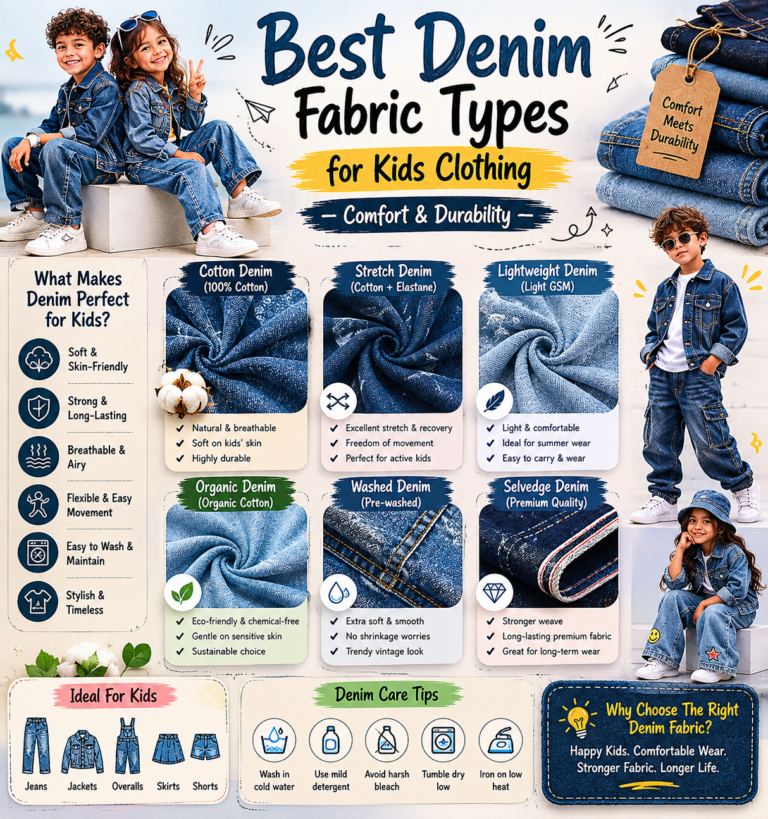
Best Denim Fabric Types for Kids Clothing — Comfort& Durability


Children’s denim remains a top clothing category because it is durable, easy to wash, and perfect for everyday wear. Understanding Denim Fabric Types for Kids Clothing helps brands choose the right styles, fits, and construction for comfort, quality, and commercial success.

This guide will help you to understand the different types of denim clothing for kids so that you can build your own range.

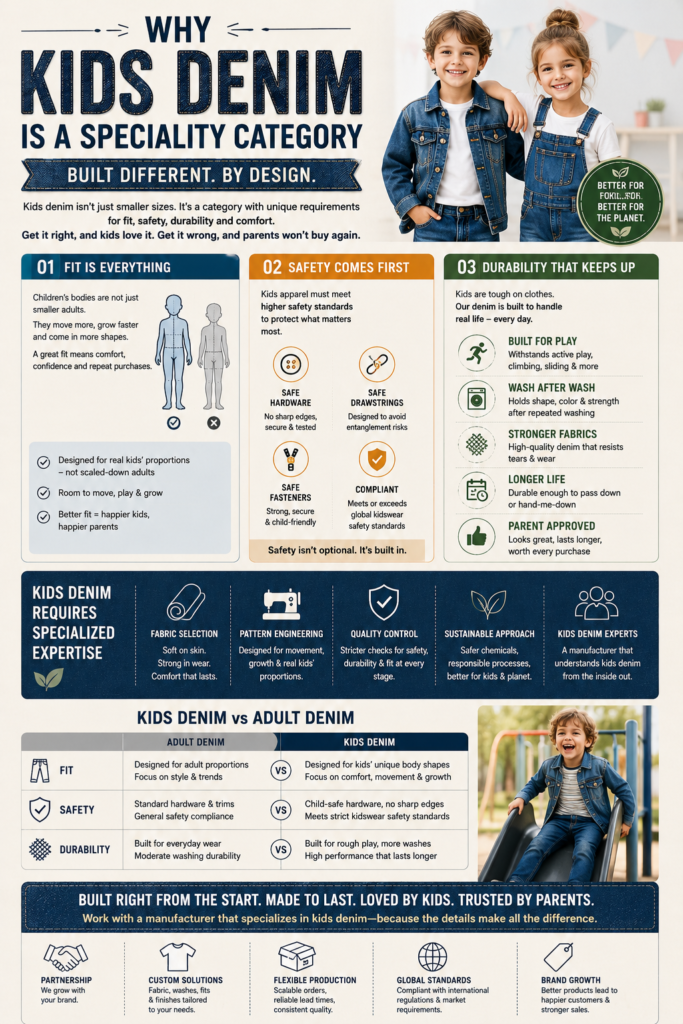
Why Kids Denim is a Speciality Category

Kids denim manufacturing infographic explaining the importance of proper fit, child safety standards, durable fabrics, and specialized production expertise for children’s denim apparel.
Kids denim requires specialized manufacturing focused on comfort, safety compliance, durability, and accurate fit to meet the demands of active children and modern parents.

Denim styles are different for children than for adults. Fit requirements are higher. Children’s bodies are different from adult scaled down bodies. A poor fit in a child’s garment can be immediately noticeable and damaging to the business.

Safety requirements are more stringent. Hardware, drawstrings and fasteners must meet the safety standards for children’s clothing. These vary depending on the market, but are always more stringent than adult apparel regulations.

The durability standards are also higher. Clothing is a major problem for children. Denim for children needs to be durable enough to withstand playground wear, repeated washings, and physical activity that would ruin lesser fabrics, while still looking good enough for parents to purchase it again.

manufacturer that is dedicated to kids denim understands these needs from the beginning and incorporates them at every stage in the production process, rather than treating them like an afterthought.

1. Kids Denim Jeans

The backbone of every children’s jeans range is the kids denim jeans. The most popular, the most reliable, and the most frequently repurchased product in this category.

Fit and construction are the key differences between adult jeans and children’s jeans. The waistbands of children’s jeans should be adjustable. These are the elastic or button-tabs that can be placed inside the waistband to allow parents the ability to adjust the fit according to the child’s growth. This feature is essential to allow for a more flexible sizing and reduce the return rate.

It is important to consider the rise. Children’s jeans require a higher rise in relation to the leg size than adult jeans, because children have a larger midsection. If you get this wrong, your jeans will either gape at the back of the leg or be uncomfortably short.

The reinforced knees can be achieved by using a double-layer of fabric or a separate patch. This is because the knees on children’s jeans are usually where they fail first. Brands that address this issue proactively build genuine customer loyalty.

denim pants manufacturer who has experience with children’s sizes and adjustable waistbands gives brands a solid foundation for their hero product.

2. Kids Denim Jackets

The denim jacket for children is the second most popular product in this category. It can be worn with almost anything, in all seasons and is so versatile that parents will reach for it again and again.

The construction of denim jackets for children differs from the adult version in several key ways. Different proportions are used for the sleeve and body length. The chest width must accommodate the roundness of a kid’s torso naturally without pulling. All hardware, including buttons, snaps and rivets, must be attached securely to the garment, and all small parts tested for safety.

Linings are an important factor to consider when purchasing jackets for children. A quilted or a fleece lining will add warmth and prolong the wearing season. This is a powerful commercial argument for brands that want to maximize revenue per style. Unlined versions are easier to make and cost less, making them ideal for spring and fall wear.

denim shirt manufacturer that also produces kids jeans with the same fabric and wash will help you to create a matching pair — which sells consistently well on the children’s market.

3. Kids Denim Overalls

The kids denim overalls, also known as dungarees on many markets, are a very distinctive product in the children’s denim market. These are especially popular with toddlers and younger children, for whom ease of dressing is just as important as looks.

Overalls are practical for parents, especially for young children who may still be in nappies, or for those in the early stages of toilet training. This practical advantage is an important commercial differentiator on a crowded market for kids’ clothing.

The construction quality of overalls is particularly visible. All of the strap hardware and side fastenings, including the bib stitching and the bib stitching itself, must function reliably over repeated washings and use. Strap adjusters must stay in place — slipping strap adjusters are common failure points for poorly constructed overalls.

denim Overalls Manufacturer who has specific experience with children’s overall construction will understand these functional requirements and build them into the pattern and the construction spec right from the beginning rather than adapting a pattern for adult overalls downward.

4. Kids Denim Skirts

Denim skirts for girls are popular among toddlers and younger girls. They have strong seasonal peaks during spring and summer.

Styles with A-line and tiers are the most popular. The A-line skirt sits flat on the hips and flares out gently, giving it a flattering, clean silhouette. It works for a variety of sizes. Tiered skirts, with their horizontal fabric layers, have a playful and fashion-forward look that is appealing to both younger children and parents.

The construction of waistbands for kids skirts must balance comfort and security. For younger children, a fully elasticated waistband will be the most convenient. Partial elastic and denim give a more modern look that is better for older children.

Brands building a girls’ denim collection can create a strong set proposition by coordinating a skirt with a jacket, or shirt that are in the same fabric and wash. This will consistently drive higher average order values.

5. Kids Denim Shorts

Denim shorts for kids are a staple of the season. They’re most popular in spring and summer, but can be worn all year round in warmer climates or as part layered looks during cooler months.

Construction requirements are similar to kids jeans, including adjustable waistbands and a rise that is appropriate, as well as reinforced stress points on the pockets and waistband attachment. Style your hems carefully. A raw hem or turned cuff is great for casual styles. But a finished hem will suit smarter pieces.

Brands that are targeting boys in particular will find denims shorts to be a more commercially successful product than skirts. They should therefore be a key style when building a range of denim for kids.

6. Kids Denim Vests

Kids denim vests are a niche but commercially interesting product — particularly for brands building fashion-forward or streetwear-influenced children’s ranges. These vests can be worn over long sleeves and hoodies, and are a great styling piece for older kids.

The construction is simpler than that of a jacket – no sleeves and no complicated arm construction – but the armhole shape still requires careful attention in order to maintain comfort for children’s activewear.

denim shirt manufacturer who has experience with children’s sizes can create a vest that fits a child correctly, rather than scaling down an adult pattern.

Build a Coordinated Kids Jeans Range

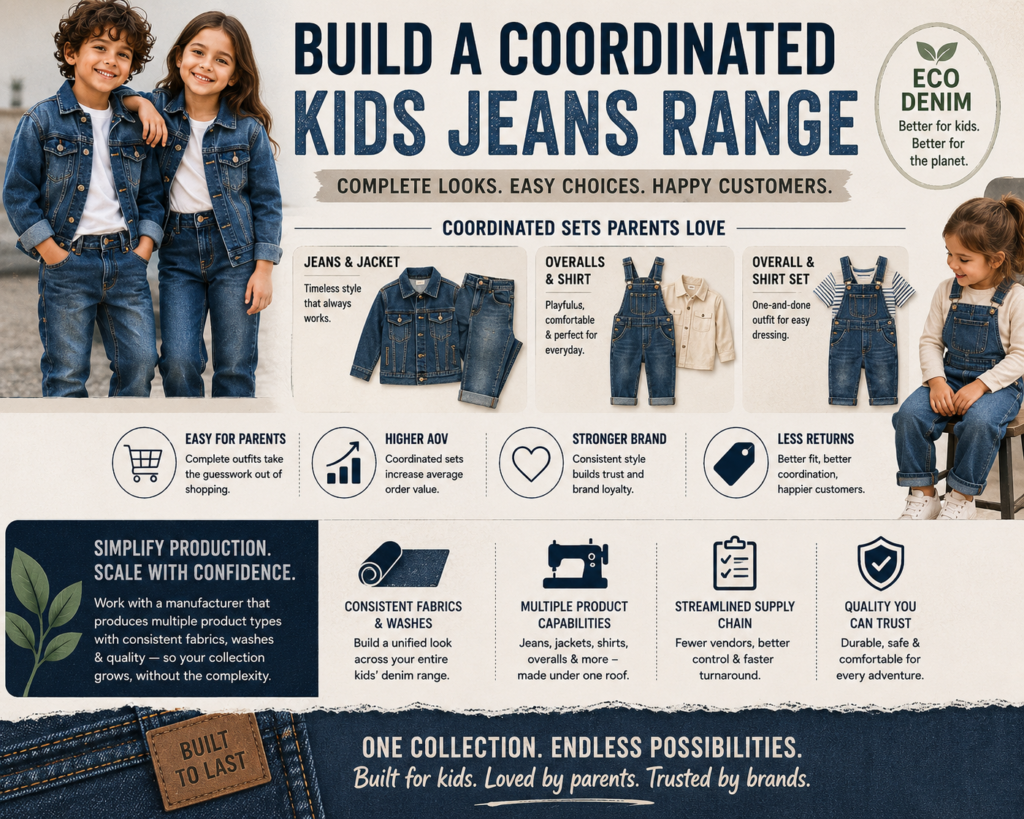
Kids denim collection infographic featuring coordinated denim outfits including jeans, jackets, overalls, and shirts designed to create consistent branding and simplified product ranges.
Coordinated kids denim collections help brands increase customer convenience, strengthen product identity, and maintain consistent quality across multiple apparel categories.

Brands that are most successful in the kids’ denim market are those that focus on coordinated ranges, rather than single products. A set of jeans and jackets. A combination of overalls and a shirt. An overall and shirt combination.

These coordinated propositions make it easy for parents to decide whether or not they want to buy something. They also increase the average order value without adding significant production complexity.

Building these ranges is much easier when you work with a manufacturer that can produce multiple product types using consistent fabrics and washes. This also keeps your supply chain in control as your kids’ denim collection grows.

Conclusion

Kids’ denim clothing includes jackets, jeans, overalls, skirts, shorts, and vests. Understanding Denim Fabric Types for Kids Clothing helps brands choose styles that balance comfort, durability, seasonal appeal, and strong commercial value.

Knowing what each style entails helps brands make better product decisions and create kids denim collections that parents want to purchase.

Find the best production partner to help you develop your kids denim brand.

FAQs

Which types of denim clothing for kids are most popular in the market?

 Jeans, jackets and overalls are consistently the most popular. The overalls are popular with younger children. Skirts, shorts and dresses are popular for the season.

Why are adjustable waistbands necessary for kids’ denim jeans?

 Children grow rapidly and their bodies change significantly between sizes. The adjustable waistbands enable parents to customize the fit of the jeans and prolong the wearable life.

What safety standards apply to denim clothing for kids?

 Hardware should meet the requirements of small parts testing. In many markets, drawstrings in outerwear for children are either restricted or banned. All fastenings should be tested and securely attached.

What’s the difference between denim overalls for kids and overalls for adults?

 Children’s overalls should have practical fastenings to make dressing easier, adjustable shoulder straps that can grow with the child, and constructions that take into account the differences in proportions of the body of the child.

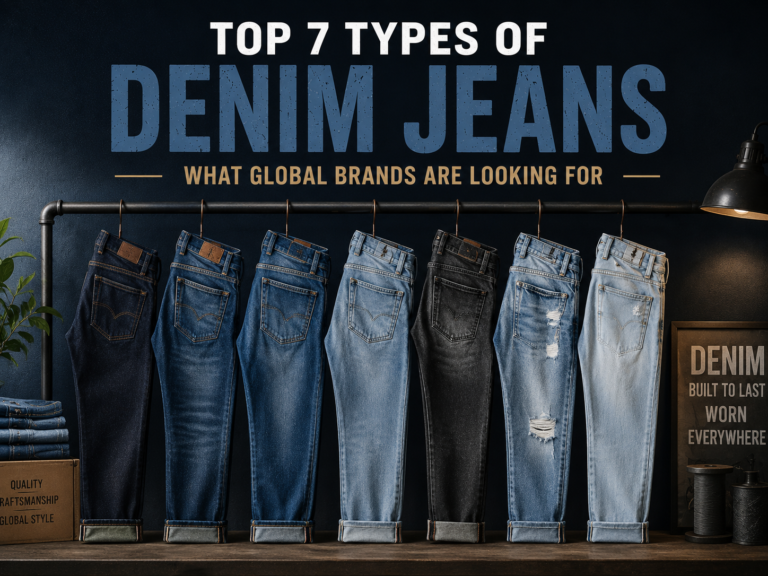
Top 7 Types of Denim Jeans What Global Brands Are Looking For

Denim jeans have remained a consistent category in global fashion for many years. Within that category, however, the styles retailers and brands actually want have changed significantly in recent years.

Some cuts are now back in demand, while others have stayed consistent across global markets. New silhouettes are also creating strong commercial opportunities for brands that stay ahead of trends. Understanding the Top 7 types of denim jeans helps brands identify the most profitable and market-driven styles for modern consumers.

This guide explains the Top 7 types of denim jeans brands seek from global manufacturers and why each style matters. It also highlights key considerations in OEM vs ODM Denim Apparel production, helping brands choose the right manufacturing approach for their denim collections.

1. Straight Leg Jeans

Straight leg jeans are the foundation of nearly every denim collection. The straight leg jean has a constant width from hips to hem, with no taper or flare, giving it a versatile, clean silhouette that can be worn by all body types.

Straight leg jeans are in the middle market. Straight leg jeans are not the most popular trend, but their lack of popularity is exactly what makes them so appealing. They are reliable, sell across seasons and appeal to a wide customer base.

Straight leg denim is the best starting point for brands who are building their own denim collection. denim jean manufacturers who have a strong straight leg experience will give you a solid foundation on which to build your other silhouettes.

2. Slim Fit Jeans

The slim fit jeans are tapered from the thigh down to the ankle. They are closer to the body compared to straight leg jeans, but have more room than skinny jeans. The clean, athletic silhouette they provide has been commercially successful across several trend cycles.

Menswear is a popular choice for slim fit. It offers a well-put together look without the extremes that come with skinny clothing or the casualness associated with relaxed clothing. Slim fit is a good option for women’s clothing, as it offers a middle ground between fitted and loose silhouettes.

Slim fit is a great option for brands that want to appeal to fashion-conscious consumers who are looking for a stylish look without sacrificing their comfort.

3. Wide Leg Jeans

In the last two to three decades, wide leg denim has evolved from a trend to a commercial staple. The loose, open silhouette from hip to hem has been adopted by all age groups and markets in a way few other trend-driven cuts have managed to maintain.

Wide leg jeans cost more per unit than slim or straight styles. To ensure that the wide leg jeans hang correctly in every size, it is important to pay attention to the pattern grading.

Wide leg denim options are sought by global brands from denim clothing manufacturers that know how to consistently produce this silhouette, not just on an occasional sample.

4. Skinny Jeans

The wide-leg trend dominated the market for a while, but skinny jeans have shown a remarkable resilience. They are now gaining popularity in certain demographics and markets.

To move comfortably in such a tight fit, skinny denim needs a high stretch content. This is usually a blend of polyester or elastane with the denim. Stretch recovery is crucial. The brand’s reputation is damaged by a skinny jean with a bagging out knee area after only a few wears.

A manufacturer who has experience in the fabrication and construction of stretch denim knows how to balance compression with recovery, which is at the core of a great skinny jean.

5. Bootcut Jeans

Bootcut jeans have experienced a commercial revival, largely due to the trend towards vintage and 70s fashion. The jeans are fitted close to the thigh, and slightly open at the knee. Originally designed to accommodate boots, they’re now valued for their elongating and balanced silhouette.

Bootcuts are a great opportunity for brands that target womenswear. The bootcut flatters all body types, and can be styled in casual or smart-casual contexts.

Bootcut jeans, when paired with denim shirt and denim jacket in coordinated wash combinations, create a cohesive denim collection that sells well.

6. Relaxed Fit Jeans

The relaxed fit trend has been growing along with the casualwear and comfort first trend, which has transformed apparel retailing since 2020. The relaxed fit gives a more comfortable and lived-in look and feel by allowing for extra room in the seat and thigh without sacrificing the width of the wide leg. This resonates strongly with the lifestyle and streetwear market.

For denim, the relaxed fit is an important product. This silhouette is perfect for oversized tops and layered styling. It’s also a youthful style.

7. Tapered Jeans

The tapered jeans are characterized by a wider opening on the thigh, which is often straight or relaxed through the hip. This widening narrows towards the ankle. The result is a shape that blends comfort on the upper half of the leg with a more structured finish near the hem.

Menswear is a popular place to find tapered denim. It offers a modern alternative to a slim fit without sacrificing the comfort that comes with a relaxed cut. This is a great option for brands that are targeting the workwear and smart-casual market, where comfort and professional finish are both important.

A strong denim clothing manufacturer has pattern grading expertise across all seven silhouettes. They can also advise you on the best cuts for your customer base and price point.

Conclusion

Global brands have a variety of styles in mind when it comes to denim jeans. From straight leg styles, known for their reliable commercial appeal, to trendy wide leg fits and the resilient comeback of bootcut designs, understanding the Top 7 types of denim jeans helps brands make smarter product decisions.

When comparing manufacturing options like OEM vs ODM Denim Apparel, knowing where each denim style fits within the commercial market allows brands to choose the right production strategy, improve product planning, and meet changing fashion demands more effectively.

Find the best production partner to help you develop your denim collection by exploring the full range denim jeans manufacturing possibilities.

FAQs

Which denim jean style is most reliable in terms of sales?

Straight-leg jeans are most consistent — they appeal to a wide range of people, sell throughout the year, and are at the core for most successful denim lines.

Why are wide-leg jeans so popular?

 Wide legs have gone from a trend to a commercial staple, embraced by all age groups and markets because of their comfort and versatility.

How much fabric is needed for skinny jeans?

 The jeans must have a high stretch content, usually elastane blended with polyester to maintain a tight fit and shape recovery.

How are tapered jeans different than slim fit jeans?

 The width of the jeans is typically greater in the hip and thigh, providing more comfort on the upper part. They then narrow down to the ankle. Slim fit is more closely fitted throughout.

How to Build Your Own Streetwear Private Label Denim Brand with Private Label

Streetwear is an emerging and influential fashion movement shaping global trends, and denim remains a key part of that culture. Oversized jackets, distressed jeans, vests, and hoodies make streetwear denim more than clothing — it’s wearable art admired by consumers worldwide. There has never been a better time to start your own Private Label Denim Brand with private label manufacturing, and this guide will show you how.

Define Your Brand Identity Before Anything Else

Every successful streetwear brand starts with a clear identity — not a product. Before you think about fabrics, fits, or manufacturing, get crystal clear on what your brand stands for, who it speaks to, and what visual language it uses.

Ask yourself:

  • What aesthetic does my brand own — raw and distressed, clean and minimalist, bold and graphic, or vintage-inspired?
  • Who is my core customer — age, lifestyle, values, and spending habits?
  • What makes my brand different from the hundreds of other streetwear labels already competing for attention?

Your answers drive every product decision that follows. Without this clarity, even the best manufacturing partner cannot save a brand that doesn’t know what it is.

Choose Private Label Manufacturing From Day One

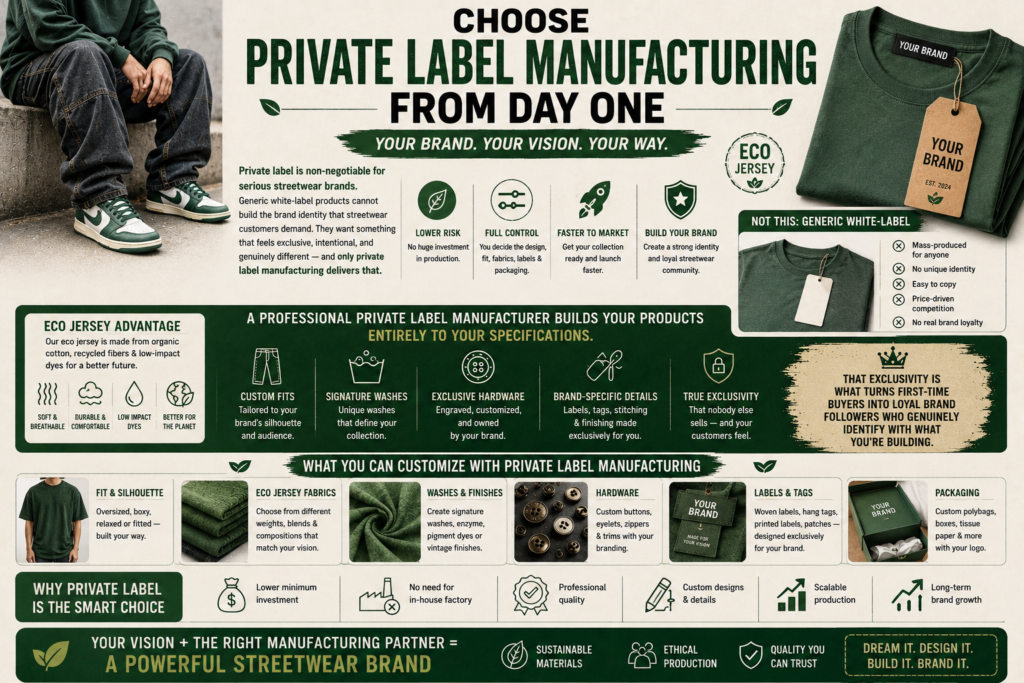
Streetwear denim customization infographic featuring signature washes, custom hardware, stitching details, woven labels, premium packaging, and sustainable private label branding solutions.
Strong streetwear brands build recognizable identity through customized washes, hardware, stitching, labels, and packaging that create a consistent visual signature across every product.

Private label is non-negotiable for serious streetwear brands. Generic white-label products cannot build the brand identity that streetwear customers demand. They want something that feels exclusive, intentional, and genuinely different — and only private label manufacturing delivers that.

A professional private label denim manufacturer builds your products entirely to your specifications — custom fits, signature washes, exclusive hardware, and brand-specific details that nobody else sells. That exclusivity is what turns first-time buyers into loyal brand followers who genuinely identify with what you’re building.

Build Your Core Product Range Strategically

Don’t launch with everything at once. Streetwear brands that launch focused collections build stronger brand identities faster than brands that scatter across too many products simultaneously.

Start with two to three hero pieces that define your aesthetic clearly:

  • Denim jackets are the ultimate streetwear layering piece that photographs powerfully and anchors full outfit looks
  • Denim jeans are the foundation every streetwear customer builds their wardrobe around
  • Denim vests a distinctive, customizable piece that carries strong creative expression and brand personality

Master these three before expanding. Each successful launch teaches you what your customer actually wants — and that knowledge makes every future product development decision significantly smarter.

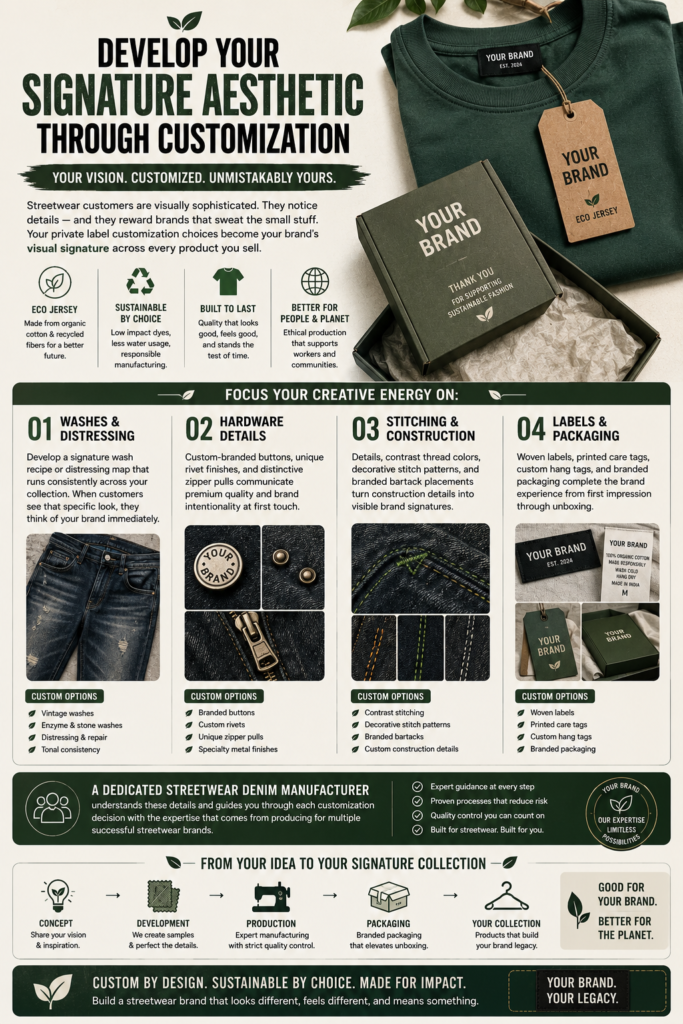
Develop Your Signature Aesthetic Through Customization

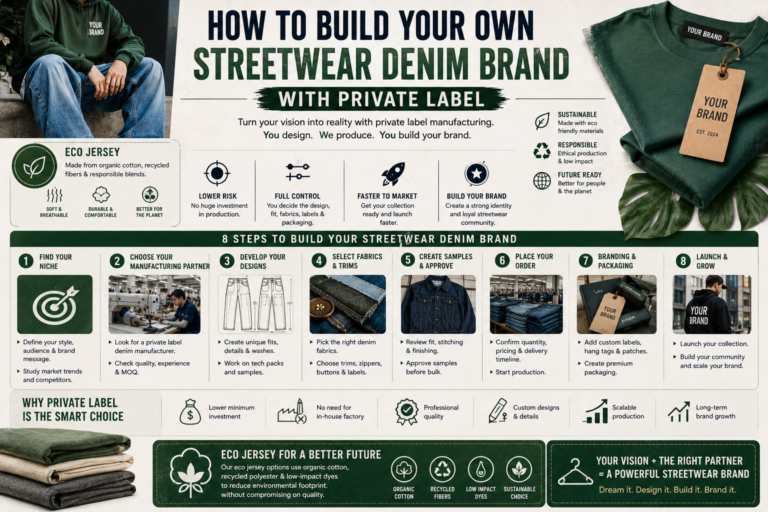
Private label streetwear manufacturing infographic showing exclusive product customization, sustainable apparel branding, premium packaging, and Eco Jersey-inspired private label production solutions.
Private label manufacturing helps streetwear brands create exclusive products, stronger brand identity, and long-term customer loyalty through fully customized apparel production.

Streetwear customers are visually sophisticated. They notice details — and they reward brands that sweat the small stuff. Your private label customization choices become your brand’s visual signature across every product you sell.

Focus your creative energy on:

Washes and distressing develop a signature wash recipe or distressing map that runs consistently across your collection. When customers see that specific look, they think of your brand immediately.

Hardware custom-branded buttons, unique rivet finishes, and distinctive zipper pulls communicate premium quality and brand intentionality at first touch.

Stitching details, contrast thread colors, decorative stitch patterns, and branded bartack placements turn construction details into visible brand signatures.

Labels and packaging, woven labels, printed care tags, custom hang tags, and branded packaging complete the brand experience from first impression through unboxing.

A dedicated streetwear denim manufacturer understands these details and guides you through each customization decision with the expertise that comes from producing for multiple successful streetwear brands.

Expand Your Collection as Revenue Grows

Once your core products gain traction, expand strategically into complementary categories that serve the same customer naturally. Streetwear customers rarely buy just one piece — they build full looks and return for new drops regularly.

Natural expansion categories include:

Each expansion deepens your customer relationship and increases average order value — two of the most important commercial metrics for growing streetwear brands.

Work With a Manufacturing Partner Who Grows With You

The right manufacturing partner does more than produce your current collection. They actively support your brand’s growth offering flexible MOQs for new product testing, fast turnaround on small reorder quantities, and genuine expertise across the full denim apparel production spectrum.

As your brand scales from hundreds of pieces to thousands, your manufacturing partner should scale seamlessly alongside you maintaining the same quality standards, communication levels, and creative flexibility that made your first collection successful.

Conclusion

Building your own streetwear denim brand with private label manufacturing is absolutely achievable — even for brands starting small. Define your identity clearly, commit to a private label from the beginning, launch with focused hero products, develop a signature aesthetic through customization, and expand strategically as your customer base grows. The brands winning in streetwear denim today didn’t get there by accident — they built intentionally, partnered smartly, and stayed true to what made them different from day one.

FAQs

How much investment do I need to start a private label streetwear denim brand?

Starting budgets vary widely, but many brands launch successfully with investment covering sampling costs, initial MOQ production, branding, and basic marketing — often starting from a few thousand dollars upward.

How many pieces should I order for my first private label streetwear collection?

Start conservatively — 50 to 150 pieces per style allows you to test market response without overcommitting budget before you understand exactly what your customers want.

How do I protect my streetwear denim designs from being copied by competitors?

Work with manufacturers who sign NDAs, register distinctive design elements where possible, and build brand identity around details and aesthetics that are genuinely difficult to replicate without your specific manufacturing relationship.

How long does it take to launch a private label streetwear denim collection from scratch?

From initial brand development through manufacturing and delivery, most brands realistically plan for four to six months from concept to first product launch — allowing proper time for sampling, revisions, and production.

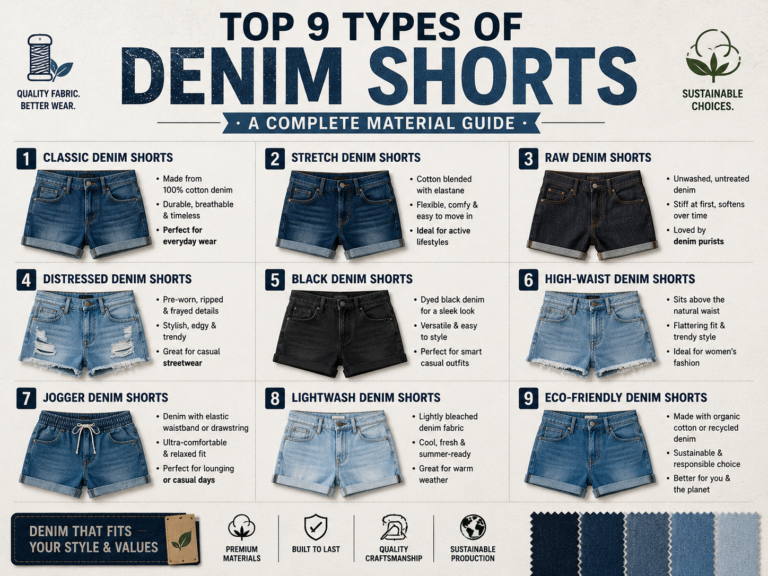
Top 9 Types of Denim Shorts: A Complete Material Guide

The denim shorts will never go out of style. They are a wardrobe staple that never goes out of style. Not all denims shorts are created equal. Cuts, materials, and lengths are all different and serve entirely different purposes and customers. Understanding the denim materials and the 9 most popular types of shorts will help your brand create a line that is truly functional.

Classic Cut-Off Shorts

The cut-off shorts look relaxed and casual. The frayed, unfinished hem gives the shorts that lived-in look. For cut-offs, manufacturers use denim that is 10-12 oz in weight. This fabric is heavy enough to fray without the fabric falling apart when washed.

This style suits lifestyle and casual fashion brands targeting summer and resort wear markets. A professional denim shorts manufacturer controls fray length and distressing consistently across bulk production — ensuring every pair looks intentional rather than accidental.

High-Waisted Denim Shorts

Shorts with a high waist sit above or at the natural waist, creating a defined shape that flatters all body types. The style is equally at home in casual, vintage, or fashion forward aesthetics.

High-waisted denim styles are best suited to stretch denim, which is typically a blend of 95% cotton and 5% elastane. This added stretch allows for a higher rise without hindering your movement.

Bermuda Denim Shorts

Bermuda shorts are cut just below or above the knee, providing more coverage and a summery feel than regular shorts. These shorts are perfect for conservative markets and work-casual clothing. They also suit older women who prefer modesty and comfort with casual style.

The mid-weight denim, in 12 to 14 oz weights is ideal for Bermuda styles. It provides the necessary structure to maintain a neat and tailored look at long lengths.

Distressed Denim Shorts

The fabric is distressed with strategically placed rips and tears. They are also faded. This deliberate destruction creates an edgy, bold aesthetic, which is popular in the youth fashion, festival, and streetwear markets.

Achieving consistent distressing across bulk production requires skilled manufacturing. Brands building streetwear denim collections rely on experienced manufacturers who control distressing placement precisely — so every pair looks intentionally styled rather than randomly damaged.

Tailored Denim Shorts

Denim shorts are given structure and shine with tailored shorts. The clean hems and precise cuts combined with minimal distressing give a casual-smart look that can easily transition from the day to night. These suits fashion-forward markets, including brands that target elevated casual clothing.

Denim that is heavier — between 12 and 14 oz — will work best with tailored styles. Weight provides structure and body to the tailored silhouette, allowing it to maintain its clean shape throughout the day.

Wide Leg Denim Shorts

Wide leg shorts feature a relaxed, voluminous cut through the thigh and leg opening — creating a bold, fashion-forward silhouette that is trending strongly right now. They pair naturally with fitted tops and platform shoes for that balanced proportion contemporary fashion customers love.

Softer denim fabrics — including lightweight chambray blends — work better for wide leg styles because they allow the fabric to drape naturally rather than standing stiffly away from the body.

Cargo Denim Shorts

Cargo shorts add utility pockets to the classic denim short — creating a functional, rugged aesthetic that appeals to outdoor, workwear, and streetwear markets simultaneously. Multiple pockets, D-ring hardware, and relaxed fits define this style.

Heavyweight rigid denim in 12 to 14 oz suits cargo styles perfectly — providing the durability and structure that makes the additional pocket hardware sit flat and function properly through extended everyday use.

Kids Denim Shorts

Kids denim shorts require specific material considerations that adult styles don’t. Softness, durability, and safety come first. Lightweight stretch denim — typically 8 to 10 oz with elastane content — suits children’s shorts because it moves freely with active young bodies without causing skin irritation.

A specialist kids denim manufacturer understands these requirements thoroughly — delivering shorts that parents trust for comfort and brands trust for quality consistency across size ranges.

Embellished Denim Shorts

Embellished shorts add decorative details — embroidery, studs, patches, lace trim, or printed panels — directly onto the denim surface. They target fashion-conscious customers who want individuality and creative expression rather than classic denim simplicity.

This style suits private label denim brands building distinctive collections that stand apart from generic wholesale alternatives. Custom embellishments become genuine brand signatures that customers recognize and seek out repeatedly.

Choosing the Right Material for Your Denim Shorts Collection

Across all nine styles, material choice defines how the final product looks, feels, and performs:

  • Rigid denim — classic structure, strong fade potential, suits cut-offs and tailored styles
  • Stretch denim — comfort and flexibility, suits high-waisted and fitted cuts
  • Lightweight chambray — breathable and soft, suits wide leg and casual summer styles
  • Heavyweight denim — durability and body, suits cargo and tailored structured styles

Working with a trusted denim apparel manufacturer ensures the right fabric weight, composition, and finish for every short style in your collection — so each product performs exactly as your customers expect from first wear through hundreds of washes.

Conclusion

The top 9 types of denim shorts each serve a distinct customer, occasion, and market segment. From raw cut-offs to polished tailored styles — understanding both the cut and the material behind each type lets your brand build smarter, stronger collections. Cover the right styles, choose the right fabrics, and partner with the right manufacturer — and your denim shorts range becomes one of the most reliable seasonal performers your brand produces.

FAQs

What weight denim suits the most popular shorts styles best?

The majority of styles can be made with mid-weight denim, between 10-12 oz. This weight provides enough structure to retain shape and comfort in hot weather.

Should denim shorts include stretch fabric?

Yes, for high-waisted styles, kids’ styles, and fitted styles. Small elastane increases comfort without altering the visual appeal of denim

Can all nine denim shorts styles be produced under a private label?

Absolutely. You can customize all styles with your own private label, including embellishments, hardware, custom distressings, embroideries and labels.

Which denim shorts style sells best across global markets?

The classic cutoffs and the high-waisted style consistently perform better than other styles globally. Their appeal to a wide range of demographics, and their styling versatility drive strong and reliable seasonal demand.

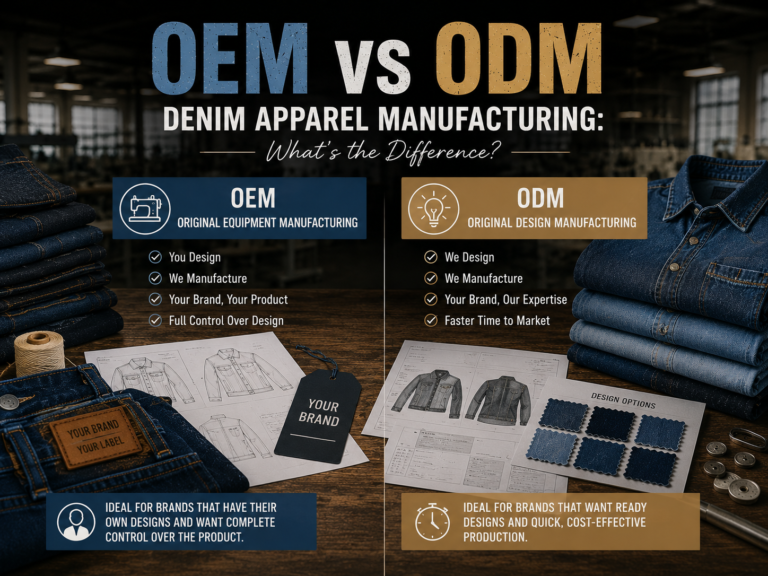
OEM vs ODM Denim Apparel Manufacturing: What’s the Difference?

If you’ve researched denim manufacturing, you’ve likely come across OEM vs ODM Denim Apparel. Some factories use these terms interchangeably, which can create confusion for brands trying to understand what services are actually being offered.

However, OEM and ODM are two very different manufacturing models, and choosing the wrong one can cost both time and money.

This guide explains the difference between OEM vs ODM Denim Apparel so you can make informed decisions when selecting the right manufacturer for your next denim collection.

What is OEM Denim Manufacturing?

Original Equipment Manufacturer is the acronym for Original Equipment Manufacturer. OEM in denim clothing means that you, the brand, provide the design. You provide the specs, the tech pack and fabric directions, as well as the construction requirements. It is the manufacturer’s responsibility to produce your design consistently and accurately.

You are responsible for every detail. Your team will define the silhouette, wash, hardware, fit, and other details. The factory will then execute them. The factory contributes only production capabilities, not creative input.

OEM is the best model for brands that have a clearly defined product vision, in-house design capabilities or freelance designers, and technical expertise to fully specify a garment. This gives you full ownership and differentiation, but requires more upfront preparation.

What is ODM Denim Manufacturing?

ODM is the acronym for Original Design Maker. ODM in denim clothing means that the manufacturer has already developed a variety of styles. You then choose from these existing designs, add your branding, and take them to market.

Design work is already done. The samples are ready, and there are already patterns. By customising the hardware, packaging, and labelling, you can make your product unique.

ODMs are the best option for brands that want to move fast, do not have the in-house design capabilities, or want to test the market before investing in custom denim development.

denim private label manufacturer often operates on an ODM model — providing a variety of denim styles that brands can customize and brand.

The Differences in Key Terms

The difference is simple in OEM vs ODM Denim Apparel manufacturing. In OEM, you create the design and the factory produces it. In ODM, the factory creates the design, and you apply your branding.

This distinction shapes the entire production process. OEM allows brands to develop unique denim apparel that cannot be duplicated because the design is original. ODM offers speed and convenience, but the base denim designs may also be used by other brands working with the same manufacturer.

OEM production usually requires a longer lead time because design development, tech packs, and multiple sampling stages are completed before manufacturing begins. ODM denim apparel can reach the market much faster—sometimes within weeks after selecting a style and confirming branding.

What model suits different types of denim products?

Within a denim line, the choice between OEM or ODM can vary by product category.

OEM is often preferred for denim Jeans, where fit is the key factor and brands have specific requirements on silhouette. Fit is an important brand differentiator. To get it right, a custom-developed process is required.

ODM is a great option for denim shirts or denim vests. ODM can be a great option for these styles because they are less fit-critical. Custom branding and washing combined with an ODM base design can create a unique product without investing in OEM development.

ODM is often preferred for kids’ jeans — especially by brands new to the category. The established size ranges and tried-and-tested constructions help reduce the likelihood of fit problems, which are especially problematic for children’s clothing.

Can you use both models together?

Many successful denim brands have done so. It is common to use ODM for seasonal or entry-level styles, while OEM is used for hero pieces.

The brand can benefit from the commercial flexibility and speed of ODM, while also retaining the ownership and differentiation of OEM. The ODM products fill out the range, generating revenue. Meanwhile, the OEM pieces – which take longer to create – become the brand’s signature pieces.

The ability to expand their product range without having to change production partners is possible with a denim jacket or a full-range factory that supports both models.

You can ask any manufacturer about their model

Be sure to ask which denim model the manufacturer uses and how flexible they are.

Some factories claim to be OEMs, but prefer to steer brands towards their own designs. Some factories claim ODM capabilities, but their sample range is limited or outdated and doesn’t reflect the current market trends.A

streetwear manufacturer who has genuine OEM capabilities will be able to work from your tech package and produce a prototype that accurately reflects the design you have created — not just a modified version. A strong ODM range will include current samples with high-quality finishes that reflect a genuine understanding of the market.

Here are some key questions you should ask:

  • You can use brand tech packs to help you guide your design or you can work with the original designs.
  • How current is your sample range?
  • Can you support both OEMs and ODMs within the same brand?
  • How can you protect the intellectual property of OEM designs?
  • How much is the minimum quantity to order for each model?

Conclusion

The OEM vs ODM Denim Apparel decision is not about which model is better, but which fits your brand’s current needs. OEM gives you customization, differentiation, and ownership, but requires more preparation, development time, and investment. ODM offers faster production and a simpler process, but with less uniqueness and flexibility.

Understand where your brand stands, choose accordingly, and work with a manufacturer that can support both OEM and ODM as your denim apparel business grows.

Explore the entire range of denim clothing manufacturing and find the best fit for your production needs.

FAQs

What is OEM in denim manufacturing? 

OEM means Original Equipment Manufacturer – the brand provides the design, and the factory manufactures it. The brand has created the product.

What is Original Design Manufacturer in denim manufacturing? 

The factory already has designs that brands can select, brand, and market as their own.

Which model will be faster to market?

 ODM, because the design is already in place, and sampling is minimal. OEM requires a full design and multiple rounds of sampling before production can begin.

What is the best way to protect my OEM design from a manufacturer? 

Sign a nondisclosure contract before you share design files or tech packs. Before any development work starts, discuss intellectual property terms.

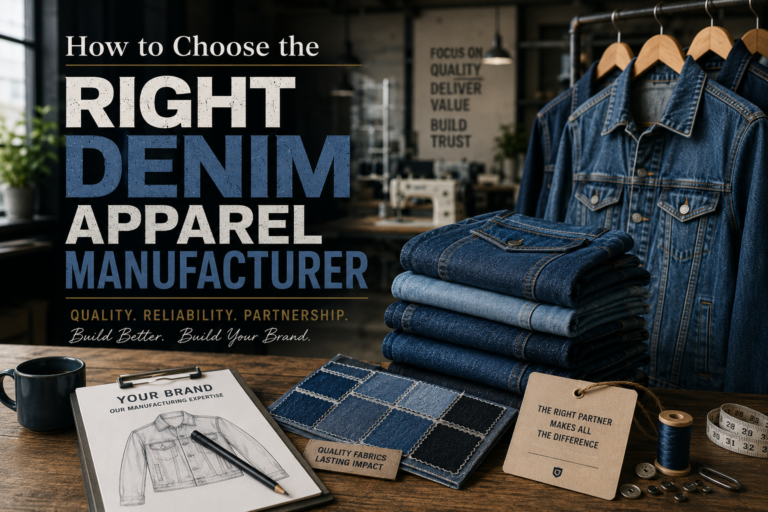
How to Choose the Right Denim Apparel Manufacturer

It is easy to find a denim producer. Finding the best one is another story. A denim apparel manufacturer is considered a specialty category. Fabrics behave differently from standard clothing materials. The finishing and washing processes are more complicated. The quality indicators — stitching, hardware, and wash consistency — are more complex.

This guide will help you determine what you should look for in a manufacturer of denim clothing before you make a decision.

Why Denim Manufacturing is a Specialty Category

Denim is not understood by every apparel manufacturer. A company that produces t-shirts, hoodies and sweatshirts operates in a different environment than one that makes stretch denim jackets or selvedge jeans.

Denim is heavy. Denim is heavy. It requires industrial machines that can handle the fabric without any skipped stitches or broken needles. It fades and shrinks in a way that needs to be precisely controlled. Finishing processes like stonewashing and sandblasting require specialized equipment, as well as expertise, that are not available in general apparel factories.

It is for this reason that category experience is the primary filter. Check that the factory is a specialist in denim before evaluating its price, capacity or location.

Know Your Product Before You Search

A manufacturer of denim jeans will operate differently from a factory that produces denim jackets or overalls. A denim jeans manufacturer will operate differently than a factory that specializes in denim jackets or overalls. Construction requirements, machinery required, and finishing expertise differ significantly between denim products.

Before you contact any manufacturers, know your fabric weight, wash finish, hardware specifications and target price. These details will determine which factories you should approach.

Evaluate Washing and Finishing Capability

Denim takes on its final character during washing and finishing. This is also where the most variation in quality occurs. Washing can make all the difference between a good pair of jeans and one that is mediocre.

Ask each manufacturer to describe their washing capabilities. Are they able to produce vintage finishes, acid washes and stone washes? They have their own facility for washing or outsource it? Who controls the quality of washing if it is outsourced?

You can control the finish more closely with a denim clothing manufacturer that has in-house wash capability. This also means you have fewer points of failure in your supply chains.

Check Fabric Sourcing and Denim Quality

Everything downstream is determined by the denim fabric. The weight, stretch content and weave structure of the denim fabric, as well as its shrinkage rate, all influence how the final garment fits and looks.

You can ask manufacturers about the fabric they use. Where is the denim sourced? What are the weights they use? Are they able to source denim in different weights, such as stretch, rigid, selvedge, or sustainable? It’s better to choose a manufacturer who has strong relationships with fabric suppliers than one that will accept whatever you request.

Access to specialist or premium denim fabrics is a real competitive advantage for brands that are interested in Streetwear Denim and fashion-forward collections.

Assess Hardware and Trim Quality

Hardware is very visible in denim. All the hardware is visible, including buttons, zippers and rivets.

YKK zippers set the standard. Copper rivets must be solid, not hollow. Buttons must be able to fasten and unfasten without any wobble. All hardware should be the same across all units in a run – same finish, weight and placement.

A serious hardware manufacturer will have a list of suppliers and be open to discussing their specifications. A manufacturer who is vague on hardware sourcing will give you valuable information about the quality of their products.

Confirm Private Label and Custom Options

Many denim brands begin with a private label and then move on to fully customized production. If you confirm that a manufacturer offers both options, it gives you more flexibility as your brand expands.

You can enter the market faster by working with a denim manufacturer that has a solid base range. You can apply your branding to existing styles and develop custom pieces simultaneously. It is possible to switch from private label to customized with the same factory, keeping your supply chain simple.

Sample Rigorously Before Committing

Samples are always recommended before committing to bulk production. After washing, denim behaves in a different way — the measurements will change, colors may shift, and the fabric texture will transform. A sample that isn’t fully washed and finished will not be a good indicator of the bulk product.

Before approving a denim style, request a sample that is fully finished — washed and finished, pressed and labelled. After washing, measure the denim. Check the color. Check the hardware. Wear it, if possible.

Check these key points on each denim sample.

  • Measurements after washing against your size specification
  • Colour consistency with approved wash standards
  • The quality of the stitching and thread tension is consistent throughout
  • Hardware finish and function quality
  • Label placement and brand execution

Conclusion

It takes more than just finding a factory to stitch denim before you can choose the best denim apparel manufacturer. Finding a partner that understands your category — fabric, washing, hardware and finishing — is key.

Spend the time necessary to properly evaluate. Sample rigorously. Choose based on the demonstrated ability.

Explore the options for denim clothing manufacturing and find the best partner to help you grow your brand.

FAQs

How is denim different from other apparel?

Denim production requires specialized machinery, washing and finishing equipment and expertise in shrinkage control.

Is it better to choose a manufacturer that has in-house washers? 

When possible, yes. You can control the quality of your finished product better by washing it in-house.

What quality hardware can I expect from premium denim jeans? 

Solid copper rivets and YKK zippers are among the most important indicators of quality.

Can i start with private label before I go custom? 

Of course. Private label is a popular way for brands to quickly enter the market and then transition to custom production after they’ve validated customer demand and preferences.