Home Blog Page 16

Why the Global Islamic Fashion Market Is a Golden Opportunity for New Retailers & Brand Owners

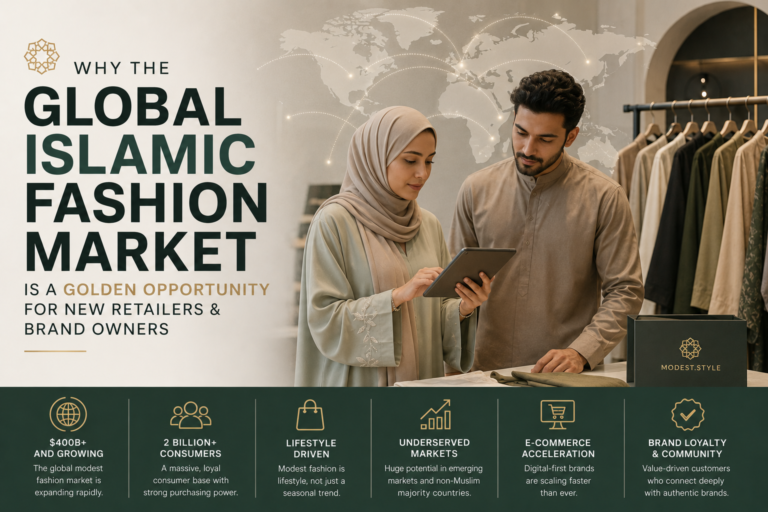
Some market opportunities come around once in a generation. The global Islamic fashion market is one of them. With hundreds of millions of Muslim consumers worldwide actively seeking stylish, high-quality modest clothing — and mainstream fashion consistently failing to serve them adequately — the gap between demand and supply represents one of the most significant commercial opportunities available to new retailers and brand owners today.

The Numbers Behind the Opportunity

The global Islamic fashion market generates hundreds of billions of dollars annually — and it continues growing faster than most mainstream fashion segments. The global Muslim population exceeds 1.8 billion people. A significant proportion of that population actively purchases modest clothing across casualwear, occasionwear, streetwear, activewear, and professional wear categories simultaneously.

These consumers are young, digitally connected, fashion-conscious, and chronically underserved by mainstream fashion brands that treat modest dressing as an afterthought rather than a genuine market priority. That underservice is precisely where commercial opportunity lives for new brand owners willing to enter with authentic commitment and genuine product quality.

Why Mainstream Fashion Keeps Failing This Market

Despite the market size, mainstream fashion brands consistently fall short in Islamic fashion. The reasons are revealing and they highlight exactly where new brands can win.

Generic modest adaptations feel inauthentic. When mainstream brands simply add sleeves to existing designs or drop hemlines without rethinking silhouette and construction, Muslim consumers recognize the lack of genuine commitment immediately and respond by supporting brands that actually understand their needs.

Regional and cultural nuance gets ignored. The global Islamic fashion market spans dozens of cultures, geographies, and interpretive traditions each with distinct preferences around silhouette, color, occasion, and coverage standards. Brands that treat all Muslim consumers identically consistently miss the mark across every market they attempt to serve.

Quality and modesty standards conflict. Many mainstream manufacturers lack the specific expertise needed to produce garments that are simultaneously modest, contemporary, and genuinely well-made. Fabric opacity testing, coverage-conscious pattern making, and modest movement testing require specialized knowledge that general apparel factories don’t automatically possess.

The Segments Driving Strongest Growth

New retailers entering this market find commercial opportunity across multiple product segments — each serving a distinct Muslim consumer need.

Modest Streetwear The fastest-growing Islamic fashion segment globally. Young Muslim consumers in Western markets — UK, USA, Europe, Australia are building personal style identities that combine contemporary streetwear aesthetics with full modest coverage. Longline hoodies, wide-leg joggers, and modest co-ord sets all perform strongly in this segment.

Modest Casualwear Daily modest dressing represents the highest volume purchase frequency in Islamic fashion. Muslim consumers buy modest casualwear constantly for work, family life, social occasions, and everyday movement. A reliable casual wear range built around genuine modest standards serves this consistent, repeatable demand effectively.

Modest Occasionwear Eid, weddings, religious celebrations, and formal social events create strong seasonal demand spikes for modest occasionwear. Brands that serve this segment well build intensely loyal customer bases because finding genuinely beautiful, appropriately modest occasion pieces remains genuinely difficult for most Muslim consumers in most markets.

Modest Activewear Muslim women who exercise, practice sports, or maintain active lifestyles need performance clothing that maintains full coverage during movement. This segment is significantly underserved representing a genuine white space opportunity for brands willing to develop technically sound modest activewear with proper coverage performance testing.

How to Enter This Market Successfully

Entering the global Islamic fashion market successfully requires more than good intentions and modest-length garments. It requires genuine commitment across product development, cultural understanding, and manufacturing expertise.

Choose one segment and serve it deeply. New brands that try to cover the full spectrum from abayas to modest activewear simultaneously typically serve no segment particularly well. Pick one consumer need, understand it thoroughly, and build products that genuinely solve it better than existing options.

Work with specialist manufacturing partners. General apparel factories without Islamic fashion expertise produce technically modest garments that still fail Muslim consumers — through inadequate fabric opacity, poor coverage during movement, or culturally inappropriate design choices. A dedicated Islamic fashionwear manufacturer brings the specific expertise this market requires.

Build with cultural authenticity. Muslim consumers recognize and reward brands that approach their market with genuine respect and cultural understanding — and they quickly identify and reject brands that treat Islamic fashion as a trend opportunity rather than a genuine service commitment.

Expand strategically as you grow. Once your initial segment gains traction, expand naturally into complementary categories. A modest streetwear brand adds tracksuits and fashion jackets. A modest casualwear brand expands into knitwear and coordinated sets. Each expansion deepens your customer relationship and increases lifetime customer value across your growing brand.

Working with a trusted fashionwear manufacturer who understands both modest fashion requirements and global production standards makes every stage of that expansion faster, more reliable, and more commercially successful.

Conclusion

The global Islamic fashion market represents a genuine golden opportunity — not because it’s fashionable to say so, but because the commercial fundamentals are undeniably strong. Massive consumer population. Strong purchasing power. Chronic underservice from mainstream fashion. Growing digital commerce infrastructure. Increasing consumer sophistication and demand for quality. New retailers and brand owners who enter this market with authentic commitment, genuine product quality, and the right manufacturing expertise don’t just find customers — they build loyal brand communities that sustain commercial success across years and decades rather than just seasonal trend cycles.

FAQs

How large is the global Islamic fashion market currently?

The global Islamic fashion market generates hundreds of billions of dollars annually and continues growing faster than most mainstream fashion segments — driven by a young, digitally connected, and chronically underserved Muslim consumer population worldwide.

Which geographic markets offer the strongest opportunity for new Islamic fashion brands?

Which geographic markets offer the strongest opportunity for new Islamic fashion brands?

Do I need specific manufacturing expertise to produce Islamic fashion collections?

Yes. Fabric opacity testing, coverage-conscious pattern making, and modest movement performance testing require specialized manufacturing knowledge that general apparel factories typically lack — making specialist modest fashion manufacturing partnerships essential for product quality and brand credibility.

Is modest streetwear a sustainable long-term market or just a passing trend?

Modest streetwear reflects a deep identity-driven consumer movement among young Muslim consumers globally — not a passing fashion trend. Its growth is sustained by cultural identity, community values, and genuine consumer demand rather than seasonal fashion
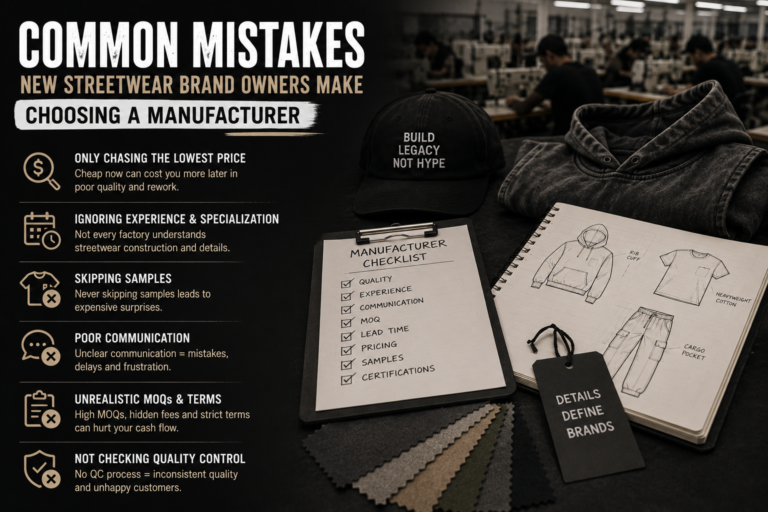
Common Mistakes New Streetwear Brand Owners Make – Choosing a Manufacturer

One major reason why a lot of new businesses in the streetwear market fail is that they struggle with their manufacturing partners. While streetwear markets are competent, the success of a brand is dependent on the right choice of manufacturing partners who can balance all three standards of quality, consistency, and manufacturing capacity.

When streetwear brand make mistakes choosing manufacturer, it is usually because new streetwear brand owners are solely focused on price and not on the other three factors of quality, communication, and production capacity. This results in multiple challenges for the new brand including delays, unsatisfactory standards in products, and poor brand values. Many businesses explore structured production systems through Fashionwear Manufacturer to understand how professional apparel development actually works.

Why Choosing the Right Manufacturer Matters

Choosing a good manufacturer is essential for success at any streetwear brand. Bad manufacturing decisions lead to inconsistent sizing, weak stitching, and poor fabric quality.

These issues remove customer confidence and stifle brand growth. That is why many successful businesses rely on experienced suppliers such as Streetwear Manufacturer to maintain quality and production stability across all orders.

Common Streetwear Brand Make Mistakes choosing manufacturer

Focusing Only on Low Price

Picking a manufacturer based on low cost is a big mistake new brands make. Buyers do need to be cost conscious. However, looking for a cheaper option almost always backfires. When a manufacturer is that cheap, they cut costs on quality of fabric and stitching. A brand will be better off spending a little more, saving their stitching and fabric quality. Without that, their reputation will be impacted.

Ignoring Sample Testing

A mistake that many new brands make is forgoing samples, which is something that should never be done. If brands do not sample, fabrics can be structurally weak, fit can be completely off and stitching can be horrible before mass production.

Poor Communication with Manufacturers

Communication is of utmost importance in production. Startups tend to offer vague tech packs. Many incorporate little to no measurements or design specifications. In providing little to no detail, errors become inevitable.

How to Avoid Streetwear Brand Make Mistakes choosing manufacturer

Work with Experienced Production Partners

Choosing experienced manufacturers helps reduce risk and improve product consistency. Many brands prefer working with Fashion Jacket Manufacturer for structured production and reliable quality control.

Always Approve Samples Before Bulk Orders

Sampling confirms that the finished product meets your requirements. It allows companies to assess quality, sizing, and fabric performance without committing to bulk production.

  • Working with a verified manufacturer and following a proper sampling process helps brands avoid costly production errors and ensures long-term product consistency.

Plan Your Budget and Production Strategy

A budget helps keep costs in check. Brands with early budget planning scale faster and control quality and pricing better.

Expanding Beyond Basic Manufacturing Choices

Successful streetwear brands do not depend on a limited selection of products. To establish a dominant position in the market, they cover the spectrum from hoodies, to tees, to joggers, to entire collections.

Many businesses scale production through Hoodies Manufacturer to create winter collections, while others use T-Shirts Manufacturer to build everyday essentials.

Conclusion

The streetwear brand make mistakes choosing manufacturer process makes clear that design and manufacturing go hand in hand. Pick a bad supplier and you end up with a failed product.

Brands that emphasize communication, sampling, and worked manufacturing partners create scalable, successful, and profitable streetwear businesses.

FAQs

What is the worst thing you can do when picking a manufacturer?

Prioritizing the lowest price over quality and their ability to produce.

What is the sampling process in manufacturing?

It allows for the testing of the fabric, stitching, and overall fit before the main production run begins.

What should I pay attention to when selecting a streetwear manufacturer?

You should take into account their level of experience, their consistency of quality, their ability to communicate, and their capacity of production.

Are smaller brands allowed to collaborate with licensed professionals, such as manufacturers, who can produce mass production?

There are many manufacturers that help to accommodate small brands in the beginning with flexible scaling of production.

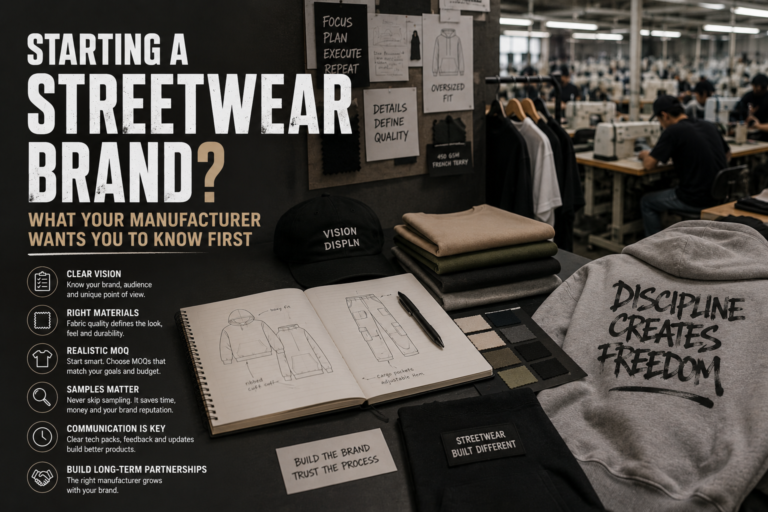
Starting a Streetwear Brand? What Your Manufacturer Wants You to Know First

Opening a streetwear brand is popular as more fashion startups step into the quickly expanding urban fashion industry. Streetwear has developed from simple comfortable clothing to a global fashionable identity.

Design ideas alone will not be enough to starting a streetwear brand. One must know the different steps in the process, quality of fabric, the time it will take to produce, and most importantly the demand in the market. Many new brands explore structured production systems through Fashionwear Manufacturer to understand how full clothing collections are developed before launching.

Why Starting a Streetwear Brand Requires Manufacturing Knowledge

When starting a streetwear brand most beginners place most of their emphasis on design. While that is important, a large portion of your brand’s success will come from manufacturing. An understanding of manufacturing creates successful brands. New brands often struggle with delays, quality issues, and high costs. These issues stem from lack of an understanding about production, fabric selection, and large order processes.

With enough knowledge regarding manufacturing, you’ll be able to navigate your way through all of the suppliers and create a product that stays true to your brand. This will also help ensure that your visions don’t stray from what your final product looks like. This is why working with experienced manufacturers such as Streetwear Manufacturer can make the entire process smoother and more reliable.

Starting a Streetwear Brand: What Manufacturers Expect

Clear Design Direction and Tech Packs

Before commencing production, manufacturers expect unambiguous guidelines. In the case of starting a streetwear brand, less confusion manifests and sampling accuracy is enhanced with the provision of intricate tech packs, sketches, and fabric references.

Realistic Budget and Order Planning

Having a realistic budget is a crucial factor in launching your own streetwear brand. Manufacturers like to partner with brands that know about the Minimum Order Quantity (MOQ), know their costs for scaling, and know how to budget for that scaling. This kind of understanding helps with collaborative planning and overall brand/ company goals.

Fabric Selection and Quality Standards

Streetwear production is highly dependent on the choice of fabric. Manufacturers use different fabrics for different styles and types of products. The right fabric for a collection is of high quality and provides a high level of comfort to the customer. Additionally, a durable fabric collection has higher chances of being accepted in the market.

Sampling Before Bulk Production

Sampling is vital for every production process. Businesses may evaluate their designs for production accuracy, stitching consistency, fabric performance, etc. before mass production. This decreases the risk associated with each process, improving the quality of the final product.

Building a Strong Streetwear Product Range

Successful streetwear labels understand that product variety matters, so they offer an extensive range of hoodies, t-shirts, joggers, jackets, and co-ord sets. This also allows them to appeal to different customer segments.

  • Expanding product categories helps brands build a complete and consistent streetwear identity while increasing customer reach and overall sales potential.

Many brands expand their collections through Hoodies Manufacturer to create strong winter and casual wear lines, while others use T-Shirts Manufacturer to build everyday essential collections.

Common Mistakes When Starting a Streetwear Brand

Many new brands cannot be sustainable and successful in manufacturing due to a lack of understanding of various production elements. Poor fabric selection, lack of communication with manufacturers, and overstated price expectations can result in many production and quality issues.

If new brands can identify key production issues before launching their brand, to be successful over a long period of time can be financially viable.

Conclusion

To start a streetwear brand, one must balance creativity and technical knowledge. Fabric manufacture and production planning are as equally important as design.

The right manufacturer partnered with a branded, organized development process, facilitates a scalable, and profitable streetwear label.

FAQs

What is the first step in Starting a Streetwear Brand?

Take the time to sketch a variety of concepts while preparing to determine the best fabric and size to meet market demand.

Do I need a manufacturer to start a streetwear brand?

Definitely. Without a manufacturer it is impossible to sample an idea, create a production run, and maintain the integrity of streetwear.

What fabrics are best for streetwear brands?

Most streetwear begins construction using cotton, fleece, denim, or any combination of the three.

How much investment is needed for starting a streetwear brand?

That will depend on the complexity of the design, how many orders you plan to place, and how many items you intend to sell.

Can small brands compete in streetwear fashion?

Certainly! If a small brand can set a design apart from the rest while maintaining quality, they can attain serious growth.

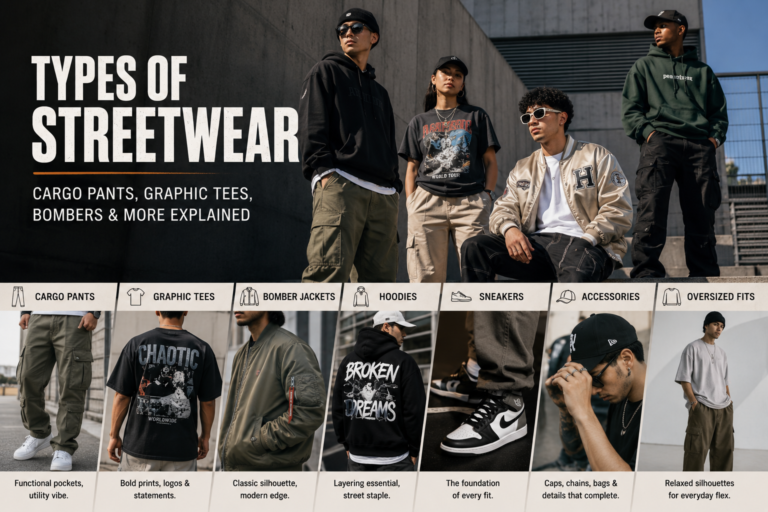
Types of Streetwear : Cargo Pants, Graphic Tees, Bombers & More Explained

Different Types of streetwear help fashion startups and retailers to understand how contemporary urban fashion is designed and its importance in the modern clothing market. Streetwear transcended its initial stage to become the global fashion system influenced by contemporary youth culture, music, and lifestyle.

Additionally, different kinds of streetwear show how individual styles like hoodies, joggers, cargo pants, and graphic tees form a complete collection. Today’s brands are concerned with comfort, creativity, and quality manufacturing in order to thrive in this rapidly developing sector.

Why Types of Streetwear Matter in Modern Fashion

Identifying the different categories of streetwear allows one to recognize the intention behind the specific design and the target customer of that design. Urged by the market demand for utility aesthetics are cargo pants, creativity and self-expression are represented by graphic t-shirts, and a street style premium is captured by bomber jackets.

Today’s consumers want comfort in their clothing, but also want their wardrobe choices to represent their individuality. Because of this, streetwear has remained at the top of the fashion industry. Many brands rely on structured production systems like Fashionwear Manufacturer to develop complete apparel collections with consistency and quality control.

Types of Streetwear Explained

Cargo Pants in Streetwear Fashion

Streetwear finds a lot of versatility with cargo pants because of their functionality. Their flexible design gives a casual appearance that fits contemporary urban clothing.

Graphic Tees as Streetwear Identity

Streetwear makes use of graphic tees as a medium of self expression, printing snaps and illustrations on shirts to tell a story. Graphic tees also fulfill demands in casual style and youthful fashion.

Bomber Jackets and Outerwear Trends

Bomber jackets are a quintessential part of streetwear. One can expect them when the colder weather hits or in many premium collections because of their construction and contemporary design.

Hoodies and Joggers in Streetwear Culture

Joggers and hoodies are comfortable, accommodating, and integral to streetwear and athleisure trends.

Many brands develop these categories through Hoodies Manufacturer and Joggers Manufacturer for consistent production quality.

Co-ord Sets and Modern Streetwear

Complete outfits are hard to come by and that’s why co-ord sets are gaining popularity in today’s streetwear; offering a matching set solution. This trend is seen in the more casual and fashionable collections.

Expanding Streetwear Collections

To maximize market reach, successful brands diversify their streetwear range beyond a single product. This allows them to connect with various customer segments.

For example, cargo-focused production is often developed through Cargo Pants Manufacturer while full fashion expansion is supported by Casual Wear Manufacturer for broader clothing lines.

Conclusion

Modern fashion integrates comfort, identity, and creativity The elements which comprise streetwear from cargo pants, and hoodies to bomber jackets serve significant components of streetwear apparel.

Streetwear brands that are knowledgeable and work with the right manufacturing partners are able to build strong and relevant collections in the global fashion market.

FAQs

What are the major Categories of Streetwear?

Streetwear is defined by cargo pants, joggers, bomber jackets, hoodies, and graphic t-shirts.

What makes streetwear an appealing option?

It represents modern urban culture and identity while also being comfortable.

What textiles are associated with streetwear?

Streetwear uses denim, fleece, cotton, and blended materials.

How do companies develop streetwear collections?

They partner with manufacturers to maintain consistent construction and quality.

Is streetwear all-inclusive of premium fashion and casual wear?

Yes, streetwear contains casual and luxury high-end fashion.

Top Casualwear Trends – Every Clothing Brand Should Add to Their Collection

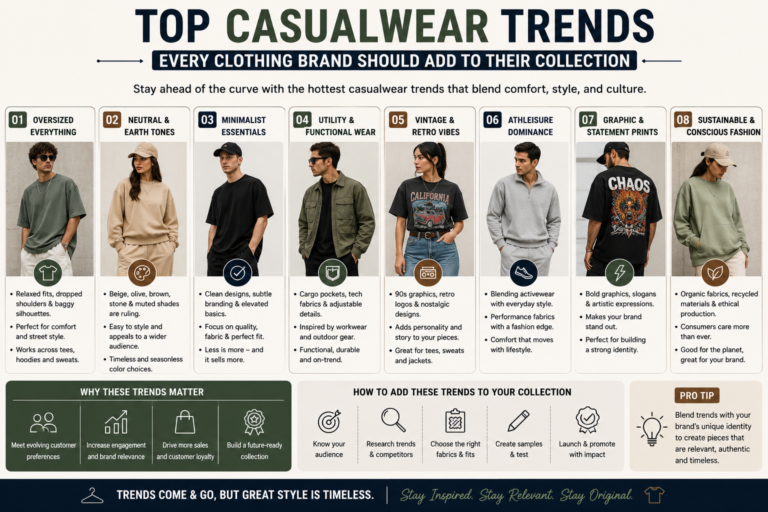
Top casualwear trends can move quickly, sometimes faster than brands anticipate. What was a best-seller the previous season may not even be requested the following season. And, some of the styles that the previous season may have seemed the least popular may become the most popular styles in the entire category.

Brands that maintain their relevancy and ability to sell their product are the brands that identify and respond to these trends early. They are able to introduce products at the right time, which is before a particular trend has peaked. This guide identifies the key casualwear trends that should be considered by every clothing brand.

Why Trend Knowledge is Important in Casualwear

While casual wear may sometimes seem timeless and stable, in reality, that is only partially true. Casualwear can demonstrate a variety of changes from season to season based on varying silhouettes, fabric weights, colors, and design details that are consistently evolving.

For a brand that has a casualwear line that includes hoodies, in the same style and color year after year, will result in their product demand plateauing. This is because, regardless of how high-quality their product is, customers have new expectations, and they have moved on. Continuing to track the direction of the market provides brands with the opportunity to extend their product lines.

Offering new products is one aspect, but the key is offering new products and maintaining high quality. This should be the same level of quality and consistency to maintain customer loyalty. Keeping the right balance helps maintain a long-term partnership.

Trend 1 – Heavyweight Basics

The trend towards heavier-weight fabrics in fundamental pieces of casualwear has been the most noticeable market change in this category over the last two years — it’s likely to continue into 2026 as well.

It has become more and more apparent that customers have an affinity for thicker, more substantial, premium, and durable casualwear basics. In the premium and mid-market segments of casualwear, heavier-weight casualwear basics outperform their lighter counterparts, including t-shirts in the 220-280 GSM range, hoodies in the 380-450 GSM range, and sweatshirts in the 340-400 GSM range.

For brands currently producing standard-weight basics, transitioning to heavier-weight options in the same silhouettes is one of the most commercially impactful changes available. A t-shirt manufacturer or hoodies manufacturer with access to premium-weight fabrics can support this transition without requiring a full product redesign.


Trend 2 — Oversized Silhouettes

At ease oversized clothing items have been a trend in recent years with more and more people gravitating toward relaxed clothing. In 2026, we will see a massive rise in this segment with dropped shoulder clothing items with oversized silhouettes.

Successfully selling oversized casual clothing relies on the right proportions. Baggy clothing items need to be constructed properly to ensure items have the right fit and are not poorly sized. Oversized hoodies need the right design so items have the right fit and aren’t poorly designed. Dropped shoulder items need to be rightfully constructed to be dropped shoulder items and not improperly designed. The chest needs to have a relaxed sizing so the design is properly made and not poorly constructed.

Getting these proportions right requires dedicated pattern development — not simply grading up an existing pattern. A sweatshirt manufacturer with experience in oversized construction understands where these proportional decisions matter most and builds them into the pattern from the start.


Trend 3 — Matching Co-ord Sets

Co-ord sets are a growing segment in commercial casualwear. They show a promise of moving from trend to staple. The appeal is apparent. Customers no longer have to mix and match. A complete look can be purchased in one effort-free transaction.

Co-ord sets in 2026 will surpass the basic matching co-ord sets. Design will be taken into consideration. Details like tonal embroidery, contrast stitching, ribbing, and hardware will be included to elevate a co-ord set from a completed set to a crafted design.

For brands not yet offering a co-ord proposition, adding one to the casualwear range is one of the clearest commercial opportunities available. A co-ord set manufacturer who produces both pieces in the same fabric lot ensures the matching is accurate, which is the fundamental commercial requirement of the style.


Trend 4 — Utility and Cargo Details

Utility aesthetics such as cargo pockets, technical fastenings, D-rings, and other functional detailing used to design casualwear silhouettes have steadily increased in commercial relevance and will continue to have a strong market presence in 2026.

The best example of this trend in casualwear is incorporating utilitarian details into comfort-based silhouettes like cargo joggers, utility co-ords, and technical tracksuits, instead of incorporating workwear-inspired pieces. The consumer wants the function of workwear and the design aesthetics, but they do not want to sacrifice comfort and the ease of wear that allows casualwear to be their daily clothing choice.

A cargo pants manufacturer with experience in both casualwear construction and multi-pocket utility detail can help brands execute this trend with the construction quality it requires.


Trend 5 — Tracksuits as Fashion Statements

Tracksuits began as sportswear, became a fashion statement, and by 2026, have a category of their own in the realm of high-end, casual apparel for some of the most profitable companies.

The best tracksuit lines are those that recognize the tracksuit as a fashion item and not an athletic item, that use premium materials for fabric, construction, and thoughtful branding. These factors, along with high-quality zippers, tonal embroidery, and color-blocked designs, can ensure customer loyalty while tracksuits remain premium products.

For brands not yet offering a tracksuit, the category represents a meaningful commercial opportunity — particularly in markets where the crossover between fashion and sportswear-inspired dressing is strong. A tracksuit manufacturer that produces at a fashion quality standard gives brands the production partner they need to compete in this premium segment.


Trend 6 — Flannel and Heritage Textures

Flannel and brushed-texture fabrics have become popular across casual wear, and an increased demand for warm, heritage-inspired clothing has rejuvenated the market.

Flannel shirts, brushed fleece hoodies, and textured knitwear provide a great opportunity to tap into the market trend for each gender and age. The most important aspect of this opportunity is the proper quality construction of these fabrics, especially with pattern matching in flannel and yarn quality in textured knitwear.

A flannel shirt manufacturer with experience in check pattern alignment produces a product that immediately signals quality — because the effort required to match patterns correctly is visible and appreciated by customers who know what they’re looking at.


Trend 7 — Premium Knitwear in Casualwear

Knitwear has developed from a winter seasonal product to a year-round staple in casualwear, available in seasonal weights and constructions.

You can now find easily worn, premium knitwear in the form of knit co-ords, oversized, and textured sets, all with a more elevated price, in the same comfort area as casualwear jersey.

A knitwear manufacturer who works specifically in this category brings the technical knowledge — yarn selection, stitch construction, finishing — that woven garment factories cannot replicate.


Conclusion

The 2026 trends in casual work include heavyweight basics, wider designs, matching sets, utility details, high-end tracksuits, heritage textures, and improved knitwear. Each of these Top Casualwear Trends shows a new shift in consumer buying habits. Retailers that prioritize these trends and invest in quality and innovation in their product development will have a competitive advantage in the marketplace.

When you’re ready to build your trend-led casualwear collection, explore the full range of casual wear manufacturing options and find the right production partner for your brand.


FAQs

What is the biggest casualwear trend in 2026?

Heavyweight basics and oversized silhouettes are the two strongest commercial trends — reflecting the sustained shift toward comfort-led, premium-feeling casualwear across multiple markets.

Are co-ord sets still trending in 2026?

Yes — co-ord sets have moved from trend to commercial staple and continue to grow in demand as more customers embrace the matching proposition for its ease and visual appeal.

Is the utility trend relevant for casualwear brands?

Yes — particularly for brands targeting streetwear-influenced or younger demographics. Cargo details and utilitarian aesthetics applied to comfort-led silhouettes represent a strong commercial opportunity.

What makes oversized casualwear work commercially?

Proportion. An oversized garment needs to be constructed with deliberately dropped shoulders, extended body length, and specific width proportions — not just graded up from an existing pattern.

Is knitwear becoming a year-round casualwear category?

Yes — lighter-weight knits and relaxed knit co-ords have extended knitwear beyond purely seasonal relevance into year-round casualwear territory for many brands.

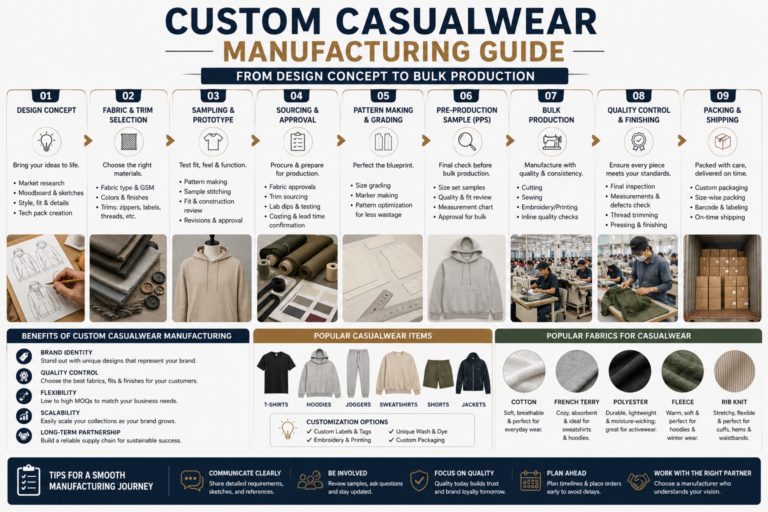
Custom Casualwear manufacturing guide – From Design Concept to Bulk Production

Creating a personalized casualwear line seems simple. What people don’t realize is that there are more stages and hurdles than they anticipate. Fortunately, there are ways to manage every step of the process, especially for first-time brands. This guide details the custom casualwear manufacturing guide, step by step, from the first idea to the final bulk shipment.

Stage 1 — Define Your Product and Brand Position

No design should happen before you know the answer to: “What are you going to sell?” and “Who are you going to sell to?”

These two questions seem easy to answer. However, they impact every design decision of the finished garment. A brand may decide to sell heavyweight hoodies to a premium segment, while a brand may opt for lightweight co-ordinates to sell to a budget segment.

Before reaching out to a manufacturer or designer, write a product brief. In a product brief, be sure to answer: What is the garment type? Who is the target customer? What is the target price? What are the design details? What are the garment performance details? This document will be referenced throughout the entirety of the design process.

Stage 2 — Choose Your Manufacturing Model

Your brand and design goals impact the manufacturing model you choose for producing your custom casualwear line. The model you choose will impact the design goals and cost of the final product. The model you choose will impact the design goals and cost of the final product. The model you choose will impact the design goals and company.

Full package production — where the manufacturer handles fabric sourcing, cutting, making, and finishing — is the simplest model for brands without established supply chain relationships. A casual wear manufacturer offering full package production gives you one point of contact for the entire process.

CMT — where you supply the fabric and the manufacturer handles cutting, making, and trimming — gives you more control over material sourcing but requires you to manage fabric procurement independently.

For brands entering casualwear for the first time, full package production is almost always the more practical starting point. It reduces the number of relationships you need to manage and keeps the development process more contained.


Stage 3 — Develop Your Tech Pack

A tech pack takes a design idea and outlines a viable way to make a product. It instructs a factory on how to carry out the design by providing details on every attribute of the item to be made.

When details on a tech pack are omitted, the factory will fill in the gaps for you. Unfortunately, the factory’s design assumptions will create inconsistencies in many aspects of the product, most notably, fit and branding. These gaps will become more of a problem the further along the process you are.

Tech packs include design pictures as well as technical details and draw every view of the product. They also include precise details on every aspect of the item, such as finish and fabric. Tech packs will also include design details such as the placement of various branding pieces and the placement of reinforcing branding. This will also outline the coordinates for placement.

For brands producing hoodies and sweatshirts as part of a casualwear range, the tech pack needs to specify hood construction, drawstring routing, kangaroo pocket dimensions, and cuff and hem rib depth — all details that affect the finished quality significantly.


Stage 4 — Fabric Selection and Approval

You select your fabric as you develop your tech pack — fabric impacts details concerning measurement, construction, and finishing methods of a tech pack.

Always order samples from your manufacturer before making any specifications. Weigh the fabric. Evaluate the bounce back of the stretch. Compare your design references to the fabric color. Lastly, see how the fabric ages by prewashing it. A fabric that shrinks or changes form will cause the same issue to the finished garment. Customers will see the changes after the first wash. The concern of form loss is not only on your end.

For a t-shirts manufacturer producing premium casualwear, fabric approval is a non-negotiable step — because the t-shirt’s quality is almost entirely determined by the fabric. Getting it wrong at this stage means the finished garment is wrong, regardless of how well it’s constructed.


Stage 5 — Sampling and Fit Approval

There’s a lot that happens between finalized tech packs, approved fabrics, and the beginning of sampling. This is the stage of the process where your design becomes the first physical version of itself, and where most of the development manifests.

The first sample is sometimes called the prototype or the fit sample. It is the sample that will be used to assess the construction of the sample and the fit of the sample. At this point in the process, the sample may not be made of the final iteration of the fabric, or the sample may not have final branding. At this point, your focus should be on the construction quality of the garment, the fit and proportion of the sample, and on the construction quality per the instructions in the tech pack.

As the designer, it is your responsibility to document any and all construction quality changes in detail. Be sure to reference the specific measurements where construction quality changes need to occur, and communicate this as a type of construction that is needed per the construction instructions given to the manufacturer. Vague responses like “make it a bit bigger” result in fit and construction inconsistencies. A response like “increase the chest width by 2cm and the body length by 1.5cm” will have the design completed to your specifications.

Most casualwear orders go through two, and sometimes, three sampling rounds before the order is approved for the main run. If this step is attempted to be expedited, more time and finances will be wasted in attempting to deal with the problems created by bulk production.

Stage 6 Branding and Print Approval

There is a lot of detail that goes into finishing the bulk production run, and before each of the elements of the garment are finalized, each of the elements need to be approved for construction. Print placement, the quality of the embroidery, the placement of the labels, and the finishing of the hardware will all require a round of approvals — because errors in production runs will be expensive and sometimes irreversible.

Before approving bulk production, request a branded pre-production sample, which includes the complete garment design in the final material with all branding elements added. This sample allows you to check each detail including the sharpness and accuracy of the print, the density and placement of the embroidery, and the quality and placement of the labels. Additionally, assess the quality of the branding hardware and its function.

For brands producing co-ord sets with matching branding across both pieces, this approval stage confirms that the logo placement, scale, and finish are consistent across the top and bottom — which is a detail that needs deliberate checking rather than assumption.


Stage 7 — Bulk Production and Quality Control

Bulk production can start once we have all the approvals. Every unit for that bulk run will be compared to your approved sample, which then becomes the reference standard.

Quality control occurred at various steps if the sample bulk run was approved. Rather than inspecting the finished product and determining if the sample was approved, the fabric used was inspected to ensure the correct material was supplied. Finally, every unit was inspected to ensure the bulk run conformed to the approved sample before packing.

For brands producing joggers or cargo pants in bulk, waistband construction, pocket attachment, and hem finishing are the construction points most likely to show variation across a large run — making them the priority areas for in-line quality checks.


Conclusion

This guide to custom casualwear manufacturing guide outlines all stages from concept to delivery. The takeaway from all of them is the same. Preparation prevents problems. Clear briefs, detailed tech packs, all the fabric approvals, and strict sampling techniques can help you in all stages. All of them help prevent the bulk production errors that set brands back a lot.

When you’re ready to start your custom casualwear production, explore the full range of casual wear manufacturing options and find the right partner for your brand.


FAQs

What is a tech pack, and why do I need one for casual wear?

A tech pack is a detailed manufacturing document that specifies every aspect of your garment — measurements, fabric, construction, and branding. Without one, factories make assumptions that lead to inconsistent results.

What is the difference between the full package and CMT production?

Full package means the manufacturer handles fabric sourcing and all production. CMT means you supply the fabric and the factory handles cutting, making, and trimming.

When should branding be approved in the production process?

Before bulk production begins, a dedicated branded pre-production sample that shows all print, embroidery, label, and hardware details applied to the final fabric.

What quality control checks should happen during bulk production?

Fabric inspection on arrival, in-line construction checks during production, and a final inspection before packing — covering measurements, construction, branding, and finish.

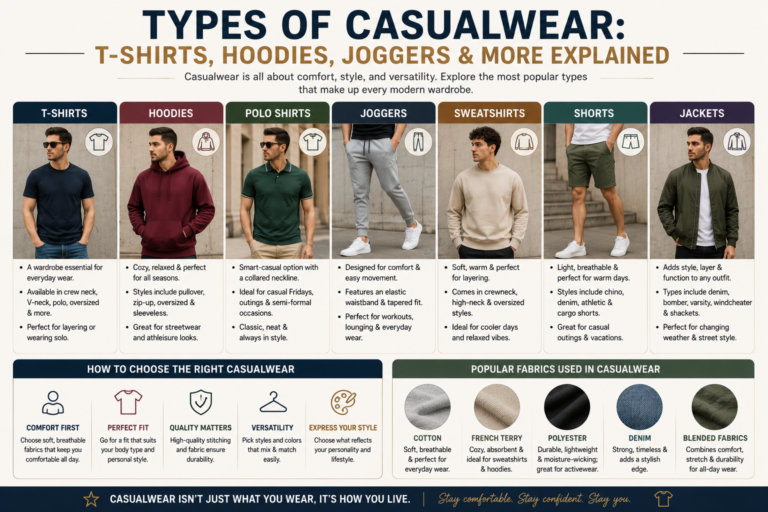
Types of Casualwear: T-Shirts, Hoodies, Joggers & More Explained

Wear is the largest, most commercially consistent, and most profitable category in fashionwear. It is the category people wear the most — in their homes, on errands, social engagements, at home workspace, and all the more mundane parts of daily life that don’t need to be formal.

With that constant everyday demand, types of casualwear are one of the most trustworthy categories to base a fashion business on. Casualwear also isn’t one item — it’s an umbrella term of many items and styles, each with its own construction preferences and appeals to different customers, and each with its own commercial opportunities.

This guide simply articulates the main styles of casualwear and the range they cover to help you develop your collection.

How is Casualwear Different From Other Fashionwear?

Casualwear is the relaxed, comfortable end of fashionwear. What takes precedence is the sort of relaxed structure of soft fabric, and a fit that has leeway, covering a wide range of everyday scenarios and can be worn with minimal style effort.

That being said, casualwear certainly can be challenging to produce well, and done well, can be highly commercially successful. The most successful casualwear brands have done just that, building basic shapes and silhouettes to new heights, providing more quality in fabric, with basics, and maintaining a strong brand identity. A premium, thick, and soft hoodie can look eerily similar to a cheaply made one on a hanger, but the difference in construction, fabric, and finishing is immediately identifiable once picked up and weighed.Premium heavyweight hoodie and a cheap one might look similar on a hanger — but the difference in fabric, construction, and finish is immediately apparent when you pick them up.

A dedicated casual wear manufacturer who understands what separates good casual wear from commodity products is the right starting point for any brand building in this category.


1. T-Shirts

Casual wear worldwide is most commonly recognised by an item that people often refer to simply as a t-shirt. Because entering casualwear is as simple as producing basic t-shirts, there are a lot of businesses producing t-shirts, making the industry equally competitive, regardless of where in the world it is taking place.

What most differentiates t-shirts that sell, and those that don’t, is rarely the shape of the t-shirt itself. Instead, it most often is the weight, fit, etc. of the fabric used. For example, a t-shirt produced with a clean neck finish and weighty cotton with a fabric weight of 220 to 260 GSM that has accurately located shoulder seams and consistent sizing will look and feel fundamentally different from similar-priced t-shirts that are thin and misshapen.

For brands building a casualwear range, the t-shirt is the right starting product — because it validates fabric and fit decisions that carry through to every other product in the range. A t-shirt manufacturer with strong fabric sourcing and consistent construction gives brands a reliable foundation.


2. Hoodies

The hoodie is the second most commercially important piece of casualwear, and some would argue the number one piece in terms of expressiveness of the brand. Compared to a T-shirt, a hoodie is bigger, has more branding space, and has more design elements. Because of this, hoodies tend to be more expensive, which gives companies more commercial room to produce better quality products.

When looking at hoodies, a good sign of quality is the weight of the material. A good quality hoodie should be made of a 320 to 400 GSM French terry or fleece. Anything below 280 GSM feels more like a disposable product, regardless of construction quality.

Ribbed cuffs and hems should maintain their shape after multiple washes, and construction quality can also be shown by a kangaroo pocket that stays flat and a hood that has a proper cut, so that it is not sagging or misshapen.

A hoodies manufacturer experienced in premium casualwear understands these quality indicators and builds them into production standards — rather than treating them as optional details.


3. Sweatshirts

The sweatshirt is a streamlined design cousin of the hoodie where the silhouette is free of a drawstring and hood. Your choices for necklines are crew or mock. Available in fleece or french terry, this design is perfect for brands looking for a more elevated casualwear staple.

Sweatshirts have found their way into the premium casualwear tier (which is where they’d likely find their strongest market) as the clean design of the silhouette is perfect for where they’d likely find their strongest market. As a canvas for embroidery, branding, tonal prints, and graphic details, the design remains clean, unlike other silhouettes where the presence of a hood creates visual clutter.

The construction requirements are simpler than a hoodie, which can make the sweatshirt a more cost-efficient product at the same fabric quality level. For brands building a coordinated casualwear range, a sweatshirts manufacturer that produces sweatshirts and hoodies in matching fabrics and washes creates a coherent range without requiring multiple fabric sourcing relationships.


4. Joggers

Joggers are the pants equivalent of hoodies and sweatshirts; they’re the most versatile and commercially viable option for casual wear. They’re functional for loungewear and casual daywear, and can serve as a stylish option for structured trousers as a better alternative.

Quality joggers have an elastic waistband, but the drawstrings are fed and stay flat when adjusted. They also have tapered leg construction that maintains its shape through washes, as well as ribbed cuffs that don’t slide when joggers are worn.

The commercially viable option for joggers is dependent on the fabric. A breathable midweight option is French terry of 280 to 340 GSM. For a warmer option for autumn and winter, heavyweight fleece works. For an option with a summer fit, a lightweight jersey gives a more relaxed choice.

A joggers manufacturer who works across multiple fabric weights and has strong waistband and cuff construction experience gives casualwear brands the production quality their jogger range needs.


5. Co-ord Sets

Co-ord sets, tops and bottoms made as an intentional pairing have quickly become a favourite among casualwear products. The convenience of the single purchase solution to styling encourages repeat business.

Co-ord casual wear consists of a pair of hoodies/sweatshirts with matching jogger pants. These elements are the same fabric and dye lots and have the same weight. The essential requirement for production is fabric or dye lot consistency. Without matching fabric, the co-ord proposition can’t be. A co-ord set manufacturer who produces both pieces from the same fabric, cut and dye lot, eliminates this risk.


6. Cargo Pants

There has been an increasing interest in a certain type of workwear pants. Functional aesthetics have grown to become a popular element among most casual clothing on the market. Conversely, cargo pants have gone from utility workwear to commonplace pants for the everyday person.

Among cargo pants, the defining trait, most noticeable aspect, and most instrumental piece to consider is the side cargo pocket — the large, often flap-covered pocket on the outer thigh. The craftsmanship of cargo pants must be flawless to avoid a poor construction quality appearance. Pockets that bulge, flaps that sit unevenly, or pocket seams that pucker are all poor construction quality.

For brands targeting streetwear-influenced or utility-aesthetic casualwear markets, cargo pants are a strong commercial opportunity. A cargo pants manufacturer with experience in multi-pocket construction gives brands the precision execution this style requires.


7. Flannel Shirts

Flannel shirts are a seasonally strong casualwear product — particularly in autumn and winter collections. The brushed surface of flannel fabric gives a warm, soft handfeel that is strongly associated with casual comfort and heritage aesthetics.

Flannel works across genders and age groups — and coordinates naturally with jeans, cargo pants, and joggers across a casualwear range. A flannel shirt manufacturer with experience in check pattern matching — ensuring that the plaid or check pattern aligns across seams — produces a noticeably more premium product than one who treats flannel like any other woven fabric.


Conclusion

Types of casualwear include a variety of products with specific construction needs and customer demographics. A good range of products requires depth. T-Shirts and Hoodies form the core of cash sales. Trousers and co-ords supplement depth. Seasonal and aesthetic variety is provided by Cargo Pants and Flannel Shirts.

When you’re ready to build your casualwear collection, explore the full range of casual wear manufacturing options and find the right production partner for your brand.


FAQs

What are the most commercially reliable casualwear products?

T-shirts and hoodies are the most consistently commercial — they sell across seasons and form the foundation of most successful casualwear ranges.

What fabric weight should a quality hoodie be?

320 to 400 GSM is the range that delivers a premium feel. Below 280 GSM starts to feel thin regardless of construction quality.

What makes a co-ord set commercially strong?

It solves the customer’s styling problem in one purchase — which drives strong conversion rates and repeat buying from customers who value the matching proposition.

Are cargo pants suitable for all casualwear brands?

They work best for brands targeting streetwear-influenced, utility-aesthetic, or younger-demographic customers. They carry more risk for brands with a clean, minimal casualwear positioning.

Can I coordinate all casualwear products in a single fabric?

Some products — hoodies and joggers for example — coordinate naturally in the same fabric. Others — like flannel shirts and cargo pants — use different materials that need to be coordinated through colour and design rather than fabric.

Men’s vs Women’s vs Unisex Fashionwear — Key Design Differences

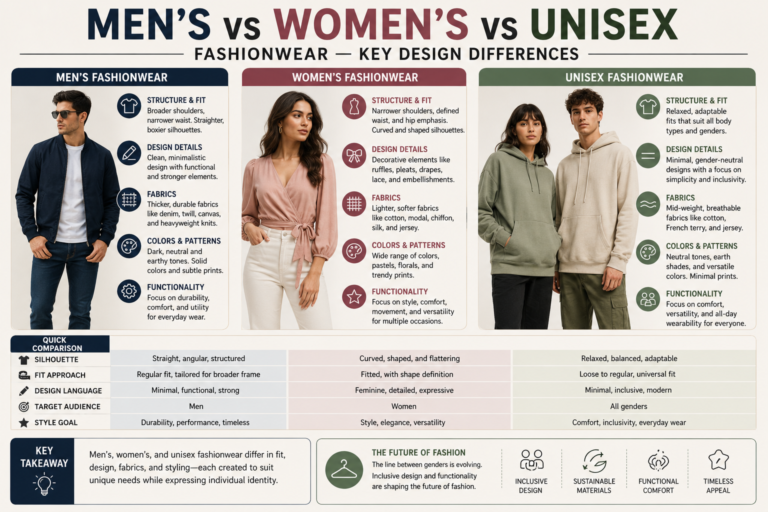
When launching a fashion category, brands must decide whether to focus on men’s, women’s, unisex, or all three product lines. Understanding Men’s vs Women’s vs Unisex Fashionwear is essential because this decision impacts design, production, sizing, fabric selection, marketing, and overall business costs. Choosing the right approach from the start helps create fit-for-purpose products that meet customer expectations and represent the brand accurately.

This guide provides clear distinctions of the designs of Men’s vs Women’s and Unisex fashionwear.

Why the Distinction Matters More Than Most Brands Anticipate

Many of the less mature brands think that by creating a garment in more than one size, they have created a garment for a different gender. They have not. Men’s and Women’s Garments differ in so many ways (beyond just a smaller size of Men’s Garments).

Let’s use Hoodies as an example. A Women’s Hoodie is not a Men’s Hoodie with a smaller size. Women’s Hoods have a different shoulder to chest ratio, different waisters and hip ratio, different shoulder length, different sleeves length, and different proportionate body lengths, and all of which require a different garment and not just a different size.

A fashionwear manufacturer who understands gendered pattern making will tell you this from the first conversation. One who suggests simply grading a men’s pattern down for women is not the right partner for a brand that takes fit seriously.

Men’s Fashionwear: What Makes It Different

Men’s fashion focuses on wider shoulder placement, straighter torso shapes, and longer body and sleeve lengths relative to width. The fit with the chest and shoulders works with the fabric and drape of the garment, since men’s clothing hangs from the shoulder. The fit of the shoulder dictates the drop of the remainder of the garment. Body structure is not accounted for beyond the fit of the shoulders and the chest.

Men’s clothing styles are basically less contoured. Hoodies, sweatshirts, and T-shirts are typically cut with little to no waist suppression and are left with a straight silhouette from the chest down to the hem. That makes it easier to design and manufacture patterns for men’s clothing than for women’s clothing, but men’s clothing requires varied attention to fit throughout the full size range for the shoulder and chest.

In men’s fashion, designs have the labels and hardware less visible and positioned less prominently, internally on the garment and often stitched in place using tonal embroidery with a stenciled patch, as opposed to the visible branding that is often acceptable on a unisex style and women’s clothing.

For brands producing cargo pants or tracksuits specifically for men, the rise, the leg opening, and the waistband construction all follow men ‘s-specific proportions, which differ meaningfully from women’s equivalents in the same style.

Women’s Fashionwear: What Makes It Different

Around the world, women’s clothing and fashion is designed for different body shapes, across proportional differences seen in areas such as the shoulders, waist, and torso. These fashion differences require advanced shapes, especially in the waist and hip region.

Almost all clothing styles for women use some form of waist shaping, even the more relaxed and looser styles. The side seam curvature, the placing of darts, and the hip-to-waist proportion must be created specifically for women and cannot be adapted from men’s or unisex styles.

Compared to men’s clothing and fashion, women’s clothing involves more construction details and shape variations. These differences increase the difficulty of manufacturing, but also the potential for different styles of fashion.

The choice of fabric used for women’s clothing is highly different than that of men’s clothing. Women’s clothing is frequently made from lighter and softer fabrics than men’s clothing, which makes fabric sourcing more difficult and leads to more advanced manufacturing processes.

A co-ord set manufacturer producing women’s styles understands that the top and bottom in a women’s co-ord need to be graded independently — because the hip-to-waist relationship changes across sizes in ways that affect both pieces differently.

Unisex Fashionwear: What It Actually Means

Unisex fashion is quite different from some common assumptions. Some brands think it means designing one style of clothing that everyone can wear. That’s not really the case. Thoughtfully designed unisex clothing often makes compromises. For example, if a clothing style uses a gendered pattern, it may fit women’s bodies better than men’s (or vice versa). In contrast, unisex clothing may not fit as well, but it probably fits a greater number of body types.

Unisex fashion works best for designs that use more relaxed or oversized proportions. A style like this will likely fit a greater number of body types. For example, oversized hoodies work as unisex clothing while fitted T-shirts do not. A fitted men’s T-shirt probably won’t fit women’s torsos without a lot of adjustments to the pattern.

The greatest challenge while making clothing unisex is probably the sizing. Developing a unisex size chart works best rather than borrowing one from men’s or women’s clothing lines, and then, this chart needs to be clearly stated to have a successful unisex fashion line.

A hoodies manufacturer with experience in unisex production understands how to develop sizing that works commercially — appealing to the broadest possible customer base while maintaining a coherent fit identity.

When to Choose Each Approach

The preferred method is contingent on your brand’s positioning and your consumer. For example, if you have a niche brand catering to women’s streetwear or men’s casualwear, gendered patterns allow you to establish a better fit and stronger product relevance.

For a brand based on gender inclusivity, gender-neutral identity, or gender community, gender-neutral clothing is a commercially viable option that increases ease of production and expresses your brand values.

Many brands begin with gender-neutral clothing, as it allows a single size run to meet the needs of a broader consumer base and reduces the complexity of developing patterns. As the brand and its consumer base grow, they often add gendered clothing options.

A sweatshirts manufacturer or fashionwear specialist who has produced across all three approaches can advise on which makes most sense for your specific product and brand positioning.

How Production Differs Across Each Approach

From a manufacturing standpoint, gendered production has more intricacies than unisex production due to the separate requirements for each gender, including developing and managing separate patterns, grading, and fabric specifications.

Unisex production streamlines pattern development but complicates sizing and customer expectations. Unisex garments may fit well, but if customers are not informed about the fit, they may return the garment, as they assume it will fit like a gendered garment.

A t-shirts manufacturer who has worked across men’s, women’s, and unisex production can advise on the pattern and grading implications of each approach before development begins — saving significant revision time later.

Conclusion

Saying unisex clothing is simply a different size than men’s or women’s apparel is only partly true. In Men’s vs Women’s vs Unisex Fashionwear, factors like fit, fabric selection, brand positioning, production strategy, and marketing all play an important role in how garments are designed and sold.

You need to understand your consumer product to clothing strategies. Select a partner manufacturer that understands how subtle the differences are and can implement them correctly.

When you’re ready to develop your fashionwear range, explore the full range of fashionwear manufacturing options and find the right partner for your collection.


FAQs

What is the main difference between men’s and women’s fashionwear patterns?

Women’s patterns are built around a defined waist, wider hips relative to shoulders, and a shorter torso. Men’s patterns follow broader shoulders, a straighter torso, and different length proportions.

Can I make a unisex garment by simply grading a men’s pattern down?

No. A well-designed unisex garment requires its own pattern development, making considered compromises between body proportions rather than scaling an existing gendered pattern.

What styles work best as unisex fashionwear?

Oversized and relaxed silhouettes work best — because they are inherently more forgiving of body proportion differences. Fitted styles rarely work effectively as genuine unisex.

How does fabric choice differ between men’s and women’s fashionwear?

Women’s fashionwear typically uses lighter weights and softer handfeel fabrics more frequently than men’s equivalents — though this varies significantly by category and brand positioning.

How to Choose the Best Fashionwear Manufacturer for Clothing Brand

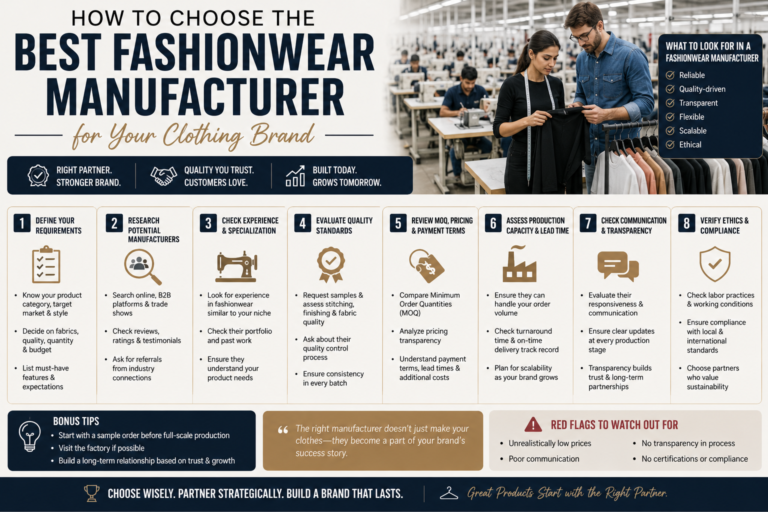
Finding manufacturers for fashionwear is not difficult, but knowing How to Choose the Best Fashionwear Manufacturer for your brand can be challenging. Everyone can show clean samples and polished presentations, but true reliability is proven when it’s time to deliver quality, consistency, and production results.

This guide will give you the most important information necessary in order to select a manufacturer that is the best fit for your brand.

Start With Your Own Requirements

Only after you understand your own requirements are you able to examine manufacturers.

You must understand your requirements. What kind of fashionwear are you trying to produce? What types of fabric and what level of construction does your product demand? What do you want to charge, and how much do you want to sell? You must know the answers to all of these.

Only after you can answer these are you able to have conversations with manufacturers. A manufacturer that specializes in casualwear is completely different than a manufacturer that makes technical knitwear. If you do not understand your own requirements you will waste a lot of time with conversations with many manufacturers that are not a good fit for your needs.

A broad fashionwear manufacturer who covers multiple categories can sometimes be a useful starting point — but always confirm that their strongest capabilities match your specific product, not just their general range.


Step 1 — Look for Category Specialisation

What factor do you think is most important for selecting a fashionwear manufacturer? It is most heavily related to manufacturing experience in that particular category. A manufacturer that makes great t-shirts may not produce great tracksuits. They may excel in knitwear but struggle in making woven fashion jackets.

When looking at manufacturers, inquire about the product/service category experience. Make sure to get examples of products they’ve manufactured that are close in relation to your category. Ask about the brands that they partner with. This is not incurring a confidentiality clause, but more to understand the degree of market they operate within.

A streetwear manufacturer who regularly works with established streetwear brands understands the graphic application standards, the fabric weights, and the finishing expectations of that market. That category knowledge is not something a general factory can replicate — regardless of how capable they are in their own specialty.


Step 2 — Evaluate Fabric Knowledge and Sourcing

A production facility is a manufacturer who is only capable of producing what you dictate. A real partner type of manufacturer is one who can inform you about your fabric options based on how the different materials behave in their machinery in their production process.

When assessing manufacturers, inquire about their fabric sourcing relationships. Are they able to obtain the fabrics necessary for your product? Do they have access to sustainable or certified fabrics? Are they able to provide advice on fabric performance at your desired price level or within particular garment construction?

For brands producing hoodies and sweatshirts, fabric weight and handfeel are critical quality indicators that a knowledgeable manufacturer will discuss confidently — rather than simply accepting whatever GSM you specify without comment.


Step 3 — Check Minimum Order Quantities Against Your Volume

MOQ is amongst the first valid filters when searching for manufacturers. If a factory has a minimum order quantity (MOQ) of 1,000 units, then they aren’t a suitable partner for a brand with an order quantity of 150. Validating the MOQ before going into the details of a contract saves a lot of effort for both parties.

Find out the MOQ for each style, color, and fabric, since the minimums usually aren’t the same, and there may be separate minimums for each variation. Inquire about the possibility of reducing the MOQ for future reorders. Lastly, ask if the minimum order quantity can be complemented by combining different styles in the same order.

For brands at an early stage, a casual wear manufacturer or fashionwear specialist who works with growing brands at flexible order sizes is a better starting point than a large factory built for volume production that has no interest in smaller initial orders.


Step 4 — Assess Print and Branding Capabilities

Most fashion items require some sort of printing or branding, like screen printing, DTG, embroidery, sublimation, or heat transfer. Legitimacy with any of these applications varies greatly from one manufacturer to another, and is the main cause of bulk production rejections due to inconsistency in print quality or issues in placement.

When evaluating a manufacturer, take time to analyze their branding or printing samples for various techniques. Look for placement consistency, details of print edges, and how well it withstood a wash. A manufacturer who brands in-house gives you one less variable in your production chain, and gives you tighter quality control.

For t-shirts and graphic-led fashionwear in particular, print quality is a core product attribute — not an add-on detail. Your manufacturer’s print capability directly affects your product’s quality perception in the market.


Step 5 — Request Samples and Evaluate Honestly

Avoid doing bulk deals with any manufacturer that you haven’t sampled with. No portfolio, website, or even factory visit can show you what that factory can actually do better than a sample.

Ask them to create a sample with your fabric, with your specs, with your construction, and with your label. Be thorough and order samples to be objective and analyze every component, stitch, seam, print, label, and even how the garment holds up after a wash.

If you are genuinely impressed with a sample, that is a good sign. However, if you see any of the mentioned issues in the sample, you can expect exactly what you got in bulk. It should be noted that the sampling process is an overview of what you can expect in the production process and is not a reflection of the product.

A co-ord set manufacturer who samples both pieces in exactly matched fabric from the same dye lot — without being asked — is demonstrating the kind of attention to detail that makes bulk production reliable.


Step 6 — Verify Quality Control Processes

In the relationship between value and quality in clothing production, quality control (QC) is of utmost importance. Instead of saying they have a QC process, ask each manufacturer to explain their QC process in detail.

You should expect answers to questions like, how do you examine the fabric before construction? What is done at each stage during the construction process? What assessment is done on the garment after it is constructed? A manufacturer with a clear QC process should give answers with confidence. If the manufacturer cannot answer these questions in a detailed manner, then it is safe to say, they have poor QC process.

For brands producing cargo pants or joggers — where pocket construction, waistband integrity, and hem finishing are all visible quality indicators — a manufacturer with strong in-line QC prevents the kind of bulk production errors that are expensive and time-consuming to correct after the fact.


Conclusion

Choosing the right manufacturer for your brand means focusing on capability, experience, fabric knowledge, and quality control. This guide on How to Choose the Best Fashionwear Manufacturer helps brands identify reliable partners that deliver transparency, accurate sampling, and consistent production quality.

Take your time. Sample thoroughly. Choose a partner who is equally as invested in your product as you are.

When you’re ready to find your manufacturing partner, explore the full range of fashionwear manufacturing options and start the conversation.


FAQs

What is the most important factor when choosing a fashionwear manufacturer?

Category experience. A factory that specialises in your specific product type will consistently outperform a general factory claiming to handle everything equally well.

How do I evaluate a manufacturer’s fabric knowledge?

Ask them to recommend fabrics for your product and explain why. A knowledgeable manufacturer will give specific, confident answers — not just accept whatever you specify.

What MOQ should I expect from a fashionwear manufacturer?

It varies widely — from 50 to 1,000 units per style depending on the factory, product type, and fabric. Always confirm before entering detailed discussions.

How many sample rounds should I expect before bulk production?

Two to three rounds is typical for most fashion wear. More complex styles or technical constructions may require additional rounds.

Types of Fashionwear: Casualwear, Islamic fashion, Streetwear & More Explained

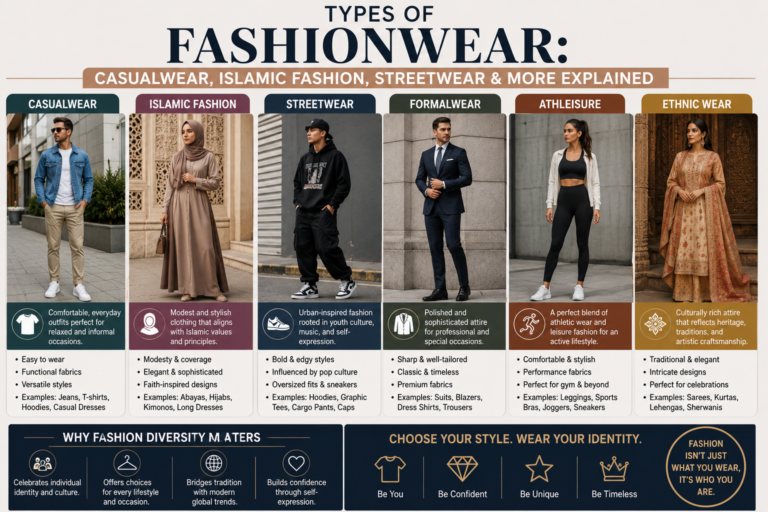
Fashion is a broad industry with unique styles, customers, and production needs. Understanding the different Types of Fashionwear helps brands choose the right manufacturer, define their product range, and build collections that connect with the right audience.

This guide will help you understand the different types of fashion wear and how they are classified.

What is Fashion Wear?

Fashionwear is an umbrella term that includes clothing for self-expression and everyday style. It differs from technical apparel, activewear, or workwear. Fashionwear includes everything from the basic T-shirt to a structured jacket. It also includes casual loungewear and culturally specific clothing, such as Islamic fashion.

All fashion wear is united by the importance of appearance and individuality. Fashionwear is bought by customers for how they feel and look, not because it performs well. This does not mean that construction quality is unimportant. The design, aesthetics, and cultural relevance of a product are primary factors in purchase.

The fashion industry is a specialist in this field and understands the importance of visual consistency and brand consistency. They approach production with the same care and attention that performance manufacturers pay to technical functionality.

1. Casual Wear

Casual wear is the most popular and consistent fashion category. Casual wear is the everyday clothing that people wear in non-formal settings. This includes t-shirts and hoodies as well as sweatshirts, coord sets, and other relaxed styles.

Casualwear has a design that is based on comfort. Fabrics are softer, cuts are more relaxed, and the construction prioritizes comfort and wearability above structure and formality. Comfort doesn’t have to be cheap. The best casualwear brands have achieved commercial success through elevating basic silhouettes with fabric quality, brand identity, and design details.

Casual wear is the easiest category for new fashion brands to enter. It is a good starting point for new brands because of its lower construction complexity, existing fabric options, and wide market appeal. New brands can build a solid foundation with a dedicated casualwear manufacturer that has a strong fabric sourcing process and a transparent production process.

2. Streetwear

Streetwear is at the intersection of youth culture, fashion, music, sport, and more. Streetwear is characterized by its bold graphics, oversized shapes, premium basics, and a strong cultural identity that extends beyond the garment.

Streetwear’s relationship with exclusivity and community is what makes it commercially distinct. As important as the actual product are drops, limited editions, and collaborations. Streetwear customers buy into a whole world, not just a hoodie.

Streetwear is often made to the same standards as high-end fashion, including consistent fabric weights, precise graphics, and hardware that perfectly matches the aesthetic. Streetwear brands can find the right production partner by working with a streetwear producer that understands their culture and construction requirements.

3. Islamic Fashionwear

Islamic fashionwear, which includes modest styles such as abayas and jilbabs along with modest dresses, kaftans, and separates, is among the fastest-growing segments of global fashion. Globally, the Muslim fashion industry represents hundreds of millions in consumer spending. Demand for stylish, well-made modest clothing is growing across multiple markets.

The combination of modesty and fashion sensibility is what makes Islamic clothing unique. The garments must meet certain coverage standards – longer lengths, higher collarlines, covered arms – while also reflecting current design trends in fabric, silhouette, and colour.

Specific construction requirements also exist. Fabric selection is crucial — breathable, flowing fabrics that drape and provide modest coverage are key. An Islamic Fashionwear Manufacturer that understands the fashion and cultural expectations of the market will be a much better partner than a casualwear factory.

4. Co-ord Sets

The co-ord set, a matching two-piece outfit where the top is designed and made as one unit with the bottom, has grown to be a staple in multiple fashion segments.

Co-ord sets are popular because they’re easy to buy. The customer doesn’t have to worry about matching because the set does it for them. The average order value is higher and customers are more likely to buy again.

Co-ord set designs are available in a variety of aesthetics: casualwear in fleece or jersey, loungewear in soft fabrics, and fashion in printed or structured materials. A coordinated set manufacturer that can produce both pieces of fabric in the same color lot will ensure the set looks just as intentional as it does on the product photographs.

5. Tracksuits

Tracksuits are a fashion staple that sits between sportswear with a performance focus and pure fashion. Tracksuits have evolved from being a purely functional piece of athletic clothing to a separate fashion category. They are worn for both style and sport.

Its versatility is the tracksuit’s greatest selling point. The tracksuit is versatile enough to be worn as loungewear or casual daywear. It can also make a fashion statement when done in a premium way. Tracksuits are a key product for brands that target youth markets or those with sportswear aesthetics. They can also be used to create casual wear with athletic credentials.

manufacturer who is experienced with both the fashion and athletic sides of the category will know how to balance the performance fabric properties of the tracksuit with the fashion-forward design. This is the technical core that makes a tracksuit work in both contexts.

6. Fashion Jackets

Fashion jackets are an elevated expression of outerwear. They include bomber jackets and varsity jackets as well as coach jackets and trucker jackets.

Fashion jackets often represent the star of a brand, attracting the most attention and showcasing the best photography. They also tell the brand’s story in the most compelling way. The construction is more complicated than other fashion styles. There are more panels, more metal, and more details in the finishing.

Fashion jackets that are produced by fashion coat manufacturers who use high-quality hardware, pattern grading, and finishing processes, as well as a manufacturer, will have the quality needed to meet their premium positioning.

7. Knitwear

Knitwear, including sweaters, cardigans, and knitted outerwear, is one of the most technical categories in fashion. Knit fabric construction is fundamentally distinct from woven fabric, requiring different machines, different patterns, and different quality assurance processes.

Knitwear is a strong commercial category, especially in the autumn and winter seasons. It can be positioned as a premium product when made with quality yarns and carefully constructed. Knitwear manufacturers that specialize in this area bring a level of expertise that woven garment factories cannot match.

Conclusion

Fashionwear includes many styles, customers, and production needs. Explore the different Types of Fashionwear to choose the right products and manufacturing partners.

Explore the options for fashionwear production and find a partner that best suits your brand.

FAQs

What exactly is fashionwear? 

It’s clothing that is designed for everyday style, self-expression, and comfort. This includes casualwear, streetwear, and Islamic fashion.

What’s the difference between streetwear and casualwear? 

The emphasis is on comfort and wearability for everyday use. Streetwear is a mix of cultural identity, bold graphics, and community-driven branding.

How is Islamic clothing different from other types of clothing? 

Islamic clothing must adhere to modesty standards, including longer lengths, higher collarlines, and covered arms, while also reflecting current fashion trends.