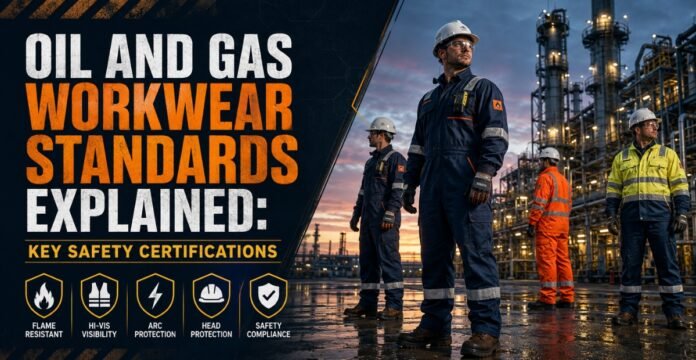
Oil and gas sites may expose workers to fire, heat, electric arcs, moving vehicles, rough surfaces, and changing weather. For this reason, oil and gas workwear standards are more than paperwork. They help a company choose clothing that has been tested for a known danger. A complete industrial workwear range may include coveralls, jackets, trousers, and vests, but every item must match the worker’s actual task. Oil and gas workwear standards also help buyers compare garments by test results instead of colour or appearance. Good oil and gas workwear standards make purchasing decisions clearer and safer. No single garment protects against every hazard, so protective clothing must be part of a wider safety plan.
Oil and Gas Workwear Standards Begin With Risk Assessment
Hazard identification is the first step in the standards selection process. For example, drilling workers may require flame resistant clothing, while an electrical worker may require arc rating as well. A pipeline crew working near traffic may require high visibility clothing, and workers in an explosive atmosphere may require antistatic protection. Standards selection therefore requires many tasks, locations, equipment, exposure levels, and working conditions. The strongest looking garment will not suffice. Standards selection requires matching the hazard, properly fitting the worker, and being used along with other required PPE such as gloves, helmets, boots, eye protection, or breathing equipment.
NFPA 2112 for Flash-Fire Protection
NFPA 2112 is an important standard for flame-resistant clothing used by industrial workers who may face a short-duration thermal exposure from fire. It covers areas such as fabric performance, garment construction, heat resistance, testing, and labels. Oil and gas workwear standards based on NFPA 2112 are especially useful where flammable gases, vapours, or liquids can create a flash-fire risk. Properly designed oil and gas safety coveralls provide wide body coverage and reduce open gaps between separate garments. However, oil and gas workwear standards do not make a worker fireproof. Flame-resistant clothing is intended to reduce injury and may give the worker valuable time to escape. The current listed edition is NFPA 2112:2023.
ISO 11612 for Heat and Flame Hazards
ISO 11612 stipulates minimum requirements for protective clothing to be used for exposure to hazards associated with heat and flame. It covers limited flame spread and various types of heat exposure, namely radiant, convective, and contact heat. Oil and gas workwear standards; especially those based upon ISO 11612, should be examined very closely. Garment labels may show different performance codes and levels. Buyers should prefer the technical sheet over the standard number alone. Oil and gas workwear standards are valid only is the protection level of the tested standard matches the exposure level of a worker.
Arc-Rated Clothing for Electrical Tasks
It is important to distinguish between flame-resistant (FR) clothing and arc-rated (AR) clothing. Though there is some overlap, they are not necessarily identical. AR clothing is tested to withstand the thermal energy that is produced by an electric arc and is thus afforded an arc rating. The minimum requirements for flame resistance, arc rating, the construction of the garment, durability, and labelling are covered by ASTM F1506. For oil and gas workwear standards for electricians, switchgear workers, and maintenance personnel, an electrical risk assessment is required. Oil and gas workwear standards should not be selected by colour, thickness, or fabric weight alone.
High-Visibility Protection Near Vehicles
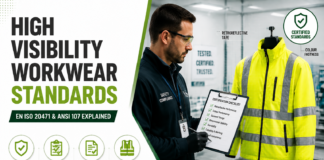
Oil, gas, terminals, refinery projects, and pipelines may involve heavy equipment and vehicles in all stages from design and construction to operations and transporation. Movement of vehicles, heavy equipment, and other machines may be commonplace in oil and gas workwear standards for visibility. ISO 20471 specifies the minimum requirements for high-visibility clothing which provides the wearer with conspicuity in daytime and in the presence of vehicle headlights to provide improved conspicuity. The minimum requirements are stated for the application of fluorescent colours, the type and amount of retroreflective material, the minimum size and placement of areas of the material of the garment, and of the labelling of the garment.
Antistatic Protection and EN 1149-5
Under certain circumstances, static electricity can ignite combustible gases and vapors. EN 1149-5 describes requirements for the performance and design of protective clothing that dissipate electrostatic charge. Such protective clothing is intended to be used as part of a totally earthed protective system, and should not be considered a solution for controlling every static risk. Oil and gas protective workwear standards should be coupled with appropriate protective shoes, correct grounding, proper internal layers, and secure working methods. Oil and gas protective workwear standards also rely on proper use, since damage, dirt, unsuitable repairs or incorrect layers can reduce the protection afforded by the workwear.
Garment Design, Fit, and Full Coverage
A fabric can pass a laboratory test, but poor garment design may still leave the worker exposed. Oil and gas workwear standards should be supported by secure closures, covered metal parts, strong seams, suitable cuffs, useful pockets, and enough overlap between garments. A properly fitted oil and gas safety jacket should allow safe movement without hanging loosely near machinery. Oil and gas workwear standards also depend on full coverage, so sleeves must stay down and fasteners must remain closed during work. Clothing that is too tight may restrict movement or pull open, while oversized clothing may catch on equipment. OSHA guidance also stresses that poor fit can reduce protection, so employers should provide the correct size for each worker.
Labels, Documents, Washing, and Inspection
A protective garment should provide information such as the manufacturer, size, care, standard, performance class, and required markings. Buyers should also request a declaration of conformity, test reports, certificate details where applicable, fabric data, garment model number, and washing limits. Standards for oil and gas workwear should be documented and supported by actual fabric and design samples instead of similar samples. Standards for oil and gas workwear also require clear product traceability. Oil and gas workwear standards should guide washing, inspection, repair, storage, and replacement.
Quick Buying Checklist
Oil and gas workwear standards should be checked with this simple list before an order is approved:
- Identify the exact fire, heat, arc, visibility, static, chemical, and weather hazards.
- Match every hazard with the correct standard and performance level.
- Confirm that the report covers the same fabric, design, and garment model.
- Check the label, declaration, certificate scope, issue date, and washing limit.
- Choose the correct size so the worker can move and remain fully covered.
- Confirm that tape, zips, thread, trims, and accessories suit the hazard.
- Review care instructions because poor washing may lower protection.
- Train workers to wear, close, inspect, store, and replace clothing correctly.
This checklist makes oil and gas workwear standards easier to use during sourcing, approval, and final inspection. It also helps buyers avoid products that display a standard number without enough supporting evidence.
Conclusion
Oil and gas workwear standardization offers employers and buyers a means of comparing protective clothing; however, every same standard must be applied to a real-world occupational hazard. The purpose of NFPA 2112 is the protection from flash fires. ISO 11612 offers several Heat and Flame Protections, ASTM F1506 provides arc-rated clothing, ISO 20471 covers the improvement of visibility, and EN 1149-5 addresses electrostatic properties. Oil and gas workwear standards, will work when tested or certified garments are correctly selected, fitted, worn, cleaned, inspected, and replaced.The real function of oil and gas workwear standards is to prevent injury and assist every worker to return home safely following every shift.
FAQs
What are the main oil and gas workwear standards?
There is no single standard for every oil and gas job. NFPA 2112 covers short-duration flash-fire protection, ISO 11612 covers heat and flame risks, ASTM F1506 covers arc-rated clothing, ISO 20471 covers visibility, and EN 1149-5 covers electrostatic properties.
Is flame-resistant clothing the same as arc-rated clothing?
No. Flame-resistant clothing is designed to resist ignition and continued burning, while arc-rated clothing has also been tested against electric-arc thermal energy. Electrical workers should wear clothing with an arc rating suitable for the assessed hazard.
How often should oil and gas workwear be replaced?
There is no single replacement date for every garment. Clothing should be removed when it becomes torn, badly worn, contaminated, incorrectly repaired, or unable to provide its stated protection. Employers should also follow the manufacturer’s washing and service-life instructions.