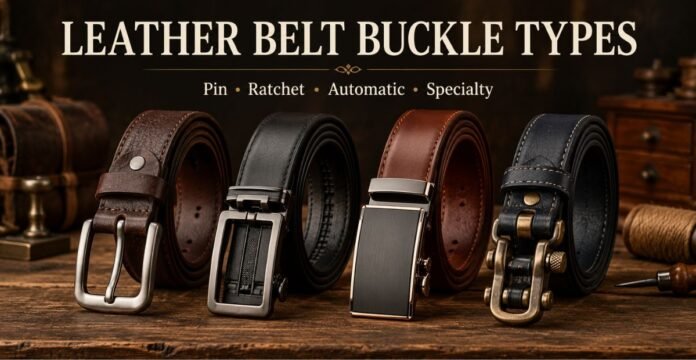
A leather belt may look simple, but the buckle changes how the whole belt works. Different leather belt buckle types affect fit, adjustment, appearance, comfort, and everyday use. Some buckles use a traditional pin and hole system, while others use tracks, clamps, sliding parts, or quick-release mechanisms. Understanding the main leather belt buckle types makes it easier to choose a belt for formal clothing, casual wear, work, or daily use.
Understanding the Main Leather Belt Buckle Types
The most common leather belt buckle types include pin buckles, ratchet buckles, automatic buckles, frame buckles, plate buckles, roller buckles, snap buckles, and specialty mechanisms. Each design holds the leather strap differently. Traditional designs usually depend on holes punched into the strap, while modern mechanisms may allow much smaller adjustment steps. The leather itself is equally important because a buckle works best when the strap has the correct thickness and firmness. Buyers comparing different constructions can explore the leather belts category while considering which buckle mechanism best matches the intended use.
Pin Buckles
Pin buckles are the most common and oldest type of leather belt buckle. A metal frame supports a moving pin, also known as a prong or a tongue. The pin is inserted through the holes of the leather belt and holds it closed. Pin buckles are made with a simple design that has few moving parts. This makes them reliable for long-term usage. Pin buckles can be found on many belts including dress belts and casual belts. The classic look of the pin buckles works well with natural leather, as both the buckle and strap will age together.
Ratchet Buckles
Ratchet buckles, a modern type of leather belt buckle, are designed to allow for more precise adjustments. The back of the belt strap is usually covered with a track of teeth instead of traditional holes. As the strap moves through this track, the buckle is able to catch different points. Ratchet belts can be fitted more precisely because the adjustment spaces of the belt holes are smaller. It can be helpful when a belt is too tight in one hole and too loose in another. Ratchet mechanisms can be found in dress, casual, and business belts, where a neat appearance is desired.
Automatic Buckles and Their Locking System
Automatic buckles are another important group of leather belt buckle types, although the term can describe several locking designs. Many automatic buckles use a hidden clamp, track, or locking lever instead of a visible pin. The wearer slides the strap through the buckle until the desired fit is reached, and the internal mechanism holds it in position. A button or lever usually releases the belt. The smooth front gives these buckles a modern appearance. When paired with a suitable full-grain leather belt, the quality of both the leather and buckle mechanism should be considered because both parts affect the belt’s overall durability.
Frame, Roller, and Plate Buckles
Many traditional leather buckles use variations on the basic frame. Frame buckles surround the strap, and are usually used with a pin for entering a belthole. Roller buckles have a rotating metal wheel that makes it easier for the belt to move through. They are often used on thicker belts. Plate buckles have a large decorative plate that is attached to the belt by hooks, snaps or other fastening systems. These buckles are used in belts that have a strong emphasis on appearance, such as western-inspired, casual and heritage style belts.
Quick Guide to Common Buckle Mechanisms
The major leather belt buckle types can be understood through a few simple differences:
- Pin buckle: Uses a metal pin and punched belt holes.
- Ratchet buckle: Uses a toothed track for smaller adjustment steps.
- Automatic buckle: Uses an internal clamp or locking mechanism.
- Frame buckle: Uses a simple metal frame around the strap.
- Roller buckle: Adds a roller to help thicker leather move smoothly.
- Plate buckle: Uses a larger front plate for a stronger visual style.
- Snap buckle: Uses connecting parts that lock together quickly.
- Quick-release buckle: Opens through a release mechanism rather than a traditional pin.
- Reversible buckle: Rotates or changes position so both sides of the strap can be worn.
- Specialty buckle: Uses a mechanism designed for a particular fashion, work, or functional purpose.
Specialty Buckles for Work and Functional Belts
Specialty leather belt buckle types are often designed around a particular job rather than appearance alone. Work belts and tool belts may need stronger hardware because they can carry tools, pouches, and accessories. Their buckles must work properly with thicker straps and should remain secure during movement. Some designs use heavy frame buckles, double-prong systems, reinforced hardware, or quick-release mechanisms. A leather tool belt can therefore require a different buckle construction from a lightweight dress belt because its load and working conditions are very different.
Buckle Material and Construction Quality
Specialty leather buckles are designed to perform a specific job, rather than just for aesthetic purposes. Because they carry pouches, tools and accessories, tool belts and work belts can require stronger hardware. Buckles must be able to work with thicker straps, and they should stay secure when moving. Some designs feature heavy frame buckles or double-prong systems. Others use reinforced hardware and quick-release mechanisms. The buckle design for a leather tool belt will be different from that of a lighter dress belt, because the load and conditions are different.
Choosing Buckles for Dress, Casual, and Everyday Belts
Different types of leather buckles suit different styles of clothing. For formal trousers or business attire, a small polished pin buckle has been a popular choice for years. Ratchet buckles and automatic buckles have a more modern appearance and are easier to adjust. Casual jeans belts are more likely to use decorative, roller or pin buckles, as they tend to be wider and easier-to-see. Comfort and appearance are equally important for everyday users. It may be uncomfortable to use a buckle that is attractive, but feels heavy or opens in an awkward way, or doesn’t match the thickness of the strap.
How Buckle Choice Affects Belt Durability
Long-term wear can be affected by the relationship between the leather belt buckle and the strap. Pin buckles are a traditional option. They repeatedly apply pressure to the belt hole. This can cause it to stretch or wrinkle. Ratchet belts do not have visible holes, but their condition is dependent on the internal track. The locking mechanisms of automatic mechanisms must be secure. Roller buckles reduce friction as thicker leather passes through the frame. The most durable mechanism may not be the best in all situations.
Conclusion
Understanding leather belt buckle types helps buyers look beyond appearance and choose a belt that works properly for its intended purpose. Pin buckles remain simple and traditional, ratchet buckles provide fine adjustments, automatic buckles create a clean modern fastening system, and specialty designs serve fashion, work, or functional needs. The best choice depends on strap thickness, leather quality, adjustment preference, clothing style, and expected use. When these factors are matched correctly, different leather belt buckle types can provide reliable fastening, comfortable adjustment, and a balanced overall design.
FAQs
What are the most common leather belt buckle types?
The most common leather belt buckle types are pin, ratchet, automatic, frame, roller, plate, snap, reversible, and specialty buckles. Each uses a different method to secure and adjust the strap.
Is a ratchet buckle better than a pin buckle?
Neither is always better. Ratchet leather belt buckle types provide smaller adjustment steps, while pin buckles offer a simple traditional design with fewer moving components.
Do automatic leather belts have holes?
Many automatic leather belt buckle types do not use normal belt holes. They commonly use an internal track, clamp, or locking mechanism to hold the strap.